One-Time Carfax Report: A Single Vehicle History Check Without a Subscription
For one car you want one report, paid once — not a subscription that renews. Who sells a genuine single report, who sells monthly plans, and how to spot the $1 trial that turns into a recurring charge.
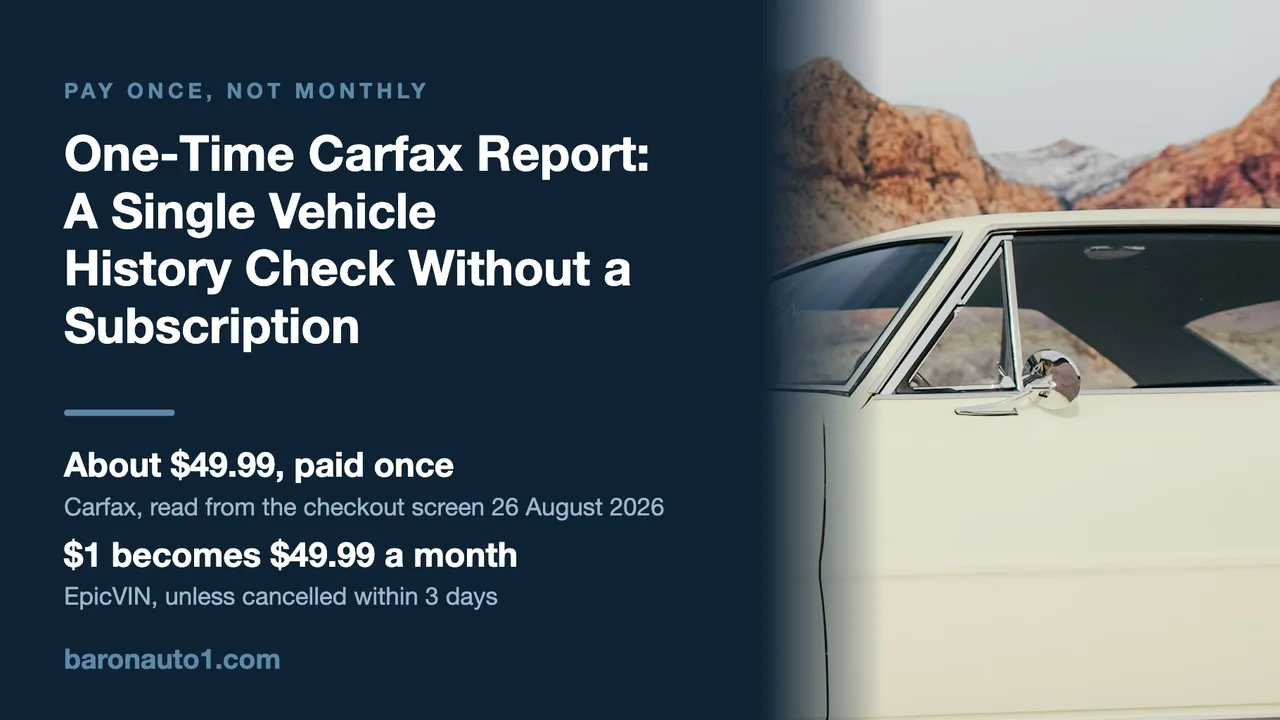
The short version
- If you are buying one car, you want one report — a single, one-time purchase — not a subscription that keeps charging after you have stopped shopping.
- Some providers sell exactly that: a single report for a single payment. Others sell vehicle history mainly as a monthly subscription, and a few disguise it as a “free” or $1 trial that renews unless you cancel in time.
- A single report is a one-time purchase at Carfax too — but its price only appears inside the checkout (about $49.99, read from the checkout screen on 26 August 2026). Smaller providers publish a single-report price openly: VinAudit $9.99, iSeeCars $8.95, CarCheckerVIN $14.99, the last stating plainly “one-time payment, no subscription.”
- Before you enter a card, settle one question: is this a single charge, or does it repeat? That matters more than the price on the button.
- Use a free preview to confirm the car has records worth reading before you pay for anything — and if you are checking several cars, a one-time bundle is still one payment, not a subscription.
A one-time vehicle history report is what most private buyers actually need: you are checking one car, so you want to pay once, read the report, and be done — with no account quietly renewing next month. That sounds obvious, but the market does not always sell it that way. This page sets out which providers sell a single report for a single payment, which sell subscriptions instead, how to spot the trial that turns into a recurring charge, and how to buy exactly one report and nothing more.
What “one-time” actually means
A one-time report is a single transaction: you pay once, you receive one report on one VIN, and no further charge follows. That is different in kind from a subscription, where you pay a recurring monthly fee — usually for unlimited or many reports — aimed at people who check cars often, such as dealers and frequent flippers. Both are legitimate products. The problem is only that they are easy to confuse at the point of purchase, and the confusion runs one way: someone who wanted a single report ends up on a recurring plan, rather than the reverse. Knowing which one you are buying, before you type in a card, is the whole game.
Who sells a single report, and who sells a subscription
The providers split fairly cleanly. Selling a genuine single report, one payment, are the likes of VinAudit ($9.99), iSeeCars ($8.95) and CarCheckerVIN ($14.99), which states its terms as a one-time payment with no subscription and a free preview first. Carfax also sells a single report as a one-time purchase — with no subscription; its order page lists $49.99 for one report (read on 2 October 2026, the same figure its checkout showed on 26 August 2026). On the subscription side, Bumper sells access at about $27.99 a month, and EpicVIN runs a $1 three-day trial that converts to a $49.99-a-month unlimited plan unless you cancel inside the three days. Both are reasonable if you check cars constantly; neither is what a one-car buyer wants.
These figures are dated — the openly-published ones were recorded on 1 September 2026, the Carfax one on 26 August 2026 — and prices move, so confirm the current one on the live page. But the shape of each offer changes far more slowly than the digits, and the shape is what tells you whether you are buying one report or renting access.
The trial that becomes a subscription
The single most common way a one-report buyer overpays is the trial that renews. It is priced to look like a one-off — “free VIN check,” “$1 for three days,” “unlimited reports” — and the recurring charge is disclosed, but quietly, in the terms below the button. Miss the cancellation window and a one-time need becomes a monthly bill. This is not unique to vehicle history; streaming and software do the same. The defence is the same too: read the line under the price, not just the price.
Before you enter a card, find the sentence that says what happens next month. If a “free,” “$1,” or “trial” offer is a subscription, it must say so somewhere near the button — look for “renews,” “per month,” “until cancelled,” or “auto-renew.” If you cannot find a clear statement that the charge is one-time, assume it repeats, and either set a cancellation reminder or choose a provider that charges once.
Carfax: one-time to buy, but the price is hidden
Carfax is worth singling out because it confuses two different questions. A single Carfax report is a one-time purchase — you are not signed up to anything by buying one. What Carfax does not do is publish that price on a page you can reach without starting to buy; the number only appears inside the purchase flow. When this site walked that flow, the price read from the checkout screen on 26 August 2026 was $49.99 for a single report, but treat that as a dated observation rather than a rate card, and read our full account of how much a Carfax report costs for why every undated figure you find elsewhere is worth ignoring. So Carfax passes the “one-time” test but fails the “can I see the price first” test — the opposite of a provider that publishes $14.99 openly but you have never heard of.
How to buy exactly one report
- Start from the free checks. Decode the VIN and run an open-recall lookup at no cost; that alone screens out some cars before you pay for anything.
- Use a free preview. A genuine preview confirms the vehicle and counts the records on file before asking for a card — buy the full report only if there is something worth reading.
- Choose a provider that states “one-time” or “no subscription.” If the page does not say the charge is single, treat it as recurring.
- Read the line under the price. Confirm there is no “per month,” “renews,” or “trial” wording before you enter card details.
- Keep the receipt and check your statement once. A one-time charge should appear a single time; a second charge next month is the sign you were on a subscription.
What a single report should include
Paying once should still get you the records that change a decision. Whatever the price, look for the same core a good report always carries: the NMVTIS-sourced title and brand history (including salvage, rebuilt, flood or lemon brands), the odometer readings that expose a rollback, and total-loss or salvage-auction records. Open recalls belong on the list too, though you can get those free. A single report that carries those is doing its job; one that is thin on them is not worth buying even once. Carfax is the exception on the first item: the Justice Department lists it as dealer-only for NMVTIS, so its one-time report carries Carfax’s own compiled title and brand history rather than the federal record, which consumers buy from an approved provider. Accident and service history vary by provider because they depend on who reported to whom, so no single report — at any price — is complete.
Let a free preview decide whether to pay at all
The best way to avoid overpaying for a single report is to not buy one you did not need. A free preview — CarCheckerVIN’s, for instance, needs no card — returns the vehicle’s identity and a count of the records on its VIN before any payment. If the preview shows a clean, ordinary car with the records you expected, a full report may add little; if it shows title brands or auction records, that is exactly when the one-time purchase earns its price. Either way you have decided with information rather than paying to find out there was nothing to find.
A bundle is still one payment
If you are down to two or three cars rather than one, a small bundle is worth knowing about, because it is still a one-time purchase — not a subscription — and the per-report rate falls with the count. CarCheckerVIN’s single report is $14.99, dropping to $9.00 each in a ten-report bundle, all paid once. The rule is the same as for any bundle: size it to the cars you will actually check, since credits you never use are money spent for nothing. A bundle is the right one-time purchase for a shortlist; a single report is the right one for a single car.
If you have already started a subscription
If a “trial” has already signed you up, act before the renewal date rather than after. Cancellation is usually in the account settings under billing or membership; do it as soon as you have the report you came for, and keep the confirmation. Check the next statement to confirm the charge stopped. If a charge you did not expect has already landed, contact the provider first, and if that fails, your card issuer can often dispute a subscription charge that was not clearly disclosed. The cleaner fix, next time, is to buy from a provider that charges once so there is nothing to cancel.
Common questions
Can I buy a single Carfax report without a subscription?
Yes — a single Carfax report is a one-time purchase, not a subscription. The complication is only that Carfax does not publish the price on a page you can open; it appears inside the checkout, and was $49.99 for one report as read from the checkout screen on 26 August 2026. So you are not signing up to anything, but you also cannot compare the price without starting to buy. See how much a Carfax report costs for the dated detail.
Which vehicle history providers charge once instead of monthly?
Several sell a genuine single report for one payment — among them VinAudit ($9.99), iSeeCars ($8.95) and CarCheckerVIN ($14.99), which states “one-time payment, no subscription” and offers a free preview first. Carfax also sells one report as a one-time purchase. Providers that lean on subscriptions include Bumper (about $27.99 a month) and EpicVIN (a $1 three-day trial that converts to $49.99 a month). Confirm the model on the live page before buying.
How do I avoid getting signed up for a subscription?
Read the line under the price before entering a card, and look for “renews,” “per month,” “until cancelled,” or “auto-renew.” Prefer a provider that explicitly says the charge is one-time or that there is no subscription. Be especially wary of “free” or $1 trials, which are the usual way a single-report need turns into a monthly bill. After buying, check your next statement once to confirm no second charge appeared.
Is a one-time report enough to check a used car?
For one car, yes — a single report covering title and brand history, odometer readings, and salvage or total-loss records tells you what a history report can tell you. Pair it with the free federal checks (VIN decode and recall lookup) and, ideally, a mechanic’s inspection, which finds the mechanical problems a history report cannot. You do not need a subscription to check one car; a subscription is for people checking many.
What is the cheapest one-time vehicle history report?
Single-report list prices at the low end run from about $4.49 to the mid teens, well under the $49.99 of the best-known brand (Carfax, read from the checkout screen on 26 August 2026), and all are one-time purchases. But the cheapest sticker is not the whole story: a slightly dearer report that carries the core NMVTIS records, shows a free preview first, and charges once can be the better buy than a rock-bottom price that turns out to be a trial. Our guide to a cheap report weighs price against what you actually get.
Sources and further reading
- NMVTIS (US Department of Justice)
- NMVTIS approved data providers
- FTC used car buying guide
- NHTSA odometer fraud
Recall, complaint and safety-rating figures on this page were retrieved from the federal databases above on August 19, 2026. Federal data changes — re-check any VIN before you rely on it.
Published September 11, 2026 · last updated October 2, 2026. Found something out of date or wrong? Tell us and we will correct it.