Acura Certified Pre-Owned: When the Precision Certified Clock Starts
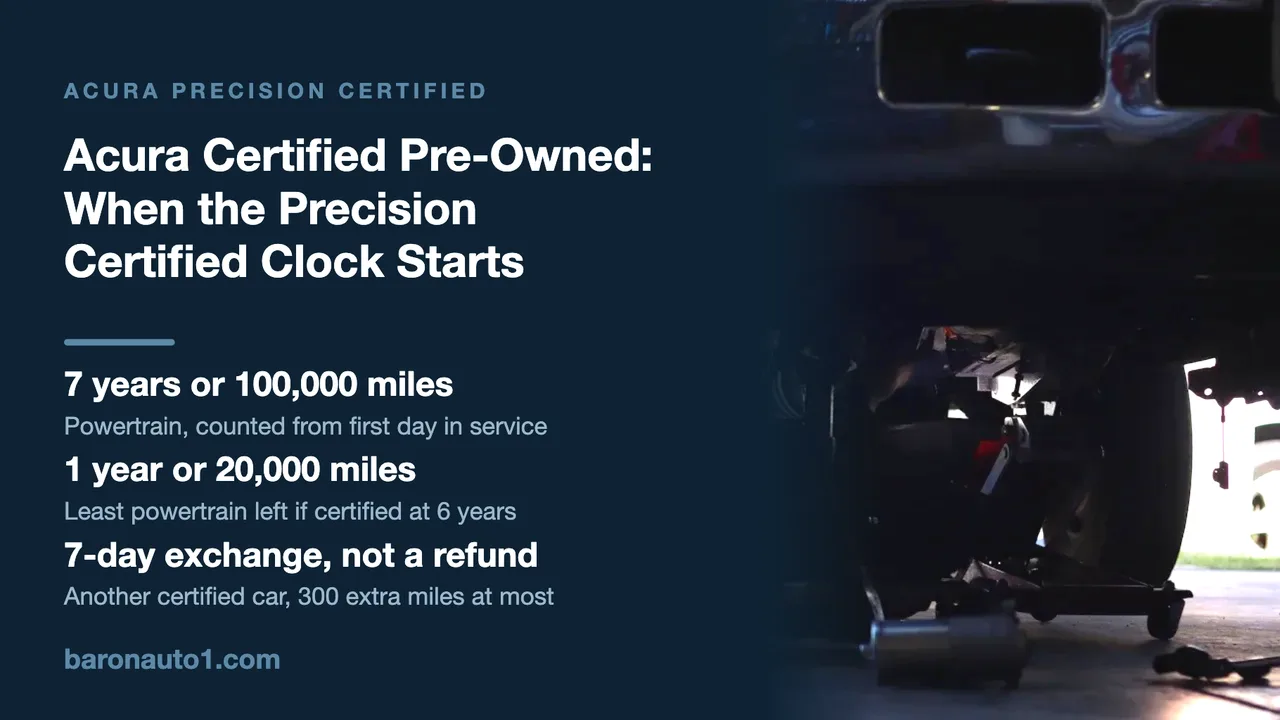
Acura certifies cars in three tiers, but its 7-year powertrain warranty counts from the car's first day in service, so a car certified at 6 years and 80,000 miles may keep about a year or 20,000 miles of it. Acura's own pages also disagree on the EV age limit.
The short version
- Acura’s April 2026 warranty booklet names three certified tiers: Precision Certified, Precision Certified EV and Precision Used. A car listed as plain “Used” on acuracertified.com isn’t certified.
- Precision Certified takes Acuras 6 years old and newer with 80,000 miles or fewer. Its powertrain cover ends at 7 years from the day the car was first put in service or at 100,000 total miles, whichever comes first. A new Acura’s powertrain warranty already runs 6 years or 70,000 miles.
- Non-powertrain cover is 2 years or up to 100,000 total miles, whichever comes first, starting when the 4-year, 50,000-mile new-car warranty ends, or at purchase if it already has.
- By our arithmetic, a car certified at 6 years and 80,000 miles has as little as about 1 year or 20,000 miles of powertrain cover left.
- Acura says the inspection is 182 points, 167 for EVs and 112 for Precision Used. Its checklist form rules out branded titles, flood damage, buybacks, unibody damage and aftermarket parts.
- Every tier has a $0 deductible and a 7-day exchange, which is a swap for another certified car, not a refund. Trip interruption pays up to $900, and on the two certified tiers rental reimbursement pays up to $180 per breakdown.
An Acura certified pre-owned car is a used Acura that an Acura dealer has inspected and sold under one of three tiers, each with a limited warranty from the Acura division of American Honda. The tier decides which cars qualify, how long the warranty runs and which extras come with it. What decides the value of a particular car is when each warranty clock starts: the powertrain clock started on the car’s original in-service date, not on the day you buy it. This page is built from Acura’s certified warranty booklet dated April 2026, the program pages on acuracertified.com, Acura’s 2026 new-car warranty booklet, Acura’s blank inspection forms and five Acura press releases, all read on 30 September 2026.
Three certified tiers, and a label that isn’t one
Acura’s Certified Pre-Owned Vehicles Warranty Booklet sets out three packages. Precision Certified and Precision Used appear in its section for gasoline and hybrid cars; Precision Certified EV has a section of its own. The booklet names the warrantor as the Acura Automobile Division on behalf of American Honda Motor Co., Inc., so the warranty comes from the carmaker, not the dealer or a third-party service contract company.
Acura’s site shows a fourth group too. Since December 2020, acuracertified.com has listed non-certified used Acuras beside certified ones, from dealer inventories of up to 10 previous model years, according to Acura’s release at the time. The leasing page still mentions “the Precision Used and Used tiers”. A car labelled plain Used is not in the booklet, and none of the terms below apply to it.
| Term | Precision Certified | Precision Certified EV | Precision Used |
|---|---|---|---|
| Who qualifies (booklet) | 6 years old and newer, 80,000 miles or fewer at delivery | Electric Acuras 6 years old and newer, 80,000 miles or fewer | 10 years old or newer from the in-service date; the benefits page adds no mileage limit |
| Model years (benefits page) | 2021 to 2026 | 2024 | 2016 to 2026 |
| Powertrain | 7 years from the original in-service date or 100,000 total miles | Battery keeps its new-car cover of 8 years or 100,000 miles | 6 months or 10,000 miles |
| Non-powertrain | 2 years or up to 100,000 total miles | Limited warranty of 2 years or up to 100,000 total miles | Included in the 6 months or 10,000 miles |
| Inspection Acura states | 182 points | 167 points | 112 points |
| Rental reimbursement | Yes | Yes | No |
| Deductible | $0 | $0 | $0 |
| Can be leased | Yes | Yes | No |
The benefits page labels its columns by model year, but its own footnotes count age from the car’s original in-service date, as the booklet does for Precision Used. The booklet is the warranty document, so its wording governs.
Which Acuras qualify, and what rules a car out
Precision Certified is what most shoppers mean by a certified Acura. The booklet says “Acura vehicles 6 years old and newer with 80,000 miles or fewer at time of delivery”, and the benefits-page footnote counts the years “from their original in-service date”. The section’s covered-parts list includes high-voltage batteries used only in hybrid vehicles, which tells you hybrids are certified under the gasoline-and-hybrid terms, not the EV tier. Acura’s wording on miles varies: the benefits table header prints “< 80,000 miles” and the leasing page says fewer than 80,000. That only matters for a car at exactly 80,000, which is also the car with the least warranty left.
Precision Certified EV is where Acura’s documents disagree most. The booklet admits “Acura electric vehicles 6 years old and newer with 80,000 miles or fewer at time of delivery”. The benefits-page footnote says “Vehicles 2 years old and newer”, and the table header lists 2024 vehicles only. The EV page names one model: “You can now lease or finance the all-electric ZDX as a Precision Certified EV.”
Precision Used takes “Acura vehicles 10 years old or newer from their original In-Service Date at the time of sale”, with no mileage limit. Acura launched it in March 2022.
Age and miles are only the first filter. Acura’s blank 182-point form, in the most recent version we could read (Acura Item #PP011, dated April 2019), starts with eligibility checks, and the EV form repeats them. The vehicle history report “cannot have any conditions listed” from this set: odometer rollback or not-actual mileage, “exceeds mechanical limits”, a manufacturer buyback, hail, fire or flood damage, dismantled or reconstructed, a branded, junked or salvaged title, and airbag deployment or gray-market status. Cars with unibody damage are not eligible. Cars with aftermarket items are not eligible either, since only genuine Acura factory accessories are acceptable. Every open campaign or recall must be completed, and the VIN plates in the engine compartment, door jamb and dash must match.
When each warranty clock starts
Precision Certified has two warranty clocks. Neither starts on the day you buy.
The powertrain clock started when the car was new. The booklet gives cover of “7 years or 100,000 total odometer miles (whichever occurs first) from original In-Service Date”. Acura’s warranty booklet for 2026 models says a new Acura’s powertrain “is covered for 6 years or 70,000 miles, whichever comes first.” So certification moves the end point from 6 years or 70,000 miles to 7 years or 100,000 total miles. By our arithmetic, that is up to 1 more year and up to 30,000 more miles. Whichever limit arrives first still ends it, so a high-mileage car gets less of the year and a low-mileage car less of the miles.
The non-powertrain clock waits for the new-car warranty. The new-car booklet says “Every new Acura is covered, including the 12-volt battery, for 4 years or 50,000 miles, whichever comes first.” The certified booklet gives 2 years or 100,000 total odometer miles of non-powertrain cover, beginning “at the expiration of the New Vehicle Limited Warranty or the date of sale if the vehicle was purchased after the expiration”. It “commences only when the existing New Vehicle Limited Warranty has expired” and “does not extend the length of” it. On a young car you aren’t buying 2 years on top of today; you are buying 2 years that begin when the factory’s 4 years end. Acura’s Quick Look chart prints that end point as “6 years*/100,000 mi.” from the in-service date, and 4 plus 2 is 6 by our arithmetic too.
The booklet words this two ways. The Quick Look starts the 2 years when the new-car warranty expires; the Period of Coverages says cover after that expiry runs “up to 6 years/100,000 total odometer miles (whichever occurs first) from original In-Service Date”. They agree when the factory warranty ends on time at 4 years. If a car reaches 50,000 miles earlier, the factory warranty ends then, and the two readings point to different end dates. If the car you want is on pace to pass 50,000 miles before its fourth birthday, have the dealer write the non-powertrain end date on your paperwork.
| Situation | Powertrain cover ends | Non-powertrain cover ends |
|---|---|---|
| Precision Certified, in service 1 June 2022, 45,000 miles; factory warranty ended 1 June 2026 | 1 June 2029 or 100,000 total miles (uncertified: 1 June 2028 or 70,000 miles) | 30 September 2028 or 100,000 total miles |
| Precision Certified, in service 30 September 2024, 20,000 miles; factory warranty running | 30 September 2031 or 100,000 total miles | Factory cover to 30 September 2028 or 50,000 miles; if it ends on time, certified cover to 30 September 2030 or 100,000 total miles |
| Precision Certified at the limit: in service 1 October 2020, 80,000 miles | 1 October 2027 or 100,000 total miles: at most 20,000 miles | 30 September 2028 or 100,000 total miles: at most 20,000 miles |
| Precision Used, factory warranty expired | Both coverages: 30 March 2027 or 10,000 miles | |
The third row is the one to study. A car certified at nearly 6 years and 80,000 miles may, by our arithmetic, have as little as about 1 year or 20,000 miles of powertrain cover, and at most 20,000 miles of non-powertrain cover. That doesn’t make it a bad buy. It means its warranty is much shorter than the headline “7 years/100,000 miles”, and the price should reflect that.
EVs. The Precision Certified EV limited warranty works the same way: 2 years or up to 100,000 total miles, from the end of the new-car warranty or from purchase. The high-voltage battery is separate. The booklet calls its cover “a continuation of the New Vehicle Limited Warranty’s coverage” for 8 years or 100,000 miles, and the benefits page says it “begins on the same date as the New Vehicle Limited Warranty”. By our arithmetic, an EV certified at 80,000 miles has at most 20,000 miles left on both. At the booklet’s age limit of 6 years, about 2 years of battery cover would remain; at the benefits page’s 2 years, about 6.
Precision Used. Its 6 months or 10,000 miles begin when the new-car warranty expires, or at the date of sale if it already has. On a car up to 10 years old, that almost always means the day you drive away. Acura’s 2022 launch release printed 6 months or 7,500 miles; the April 2026 certified booklet prints 10,000. The booklet’s footnote says “Based on odometer miles” where the benefits page says “total odometer miles”, so ask the dealer to write the ending odometer reading on the paperwork.
Ask for the in-service date, not just the model year. The powertrain end date and every tier’s age limit count from it. Have the dealer print it on the buyer’s order with the end date and end mileage of both coverages, and check the sums against the booklet before you sign.
The 182-point inspection, section by section
The benefits page says an “Acura Certified Technician conducts a 182-Point Inspection” on Precision Certified cars, 167 points on EVs and 112 on Precision Used, and the home page promises a downloadable inspection report for every certified car. American Honda launched digital checklists in October 2017, saying the inspection “covers every major system”; Acura’s 2019 release said each certified car comes with a completed, VIN-specific checklist.
Acura doesn’t post blank forms on acuracertified.com. The copies we read are Acura’s own forms on other servers: the 182-point form of April 2019 on a dealer-website vendor’s, and the undated 167-point EV form (Acura Item #PP041) on cars.com’s. Both number their items, so the points can be counted by section. Acura still gives the count as 182, but items may have changed since 2019.
| Section | 182-point form (April 2019) | 167-point EV form |
|---|---|---|
| VIN verification: history report, recalls, VIN plates, labels | 4 | 4 |
| Unibody, and aftermarket accessories | 1 each | 1 each |
| Front interior | 54 | 51 |
| Rear interior | 17 | 16 |
| Front exterior | 14 | 15 |
| Rear exterior | 17 | 14 |
| Under hood and fluids | 26 | 19 |
| Under vehicle | 6 | 6 |
| Brakes, wheels and tires | 18 | 16 |
| Replacement items | 11 | 7 |
| Charging | None | 5 |
| Road test | 13 | 12 |
By our count, the two interior sections take 71 of the 182 points: switches, seats, windows, audio, and navigation data that must be cleared. The mechanical core is 26 under-hood items, 6 under the car, 18 at the wheels and 13 on the road test. The useful part is the standards a car must meet:
- Tires: at least 5/32 inch of tread across the width, no sidewall cracks or cuts, and all four the same size, brand, load and speed rating.
- Brakes: pads or shoes replaced if wear exceeds 50% of minimum thickness; rotors replaced if worn beyond service limits, with measurements recorded.
- Body: scratches over 4 inches, dents a dime can’t cover and damage through to base metal must be repaired; damaged windshields replaced with Acura Genuine glass.
- Batteries and keys: a load test on the 12-volt battery, a trouble-code check on the high-voltage battery, and two master keys and two remotes.
The EV form adds five charging checks, among them DC fast charging and “Ability to charge to a minimum of 80%”. On both forms the technician certifies the car meets the standards and “will be reported to American Honda within 48 hours of retail delivery”; a manager and the buyer sign too. The inspection is done by the selling dealer’s technician, so read what was repaired, not just the pass marks, and book an independent pre-purchase inspection.

What the certified warranty covers
For gasoline and hybrid cars the booklet has two lists. The powertrain list, which runs to 7 years or 100,000 total miles, covers the engine block, head and internal parts, timing chain or belt, oil pump, manifolds, engine mounts, turbocharger and water pump; the transmission, transfer case, torque converter and their control module; and the final drive, differential, driveshafts, joints, hubs and bearings, with their seals and gaskets.
The non-powertrain list runs for the 2-year window. It covers the fuel system including the fuel pump and injectors, the suspension, steering, brake hydraulics and ABS (not pads, rotors, drums or shoes), heating and air conditioning, and electrical parts and sensors such as the alternator, starter, control modules, power seat, window and sunroof motors, gauges and wiring. It also covers factory audio and navigation, hinges and window regulators, airbags not deployed in a collision, and “high-voltage Batteries used only in hybrid vehicles”. Fluids are covered as part of a covered repair, and so is reasonable diagnostic teardown time.
For EVs, the covered page lists the high-voltage battery and diagnostic time, and the coverage section says Acura will repair or replace any covered original part “defective in material(s) or workmanship under normal use”. The booklet says “Gradual capacity loss of the high-voltage battery is expected and not covered under warranty”; degradation below 75% of original value within 8 years or 100,000 miles, as an Acura dealer determines it, is subject to repair or replacement.
Acura may use factory-remanufactured parts, pays suggested retail for parts and its flat-rate time for labor, and covers a replaced part only until the certified warranty expires.
What it doesn’t cover
The booklet has three exclusion categories for gasoline and hybrid cars and two for EVs:
- Maintenance and wear items: spark plugs, filters, fluids, belts other than the timing belt, wiper blades, the clutch, and brake pads, rotors, drums and shoes.
- The emission system on gasoline and hybrid cars: catalytic converters, mufflers, pipes and heat shields. The separate federal and state emission warranties may run alongside certified cover until they end.
- Body, interior, glass and wheels. The booklet’s reasoning is that the car “was inspected before delivery and, at that time, met the standards required of Acura Certified Pre-Owned Vehicles”. Check them before you buy.
The 12-volt battery is the exclusion most buyers miss. A new Acura’s factory warranty covers it; the certified booklet excludes every battery except hybrid high-voltage packs, along with bulbs, LED light assemblies and fuses.
The additional limitations that catch certified buyers:
- Records. Acura can ask for “verifiable maintenance receipts/records showing the date and vehicle mileage” before paying for a covered part that needs routine maintenance.
- Aftermarket parts. A non-genuine part that caused or contributed to a breakdown voids cover for that repair.
- Commercial use, including deliveries, rental or “carrying passengers for hire”, ends cover, as do an altered odometer and a factory warranty Acura has voided.
- Abroad. Repairs outside the United States aren’t covered, nor is a U.S.-registered Acura regularly driven in other countries.
- A cap on the total. Payments stop once paid repairs exceed the price you paid for the car, and no single claim is paid above its replacement cost as Acura determines it.
Acura Care, Acura’s service contract, is a separate purchase that the benefits page says “May be eligible for purchase”. The brochure it links to is marked 2015, names four levels including Certified Additional Coverage, and prints no price. Our Acura extended warranty guide reads the current Acura Care brochures and names who provides each product. For service contracts in general, see whether an extended warranty is worth it and what extended warranties cost.
Roadside help, trip interruption, a rental car and free service
Roadside assistance comes with every tier, provided through the American Automobile Association, 24 hours a day, 365 days a year. Precision Certified cars get it during the certified non-powertrain period, which the benefits page states as 2 years or up to 100,000 total miles; EVs during their limited warranty period. While the factory warranty runs, the booklet says roadside help comes through the new-car warranty’s own program. Services are towing to the nearest Acura dealer after a breakdown or collision, a flat-tire change, a jump-start, lockout help, winch service and 2 gallons of emergency fuel, no more than twice a calendar year. EVs also get flatbed towing to the nearest charging station, two tows a calendar year.
For Precision Used, the benefits page prints 1 year or 12,000 miles, but the booklet makes those cars eligible “during the Precision Used Non-Powertrain Coverage period”, which is 6 months or 10,000 miles. If the longer term matters, get it in writing.
Trip interruption. If a breakdown leaves the car disabled overnight more than 100 miles from home, the booklet reimburses receipts for transport, food and lodging for the first 3 days: “Total benefits are $900: $300 per day for a maximum of 3 days.” Concierge service will book flights, hotels and a rental, but Acura says third-party costs are yours.
Rental reimbursement, which Precision Used doesn’t get, pays “up to $45 per day to a maximum of 4 days and $180 per breakdown” when a covered part fails. The days allowed depend on Acura’s flat-rate repair time:
| Acura flat-rate repair time | Days allowed | Most Acura pays |
|---|---|---|
| 2.0 to 8.0 hours | 2 | $90 |
| 8.1 to 16.0 hours | 3 | $135 |
| More than 16.0 hours | 4 | $180 |
Mileage, fuel, insurance and collision damage waiver charges are excluded, and a rental costing more than $45 a day leaves you paying the difference.
Free service. Precision Certified buyers get their first scheduled maintenance within 12 months or 12,000 miles of delivery: oil and filter, tire rotation, air and cabin filters, rear differential fluid where fitted and brake fluid, as the Maintenance Minder calls for them. The NSX is excluded, and for 2025 model year cars and newer the benefits page says eligibility begins only after Acura’s complimentary maintenance program ends at 1 year or 12,000 miles. EVs get 4 tire rotations, 4 pairs of wiper blades as needed and 1 drive unit fluid change within 2 years or 24,000 miles. Precision Used gets 1 oil change within 12 months or 12,000 miles.
Trials and the deductible. Certified cars with AcuraLink are eligible for 3-month trial packages, which the booklet says must be activated within 90 days of delivery; Precision Used is excluded. Every tier gets a 3-month SiriusXM trial. The benefits page says repairs “have a $0 standard deductible per repair visit.”
The 7-day exchange, the price and leasing
Every tier is marked Yes for a “7-Day Exchange Policy”. The footnote says it starts on the delivery date and “allows the customer to exchange the vehicle purchased for another Acura Precision Certified Pre-Owned vehicle in the dealer’s inventory.” The returned car must be in the same condition and “may have no more than 300 miles over the mileage shown as of the date of purchase.” It is a swap from the same lot, not a refund, and the warranty booklet doesn’t mention it, so get the terms on the buyer’s order.
Price. Acura prints no price for any certified car, and we don’t supply one. Its own offers page says “Dealer sets actual sales price.” Acura does post certified finance and lease offers for well-qualified buyers. They change often and each carries an end date, so check the date and compare the rate with your own bank or credit union.
Leasing. The leasing page says “leasing is unavailable for the Precision Used and Used tiers”, so only the two certified tiers qualify, at up to 6 years old. It says Guaranteed Asset Protection “comes standard” and that a mileage allowance is “typically between 10,000 - 15,000 miles” a year. The certified limits count total odometer miles, so work out where the odometer will be at lease end.
Transfer, where to get repairs, and disputes
Transfer. The warranty passes to the next owner on a sale “private party to private party”, with the balance of the coverage periods. To transfer it, the booklet says to contact Acura Care Client Services and to notify Honda’s warranty department with the Change of Ownership card attached to the booklet. Buying privately, confirm the remaining cover with an Acura dealer by VIN.
Service. Warranty repairs go to an authorized Acura dealer, but the booklet says dealer maintenance “is not mandatory for continued warranty coverage but is recommended”. Elsewhere, keep dated records with the odometer reading and a signature, or your own dated statement backed by parts receipts. With no Acura dealer within 50 miles, or dealers closed, Acura will reimburse a covered repair at another shop if the car couldn’t safely be driven and Acura Care approved the repair first.
Disputes. After the dealer and Acura Client Relations, the booklet points to the National Center for Dispute Settlement, which Acura says generally resolves cases within 40 days, or 47 if you haven’t first contacted Acura. Its decision “is not binding on you unless you agree to accept it”, and Acura doesn’t require it before court, though some states may. Implied warranties are limited to the written warranty’s length where state law allows; the FTC’s guide to warranty law explains what that means.
How to confirm an Acura is really certified
- Check the program on acuracertified.com. Precision Certified, Precision Certified EV or Precision Used means one of the three packages. Plain Used means none.
- Get the completed checklist with the VIN and the technician’s and manager’s signatures. The form lists what you should get at delivery, including the history report and the Certified Warranty Booklet.
- Wait for the card. The booklet says a warranty identification card “will be issued by Acura and sent to you within 30 days after delivery”.
- Have an Acura dealer run the VIN. The booklet notes a dealer may use the VIN to confirm a car is certified; ask for that check before you buy.
- Read the history report. The EV page says EV reports are “provided by CARFAX”; the forms list CARFAX or AutoCheck. A salvage or rebuilt title should never appear on a certified car.
- Ask for proof the recalls are done, and check the odometer against the tier: over 80,000 miles at delivery can’t be Precision Certified or EV.
To read the VIN itself, see our Acura VIN decoder guide. If you finance or lease through the brand, our Acura Financial Services review reads its payment, payoff and lease-end pages.
Certified, ordinary used, or new
The real comparison is the certified premium, which the dealer sets, against what the certified terms add for that particular car.
| Route | Warranty from Acura | What to weigh |
|---|---|---|
| New Acura | 4 years or 50,000 miles; powertrain 6 years or 70,000 miles | The longest factory cover, at the highest price |
| Precision Certified | Powertrain to 7 years or 100,000 total miles from new; 2 years of non-powertrain | Worth most on a young, low-mileage car |
| Precision Certified EV | Battery to 8 years or 100,000 miles from new; 2 years of limited warranty | Acura’s pages disagree on the age limit |
| Precision Used | 6 months or 10,000 miles | A short safety net; no rental benefit or leasing |
| Ordinary used | Whatever factory cover is left | Cheapest; rely on your own inspection |
On a young car with modest miles, Precision Certified buys a lot: 2 years of wide cover after the factory warranty, up to 100,000 total miles instead of 50,000, a later powertrain end point, a $0 deductible, and the rental and trip benefits. Near 6 years or 80,000 miles the same badge leaves little, and the premium should shrink to match. Precision Used buys a short warranty and a record that an older car passed Acura’s 112-point inspection when it was sold.
Acura’s parent also certifies Honda-brand cars. Against the figures in our Honda certified pre-owned guide, Acura differs in three places we checked: its EV limited warranty runs to 100,000 total miles against Honda’s 86,000, its trip-interruption cap is $900 against $300, and its exchange window is 7 days against Honda’s 3. The inspection counts match at 182 and 167. For factory programs against dealer “certified” labels, see our certified pre-owned guide.
- Name the tier. If the listing says plain Used, or the dealer says “dealer certified”, none of Acura’s terms apply.
- Get the in-service date and both end points for each coverage in writing: powertrain 7 years from in-service or 100,000 total miles; non-powertrain 2 years from the end of the factory warranty or from purchase, or 100,000 total miles.
- Check the odometer. Near 80,000 miles, little cover is left. Near 50,000 miles and under 4 years old, pin down the non-powertrain end date.
- Read the completed checklist, including the tread and brake measurements, then book an independent inspection.
- Confirm recalls, keys and paperwork: recalls done, two keys and two remotes, the booklet in hand, the card within 30 days.
- Put the exchange terms on the buyer’s order: 7 days, another certified car from the same dealer, no more than 300 extra miles.
Common questions
Is Acura certified pre-owned worth it?
It depends on the car more than the badge. On a young, low-mileage Acura, Precision Certified adds 2 years of non-powertrain cover after the 4-year, 50,000-mile factory warranty and moves the powertrain end point from 6 years or 70,000 miles to 7 years or 100,000. Near 6 years or 80,000 miles, our arithmetic puts the powertrain cover left at as little as about 1 year or 20,000 miles. Weigh the premium against that.
What does the Acura certified pre-owned warranty cover?
For Precision Certified, the engine, transmission and drive systems for 7 years from the in-service date or 100,000 total miles; the fuel system, suspension, steering, brake hydraulics, electrical parts, air conditioning, audio, airbags and hybrid batteries for 2 years or up to 100,000 total miles. Wear items, the 12-volt battery, emissions parts, body, glass, interior and wheels aren’t covered.
When does the Acura CPO warranty start?
The powertrain cover counts from the day the car was first put in service. The non-powertrain cover starts when the new-car warranty ends, or at purchase if it already has. Acura’s chart puts its end at 6 years from new for a car bought under the factory warranty.
What is the difference between Precision Certified and Precision Used?
Precision Certified takes Acuras 6 years old and newer with 80,000 miles or fewer, with the 7-year powertrain end point, 2 years of non-powertrain cover, a 182-point inspection, rental reimbursement and leasing. Precision Used takes Acuras up to 10 years old at any mileage, with 6 months or 10,000 miles of cover, a 112-point inspection and no leasing.
Can you return a certified pre-owned Acura?
Not for a refund. The benefits page offers a 7-day exchange for another Precision Certified car in the same dealer’s inventory, if the car you return is in the same condition with no more than 300 miles added.
Is the Acura certified warranty transferable?
Yes, on a private sale. The booklet says the balance of the cover passes to the new owner when the car is sold private party to private party, arranged through Acura Care Client Services.
For sale near you
Dealer listings, checked liveFinding used Acura cars near you…
Sources and further reading
- FTC: a businessperson’s guide to federal warranty law
- 15 U.S.C. § 2301 (Magnuson-Moss definitions)
- FTC: auto service contracts and warranties
Recall, complaint and safety-rating figures on this page were retrieved from the federal databases above on August 19, 2026. Federal data changes — re-check any VIN before you rely on it.
Published September 30, 2026 · last updated September 30, 2026. Found something out of date or wrong? Tell us and we will correct it.