Acura VIN Decoder: The Codes Belong to the Parent Group
The register has no entry under Acura. The codes sit with the parent group, whose entry is broader than the showroom.
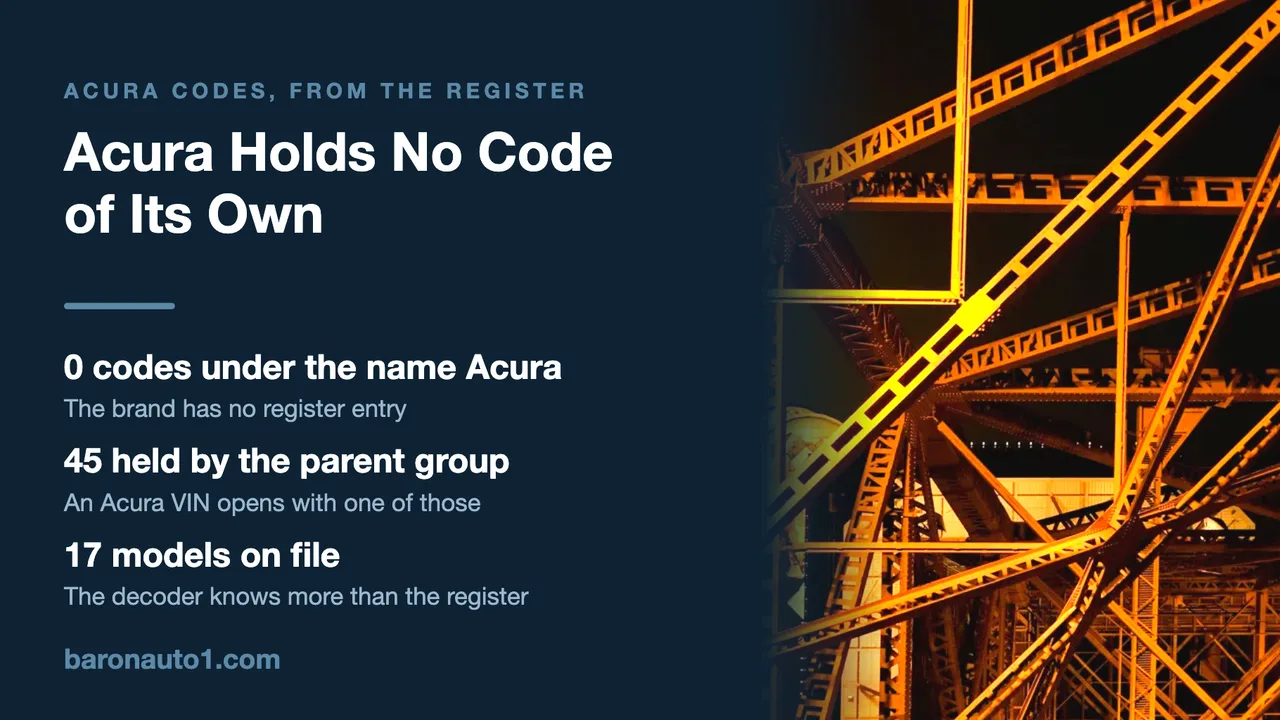
The short version
- There is no Acura-only decoder and there does not need to be one. Every vehicle certified for this market carries the same seventeen-character number, and one federal register resolves the manufacturer prefix on all of them.
- Acura holds no world manufacturer identifier of its own. The count in the register entry is zero, and the codes an Acura VIN opens with are registered to the parent group the entry records, which holds forty-five of them.
- That parent entry is broader than any showroom. By vehicle class the forty-five codes split fourteen Motorcycle, thirteen Multipurpose Passenger Vehicle, twelve Passenger Car and six Truck — motorcycles are the largest single group in the file the badge sits beneath.
- A register query on the brand name returns nothing at all. Not a short list, not a padded one: zero codes under the name and zero unrelated companies caught by the string. Search the parent group instead, or decode an actual number.
- The forty-five parent codes are recorded against thirteen country buckets, the largest being the United States with sixteen, then Canada with six and Mexico with five. Four have no country recorded. Country describes where the registering entity filed, not where a vehicle was assembled.
- The decoder holds seventeen models under the make, and the archived read carries the names: ADX, CL, ILX, Integra, Legend, MDX, NSX, RDX, RL, RLX, RSX, SLX, TL, TLX, TSX, Vigor and ZDX.
- What no decode carries, on this make or any other: service history, the condition of the car in front of you, and whether a recall was actually carried out rather than merely recorded.
The phrase “VIN decoder” suggests a tool built for one marque. No such thing exists. It does not. The number stamped on an Acura is built to the same federal standard as the number on a pickup, a van or a motorcycle, and the register that turns the first three characters into a manufacturer is the same register for every one of them.
What is worth reading is what that register actually holds under the name, because Acura’s entry has a feature that sends a steady stream of people to the search box convinced their lookup has broken. This page works from the entry. The headline number in it is zero. Not a small entry, not an unusual one: an empty one, with the codes that matter recorded somewhere else entirely.
Everything below is read off that archived entry and nothing else. Where the entry is silent — and it is silent about a great deal that brand VIN pages routinely assert — this page says so rather than filling the gap from memory. That restraint is the whole point. A used-car buyer’s real questions are about how a specific car was treated, and the honest first step is knowing exactly which of those questions seventeen characters can and cannot touch.
One register reads every VIN, this make included
The vehicle identification number is a federal standard and its layout does not vary by badge. Positions one to three are the world manufacturer identifier, assigned to the legal entity that builds the vehicle. Positions four to eight describe the vehicle in a descriptor scheme the manufacturer designs for itself. Position nine is a check digit computed arithmetically from the other sixteen characters. Position ten carries the model year. Position eleven identifies the assembling plant. The final six are the serial.
Our guide to reading a VIN position by position sets out the full layout, and the by-make index collects what the register holds for each manufacturer we have read.
Where a brand-specific decoder would genuinely earn its keep is the middle block, and this is the point at which we have to be straight about a gap. Positions four to eight are the manufacturer’s own descriptor scheme, and the federal register does not publish the key to it. The register records who holds a prefix, what vehicle class the prefix covers, which country the entity filed in and when the code was opened. It does not record that a particular letter in position five means one body style on a saloon and something else on a crossover.
So this page prints no position-by-position table for the make, and no plant-code list, because we hold neither from a source we would defend. Tables of that kind are published in several places. None of them is the register, and we do not hold one from a source we would defend. A decode of a real number returns the descriptor fields as the federal system resolves them for that one vehicle, which is a different and far more reliable thing than a printed key assembled from a forum thread.
The number under this badge is zero
A VIN opens with three characters the manufacturer does not choose. They are assigned centrally, published in full, and they identify the entity that filed for the right to issue numbers. Ask the register how many of them are held under Acura and the answer is none.
That is worth stating flatly because it is so easily misread. Zero here does not mean the register has a gap, that the data pull failed, or that Acura vehicles carry numbers of some irregular kind. Every Acura certified for this market carries a properly assigned seventeen-character number that opens with a properly registered three-character prefix. The prefix is simply not filed under the badge. The entry records a parent group — Honda — and that group holds forty-five codes. An Acura VIN begins with one of those.
This is ordinary in the way registers work and disorientating in the way buyers read them. A world manufacturer identifier is registered by a corporate entity, not by a marketing name, and nothing obliges the two to line up. Where they do line up, nobody notices the register exists. Where they do not, a perfectly correct decode comes back naming a company the buyer has never associated with the car, and the natural conclusion is that something is wrong.
Acura is not alone in this. Across the thirty-six makes in our index, eight hold no code of their own: Chevrolet, Jeep, Dodge, Lexus, GMC, Mopar, Can-Am and this one. That is a count we have run over the whole file rather than an impression, and it is the reason the by-make index is organised the way it is. A badge with an empty entry is a normal state of affairs, not a defect, and the useful question is never “why is it empty” but “where did the codes go instead”.
One caution before anyone tries to shortcut the answer. Knowing that the codes sit with the parent group does not, by itself, tell you which of the forty-five issues Acura numbers. The archived read behind this page records the parent’s codes as a group; it does not tag any individual code as the one behind a given badge. So this page prints no list of “Acura WMIs”, because producing one would mean guessing. Decoding an actual number returns the actual prefix and the actual registrant for that vehicle, which is both easier and correct.
Why a brand-name search returns nothing at all
Most of the make pages on this site carry a warning about the same trap, and Acura manages to fall through a different hole in the same floor. The register’s name endpoint matches company names as text rather than resolving brands. Ask it for a common word and it drags in every small builder, trailer shop and specialist converter whose registered name happens to contain that string. On some makes the noise is the problem: a reader gets a dozen rows back, half of them nothing to do with the marque, and concludes the badge holds codes it has never held.
Query the register for this name and the opposite happens. There are no codes filed under it, and there are no unrelated companies whose registered names catch the string either — the entry records zero name matches alongside its zero codes. The query succeeds and returns an empty set. That is a genuinely confusing result to meet, because an empty answer looks identical to a broken tool, and there is nothing on screen to distinguish the two.
Acura is one of five makes in our index whose entry is empty on both counts at once, which is why this particular flavour of confusion is not something most brand pages have to explain. The others reading empty in the same way are Lexus, GMC, Mopar and Can-Am. Chevrolet, Jeep and Dodge hold no codes either, but their names do catch unrelated registrants, so at least something comes back to look at.
What to search instead depends on what you are actually after. If the question is “which codes might this vehicle open with”, the answer lives in the parent group’s entry, and our Honda register page covers what that entry holds in its own right. If the question is “what is this specific car”, then no name query of any kind will help and the seventeen characters will. Decode the number. The federal system resolves the prefix, the model and the model year for that vehicle without you needing to know in advance whose filing cabinet the code sits in.
And if the question is really “why do two sites give different answers for the same badge”, this is most of the reason. Sites that query on the brand name, sites that query on a parent name, and sites that filter the name-matched noise by hand all end up with different lists. None of them is necessarily lying. They are asking the register different questions.
Forty-five codes, and what else is in them
The parent entry holds forty-five world manufacturer identifiers, and the register files each one under a vehicle class. Those classes are the most revealing thing on this page, because they show how much wider the file is than the forecourt the badge appears on.
Fourteen of the forty-five are filed as Motorcycle. Thirteen are Multipurpose Passenger Vehicle, the federal class that catches most of what the market calls an SUV or a crossover. Twelve are Passenger Car. Six are Truck. Motorcycles are therefore the largest single class in the entry, ahead of every category of car in it — and they sit in the file that a decode of an Acura number will point into.
Set that against what the register holds for the make itself and the mismatch is stark. The entry lists three vehicle types under the badge: Passenger Car, Truck and Multipurpose Passenger Vehicle. There is no motorcycle class among them. So the make’s own classification covers three kinds of road vehicle, while the codes behind it sit in a file whose largest single group is two-wheeled.
Of the eight badges in our index that hold no codes of their own, only two have a parent entry containing motorcycle filings at all: this one and Can-Am. Can-Am’s own entry also lists Motorcycle among its vehicle types, so the two halves agree there. Acura is the one case in that set where the parent file is full of motorcycles and the make’s own classification contains none. We have checked that across every make in the file rather than assuming it.
The practical consequence is narrow but worth carrying. If you go digging in the parent’s register entry looking for the code behind a car, most of what you find will be filed as something you were not shopping for, and none of that is evidence of a problem. It is the register describing a corporate registrant with a wide product base. Our pages on motorcycle VIN lookups and ATV VIN lookups cover how the same seventeen-character system reads on machines that are not cars, which is the part of the register a car buyer usually never has cause to meet.
Thirteen country buckets, and what the field means
Every code in the parent entry also carries a country. Read them as a distribution and the shape of the filing becomes clear.
Sixteen of the forty-five are recorded against the United States, which is the largest single bucket by some distance. Canada follows with six, Mexico with five, and Japan with three. Below those sit China with two, Spain with two and the United Kingdom with two, then a run of single codes recorded against Belgium, Italy, Thailand, Vietnam and Brazil. Four codes carry no country in the archived read at all.
Now the caution that has to travel with every one of those numbers, because it is the single most misused field in the whole register. The country recorded against a code describes where the registering entity filed. It is not a statement about where any vehicle was assembled. An entity registered in one country can be responsible for numbers issued on vehicles built elsewhere, and the register carries nothing that would let a reader tell the difference. Treating the country column as a plant location is the most common way a careful-looking VIN page ends up wrong.
The same caution applies in the other direction, to the four codes with no country recorded. A blank is not a suspicious code, an anonymous manufacturer or a defect in the vehicle. It is a field the archived read carries no value for, and the honest thing is to print it as blank rather than to infer one.
What the distribution does support is modest. It shows that the group holding these codes has filed in a lot of places, that the largest share of its filings sit in the United States, and that a decode returning an unfamiliar country is not a warning sign. Position eleven of an individual number is the plant character, but the register does not publish the key that turns it into a plant name, so no plant table appears on this page.
Ten registered names, and not one of them is the badge
The forty-five codes are not filed by a single company. The entry records ten distinct registered names behind them: AMERICAN HONDA MOTOR CO., INC.; HONDA DE MEXICO, S.A. DE C.V.; HONDA MOTOR CO., LTD.; HONDA OF CANADA MFG., A DIVISION OF HONDA CANADA INC.; HONDA OF THE U.K. MFG., LTD.; HONDA VIETNAM CO., LTD.; MONTESA HONDA SA; MOTO HONDA DA AMAZONIA LTDA.; SUNDIRO HONDA MOTORCYCLE CO., LTD.; and THAI HONDA CO., LTD.
Read that list once and the point of this page falls out of it. Ten names, and the word Acura appears in none of them. A decode of an Acura number returns the registered entity that issued the number, character for character as filed, because that is the field’s job. It is not telling you who designed the car, who sold it, who warrants it or whose name is above the dealership door. It is telling you which registered entity holds the prefix.
The archived read also carries a small sample of the parent’s individual codes, and it is worth being explicit about what a sample is. It is capped by the tool that produced it, which means it is a window rather than a census. Nobody should count it, total it, or treat the codes in it as the complete set. Every row in the sample we hold happens to be filed as Motorcycle: JH2 against HONDA MOTOR CO., LTD. in Japan; 1HF against AMERICAN HONDA MOTOR CO., INC. in the United States; ZDC against the same entity but recorded in Italy; MLH against THAI HONDA CO., LTD. in Thailand; 9C2 against MOTO HONDA DA AMAZONIA LTDA. in Brazil.
Those five are printed here as illustration of what the register looks like, and specifically not as candidates for the code on any car. A capped sample that happens to contain only motorcycle filings tells you nothing whatsoever about which prefix an Acura opens with, and a page that presented it otherwise would be inventing. The one row worth dwelling on is ZDC: the same registered entity appears against two different countries, which is exactly the reason the country field cannot be read as a plant.
What the ten names do establish is that the arrangement is not unusual. A group that files in twelve countries generally establishes a separate legal entity in several of them, and each of those entities registers in its own right. The badge is constant across all of it. The registrant is not.
Seventeen models the decoder holds
The register may hold no codes under this name, but it is not empty of everything. The decoder holds seventeen models for the make, and unlike some entries in our index, the archived read carries the names rather than only the count. They are ADX, CL, ILX, Integra, Legend, MDX, NSX, RDX, RL, RLX, RSX, SLX, TL, TLX, TSX, Vigor and ZDX.
That list is printed exactly as the register spells it, including the entries that look odd next to their neighbours. Three of the seventeen are words rather than letter groups — Integra, Legend and Vigor — and the remaining fourteen are two- or three-character strings. We have not tidied, expanded or reordered any of them, because a model list is only useful if it matches what a decode will actually return. A name that has been smoothed out on a web page will not match the string that comes back from the federal system, and the mismatch reads to a buyer as a discrepancy.
It is worth being clear about what the count covers. Seventeen is what the register holds for the make across all years, not a current line-up, and no page should present it as one. The list is the decoder’s vocabulary for the badge: the set of names a decode can resolve to when it reads a specific number.
Two things the list does not do. It does not tell you which of the forty-five parent codes sits in front of any of those names, because the entry holds no mapping between the two. And a model name is not a trim. The register knows the model line; it does not know the engine option, the drive configuration, the wheel, the interior or the options package a particular car left the factory with — and those are the distinctions that move the price on a used car. Our pages on trim level by VIN and build sheets set out how far that can be pushed and where it stops.
Three vehicle classes under the badge
Alongside the models, the entry records three vehicle types for the make: Passenger Car, Truck and Multipurpose Passenger Vehicle. Those are federal vehicle categories rather than descriptions a salesperson would use, and reading them too literally is a reliable way to reach a wrong conclusion.
Multipurpose Passenger Vehicle in particular is a regulatory classification with consequences for which safety standards apply, and it covers a wide range of shapes. A decode returning it is telling you how the vehicle was certified. It is not telling you the body style, the number of doors or the seating layout, and it should not be read as a verdict on whether something is “really” an SUV. Truck, likewise, is a certification class and not a description of a load bed.
Notice also what these three are counted against, which is nothing. The register records vehicle classes for the make, but because the make holds no codes of its own, there is no per-class code count to report — the tally is empty by construction. The class counts on this page all belong to the parent entry, and this page keeps the two apart deliberately. Three classes under the badge; fourteen, thirteen, twelve and six codes by class under the group that holds the prefixes. Mixing those two sets of numbers is how brand VIN pages end up asserting things the register never said.
Nor does the class field cross-check the badge for you. It tells you which classes the register associates with the make in general. Confirming that a specific car matches its advert is still a job for the decode of that car’s own number, read against the listing, and then for your own eyes on the vehicle.
What a registration date is, and what it is not
The register carries an opening date against each code, and on several of our make pages that field supports a short timeline of when a manufacturer set up to issue numbers. It cannot do that here, for a simple reason: the archived read behind this page carries no dates for the codes in the parent entry, and the make itself holds no codes to carry dates for. So no dates are printed. That is a limit of the pull rather than a claim about the register, and it seemed better to say so than to leave a reader wondering why a section is missing.
It is still worth knowing what the field means, because you will meet it elsewhere and it is misread constantly. An opening date records when a code was registered. It is not a build date, not a sale date, not a first-titling date and not a model year.
The model year is a separate matter entirely and lives at position ten of an individual number, where it is read against a published cycle rather than inferred from anything corporate. Our model-year chart covers how that character resolves, including the repetition that catches people out on older vehicles.
The habit worth building is to treat register dates and vehicle dates as belonging to different systems that happen to be printed near each other. One describes paperwork filed by a company. The other describes a car.
What the decode will not tell an Acura buyer
This is the section that does the most work, because it is where the gap between what people expect from a VIN and what a VIN actually carries is widest — and it is identical on this make and every other, which is itself the argument against brand-specific decoders.
The number is a build identity. It exists so a regulator can tie a recall campaign to a batch of vehicles, an insurer can tie a policy to an object, and a state can tie a title to that same object. It was never designed to describe a vehicle’s condition today, and it has no field for any of the following.
Service history. Nothing about oil changes, transmission fluid, brake work or the last time the cambelt was looked at reaches the register, and none of it is encoded in the number. On a car maintained by independent workshops or by an owner on a driveway there may be no central record anywhere — only a folder of receipts, which is worth asking for and worth reading properly when it appears.
Whether a recall was actually done. This one is worth being careful about. The federal recall lookup will tell you whether a campaign is open against a specific number, which is genuinely useful and free. What no decode does is confirm that a previous owner ever presented the car. A campaign showing as remedied means a remedy was recorded; a campaign showing as open means the work is outstanding as far as the system knows. Our guide to checking a car for open recalls covers how to read the result properly, including the cases where the flag and the reality diverge.
Condition. A decode reads the build, not the car. It does not know the state of the tyres, the clutch, the paint, the suspension bushes or the air conditioning, and it cannot see a repair that was paid for privately and never reached a file. Damage enters the record only where an insurer or a state filed something. Our page on accident checks by VIN sets out which events reach a record and which never do.
Which options are fitted. A build record can describe how a car was configured when it was made, and how much of that is recoverable varies enormously by manufacturer. What no historical decode shows is a change made afterwards: an accessory added, a component swapped, a feature disabled, a wheel and tyre package replaced. Original specification and current specification are two different claims, and only the first has any chance of living in a record. Our page on options by VIN makes the same argument across all makes.
Reading the number off the car
Whatever the listing says, the number to work from is the one on the vehicle. Read it yourself rather than copying it from an advert, and read it from more than one place.
The usual locations on a passenger vehicle are the plate visible through the base of the windscreen on the driver’s side and the certification label in the driver’s door aperture. That label is a federal requirement rather than a manufacturer courtesy, which is why it makes a dependable second reading. Our guide to where the VIN is on a car covers the wider set of locations, including the ones worth checking on a car you suspect has been apart.
Two readings that disagree is a finding in itself rather than a transcription problem to be shrugged off. So is a label that looks newer than the aperture around it, or fixings that have clearly been disturbed. Where the numbers on a car do not agree with each other or with the paperwork, our page on VINs that do not match covers what that means and what to do next.
Before anything else, run the check digit. Position nine is computed from the other sixteen characters, so a mistyped number usually fails arithmetically before it has cost anybody a journey. Our validator page explains how to run that check by hand, and it is worth doing on any number that arrived by text message or was read off a photograph of a screen.
The records that sit around the number
The decode is the cheap part and the fast part. The record is where used-car money is won and lost, and the record is retrieved rather than decoded — it lives in title files, insurer reports and recall databases, keyed to the number rather than encoded inside it.
Three retrievals do most of the work, in this order. The federal recall lookup is free, per-vehicle and authoritative on open campaigns. The theft check is also free and answers a question that ends a purchase outright; how to check if a car is stolen covers running it. And the title history — the brands, the state-by-state chain, the odometer readings that entered the record at each titling — is the one that repays paying for. Our title-check page explains what comes back and, just as usefully, what structurally cannot.
Know the boundaries of the free tools before leaning on them. Our page on what a free VIN check actually returns sets out what each one covers, because a clear result from a database that only includes participating members is a weaker statement than it looks. Free checks start the enquiry. They do not finish it.
Where a car carries a brand on its title, the brand is the purchase. What a branded title means ranks the brands by how much each should worry a buyer. Water damage deserves its own note, because it reaches wiring, connectors and modules in ways that surface months later and are difficult to see on a forecourt — our page on flood checks by VIN covers what the record shows and, more importantly, the cars it never sees.
A sequence for a used Acura
Put together, the order looks like this, and none of the first four steps requires leaving home.
Get the full seventeen characters from the seller and validate the check digit. A number that fails is a transcription error until proved otherwise, and finding that out early costs nothing.
Decode it. Confirm that the model and model year returned agree with the advert — the model should resolve to one of the seventeen names the register holds for the make, and a disagreement here ends the conversation before anyone has driven anywhere. Then read the manufacturer name for what it is. On this badge it will not say Acura, and that is expected rather than alarming.
Run the free lookups. Recalls and the theft flag are per-vehicle, free and fast, and either can settle the matter from the kitchen table.
Buy the title history once and read the chain rather than the headline. Which states, in what order, with what readings and what brands. A short chain with long ownerships reads well. A car that has crossed several states quickly is asking a question the seller should be able to answer without hesitating.
Then do the part no record covers. Read the number off the car with your own eyes, from the windscreen and the door aperture, and compare it character by character with the number you decoded and the number on the title. Ask for the service folder and read it. And book a pre-purchase inspection, because the condition of a specific car is the one thing this entire page has been telling you the number cannot carry.
A seller reading this can run the same list in the other direction and be better off for it. Publishing the number in the listing signals that the record will survive being checked, and a seller who can explain in one sentence why the decode returns a company name that is not the badge looks like somebody who has read their own paperwork — which is exactly the impression worth having when the negotiation starts.
Common questions
Is there an official Acura VIN decoder?
Not a separate one, and none is needed. These vehicles carry the same seventeen-character number as everything else built for this market, and the federal register resolves the manufacturer prefix for every make on the same terms. A general decoder handles the badge.
How many manufacturer codes does Acura have?
None. The register entry holds zero world manufacturer identifiers under the name. The codes an Acura VIN opens with are registered to the parent group the entry records, which holds forty-five of them.
Why does searching the register for Acura return nothing?
Because there is nothing filed under the name to return. There are no codes under it and no unrelated companies whose registered names catch the string either, so the query succeeds and comes back empty. An empty result looks the same as a broken tool, which is why this trips people up. Search the parent group’s entry instead, or simply decode an actual number.
Why does my Acura decode to a company that is not Acura?
Because the field reports the registered entity that issued the number rather than the badge on the car. The entry records ten registered names behind the parent group’s codes, and not one of them contains the word Acura. A result of that kind is the register working as designed, not evidence that the car is misdescribed.
Which WMI does an Acura VIN start with?
The archived read behind this page cannot say. It records that the parent group holds forty-five codes, but it does not tag any individual code as the one behind this badge, so printing a list here would mean guessing. Decoding a specific number returns the actual prefix and the actual registrant for that vehicle.
Why are there motorcycles in the entry behind an Acura VIN?
Because a world manufacturer identifier is registered by a corporate entity rather than by a showroom, and this parent entry covers a wide product base. Fourteen of its forty-five codes are filed as Motorcycle, which is the largest single class in the file — ahead of the thirteen filed as Multipurpose Passenger Vehicle, the twelve as Passenger Car and the six as Truck. The make’s own three vehicle classes contain no motorcycle at all.
What countries are the codes registered in?
Thirteen buckets in total across the forty-five parent codes, led by the United States with sixteen, then Canada with six, Mexico with five and Japan with three. China, Spain and the United Kingdom hold two each, and Belgium, Italy, Thailand, Vietnam and Brazil one each. Four codes carry no country in the read. The field records where the registering entity filed, not where a vehicle was assembled.
How many Acura models does the register hold?
Seventeen: ADX, CL, ILX, Integra, Legend, MDX, NSX, RDX, RL, RLX, RSX, SLX, TL, TLX, TSX, Vigor and ZDX. That is what the register holds for the make across all years rather than a current line-up, and the names are printed exactly as the register spells them.
Will a decode tell me the trim or the options?
It will confirm the model line as filed. Trim, engine option and fitted equipment belong to the build record rather than to the model name, and how much of that is recoverable varies by manufacturer. Anything added, removed or swapped after the car was built is outside every historical decode.
Can a VIN check show whether a recall was completed?
It shows whether a campaign is recorded as open or remedied against that number, which is free and worth running. It does not prove that a previous owner presented the car, and it does not show work done outside the campaign system. Read the campaign text rather than only the flag.
Does an Acura VIN tell me which factory built the car?
Not from the federal data. Position eleven of an individual number is the plant character, but the register does not publish the key that turns it into a plant name, so this page prints no plant-code table. The country recorded against a code describes the registering entity’s filing, not an assembly location.
For sale near you
Dealer listings, checked liveFinding used Acura cars near you…
Sources and further reading
- NHTSA VIN decoder
- NHTSA recall lookup
- NMVTIS (US Department of Justice)
- 49 CFR Part 567 — Certification
Recall, complaint and safety-rating figures on this page were retrieved from the federal databases above on August 19, 2026. Federal data changes — re-check any VIN before you rely on it.
Published September 5, 2026 · last updated September 5, 2026. Found something out of date or wrong? Tell us and we will correct it.