Buying a Used Rolls-Royce or Bentley: A Realistic Guide
The short version
- The purchase price of an older Rolls-Royce or Bentley is the smallest number in the transaction. Everything after it is priced as though the car were still new.
- The Silver Shadow and Bentley T-Series are the cheapest way into the marque and the easiest way to lose money, because a neglected one costs more to make right than a good one costs to buy.
- Original handbooks, workshop manuals, parts catalogues and a documented service record are not sentimental extras. They are a measurable part of the car’s value and the cheapest insurance you can buy.
- Cars built before 1981 carry a factory chassis number rather than a 17-character VIN, so verification runs through the chassis plate, the build record and the title rather than a single database lookup.
- Budget the running costs before the purchase price. A car bought for $20,000 can easily cost more over five years than one bought for $60,000.
Look at the classified listings for long enough and the arithmetic starts to seem absurd. A car that cost more than a house when it was built — hand-finished, coachbuilt in places, with the sort of materials no volume manufacturer has used in decades — can be had for the price of a used family saloon. The badge on the bonnet has not depreciated. Only the car has.
The trap is that the depreciation stopped at the purchase price and went no further. The parts are still made in tiny numbers or fabricated to order. The specialists who understand the hydraulics are a finite population and they charge accordingly. The interior contains more hide and more veneer than a modern car, and every square inch of it costs money to put right. Nothing about owning the car got cheaper; only buying it did.
This guide is about telling the difference between a car that is cheap because the market has moved on and a car that is cheap because the last three owners deferred everything. That distinction is almost entirely a matter of records, and it is why the paperwork gets a section of its own below.
Which era are you buying?
These are not interchangeable cars. A Silver Cloud and a Silver Seraph share a badge and very little else — different construction, different engines, different electrical philosophy, different parts economics. Deciding which era suits you is the first real decision, and it matters more than choosing between the two marques, because for most of the post-war period a Bentley was the same car with a different grille.
| Era | Rolls-Royce | Bentley | What defines it |
|---|---|---|---|
| 1955–1965 | Silver Cloud I, II, III | S1, S2, S3 | Separate chassis, coachbuilt bodies available, drum then disc brakes. Straight-six then aluminium V8. Mechanically simple, structurally rust-prone. |
| 1965–1980 | Silver Shadow, Shadow II | T-Series, T2 | Monocoque construction, independent rear suspension, high-pressure hydraulics for brakes and self-levelling. The entry point, and the era that punishes neglect hardest. |
| 1980–1998 | Silver Spirit, Silver Spur | Mulsanne, Eight, Turbo R | Same basic platform, modernised. Fuel injection arrives, then forced induction. The Turbo R is the first of these that is genuinely fast, and the first with suspension worth checking properly. |
| 1998–2009 | Silver Seraph | Arnage | The split. Rolls-Royce takes BMW power, Bentley eventually returns to the old V8. Modern electronics arrive, and with them modern diagnostic costs. |
| 1971–2003 | Corniche, Camargue | Continental R and successors | Two-door and convertible derivatives, built in small numbers with far more hand work. Values are higher, parts are scarcer, and body repairs are a specialist job rather than a panel-shop job. |
Two groups sit outside that table. The first is the pre-war and immediate post-war cars — the Silver Ghosts, the Phantoms, the Silver Wraith and Silver Dawn, and the Derby-built and earlier Bentleys. These are not used cars in any ordinary sense. They are historic vehicles with their own restoration economy, their own registry culture, and values driven by originality and known history rather than condition alone. If that is where you are heading, the club archives matter more than any of the advice below about hydraulics.
The second group is the coachbuilt cars. Through the Cloud era and into the Shadow era, a customer could buy a chassis and have a body built on it. H.J. Mulliner, Park Ward — later merged as Mulliner Park Ward — Freestone & Webb, James Young and Italian houses including Frua all produced bodies on Rolls-Royce and Bentley chassis. A coachbuilt car is a different proposition again: body panels are effectively unobtainable, trim is bespoke, and identifying exactly what you are looking at is part of the buying process rather than a footnote to it. The compensation is that these cars are individually documented, so a serious buyer can usually establish precisely what was built and for whom.
Documentation is half the value
On an ordinary used car, paperwork is reassurance. On these cars it is a component. Two apparently identical Silver Shadows — same year, same colour, same mileage, both presenting well — can differ substantially in value on the strength of what comes in the boot with them, and the gap is not sentiment. It is the cost of the work you will otherwise have to do blind.
Handbooks, workshop manuals and parts catalogues
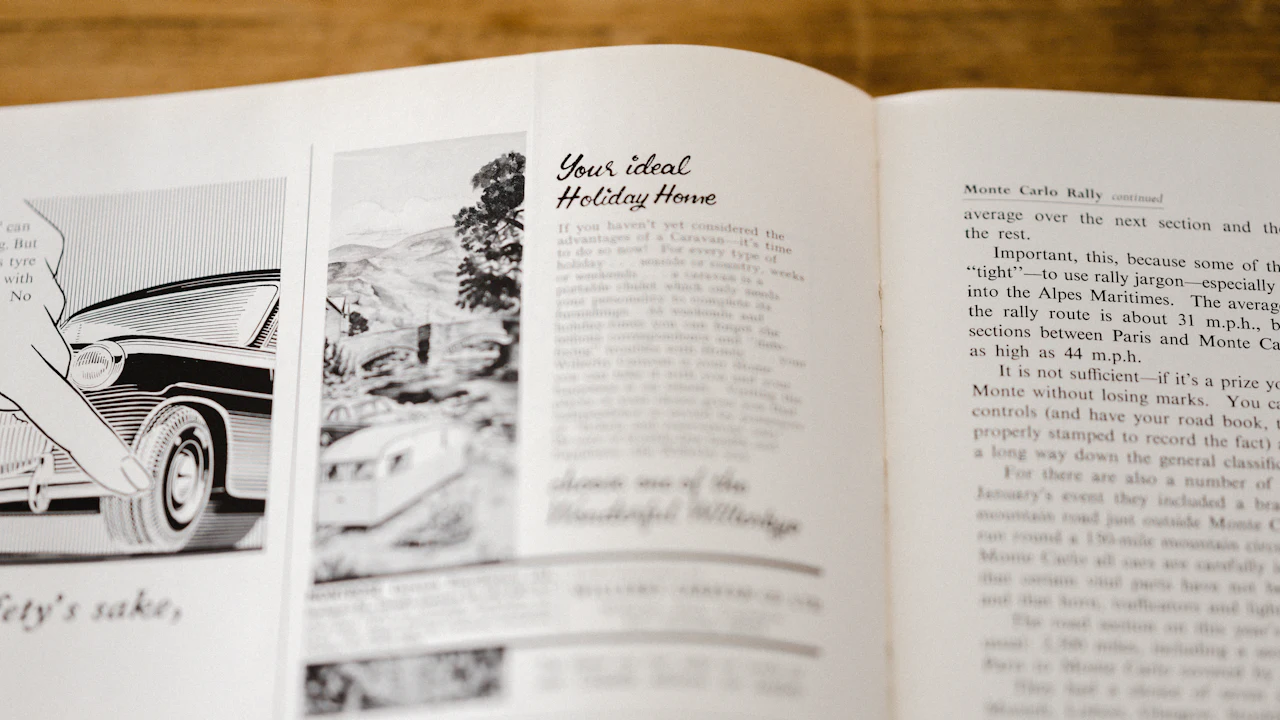
Three distinct documents matter, and buyers routinely confuse them. The factory owner’s handbook is the small book that came with the car, covering operation, controls and basic service intervals; it establishes what the car was delivered as, and its presence is a reasonable proxy for whether the car has been looked after by people who cared. The workshop manual is the technical document written for the people who repair the car, and on the hydraulic-era cars it is not optional reading — procedures on those systems are specific, and guessing at them is how expensive components get destroyed. The spare-parts catalogue is the illustrated listing that tells you and your specialist exactly which part number belongs to which chassis range, which matters enormously on cars that changed detail specification during a production run without changing model name.
A car offered with all three, plus stamped service records and old invoices, tells you something the inspection cannot: that somebody has been keeping track. A car with none of them is not necessarily a bad car, but you are buying an unknown quantity and should price it that way.
Build records and chassis cards
Both marques have unusually good archival coverage compared with volume manufacturers. The Rolls-Royce Enthusiasts’ Club maintains an extensive archive of factory build records and can, for many cars, supply a copy of the original build sheet showing the specification as delivered — colour, trim, options, coachbuilder where relevant, and the first owner. The Bentley Drivers’ Club performs a similar role, particularly for pre-war and Derby-built cars. For a modest fee and a chassis number, you can often establish what the factory actually built before you ever see the car.
That document does more work than any inspection. It settles whether the colour is original, whether the engine number matches, whether the car left the works with the equipment the advertisement claims, and whether the “rare factory option” in the listing was ever fitted. When a seller resists supplying a chassis number so you can request one, treat that as information.
Where the literature lives now
Original handbooks and manuals surface through the clubs, through specialist booksellers and autojumbles, and through owners selling on when a car changes hands. Good-quality reprints exist for the more common workshop manuals and are perfectly adequate as working documents, though they carry no value as provenance. We do not sell any of this and have no interest in where you buy it — the point is simply that the literature exists, that it is findable, and that a car sold with its own original set is worth more than one sold without.
Verify the chassis number and history before you pay
Verification on these cars splits cleanly at 1981, and the split is the single most useful thing to understand before you start.
Cars built after 1981 carry a 17-character vehicle identification number in the modern international format: a manufacturer identifier, a descriptor section encoding the model and body, a check digit, a model-year character and a sequential serial. It is stamped and plated in the usual places and it behaves like any other VIN. Cars built before that carry a factory chassis number instead — a shorter alphanumeric series, generally with a letter prefix indicating body type and steering side, stamped on a chassis plate in the engine bay and repeated on the body and major components. It is not a VIN, it will not decode in the usual online tools, and its meaning has to be read against the factory records for that model.
Whichever kind of number the car carries, the checks are the same in principle:
- Read the number off the car, not off the advertisement. Find the chassis plate or VIN plate physically, photograph it, and check it against the title and against any secondary stamping on the body and engine.
- Confirm matching numbers where the model expects them. On the older cars the engine carries its own number, and a build record will tell you what it should be. A replacement engine is not automatically a problem, but it is a price difference and it should be disclosed.
- Check the title and the lien status in the state of registration. Long-dormant cars change hands informally, and an unresolved lien or a title that does not match the person selling the car is a common and expensive surprise.
- Check the car is not recorded as stolen or written off. A car that has been off the road for years has a paper trail that nobody has looked at in years.
- Run the VIN through a vehicle history check if the car is post-1981 and has been US-registered. A vehicle history report by VIN will show reported ownership changes, odometer readings as recorded at each transfer, and any title brand on file — the information that decides whether a car is worth the cost of a specialist inspection.
For a pre-1981 car, no commercial history service will have meaningful coverage, and the equivalent work is done through the club archive, the title chain, old invoices and the marque registers. That is slower and it is worth doing anyway. The general sequence — identify, verify, check the title, confirm the odometer, then inspect — is set out step by step in our guide to checking a used car’s history before buying. On any car recent enough to be covered, it is also worth a two-minute check for open safety recalls, which are free to have remedied and are routinely left outstanding on low-mileage cars that sat.
Known trouble spots, era by era
Every one of these families has a small number of failure modes that account for most of the money owners spend unexpectedly. None of them is a secret, and all of them are inspectable.
Cloud and S-Series: structure first. These cars have a separate chassis and steel bodywork with aluminium in places, and the combination corrodes at the joints in ways that are hidden until the body is off. Sills, the base of the doors, the boot floor and the areas around the rear spring hangers are where to look. Mechanically they are straightforward, and the drum-braked early cars need their servo mechanism understood by whoever maintains them.
Shadow and T-Series: the hydraulics. Brakes and self-levelling run on a high-pressure system with accumulators, and the system uses a specialised fluid rather than ordinary brake fluid. Many cars have since been converted to a mineral-oil system with new seals throughout. Both arrangements work; mixing them destroys every seal in the car. Establish which system the car is on, in writing, before anyone touches it. Beyond that: subframe mounts, rear suspension bushes, and corrosion in the monocoque around the front and rear subframe pickups, which is structural and expensive.
Silver Spirit, Mulsanne, Eight and Turbo R: the 6.75-litre V8 is a durable engine, but head gaskets and the corrosion of the alloy around the cylinder liners are the known weak point, and both are aggravated by neglected coolant. Any evidence of coolant loss with no visible external leak deserves a compression and leak-down test before you go further. On the Turbo R specifically, check the suspension thoroughly: the car was set up much harder than its siblings, the bushes and dampers wear accordingly, and a soft one has usually had nothing done to it.
Seraph and Arnage: know which engine is in the car in front of you. The Silver Seraph uses BMW power, and so do the earliest Arnages before Bentley reverted to the old V8. They are entirely different propositions to maintain, they have different specialist networks, and the values differ. Electronics are now a genuine cost centre on both, and a module fault can absorb several hours of diagnostic labour before a part is fitted.
Interiors, all eras: wood and hide are the quiet budget killers. Cracked or lifting veneer needs re-veneering rather than polishing, and a full set is a five-figure job on some cars. Retrimming hides costs what it costs because it is hand work. Sun damage, a leaking screen seal or a car stored damp will have done more financial damage to the interior than to anything mechanical.
What ownership actually costs
Set a realistic annual figure before you agree a price, because the figure is what decides whether the ownership is enjoyable or corrosive.
For a sorted, well-documented Shadow or Spirit that you drive regularly but not hard, a maintenance reserve in the region of $3,000 to $5,000 a year is a defensible starting point. That is not a prediction of what any specific car will cost; it is the size of reserve that stops a single job becoming a crisis. Individual jobs give a sense of scale: a full hydraulic overhaul on a neglected Shadow runs into the low thousands, a suspension refresh on a Turbo R similarly, and interior work — veneer, hides — passes $10,000 without difficulty on a car that needs all of it.
Parts pricing is where expectations break. Some items are surprisingly reasonable, because they were shared with other British cars of the period or are still being made. Others are astonishing, because they are produced in batches of a few dozen or fabricated individually. There is no reliable rule for guessing which is which, and the only defence is to price the specific parts a specific car needs before you buy it rather than after.
The counter-intuitive part
A $20,000 car can cost more over five years than a $60,000 one. The cheap car is cheap because the deferred work has accumulated, and that work does not become optional once you own it. The expensive car is expensive because somebody already paid for it. You are not choosing between two prices; you are choosing between paying now at a discount and paying later at retail.
The same logic applies across the modern luxury market, and for the same reason — depreciation reduces the purchase price and touches nothing else. We set that argument out with federal cost data in our guide to buying a used luxury car, and the conclusion there holds here in a more extreme form: the reserve matters more than the rate, and more than the price.
The buying checklist
Work through this in order. Most of it can be done before you travel to see the car.
- Get the chassis number in advance and request the build record from the relevant club archive. Do this before viewing, not after.
- Ask what documentation comes with the car — handbook, workshop manual, parts catalogue, service records, old invoices. Ask for photographs of the invoice pile, not a description of it.
- Establish which hydraulic system the car is on if it is Shadow-era or later, and who last worked on it.
- Look underneath, not at the paint. Subframe mounts, sills, floors, spring hangers and boot floor decide whether the car is viable. Paint decides very little.
- Check the coolant and the oil for cross-contamination, and ask when the coolant was last changed. On the V8 cars this is the single most informative question you can ask.
- Sit in it and use everything. Every switch, every window, the seat motors, the heating and air conditioning. Electrical faults on these cars are labour, and labour is the expensive part.
- Commission a pre-purchase inspection from a marque specialist — not a general workshop, and not a mobile inspection service. Someone who works on these cars weekly will tell you in an hour what you would learn in a year.
- Talk to the clubs before you commit. Regional sections know the local cars, and it is common for a car’s recent history to be known to somebody in the register.
- Price the first year of ownership from the inspection report, and add the cost of anything the car needs to the purchase price before you compare it with the alternatives.
None of this makes the purchase safe. It makes it informed, which is the most that can be said of buying any car whose maintenance history is longer than the memory of the person selling it.
Frequently asked questions
Where can I find an owner’s manual for a Rolls-Royce Silver Shadow?
Original factory owner’s handbooks turn up through the Rolls-Royce Enthusiasts’ Club and its regional sections, through specialist automotive booksellers and autojumbles, and through owners selling on when a car changes hands. Reprints of the workshop manual are widely available and are perfectly usable as working documents, though they add nothing to a car’s provenance. If you want the original book that belongs with a specific car, the club noticeboards are the most productive place to ask.
How do I check a Rolls-Royce chassis number?
It depends on the age of the car. Cars built from 1981 onwards carry a 17-character VIN in the modern international format, which can be read from the plate and checked against the title and against a vehicle history report. Cars built before then carry a factory chassis number on a plate in the engine bay, which does not decode in ordinary VIN tools. For those, the chassis number is submitted to the Rolls-Royce Enthusiasts’ Club archive, which can supply a copy of the factory build record showing the original specification.
Is a Silver Shadow a cheap way into a Rolls-Royce?
It is the cheapest way in and the easiest way to lose money. The cars were built in large numbers by the standards of the marque, so purchase prices are low, but the hydraulic system, the subframe mountings and the interior are all expensive to put right. A well-documented car at a higher price is almost always cheaper to own than a neglected one at a low price.
Does it matter whether I buy the Rolls-Royce or the Bentley version?
Mechanically, for most of the post-war period, barely at all — the Bentley S-Series, T-Series and Mulsanne are the same cars as the contemporary Rolls-Royce with different grilles and badging. The differences are in production numbers, market preference and, from the Turbo R onwards, genuine engineering divergence. Buy the individual car and its record rather than the badge.
Are parts still available for these cars?
For the mainstream post-war models, yes — through specialists, club spares schemes and remanufacture, though prices and lead times vary enormously by part. For coachbuilt bodies and low-volume derivatives, body panels and trim are effectively bespoke, and anything missing has to be made. That is why the parts catalogue and the build record matter so much: they establish what the car should have before you start looking for it.
This site is not affiliated with Rolls-Royce Motor Cars, Bentley Motors, or the former RRAB Shop.
For sale near you
Dealer listings, checked liveFinding used cars near you…
Sources and further reading
Recall, complaint and safety-rating figures on this page were retrieved from the federal databases above on August 19, 2026. Federal data changes — re-check any VIN before you rely on it.
Published August 20, 2026 · last updated August 20, 2026. Found something out of date or wrong? Tell us and we will correct it.