Chevrolet Certified Pre-Owned Is Now CarBravo: What You Get
Chevrolet's certified used cars are now sold as CarBravo, in two tiers with very different warranties. When the 12 months really start, why the old 6-year powertrain cover is no longer offered, and the battery exclusion.
The short version
- Chevrolet’s certified used program is now CarBravo. GM says that from June 2, 2026, CarBravo is its only certification program for U.S. Chevrolet, Buick and GMC dealers, who can also certify other makes. Cadillac keeps its own program.
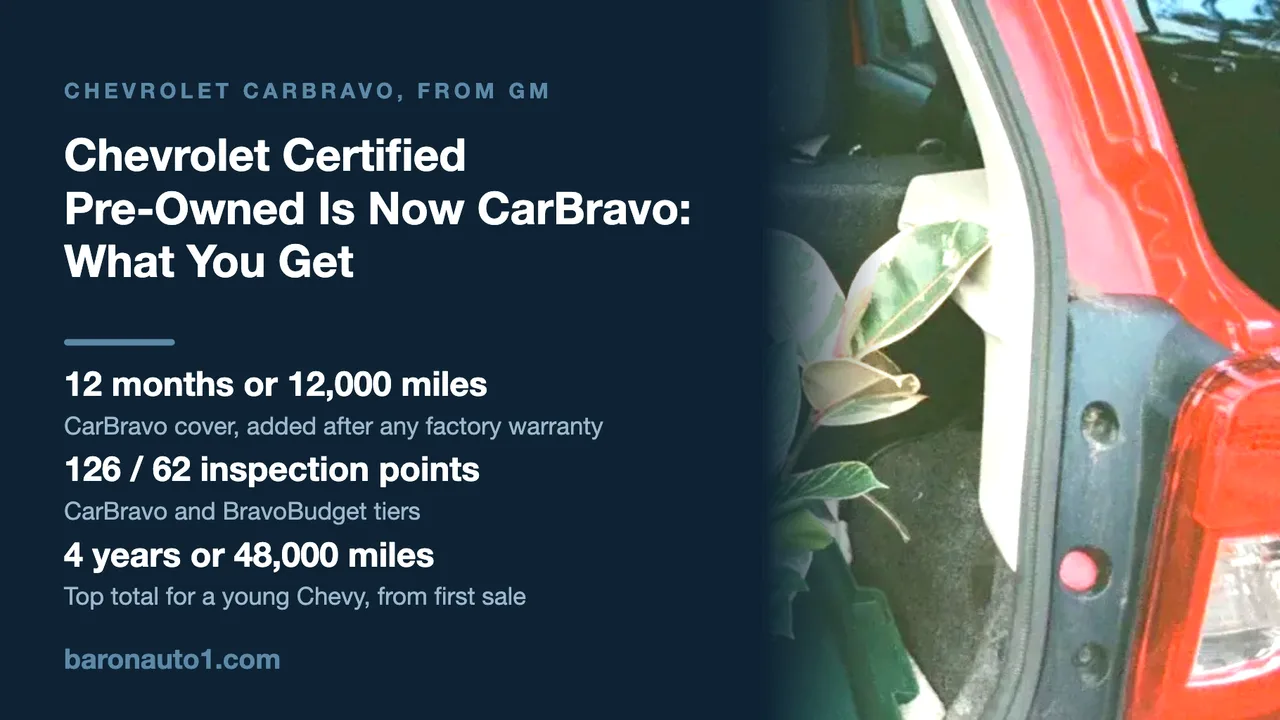
- CarBravo Certified (less than 10 model years, less than 100,000 miles) gets a 126-point inspection and 12 months or 12,000 miles of bumper-to-bumper cover with no deductible. BravoBudget (10 to 15 model years and/or 100,000 to 150,000 miles) gets a 62-point inspection and 30 days or 1,000 miles of powertrain cover.
- The CarBravo term starts only when any remaining factory bumper-to-bumper cover expires. For a young Chevrolet, GM’s booklet puts the total at 4 years or 48,000 miles from the original in-service date, whichever comes first; otherwise the 12 months start the day you buy.
- The CarBravo tier has no powertrain warranty of its own. GM’s old certified package printed 6 years or 100,000 miles of powertrain cover from the original in-service date.
- Both CarBravo warranties exclude 12-volt and EV batteries and “Any preexisting condition”.
- GM’s own pages disagree on details, including when the warranty starts, so get the tier and coverage dates on your paperwork. The 10-day or 500-mile window is an exchange, not a refund.
A Chevrolet certified pre-owned vehicle is now a CarBravo vehicle. General Motors merged the Chevrolet, Buick and GMC certified programs into CarBravo on June 2, 2026, and chevrolet.com’s certified page now opens with “Hey there, we’re CarBravo.” A certified Chevy is sold in one of two tiers: CarBravo Certified, with 12 months or 12,000 miles of bumper-to-bumper cover that begins after any factory warranty, or BravoBudget, with 30 days or 1,000 miles of powertrain cover. This page is built from GM’s 2026 CarBravo warranty booklet and its 2025 and 2023 editions, GM’s March 2026 announcement, the carbravo.com program pages and GM’s 2018 certified brochure, all read on 30 September 2026.
What happened to Chevrolet certified pre-owned
GM announced the change on 3 March 2026: “Starting June 2, U.S. Chevrolet, Buick and GMC certified used vehicle sales programs will come together under one modern, easy-to-love platform, CarBravo.” CarBravo “will become GM’s sole used vehicle certification program for U.S. Chevrolet, Buick and GMC dealers and allow them to certify and sell GM and non-GM makes and models.” GM calls it “not the launch of a new program, but an evolution of one that has been in market for more than three years.” Cadillac keeps its own certified program (see our Cadillac certified pre-owned guide), and GM Canada keeps a traditional one.
The old program site, gmcertified.com, now redirects to carbravo.com, and Chevrolet’s certified used vehicles page is titled “Shop CarBravo Inventory”; GMC’s page opens with the same CarBravo text. A certified car at a Chevrolet dealer now means CarBravo, on the same terms as at a Buick or GMC store. Only the factory warranty figures below are Chevrolet’s own.
A certified car on a Chevrolet lot is not necessarily a Chevrolet. CarBravo’s blog says “We sell all types of certified used Hondas, Toyotas, Fords and more,” and those cars get a different warranty, administered by Safe-Guard Products International, LLC. Only enrolled dealers sell CarBravo vehicles: GM said in March that “More than 750 dealers across all 50 states are already enrolled in CarBravo,” and that “Coverage and terms may vary by state.” The GM documents we read describe no separate tier for electric vehicles.
CarBravo Certified and BravoBudget: which cars qualify
The 2026 CarBravo Warranty Coverage and Owner’s Assistance Manual sorts cars by age and mileage at the time of sale. CarBravo Certified needs “these two criteria”: vehicles “less than 10 model years old; and” “less than 100,000 miles at the time of sale”. BravoBudget Certified takes a car that fails those tests but is “greater than 10 and less than 15 model years old; and/or” has “greater than 100,000 and less than 150,000 miles at the time of sale”.
CarBravo needs both tests and BravoBudget accepts either, so a young car with more than 100,000 but less than 150,000 miles can only be BravoBudget. GM’s March release words the tiers more loosely, as “up to 10 years old with fewer than 100,000 miles” and “10–15 years old with no more than 150,000 miles”. Read literally, the booklet places a car of exactly 10 model years or 100,000 miles in neither tier. What decides your coverage is the label: each warranty applies “if labeled a CarBravo vehicle” or “if labeled a BravoBudget vehicle”.
| Term | CarBravo Certified | BravoBudget Certified |
|---|---|---|
| Age at sale | Less than 10 model years old | Greater than 10 and less than 15 model years old, and/or the mileage band |
| Mileage at sale | Less than 100,000 miles | Greater than 100,000 and less than 150,000 miles, and/or the age band |
| Inspection | 126 points | 62 points |
| Warranty | Bumper-to-bumper, 12 months or 12,000 miles | Powertrain, listed parts only, 30 days or 1,000 miles |
| Starts | When any remaining factory bumper-to-bumper cover expires; otherwise on the contract date of the sale | On the contract date of the sale |
| Deductible | None: “no deductible”, says carbravo.com | None stated; covered repairs are made “at no charge” |
| Roadside assistance | 24-hour, for the warranty period | 24-hour, for the warranty period |
| Rental car during covered repairs | Up to $40 a day for up to 10 days | Up to $40 a day for up to 10 days |
| Exchange window | 10 days or 500 miles, exchange only | 10 days or 500 miles, exchange only |
| If you sell the car | Continues for “any subsequent owners” | Continues for “any subsequent owners” |
When the 12 months start, and why a young Chevrolet gets more
This detail decides what a CarBravo Chevrolet is worth. The booklet says: “If the vehicle has bumper-to-bumper coverage remaining under the Original New Vehicle Limited Warranty, then the CarBravo standard coverage will go into effect upon expiration of the original New Vehicle Limited Warranty.” If that cover “has already expired by time or mileage as of the date of the CarBravo transaction, then the CarBravo standard coverage becomes effective on the contract date of the CarBravo sale.”
A Chevrolet’s factory bumper-to-bumper cover is 3 years or 36,000 miles. The booklet’s table, “from the original vehicle in-service date”, gives Chevrolet an “Original Factory Warranty” of 3-Year/36,000 Miles, “Plus CarBravo Extended Warranty” of 1-Year/12,000 Miles, “Equals Total Coverage” of 4-Year/48,000 Miles. GMC’s column is identical. We checked the arithmetic: every column adds up, and the Chevrolet factory row matches Chevrolet’s own 2025 warranty booklet. So a young certified Chevy can have bumper-to-bumper cover until it is 4 years old or reaches 48,000 miles, whichever comes first. An older one gets 12 months or 12,000 miles from the day you buy it.
Chevrolet’s own warranty page describes the start date differently. The owner warranty page on chevrolet.com says certified pre-owned vehicles “include a limited warranty that activates at the time of purchase/lease”. GM’s 2026 CarBravo booklet and carbravo.com’s disclosures for the CarBravo tier say the term waits until any remaining factory bumper-to-bumper cover expires, so on a young Chevrolet it is added after the factory cover rather than overlapping it. The booklet is the warranty document. Have the dealer write the start date on your paperwork.
Two readings of the same booklet
The booklet describes the term two ways. Its overview gives “coverage for 12 months or 12,000 miles (whichever comes first)” starting when the factory cover expires. Its details page calls it an “extension” that “adds 12 months/12,000 miles to the vehicle’s original bumper-to-bumper warranty”, which is how the table reaches 4 years and 48,000 miles. The two agree only when the factory cover reaches 3 years and 36,000 miles together. Take a hypothetical 2025 model-year Chevrolet first sold on 15 April 2025 and bought certified on 30 September 2026 with 18,000 miles:
- If its factory cover runs out on the calendar, on 15 April 2028, with 30,000 miles on the odometer, the overview reading ends on 15 April 2029 or at 42,000 miles; the table reading ends on 15 April 2029 or at 48,000 miles.
- If it reaches 36,000 miles first, say on 15 October 2027, the overview reading ends on 15 October 2028 or at 48,000 miles; the table reading ends on 15 April 2029 or at 48,000 miles.
Those are our worked examples, not GM figures. Ask the dealer to write the CarBravo start and end, by date and mileage, on the buyer’s order.
| Car | Certified warranty ends | Other cover still running |
|---|---|---|
| 2025 Chevrolet, first sold 15 April 2025, 18,000 miles at purchase | Starts when the factory cover expires (15 April 2028 or 36,000 miles); ends 15 April 2029 or 48,000 miles by the booklet’s table, possibly sooner by the overview reading | Chevrolet factory powertrain to 15 April 2030 or 60,000 miles |
| Chevrolet first sold 1 August 2021, 64,000 miles at purchase | 30 September 2027 or 76,000 miles | Depends on that model year’s factory terms, which we did not read |
| CarBravo Certified car with 99,000 miles at purchase | 30 September 2027 or 111,000 miles | Cover runs past 100,000 miles, because that limit applies at the time of sale |
| BravoBudget car with 130,000 miles at purchase | Listed powertrain parts only: 30 October 2026 or 131,000 miles | None from CarBravo |
| Chevrolet certified under the old GM program, first sold 1 June 2022 | Old certified powertrain to 1 June 2028 or 100,000 miles, on the 2018 brochure’s terms | Check that car’s own certified paperwork |
What Chevrolet’s own warranty adds
A young certified Chevrolet keeps what remains of its factory warranty, which belongs to the car rather than to CarBravo. Chevrolet’s 2025 model-year booklet, which we read for our GM extended warranty guide, counts each term from the day the vehicle “is first delivered or put in use”, ending at whichever limit comes first:
- Bumper-to-bumper: 3 years or 36,000 miles.
- Powertrain: 5 years or 60,000 miles, or 5 years or 100,000 miles for certain engines and qualifying fleet vehicles.
- Hybrid propulsion battery: 8 years or 100,000 miles.
- Seatbelts and airbags: 6 years or 72,000 miles. Rust-through of body sheet metal: 6 years or 100,000 miles.
The 2024 booklet prints the same terms. The factory warranty is “provided to the original owner and any subsequent owners of the vehicle during the warranty period”, and Chevrolet’s factory roadside assistance runs “for the duration of the Limited Powertrain Warranty Coverage”. By our arithmetic, the factory powertrain end points of 5 years and 60,000 miles sit 1 year and 12,000 miles beyond the CarBravo total, so on a one- or two-year-old certified Chevy the factory powertrain term is the longest cover you get. For older model years, ask the dealer to print the factory terms by VIN; we read only the 2024 and 2025 booklets. (Our explainer sets out powertrain versus bumper-to-bumper warranty cover.)
The inspection: 126 points, 62 points, and a checklist GM doesn’t link
CarBravo’s certified used cars page gives the counts: “CarBravo vehicles under 10 model years old with less than 100k miles get a 126-point inspection, while BravoBudget vehicles between 10-15 model years old with 100k-150k miles receive a 62-point inspection.” CarBravo’s blog says technicians “review the vehicle history and check out the engine, transmission, steering, HVAC and safety systems, maintenance, tires and brake pads”, and that “Every Certified Service technician completes the GM Automotive Service Educational Program.”
GM does not publish the checklist. The FAQ answer ends “Click here to see the checklists.” with no link, and we found neither list on carbravo.com. Nothing in the GM documents we read sets a pass mark, such as a minimum tire tread or brake pad thickness. What you can get is the report: “Every vehicle listing includes a CARFAX® Vehicle History Report, photos, features, a full inspection report and more.” Ask for the inspection report for that VIN, with the technician’s entries on it.
The old GM Certified program used a “172-Point Vehicle Inspection and Reconditioning Process”. By our subtraction, CarBravo’s has 46 fewer points, and BravoBudget’s has 64 fewer than CarBravo’s. A point count is not a quality score, though: it depends on how finely a checklist splits its items.
Recalls. GM says: “Before a CarBravo vehicle is listed or sold, GM requires dealers to complete all safety recalls. However, because even the best processes can break down, we encourage you to check the recall status of any vehicle through your GM account and NHTSA.” Run the VIN yourself; our guide to checking a car for open recalls shows how. The warranty excludes any loss that is “a direct result of a mechanical or structural defect for which a manufacturer has announced a recall”.
The warranty also excludes “Any preexisting condition”, so a fault the inspection missed may not be covered at all. An independent check before you buy is the remedy; our pre-purchase inspection guide covers what a second mechanic should look at.
What the CarBravo warranty covers
CarBravo Certified is whole-vehicle cover with exclusions. For GM-built vehicles, the booklet says: “The complete vehicle is covered for this term, except for other coverages listed here under the ‘What is Covered’ and those items listed under ‘What is Not Covered’ sections of this manual.” It pays for “repairs to correct vehicle defects related to materials or workmanship occurring during the warranty period, excluding slight noise, vibrations or other normal characteristics of the vehicle”, using “new, remanufactured or refurbished parts”. CarBravo’s warranties page ticks 16 systems, from the engine, transmission and drive systems to electrical, steering, air conditioning, brakes, suspension, EV and hybrid components and regenerative braking.
BravoBudget is a parts list and nothing else: “Components not listed are not eligible for coverage under the BravoBudget Powertrain Limited Warranty.” The warranties page ticks the first 7 of those 16 rows. For GM-built vehicles the booklet lists:
- Engine: block, heads and internally lubricated parts, timing gears, chain or belt, oil pump and pan, seals, gaskets, manifolds, flywheel, water pump, engine mount, turbocharger and supercharger, and electrical parts inside the engine. Diesel engines add the fuel pump, emissions reduction parts and the glow plug system.
- Transmission or transaxle: internally lubricated parts, case, torque converter, mounts, seals, gaskets, internal electrical parts and directly connected actuators. Transfer case: much the same, plus the encoder motor.
- Drive systems: internally lubricated parts, final drive housings, axle shafts and bearings, constant velocity joints, propeller shafts and universal joints.
- Turbocharger or supercharger, factory installed only, and the seals and gaskets of covered parts.
The list carries its own exclusions. The engine cover leaves out “sensors, wiring, connectors, engine radiator, coolant hoses, coolant, heater core, starter motor, and entire pressurized fuel system”. The transmission cover leaves out cooling lines, hoses, sensors, wiring, and the clutch and pressure plate; the drive systems cover leaves out “all wheel bearings”, hub bearings and locking hubs. The GM-vehicle list names no electric drive motor, while the non-GM list includes “Electric Vehicle Components”. On an older electric or plug-in hybrid Chevrolet sold as BravoBudget, ask which parts the dealer believes are covered, in writing.
No charge, where repairs happen, and the next owner
“Covered repairs including towing, parts and labor will be made at no charge”, the booklet says, and carbravo.com describes the bumper-to-bumper cover as coming “with no deductible”. GM’s documents disagree on where to go. The booklet says to “take the vehicle to a GM dealer facility” and that CarBravo vehicles “can be serviced at any General Motors (Chevrolet, Buick, GMC or Cadillac) dealership”; carbravo.com says “Get your vehicle repaired at any CarBravo dealership nationwide”. A GM dealer that also sells CarBravo satisfies both, so call ahead if yours doesn’t.
For a GM-built car, the warranty “is provided to the original and any subsequent owners of the vehicle during the warranty period”, so it stays with the car if you sell it. The non-GM warranty “is not transferable to another vehicle or subsequent owner of the Covered Vehicle.” Disputes differ too: the GM section points to “the voluntary, nonbinding Alternative Dispute Resolution Program in which CarBravo participates”, while the non-GM warranty has an arbitration clause in which “You agree to abide by the Arbitrator’s decision”. Keep your service receipts too: the booklet says they “can be very important” when a claim turns on maintenance.
What CarBravo doesn’t cover
The booklet lists 22 numbered exclusions for GM-built cars (27 for non-GM cars, by our count). Those most likely to matter:
- Anything already wrong: “Any preexisting condition (defined as a condition that already existed on the covered vehicle on the effective date)”.
- Batteries: 12-volt and EV batteries; see below.
- Tires, wheels, paint, trim and appearance items, and glass cracks, chips or scratches “due to impact”.
- Maintenance and fuel: damage from missed maintenance or the wrong fluids, and from poor-quality fuel. On a car that needs premium, gasoline below 91 octane “may not be covered”.
- Towing and plowing: “Any vehicle used for pulling a trailer, unless the vehicle was properly equipped beforehand for this purpose as recommended by the manufacturer”, and “Any vehicle used for plowing snow”.
- Work use: government, fire, police and emergency vehicles, and commercial use “including rental, taxicab, limousine, shuttle or livery service”.
- Recalls and other cover: losses from a recalled defect, parts under the Federal Emissions Warranty, and breakdowns covered by another warranty or a customer assistance program.
- Extra costs and alterations: lodging, meals, loss of use, lost pay and storage; shop supplies, and diagnosis when no covered breakdown is found; tampering, including software; an altered odometer; tinting films on the glass.
- Named parts in item 22, including key fobs, GPS and mapping services, Bluetooth and Wi-Fi parts, seat frames and tracks, tire pressure sensors “unless specifically covered”, evaporative emission parts such as purge valves, and airbag sensors.
The battery exclusion
Neither CarBravo warranty covers the battery. The booklet puts it in capitals, “BATTERIES ARE NOT COVERED UNDER CARBRAVO WARRANTIES”, and adds: “12-volt and EV batteries are not covered. Batteries are covered, if applicable, under the manufacturer’s new vehicle limited warranty.” On a certified electric Chevrolet, the traction battery is covered only by what is left of its factory battery warranty, if anything.
The wording varies inside the booklet: item 11 reads “Volt and EV batteries are not covered”, where the page 8 note says “12-volt” and the non-GM list “12 Volt”. Chevrolet’s 2025 booklet lists hybrid propulsion battery cover of 8 years or 100,000 miles and says gradual capacity loss is expected and not covered. We did not read Chevrolet’s electric-vehicle battery terms for this page. Before buying any certified hybrid or EV, ask the dealer to print its remaining factory battery coverage by VIN.
Roadside help, loaner cars, the exchange and the extras
Roadside assistance. Both tiers get “a 24-hour Roadside Assistance Program” for the applicable warranty period, which on a BravoBudget car means 30 days or 1,000 miles. The booklet lists towing to the closest CarBravo and/or GM dealer from a legal roadway, a flat tire change using your spare, emergency fuel delivery of up to $5.00 of fuel, oil, fluid and water delivery with the fluids paid for by you, lockout help (a new key and labor are not covered) and jump-starts. CarBravo can change or end the program “at any time without notification”. A young Chevrolet also has factory roadside assistance while its factory powertrain cover lasts.
Courtesy transportation. During covered repairs, “alternate transportation and/or reimbursement of certain transportation expenses may be available”. The booklet allows rental costs of “up to $40 per day for a maximum of 10 days”, excluding fuel, collision damage waivers and optional insurance, and “Subject to vehicle availability”. By our arithmetic that is a ceiling of $400. A non-GM car gets $40 a day for up to 3 days, a $120 ceiling, or up to 10 days when a parts delay is reported within the first 5 days and verified, and “You must receive prior authorization for rental expenses.”
The exchange. CarBravo’s “10-day/500-mile Vehicle Exchange Program” says: “If it doesn’t feel right, contact your dealer to exchange it for another vehicle”. The disclosure: “Whichever comes first. Vehicle exchange only. Limitations apply. See dealer for details.” It is not a money-back guarantee; get the unpublished limitations in writing before you sign. The old GM program’s window was 3 days or 150 miles; by our arithmetic CarBravo’s runs 7 days and 350 miles longer.
Trials, history and points. “Eligible vehicles receive 1 month of Premium Plan coverage” from OnStar, and a 3-month SiriusXM trial comes with cars “equipped with satellite radio at participating dealerships”. Every vehicle comes with “a free CARFAX® Vehicle History Report”. GM Rewards members “Earn 1x point for every $5 spent” at dealers in both programs, with points “based on the purchase price of the vehicle”, but only if they are members “at the time of purchase”.
Optional plans and financing. CarBravo sells four optional BravoCare products: a protection plan, pre-paid maintenance, tire and wheel protection and GAP coverage. Its disclosures say “The CarBravo Protection Plan is optional and is not insurance” and name GM Protections, LLC as obligor and Safe-Guard Products International, LLC as administrator. Our GM extended warranty guide reads a GM protection plan contract clause by clause. carbravo.com also posts certified finance offers through GM Financial, limited to named models and a take-delivery deadline; check the current offer and its end date there.
Certified before June 2026: the old GM Certified terms
A Chevrolet certified before June 2026 was sold under GM Certified Pre-Owned, and its warranty can still be running. The program’s brochure, dated 2018 (form CPO-18-POS-DIGIBRO), is still on gmc.com and is the most recent GM statement of the old terms we could read; the Internet Archive lists 2026 captures of gmcertified.com but refused our requests. Later changes to the old package, if any, are not reflected here.
| Term | Old GM Certified (2018 brochure) | CarBravo (2026) |
|---|---|---|
| Makes | Chevrolet, Buick or GMC | GM and non-GM makes |
| Age | Within 6 model years | Less than 10 model years; BravoBudget greater than 10 and less than 15 |
| Mileage | Maximum 75,000 miles | Less than 100,000; BravoBudget greater than 100,000 and less than 150,000 |
| Inspection | 172 points, with reconditioning | 126 points; BravoBudget 62 |
| Bumper-to-bumper | 12 months or 12,000 miles, in addition to remaining factory cover | 12 months or 12,000 miles, starting when factory cover expires; BravoBudget none |
| Powertrain | 6 years or 100,000 miles from the original in-service date | None on CarBravo Certified; BravoBudget 30 days or 1,000 miles from the sale |
| Deductible and transfer | “$0 Deductible and Transferable” | No deductible; transfers with a GM-built car |
| Maintenance | Two included visits within 2 years or 24,000 miles | None included; pre-paid maintenance sold separately |
| Exchange | 3 days or 150 miles | 10 days or 500 miles |
| Roadside assistance | For the powertrain period, 6 years or 100,000 miles from new-vehicle delivery | For the CarBravo warranty period |
| Trials | 1 month of OnStar, 3 months of SiriusXM | 1 month of OnStar, 3 months of SiriusXM |
The powertrain line matters most. The old program gave certified cars powertrain cover to 6 years or 100,000 miles from the original in-service date; by our arithmetic, that ran 1 year and 40,000 miles past the end points of Chevrolet’s current factory powertrain term of 5 years or 60,000 miles. CarBravo Certified has no powertrain term of its own, so once the factory powertrain cover and the CarBravo year have both run out, a certified Chevrolet has no GM powertrain or bumper-to-bumper cover left unless you buy a plan. In return, CarBravo accepts older, higher-mileage cars and gives a longer exchange window.
Buying a Chevrolet that a previous owner bought certified before June 2026? The brochure described its warranties as “$0 Deductible and Transferable”. Ask the seller for the certified paperwork and have a Chevrolet dealer confirm by VIN what remains. The old powertrain clock ran “from original in-service date”, so count from the first sale, not the certification date.
How to confirm a Chevrolet is really certified
“Certified” on a listing means little unless a participating CarBravo dealer sold the car under one of GM’s two labels. Before you sign:
- Check the label. Coverage applies “if labeled a CarBravo vehicle” or “if labeled a BravoBudget vehicle”, so make sure the buyer’s order names the tier.
- Check the dealer. GM points to carbravo.com/locate-dealer “for a list of CarBravo participating dealers”. An independent lot’s “certified” is its own promise, not GM’s.
- Get the booklet, the dates and the reports. The CarBravo booklet, the contract date, the coverage start and end, and the listing’s “full inspection report” and CARFAX report, matched to the VIN.
- Run the recall check yourself, as GM suggests, through your GM account and NHTSA.
- Check the title. Chevrolet’s factory warranty is void on vehicles “currently or previously titled as salvaged, scrapped, junked, or otherwise considered a total loss”; see what a salvage title means.
- For a non-GM car sold in California, expect a vehicle service contract, provided at the time of sale, in place of the warranty.
We found no GM tool that confirms CarBravo status by VIN, so the labelled paperwork, the booklet and the dealer’s signature are your proof. Keep them with the car’s records.
CarBravo, an ordinary used Chevy, a new one, or a protection plan
CarBravo Certified against an ordinary used Chevrolet. Certification adds a 126-point inspection, 12 months or 12,000 miles of bumper-to-bumper cover with no deductible, roadside help and courtesy transportation for that period, the exchange window and the trials. GM prints no price for any certified vehicle, so the value depends on the premium over a similar car that isn’t certified. The cover adds most on a very young car, where the year stacks on the factory term, and on a car whose factory warranty has expired, where the 12 months start at once.
BravoBudget against buying as-is. BravoBudget adds a 62-point inspection and 30 days or 1,000 miles of cover on listed powertrain parts: a short backstop, not long-term protection. GM’s pitch: “It extends GM-backed confidence to older, higher-mileage vehicles that are often sold ‘as-is’ elsewhere.”
CarBravo against new. A new 2025 Chevrolet carries 3 years or 36,000 miles of bumper-to-bumper cover and 5 years or 60,000 miles of powertrain cover. A one-year-old CarBravo Chevrolet inherits most of that and adds its 12 months on top.
CarBravo plus a protection plan. Once the factory and CarBravo terms run out, longer cover means a paid service contract, such as CarBravo’s BravoCare plan or a GM protection plan. Our GM extended warranty guide reads a GM plan contract in detail, extended car warranty cost covers prices, and is an extended warranty worth it works through the decision. Our certified pre-owned overview explains how these programs work in general.
Before you sign: a Chevrolet certified pre-owned checklist
- Name the tier. CarBravo Certified or BravoBudget, written on the buyer’s order. “Certified” alone says nothing about the warranty.
- Get the in-service date. Chevrolet’s factory terms, and any old GM certified powertrain term, run from the car’s first delivery.
- Get the CarBravo start and end in writing, by date and mileage, because the booklet can be read two ways.
- Check the mileage against 100,000. Above it, and below 150,000, a car can only be BravoBudget, with 30 days of powertrain cover.
- Ask about the battery. Neither CarBravo warranty covers 12-volt or EV batteries; on a hybrid or EV, get the remaining factory battery coverage by VIN.
- Take the inspection and CARFAX reports for that VIN, and run your own recall check.
- Get the exchange limitations in writing. 10 days or 500 miles, exchange only.
- Join GM Rewards first if you want the points.
- Keep every service receipt, and get an independent inspection anyway: pre-existing conditions are excluded.
Common questions
Is Chevrolet certified pre-owned worth it?
It depends on the tier and the car’s age. A young CarBravo Certified Chevrolet can carry bumper-to-bumper cover to 4 years or 48,000 miles from first sale, plus the rest of its factory powertrain term. An older one gets 12 months or 12,000 miles from the day you buy it, and a BravoBudget car 30 days or 1,000 miles of powertrain cover. Compare the premium with the cover left on that VIN; the old certified powertrain warranty of 6 years or 100,000 miles is no longer offered.
What does the Chevrolet CPO warranty cover?
On a CarBravo Certified car, “The complete vehicle is covered” for 12 months or 12,000 miles, apart from the exclusions, with no deductible. The main exclusions are pre-existing conditions, 12-volt and EV batteries, tires, wheels, paint and trim, missed-maintenance damage, snowplowing and commercial use. BravoBudget covers only listed powertrain parts, for 30 days or 1,000 miles.
Does Chevrolet still have a certified pre-owned program?
Yes, under a different name. GM says CarBravo became its sole certification program for U.S. Chevrolet, Buick and GMC dealers starting June 2, 2026. chevrolet.com’s certified page now sends shoppers to CarBravo inventory, and gmcertified.com redirects to carbravo.com.
When does the Chevy certified warranty start?
Per GM’s 2026 booklet, the CarBravo term starts when any remaining factory bumper-to-bumper cover expires, or on the contract date if that cover has already expired; BravoBudget starts on the contract date. chevrolet.com’s owner warranty page says a certified warranty “activates at the time of purchase/lease”, so have the dealer write the start date down.
Is the Chevrolet certified warranty transferable?
For a GM-built car such as a Chevrolet, yes: the warranty “is provided to the original and any subsequent owners of the vehicle during the warranty period.” For a non-GM car sold through CarBravo, no.
Can I return a certified used Chevrolet?
You can exchange it, not return it for a refund. CarBravo allows an exchange for another CarBravo vehicle within 10 days or 500 miles, whichever comes first, with limitations GM does not publish. The old GM Certified program’s window was 3 days or 150 miles.
For sale near you
Dealer listings, checked liveFinding used Chevrolet cars near you…
Sources and further reading
- FTC: a businessperson’s guide to federal warranty law
- 15 U.S.C. § 2301 (Magnuson-Moss definitions)
- FTC: auto service contracts and warranties
Recall, complaint and safety-rating figures on this page were retrieved from the federal databases above on August 19, 2026. Federal data changes — re-check any VIN before you rely on it.
Published September 30, 2026 · last updated September 30, 2026. Found something out of date or wrong? Tell us and we will correct it.