Nissan Certified Pre-Owned: When the 7 Years Start, What They Cover
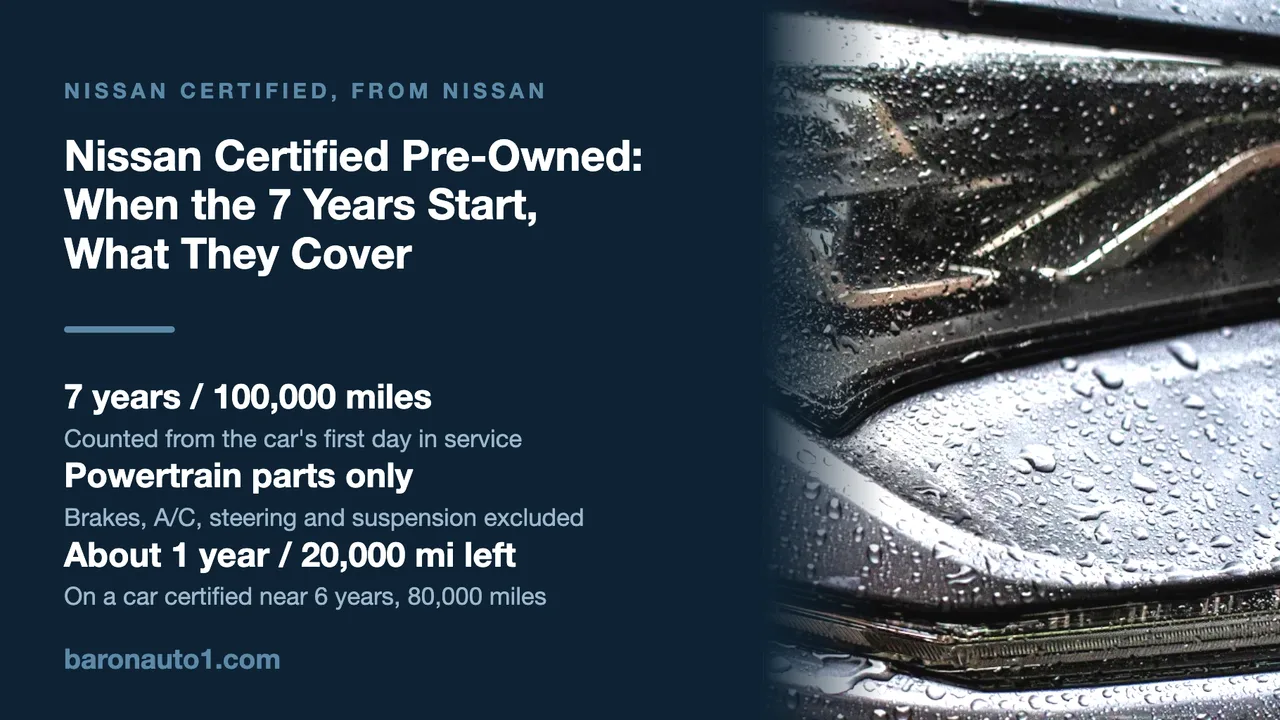
Nissan's 7-year, 100,000-mile certified warranty counts from the day the car was first sold and covers only the powertrain, so a car certified near 6 years and 80,000 miles may keep about a year or 20,000 miles of it. Nissan's own web page disagrees with its booklet on when that clock starts.
The short version
- Nissan certifies used cars under three programs: Nissan Certified (gas-powered Nissans up to 6 years old with less than 80,000 miles), EV Certified (electric Nissans on the same limits) and Certified Select (Nissans and qualified other brands up to 10 years old with less than 100,000 miles).
- Nissan’s booklet runs the Nissan Certified warranty 7 years from the car’s original in-service date or to 100,000 miles on the odometer, whichever comes first. The clock started when the car was new, even though two footnotes on Nissan’s program page say “date of sale”.
- It covers the powertrain only: engine, transmission, transfer case, drivetrain and electric drive parts. Brakes, suspension, steering, air conditioning, infotainment, airbags and high-voltage battery cells are excluded, and each covered visit costs a $100 deductible.
- By our arithmetic, a car certified at nearly 6 years and nearly 80,000 miles can have as little as about 1 year or 20,000 miles of cover left, whichever runs out first.
- Certified Select gets 12 months or 12,000 miles from the day you buy. Nissan’s 2022 booklet printed 6 months or 6,000 miles, and Nissan’s Security+Plus Wrap brochure still does.
- All three include roadside help, towing up to $100 a claim, a rental car at up to $42 a day for 5 days and up to $500 of trip-interruption cover. The warranty transfers to one later private owner.
A Nissan certified pre-owned car is a used car that a participating Nissan dealer has inspected and sold under one of three programs, with a limited warranty backed by Nissan. The program decides which cars qualify, how many inspection points they pass and how long the warranty lasts. The detail that matters most is when the clock starts: Nissan’s booklet counts the 7 years from the day the car was first put in service, not from the day you buy it. This page is built from Nissan’s certified warranty booklet and its 2022 edition, the two inspection checklists Nissan hosts, the program page on nissanusa.com and three Nissan newsroom pages, all read on 30 September 2026.
Nissan Certified, EV Certified and Certified Select
Nissan’s certified pre-owned page is headed “Three ways to buy Certified” and says each car is “inspected, reconditioned, and comes with roadside assistance, prepaid maintenance and a limited warranty”. The terms that bind Nissan are in the 16-page limited warranty booklet the page links as “Read the Warranty Booklet”, dated ©2025.
| Term | Nissan Certified | EV Certified | Certified Select |
|---|---|---|---|
| Which cars | Gas-powered Nissan models only | 100% electric Nissan models only, such as Ariya and LEAF | Nissan and qualified non-Nissan models |
| Age and mileage | Up to 6 years old, less than 80,000 miles | Up to 6 years old, less than 80,000 miles | Up to 10 years old, less than 100,000 miles |
| Inspection | 167 points | 139 points | 84 points |
| Limited warranty | 7 years or 100,000 miles on the odometer | 7 years or 100,000 miles | 12 months or 12,000 miles |
| Warranty clock starts | Original new-car in-service date | Not stated in the booklet; the page gives the Nissan Certified term | Date of purchase |
| What it covers | Powertrain list only | Powertrain list, including electric drive parts; not battery cells | Powertrain list only |
| Deductible | $100 per visit | $100 per visit | $100 per visit |
| Maintenance included | Two oil and filter changes and two tire rotations, 12 months or 15,000 miles | Up to two tire rotations and one in-cabin microfilter, 12 months or 15,000 miles | One visit in the first year or 15,000 miles; up to $50 on a non-Nissan |
| Roadside assistance | 84 months or 100,000 miles from first delivery | With the limited warranty, per the program page | 12 months or 12,000 miles from purchase |
The booklet names only two programs, Nissan Certified Pre-Owned and Certified Select, and has no EV Certified section. The program page gives EV Certified the same “7-year / 100,000 mile (whichever occurs first) limited warranty” as Nissan Certified, and the booklet’s covered list includes a Hybrid / Electric Vehicle group. Ask the dealer to confirm the EV terms in writing.
Nissan says Nissan Certified and Certified Select cars are “sold only through participating Nissan dealerships”, and that a Nissan Certified car’s “Factory Backed Limited Warranty” can only be offered by a Nissan dealer. In the booklet, “Nissan” means Nissan North America Inc. and Nissan Extended Services North America. A car another lot calls “certified” is in neither program.
Which cars qualify, and the checks before the inspection
Nissan Certified takes gas-powered Nissans “up to 6 years old with less than 80,000 miles”. Nissan’s 167-point checklist words it as “no more than 72 months from the original in-service date AND no more than 80,000 miles on the odometer”. Seventy-two months is six years, and the wording confirms that age counts from the in-service date, not the model year.
Before the inspection starts, the checklist has the dealer print what it calls Service Comm and the CARFAX report, and review the car’s service history. The car must have been originally distributed in the US, with a clean title, no open service campaigns or recalls, no warranty exclusions and no “adverse service history indicators (i.e. sludged engine, lack of maintenance, etc.)”.
EV Certified is for “100% electric Nissan models only”, on the same age and mileage limits. Nissan’s newsroom FAQ, published on 21 September 2026, names the Ariya and the LEAF. When Nissan first certified the LEAF in September 2013, it required at least 9 of the car’s 12 battery capacity bars. None of the current Nissan pages we read prints a battery minimum for EV Certified, so ask for the battery report.
Certified Select takes Nissan and qualified non-Nissan models “up to 10 years old with less than 100,000 miles”. Nissan launched it in October 2022, and its release said the program included “certain non-Nissan vehicles for the first time”. The only Certified Select checklist Nissan hosts is an older ©2018 form that asks for “no more than 120 months from the original in-service date AND miles between 60,000 - 100,000 on the odometer”. The program page prints no lower mileage limit.
Hybrids fall in a gap. The page limits Nissan Certified to gas-powered models and EV Certified to electric ones, yet the booklet covers hybrid drive parts and the 167-point form has a Hybrid System section. None of the Nissan pages we read says which program a hybrid goes in, so get the program named on your paperwork.
When the 7 years start: the booklet against the web page
The booklet’s first line of terms answers it: “For a period of 7 years from the original new car in-service date or 100,000 miles on the odometer, whichever occurs first”. Nissan’s booklets date a car’s service life from when it was delivered to its first retail buyer or otherwise put into use, whichever is earlier. The purchase-information page the dealer fills in has a field for the “CPO In-Service Date / Certified Select Sale Date”. Nissan Certified counts from the first date; Certified Select counts from the second.
Nissan’s program page muddies this. The footnote on its “7-year / 100,000 mile” line reads: “Pre-owned limited warranty runs from the date of sale.” So does the footnote on its roadside, towing and transfer rows. The footnote on the same page’s $100 deductible line says it “runs from the vehicle’s original in-service date”, and Nissan’s newsroom FAQ agrees. The page sends readers to the booklet “for complete information concerning warranty coverage”, and the booklet is the warranty. Go by the booklet: the 7 years began when the car was new.
The 100,000 miles is a total odometer reading. The booklet defines “miles on the odometer” as “the actual number of miles indicated”, not miles added after you buy. A tampered or broken odometer that leaves the true mileage unknown voids the warranty.
Certified Select is the exception. It runs “12 months from the date of purchase or 12,000 miles from date of purchase, whichever occurs first”. Because both limits count from the sale, its cover can pass 100,000 miles. By our arithmetic, a car bought just under the 100,000-mile limit is covered to just under 112,000 miles, unless the 12 months end first.
| Situation | Certified warranty ends | What else is running |
|---|---|---|
| Nissan Certified, in service 1 June 2023, 40,000 miles at purchase | 1 June 2030 or 100,000 miles on the odometer | The new-car powertrain warranty, to 1 June 2028 or 60,000 miles. The 36,000-mile basic warranty is already over. |
| Nissan Certified at the edge: in service 1 October 2020 (71 months old), 79,000 miles | 1 October 2027 or 100,000 miles: about 12 months or at most 21,000 miles | No new-car basic or powertrain cover. The powertrain warranty ended by 1 October 2025. |
| Certified Select, in service 1 September 2018, 92,000 miles at purchase | 30 September 2027 or 104,000 miles | No new-car basic or powertrain cover on an 8-year-old car. |
The edge case is the one to understand. A Nissan Certified car can be nearly 6 years old with nearly 80,000 miles, so by our arithmetic it can have as little as about 1 year or 20,000 miles left, whichever comes first. That doesn’t make an older certified Nissan a bad buy. It means the “7-year / 100,000 mile” headline is an end date and an odometer reading the car is already most of the way to.
Get the in-service date in writing. Ask the dealer to fill in the “CPO In-Service Date” on the booklet’s purchase-information page and to write the warranty’s end date and end mileage on your buyer’s order. If anyone says a Nissan Certified warranty “starts today”, point to the booklet’s first line of terms.
What the certified warranty covers: the powertrain list
The booklet covers repairs “for the powertrain components listed in the following categories”. The same four groups are printed for Nissan Certified and Certified Select:
- Engine: heads, block and all internally lubricated parts, oil pan, valvetrain, timing chain and tensioner, oil and fuel pumps, fuel injectors, intake and exhaust manifolds, turbocharger, flywheel, seals and gaskets.
- Hybrid / electric vehicle: traction motor, power converter, inverter unit, reduction gear or transaxle, EV cables, DC/DC converter, onboard charger and its connector, and the trickle charge cable.
- Transmission and transfer case: the case and all internally lubricated parts, torque converter, transmission control module and electronic controls, the transfer case and its internal parts, seals and gaskets.
- Drivetrain: drive shafts, final drive housing and its internally lubricated parts, propeller shafts, universal joints, bearings, seals and gaskets.
That is the whole list, which the program page itself calls “your Certified powertrain limited warranty”. Nissan’s Security+Plus Wrap brochure counts the certified warranty at 630+ components, all in the engine, transmission and transfer case, drive axle and hybrid/EV groups. The transmission group doesn’t mention CVTs by name; it lists the case, “all internally lubricated parts” and the control module, and prints no CVT exception.
It pays only for a “Mechanical Breakdown”: a covered part failing “due solely to defects in materials or faulty workmanship”. Accident damage, negligence, damage caused by a non-covered part failing and gradual wear are outside it. Nissan may repair with a new or remanufactured part.
Each visit for covered repairs carries a $100 deductible, “except where prohibited by law”. Nissan’s maximum liability for any covered repair is “the lesser of the total amount to repair or the actual cash value of the vehicle”, and loss of use and inconvenience are not covered.
What the certified warranty leaves out
The booklet’s eleven-item “What is not covered” list applies to both warranties. The first item does most of the work: “Any component not listed in the ‘WHAT IS COVERED’ section”. The rest spell out the big exclusions and what can end a claim:
- The high-voltage battery. “Any and all High Voltage Electric Battery (EB) cells/modules and sensors”. On an EV Certified car the drive motor and inverter are covered, but the battery’s cells are not.
- Chassis and climate. Suspension, steering, brakes, regenerative braking and air conditioning, including refrigerant.
- Electrical and cosmetic items. Paint, glass, carpet, upholstery and trim, squeaks, rattles and leaks, the infotainment system, airbags and their sensors, the 12 volt battery, belts and hoses, tires, wheels, the immobilizer key and headlight systems.
- Maintenance and wear. Tune-ups, alignment, timing belt replacement, fluids, wiper blades, filters, brake pads and shoes, and loss of performance from normal wear.
- Outside causes and upkeep. Accidents, fire, theft, flood, modifications and improper repairs. Failures from missed scheduled maintenance (including sludge build-up), wrong or contaminated fluids, towing beyond Nissan’s limits, rust or racing. Adjustments such as software updates or calibration, and commercial use “such as a taxi or limousine service”.
- Anything another warranty or a recall covers. Expenses covered by the original New Vehicle Limited Warranty or another agreement, and repairs covered by warranty extensions, recalls or campaigns.
- Salvage and total-loss history. The warranty “does not apply and is rendered void” if the car has ever had a salvage or similar title, or an insurer has ever declared it a total loss.
- Seepage. “Seepage around seals”, which the booklet defines as a wet seal or gasket.
Nissan’s answer to the gap is a separately sold service contract. The program page offers a Security+Plus Wrap plan that “wraps” around the certified powertrain warranty, “adding coverage for virtually all key vehicle systems”. It costs extra and has its own contract, and the booklet says Security+Plus is not available on non-Nissan cars. We cover it on the Nissan extended warranty page rather than repeat it here.
What is left of the new-car warranty, and which one pays
A young certified Nissan still carries part of its original warranty, and it passes to you without paperwork. Nissan’s new-car booklet says the warranty is “generally transferable from the original owner to subsequent owners at any time ownership is transferred, without any action on the owner’s part”. Nissan’s 2025 and 2026 booklets print Basic coverage of 36 months or 36,000 miles and Powertrain coverage of 60 months or 60,000 miles, both from the in-service date, whichever comes first.
The certified warranty doesn’t pay twice. It excludes “any expense that is covered by other existing warranties, including but not limited to the original New Vehicle Limited Warranty”. On a young car the new-car warranties pay first, and certified cover takes over where they stop. In effect, certification moves the powertrain end point from 60 months or 60,000 miles to 84 months or 100,000 miles. By our arithmetic that is up to 2 more years and 40,000 more miles, and whichever limit arrives first still ends it. A high-mileage car gets less of the extra time; a low-mileage car gets less of the extra miles.
Outside the powertrain, the broad factory cover is whatever is left of the 36-month, 36,000-mile Basic warranty. Once it ends, a Nissan Certified car has no factory cover for its brakes, air conditioning, steering or suspension. The new-car booklets’ separate emissions, seat belt and corrosion warranties run on their own terms.
EV batteries follow their own booklet. Because the certified warranty excludes the battery cells, a certified EV’s battery relies on the EV warranty for its model year. Nissan’s 2026 EV booklet, for example, covers the lithium-ion battery for 96 months or 100,000 miles, and covers capacity loss for the same period if the gauge falls below ten segments on an Ariya or 70% on a LEAF. Terms have changed: Nissan’s 2013 release described capacity cover of 5 years or 60,000 miles for the LEAFs of that time. Ask for the EV booklet for the car’s own model year. Our used Nissan LEAF guide covers how the LEAF’s batteries changed.
The 167-, 139- and 84-point inspections
Nissan hosts a blank copy of its 167-point inspection checklist, a ©2021 form on which each line is marked Meets Standards, Adjust/Repair or N/A. By our count of the headings Nissan prints:
- 9 lines are records and scan-tool work: VIN match, emissions test, open campaigns and recalls, fault codes, maintenance and software updates.
- 61 are powertrain and chassis checks: engine, cooling, fuel, electrical, transmission, hybrid system, suspension and steering, brakes and exhaust.
- 2 are body frame lines and 17 are road-test lines.
- 42 are interior lines, 27 body exterior lines and 9 “additional detail items”, such as a clean interior and a body free of dents.
So 89 of the 167 lines are mechanical checks and the road test, and 78 cover the interior, exterior and appearance. A few lines deserve a close read on your copy:
- The CVT lines. Line 38 tells the technician, on a car with a CVT, to “Verify Fluid Interval and Record Data Reading From ECM”, and line 39 to document the CVT fluid change code. Ask to see what was recorded.
- Brakes and tires. Pads and shoes need a “Minimum 50% Remaining”. All four tires must match in brand, model, size, tread design, speed and load rating, with at least 5/32″ of tread, on OEM-type wheels.
- Hidden damage. Line 71 sends the technician under the trunk carpet, the interior and the dash to look for flood damage. Line 98 checks the steering wheel for wear that “could indicate vehicle has been repaired and a used Steering Wheel and Air Bag have been used”.
- Keys. At least two keys or keyless remotes, where applicable.
The technician, the service manager and the used vehicle manager all sign, and you sign to confirm you received the checklist, the CARFAX report and the booklet. The instructions matter too. The dealer’s work order is “the document of record for all notes, readings, consult printouts and repairs performed”, and the checklist, work order, service contract application and bill of sale “may be requested in the future to determine repair eligibility”. Ask for a copy of the work order: it is where the repairs made before the sale are written down.
Inspected is not the same as covered. The 167 lines check brakes, suspension, steering, air conditioning, airbags and tires. The certified warranty covers none of them once you drive away. For those systems the inspection is a check on the day of sale, not a promise about next year.
EV Certified’s 139-point checklist isn’t published. We found no copy on any Nissan site, so we can’t list its items. Nissan’s 84-point Certified Select form has a nine-line LEAF-only section that includes a “Lithium-ion Battery capacity inspection (Battery Usage Report)”. On any certified EV, ask for that report and the signed 139-point checklist.
The 84-point form Nissan hosts is a filled-in ©2018 sample, every line ticked, hybrid and LEAF lines included, on a pickup. Unlike the 167-point form, it prints no minimum for pad life or tread depth. Every certification checklist is signed off by the selling dealer’s own technician and managers; an independent pre-purchase inspection adds a second opinion from someone with no stake in the sale.
Roadside assistance, rental cars, trip interruption and the extras
“For the duration of your Limited Warranty”, the booklet’s Emergency Roadside Assistance Package dispatches help “with no out-of-pocket expense up to $100” for a jump-start, a flat-tire change using your good spare, a lock-out, and fuel delivery of up to two gallons, up to five times in a calendar year.
How long it lasts. For Nissan Certified the booklet says 84 months or 100,000 miles from the date the car was first delivered or put into use, whichever is earlier; 84 months is 7 years, so it ends with the warranty. For Certified Select it is 12 months or 12,000 miles from the date of purchase. The program page disagrees again here: its Certified Select footnote counts the 12 months from first delivery, which on a car up to 10 years old would leave no roadside cover at all. Rely on the booklet.
Towing. After a mechanical breakdown, the car is towed to the nearest Nissan dealer where possible, or the nearest authorized repair facility, at a cost “not to exceed $100 per claim”.
Rental car. While a failed covered part is repaired, the booklet reimburses rental costs up to $42 a day, “to a $210/5 day maximum”. By our arithmetic the caps agree: $42 for 5 days is $210.
Trip interruption. If a covered part breaks down more than 100 miles from home, Nissan reimburses meals, lodging and alternative transportation up to $500.
Maintenance. Nissan Certified includes a prepaid maintenance agreement with two oil and filter replacements and two tire rotations, up to 12 months or 15,000 miles, whichever comes first; its footnote adds that “Not all buyers qualify”. EV Certified gets up to two tire rotations and one in-cabin microfilter replacement on the same limits. Nissan’s newsroom FAQ says two oil and filter changes for EV Certified, which an electric car doesn’t need; the program page’s footnote is the one that fits. Certified Select buyers get one complimentary visit in the first year or 15,000 miles on a Nissan, or up to $50 toward one visit on another brand.
The rest of the list. The program page also lists a free CARFAX Vehicle History Report, a 90-day SiriusXM trial and a “Guaranteed trade-in”, which has no footnote or terms, so get its meaning in writing. It lists special financing offers and promotes financing through NMAC, Nissan’s lender; such offers change often, so check the rate on your credit application and the offer’s end date. Nissan prints no price for any certified car; the dealer sets it.
Transfer, repairs, maintenance records and disputes
Transfer. The 2025 booklet says: “Your Nissan Certified or Certified Select Limited Warranty is transferable to one subsequent private owner (private party to private party) for the duration of the Limited Warranty.” That is new for Certified Select, which the 2022 booklet called “non-transferable”. The booklet points to NissanUSA.com/owners/ownership/FAQ for the transfer steps, but that address now redirects to a finance help page with no certified-warranty instructions. If you sell or buy privately, ask a Nissan dealer or Nissan Consumer Affairs how to record the transfer, and hand over the booklet.
Where to get repairs. Nissan Certified warranty work must be done by “an authorized Nissan Certified dealer” in the United States, excluding US territories, and getting the car there is at your expense unless Nissan approves otherwise. For Certified Select the booklet says the same for “a Nissan Vehicle” at an authorized Nissan dealer, and nothing about non-Nissan cars, though the 2022 edition did. On a non-Nissan Certified Select car, get the repair arrangement in writing.
Maintenance records. The booklet warns that “failure to provide such evidence and/or failure to maintain the vehicle in accordance with your owner’s manual may disqualify you from coverage”. Keep dated receipts with the mileage for every service, wherever you have it done.
Disputes. The booklet sets out three steps: the dealership’s management, Nissan’s Consumer Affairs Department, then AUTO LINE, a mediation and arbitration program run by the Council of Better Business Bureaus. The BBB must decide within 40 days, plus 7 if you haven’t first contacted the dealer or Nissan, and a decision binds you only if you accept it. The same page says AUTO LINE is for Nissans “fewer than three years old” with “fewer than 36,000 miles”, and to check eligibility with Nissan or the BBB, so don’t assume an older certified car qualifies. The booklet also limits implied warranties to the written warranty’s length where state law allows; the FTC’s guide to warranty law explains what that means.
How to confirm a Nissan is really certified
A “certified” sign on a lot proves nothing by itself. These checks do:
- The window label and the program. Nissan says to “look for the Nissan Certified Pre-Owned or Certified Select label in the window of the vehicle”. Nissan’s own inventory search, linked from the program page, filters by program.
- The delivery documents. Nissan lists four: the Limited Warranty Registration Form, the signed 167-, 139- or 84-point checklist, a copy of the CARFAX report and the warranty booklet. If any is missing at delivery, stop.
- The booklet’s purchase page. Check that the dealer has filled in the VIN, purchase date and “CPO In-Service Date / Certified Select Sale Date”.
- The title and history. The checklist requires a clean title, and a salvage or total-loss history voids the warranty. Read the history report yourself; a salvage or rebuilt title on a car sold as certified is a serious red flag.
- Recalls. Line 4 of the checklist requires every campaign and recall to have been done. Check the VIN against the federal recall lookup yourself; our guide to what a VIN warranty check can show explains what a VIN can and can’t tell you.
- The odometer against the limits. Under 80,000 miles for Nissan Certified and EV Certified, under 100,000 for Certified Select.
Certified, Certified Select, ordinary used or new
The honest comparison is the dealer’s certified price premium, which Nissan doesn’t publish, against what the certified terms add to that particular car.
| Route | Warranty from Nissan | What to weigh |
|---|---|---|
| New Nissan | Basic 36 months or 36,000 miles; powertrain 60 months or 60,000 miles | The broadest factory cover, from zero miles, at the highest price |
| Nissan Certified or EV Certified | Powertrain list to 7 years from first in-service or 100,000 odometer miles; $100 a visit | Worth most on a young, low-mileage car; about 1 year or 20,000 miles at the edge |
| Certified Select | Powertrain list for 12 months or 12,000 miles from purchase; $100 a visit | A short safety net on an older car, and the only program open to other brands |
| Ordinary used Nissan | Whatever is left of the new-car warranty, which transfers automatically | Cheapest route; rely on an independent inspection and your own history check |
On a two- or three-year-old Nissan with modest miles, Nissan Certified buys a real extension: the powertrain end point moves from 60,000 to 100,000 miles, plus the inspection, a year of maintenance and the roadside, rental and trip cover. Near 6 years or 80,000 miles, the same badge may leave about a year of cover, and the premium should shrink to match. Either way it covers far less than a bumper-to-bumper warranty; our guide to powertrain and bumper-to-bumper warranties explains the difference. See our guide to certified pre-owned programs for how factory certification compares with dealer programs, and whether an extended warranty is worth it and what extended warranties cost for the service-contract side.
Before you sign for any certified Nissan, work through this list.
- Name the program. Nissan Certified, EV Certified or Certified Select, as printed on the paperwork. On a hybrid, ask which one and get it in writing.
- Get the in-service date. Write down both end points of a Nissan Certified warranty: 7 years from that date, and 100,000 miles on the odometer.
- Check the odometer against the edge. The closer to 80,000 miles and 6 years, the less of the warranty is left.
- Read the checklist and the work order. Look for lines marked Adjust/Repair, the CVT readings, pad and tread measurements, and the repairs made before the sale.
- Price the gaps. Brakes, suspension, steering, air conditioning and electronics aren’t covered. Decide whether you want a separate plan, and read its contract first.
- On an EV, get the battery report. The certified warranty excludes the battery cells, so the model-year EV warranty is what protects them.
Common questions
Is Nissan certified pre-owned worth it?
It depends on the car’s age and mileage more than the badge. On a young, low-mileage Nissan, certification moves the powertrain end point from 60 months or 60,000 miles to 7 years or 100,000 miles and adds a year of maintenance and roadside help. Near 6 years or 80,000 miles, our arithmetic puts the cover left at as little as about 1 year or 20,000 miles. Weigh the dealer’s premium against what that car actually gets.
What does the Nissan certified pre-owned warranty cover?
Powertrain parts only: the engine, transmission and transfer case, drivetrain, and on hybrids and EVs the traction motor, inverter, converters, onboard charger and EV cables. It excludes the high-voltage battery cells, brakes, suspension, steering, air conditioning, infotainment, airbags, tires, wheels and wear items. Each covered visit has a $100 deductible.
When does the Nissan CPO warranty start?
For Nissan Certified, the booklet counts 7 years from the original new-car in-service date, or to 100,000 miles on the odometer, whichever comes first. Two footnotes on Nissan’s program page say “date of sale”, but the booklet, a third footnote on the same page and Nissan’s newsroom all say in-service date. Certified Select’s 12 months or 12,000 miles start on the day you buy.
What is Nissan Certified Select?
Nissan’s program for older cars, launched in October 2022. It takes Nissan and qualified non-Nissan cars up to 10 years old with less than 100,000 miles, after an 84-point inspection, with a powertrain warranty of 12 months or 12,000 miles from purchase. The 2022 booklet gave 6 months or 6,000 miles, so check which booklet your paperwork refers to.
Is the Nissan certified warranty transferable?
Yes, once. The 2025 booklet says the Nissan Certified and Certified Select warranties both transfer to one subsequent private owner, private party to private party, for the rest of the warranty. Certified Select was non-transferable under the 2022 booklet.
Does the Nissan certified warranty have a deductible?
Yes. Covered repairs carry a $100 deductible per visit, except where the law prohibits it, and Nissan’s program page lists it for all three programs.
For sale near you
Dealer listings, checked liveFinding used Nissan cars near you…
Sources and further reading
- FTC: a businessperson’s guide to federal warranty law
- 15 U.S.C. § 2301 (Magnuson-Moss definitions)
- FTC: auto service contracts and warranties
Recall, complaint and safety-rating figures on this page were retrieved from the federal databases above on August 19, 2026. Federal data changes — re-check any VIN before you rely on it.
Published September 30, 2026 · last updated September 30, 2026. Found something out of date or wrong? Tell us and we will correct it.