How Often to Change Oil, and What the Receipts Tell a Buyer
An oil life monitor does not count miles. It runs a model — and it can be reset in ten seconds by anyone with the steering-wheel buttons and no oil at all.
The short version
- The three-thousand-mile rule is a survival from an era of conventional oil and a business model that needed you back on the forecourt four times a year. Our own published interval table puts engine oil and filter at 5,000 to 7,500 miles, and adds the qualifier that matters more than the range: sooner on turbo engines and short trips.
- No single number is right, because three separate things move it — the oil that went in, the engine it went into, and what the car is asked to do between changes. They do not always move it the same way.
- Severe service is not an exotic category for people who tow boats up mountains. Read the definitions in almost any manual and you will find your own commute described in them.
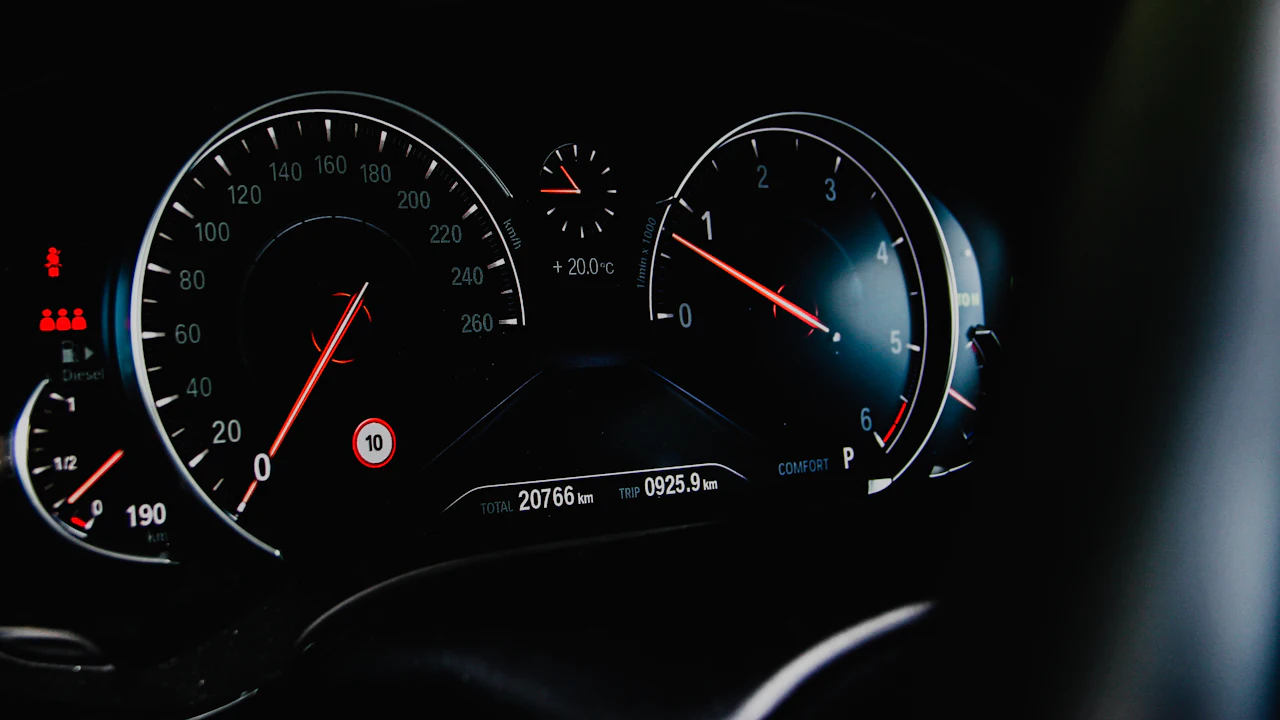
- An oil life monitor does not count miles. It runs a degradation model fed by engine temperature, cold starts, revs, load and running time, and it reports a percentage. That percentage can be reset in about ten seconds by anyone with the steering-wheel buttons and no oil at all.
- For a buyer, oil receipts are one of the very few direct pieces of evidence about how a car was treated by the person who owned it. Read the cadence rather than the interval — the shape of the sequence tells you more than any individual entry.
- A folder that looks too good deserves the same scrutiny as an empty one. Receipts printed within a week of each other, sequential invoice numbers, mileages that do not sit sensibly against their dates: those are made, not kept.
Ask this question in a workshop, a forum and a dealer’s waiting room and you will get three different numbers, all delivered with total confidence. The windscreen sticker says one thing. The owner’s manual says something longer. The dashboard, if the car has a monitor, refuses to commit to a number at all and instead counts down a percentage nobody has ever had explained to them. None of the three is lying. They are answering different questions.
The useful version of the question is not “how many miles” but “what is the interval a function of”, because once you know that, you can work out where any particular car sits — including a car you have not bought yet, whose previous owner made all these decisions for you and left behind a folder of paper as the only record of what they chose.
That second half is what a buying site can contribute here that a repair blog cannot. Engine oil is the most frequently performed service in motoring, which means it is also the service most likely to have generated paperwork. On a car with an otherwise unknown past, the oil receipts are often the only sustained record of an owner’s attention that survives. Learning to read them properly is worth more to a buyer than memorising any interval.
Where the three-thousand-mile habit came from
It was once close to correct. Conventional mineral oil in an engine of the era it was written for — carburetted, running rich on a cold morning, with crankcase ventilation that was crude by modern standards and no computer to lean out the mixture — genuinely did degrade in a few thousand miles. The number was a reasonable piece of engineering advice for the machinery of the time.
What kept it alive long after the machinery changed was that an enormous industry grew up around a service performed four times a year. A quick-change outlet built on that assumption does not survive on a customer who visits half as often. The 3,000-mile sticker in the corner of the windscreen is the physical residue of that model, and it is worth noticing who writes it: the shop that wants to see you next, not the company that designed the engine.
Meanwhile the engineering moved. Oil formulation improved out of recognition, particularly the additive packages that handle acid neutralisation, dispersal of soot and the anti-wear film at the cam and follower. Closed-loop fuel injection stopped engines from washing raw fuel down the bores at every start. Positive crankcase ventilation improved, filtration improved, and the manufacturers who had to warrant the results published longer intervals and stood behind them.
Our own published service table, which sits in full on the guide to what actually needs maintaining on a used car, puts engine oil and filter at 5,000 to 7,500 miles. That is a planning range rather than a rule, and the width of it is where all the real information lives. Steady journeys of an hour or more, in a temperate climate, on a full synthetic, sit at the long end. Winter commuting in a congested city, on an engine that reaches operating temperature just as it is switched off again, sits at the short end or beyond it. The same table puts cabin and engine air filters at 15,000 to 30,000 miles, transmission fluid at 30,000 to 60,000, spark plugs at 60,000 to 100,000 and a timing belt, where one is fitted, at 60,000 to 105,000. Set against those, oil is the short-cycle item, and the one that keeps every other number on the list honest.
Two positions are therefore both defensible and both wrong when stated as universal law: that the old three-thousand-mile figure is obsolete superstition, and that it is prudence. It is neither. It is an interval that fits one particular combination of oil, engine and duty, and most modern combinations are not that one.
The three things that actually set the interval
Every argument on this subject is really a disagreement about one of three variables, and it is worth separating them, because a person who changes conventional oil in a turbocharged direct-injection engine used for school runs and a person who changes full synthetic in a naturally aspirated engine used for motorway commuting are not disagreeing. They are describing two different problems.
The oil that went in
Base oil quality sets how long the lubricant resists oxidation, how much it thins when hot and how much of it evaporates off the hot parts. A full synthetic holds viscosity across a wider temperature range, resists thermal breakdown better, and carries a more robust additive package than a conventional oil at the same grade. That is not marketing; it is the reason manufacturers who publish long intervals also specify a synthetic to run them.
The grade matters at least as much as the chemistry. Modern engines are built to tight clearances and rely on thin oils to reach narrow galleries, hydraulic lash adjusters and the tiny control passages inside variable-valve-timing phasers. Putting a heavier oil in an engine designed for a thin grade such as 0W-20 does not make it better protected; it slows the oil reaching the parts that need it most in the first seconds after a cold start, which is precisely when nearly all wear happens. The grade printed on the filler cap is a specification, not a suggestion.
The engine it went into
Two engines of identical displacement can consume oil life at very different rates. Forced induction adds a turbocharger bearing running at extreme shaft speed on a thin film of the same oil that lubricates the crank. Direct injection puts the fuel spray inside the cylinder, where some of it can reach the bore wall and be scraped past the rings. A large, lazy, naturally aspirated engine turning slowly on a motorway is asking almost nothing of its oil by comparison.
Sump capacity is the quiet variable nobody discusses. A small-capacity engine carrying a modest oil charge concentrates the same contamination into less oil, so the additive package depletes faster for the same distance driven. Downsizing has generally reduced sump volumes while increasing specific output, which pushes in the wrong direction on both counts at once.
What the car is asked to do
This is the variable owners consistently misjudge, and it is the one the figure above is built around. Oil is consumed by heat, by contamination and by time, and different driving patterns supply those three in different mixtures. Sustained high load supplies heat. Stop-start traffic supplies both heat and running hours without distance. Short journeys supply contamination and almost nothing else, which is a specific and underrated problem dealt with in its own section below.
The reason a mileage interval alone is a poor instrument is that it measures only one of the three. Two cars can arrive at the same odometer reading having given their oil completely different lives, and the manual’s response to that has always been to publish a second, shorter schedule and hope people notice it.
Severe service is the ordinary case
Most maintenance schedules carry two columns. One is for normal service. The other is variously labelled severe, heavy duty or special operating conditions, and it typically specifies oil changes at something like half the normal distance. Owners read the word “severe”, picture a tow truck in Death Valley, and turn the page.
The definitions do not describe anything dramatic. They describe idling in traffic, repeated short journeys, driving in dust, driving in extreme heat, driving in extreme cold, mountainous terrain, roof racks and trailers, and — on many schedules — simply covering a low annual mileage. A city commute of a few miles each way, twice a day, in a place with real winters, ticks at least three of those. So does a car that mostly sits and is used at weekends. So does anything used for deliveries or ride-hailing.
The mechanisms are worth setting out plainly, because “severe” sounds like an intensity when it is really a list of specific chemistry problems.
| Condition | What it does to the oil |
|---|---|
| Repeated short journeys | Oil never reaches a temperature that boils off condensed water and light fuel fractions, so both accumulate. Water plus combustion acids attacks bearing surfaces and feeds sludge formation. |
| Stop-start traffic and idling | Running hours accumulate without distance, so a mileage-based interval systematically under-counts the work done. Airflow through the engine bay is poor, so under-bonnet temperatures rise. |
| Sustained high load, towing, long climbs | Higher oil temperature accelerates oxidation, which thickens the oil and deposits varnish on hot surfaces. Turbocharger bearing temperatures rise sharply. |
| Dusty or unsealed roads | Abrasive silica passes the air filter in greater quantity and ends up suspended in the oil, where it works as a lapping compound on bearings and rings. |
| Extreme cold | Extended warm-up enrichment puts more unburnt fuel into the crankcase, and thickened cold oil delays pressure reaching the top of the engine on start-up. |
| Very low annual mileage | Time, not distance, becomes the limit. Acids and moisture already in the oil keep working on the metal while the car sits, which is why the calendar half of the interval is not optional. |
Read that list against the way an ordinary car is actually used and the conclusion is uncomfortable but simple: the severe column is the default for a very large share of drivers, and the normal column describes a fairly specific pattern of long, warm, steady journeys that most people do not have. When somebody says their car was serviced strictly on schedule, the honest follow-up is: which schedule?
Short journeys put water and fuel in the oil
This is the failure mode that catches the most careful owners, because it disguises itself as light use. A car that covers very little distance looks pampered. Mechanically it may be having a harder life than the same car doing three times the miles.
Combustion produces water. A great deal of it — water is one of the two main products of burning a hydrocarbon in air. Most goes out of the exhaust, but a portion blows past the piston rings into the crankcase along with combustion gases. When the oil is hot enough for long enough, that water evaporates and the ventilation system carries the vapour away. When the engine is switched off after twelve minutes and never gets there, the water stays. It emulsifies with the oil, reacts with combustion acids, and shows up as the pale mayonnaise-coloured deposit people find under the oil filler cap and misdiagnose as a head gasket.
Fuel does something similar and rather worse. On a cold start the mixture is enriched deliberately, and some of that extra fuel condenses on the cold cylinder wall and is scraped down into the sump. On a port-injected engine that is a modest effect. On a direct-injection engine, where the injector sprays at very high pressure straight into the combustion chamber, more of the spray can reach the bore before it evaporates, and fuel dilution becomes a real design consideration rather than a footnote.
Diluted oil is thinner than the grade on the cap, which reduces the film thickness protecting bearings and the cam drive. It also drags the additive package down with it, because a given volume of oil now contains proportionally less of everything that was doing the protecting. None of this is visible on a dipstick. A car whose oil level appears to be rising slightly rather than falling is one worth thinking about carefully, and it is a symptom that belongs on the list for any pre-purchase inspection where the car will be up on a lift and warm.
Turbocharged and direct-injection engines change the arithmetic
Our interval table says “sooner on turbo engines and short trips” for a reason, and the reason is worth a paragraph each because these two features now appear on an enormous share of the used cars on any forecourt.
A turbocharger is lubricated by engine oil fed to a bearing cartridge with a shaft spinning at speeds no other bearing in the car approaches, sitting directly in the exhaust stream. While the engine runs, oil flows through and carries heat away. When the engine stops, flow stops but heat does not: the exhaust housing soaks its heat back into the bearing housing, and the static oil trapped in there cooks. Cooked oil leaves hard carbon deposits, and those deposits progressively block the small feed passage that keeps the bearing alive. This is the classic mechanism behind turbo failures on cars that were otherwise fine, and it is much worse with degraded oil, which cokes at a lower temperature and leaves more behind. A synthetic that resists thermal breakdown is not a luxury on a turbo engine, and an interval stretched past its useful life is expensive in a very specific way.
Direct injection brings two related problems. The first is the fuel dilution described above. The second is intake valve deposits: with no fuel spraying across the back of the intake valve, there is nothing washing it clean, and the oil vapour drawn through the crankcase ventilation system bakes onto the valve stem and seat over tens of thousands of miles. Oil quality contributes here, because a more volatile oil puts more vapour into the intake tract. Turbocharged direct-injection engines also brought a phenomenon called low-speed pre-ignition, an abnormal and violent combustion event at low revs and high load that has been linked to oil additive chemistry. Oil specifications were revised specifically to address it, which is another way of saying that on this class of engine the specification on the filler cap is not interchangeable with whatever is in the bulk tank.
Why this matters more to a second owner than a first. The first owner of a turbocharged direct-injection car typically ran it under warranty, on a dealer schedule, with the right oil, and sold it before any of this compounded. The second owner inherits the accumulated consequences of every decision made in that period without seeing any of them. Which is precisely why the paperwork is worth reading rather than weighing.
What an oil life monitor is actually counting
Most cars built in the last couple of decades carry an oil life monitor, and almost nobody knows what it is doing. Two broad approaches exist, and the difference is not academic.
The common type is algorithmic. It has no sensor looking at the oil at all. Instead the engine control unit runs a degradation model fed by things it already measures: engine revolutions, running time, coolant and oil temperature, engine load, the number of cold starts, and how long each trip lasted relative to how long warm-up took. Those inputs are weighted and integrated, and the result is expressed as a percentage of remaining life. A car doing long warm motorway runs will see the percentage fall slowly per mile. The same car doing short cold journeys will see it fall much faster per mile, which is exactly the behaviour you want and exactly what a fixed mileage interval cannot do.
The less common type adds a physical sensor, usually measuring the dielectric constant of the oil, which shifts as the oil oxidises and accumulates contaminants and soot. That gets closer to measuring the actual condition of what is in the sump rather than modelling it.
Both are better instruments than a number written on a sticker, and both have the same two weaknesses. The first is that a model is only as good as its assumptions: it knows what the engine did, but it does not know what oil you put in, and an algorithm calibrated for a full synthetic will happily count down the same way over a cheap conventional oil that will not last the distance. The second weakness is the one that matters on a used car.
The reset is the weak point, and it is trivially easy
Every one of these systems has an owner-accessible reset procedure, because owners who change their own oil need one. On most cars it is a short sequence of steering-wheel or dashboard buttons, or an ignition-and-pedal dance, and it takes seconds. Nothing about the procedure verifies that any work was done. A monitor reading full life on a car being offered for sale is therefore evidence of exactly one thing: that somebody pressed the buttons. It is not a service record, it does not corroborate a service record, and on a car being prepared for sale it is the single cheapest thing to falsify. Treat a healthy-looking monitor as neutral information and go and read the paperwork instead.
There is a second, subtler consequence for buyers. Because the monitor computes from behaviour, its history is a fingerprint of how the car was driven — and when it was reset early, or reset at wildly varying intervals, it says something about who was looking after it. You cannot usually read that history at a viewing. But you can compare what the monitor says now against the mileage on the most recent receipt, and if the two disagree, you have found something worth asking about.
Synthetic, semi-synthetic and conventional
The practical differences are narrower than the advertising and wider than the cynics allow.
A full synthetic is built from base stocks with a uniform molecular structure, whether chemically synthesised or produced by severe hydrocracking. It holds its viscosity across a wider temperature span, flows better when very cold, resists oxidation and thermal breakdown at high temperature, and evaporates less from hot surfaces. Those properties are what make long published intervals possible in the first place.
A conventional oil is refined from crude with a much more varied molecular mix. It is perfectly adequate in an engine designed around it, driven in conditions it was formulated for, changed at a short interval. It is a poor match for a small turbocharged engine that puts oil through a bearing sitting in the exhaust stream.
A semi-synthetic blend sits between the two, and is mostly a price point rather than a distinct engineering category.
Three things follow that are worth knowing before you spend money. First, the specification matters more than the word on the bottle: manufacturer approvals and industry service categories are what the engine was designed around, and an oil meeting the required approval is the requirement, whatever its base stock. Second, a synthetic does not extend an interval on its own — it makes a long interval survivable if the engine, the driving and the filter agree, and running a long-life oil to a long-life distance in short-trip service simply means the water and fuel dilution arrive in better oil. Third, the filter is part of the system. A filter chosen for a modest interval and left in for double it is a filter operating in bypass, which means unfiltered oil circulating for the second half of the change.
The honest summary is that a synthetic buys margin. On a used car of unknown history, margin is exactly what you want, and the price difference over a year is smaller than most single repairs on the rest of the service list — smaller, for instance, than the brake fluid and coolant work described in our guide to how long brake pads actually last.
What actually happens when the change is skipped
Skipping one oil change does not destroy an engine, and anyone who tells you otherwise is selling something. What skipping does is spend margin, and the damage it eventually produces arrives through several distinct routes rather than one.
Additive depletion comes first. The detergents and dispersants that hold soot and combustion by-products in suspension are consumed. So is the alkaline reserve that neutralises the acids formed from water and fuel. Once that reserve is gone, the acids start working on bearing overlays and any yellow metal in the engine.
Then oxidation thickens the oil. Oxidised oil is more viscous, flows less readily through narrow galleries, and starts laying down varnish on hot components. On engines with variable valve timing, that varnish is a specific problem: the phasers and their control solenoids depend on clean oil moving through small orifices, and a sticking phaser produces rough running, poor economy and a stored fault code that looks electrical and is not.
Sludge is the end state. Thickened, oxidised, water-contaminated oil forms deposits that block the pickup screen in the sump, coat the crankcase, and restrict return drains from the head so oil pools where it should not. An engine that starves its oil pump inlet is minutes away from serious damage regardless of how much oil is in the sump.
The cam drive suffers quietly. A timing chain runs against plastic guides and depends on oil pressure to keep its tensioner extended. Degraded oil accelerates guide wear and chain elongation, and a stretched chain retards valve timing, which the engine control unit tries to compensate for until it cannot. Chain replacement on many modern engines is a large job. Where a belt is fitted instead, oil contamination is a different but real risk on the wet-belt designs that run the belt inside the oil.
And the turbo, if there is one, cokes, by the mechanism described above — the route most likely to turn deferred maintenance into a large invoice on a car that seemed fine the week before.
None of these is instant. That is the trap. Every one of them is cumulative, and every one of them is inherited by whoever owns the car next.
The engine figure in the federal complaint file, and what it cannot tell you
This site maintains its own extract of the federal complaint archive, in which some reports carry an odometer figure that can be pulled out of the intake wording. The extract runs to 1,324 usable readings out of 9,096 reports examined — coverage of 14.6% — over 13 models and 15 component groups, all from the 2015, 2016 and 2018 model years. Where that file comes from, and why its far end cannot bear weight, is documented on the brake pad guide that carries the chart built from it.
Two categories in that file are relevant here. The engine category is the largest single component group in the whole archive, with 200 readings and a median odometer of 58,000 miles. Engine and engine cooling, tracked separately, holds 97 readings at a median of 98,000 miles. The median across every category in the file is 60,000 miles.
What this is not
It is not evidence that oil changes would have prevented anything. Every record in this file is an owner report of a problem serious enough to take to a federal safety regulator, and nothing in it records maintenance. Nobody files a federal complaint about a missed oil change, and no field in the archive says what oil was in the engine or when it was last replaced. So the file cannot support any causal claim in either direction: it does not show that neglect caused these problems and it does not show that servicing would have avoided them. What it records is when engine trouble became worth complaining about. On top of that, the data is right-censored — the pull is dominated by a young model year, so few of these cars have yet been driven far enough for their late-life behaviour to appear, and nothing whatever may be claimed about the upper tail. Use it for the ordering between categories — a comparison that holds up because the whole extract is drawn from one pool of vehicles and one span of years — and for nothing else.
Within those limits it still earns its place, because it corrects a common assumption. People tend to file engine trouble under things that happen to old cars. What owners actually reported puts the engine category at 58,000 miles — squarely inside the mileage band of the cars sitting on a forecourt today, and below the median for the archive as a whole. Engine and engine cooling sitting much later at 98,000 is consistent with a different kind of problem arriving on a different timetable: cooling components tend to fail through age and material fatigue rather than through anything an owner did on a Saturday morning.
The buyer’s reading is therefore a modest one. Engine is the category owners complain about most in this archive, and they do it at a mileage an affordable used car has usually already passed. That is an argument for taking engine evidence seriously at the point of purchase, which is what the rest of this page is about.
Reading an oil-change history: the pattern, not the interval
Here is the part that only a used-car site writes, and it is the part worth the most money. When you are handed a service folder, the instinct is to check whether the intervals look right. That is the least informative thing in the folder. Our Take 5 and Valvoline pages read what those chains include in an oil change.
The interval only tells you what the owner believed. The pattern tells you what they did, and patterns are much harder to fake than individual documents.
What a coherent history looks like
Take the receipts and lay them out by date and by odometer reading together. What you are looking for is internal consistency between three things: the dates, the mileages, and the kind of driving the gaps imply.
A car that covers a fairly steady distance each year, serviced at a fairly steady interval, at one or two shops, with the oil specification written on the invoice, is a car with an owner who had a habit. That is genuinely valuable, because habits are what protect an engine. Note the annual distance while you are at it: the EPA computes its published annual fuel cost figures at 15,000 miles a year, which is a serviceable yardstick for whether a car has been driven more or less than the average one, and a car doing a fraction of that has been living in the severe column whatever its receipts say.
Read the shops too. A folder from a single independent garage over many years is a strong signal — the same people saw the car repeatedly, and the invoices often carry incidental notes about what they found. A folder from six different chains suggests somebody buying the cheapest available service each time, which is not damning but tells you the oil specification probably varied.
The tells that a folder was assembled rather than accumulated
A perfect set of receipts is not automatically a good sign, and this is where a careful buyer separates from a grateful one.
Look at the print dates and the paper. Receipts genuinely accumulated over years look it: different stock, different fading, coffee, folds, thermal paper that has gone grey. A set that all looks the same age was printed at the same time, and there is only one reason to print a car’s entire service history in one session. Sequential or near-sequential invoice numbers across documents supposedly separated by a year are the same finding in a harder form.
Check the odometer readings against the dates for physical plausibility, and then check the most recent one against the odometer in front of you. A gap of a few thousand miles between the last service and today is ordinary. A reading on the newest receipt that is higher than the car currently shows is not ordinary at all, and it is the single most valuable thing a folder can accidentally tell you.
Look for the boring detail that a forger has no reason to invent: the oil grade, the filter part number, the sump plug washer, the tyre pressures noted, the advisory about a weeping hose that was fixed three services later. Real invoices are cluttered. Manufactured ones are clean.
Finally, compare the paper against the records the seller does not control. Service receipts are the seller’s own documents; the mileage and title record attached to the vehicle is not. Where a folder claims one story and the recorded mileage history behind the VIN tells another, the folder is the part that is wrong. And a car whose recorded odometer readings do not progress sensibly makes every interval on this page meaningless, because the distances the receipts describe were never real.
What a gap is worth, and what an absence is worth
Gaps are not all equal, and the useful skill is grading them rather than reacting to them.
A gap during which the car covered very little distance is usually nothing: a car that sat for a year does not need an oil change it did not earn, though the calendar argument still applies. A gap during which the car covered a great deal of distance is a deferred service you are being asked to inherit, and it is priceable. A gap that coincides with a change of registered keeper is the most interesting of the three, because it often marks the period when the car was owned by somebody who intended to sell it, and that is precisely the period when maintenance stops.
An outright absence of records is a different thing again, and it is worth being unsentimental about what it does and does not mean. It does not prove neglect. Plenty of perfectly well-maintained cars belonged to owners who did the work themselves and threw the receipts away. What it does is remove your ability to distinguish between that owner and the worst case, and the price of the car should reflect the width of that range rather than the midpoint of it. Note also that nothing obliges a seller to have kept any of this: the federal window form on a dealer’s used car addresses warranty status, not maintenance, and no rule requires anyone to produce a service history at all. The absence is a normal, legal state of affairs, which is exactly why the burden of establishing condition falls on you.
Similar reasoning applies to every other fluid in the car, though it lands somewhere quite different once the item in question is serviced twice a decade rather than twice a year. That case is made separately in our guide to how often transmission fluid needs changing.
Buying a car with no oil history at all
You can learn a surprising amount about how an engine has been treated without a single piece of paper. None of it is conclusive on its own. Together, several of them pointing the same way is a finding.
Pull the dipstick cold, before the seller starts the car. You want the level first — low is a question, and an engine consistently run low leaves a tide mark on the stick. Then the oil itself. Dark is normal; oil goes dark within a few hundred miles in a modern engine and colour alone proves very little. What you are actually reading is texture and smell. Gritty between finger and thumb is bad. A sharp fuel smell is dilution. A thin, watery feel suggests the same. A thick, tarry, slow-to-drip consistency is oil that has been in there a long time.
Take the oil filler cap off and look underneath it, and into the rocker cover if you can see anything. Clean metal with a light honey film is what you want. Pale emulsion means water, which on a short-trip car is often just condensation but needs distinguishing from a head gasket. Hard black lacquer or crusty brown deposits mean oil that was cooked, left in too long, or both.
Look at the underside of the engine. A film of oil-wet dust around the sump, the cam cover gasket or the rear of the block tells you about leaks. A suspiciously clean engine bay on an otherwise average car is worth a second look, because degreasing an engine before a sale hides exactly this.
Start it cold and listen to the first three seconds. A rattle on start-up that clears quickly is oil taking too long to reach the top of the engine, which points at wear in the pump, a failed anti-drainback valve in the filter, or oil that is too thick and too old. On a chain-driven engine, a brief rattle from the front of the engine is a tensioner and chain worth investigating before, not after, you buy.
Check the monitor against the sticker against the odometer. Three sources that should agree. Any two of them disagreeing is a conversation.
Have the codes read. Timing correlation faults, misfires and camshaft position codes are all consistent with an engine that has been running on tired oil, and stored history survives longer than most sellers expect. A recently disconnected battery that has cleared everything is itself information.
And then use the sources the seller cannot edit. Title brands, reported readings and open recall campaigns sit outside the folder entirely, and our walk-through of what a vehicle history check actually reveals covers what those records hold and where the gaps in them are. A quick check against the VIN takes a couple of minutes and settles the questions no dipstick can answer.
What to actually do
- Find the interval in your own car’s maintenance schedule and read both columns, then decide honestly which one describes your driving. If your commute is short, cold or congested, it is the severe one.
- Use the oil specification the manufacturer requires, not the nearest grade in the shop. On a turbocharged or direct-injection engine this matters more than on anything that came before it.
- Treat the calendar half of the interval as binding. A car that covers very little distance still needs its oil changed, because the acids and moisture in it do not care whether the wheels are turning.
- Change the filter every time. There is no version of this job where the old filter stays in.
- Check the level between services rather than trusting the warning light, which reports pressure rather than quantity and arrives far too late to be useful as a reminder.
- Treat an oil life monitor as a good instrument with one known failure mode, and never as proof that work was done.
- Keep the receipts, and keep them boring and complete. On resale they are the cheapest evidence you will ever own about how the car was treated.
- Buying, not maintaining? Read the sequence of receipts before you read any single one, and let a suspiciously tidy folder raise your suspicion rather than lower it.
Common questions
Is the three-thousand-mile interval still necessary?
For most modern engines running the oil they were designed around, no. It was a reasonable figure for conventional oil in older engines, and it survived long past that because a service performed four times a year supports an industry that a service performed twice a year does not. Our own published range for engine oil and filter is 5,000 to 7,500 miles, shorter on turbocharged engines and on cars used for short journeys. If you run conventional oil in an engine doing severe-service driving, something close to the old figure may still be right for you — but as a conclusion from your own circumstances rather than as a default. If you book one at Walmart, our Walmart oil change page reads what each package includes and what costs extra.
Can I trust the oil life monitor on a used car?
Trust it as an instrument on a car you own and have serviced yourself, because a well-implemented monitor models degradation from temperature, cold starts, load and running time and will beat a fixed mileage figure. Do not trust it as evidence on a car you are buying. Every one of these systems has an owner-accessible reset that takes seconds and verifies nothing, so a full-looking reading on a car being sold tells you only that someone pressed the buttons. Cross-check it against the last receipt and the odometer and see whether the three agree.
What does a missing oil-change history actually mean when buying?
It means the range of possible histories has widened, not that the worst case is true. A car may have been serviced meticulously by an owner who never kept paper. The problem is that you now cannot tell that owner apart from one who did nothing, so the car should be priced for the width of the uncertainty rather than the middle of it. Close some of the gap with evidence: read the oil cold, look under the filler cap, listen to a cold start, have the stored codes read, and check the recorded mileage and title history, which the seller does not control.
Does synthetic oil let me go longer between changes?
It permits a longer interval; it does not create one. A synthetic resists oxidation and thermal breakdown better and holds viscosity across a wider range, which is what makes long published intervals possible in the first place. But an interval is set by the engine, the oil and the driving together. Run a long-life synthetic to a long-life distance in short-trip service and the water and fuel dilution arrive on schedule regardless, just in better oil. And the filter has to be capable of the distance too, or the second half of the interval is spent in bypass.
Why do turbocharged engines need oil changed sooner?
Because the turbocharger bearing is the hardest-worked lubrication point on the car. It runs at extreme shaft speed in the exhaust stream, and when you switch the engine off the oil flow stops while the heat does not, so residual heat soaks into the bearing housing and cooks the oil sitting in it. That leaves carbon deposits which gradually restrict the oil feed. Degraded oil cokes at lower temperatures and leaves more behind, so a stretched interval on a turbo engine converts into a specific and expensive failure rather than general wear.
Do the NHTSA complaint figures show that skipped oil changes cause engine failure?
No, and it is important to be exact about this. The engine category in our archive holds 200 recovered odometer readings with a median of 58,000 miles, and engine and engine cooling holds 97 at a median of 98,000. Those are the mileages at which owners reported engine trouble to a federal safety regulator. The archive contains no maintenance information at all — no oil grade, no service dates, nothing — so it cannot show that neglect caused these reports or that servicing would have prevented them. It is also right-censored towards a young model year, so its upper tail is not usable. What it supports is the comparison between component categories, and nothing more.
My car is barely driven. Do I still need to change the oil?
Yes, and possibly more urgently than the mileage suggests. Very low annual mileage usually means short journeys, and short journeys are the pattern that leaves water and unburnt fuel in the oil because it never gets hot enough for long enough to drive them off. Those contaminants form acids that keep working on bearing surfaces while the car sits. This is why maintenance schedules give an interval in months as well as miles, and why the calendar half is the binding one on a car like yours.
Sources and further reading
- NHTSA Office of Defects Investigation complaint database
- EPA fueleconomy.gov
- FTC used car buying guide
Recall, complaint and safety-rating figures on this page were retrieved from the federal databases above on August 19, 2026. Federal data changes — re-check any VIN before you rely on it.
Published August 28, 2026 · last updated August 28, 2026. Found something out of date or wrong? Tell us and we will correct it.