How to Jump Start a Car, and Why the Last Clamp Matters
The last connection is the one that sparks, and a flat lead-acid battery is venting hydrogen. That is why it does not go on the negative terminal.
The short version
- The connection order is a safety procedure, not a convention, and the step most casual explanations get wrong is the last one. The final clamp goes to unpainted metal on the engine block or to a designated ground point on the dead car — never to its negative battery post.
- The reason is specific rather than superstitious. A lead-acid battery vents hydrogen, the last connection made in the circuit is the one that sparks, and the entire point of the sequence is to put that spark somewhere the gas is not.
- Reversing the clamps is the other way this goes badly, and the car does not shrug it off. Red to negative is a short circuit through two batteries, and it can take out fusible links, alternator diodes and control modules faster than you can notice the mistake.
- Modern vehicles have moved the goalposts: designated jump posts under the bonnet, batteries living in the boot or under a seat, start-stop cars running AGM chemistry, and hybrids and electric cars with a low-voltage battery that can be jumped but must never be used to jump anybody else.
- Do not jump a battery that is frozen, cracked, leaking, swollen or hot to the touch, and do not jump a car whose manual says not to. Find your own vehicle’s designated points on a dry afternoon rather than in a dark car park.
- At a viewing, a car that needs a jump is telling you something useful. A seller who has already jumped it before you arrived has quietly removed that information from your visit.
Jump starting is one of the few repairs an ordinary driver still performs by hand, and it is the one where the gap between what people do and what they should do is widest. Most of us learned it by watching somebody else do it in a car park, which means most of us learned a version with the last step missing or wrong. The procedure survives that omission almost every time. Almost is doing a great deal of work in that sentence.
What follows is the order, the reason behind each connection, and — more usefully for anybody driving something built this century — the ways in which the car in your driveway may not be the car this procedure was written for. The sequence itself is best read as a picture, so here it is.
Take that as the reference and treat the rest of this page as the argument behind it. Every one of those connections exists to keep a small, entirely predictable spark away from a small, entirely predictable pocket of flammable gas, and once you understand which connection sparks and why, the order stops being something you have to memorise. It becomes the only order that makes sense.
What you need, and what to settle before you touch anything
Very little, but the quality of it matters more than people expect. The leads and the donor are, between them, why most jumps that were performed correctly still fail.
The leads
Jump leads are sold in a wide range of thicknesses and the cheap ones are cheap because there is less copper in them. Thin cable cannot carry the current a starter motor wants. What you get instead of a start is warm cables, a voltage drop across the leads themselves, and a dead car that turns over slowly or simply clicks while the donor engine sits there sounding perfectly healthy. On a large petrol engine or any diesel, undersized leads are the single most common reason a textbook-correct jump does nothing at all.
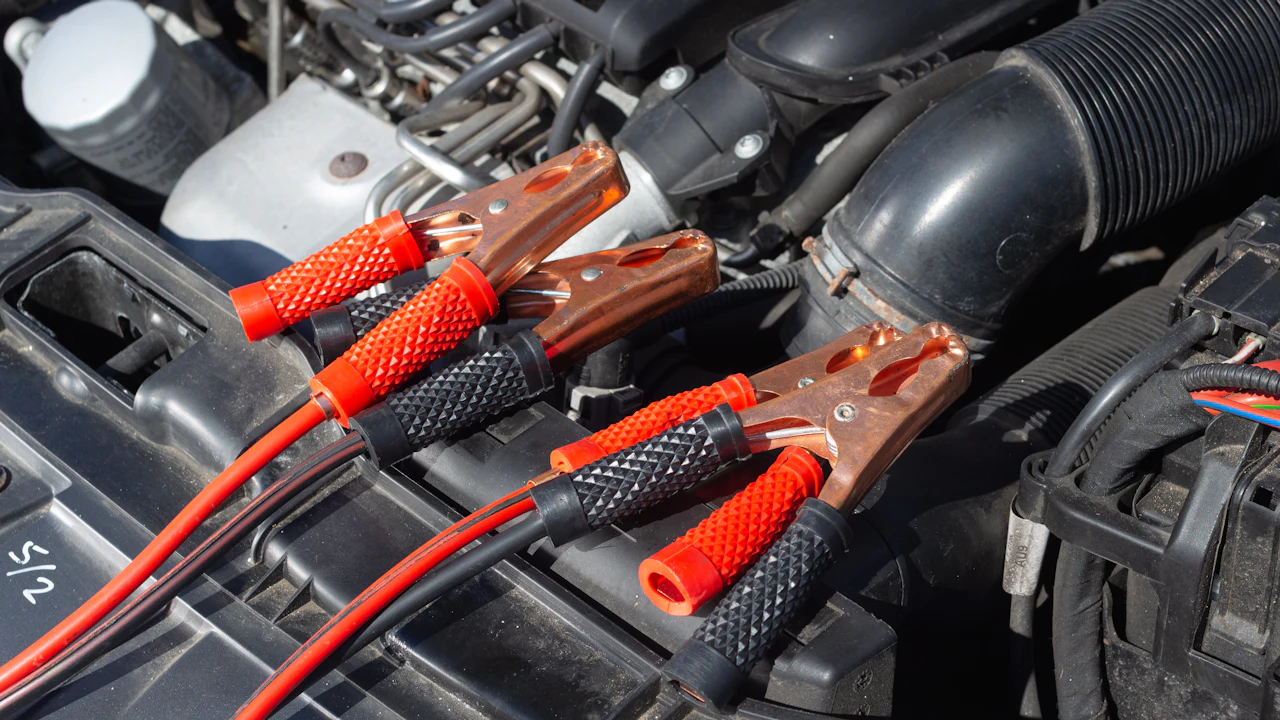
Look for heavy, flexible cable, clamps that open wide enough to reach a recessed post, and jaws with a decent serrated bite rather than a shiny stamped edge. Check the insulation before you use them. Leads that have been rattling around in a boot for years develop cracked sheathing and corroded jaws, and a clamp that will not make a clean connection is a lead that will not work.
The donor
You want an ordinary petrol or diesel car with a healthy twelve-volt system and an engine at least as large as the one you are trying to start. A small car can jump a large one, but it will do it more slowly and the donor will need to be running.
Three donors to rule out before you start. A commercial vehicle running a twenty-four-volt system is not a donor; connecting it to a twelve-volt car will destroy the car. A hybrid or an electric vehicle is not a donor either, for reasons set out further down this page. And a car whose own battery is marginal is not a donor, because you are about to create a second stranded vehicle in the same car park.
You, and where you are standing
Eye protection and gloves are sensible and almost nobody wears them. Take off rings, a metal watch strap and anything hanging round your neck before you lean over an engine bay. A ring that bridges a live post to a bracket does not blow a fuse; it heats to the point of burning through skin in seconds, and it cannot be pulled off in time.
No smoking, no naked flame, and no doing this in a closed garage. Position the vehicles so that the leads reach comfortably without stretching and so that the two cars are not touching each other anywhere — touching bodywork creates a second, uncontrolled path between the two electrical systems. Handbrakes on. Automatics in park, manuals in neutral. Ignition off on both cars, and every load you can find switched off: headlights, blower, heated glass, wipers, radio, phone chargers.
Finally, and this is the item that saves the most trouble: read the relevant page of the owner’s manual for the dead car before you connect anything. That page will name the designated jump points if the vehicle has them, and it will say plainly if the manufacturer forbids the procedure. Both of those are things you want to know before the clamps are in your hand, and neither is guessable from the outside of the car.
Why the order is a safety procedure rather than a habit
Here is the physical situation, and it is worth understanding rather than memorising, because the understanding is what makes the rule stick.
A lead-acid battery works by a reversible chemical reaction in dilute sulphuric acid. When it is charged, and particularly when it is charged hard or has been sitting deeply discharged, some of the energy goes into splitting water in the electrolyte rather than into the reaction you want. The battery gives off hydrogen and oxygen as a result. On a sealed battery most of that recombines internally, which is why they are called sealed rather than gas-free; every one of them has a vent, because a battery with no way to relieve pressure is a pressure vessel. On an older or badly treated battery the venting is more generous, and the gas collects around the top of the case where the posts are.
Hydrogen ignites over a wide range of concentrations in air and needs remarkably little energy to set it off. A small spark from a clamp closing a live circuit is more than sufficient.
The hazard this whole sequence exists to manage
A lead-acid battery vents hydrogen, and hydrogen collects exactly where the terminals are. If it ignites at the battery, the case can rupture and throw sulphuric acid and fragments of casing upwards, into the face of whoever is leaning over it. This is not a theoretical hazard: it is the reason every manufacturer, every recovery service and every battery maker publishes the same connection order. Make the final connection away from both batteries, keep your face out of the engine bay while the clamps go on, and never lean directly over a battery while a circuit is being made or broken.
Which connection actually sparks
Work out which of the four clamp connections carries a potential difference at the moment you make it, and the order writes itself.
The first clamp goes onto the dead car’s positive point while nothing else is connected. There is no completed path anywhere, so nothing happens. The second clamp joins the other end of the same red lead to the donor’s positive post. That connects two positives together with no return path, so again nothing happens. The third clamp goes onto the donor’s negative post, which is already the reference point for the donor’s own system — still no completed circuit between the two cars.
The fourth clamp is the one that closes the loop. At the instant it approaches metal, there is a voltage across the gap and current wants to flow, so a small arc jumps before the jaws touch. That arc is not a fault. It happens every time, on every correctly performed jump start, and it is entirely harmless provided it happens somewhere that is not sitting in a cloud of hydrogen.
That is the whole argument for the last step. The final clamp goes to bare, unpainted metal on the engine block, to a substantial bracket, or to whatever ground point the manufacturer has designated — as far from the battery as the lead sensibly allows, and away from fuel lines, the fuel rail, and anything that spins or moves when the engine fires. Put it on the dead battery’s negative post instead and you have deliberately placed the one guaranteed spark of the procedure directly above the vent of a battery that has been sitting there gassing.
A second reason for the same rule, which is newer
There is a modern argument for the designated ground point that has nothing to do with hydrogen, and it applies to a growing share of the fleet.
Many vehicles now carry a battery monitoring sensor clamped around or built into the negative terminal. Everything the car knows about how much current has gone into and out of the battery passes through that sensor, and the charging strategy uses that picture to decide how hard to charge. Clip a jump lead straight onto the negative post and you have connected upstream of the sensor: current now flows into the battery by a route the car cannot see. On some vehicles that is merely untidy. On others it confuses the battery model badly enough that the car mischarges afterwards, and the manufacturer says so in the manual. The designated ground point sits on the correct side of that sensor, which is one of several reasons it exists.
The mistake that is not recoverable
Never let red touch a negative, or black touch a positive
Connecting the leads the wrong way round places two batteries in opposition with almost nothing between them but copper. The current that flows is enormous and immediate. Cables get hot enough to melt their own insulation, clamps can weld themselves to the posts, and a battery under that kind of abuse can vent violently or rupture. On the electrical side the damage is done in a fraction of a second: fusible links, the main fuse box, alternator rectifier diodes, and any control module that happened to be on the wrong side of the wrong fuse. Check the markings on both batteries, in good light, before either clamp goes on. Positive is normally the larger post, marked with a plus, and often wears a red cover; negative is marked with a minus. Do not identify a terminal by the colour of the cable attached to it — cables get replaced, and they get replaced by people in a hurry.
One further trap in the same family: once the leads are connected, the exposed metal of the clamps at the dead car’s end is live. Never let the two clamps touch each other, and never lay a live clamp down on the bodywork or an engine bracket while you go and do something else. Drape the loose ends over a wing mirror or a wiper arm rather than into the engine bay.
Working through it, and what each stage is actually for
The figure above carries the order. What follows is the reasoning at each stage, plus the details that decide whether it works.
Before either clamp goes on
Look at the dead battery properly, in the light of a torch if you need one. You are looking for a case that is cracked, bulging, weeping or coated in dried residue, for terminals so corroded you cannot get a clean bite, and for anything that suggests the battery is not merely flat. The section on when not to jump, further down, sets out what disqualifies a battery entirely. Do that inspection first, because it is the only stage of this procedure that is free.
Then find the connection points. On a great many modern cars they are not the battery. They are a red plastic cover with a plus symbol on it, hiding a stud in the fuse box, and a matching ground stud or bracket somewhere nearby. The manual names both.
The red connections
Both red clamps go on before either black one. The order between the two cars is the one the figure shows, and the logic is simply that a lead with a clamp already attached to a live post is a lead you do not want dangling: attaching the dead car first means that if the free red clamp swings into the bodywork it is attached only to a battery that has nothing much left in it. That is a marginal safety gain, but it is free, and it is the order most manufacturers print.
Make sure each clamp is actually gripping metal rather than the lip of a plastic cover, and give it a small wiggle to bite through any surface film. A clamp resting on corrosion is a clamp making a high-resistance connection, and high resistance is exactly what stops a jump working.
The black connections
The first black clamp goes to the donor’s negative post. The second and final one goes to the dead car, and this is the connection the whole procedure is arranged around. Bare metal on the engine block, a substantial engine bracket, or the manufacturer’s designated ground stud. Not the negative post. Not the battery clamp. Not a painted panel, not an alloy inlet manifold with a coating on it, and not anything within reach of the belts, the cooling fan or the fuel system.
Expect a small spark or a light click as it goes on. That is the circuit completing and it means you have found metal.
Running the donor first, and why
Start the donor car and let it run for several minutes before you attempt the dead one. Two things happen in that time. The donor’s alternator raises the system voltage above resting level, so there is more push available across the leads. And a very flat battery on the other end absorbs some charge, which matters because a deeply discharged battery behaves like a load rather than a store: it will happily swallow whatever the donor is producing and leave nothing for the starter.
Set a fast idle if the donor makes that easy, but do not have somebody sitting in it revving the engine hard. On a car with a managed charging strategy that achieves less than people think, and it makes it harder to hear what the other car is doing.
Cranking, and knowing when to stop
Try the dead car in short attempts rather than one long one — a few seconds at a time, with a pause of the best part of a minute between attempts to let the starter cool and let the donor put something back. Prolonged cranking overheats a starter motor, and on a car that is not starting for reasons unconnected with the battery it can do worse things than that.
If it has not started after three or four attempts, stop. Continuing is not going to change the answer, and the next section on what to do when it does not start is more useful than another minute of cranking. Something other than a flat battery is in play, and more current will not supply it.
Once it starts
Taking the leads off
Leave both engines running and give it a few minutes before you touch anything. Then remove the clamps in exactly the reverse of the order they went on: last one on, first one off. The final black clamp from the dead car’s ground point comes off first, and the red clamp from the dead car’s positive point comes off last.
The reasoning is the mirror of the reasoning for fitting. Breaking a circuit arcs just as making one does, and you want that arc to happen at the ground point rather than at either battery. Keep the clamps apart as they come off, keep them off the bodywork, and do not let the loose ends fall into the engine bay of a car whose engine is now running.
Some manufacturers specify switching on a modest electrical load — the blower, or the headlights — on one or both cars before disconnecting, to absorb the voltage transient that occurs when the leads are pulled. Whether your vehicle wants that is in the manual. If it says so, do it.
Why you drive rather than idle
Once the leads are off, the recovered car is running entirely on its own alternator, and the battery underneath it is still nearly empty. Switch the engine off now and there is a good chance you are doing all of this again in twenty minutes.
Idling on the driveway is a poor way to refill it. At idle the engine is turning slowly, so the alternator is producing less than it can, and a large share of what it does produce is consumed immediately by the car’s own running load: ignition, fuel pump, engine management, lights, blower, heated glass, the entertainment system. The surplus left over for the battery is small. Raise the engine speed by driving and the alternator has considerably more to give, and it gives it for longer.
So drive the car, properly, for half an hour or so at road speed rather than doing a lap of the estate. Switch off the loads you do not need while you do it. And treat that drive as the minimum rather than the cure: a battery that has been flattened to the point of needing a jump is rarely brought back to full charge by a single journey.
A jump start is not a charge, and the distinction matters
This is the point most explanations skip. Jump leads do not charge a battery. They supply enough current, for a few seconds, to turn a starter motor. Everything that happens after the engine fires is the car’s own charging system doing the work, and an alternator is not a battery charger — it is a generator designed to run a car and top up a battery that is already mostly full.
Asking an alternator to refill a deeply discharged battery makes it work hard and hot for a long period, which is not what it was designed for, and it still tends not to reach a full state of charge. If a car has gone genuinely flat, the better sequence is to jump it, drive it somewhere sensible, and then put it on a proper mains charger overnight. That is gentler on the charging system, and it gets the battery to a state that a drive alone will not.
It also gives you a clean starting point for working out why it went flat, which is the question that actually matters and which the jump has done nothing to answer.
Modern cars are not the cars this procedure was written for
The sequence above dates from an era when every car had an accessible battery under the bonnet, a simple regulator, and almost no electronics to damage. Three of those four things have changed.
Designated jump points
On a large and growing share of vehicles the manufacturer provides dedicated connection points and expects you to use them instead of the battery. Typically that is a positive stud inside or beside the underbonnet fuse box, capped with a red plastic cover carrying a plus symbol, together with a designated ground stud, boss or bracket some distance away.
These are not a convenience feature. They exist because the battery is somewhere inaccessible, or because the manufacturer wants the connection on a specific side of the battery monitoring sensor, or because the points are engineered to carry the current where an arbitrary bracket might not. Using them is not optional in the sense that improvising works just as well; on some vehicles the designated point is the only one the manufacturer will stand behind.
Batteries that are not under the bonnet
Plenty of cars put the battery somewhere else entirely: beneath the luggage floor, under one of the rear seat cushions, tucked behind a liner in the wheel arch, or below the plastic scuttle at the base of the windscreen. Weight distribution, packaging and cabin temperature all push manufacturers in that direction. The consequence for this procedure is simple and catches people out constantly — you open the bonnet, find no battery, and have no idea what to do next.
| Arrangement | What you connect to | What catches people out |
|---|---|---|
| Conventional battery under the bonnet | Positive post; final clamp to bare metal on the block or a bracket | Grounding to a painted or coated surface, or to something that moves once the engine fires |
| Battery under the bonnet, remote posts also fitted | Either, but the designated posts are the safer choice | Assuming the red-capped stud is decorative and going to the post instead |
| Battery in the boot or under a seat | The underbonnet positive stud and the designated ground point only | Opening the bonnet, finding no battery, and concluding the car cannot be jumped |
| Start-stop car with AGM or enhanced flooded chemistry | Designated points, following the manual to the letter | Treating it as an ordinary battery when the manufacturer has specific instructions |
| Hybrid or electric vehicle | The designated low-voltage points, and nothing else in the car | Believing the high-voltage system is involved, or using the vehicle as a donor |
| Any vehicle whose manual forbids it | Nothing — call for recovery | Not having read the manual until after the leads are on |
The recurring theme in that table is that the answer is written down somewhere and almost nobody has read it. Ten minutes with the manual on a dry afternoon is worth more than any amount of improvisation at the roadside.
Start-stop cars
A car that shuts its engine down at every set of lights restarts it dozens of times on a busy commute, and that duty cycle needs a battery built for it — absorbent glass mat, or an enhanced flooded unit. Both behave differently from an ordinary flooded battery when deeply discharged, and several manufacturers publish jump-starting instructions specific to them, including where to connect and what not to do afterwards. Follow those instructions rather than the generic ones.
The wider consequences of that chemistry — what it costs, why it cannot be substituted downwards, and why a replacement often has to be registered to the car before the charging system treats it correctly — belong to our guide on what actually decides a battery replacement bill, and this page will not repeat them.
Hybrids and electric cars
This is the area with the most confusion attached to it, and the confusion runs in both directions.
Both types carry a high-voltage traction pack. Both also carry a perfectly conventional low-voltage battery, and that second one runs everything you would expect it to run in any other car: the locks, the lamps, the computers, the instrument display, and the contactors that bring the high-voltage system online in the first place. It goes flat for all the usual reasons, and when it does the vehicle is every bit as stranded as a petrol car with a dead battery. Usually more so. With the low-voltage side asleep the traction system never wakes at all, so there is nothing to crank and nothing to switch on — on some models not even a way to open the doors or release the bonnet without following the manufacturer’s emergency-access instructions.
Two rules cover almost all of it. The first: the high-voltage system is not involved in a jump start and you never go near it. Orange cable is high-voltage cable and it is not yours to touch. Every jump connection on a hybrid or an EV is on the low-voltage side, at designated points, and the manual will tell you where.
The second is the one people get wrong: a hybrid or an electric car must never be used to jump-start another vehicle. Its low-voltage supply is not maintained by a belt-driven alternator sized for cranking; it comes from a converter fed by the traction pack and rated for the car’s own modest loads. Ask it to turn somebody else’s starter motor and you are asking a component to supply a current it was never built for. Manufacturers state this in plain language, and it is one of the few points on which they all agree.
What a careless jump can actually damage
The realistic list, in rough order of how often it happens. Reversed polarity, which is catastrophic and instant. A voltage transient at connection or disconnection, which is the reason for the reverse-order rule and for the load-on-first instruction some manufacturers give. Cranking hard through undersized leads, which pulls system voltage down far enough that modules reset or log faults. And a donor engine being revved aggressively into a deeply discharged battery, which is a good way to stress everything in the path.
None of that turns jump starting into something to be frightened of. It does mean that the difference between doing it properly and doing it roughly is measured in components rather than in tidiness.
Jump packs, and how they change the procedure
A portable jump pack removes the donor car from the problem, which removes several of the ways this goes wrong. There is no second vehicle to position, no risk of the two cars touching, and no engine running next to you while you work.
What does not change is the ground rule. The final clamp still goes to a designated ground point or to bare metal away from the battery, for exactly the reason it does with a donor car: the last connection is the one that arcs, and a hydrogen-venting battery is a bad place for an arc. Packs that are supplied with a specific connection sequence — and most are, usually connect-then-switch-on rather than switch-on-then-connect — should be used in the sequence their own instructions give.
Most modern packs include reverse-polarity protection: get the clamps the wrong way round and the pack beeps and refuses to deliver anything. That is a genuine and worthwhile safety feature, and it is not a licence to stop checking. Protection circuits fail, budget packs sometimes do not have the feature their packaging implies, and no protection circuit in the world stops you from letting the two clamps touch each other.
Three practical points about living with one. A pack holds a finite amount of energy, so repeated cranking attempts will flatten it, and a pack that has been sitting in a glovebox since you bought it will very likely be flat when you need it — check it on a schedule you will actually keep. A pack does not charge a battery any more than jump leads do; the same drive-it-then-charge-it logic applies afterwards. And lithium packs dislike being stored in a car that bakes in summer and freezes in winter, which unfortunately is where they need to live to be any use.
When not to jump at all
Some batteries should not have current put into them under any circumstances, and the failure mode when they do is not an inconvenience. This is the shortest section on the page and the most important one.
| What you find | How to recognise it | Why it disqualifies the battery |
|---|---|---|
| A frozen battery | The car has stood in hard frost while discharged; the case may be visibly bulged, and any fluid inside does not move | A flat battery freezes at a far higher temperature than a charged one. Ice expands, distorts and can crack the plates and the case. Forcing current into a frozen battery is how one ruptures |
| A cracked or leaking case | Dampness, staining or crusted residue running down the case; acid smell | The vessel containing sulphuric acid is compromised, and the gas it vents now escapes wherever the crack is rather than through the vent |
| A swollen or bowed case | Sides bulging outwards, the top no longer flat, a battery that will not sit properly in its tray | Heat or sustained overcharging has distorted it from the inside. The plates have moved and the battery is finished regardless of what current you put into it |
| A battery that is hot | Warm or hot to the back of the hand after the car has been standing | Something is happening inside it that should not be, most often an internal short. Adding current makes it worse |
| A smell of rotten eggs | Sharp sulphurous smell around the battery | Hydrogen sulphide, produced by a battery that has been badly overcharged or has run dry. Toxic, and a sign the battery is gassing hard |
| Visible damage to the car | Collision damage near the battery, flood exposure, a smell of fuel, damaged cabling | You cannot know what the current will find on its way through. Fuel and compromised wiring are the two that turn a jump into a fire |
| The manual says not to | Written in the vehicle handbook | Some manufacturers restrict or forbid the procedure on particular models. That instruction outranks anything on this page |
The correct response to any row in that table is the same one: do not connect anything, and get the vehicle recovered or the battery replaced by somebody who can see it. A battery is among the cheapest components on a car. It is never worth the alternative.
One additional case deserves naming because it is common and rarely mentioned. If the dead car has been sitting outside in deep cold and you cannot tell whether the battery is frozen, treat it as though it is. Get it somewhere warm and let it thaw fully before anything is connected, and have it tested afterwards rather than assumed to be fine. A battery that has frozen and thawed has usually been damaged internally even when the case looks perfect.
If it does not start
Assume the leads are good, the connections are clean, the polarity is right and the donor has been running. If the car still will not go, the extra current has done its job and told you something: the battery was not the whole problem.
What the car does during those attempts is the information worth collecting, because it points at different families of fault. Cranking that is now strong and healthy but produces no firing means the starting circuit is satisfied and something else — fuel, spark, compression or the immobiliser refusing to permit it — is missing. Rapid clicking that persists with good leads on good connections points at a connection problem you have not found, or at the leads themselves. Complete silence with the dashboard fully lit is a different fault again.
Sorting those behaviours properly is a whole subject, and it is not this one. Our guide to the four behaviours a no-start divides into takes them in the sequence that eliminates the most for the least effort, and that is the page to read next once the leads have been ruled out. What belongs here is only the boundary. Once a car is cranking healthily on jump leads, more jumping is not the answer, and persisting will cost you a starter motor.
A car that needs jumping over and over
A single flat battery has ordinary explanations. An interior light left on, a door not quite shut, a fortnight on the drive during a cold snap, a battery quietly reaching the end of its life. None of that is alarming.
A car that needs a jump repeatedly is a different statement, and the important part of it is that the battery has become a symptom rather than a cause. Either the charging system is failing to put enough back while the engine runs, or something on board is drawing current after you have walked away and locked the doors. Buying a replacement battery without settling which of those it is does no more than reset the clock. It is among the surest ways to spend money on a car and get nothing back: the cheap, obvious component gets bought twice before anybody measures anything.
Deciding between the two takes minutes with the right equipment, and our guide to sorting a worn-out battery from a charging fault covers the field tests that separate them along with the ones that mislead. The instruction that belongs on this page is narrower. If you have jumped the same car more than once, stop jumping it and get it measured. Each deep discharge takes a permanent bite out of whatever capacity the battery has left, so every repeat of the exercise makes the eventual bill slightly larger.
The jump at a viewing, and what it tells a buyer
This is where the subject stops being a repair and starts being a purchase, and it is the part of the page that matters most if you are standing next to somebody else’s car with money in your pocket.
A car that needs a jump in front of you has just handed you a genuine piece of evidence, free. It does not tell you the car is bad — there are innocent explanations and they are common — but it tells you that the battery, the charging system or something drawing current while the car sleeps is due for a conversation, and it tells you before you own it rather than afterwards.
Which is precisely why the seller who has already jumped it before you arrived has taken something from you. Nobody has necessarily lied. A seller who found a flat car at eight in the morning and got it going so the viewing could go ahead has behaved entirely reasonably by their own lights. The effect on your information is the same either way: the event happened without you, and the car in front of you now looks like a car that starts.
Signs a car was started with help
Worth a glance, and none of it takes more than a moment.
- Jump leads or a pack sitting on top in the boot rather than buried under the spare wheel cover. Equipment that lives at the top of a boot is equipment that gets used.
- Bright scratches in the corrosion on the battery posts. Terminal corrosion builds up as a dull film. Fresh clamp marks cut through it and show as clean metal, and they are quite obvious once you know to look.
- A mains charger, an extension lead or a trickle charger visible in the garage or coiled near where the car was parked.
- The car parked nose-out beside another vehicle in a way that would put two engine bays conveniently close together.
- A warm bonnet when you arrive, which carries its own separate significance: the cold start is the most revealing minute of any viewing, and a warm engine has already had it.
None of these is proof of anything, and none of them should be presented to a seller as an accusation. They are prompts for one question, asked plainly: did it start first time this morning, and has it ever needed a jump? A straight answer costs the seller nothing. Watch what you get.
What to do with the answer
If the car needed help and the seller says so openly, that is a reasonable person and the conversation can carry on sensibly. Ask when the battery went in, whether this has happened more than once, and whether anyone has measured the charging output. The distinction between a battery renewed because it had aged out and a battery renewed because the car kept dying is the whole thing. The second version gets volunteered often, and usually in complete good faith, by owners who never chased the question any further.
If the car needed help and nobody mentions it, treat the omission as information about the seller rather than about the car, and slow down accordingly.
Either way, do not accept a jump-started test drive as a test drive. If the car had to be assisted to move, you have not seen it start, and once it has been driven it will very likely start again unaided for a day or two — which means a second viewing arranged for tomorrow may tell you nothing. Arrange to see it started cold, on a different day, by you.
And put the electrical side explicitly on the list for the inspection. Having the battery loaded on a proper tester, and the charging output read with the engine running and the lights on, takes a few minutes on a ramp and settles by measurement what no amount of standing in a car park can settle by observation. Our guide to what a thorough pre-purchase inspection covers explains how to brief the workshop. Alongside that, the documented past of the car is the half no inspection reaches, so it is worth a minute to run the VIN before you take the seller’s word for anything rather than after a price has been agreed.
What the federal records support here, and what they do not
Nobody counts jump starts. No dataset exists that says how often cars need one, and it would be dishonest to pretend otherwise. What can be looked at is narrower: the point in a vehicle’s life at which electrical trouble becomes bad enough that somebody bothers to report it.
Two limits specific to this subject
The electrical system heading is much wider than the battery. It takes in wiring, control modules, switches, lighting and instrument clusters, so nothing counted under it can be attributed to a starting fault in particular. And the thing this page is about barely reaches the archive at all: a battery quietly shedding capacity until one frosty morning it will not turn the engine is ordinary consumption rather than a safety defect. No regulator gathers that, and it would not occur to an owner to report it. What does reach this heading is the frightening subset — a stall in moving traffic, a car that stranded somebody somewhere they felt unsafe, warning systems going dark. Read a midpoint from it as a battery life expectancy and you have quietly changed the subject.
With that said, rank order comes through intact, because every heading was counted the same way out of one archive and carries identical distortions. Electrical sits near the front of the queue: 145 readings with a midpoint of 49,000 miles, against 60,000 for all fifteen headings taken at once. The engine heading, the biggest single group with 200 readings behind it, does not reach its own midpoint until 58,000. Gasoline fuel system, at 134 readings, sits later still at 89,000.
The modest reading, and the one that bears on this page: for the sort of car that fills the used market, an electrical event serious enough to be worth complaining about is something owners meet early rather than late. Take that as a reason to regard “it just needed a jump” as a thoroughly ordinary thing that happens to thoroughly ordinary cars — and, precisely because it is ordinary, as a weak thing to accept in place of a diagnosis. Common and harmless are different words.
One observation from the recall side
A complaint is testimony from one driver. A campaign is an admission: the manufacturer accepts something was built wrong and undertakes to put it right, at its own cost, on every car carrying the fault. The two are different classes of evidence and should never be pooled.
Electrical system draws ten campaigns in that archive, contributed by seven unrelated manufacturers. What sits inside them is the part worth noticing. The largest cluster is software rather than any physical component, wiring comes next, and one lone campaign names a starter assembly. Nothing in the family concerns jump points, connection procedure or anything a driver does with a set of leads.
Read within the fence the note above puts up, the software cluster speaks directly to the modern half of this page. When the electrical behaviour of a car is governed by code, and its charging by a strategy that keeps a running model of the battery, the connection points and the procedure stop being folklore and become something the manufacturer specifies. That is the argument this page has been making throughout, arriving from a different direction. If a particular car is in front of you, it takes a couple of minutes to check a VIN for open campaigns before anything else is decided.
Putting it together
Jump starting is a simple procedure with two genuinely serious failure modes and a set of modern complications that the folk version does not cover. Almost all of the risk is removed by three habits.
- Read your own vehicle’s handbook page on jump starting before you need it, and find the designated points on the car while it is parked at home in daylight.
- Check the polarity markings on both batteries in good light, and never identify a terminal by cable colour.
- Make the last connection to a designated ground point or bare metal away from the battery, and break it first on the way out.
- Inspect the dead battery before you connect anything. Frozen, cracked, swollen, leaking or hot means recovery, not leads.
- Drive the car properly afterwards rather than idling it, and put it on a mains charger the same evening if it was genuinely flat.
- If the same car needs a second jump, stop and get the battery and the charging system tested rather than repeating the exercise.
- At a viewing, ask whether it started first time this morning, and do not accept an assisted start as a start.
Keep it in proportion as well. A flat battery is among the least alarming things that can happen to a car, and the ability to deal with one safely is worth having. What turns it into an expensive event is treating the jump as the fix rather than as the thing that buys you enough time to find out what actually went wrong — the same reasoning that runs through our guide to maintaining a used car, where the items worth worrying about are the ones that give no warning at all.
Common questions
Which cable do you connect first when jump starting a car?
The positive leads go on before either negative, starting at the dead car and then the donor, and the final connection of the four is a negative clamp to a designated ground point or to bare unpainted metal on the dead car’s engine block. The order exists because the last connection made is the one that produces a small spark, and a lead-acid battery vents hydrogen around its terminals. Coming off, you reverse it exactly: the last clamp on is the first clamp off.
Why should the last clamp not go on the dead battery’s negative terminal?
Because that is where the hydrogen is. The battery vents flammable gas from around the top of its case, and the final connection in the sequence arcs as it closes the circuit. Putting that arc directly above a vent is the one avoidable ignition risk in the whole procedure. On many modern cars there is a second reason as well: a battery monitoring sensor sits on the negative terminal, and connecting upstream of it means the car cannot see the current going in.
How long should the donor car run before I try to start the dead one?
Give it several minutes with the leads connected before the first attempt. A deeply discharged battery behaves like a load, so some of that time goes into putting a little charge back rather than straight to the starter. Then crank in short bursts of a few seconds with a proper pause between them, and stop after three or four unsuccessful attempts rather than continuing — if the car cranks healthily and will not fire, the battery was not the whole problem and more cranking will only cook the starter.
Can you jump-start a hybrid or an electric car?
Yes, and only in the way its manual describes. Both types carry an ordinary low-voltage battery that runs the locks, the lights and the computers, and it goes flat like any other. The high-voltage system plays no part in the procedure and is not something to go near — orange cabling is off limits. The critical rule runs the other way: a hybrid or electric vehicle must never be used as the donor to jump another car, because its low-voltage supply comes from a converter sized for the vehicle’s own loads rather than from an alternator built to crank an engine.
Is it safe to jump-start a modern car with all its electronics?
Yes, when it is done correctly and at the connection points the manufacturer specifies. The damage people worry about comes from a small number of specific mistakes: reversing the clamps, which is catastrophic and immediate; disconnecting carelessly and creating a voltage transient; and cranking through undersized leads so that system voltage collapses far enough to upset control modules. Check the polarity twice, use the designated points, and follow any instruction in the manual about switching on a load before disconnecting.
Do I need to drive the car after a jump start, or is idling enough?
Drive it. At idle the alternator turns slowly and most of what it produces is consumed by the car’s own running loads, leaving very little for the battery. A sustained drive at road speed puts back far more, and switching the engine off shortly after a jump is a reliable way to need a second one. Even then, treat that drive as partial. A battery flattened to the point of needing assistance is best finished off on a mains charger, which is also kinder to an alternator that was never designed to be a battery charger.
Should a car that needs a jump at a viewing put me off buying it?
Not by itself, but it should change what you do next. It is genuine information, offered free, and the useful response is a question rather than a verdict: how old is the battery, has this happened before, and has anyone tested the charging system. What matters more is the case where the car was jumped before you arrived, because that quietly removes the same information. Ask directly whether it started first time this morning, do not treat an assisted start as having seen the car start at all, and ask the inspector to load the battery on a tester and measure what the alternator is actually delivering.
Sources and further reading
- NHTSA Office of Defects Investigation complaint database
- NHTSA recall lookup
- FTC used car buying guide
Recall, complaint and safety-rating figures on this page were retrieved from the federal databases above on August 19, 2026. Federal data changes — re-check any VIN before you rely on it.
Published August 28, 2026 · last updated August 28, 2026. Found something out of date or wrong? Tell us and we will correct it.