Serpentine Belt Replacement: One Belt, Four Systems
Charging, cooling and steering assistance go within seconds of each other, usually at speed. Then the symptoms get blamed on each system separately.
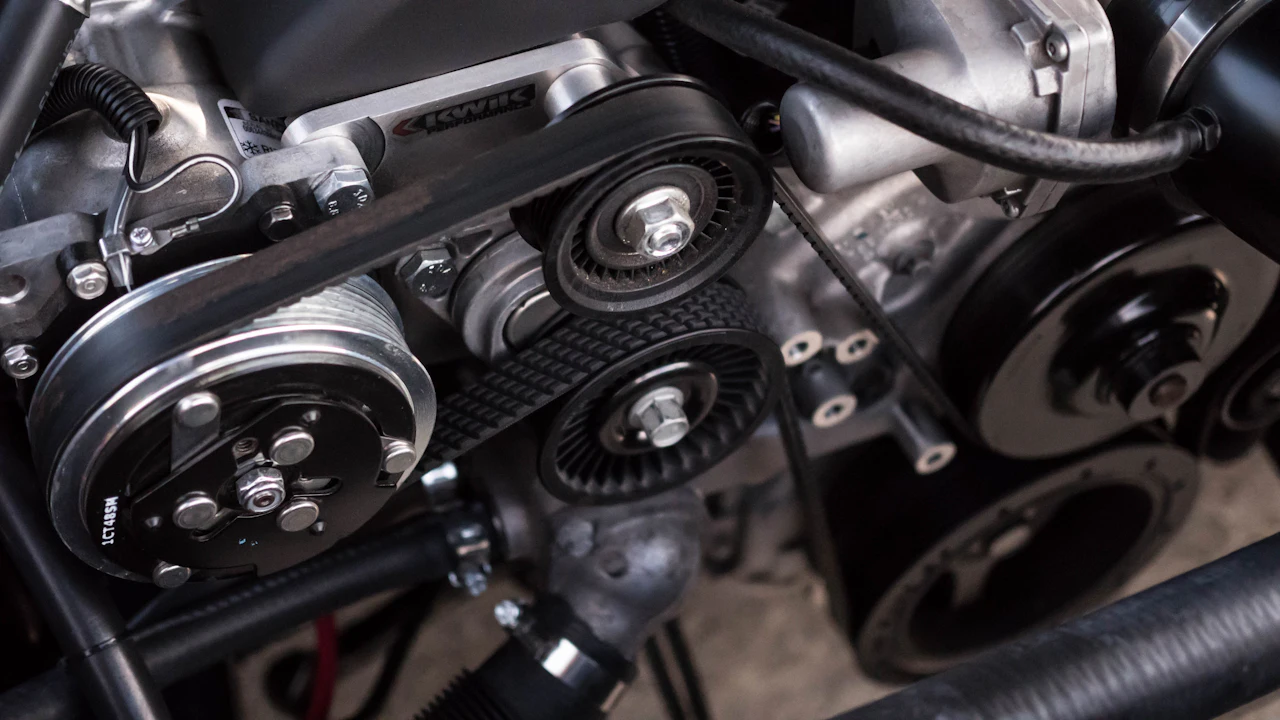
The short version
- Almost everything you would notice losing while moving — charging, cooling, steering assistance, cabin air — runs off one loop of ribbed rubber at the front of the engine. That is why a belt failure is never a single failure.
- A serpentine belt is not a timing belt, and the confusion is costly in both directions. One of them strands you at the roadside. The other, on an interference engine, can finish the engine.
- No service schedule gives this belt a mileage. Our own published interval table carries a timing belt line and no serpentine line at all, because it is a condition item — which only works if somebody looks, and almost nobody does.
- The tensioner and the idler pulleys wear on the same clock as the belt. Fitting a belt onto tired hardware is one of the more reliable ways to pay for the same labour twice.
- A slipping belt produces symptoms that get filed under three or four different systems, each with its own expensive suspect. A car that misbehaves in traffic on a hot day is often one fault wearing four disguises.
- This is one of the very few components a buyer can assess properly at a viewing, with no tools and nobody’s permission. A brand-new belt on a car with no other sign of maintenance is a question rather than a reassurance.
There is a class of car part that gets attention in proportion to what it costs rather than what it does, and the serpentine belt sits near the bottom of it. It is a loop of ribbed rubber. It is cheaper than most of the things it turns. Nothing on the dashboard is dedicated to it, no maintenance schedule assigns it a mileage, and the great majority of drivers have never deliberately looked at one.
What it is doing, meanwhile, is running most of the engine bay. Take it away and you do not lose a function; you lose a set of them, at once, at whatever speed you happened to be travelling. That is why a belt earns space on a site about buying cars rather than only in a workshop manual. One cheap component sits upstream of several systems that owners, buyers and quite often workshops treat as unrelated — diagnosed apart, quoted apart, worried about apart — and the belt is where all their symptoms meet.
Why one belt ended up doing all of it
Older engines did not work this way. They carried a small collection of V-belts, each running in a deep grooved pulley, each driving one accessory, each adjusted individually by slackening a bracket and levering the accessory outwards until the tension felt right. That arrangement had one accidental virtue: a broken belt took out one thing. Lose the belt to the air conditioning compressor and you had a hot car and nothing else.
The single flat multi-ribbed belt replaced all of that for reasons that had nothing to do with reliability. It is narrower and it wraps further round each pulley, so it transmits more power for its width. It can be routed in a snake around the front of a crowded transverse engine, driving some pulleys on its ribbed face and others on its smooth back, which is what allows the accessories to be packed into the space a modern engine bay leaves. And it is held by one automatic tensioner rather than by a series of adjustments that drifted out of specification and got skipped.
Every one of those is a real improvement. The cost of them is concentration. What used to be several independent drive paths is now one, and it is a single point of failure sitting in the most heat-soaked, dirt-exposed part of the car.
What it drives is not the same on every car
This is the part that gets flattened in most writing on the subject, and flattening it is how people end up with the wrong expectations about their own vehicle.
The alternator is on the belt on essentially every car with a combustion engine, and that connection is the one nobody argues about. Everything else varies.
The water pump may be on the accessory belt, or it may be driven by the timing belt or chain behind its cover, which changes the failure picture completely. On an engine where the pump lives on the accessory belt, a shredded belt stops the coolant moving and starts a clock. On an engine where the pump is driven off the camshaft drive, a lost accessory belt does not directly stop circulation, though a dead water pump on that layout is a far larger job when it does fail. Our guide to what an overheating engine is actually telling you works through the pump’s own failure modes and why one of them is invisible from outside.
Power steering is the variable that has changed fastest. A hydraulic rack needs a pump, and that pump is belt-driven. A car with electric assistance puts a motor on the steering column or on the rack itself and carries no pump anywhere, so the belt has nothing to do with the steering at all. Both layouts are common on cars a buyer is looking at today, and they behave completely differently when a belt goes. Assuming your car is the one you read about is how people end up surprised in either direction.
The air conditioning compressor is on the belt on almost every conventional car, driven through an electromagnetic clutch so that it can be engaged and disengaged. On hybrids and on a growing number of conventional cars the compressor is electric instead, so it keeps working with the engine off — and keeps working with the belt gone. Why a car’s air conditioning stops blowing cold covers what that compressor does and how it fails on its own terms.
Some engines add a belt-driven vacuum pump, which matters because on those the brake servo draws its assistance from the pump rather than from the intake manifold. Others run a second, separate belt for one accessory, which is a design detail that surprises people who have been told there is only ever one.
The useful takeaway is not the list. It is that the list has to be established for the specific car, and that a five-minute look under the bonnet answers it: follow the belt with your eyes and note what it wraps around. Everything it touches is a thing you will lose together.
The serpentine belt is not the timing belt
This is the single most consequential confusion in the subject, and it runs in both directions. People believe they have had a timing belt done when what they paid for was an accessory belt. People panic about an accessory belt as though it were a timing belt. Sellers say “the belt was done” without knowing which one they mean, and buyers accept it without asking.
The distinction is not subtle once you have it. They are in different places, they do different jobs, they are replaced on completely different logic, and their failures have almost nothing in common.
| Serpentine or accessory belt | Timing belt | |
|---|---|---|
| Where it lives | Outside the engine, on the front face, in plain view with the bonnet up | Behind a cover, running in a sealed and often oiled environment, frequently blocked by an engine mount |
| What it drives | The accessories — the things bolted to the outside of the engine | The camshafts, keeping the valves in step with the pistons |
| When it is replaced | On condition. No schedule assigns it a mileage | At a published interval, whether or not it looks worn |
| What its failure does | Stops the accessories. The engine keeps running until something else stops it | Lets the camshafts fall out of step with the crankshaft. The engine stops on the spot |
| Whether the engine survives | Yes, if you stop promptly | On an interference engine, frequently not |
| What the invoice looks like | A part, a modest labour line, sometimes a tensioner | Hours of labour, often a water pump, tensioners, idlers and seals on the same job |
| Whether every engine has one | Essentially yes | No — many engines use a chain, which has no interval |
The word doing the heavy lifting in that last-but-one row is interference. On an interference engine the valves and the pistons occupy the same space at different moments, and the belt is what guarantees they never want it at the same time. Remove the belt and they meet. What follows is bent valves at best, and at worst a cylinder head and a set of pistons. On a non-interference engine the same failure means the car stops and is towed, and the engine is unharmed once the belt is replaced. Which type an engine is depends on its design and is not something you can tell by looking at it.
This site keeps one published service table, and it puts the timing belt where it belongs: replaced somewhere between sixty thousand and a hundred and five thousand miles, with a note attached calling it non-negotiable on interference engines. The full table, and the reasoning behind every line in it, sits on our guide to what genuinely needs maintaining on a used car, which also explains how to establish whether a particular engine uses a belt or a chain.
What that table does not carry is a serpentine belt line, and the absence is deliberate rather than an oversight.
The question to ask a seller, in those words
“Which belt?” is a fair question and a revealing one. An owner who has had a timing belt done knows it, because the invoice was substantial and the car was in the workshop for the better part of a day. An owner who has had an accessory belt fitted usually describes it as a squeak that got fixed. If the answer is vague, ask for the paperwork rather than pressing the point — the two jobs produce documents that look nothing like each other, and the invoice settles in ten seconds what a conversation will not settle at all. On any car whose engine uses a timing belt, an undocumented belt is an assumption you would be buying, and it is the most expensive assumption available in a used car.
The maintenance item with no interval
Look down a manufacturer’s service schedule and you will find the accessory belt under a heading like inspect, with no replacement mileage against it. That is not laziness. It reflects something real about how these belts wear, and it has an unfortunate consequence.
Belt life is not governed by distance in any dependable way. It is governed by heat, by engine hours rather than road miles, by how many pulleys the belt has to bend around and in which directions, by whether the tensioner is still doing its job, by whether anything is leaking onto it, and by whether the pulleys are in the same plane as each other. A car that spends its life idling in traffic accumulates belt wear that its odometer never reports. A car that covers long motorway distances at a steady temperature accumulates far less per mile. Two identical cars with identical readings can have belts in completely different condition, which is exactly why nobody publishes a number.
The material changed too, and it changed what wear looks like. Older belts were made of a rubber that hardened and cracked with age, so a worn belt announced itself with a visible pattern of cracks across the ribs. Most belts fitted to cars built this century use a synthetic rubber that resists cracking very well and instead wears by slowly losing material from the ribs. The ribs get shallower, the belt sits deeper in the pulley grooves, and the contact geometry that makes it grip degrades. A belt in that condition can look almost new to an untrained eye and still slip under load. Manufacturers publish small gauges for measuring rib depth for exactly this reason, and a workshop that owns one is a workshop that has thought about the problem.
So the honest position is that a serpentine belt is replaced when inspection says so. The trouble is the second half of that sentence. Inspection only happens if somebody inspects, and a component with no interval attached does not appear on a service menu, does not generate a reminder, does not get quoted for, and does not get billed. In practice a great many belts are replaced when they fail, or when they are noticed during a job that has the front of the engine open anyway.
For a buyer, that produces a specific and useful conclusion. You cannot infer belt condition from a service history, however thick the folder is, because the belt was never on the list that generated those stamps. The service book tells you about oil and filters. It tells you nothing about the belt. The only evidence available is the belt itself, which is fortunate, because the belt is right there and you are allowed to look at it.
The tensioner, the idlers, and a false economy
A serpentine belt does not tension itself, and the assembly that tensions it is the part most likely to be left out of the conversation.
The automatic tensioner is a spring-loaded arm carrying a pulley, pressed against the belt with a designed force. It does two jobs. The obvious one is taking up slack, so that a belt which stretches slightly over its life stays gripping and nobody has to adjust anything. The less obvious one is damping. A combustion engine does not deliver smooth rotation; it delivers a series of impulses, and those impulses travel into the belt as a rapid flutter. The tensioner absorbs them. Without that damping, the belt oscillates against the pulleys, which is both noisy and destructive.
Tensioners wear in several ways. The spring weakens, so the belt runs slacker than intended and slips under load. The internal damping fails while the spring is still fine, so the arm stops resisting movement and starts flapping. The pivot bushing wears, so the pulley no longer sits square to the belt. And the pulley bearing itself dries out and gets noisy, then rough, then eventually seizes.
Idler pulleys are simpler. They are wheels on bearings whose only job is to route the belt round obstacles and increase the wrap on the pulleys that matter. They have exactly one failure mode, which is the bearing, and they announce it with noise long before they seize. A seized idler destroys a belt in seconds, because a belt being dragged across a stationary pulley does not survive the experience.
Why fitting a belt alone is often the expensive option
The parts on a serpentine drive are not close in price to each other, but the labour is shared entirely. Everything on that drive is reached by removing the same panels, the same liner, sometimes the same mount, and by releasing the same tensioner. Once the belt is off, the tensioner and the idlers are minutes away.
Fit a belt onto a tired tensioner and two things happen. The first is that the new belt often squeals anyway, because the noise was never the belt — it was a belt not being pressed hard enough onto the pulleys. The owner then concludes the new belt is faulty, which it is not. The second is that when the tensioner is finally replaced, the whole access job is paid for again, and on a car where reaching the belt means removing a wheel, a liner and possibly an engine mount, that access job is most of the bill.
There is a mirror image of this that a buyer should recognise. Our page on what actually sets the cost of an alternator replacement makes the same argument from the other end: when an accessory is being renewed, the drive hardware is already exposed, and a shop that leaves it untouched has quietly handed the next owner a second visit. The reasoning is identical whichever component started the job. Whoever has the front of the engine open should be looking at everything the belt touches.
What to read on an invoice. A receipt that lists only a belt is a receipt for a belt. A receipt that lists a belt, a tensioner assembly and one or two idler pulleys is a receipt for a job somebody thought about. Neither document settles anything by itself. Between two otherwise similar cars, though, the second one tells you more about the standard of work the vehicle has had than any number of oil-change stamps.
What a failing belt sounds like, and what it looks like
Belt noise is one of the more diagnosable sounds on a car, because the four common causes produce four fairly distinct noises with four different triggers. Organising them by cause rather than by sound is what makes them separable.
Slip: the noise that answers to load
Slip happens when the belt is not gripping hard enough to transmit the torque being asked of it, and it produces a squeal — high, sustained, unmistakably rubber. Its defining property is that it responds to load. Cold mornings bring it on, and damp cold mornings bring it on hardest, because condensation on the pulley faces briefly reduces the friction available. It fades as the bay warms and dries. It comes back if you ask for a big load at once: air conditioning switched on, headlights and heated screen together, or the steering held at full lock on a hydraulic rack.
The causes of slip are a glazed belt face, a weak tensioner, a contaminated pulley, or a belt whose ribs have worn down enough to bottom out in the grooves. Note that a glazed belt is usually evidence of previous slipping rather than the original cause, which is why fitting a new belt to a car with a tired tensioner buys a few months of quiet and no more.
Misalignment: the noise that keeps time
A chirp is a different animal. It is short, repetitive and rhythmic, and it keeps time with rotation rather than swelling and fading with load. Its usual cause is misalignment — a pulley that is not in the same plane as the others, so the belt is dragged sideways as it enters and leaves it. That happens after a bracket has been disturbed, after a pulley has been fitted slightly proud, or after a bearing has worn enough to let a pulley lean.
Misalignment is worth catching because it is a belt-eater. A misaligned drive will destroy a new belt at a rate that convinces people they have been sold bad parts, and it leaves a signature: fraying along one edge of the belt, and often a fine black dust deposited below the pulley that is doing the damage.
Bearings: the noise that tracks the engine
A dry bearing in an idler, a tensioner pulley or an accessory produces a whine or a growl whose pitch is tied to the revs and unmoved by anything you switch on. It is there at idle in a quiet car park, and it climbs when you blip the throttle. Finding which bearing is making it is a job for somebody with a stethoscope and the engine running, and it is not something to attempt in a stranger’s driveway.
What matters to a buyer is what that noise means about risk rather than about cost. A bearing that is audible is a bearing that is on its way to seizing, and a seizure at the front of the engine shreds the belt in a moment. The noise is therefore a warning about the whole drive, not just about the component making it.
Damping loss: the rattle
A tensioner that has lost its damping rattles or knocks at idle, and is often at its most obvious in the second or two after the engine is switched off, as the drive winds down through the resonance the damping was there to suppress. On some cars the arm can be seen visibly jumping at idle rather than sitting steady, which is as clear a diagnosis as this subject offers.
The visual check, in order
With the engine off and cool, the belt tells you a good deal.
- Cracks across the ribs. The classic sign, and still valid on older belts. Cracks running across the direction of travel, spread along the length, mean the material has hardened past its useful life.
- Glazing. The flanks of the ribs polished to a shine and hard to the touch. A glazed belt has been slipping. Look for the cause as well as replacing the belt.
- Chunking. Pieces missing from the rib valleys, or a rib partly detached. This is fatigue, and it is terminal.
- Fraying at an edge. The signature of a belt being dragged sideways. Misalignment until proven otherwise.
- Rib depth. The modern failure, and the one you cannot see. If a belt looks clean but the car squeals under load and nothing else explains it, worn ribs are a live candidate.
- Contamination. Oil, coolant or steering fluid on a belt destroys it, and swells it besides. A wet belt is a symptom of something else that needs finding first, because a new belt fitted into the same drip will go the same way.
- Deposits in the pulley grooves. A build-up of rubber in the grooves, or a line of black dust on whatever sits below the belt path, means material is coming off the belt somewhere.
- Where it sits. Every rib should sit in a groove, and the belt should be centred on each pulley. A belt riding a groove off, or standing proud at one edge, is a belt that is going to fail.
Why belt symptoms get billed to other systems
Here is the part that makes this component worth a page of its own. A belt that has stopped gripping properly does not produce a belt-shaped complaint. It produces a weak version of a failure in each of the things it drives, and each of those has a well-known and considerably more expensive suspect attached to it.
Take them one at a time.
Charging. A belt slipping under electrical load means the alternator is turning more slowly than the engine thinks it is. The result is dim or pulsing lights at idle, a battery warning lamp that flickers when the load goes on, and a battery that is never quite full at the end of a week. Every one of those is a textbook description of a failing alternator, and it is entirely possible to buy an alternator and discover the symptom is still there. The charging system page sets out the tests that separate the two, and they take minutes.
Cooling. On an engine whose water pump is on the accessory belt, slip means reduced coolant flow. The gauge creeps up in traffic and recovers on the move, the heater goes lukewarm at idle, and the whole picture points at a lazy fan or a thermostat. Both of those are real faults with the same presentation, and both get replaced on cars whose actual problem was tension.
Air conditioning. The compressor is the heaviest single load on the belt, and it is switched on abruptly by a clutch. A marginal belt is often fine until that moment. A system that cools well on the move and poorly at idle on a hot day looks exactly like a system short of refrigerant, which is what it will usually be topped up for.
Steering. On a hydraulic rack, the heaviest demand comes at parking speeds with the wheel near full lock. A slipping belt gives steering that is fine on the road and goes heavy in a manoeuvre, sometimes with a groan. That reads as a failing pump or a tired rack.
Now put them together, because this is the situation that actually walks into workshops. A hot day. Stationary traffic. Air conditioning on maximum, lights on, blower on full, engine at idle so the belt is turning at its slowest and the tensioner is doing its hardest work. Everything on the drive is asking for its worst-case load at the same moment, and a belt that has lost its grip fails all of them simultaneously.
What the driver reports is that the car did four odd things at once, which sounds like a car falling apart. What is actually in front of them is a single component that costs less than any of the four suspects. It is not always the belt, and this is not an argument for assuming that it is. It is an argument for checking the cheapest, most accessible, most easily inspected item on the list before anybody quotes for the rest of it.
What happens when it actually lets go
A belt rarely stretches gently to the end of its life. Two things end it. Either it fatigues and comes apart, shedding ribs and then splitting, or something it wraps around seizes and tears it off in an instant.
The next few seconds are worth understanding, because how you react decides how much this costs.
The steering changes first, and it is the most alarming. On a car with hydraulic assistance, the pump stops and the effort at the wheel rises sharply. The car has not lost its steering — the mechanical connection is untouched and the car remains steerable — but at low speed the effort required is far higher than anything you have practised. At motorway speed the difference is much smaller. It is the manoeuvre into a lay-by that surprises people, not the moment of failure itself.
The charging stops. From that moment every electrical demand is being paid for out of the battery, and how far that gets you depends entirely on what is switched on. Headlights, a blower and a heated screen shorten it dramatically. This is the failure with the most warning, because a battery telltale will illuminate and stay on.
If the water pump was on that belt, a clock starts. This is the expensive one, and it is why the correct response is to stop rather than to press on to somewhere convenient. Coolant stops circulating, the temperature gauge climbs quickly, and continuing turns a modest job into a cylinder head or worse. If the gauge is rising, the argument is over. Our page on what to do when the temperature gauge climbs covers what happens next and what not to do to a hot cooling system.
Braking usually continues normally, with one exception. On most petrol engines the brake servo takes its vacuum from the intake manifold, so assistance continues while the engine runs. Where an engine uses a belt-driven vacuum pump, assistance goes with the belt, and the pedal becomes hard and long. Either way, once the engine stops, the servo has only its stored vacuum left.
There is also a mess to consider. A belt that comes apart at speed does not fall neatly to the road. It whips around inside a crowded engine bay, and it can take wiring, hoses, plastic shielding or a sensor with it. On some layouts, debris can be dragged behind the crankshaft pulley, which is somewhere no rubber is meant to be. That is one more reason the difference between stopping immediately and driving another few miles is a real difference in what the repair involves.
What to do if it goes while you are driving
Expect the wheel to become heavy, and expect it to be at its heaviest when you slow down. Choose somewhere to stop early rather than late, and steer with the extra effort in mind rather than being surprised by it at the last turn. Switch off every electrical load you do not need. Watch the temperature gauge above everything else — if it moves, stop where you are rather than continuing to a better spot. Then get it recovered instead of driving it. The temptation to nurse a car home is where most of the avoidable cost in this failure lives.
What sets the bill, and why we print no number
Our position on printed repair prices is consistent across this site and it applies with unusual force here: a number set down in print keeps its air of authority for years after the number itself has moved, and nothing on the page tells the reader it has aged. Regions differ. Shop rates differ. The parts market for this component alone runs from a supermarket own-brand to the manufacturer’s own.
The stronger reason is specific to this job. Almost none of the variation is in the part. It is in the car. The same belt can be a fifteen-minute exchange on one engine and half a day on another, and no published range communicates that. What follows is what actually moves the number, all of it establishable on a specific vehicle before anybody quotes.
| Driver | Why it moves the bill | How to establish it |
|---|---|---|
| Access to the belt | Reachable from above on some engines. On many transverse layouts it means the wheel off, the liner out, and occasionally an engine mount supported and dropped | Open the bonnet and try to trace the belt all the way round. If you lose it behind something, that is the answer |
| Whether the tensioner and idlers are included | The labour is shared, so adding them to the same visit is far cheaper than a second one. Their absence from a quote is a choice somebody made | Ask what is on the quote by name, not by category |
| How many belts there are | Some engines still run a second belt for one accessory, and it is easy for one of them to be quoted and the other forgotten | Count them while the bonnet is open |
| What has to come off first | On crowded engine bays the belt sits behind a mount, a bracket, a pipe or a cover, and the removal of that is the job rather than a preliminary to it | Ask what the labour time actually covers |
| Whether the water pump is on this belt | If it is, and the pump is suspect, doing both while the drive is apart is the sensible order rather than an upsell | Trace the belt to the pump pulley, or ask |
| Whether it failed or was replaced in time | A belt replaced before it broke is a belt. A belt that came apart may have taken a hose, a wire, a shield or a sensor with it | Ask whether the old belt broke or was changed on inspection |
| Whether anybody found the cause | A belt that failed early failed for a reason — alignment, a bearing, a leak. Replacing it without finding that is a repair with a rerun booked in | Ask what was found, not what was fitted |
Read down that column of questions and notice how few of them a workshop can refuse to answer, and how many of them a buyer can answer alone with the bonnet up. That is the whole argument for not printing a range. A range hides which end of it a particular car sits at, and on this repair the two ends are not close together.
Three systems, one belt, and what the complaint file can say
We keep an archived pull of the complaints owners file with the federal safety regulator, and it is worth being blunt about how it relates to this subject before touching it: there is no belt category in it. None. The regulator does not file complaints under “serpentine belt”, and no figure below is attributed to a belt by anybody.
What the archive does have is categories for three of the systems this belt drives, and where their complaints land in a vehicle’s life is a genuinely interesting thing to look at side by side.
| System the belt turns | Midpoint of the readings | Readings behind it |
|---|---|---|
| Electrical system | 49,000 miles | 145 |
| Steering | 64,000 miles | 84 |
| Engine and engine cooling | 98,000 miles | 97 |
| Every category in the file | 60,000 miles |
Three points about that table, in order of how easy they are to get wrong.
The first is the one already made and worth making twice: not one of those readings is known to involve a belt. An owner who lost charging files under the electrical system whether the cause was the alternator, a corroded cable or the belt that turns it, and nothing in the record separates them. These are the categories the belt sits upstream of, which is not the same claim as saying the belt caused any of them.
The second is that the spread is real and the ordering is safe to reason from, because every category came out of one pull and is censored the same way. Electrical complaints reach the threshold of a federal filing early, well before the file’s overall midpoint of 60,000 miles. Steering follows. Cooling arrives late, at 98,000 miles.
The third is the one that speaks to this page. A single component sits upstream of three categories whose problems surface at three quite different points in a car’s life. That is precisely the shape of a fault that never gets recognised as one fault. There is no mileage at which “the belt” appears in this data, and there never will be, because the data has nowhere to put it. The symptoms are distributed across three headings, arriving at different times, each with a more obvious explanation waiting for it.
Which brings the argument back where it started. This is a maintenance item people should care about and generally do not, and the reason is not that it is obscure. It is that its consequences are always filed under something else.
Checking a belt at a viewing
Very little about a used car can be assessed properly in a car park. This can. It needs no tools, no lift, no seller cooperation beyond permission to open the bonnet, and it takes a couple of minutes. It is one of the highest-value free checks available to a buyer, mostly because nobody bothers to stage it.
Engine off, and cool
Everything in the first part of this list happens with the engine switched off, the key out, and the engine cool enough to touch. A running engine bay with an exposed belt drive in it is genuinely dangerous, and a belt does not need much of a sleeve or a cuff to take hold of. Nothing on this page is worth an injury.
With the engine off
- Find it and follow it. On a transverse engine the belt runs on the face nearest one wing; on a longitudinal engine it is at the front, behind the fan. Trace the whole route with your eyes and note each pulley it wraps. That single act tells you which systems this particular car loses together.
- Look at the ribbed face. Cracks across the ribs, a polished glaze on the rib flanks, chunks missing from the valleys. Use a phone torch; the belt is usually in shadow.
- Look at the smooth back face. It runs over the idlers and it cracks too, and it is the half nobody checks.
- Run a fingertip along both edges. Fraying on one side is misalignment, and misalignment is a finding about the drive rather than about the belt.
- Check the seating. Every rib in a groove, the belt centred on each pulley, nothing standing proud at an edge.
- Look for fluid. Anything wet on or near the belt path matters, and what it is matters more. Coolant, engine oil and steering fluid all attack a belt, and all of them mean a second problem to find.
- Look underneath the belt path. Black rubber dust on a shield, a subframe or a mount below the drive means material is being shed.
- Look at the tensioner. Note where the arm is sitting. Some carry a cast index mark showing the working range, and an arm sitting at the end of its travel is telling you the belt has stretched or the wrong one is fitted.
Then the cold start
Tell the seller beforehand that you would rather find the car standing, then turn up when you said you would. The first start of the day is where a belt drive gives up most of its evidence, and a pre-warmed engine has already thrown that evidence away. This is the same reason the cold start matters for half a dozen other checks, which our page on what a car tells you at the moment of starting works through in order.
- Listen to the first few seconds. A squeal that appears at start and fades as the bay warms is the single most common belt-drive symptom there is.
- Watch the tensioner arm at idle. Steady is right. Visibly bouncing is not.
- Then load it up. Air conditioning on maximum, blower to full, headlights on, heated rear screen on. Any noise that arrives with the load is a grip problem, not a coincidence.
- On a hydraulic rack, turn the wheel. Take it towards full lock briefly while stationary and listen. Do not hold it hard against the stop; there is nothing to learn there and it is unkind to the pump.
- Listen for what ignores the load. A noise that follows the revs and is deaf to every switch you press is a bearing, and that is the finding which belongs on an inspection brief.
Nothing in that amounts to a diagnosis, and none of it is trying to. All you are settling is whether the accessory drive earns a line on the brief for an independent pre-purchase inspection, where a stethoscope and a rib gauge resolve in ten minutes what you can only suspect while standing beside a wing.
A brand-new belt on a car with nothing else done
Sellers point out a new belt expecting it to be received as good news, and quite often it is. It is also one of the more informative discoveries available on a used car, less for what it is than for what tends to be true around it.
There are three stories behind a recently fitted belt, and they are not equally common.
It was replaced as part of proper maintenance. Somebody looked, did not like what they saw, and changed it. On a car with a coherent service history and other work of a similar vintage, this is entirely believable and reflects well on the previous owner. The tell is that it does not stand alone.
It squealed, and the belt was the cheapest available answer. This is by far the most common version, and it is not dishonest. A squeal is annoying. A belt is cheap. Fitting one usually quietens the car for a while, because a new belt with sharp ribs grips a slack tensioner better than a glazed one did. Then the squeal returns, on the same tensioner, some months later — potentially after the car has changed hands. The car has not been repaired; it has been quietened.
The previous belt was destroyed by something that is still there. A leak dripping onto it, a misaligned pulley chewing its edge, a bearing that has not yet seized. A new belt fitted into an unchanged situation has the same future the old one had, only starting later.
None of those is visible from the belt itself, which is why the useful move is a question rather than an inspection. Ask why it was replaced. Ask whether the tensioner went with it. Ask to see the invoice, and read what is on it by name.
The wider signal matters as much as the specific answer. A new belt on a car that is otherwise plainly overdue — tyres at the wear indicators, a service book with a gap in it, an engine bay that has not been touched in years — is a component that was addressed because it made a noise, not because the car was being maintained. That is a fact about the owner rather than about the belt, and it is worth more to you than the belt is. Where paperwork stops, records take over: a background check against the vehicle’s number reaches into a history that no amount of staring at an engine bay could ever reconstruct.
The inverse deserves saying too. A car whose whole accessory drive was renewed as a set — belt, tensioner, idlers, on one invoice, on one day — is unusual, and it is unusual in the direction you want. Very few people spend money on the parts that were not making the noise.
Putting it into the decision
A belt should not, by itself, end your interest in a car. It is among the cheaper items on the vehicle, its cost has a ceiling, and every car needs one eventually. Treating it as a deal-breaker would be daft.
What it offers instead is a small, reliable, unstaged read on two things at once: whether the car is about to need work at the front of the engine, and what standard of care it has had generally. Very few components give you both, and almost none of them are visible from where you are standing.
- Trace the belt with the bonnet up and note every pulley it wraps. That is your list of what this car loses together.
- Establish which belt any “belt was done” claim refers to, and ask for the invoice rather than debating it.
- Check both faces of the belt, both edges, and how it sits in every pulley groove.
- Look for fluid on the belt path and rubber dust below it.
- Insist on a cold start, and listen through the first few seconds before anyone talks.
- Load the car up — air conditioning, blower, lights, screen heater — and listen again.
- If the belt is new, ask why, and ask whether the tensioner and idlers went with it.
- Put any bearing noise on the inspection list rather than trying to place it yourself.
Keep it in proportion at the end of all that. The belt is a foreseeable, bounded, ordinary cost, and the reason to look at it is not the belt. It is that a car which has never had anyone look at its accessory drive has usually never had anyone look at anything else either, and that the same belt sitting quietly at the front of the engine is the common cause behind several bills a buyer might otherwise budget for separately.
The risks with no ceiling on them are never the consumables. They are whatever happened to this particular vehicle in the years before you laid eyes on it, and none of that leaves a mark on a piece of rubber. It sits in records instead, which is why it is worth the few minutes to pull the car’s recorded history while the price is still open.
The other belt gets its own guide, because the consequence of ignoring it is categorically different: timing belt replacement covers interference engines, the belt-versus-chain question, and how to establish whether the job was ever done on a car you are considering.
Common questions
What is the difference between a serpentine belt and a timing belt?
They share a word and very little else. The serpentine belt runs on the outside of the engine and drives the accessories bolted to it — the alternator, and depending on the car the water pump, the steering pump and the air conditioning compressor. The timing belt runs behind a cover and keeps the camshafts turning in step with the crankshaft, which is what stops the valves and the pistons meeting. A broken serpentine belt strands you and the engine survives. A broken timing belt on an interference engine can destroy the engine. Many engines use a chain for the timing job instead, which has no replacement interval at all.
How often should a serpentine belt be replaced?
There is no mileage, and anyone who gives you one is guessing. It is a condition item, which is why our own published service table has a line for the timing belt and no line for this one. Belt life depends on heat, on engine hours rather than distance, on the state of the tensioner, on pulley alignment, and on whether anything has been leaking onto it. The practical answer is that it should be inspected whenever the front of the engine is open for any other reason, and looked at deliberately by anyone buying the car.
Can I drive with a broken serpentine belt?
Not usefully, and on many cars not safely. The charging stops, so the car is running on stored battery charge and will eventually stop wherever it happens to be. On a car with hydraulic steering the effort at the wheel rises sharply, most noticeably at low speed. And if the water pump is driven by that belt, coolant stops circulating and the engine will overheat quickly — which converts an inexpensive job into a serious one. The right response is to pull over promptly, keep an eye on the temperature gauge above everything else, and call for recovery instead of pressing on.
Why does the belt squeal when I start the car in the morning?
Because it is slipping, and cold damp pulleys give it less to grip. That much is straightforward. The question worth asking is why it has so little grip to spare, and there are four usual answers: the belt’s face has glazed, its ribs have worn shallow, the tensioner has weakened, or something has contaminated a pulley. Only the first two are fixed by a new belt. A squeal that returns a few months after a belt was fitted is telling you the cause was one of the other two.
Do I have to replace the tensioner at the same time?
Not always, but the sums usually favour it and the reason is the labour rather than the part. Everything on that drive is reached the same way, so a tensioner fitted alongside the belt costs the access job once, and a tensioner fitted later costs it twice. On a car where the belt is reached from above in minutes, the calculation is closer. On a car where it means a wheel, a liner and possibly a mount, it is not close at all. There is also the practical point that a new belt on a weak tensioner often squeals anyway, which convinces people the new part was faulty.
Should a new belt make me more confident about a used car?
Only in company. Fitted as ordinary maintenance, alongside other work of a similar vintage, it counts for something. Fitted on its own to silence a squeal, on a car that is otherwise overdue for everything, it tells you the noise was addressed rather than the car being maintained — and the underlying cause is very likely still fitted. Ask why it was changed, ask whether the tensioner and idlers went with it, and ask for the invoice. A document naming the tensioner is a different document from one naming a belt.
What does the federal complaint data tell me about belts?
Directly, nothing, and it matters to say so rather than to imply otherwise. There is no belt category in that archive at all, so no reading in it is attributed to a belt by anybody. What it does hold are categories for three systems the belt drives, and their midpoints sit a long way apart: electrical system complaints at 49,000 miles, steering at 64,000, and cooling complaints arriving last of all at 98,000, against a whole-file midpoint of 60,000. That spread is the useful part, and not as a measurement of belt life. It shows how far apart the consequences of one component can land, which is exactly why a belt fault gets diagnosed as three separate problems.
Sources and further reading
- NHTSA Office of Defects Investigation complaint database
- NHTSA recall lookup
- FTC used car buying guide
Recall, complaint and safety-rating figures on this page were retrieved from the federal databases above on August 19, 2026. Federal data changes — re-check any VIN before you rely on it.
Published August 28, 2026 · last updated August 28, 2026. Found something out of date or wrong? Tell us and we will correct it.