Autopay Auto Refinance: How It Works, Its Fees and Its Record
Autopay brokers car refinances for The Savings Group, RateGenius’s parent. Its fees, limits, rate and savings claims read against its own terms and footnotes, plus the complaint file and a 2018 California order.
The short version
- Autopay (autopay.com) is a refinance broker, not usually your lender: “In most cases, we are not the lender or affiliated with the lender,” its terms say. The APR and fees come from whichever lender approves you.
- Autopay belongs to The Savings Group, Inc., which also owns RateGenius and Tresl. They share one privacy policy and one set of terms, and Autopay’s rate table averages “rateGenius’ lender network.” Neither files annual reports with the SEC.
- Autopay says it charges no application fee, but its legal page says “Title filing/lien transfer fees apply” and an origination fee may apply by state. No page we read prints an amount for either.
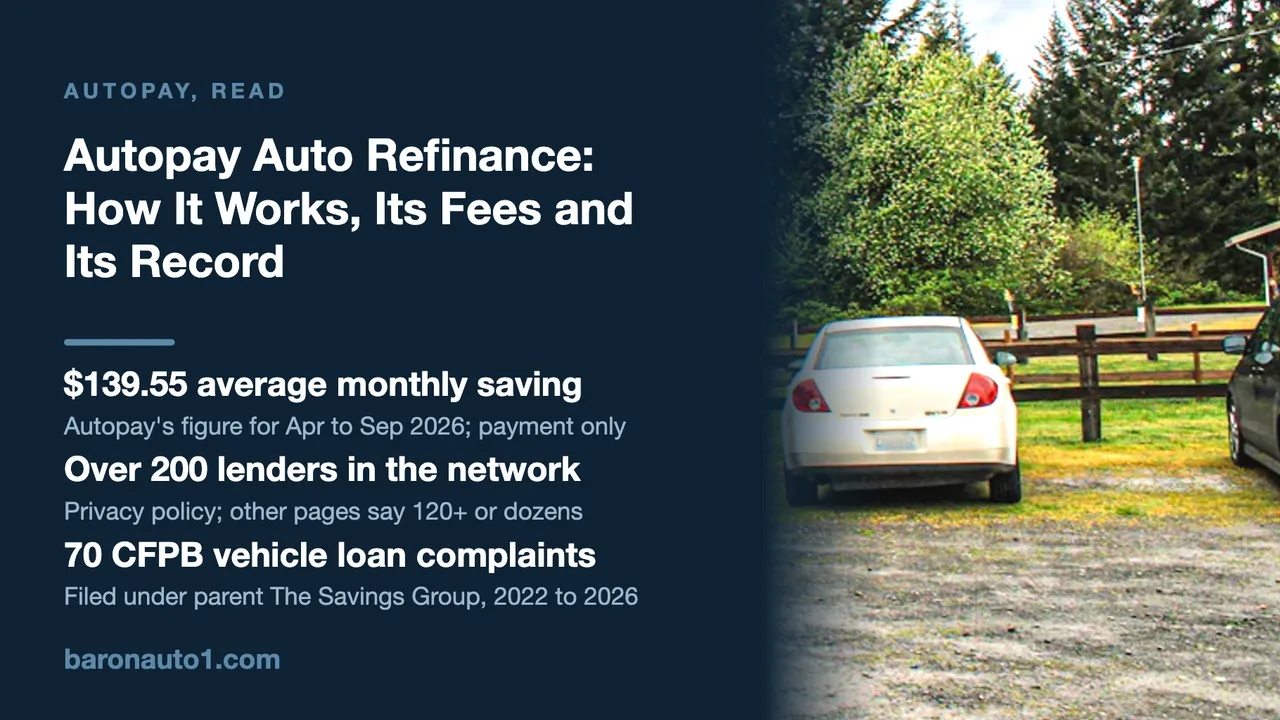
- The headline saving, $139.55 a month or $1,674.60 a year, is a payment average for 1 April to 30 September 2026. Autopay’s own disclaimer says a lower payment can come from “a longer term” and you “may pay more in interest.”
- Autopay’s pages disagree on basics: $2,500 to $100,000 loans in the FAQ but a $10,000 to $55,000 balance on the rates page, and “dozens,” 120+, over 200 or “hundreds” of lenders.
- The CFPB file holds 146 complaints naming The Savings Group, 70 of them about vehicle loans. In 2018 California’s regulator reached a consent order with RateGenius, Inc. that included $233,352 in GAP waiver refunds; RateGenius disagreed with the findings.
Autopay is an auto refinance marketplace: you apply once, it matches you to lenders in its network, and the lender that approves you makes the loan while Autopay handles the paperwork and the payoff. On 6 October 2026 we read Autopay’s Terms of Use, legal page, privacy policy, FAQ, rates page and its refinance, cash-out, lease buyout, service contract and GAP pages, plus its 2017 SEC filing, the 2021 merger release, a 2018 California consent order and the CFPB complaint file. We started no application, so there is no personal rate here; this site has no commercial relationship with Autopay or any lender.
This page is about the company Autopay, which prints its name AUTOPAY: not the “AutoPay” automatic-payment feature many lenders offer, and not AC Autopay, LLC, a separate Denver lender covered below.
What Autopay is: a broker that is usually not your lender
Autopay’s Terms of Use describe the business plainly: “We operate a technology driven loan and product matching system whereby consumers are able to apply to finance, purchase or refinance their vehicles and be considered by multiple lenders who may offer credit and options for ancillary products related to the loan or vehicle.” Autopay also provides “origination fulfillment services for approved loan offers including, but not limited to, communication of the offer, documentation collection and preparation, and lien perfection.”
The key sentence follows: “In most cases, we are not the lender or affiliated with the lender, however, we may offer loans in certain states through a licensed subsidiary.” The same terms name that subsidiary in a state notice: “RGLS Lending, Inc. (2285557) will originate loans with interest rates ranging from 2% to 36%” for Montana residents. So most borrowers get a loan from an outside bank, credit union or finance company, and a few may get one from a lender owned by Autopay’s parent. Ask which it is before you sign.
The licenses page lists one company and two licenses: “AutoPay Direct, Inc.,” NMLS 2252934, and an Oregon Consumer Finance License with the same number. The legal page adds that the group “operates pursuant to licenses in jurisdictions where its activities require licensing” and that “All lenders in the TSG network are FDIC-insured banks, credit unions or licensed lenders.”
The name causes two kinds of confusion. Lenders use “autopay” for automatic payments, and Autopay’s refinance page says some offer “a rate discount if you set up automatic payments from a savings account.” That is a lender feature, not Autopay. And AC Autopay, LLC, whose website lists NMLS 2323313, says “We provide consumers with loans to finance, purchase or refinance their vehicles” and defines “we” as AC AutoPay, LLC alone. Nothing we read ties the two together, so we treat them as separate companies.
Who owns Autopay: The Savings Group, RateGenius and Tresl
Autopay’s terms define “we” as “The Savings Group, Inc. and the companies in which The Savings Group, Inc. directly or indirectly owns a majority interest,” naming “AUTOPAY Direct, Inc. d/b/a AUTOPAY, RateGenius Loan Services, Inc. d/b/a RateGenius, Innovative Funding Services Corporation d/b/a Tresl.” The parent’s own site calls them its “three premium consumer brands, AUTOPAY, RateGenius and Tresl.” The group is based in Austin, Texas and Denver, Colorado.
The group was formed by a merger. RateGenius’s release of 19 July 2021 says that “Upon closing this all-stock merger of equals, the two companies became operating units of The Savings Group,” led by “Co-CEOs and AUTOPAY Co-Founders.” It names the owners at the time: “AUTOPAY is a portfolio company of FM Capital, while RateGenius is a portfolio company of Tritium Partners.” It also claimed “180+ lenders representing all 50 states” and more than 550 employees, and projected over $2 billion in financing in 2021. We read no later document on who owns the group now.
So Autopay against RateGenius is not a comparison of rivals: they are two storefronts with one privacy policy, one set of terms and, on Autopay’s own rates page, one lender network. Our RateGenius review reads that brand’s pages; our Caribou review covers a marketplace outside the group.
Autopay is private, and so is its parent. An EDGAR company search on 6 October 2026 found no filer named The Savings Group. It found AUTOPAY Direct, Inc. (CIK 1697138), whose only filing is a Form D of 3 February 2017. That notice of a private offering shows a Delaware corporation incorporated in 2016 that had sold $6,000,000 of a $9,000,000 offering of equity and debt to one investor, with the first sale on 20 January 2017. A Form D is a short exemption notice, not an annual report, so there are no audited figures on Autopay to read.
Its lenders, how it is paid, and the fees you pay
No Autopay page we read names a single lender. The FAQ says Autopay “partners with a network of trusted credit unions and financing institutions across the country,” each with “a different set of criteria for approvals.” The size of the network depends on which page you read: “dozens of trusted lenders” on one landing page, “120+ lenders” on another, “over 200 financial institutions” in the privacy policy and “hundreds of lending partners” on a comparison page.
The privacy policy explains where an application goes: “Your personal data is not sent to each lender in our network for review. Instead, your credit profile and needs are matched to the borrower profile established by our lenders and sent to those lenders first.” If an offer comes from a credit union, see our credit union auto loan rates guide on membership.
How lenders pay Autopay is not stated on any Autopay page we read. The parent’s site describes its customers on both sides: it helps consumers “while providing lenders with access to a reliable pipeline of qualified loan applicants.” The clearest public description of the model is about the sister brand. California’s 2018 consent order with RateGenius, Inc. records the regulator’s finding that “RateGenius’s lending partners pay a referral fee to RateGenius if a loan is made to a borrower through the RateGenius Platform.” That describes RateGenius before the merger, not Autopay today, but it is the same business model under what is now the same parent.
On what you pay, the refinance page says: “We don’t charge an application fee, and you’ll see all disclosures before signing.” The legal page adds: “Title filing/lien transfer fees apply. Depending on your state of residence, a loan origination fee may apply.” Autopay’s April 2026 blog post on refinance fees warns that some lenders “charge document processing fees or administrative costs during the refinancing process, which can vary in amount and may be rolled into the loan,” and that rolled-in fees mean “interest accrues on them over time.” Google’s AI overview for “autopay refinance” listed “Processing fees: Up to $450 from some lenders,” citing NerdWallet and an Autopay landing page; the figure is on no Autopay page we read.
Get every fee in dollars before you sign. Autopay prints that title and lien fees apply and that an origination fee may apply, but no amounts. Ask for the amount financed, each fee and whether it is rolled into the new loan, then compare the total of payments with what you owe now.
One more money flow: Autopay’s referral page says “Every referral you send our way can earn you $100!” once the loan funds.
Who and what qualifies
Autopay prints its limits in three places, and they do not line up. The rates page box, under “Does your vehicle qualify for refinancing?”, lists a car “Under 10 years old,” “Under 120,000 miles” and “A personal use vehicle,” and a loan with “A balance between $10,000 and $55,000,” “Funded at least 1 month ago” and “At least 24 months of payments left.” The FAQ says: “We offer loan amounts from $2,500 to $100,000” and “We can offer terms from 24 months to 96 months for qualified applicants.”
| Limit | What Autopay prints | Where |
|---|---|---|
| Car age and mileage | Under 10 years old, under 120,000 miles, personal use | Rates page |
| Loan balance | Between $10,000 and $55,000 | Rates page |
| Loan amount | From $2,500 to $100,000 | FAQ |
| Loan age and term left | Funded at least 1 month ago; at least 24 months of payments left | Rates page |
| New loan term | From 24 to 96 months “for qualified applicants” | FAQ |
| Cash out | Up to $12,000, “depending on your loan-to-value ratio and lender eligibility” | Refinance page |
| Credit score | No minimum printed; the rate table runs down to a 0-639 band | Rates page, FAQ |
| Income, debt and loan-to-value | “Customers must meet income qualifications, debt to income requirements and other vehicle restrictions” | Site-wide footnote |
No Autopay page sets a minimum credit score. A 2022 Autopay post says “there’s no universal minimum credit score requirement to refinance an auto loan,” and each lender sets its own. Google’s AI overview listed “Minimum credit score: 580” and “Minimum income: $24,000 gross annual income,” citing NerdWallet and Autopay’s rates page; neither appears as a requirement on that page or any other Autopay page we read.
The loan-to-value test is the one that stops most refinances. Autopay’s rate averages assume “a loan to retail value ratio (LTV) of no more than 125% and a debt to income ratio (DTI) of no more than 50%.” If you owe much more than the car is worth, read our guide to why refinancing rarely fixes negative equity before applying. For documents, the FAQ asks for a driver’s license, insurance, proof of income such as “paystubs, tax returns,” proof of residence and a “Payoff letter if refinancing.”
Autopay’s rate and savings claims, and their footnotes
Autopay’s main rate claim, on its home page and FAQ, is that “Our network of trusted lending partners compete to deliver you the lowest interest rates available**.” The double asterisk leads to a footnote on every page: “For well-qualified borrowers. Rates are subject to change and may not be available in all states.” Asked “What is your minimum APR?”, the FAQ repeats that sentence and gives no number. A landing page counter shows “as low as” 4.25% APR “with approved credit” and “for well-qualified customers.”
The rates page prints a table headed “Today’s Average Auto Refinance Rates” by credit band and term. On 6 October 2026 its 60-month column ran from 5.68% for scores of 750-850 to 13.43% for 0-639, and the whole table from 4.67% to 13.43%. Three things qualify those numbers, all from Autopay:
- They are not Autopay’s rates. The footnote calls them “an average of available rates among lenders in rateGenius’ lender network across various geographic regions.”
- They bind no one. The footnote says “the estimated APR or other terms presented do not bind any lender,” and a lender’s range “might be 2% to 24%.”
- “Today’s” may not mean today. The page’s own metadata gives its last change as 4 February 2026. We cannot tell how current the figures are.
A blog post dated 23 August 2025, still on Google’s first page for “autopay refinance,” says “Current refinance offers range from 7% to 10%.” Use none of these as a quote; the only rate that counts is the one in a lender’s signed offer.
The savings claim needs the same care. The refinance page shows an “Average payment savings” of $139.55 a month, and the comparison page says drivers “save an average of $1,674.60/year.” The footnote says the value was calculated “by using the average monthly payment savings for our customers from April 1, 2026 to September 30, 2026.” By our arithmetic, $139.55 times 12 is exactly $1,674.60, so the annual figure is a six-month payment average multiplied up. A landing page still calls it what “we saved our average customer” “last year,” and an older page prints $137.36 a month for 2 March to 31 August 2026.
The fairest reading comes from Autopay’s own legal page: “Savings claims are based on monthly payment savings alone. If approved, lower monthly payment may result from a lower interest rate, a longer term or both. A reduced monthly payment does not necessarily mean that you will pay less overall with a new loan.” Our guide to when a car refinance actually saves money walks through that test, and the ways a refinance costs you covers the longer-term trap.
| The claim | Where it appears | What qualifies it |
|---|---|---|
| “the lowest interest rates available” | Home page, FAQ, landing pages | “For well-qualified borrowers”; no minimum APR stated |
| “Today’s Average Auto Refinance Rates” | Rates page | Averages across “rateGenius’ lender network”; page last modified 4 February 2026 |
| $1,674.60 a year saved | Comparison and landing pages | Our arithmetic: $139.55 a month times 12, from a six-month window; payment savings only |
| “Don’t pay for 45 days” | Landing, purchase and lease buyout pages | “Interest accrues from the date of the new contract” |
| “We don’t charge an application fee” | Refinance page | “Title filing/lien transfer fees apply”; origination fee by state |
How an Autopay refinance runs, from credit pull to payoff
You apply online or by phone with “your name, vehicle identification number (VIN), and information about your current auto loan.” The privacy policy adds income, employment and date of birth, and says you “may voluntarily agree to provide us with your Social Security number.” If you are answering a mailed offer, you give the “pre-qualification code and zip code” printed on it.
Applying authorizes credit pulls by more than one company. The terms say: “You authorize us to pull your credit report,” and you “authorize any party in the Lender Network, to which we have submitted your application for credit, to pull your credit report.” Autopay’s purchase page promises “pre-qualified offers, all with no credit impact,” but no refinance page we read says which pulls are soft and which are hard. Ask. Autopay’s FAQ says inquiries in a two-week period “are reported by the credit bureaus as one”; its own April 2026 post is more accurate: rate shopping “is often treated as a single inquiry by credit scoring models.” Our rate-shopping guide explains the window.
Offers last a month: “Our pre-qualification and lender-approved offers are valid for 30 days.” Then you upload documents and e-sign; “We handle the whole refinance transaction process,” the home page says, including “lien perfection.” Keep paying your old loan until the old lender confirms the payoff; our refinance guide explains why the servicer matters.
Two timing claims need reading together. Landing pages say “Don’t pay for 45 days,” and one offers to “Defer your next payment for up to 45 days.” The same pages say “Interest accrues from the date of the new contract.” A later first payment is not free; interest runs from signing. After funding you pay the lender: the FAQ says “most of our lending partners offer automatic payments,” though the site footer also links a “Make a Payment” portal without saying who runs it.

Expect contact. The terms allow prerecorded and autodialed calls and texts, including at “numbers we can reasonably associate with your account (through skip trace, caller ID capture or other means),” and warn: “You will receive messages up to several times each day.”
Cash-out refinancing and lease buyouts
Autopay offers both. Its cash-out page defines the product: “A cash-out refinance allows you to replace your original loan with a new loan that’s larger than your current loan balance, and you receive the difference in cash.” The refinance page caps it: “receive up to $12,000, depending on your loan-to-value ratio and lender eligibility.” Lenders review, among other things, “Your vehicle’s market value and loan-to-value ratio.” Cash out makes the new loan bigger, which works against the loan-to-value test and adds interest on the cash.
The cash-out page also says “a VA loan may also be an option” and mentions “refinancing programs backed by the FHA.” Two paragraphs later it contrasts auto refinancing with “a VA loan or FHA refinance for homebuyers.” VA and FHA loans are home-loan programs; do not expect either for a car.
For leases, Autopay’s lease buyout page says you can “finance the buyout price listed in your lease agreement, also known as the car’s residual value,” and that it works “with your existing lender, credit union, or help you find new financing options.” Its September 2026 post explains the mechanics: “If approved, the lender pays the leasing company directly.” The page warns that “Some states charge sales tax on the purchase price”; our lease buyout guide covers the residual, fees and tax.
Add-ons: service contracts and GAP waivers
Autopay sells two add-ons alongside loans. Neither page prints a price or names the company that backs the contract; ask for both before agreeing.
The vehicle service contract page describes its product three ways. It says a contract “isn’t a policy from an insurance company, and it’s not just another extended warranty with confusing fine print,” then heads its repair list “What the Warranty Covers” and offers “a basic powertrain warranty.” A 2022 Autopay post says a service contract “is not an extended warranty. Instead, it functions more like insurance.” The page lists “typical costs” such as a transmission at $3,895 without a source, and excludes cosmetic damage, accidents, rust and non-mechanical issues. Our guide to whether an extended warranty is worth it applies to these contracts too.
The GAP waiver page lists coverage that includes “up to $1,000 in auto insurance deductibles,” terms of up to 84 months, loans of up to 125% of MSRP and vehicles “valued up to $100,000.” It says “GAP waivers are typically issued as an addendum to your auto loan agreement” and “While GAP is not required by law, it is often recommended by lenders.” The FAQ calls the same thing “Guaranteed Asset Protection (GAP) insurance.” Autopay’s April 2026 post on GAP cost says coverage “through car dealerships or lenders can cost significantly more,” with “A one-time charge between $400 and $700” common, against $20 to $40 a year added to an insurance policy, citing the Insurance Information Institute. Compare before you add it; our GAP guide covers where to buy it.
The add-on you already have needs attention too. A 2022 Autopay post says “Refinancing your car loan will cancel your GAP protection plan.” Autopay’s GAP page says you “may qualify for a full refund” on unused dealer GAP. And the terms give Autopay’s parent a limited power of attorney “to communicate on your behalf with the administrator of any ancillary product currently in effect on the vehicle,” including power “To cancel your contract, receive refunds, and direct refunds to the appropriate parties (i.e. lender and or yourself).” It lasts “until you revoke it in writing.” Ask where any refund will go; our GAP refund section explains how cancellation works.
For service members, Autopay’s Military Lending Act page says “AUTOPAY and its lenders are compliant with MAPR guidelines,” the 36 percent cap that counts “fees for ancillary products sold in connection with the credit transaction.”
The terms you accept, and what happens to your data
Autopay’s terms (updated 16 June 2026) bind you early: “BY CLICKING ON LINKS WITHIN THE WEBSITE OR WEBPAGES BEYOND THE WEBSITE’S HOMEPAGE, CLICKING ON A BOX OR ICON, SUBMITTING A LOAN APPLICATION, OR DOWNLOADING OR USING A MOBILE APPLICATION, YOU ACCEPT AND AGREE WITH THESE TERMS.” Disputes go to “binding, individual arbitration,” and you “waive your right to participate in a class action lawsuit.” You can opt out: “You may reject this arbitration provision within thirty (30) days of accepting the Agreement” by e-mail with the subject line the terms give. California law governs.
On data, the terms say you consent to sharing your application with lenders and, separately, “sharing your personal data with third-party insurance and mortgage providers in order to allow us to display potential coverage offers.” The privacy policy (also updated 16 June 2026) covers all three brands and lists data sources including the credit bureaus and “lead providers.”
The selling question is where the pages clash. The home page says Autopay “would NEVER sell your personal information to third parties,” and the refinance page says “We never sell your personal data.” The privacy policy says that for targeted advertising “we sell personal data (i.e., information from cookies) to third-party advertisers and analytics companies.” The policy uses “sell” in the state-law sense for cookie data, but the two statements cannot both be read literally. The sites honor the Global Privacy Control browser signal as an opt-out.
Complaints, regulators and the public record
The CFPB complaint database has no company named AUTOPAY Direct. Complaints about Autopay, RateGenius and Tresl are filed under the parent, “The Savings Group, Inc.,” and cannot be split by brand. Through 5 October 2026 it held 146 complaints, the first received in January 2022, a month after the last of RateGenius Loan Services’ 43. Complaints are unverified consumer reports, and the CFPB says the database “is not a statistical sample of consumers’ experiences.” Counts also grow with a company’s size.
| Company name in the CFPB file | Period | All complaints | Vehicle loan or lease |
|---|---|---|---|
| The Savings Group, Inc. | 2022 | 22 | 7 |
| The Savings Group, Inc. | 2023 | 28 | 9 |
| The Savings Group, Inc. | 2024 | 15 | 6 |
| The Savings Group, Inc. | 2025 | 52 | 30 |
| The Savings Group, Inc. | 2026 to 5 October | 29 | 18 |
| The Savings Group, Inc. | Total | 146 | 70 |
| RateGenius Loan Services Inc (sister brand) | 2018 to 2021 | 43 | 12 |
| AC AutoPay LLC, Denver, CO Branch (a different company) | 2013 to 2026 | 204 | 115 |
Two patterns stand out. The largest issue, 67 of 146 complaints (45.9% by our arithmetic), is “Improper use of your report,” and 46 of those are “Credit inquiries on your report that you don’t recognize.” That fits a model of mailed offers, lead providers and credit pulls by several parties. Among the 70 vehicle loan complaints, 48 are about “Getting a loan or lease,” and 34 of those carry the sub-issue “Confusing or misleading advertising or marketing.” Complaints rose from 15 in 2024 to 52 in 2025. The company answered all 146 on time; 3 were closed with monetary relief. Across all 74,471 vehicle loan complaints since 2022, The Savings Group ranked 80th of 931 companies.
The 204 complaints under “AC AutoPay LLC, Denver, CO Branch” are the only ones in the file with “AutoPay” in the name, and they are easy to misread as Autopay’s. For the reasons in the first section, we do not count them. On 6 October 2026 a BBB complaints page for “AC Auto Pay” even ranked on Google’s first page for “autopay refinance.”
The regulator record we read concerns RateGenius. In a consent order dated 21 December 2018, California’s Commissioner of Business Oversight and RateGenius, Inc. resolved an examination begun on 4 April 2016. Its subsidiary RateGenius Loan Services, which merged with Autopay in 2021, “carried out all critical brokering functions,” the order says. The Commissioner’s findings included disclosure statements that “did not list all amounts paid or to be paid to RateGenius,” payments to “unlicensed companies acting as lead generators,” and selling GAP waivers without disclosing “the license or other authority, if any,” for those sales. RateGenius agreed to a desist and refrain order and to refunds totaling $233,352 for California borrowers who, from 2013 to 2017, took a loan from a state-licensed lender through its platform and bought a GAP waiver from RateGenius; $33,352 already paid was credited. The order records that “RateGenius disagrees with the Commissioner’s determinations” and that entering into it “does not constitute an admission of wrongdoing.”
A web search on 6 October 2026 found no CFPB enforcement action naming Autopay, The Savings Group or RateGenius; that is a search result, not a clearance. State records surfaced for AC Autopay, LLC concern that separate company and are not reported here.
Before you apply through Autopay
Autopay’s pages contradict each other in places, so treat the signed loan documents as the only source of truth. Its legal page agrees: in a conflict, “the terms of your contract with us or our lender will prevail.”
| Topic | One page says | Another says |
|---|---|---|
| Loan size | $2,500 to $100,000 (FAQ) | A balance between $10,000 and $55,000 (rates page) |
| Lender network | “dozens” or 120+ (landing pages) | Over 200 (privacy policy); “hundreds” (comparison page) |
| Customers | “50,000+ drivers” or 700,000 customers | “1M+ drivers” (comparison page) |
| Years in business | “15 years in service” (reviews page) | Incorporated in 2016 (Form D): 10 years by our arithmetic |
| Reviews | 15006 Google reviews (widget) | “5K Google reviews and counting” |
| Selling data | “NEVER sell your personal information” | “we sell personal data (i.e., information from cookies)” |
| Service contracts | Not “another extended warranty” | “What the Warranty Covers” (same page) |
- Ask who the lender is. Get the lender’s name and whether it is RGLS Lending or another company owned by Autopay’s parent.
- Ask which credit pulls are hard. The terms let Autopay and network lenders pull your report; keep your shopping inside a short window.
- Get every fee in dollars. Title, lien transfer, origination and any processing fee, and whether each is rolled into the loan.
- Compare total cost, not the payment. Autopay’s savings figures are payment-only; a longer term can cost more interest.
- Check the 45-day deferral. Interest accrues from the contract date.
- Decide on add-ons separately. Get the price and administrator for any GAP waiver or service contract, and compare GAP through your insurer.
- Ask where old add-on refunds go. The power of attorney in the terms lets refunds go to the lender or to you.
- Consider the arbitration opt-out. You have 30 days after accepting the terms to reject arbitration by e-mail.
Common questions
Is Autopay a lender or a broker?
Mostly a broker. Its terms say “In most cases, we are not the lender or affiliated with the lender,” though it “may offer loans in certain states through a licensed subsidiary.” The approving lender sets the rate, fees and terms; Autopay handles documents, payoff and lien.
Is Autopay legit?
Autopay is a licensed business: AUTOPAY Direct, Inc., NMLS 2252934, owned by The Savings Group, Inc. since a 2021 merger with RateGenius. The CFPB file holds 146 complaints naming the parent through 5 October 2026, 70 about vehicle loans. In 2018 RateGenius settled a California examination with GAP waiver refunds, while disagreeing with the findings.
Are Autopay and RateGenius the same company?
They are sister brands of The Savings Group, Inc., with one privacy policy and one set of terms. Autopay’s rates page even describes its figures as averages across “rateGenius’ lender network.”
Does Autopay charge fees?
Autopay says it charges no application fee. Its legal page says “Title filing/lien transfer fees apply” and that an origination fee may apply depending on your state. No Autopay page prints the amounts, so ask for each fee in dollars before signing.
What credit score do you need for an Autopay refinance?
Autopay prints no minimum. Its rate table runs down to a 0-639 band. The 580 minimum in Google’s AI overview is on no Autopay page we read; each lender sets its own cutoff.
Does Autopay affect your credit score?
Applying authorizes Autopay and the network lenders that receive your application to pull your credit report. The refinance pages do not say which pulls are soft or hard, so ask before accepting an offer.
Sources and further reading
- CFPB consumer complaint database
- CFPB auto loan resources
- CFPB: what is a credit score?
- CFPB: what is Guaranteed Asset Protection (GAP)?
- FTC: auto service contracts and warranties
- CFPB, Negative Equity in Auto Lending (June 2024)
Recall, complaint and safety-rating figures on this page were retrieved from the federal databases above on August 19, 2026. Federal data changes — re-check any VIN before you rely on it.
Published October 6, 2026 · last updated October 6, 2026. Found something out of date or wrong? Tell us and we will correct it.