Caribou Auto Refinance: Fees, Fine Print and the $162 Claim
Caribou matches refinance applicants with partner lenders and is paid only when a loan funds. Its fee wording, eligibility rules, the footnotes behind its $162-a-month average, unpriced add-ons, data sharing, arbitration terms and 39 CFPB complaints.
The short version
- Caribou is not the lender. Its Terms say it “does not make credit decisions on refinance applications”; partner lenders decide and fund, and the two its credit authorizations name are Westlake Direct and Lendbuzz Funding, LLC. Lenders pay Caribou only for loans that fund.
- Caribou charges no application fee, but its Terms, Disclosures and FAQ all say your new loan “may include processing fees, title transfer fees, state fees, or other charges.” The amounts appear only in the lender agreement.
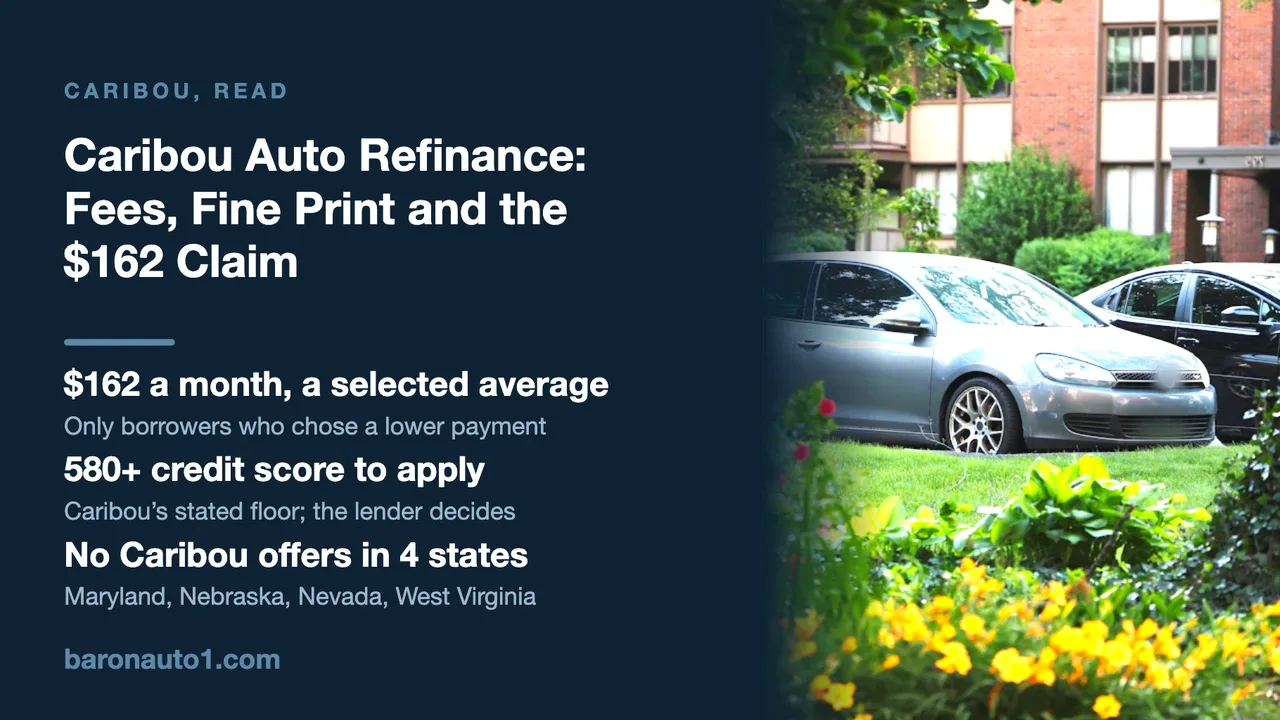
- The “$162/month” average covers only borrowers who “selected a loan offer to reduce their monthly payment,” and Caribou’s footnote says the saving “may result from a lower interest rate, longer term, or both.” Its $1,944 a year is $162 times 12.
- By Caribou’s own statements you need a 580+ credit score and $24,000 a year in income, a passenger vehicle, and an address outside Maryland, Nebraska, Nevada and West Virginia. It does not do lease buyouts.
- Add-ons (GAP waiver, service contracts, key, tire and cosmetic plans) are optional and priced nowhere on Caribou’s site. Cancellation refunds are pro-rated, go to your lender, and can take 4 to 8 weeks.
- The CFPB database holds 39 complaints against Caribou Financial, Inc. received through 5 October 2026, 29 of them about vehicle loans. Trustpilot shows 4.3 from 2,280 reviews. Using the site means accepting arbitration unless you opt out by mail within 30 days.
Caribou is a refinance marketplace, not a lender. Caribou Financial, Inc., based in Denver, takes your application, matches it to partner lenders and, if you sign, coordinates the payoff of your old loan and the title transfer. The lender approves, funds and prices the loan, and pays Caribou only when it closes. On 6 October 2026 we read Caribou’s Terms and Conditions (last modified 11 September 2026), disclosures, FAQ, privacy documents, credit report authorizations, savings footnotes, add-on and cancellation pages and a dozen resource articles, plus its Trustpilot profile and the CFPB complaint database. We ran no rate check and entered no personal, credit or vehicle detail, so this page contains no Caribou offer, and this site has no commercial relationship with Caribou or any lender.
What Caribou is, and who actually lends the money
Caribou’s Terms are direct: “Caribou is not a lender.” The company collects “relevant personal and collateral information” and, once the application is complete, sends it “to the applicable lending partner for review and decisioning.” Lenders apply “their credit guidelines,” and if you are turned down, “the Lending Partner will mail you a Notice of Adverse Action.” The Terms’ Military Lending Act notice calls Caribou “a credit marketplace platform that connects you with independent third-party lenders and insurers,” one that “does not extend, fund, or hold consumer credit.” Your loan is owned by the lender, which collects your payments; Caribou runs the application and the paperwork.
Who the lenders are is less clear. The home page mentions “trusted local and community lenders,” the about page “credit unions, community banks, and finance partners.” Caribou publishes no list. The only names we found are in its two credit report authorizations, which let Caribou’s “participating lending partners, including but not limited to Westlake Direct, and Lendbuzz Funding, LLC” pull your credit; if you are matched with either, you also accept that lender’s own terms. Westlake Financial’s privacy notice lists Westlake Direct, LLC among its companies (see our Westlake Financial review). The lender’s legal name is the first thing to confirm before you sign.
Caribou’s pages give two sizes for its network: “50+ lenders” on How it works, “40+ lenders” on its credit-union comparison page. Its licence page lists lending licences for Caribou Financial, Inc. in 22 jurisdictions, some of them broker licences by name (Maine Loan Broker, Rhode Island Loan Broker) and others lender-type licences such as Texas’s Regulated Lender License. The footer prints NMLS #1746612 and #2681596, and two insurance subsidiaries, Caribou Insurance Services, LLC and Caribou Insurance Associates, LLC, hold insurance licences.
How Caribou is paid, and the fees you pay
Caribou explains its business model on a page written for lenders. Under “Success-based pricing” its Lending Partners page says: “Your institution only pays for the loans it closes. We do not require minimums, upfront fees, or advance commitments.” It does not say how much a lender pays per loan. The incentive is simple: Caribou earns when a loan funds, whichever lender funds it.
For borrowers, the same paragraph appears in the Terms, the Disclosures and the FAQ: “Caribou does not charge applicants any application fees. There is no charge to receive a quote and submit an application to a lending partner. Your new loan may include processing fees, title transfer fees, state fees, or other charges, which vary by lender and by state.” You get “an itemized breakdown of fees in your lender agreement to review before finalizing your contract.” No page we read gives a dollar figure for any of those fees. Trustpilot’s AI-written summary of Caribou’s reviews mentions “unexpected processing fees and rates that increased after the initial quote”: unverified reviews, but pointing at the same place, the lender’s contract. Our refinancing guide explains why such fees deserve a question before you sign.
Caribou’s footer prints one range, not an offer: “APR ranges from 4.18% to 28.55% and is determined at the time of application,” with the lowest APR “available for a 36 month term, to borrowers with excellent credit,” and rates “valid as of 8/13/26 and are subject to change without notice.” The top of that range is the useful half: a refinance only helps if your offer sits well below what you pay now.
| Item | What Caribou says | Where |
|---|---|---|
| Application or quote fee | None: “no charge to receive a quote and submit an application” | Terms, Disclosures, FAQ |
| Fees on the new loan | Processing, title transfer, state and other charges; no amounts printed | Terms, Disclosures, FAQ |
| Who pays Caribou | Lenders, for loans that close; no amount printed | Lending Partners page |
| APR range across the network | 4.18% to 28.55%, valid as of 13 August 2026 | Footer of every page |
| Add-on prices | Not printed anywhere we read | Add-on articles, cancellation page |
| Add-on money flow | Caribou “may act as an agent for the third party” to pass on the price | Terms |
Who can refinance through Caribou
Caribou’s eligibility rules are spread across its Terms, FAQ, resource articles and the box marked “Written by the company” on its Trustpilot profile, which carries the numbers its own site mostly leaves out.
| Rule | What Caribou says | Source |
|---|---|---|
| Residency | A US resident, located in the US, at the age of majority in your state | Terms |
| States | “Offers are not available in Maryland (MD), Nebraska (NE), Nevada (NV), and West Virginia (WV)” | Terms, footer |
| Credit score | “Minimum credit score of 580+”; a score “around 700 or above” may help with rates | Trustpilot box; credit-score article |
| Income | “Minimum annual income of $24,000”; lenders may ask for a pay stub or W-2 | Trustpilot box; FAQ |
| Loan size | “$5,000-$125,000” in one place, “typically” $7,500 to $85,000 in another | Trustpilot box; credit-score article |
| Term | “24 months-84 months” | Trustpilot box |
| Vehicle | Cars, trucks and SUVs; not motorcycles or commercial vehicles | FAQ |
| Leases | “we do not currently offer auto lease buyouts” | FAQ |
| Co-borrower | An existing one only; Caribou “cannot add or remove a co-borrower” | FAQ |
| Identity and credit file | Your Social Security number to apply; any credit freeze lifted first | FAQ |
Two rules need care. The loan-size figures disagree: Caribou’s own credit-score article says “lenders typically look for a loan balance between $7,500 and $85,000,” so a balance outside that band may draw fewer offers. And 580 is an entry point: “That doesn’t mean 580 guarantees approval.” Our page on credit scores and car loans explains how lenders price the tiers.
Caribou’s articles add working rules. The earliest practical time to refinance a new purchase “is around 60 to 90 days after buying the car.” With negative equity, “Some lenders may consider LTVs around 120% to 125%, but approval often gets harder above that range,” in line with our negative equity guide. There “isn’t one universal age cutoff” for older cars. Leasing customers need our lease buyout guide instead.
The $162 a month claim, read against its footnotes
Caribou’s home page leads with “Save an average of $162/month by refinancing through Caribou.” The asterisk leads to a footnote on every page that narrows the claim. The figure is “estimated based on consumers whose auto refinance loan funded through Caribou between 1/1/2026 and 6/30/2026, had an existing auto loan on their credit report, and selected a loan offer to reduce their monthly payment.” They “saved an average of $162 per month, with annualized savings of $1,944 per year, and reduced their APR by an average of 3.94% points.”
Three things in that footnote matter. The group is selected: only borrowers whose loans funded and who chose an offer built to cut the payment, not applicants who got no offer or picked a shorter term. The footnote says outright that “Refinance savings may result from a lower interest rate, longer term, or both,” and a longer term lowers a payment without saving money. And by our arithmetic, $1,944 is exactly $162 times 12: twelve months of a lower payment, not interest saved. The footnote ends: “There is no guarantee of savings.”
The same $162 appears elsewhere with a different window. How it works and both comparison pages tie it to loans that “funded between January 1, 2026, and March 31, 2026,” or “in Q1 2026,” as does the footer’s claim that borrowers “saved an average of 21% on their monthly payment.” Caribou does not say whether the average stayed exactly the same when the window doubled, or which footnote is out of date.
The comparisons rest on that number. How it works promises “2X THE AVERAGE SAVINGS THAN GOING DIRECTLY TO OTHER FINANCIAL INSTITUTIONS,” citing Experian’s Q1 2026 State of the Automotive Finance Market report: “The national average monthly savings for consumers who refinanced auto loans in Q1 2026 was $81.” The credit-union comparison page sets $162 against $101 “through a credit union” and says customers “save about 60% more”; a second page adds $60 for banks. Our arithmetic confirms the ratios ($162 is 2.0 times $81, 1.60 times $101 and 2.7 times $60). But Caribou’s side counts only borrowers who chose a payment-cutting offer, and since we did not read the Experian report, we cannot say whether its averages were built the same way. Caribou’s footnotes do not say either.
Caribou’s own article on refinancing with the same lender gives an example that shows the problem, without figures: $18,000 left, 48 months remaining at 10.5% APR, and two offers at 7.5%, for 48 and 72 months. Offer B’s payment “may drop more” but it “Could increase total interest because you’re borrowing for longer.” We ran the numbers.
| Loan | Rate and term | Monthly payment | Interest still to pay | Against the current loan |
|---|---|---|---|---|
| Current loan | 10.5%, 48 months left | $461 | $4,121 | The baseline |
| Offer A | 7.5%, 48 months | $435 | $2,891 | $26 a month lower; $1,231 less interest |
| Offer B | 7.5%, 72 months | $311 | $4,408 | $150 a month lower; $287 more interest and 24 more payments |
Offer B cuts the payment by about $150, close to Caribou’s $162 average, and would count toward that average. It also costs $287 more in interest than keeping the old loan, over 24 extra payments. Offer A saves real money but barely moves a monthly-savings average. That is the gap between Caribou’s “$162/month” and saving money.
A lower payment is not the same as a cheaper loan. Caribou’s headline counts payment reductions, and its footnote says they may come from a longer term. Before accepting an offer, compare the total of the payments left on your current loan with the total of all payments on the new one, plus any fees and add-ons rolled in.
From rate check to payoff: credit pulls, data and timing
Checking your rate uses a soft pull “that will not affect your credit score,” Caribou says. If you choose an offer and continue, “we or one of our lending partners will request your full credit report,” a hard pull that “may affect your credit,” and you will need your Social Security number. Caribou’s FAQ says one more hard inquiry lowers most people’s FICO score “by five points or less.” Our refinancing guide explains why bunching applications limits the damage. Of the CFPB complaints about Caribou, 8 concern credit inquiries the consumer did not recognize, so keep a record of what you authorized.
The rate check gathers more than a score. Applying means consenting to the disclosures of Method Financial, a data provider that runs its own soft inquiry to find your “liability/debt accounts such as account number, type, balance, interest rate, payoff information, late fees, payment history,” obtains your vehicle identification numbers, and shares both with Caribou. Caribou’s Terms also let it contact your lienholder for a payoff quote and your insurer for proof of coverage. The hard-pull authorization adds: “Some of our lending partners may use an insurance product offered through our affiliate to determine whether they can extend an offer,” so clicking Submit lets Caribou or a lender “share your full consumer report with this affiliate and the insurer for that purpose.” Neither is named.
Prequalified numbers can move. A Caribou article published on 5 October 2026 tells readers who saw one rate on Credit Karma and another at Caribou that “the rate you see while shopping is often an estimate.” The Terms call anything shown “prior to final agreement with our partners” estimates “subject to change,” and warn that its AI tools, including “the Caribou VoiceAI agent,” may give “inaccurate, incomplete or inconsistent information regarding loan terms, eligibility or credit impact.” Only the lender’s documents count.
How it works lists 5 steps: check your rate, select an offer (and “explore our protection packages”), upload documents such as “your driver’s license, registration, and proof of insurance,” finalize with a loan advisor, and let Caribou “coordinate the payoff of your old loan and help update your vehicle title.” You e-sign the lender’s agreement on Caribou’s platform, and you “may withdraw your application at any time prior to executing a loan agreement.” Our list of what lenders ask for covers the paperwork. Three rules for the handover:
- Keep paying the old loan “until your old loan shows a $0 balance.” Its lender must refund any overpayment, Caribou’s FAQ says.
- Interest starts at closing. You “may choose a first payment date from 45 to 90 days after the loan closing date,” but “Interest on the loan begins to accrue on the loan closing date.” A late first payment means more interest, not a free month.
- The title is your job too. The Terms make you “liable to Caribou and/or your lender for any resulting losses” if you do not complete the titling steps.

The add-on products, what they cost, and how refunds work
Caribou sells optional protection products with the loan, and How it works raises them at the moment you pick an offer. Its add-on article says customers “may have the option to add coverage products to your new loan” and that “Add-on coverage is optional. It isn’t required to refinance.”
| Product (Caribou’s name) | What Caribou says it may help with | Cancellation-form options by name |
|---|---|---|
| GAP waiver | “A loan balance after a total loss” | Allied GAP; CareGard Gap |
| Vehicle Service Contract | “Certain covered repairs” | Allied Membercare; Veritas; CareGard PowerGard (Warranty) |
| Powertrain VSC | “Major engine, transmission, and drivetrain repairs” | No option by that name |
| Mechanical Breakdown Insurance | Covered repairs, for “Eligible California drivers” | Allied Membercare (Mechanical Breakdown Insurance) |
| All-in-One Coverage | Roadside, key, tire, rim, windshield and dent repair; not in California | All In One |
| Cosmetic Protection | “Dents, windshield chips, tires, rims, and roadside help” | NSD Cosmetic |
| Key & Remote Protection | “Lost, stolen, or damaged keys and remotes” | NSD Key Replacement |
None of the 7 products has a price on any Caribou page we read, and the “Products page” the FAQ mentions is not in Caribou’s sitemaps. The Terms say that for such products Caribou “may act as an agent for the third party selling the product or service in order to send the purchase price.” Caribou does not say what it earns on a sale.
The usual way to pay is inside the loan. Caribou’s GAP article says “Rolling it into your payment helps ensure you’ll have it for the life of your loan,” then concedes “If the cost is financed into your loan, you may pay interest on it over time.” By our arithmetic, each $1,000 rolled into a 72-month loan at the 7.5% of Caribou’s own example adds about $17 a month and $245 of interest. The same article’s checklist is the one to use: “How much does it cost? Is the cost paid upfront or financed into the loan? ... Can you cancel it?” Our guides to whether GAP is worth it, extended warranties and service contract costs help with the answers.
Cancelling runs through Caribou’s cancellation page, which lists 9 product options. Caribou emails “a vendor cancellation request which requires your approval and signature,” and “The refund process can take up to 4-8 weeks.” Then: “All cancellations are sent directly to your lender, not to us. All refunds are pro-rated.” With the loan open, the refund goes against your balance; once it is paid off, the lender pays you or credits another account you hold there. Products on the loan you are leaving are your own job: refunds from a third party “are subject to their policies,” and Caribou “cannot control or guarantee the outcome.” Our GAP refund section explains how to ask. Three CFPB complaints about Caribou concern add-on products bought with the loan.
What you agree to share, and who can call you
Caribou’s privacy policy (last modified 24 June 2026) says it sells data: “This includes identifiers (such as IP address, name and email), browsing activity, location data, and related inferences. We share this with advertising networks and marketing partners for targeted ads and analytics, and may sell such data as necessary to support our business.” Some inferences come “Through inferences made by our machine learning models,” the site uses session replay that records “mouse movements, text, and other information,” and Caribou’s AI may “be trained on information you provide, including personal information.” You can opt out through the “Do Not Sell or Share My Personal Information” link or by phone, but “it may take up to 60 days for such promotional contact to end.”
Once you apply, the Financial Privacy Notice (Rev. April 2026) applies. Caribou shares for joint marketing with other financial companies (you cannot limit this) and for affiliates and nonaffiliates to market to you (you can limit both). “If you are a new customer, we can begin sharing your information 30 days from the date we sent this notice. When you are no longer our customer, we continue to share your information.” One paragraph was never finished: California residents are told to write to “[email address/web-portal, (and/or) mailing address (only one is required to be included)],” a template placeholder rather than an address.
The contact consent is broad. Accepting the Terms lets Caribou and its agents reach you by email, texts, “calls using pre-recorded messages or artificial voice” and autodialed calls, including “promotional messages about Caribou’s products and services, and reminders to complete an application you have started but not finished.” That consent “is not required to purchase any products or services.” After you revoke it, Caribou may still contact you about a pending application or title transfer. The Disclosures say Caribou may call a number you gave “through a marketing partner,” so a rate check started on another site can bring Caribou’s calls. Check the number you dial: the footer, privacy notice and cancellation page give 1-877-445-0070, but the privacy policy’s opt-out line and the Terms’ text help line print 877-455-0070.
The terms you accept just by using the site
Caribou’s Terms say visiting is acceptance: “Taking any of these actions means that you agree to these Terms & Conditions.” The main consequence is that “all disputes related to Caribou Products and Services will be resolved by binding arbitration,” under the American Arbitration Association’s consumer rules and Delaware law, with class action and jury trial waivers.
You can reject arbitration only by mail, signed “by each person rejecting the arbitration agreement” and postmarked “no more than thirty (30) calendar days after you begin using Caribou Products and Services, including using and accessing the Caribou website.” The clock can start with your first visit, and even a valid rejection leaves “the class action and jury trial waivers” in force.
Some routes stay open. Either side may “bring an individual action in small claims court” or “file a complaint with the applicable federal, state, or local agency.” Borrowers covered by the Military Lending Act are “not required to submit any dispute involving that transaction to arbitration.” For disputes of $25,000 or less you can choose a documents-only, telephone or in-person hearing.
Three more clauses matter. If 25 or more similar disputes arrive from the same or coordinated lawyers within 90 days, 20 go first as bellwethers, 10 picked by each side, while the rest wait. Caribou’s liability is capped at “THE GREATER OF (A) ONE THOUSAND DOLLARS ($1,000) OR (B) THE AMOUNTS PAID BY YOU TO CARIBOU” in the prior 12 months. And if information you give proves wrong, “you agree to be liable to us, our lending partners, and/or other vendors for any and all losses.” Caribou may change the Terms “without delivering any notice to you.”
Complaints, reviews and the public record
The CFPB’s consumer complaint database lists 39 complaints against “Caribou Financial, Inc.” received through 5 October 2026, the first in 2020 and most recent: 12 in 2025 and 17 so far in 2026. By product, 29 concern vehicle loans, 9 credit reporting and 1 a personal loan. All 39 were closed “with explanation” and answered on time; none is recorded as closed with relief. These are unverified consumer reports, counts grow with a company’s size, and 39 is too few to compare companies. The CFPB stopped publishing narratives on 30 September 2026, so only categories can be read.
| Issue (CFPB category) | Complaints | Largest sub-issues |
|---|---|---|
| Getting a loan or lease | 12 | Changes in terms mid-deal or after closing (5); confusing or misleading advertising or marketing (5); credit denial (2) |
| Improper use of your report | 9 | Credit inquiries the consumer did not recognize (8) |
| Problems at the end of the loan or lease | 9 | Problem related to refinancing (7); title after payoff (2) |
| Managing the loan or lease | 7 | Add-on products bought with the loan (3); fees charged (2) |
| Other | 2 | Getting a personal loan (1); incorrect information on a report (1) |
Two categories line up with the fine print above: changed terms (the rate that moves between estimate and offer) and misleading advertising (the savings claims). We read no complaint text, so that is a match of labels, not a finding.
The CFPB’s enforcement-action list, searched by title for “caribou” on 6 October 2026, returned no results. We found no state order and read no court filing naming Caribou, so this page describes none; a search is not a clearance. BBB’s site blocked our browser, so we have no BBB figures.
On Trustpilot on 6 October 2026, Caribou had a TrustScore of 4.3 from 2,280 reviews, 1,025 in the last 12 months: 1,762 five-star (78%) and 258 one-star (11%). Caribou claimed the profile in August 2022, pays for a subscription, invites customers to review, and had replied to 170 of 173 negative reviews. Trustpilot’s AI summary of 1,051 recent reviews says most praise the staff and lower rates, while some describe “communication barriers” and “issues with expired applications.”
Where Caribou’s own pages disagree
Read side by side, Caribou’s documents disagree in eight places. None changes how a refinance works, but several bear on how far to trust a single number on a single page.
| Topic | One page says | Another says |
|---|---|---|
| Lender network | “50+ lenders” (How it works) | “Caribou compares 40+ lenders” (credit-union comparison) |
| Customers served | “over 100,000 customers” (Trustpilot box) | “over 140,000 borrowers” (lender page); “150k+ happy drivers” (home page) |
| Window for the $162 average | Loans funded 1 January to 30 June 2026 (footer) | 1 January to 31 March 2026 (How it works, comparison pages) |
| Loan size | $5,000 to $125,000 (Trustpilot box) | “typically” $7,500 to $85,000 (credit-score article) |
| Phone number | 1-877-445-0070 (footer, privacy notice) | 877-455-0070 (privacy policy opt-out; Terms) |
| Excluded vehicles | Motorcycles and commercial vehicles (FAQ) | Adds recreational vehicles (Trustpilot box) |
| How sure the saving is | “you could save” (FAQ) | “you often save” (How it works) |
| California privacy requests | A right to send a written request | The address is an unfilled template placeholder |
One detail is easy to misread: the licence page lists licences in Maryland and Nebraska, two of the four states where Caribou says offers are not available. A licence is not a promise of offers; follow the exclusion list.
Before you check your rate with Caribou
- Get your own numbers first. Ask your current lender for a payoff quote and add up the payments you have left, so you compare totals, not payments.
- Know the lender behind the offer. Confirm its legal name, read its contract, and check the itemized fees in the lender agreement.
- Ask for a same-term offer. Compare an offer at your remaining term with any longer one; Caribou’s own example shows a longer term can cost more.
- Decide on add-ons separately. Get each price in writing, whether it is financed, and its cancellation terms.
- Keep paying the old loan until it shows a $0 balance; interest on the new loan starts at closing.
- Limit sharing early. Use the opt-out link and the privacy notice’s Option 2; sharing can start 30 days after the notice.
- Decide about arbitration within 30 days. The rejection must be mailed, signed by every applicant, within 30 calendar days of first use.
A marketplace is one way to shop. A credit union or a direct lender may quote you without the marketplace layer; see our guides to credit union auto rates, used car loan rates and preapproval. We read other refinance services the same way: RateGenius, Autopay and LightStream. Whichever you use, our refinancing guide sets out the test that matters: the total you will pay.
Common questions
Is Caribou a lender?
No. Caribou’s Terms say “Caribou is not a lender” and that it “does not make credit decisions on refinance applications.” Partner lenders such as Westlake Direct and Lendbuzz Funding, LLC decide, fund and own the loan; Caribou coordinates the payoff and title and is paid by lenders for loans that fund.
Does Caribou charge fees?
No application or quote fee. The new loan “may include processing fees, title transfer fees, state fees, or other charges, which vary by lender and by state,” itemized in the lender agreement. Add-ons cost extra, are usually financed, and have no published prices.
Does checking your rate with Caribou hurt your credit?
The rate check is a soft pull, which Caribou says will not affect your score. Continuing with an offer triggers a hard pull, which Caribou’s FAQ says lowers most people’s FICO score by five points or less.
What credit score do you need for Caribou auto refinance?
Caribou’s Trustpilot box gives a 580+ minimum and $24,000 a year in income; its credit-score article says around 700 or above may bring better rates, and that 580 does not guarantee approval.
Is Caribou auto refinance legit?
Caribou Financial, Inc. lists lending licences in 22 jurisdictions and prints NMLS #1746612 and #2681596. The CFPB lists 39 complaints against it through 5 October 2026 and no enforcement action naming it; Trustpilot showed 4.3 from 2,280 reviews on 6 October 2026. Whether an offer suits you depends on the lender’s terms.
Can you cancel GAP or a service contract bought through Caribou?
Yes, through Caribou’s cancellation form. You sign a vendor cancellation request; refunds are pro-rated, go to your lender (against your balance if the loan is open), and can take 4 to 8 weeks.
Sources and further reading
- CFPB consumer complaint database
- CFPB auto loan resources
- CFPB: what is Guaranteed Asset Protection (GAP)?
- FTC: auto service contracts and warranties
- CFPB: what is a credit score?
Recall, complaint and safety-rating figures on this page were retrieved from the federal databases above on August 19, 2026. Federal data changes — re-check any VIN before you rely on it.
Published October 6, 2026 · last updated October 6, 2026. Found something out of date or wrong? Tell us and we will correct it.