RateGenius Review: What the Refinance Broker’s Own Terms Say
A broker paid by lenders, owned since 2021 with AUTOPAY and Tresl. Its fee statements side by side, the hard pull, the power of attorney in its terms, and a 2018 California consent order.
The short version
- RateGenius is an auto refinance broker, not usually the lender. Its Terms of Use say “In most cases, we are not the lender,” though a subsidiary, RGLS Lending, Inc., holds lending licenses in Michigan, Missouri and Oregon.
- Lenders pay it. A 2018 California consent order records that “RateGenius’s lending partners pay a referral fee to RateGenius if a loan is made.” It also sells GAP waivers and service contracts you can add to the new loan.
- Applying is a hard credit pull, RateGenius says; its online pre-qualification form is a soft one. The Terms also let any lender it sends your application to pull your report.
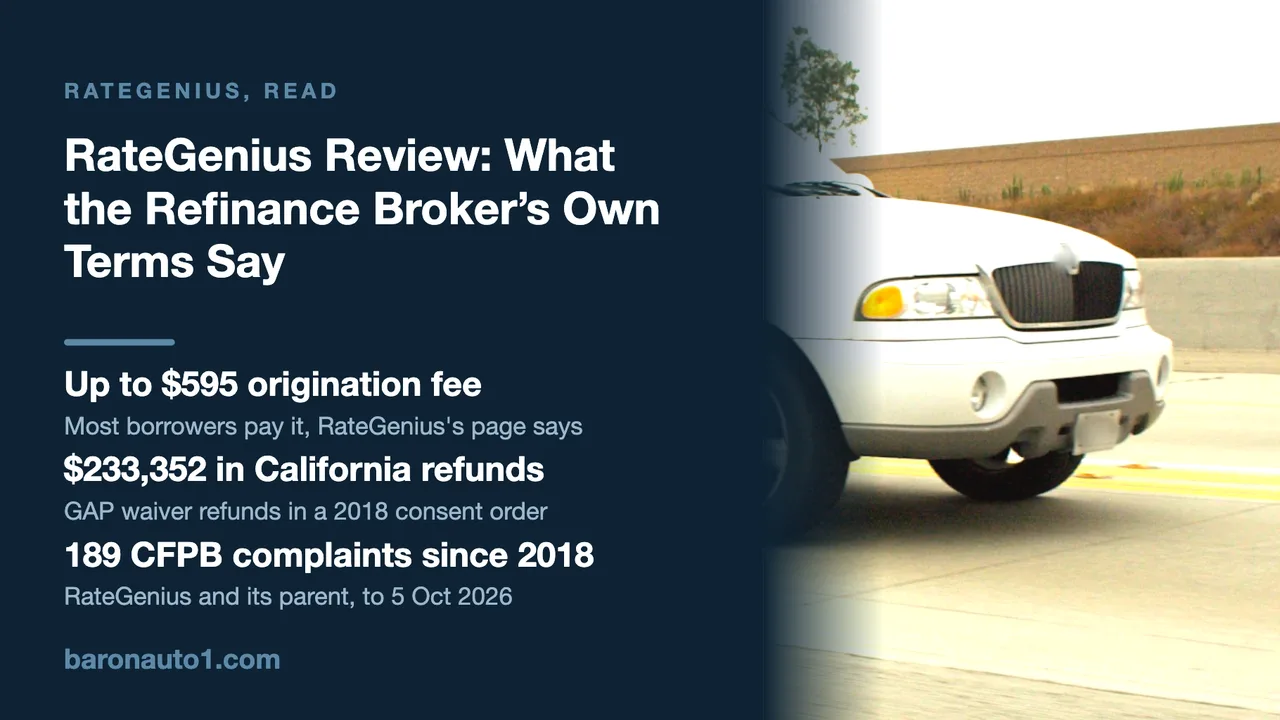
- Its refinance page says “the majority of borrowers will pay an origination fee of up to $595” to the lender, and its legal page says “Title filing/lien transfer fees apply.” No page prints a fee charged by RateGenius itself.
- Since 2021 RateGenius has belonged to The Savings Group, which also owns AUTOPAY and Tresl. Accepting its Terms makes that parent your attorney-in-fact for add-on contracts on the car and commits you to arbitration unless you opt out within 30 days.
- The record: a 2018 California consent order with $233,352 in GAP waiver refunds (RateGenius disagreed and admitted no wrongdoing), 189 CFPB complaints under its two company names from 2018 to October 2026, and a 4.7 Trustpilot score from 4,195 reviews.
RateGenius is a legitimate, long-running auto refinance broker: it takes your application, sends it to banks and credit unions in its network, and is paid by the lender when a loan funds. On 6 October 2026 we read its Terms of Use (last updated 16 June 2026), Privacy Policy, legal and licenses pages, rate table, FAQs, titles guide and lender-partner page; the July 2021 release announcing its merger with AUTOPAY; its only SEC filing; the 2018 California consent order; its Trustpilot profile; and CFPB complaint counts. We started no application, so this page holds no rate or offer, and this site has no commercial relationship with RateGenius or any lender.
Broker, not lender: what RateGenius is and who pays it
RateGenius’s Terms describe it as “a technology driven loan and product matching system,” and once a lender approves you it does the paperwork: “communication of the offer, documentation collection and preparation, and lien perfection.” One of its own landing pages is blunter: “RateGenius is a nationwide web-based vehicle refinance loan broker.”
So is RateGenius a direct lender? Mostly not. The Terms say: “In most cases, we are not the lender or affiliated with the lender, however, we may offer loans in certain states through a licensed subsidiary.” Its licenses page names RateGenius Loan Services, Inc. (NMLS #1003417), the broker, and RGLS Lending, Inc. (NMLS #2285557), which holds a Michigan license effective 2 May 2022, two Missouri lending licenses and an Oregon license. A Montana notice in the Terms says RGLS Lending “will originate loans with interest rates ranging from 2% to 36%.” Your loan documents name the actual lender.
RateGenius does not name its lenders. Its pages say only that it is “partnered with more than 150 lenders,” that credit unions “comprise most of our lender network,” and that “All lenders in the TSG network are FDIC-insured banks, credit unions or licensed lenders.”
The money runs from lender to broker. California’s regulator recorded it in 2018: “RateGenius’s lending partners pay a referral fee to RateGenius if a loan is made to a borrower through the RateGenius Platform.” The partners page pitches lenders the same model: “PAY-FOR-PERFORMANCE AUTO LENDING,” new accounts “at no up-front cost,” the chance to “Review filtered applications set to your lending specifications” and “Receive perfected title on each funded loan.” RateGenius in turn “pays a set commission for each referred, funded application” to affiliates, and its referral program says that when a friend refinances, “you both get paid $100!”
That is normal for a broker, but it shapes what you see. The lenders shown to you are ones that pay RateGenius, filtered to the borrowers they asked for; the Privacy Policy says your file goes to lenders whose borrower profile you match “first.”
Who owns RateGenius: The Savings Group, AUTOPAY and Tresl
RateGenius merged; it was not bought. On 19 July 2021, RateGenius Loan Services, Inc. and AUTOPAY Direct, Inc. announced that “Upon closing this all-stock merger of equals, the two companies became operating units of The Savings Group.” The release named AUTOPAY’s co-founders as co-CEOs and said “AUTOPAY is a portfolio company of FM Capital, while RateGenius is a portfolio company of Tritium Partners.”
The Terms of Use make the structure binding: “we” and “us” mean “The Savings Group, Inc. and the companies in which The Savings Group, Inc. directly or indirectly owns a majority interest,” naming AUTOPAY, RateGenius and Tresl. When you accept RateGenius’s terms, your contract is with the group.
We found no public parent. The only filing under RateGenius’s name on SEC EDGAR is a 2010 Form D, a notice of a private share sale: RateGenius Inc, a Texas corporation incorporated in 2007 (previously “Rategenius Acquisition, Inc.”), had sold $2,134,804 of a $2,250,000 offering to 12 investors. A full-text EDGAR search on 6 October 2026 found no Open Lending filing, or any lender’s 10-K or 10-Q, that mentions RateGenius.
One page deserves a careful read. RateGenius’s “Market Place” page asks “Which Auto Refinance Company Is Right for You?” and says “It might be RateGenius, or it might not.” The featured companies are RateGenius, AUTOPAY and Tresl, all owned by The Savings Group; apart from a copyright line, the page does not say so. Weighing RateGenius against AUTOPAY means comparing two brands of one company. Our AUTOPAY refinance review reads that brand’s own pages.
What a RateGenius refinance costs: every fee statement side by side
RateGenius describes its fees in six places, in different words. None names a fee that RateGenius itself charges you.
| Page | What it says | What to take from it |
|---|---|---|
| Auto refinance page | “the majority of borrowers will pay an origination fee of up to $595,” “a charge assessed by the lender” | The only dollar ceiling printed for the main fee |
| Auto Refinance FAQ | “In some cases, there will be prepaid finance charges”; “we may collect a small fee on behalf of your state’s DMV” | “In some cases” undersells what the refinance page calls the majority |
| Legal page | “Title filing/lien transfer fees apply. Depending on your state of residence, a loan origination fee may apply.” | The title fee is stated as certain |
| Myths page | “There could be small fees associated with your new lender and the state that you live in” | No amounts |
| Licenses page (Missouri) | “The maximum fee that customers will be required to pay for an auto loan refinance is $100.” | Listed under RGLS Lending’s Missouri licenses only |
| Terms of Use (Montana) | Returned payments $25.00; a late fee after 10 days of the “greater of $15.00 or 5% of the amount past due not exceeding $50.00” | The only late and returned-payment fees printed, for RGLS Lending loans in Montana |
A fee the lender charges to make the loan is a finance charge under the federal Truth in Lending rules (Regulation Z), so it belongs in the APR on your loan disclosure. The FAQ says RateGenius will “always disclose and document” these charges; check them in the loan package. Our refinancing guide covers the other ways a refinance can cost money.
Get the full cost in writing before you sign. RateGenius’s pages describe the fees as “up to $595,” “in some cases” and “may apply,” so the only number that counts is the one in your loan package. Ask for the origination fee, the title or lien transfer fee and the price of any GAP waiver or service contract as dollar amounts, and check whether any has been added to the amount financed.
Which loans and cars RateGenius will refinance
The firmest limits sit under RateGenius’s rate table. The car must be “Under 10 years old,” “Under 120,000 miles” and “A personal use vehicle.” The loan must have “A balance between $10,000 and $55,000,” have been “Funded at least 1 month ago” and have “At least 24 months of payments left.” Lenders add “income qualifications, debt to income requirements and other vehicle restrictions such as loan to value, age, and mileage,” and the refinance page requires applicants to be “18 years or older and a U.S. citizen.”
Other pages are looser. The refinance page says you can apply “anytime after they have purchased their vehicle”; you can apply, but the rate-table limits decide whether you qualify. The FAQ also mentions refinancing other vehicles “with a minimum loan balance of at least $10,250,” introduced as “the following vehicles,” but no list follows on the page.
The FAQ settles several edge cases:
- Company cars. A car bought in a company’s name can move into a personal loan “as long as the individual has company authorization,” but “We cannot refinance the vehicle under a company’s name,” and commercial vehicles are not eligible.
- Taking over payments. “If your name is not on the loan, you cannot refinance the vehicle. This applies to married couples, as well.” See our guide to car lease takeovers.
- Co-borrowers. You can add or remove a co-signer if your state allows it. Our cosigning guide explains why refinancing is often the only way off a loan.
- Income. Self-employed applicants give net, not gross, monthly income; an applicant short of the income requirement can add a co-applicant.
- Leases. RateGenius will take an application to buy out a lease at its end; our lease buyout guide covers the price and fees.
The rate table assumes a loan-to-value ratio of “no more than 125%.” If you owe much more than the car is worth, expect fewer offers; our page on refinancing with negative equity explains why.
Soft pull or hard pull: what RateGenius does to your credit
There are two doors. The compare-rates form promises “no impact to your credit score”: clicking through authorizes RateGenius to pull your Experian file “solely to conduct a prequalification for credit.” The full application is different: “RateGenius will perform a hard credit inquiry when you submit an application with us over the phone or online.”
Who else pulls your report? The FAQ says “A few lenders may look into your credit history after RateGenius has made the initial credit check.” The Terms you accept are wider: “You authorize any party in the Lender Network, to which we have submitted your application for credit, to pull your credit report.”
RateGenius says further inquiries will not hurt your score “as long as the additional inquiries are made within 14 days of the initial credit check,” crediting “new credit regulations passed in 2004.” How inquiries are grouped depends on the lender’s scoring model; our guide to rate shopping covers it. RateGenius says the credit score and decision notice from it or any lender that pulls your credit arrives “5–7 business days after a decision.”
Credit pulls are also the largest topic in RateGenius’s CFPB complaints. Of 189 complaints under its two company names (the parent’s may also concern AUTOPAY or Tresl), 60 carry the sub-issue “Credit inquiries on your report that you don’t recognize,” 31.7% by our arithmetic.
The rate table, five “average savings” and what they hide
RateGenius publishes estimated APRs by credit band (750-850, 700-749, 640-699 and 639 or less) and term (36 to 72 months). We do not quote them: the table carries no date, assumes a loan-to-value of no more than 125% and a debt-to-income ratio of no more than 50%, and its footnote says the estimates “do not bind any lender.” The same footnote gives a more telling example: “a lender’s range might be 2% to 24%.”
The savings claims need the same care. RateGenius prints five average savings, each for a different period:
| Where | As printed | Period its footnote gives | Per month | Per year |
|---|---|---|---|---|
| Home page and most pages | $139.55 a month | April 1, 2026 to September 30, 2026 | $139.55 | $1,674.60 |
| TotalCover page | $137.36 a month | March 2, 2026 to August 31, 2026 | $137.36 | $1,648.32 |
| About page | $122.31 a month | January 1, 2025 to June 30, 2025 | $122.31 | $1,467.72 |
| Market Place page | $101 a month | 1/1/22-12/31/22 | $101.00 | $1,212.00 |
| Compare-rates page | $914 a year | “Last year” (no dates) | $76.17 | $914.00 |
All five measure the monthly payment, and the legal page says what that leaves out: “lower monthly payment may result from a lower interest rate, a longer term or both. A reduced monthly payment does not necessarily mean that you will pay less overall with a new loan.” The FAQ says RateGenius “Generally” refinances “for the amount left in the current term,” but no claim says how much of the average came from stretching loans.
RateGenius’s own example, run forward
The refinance page shows “A $20,000 AUTO LOAN AT 10% vs 5%”: $5,500 of interest against $2,645, “$2,855 in savings” and a payment lowered “by almost $50.” It prints no term. By our arithmetic those figures fit only a 60-month loan ($424.94 a month at 10%, $377.42 at 5%), and they compare two brand-new loans. Nobody refinances on day one.
So we ran it forward with only RateGenius’s numbers: its 10% and 5% example rates (illustrations, not offers), its FAQ’s borrower with 42 months left, its “up to $595” fee paid in cash, and the longest term in its rate table, 72 months. After 18 payments the balance is $15,006.66.
| Choice | Months | Monthly payment | Interest from here | Total paid, with the $595 fee |
|---|---|---|---|---|
| Keep the 10% loan | 42 | $424.94 | $2,840.86 | $17,847.52 (no fee) |
| Refinance at 5% for the same 42 months | 42 | $390.22 | $1,382.52 | $16,984.18 |
| Refinance at 5% stretched to 72 months | 72 | $241.68 | $2,394.39 | $17,996.05 |
Kept to the same term, the refinance saves $34.72 a month and $863.33 overall after the fee, which takes 18 months of savings to recover. Stretched to 72 months, the payment falls by $183.26, more than any average RateGenius advertises, yet the loan runs 30 months longer and, with the fee, costs $148.53 more than keeping the old loan. Both count as “savings” under RateGenius’s definition. Compare the total you will pay, not the payment; our refinancing guide sets out the full test.
From application to title: the timeline RateGenius prints
RateGenius says that “within 24–48 hours” of a few minutes’ application it can have you on the way to a new loan, and that approved borrowers are contacted “by phone, email, and text.” Documents arrive through an online dashboard or “via FedEx.” Its FAQ then lays out the steps:
- A payoff quote from your current lender, “good for 10 days from the date received,” so signed paperwork must come back fast.
- A check of the signed package, including “your proof of income and proof of insurance,” which “typically takes 1 business day unless something is missing.”
- Approval and funding by the new lender, which “normally takes 2–3 business days.”
- A payoff check sent “either overnight or by 2-day shipping via UPS”; the old lender “may take 3 to 10 business days to post the payment.”
Until then, keep paying: “you are contractually obligated to make payments on your current loan until your account is paid in full.”
The title is the step RateGenius handles itself. “We handle all of the title work for every single one of our customers,” its titles guide says, but “RateGenius only facilitates the update of your vehicle’s title, not registration.” Your registration must be in good standing; toll violations, parking tickets and unpaid taxes are the usual problems, and they “can severely delay the title process.”
RateGenius lists nine title-holding states, where the owner keeps the title: Kentucky, Maryland, Michigan, Minnesota, Missouri, Montana, New York, Oklahoma and Wisconsin. “In the other 41 states, titles are issued to the lien holder.” In title-holding states, it says, the new title takes 6-10 weeks in “larger states like California and New York” and 4-6 weeks in smaller ones, although California is not on its own list of title-holding states.

GAP waivers, service contracts and the power of attorney
RateGenius sells two add-ons that can ride on the new loan. Its GAP waiver covers the gap between the insurance payout and the loan balance after a total loss, “up to $50,000,” on vehicles “valued up to $125,000 at time of purchase,” and a “Protection Plus option pays $1,000 toward your insurance deductible.” The cost is “Paid over the life of your auto refinance loan,” so you pay interest on it. “Like insurance, but less expensive” is RateGenius’s claim; it prints no price. See our guide to whether GAP is worth it.
Its vehicle service contracts come in tiers; the broadest covers major components “for up to 8 years or 125,000 miles,” and every contract starts “at the expiration of the manufacturer’s warranty.” The page does not say whether the 8 years and 125,000 miles count from the car’s first sale or from the day coverage starts, which decides how much protection you actually buy. No prices or contract terms are published; our extended warranty guide lists the questions to ask.
The Terms of Use contain a clause most borrowers never see. Under “LIMITED POWER OF ATTORNEY,” you “hereby appoint us, The Savings Group, Inc. (‘Agent’), as your true and lawful agent and attorney-in-fact” for “any ancillary product currently in effect on the vehicle,” including the power “To cancel your contract, receive refunds, and direct refunds to the appropriate parties (i.e. lender and or yourself).” It “is effective on the date these Terms of Use are agreed to and will continue in effect until you revoke it in writing,” and the Terms say you accept them by “CLICKING ON LINKS WITHIN THE WEBSITE OR WEBPAGES BEYOND THE WEBSITE’S HOMEPAGE.”
The likely purpose is practical: GAP or a service contract sold with your old loan may be refundable once it is paid off. But the Terms do not say how you will be told what was cancelled or where each refund went. Ask RateGenius in writing, and confirm any refund with the contract administrator; our GAP guide explains cancellation refunds.
Your data, the phone calls and the arbitration clause
Applying shares your file. The Terms have you consent to sharing your application with lenders and add: “By using our services, you consent to us sharing your personal data with third-party insurance and mortgage providers.” The Privacy Policy draws lenders from “our lender base of over 200 financial institutions” (other pages say 150), and says that for targeted advertising “we sell personal data (i.e., information from cookies) to third-party advertisers and analytics companies.” The older credit-check FAQ still says RateGenius “will not sell or share any personal information” without your authorization; the Privacy Policy, updated 16 June 2026, is the more specific document. The sites honor the Global Privacy Control signal.
Expect contact. The Terms allow autodialed and prerecorded calls and texts, including to “numbers we can reasonably associate with your account (through skip trace, caller ID capture or other means),” and warn: “You will receive messages up to several times each day.” Texting STOP ends the texts.
Disputes go to private arbitration: “binding, individual arbitration,” with class actions waived, small-claims court kept open, and your filing fee capped at the cost of a lawsuit. California law governs. The escape is time-limited: “You may reject this arbitration provision within thirty (30) days of accepting the Agreement by emailing us at legal@thesavingsgroup.com and including in the subject line ‘Rejection of Arbitration Provision.’” Because clicking beyond the home page counts as acceptance, the 30 days can start before you apply.
The public record: a 2018 California order, CFPB counts and Trustpilot
The California consent order. A consent order dated 21 December 2018 between California’s Department of Business Oversight (now the Department of Financial Protection and Innovation) and RateGenius, Inc., under the California Financing Law (license no. 603-7920), followed an examination that began on 4 April 2016. The Commissioner’s findings were that:
- a subsidiary, RateGenius Loan Services, Inc., “carried out all critical brokering functions” for the platform but “never held a CFL license”;
- disclosure statements to some borrowers “did not show the date, amount, and terms of agreements between RateGenius and CFL-licensed lenders” or list all amounts paid to RateGenius;
- RateGenius paid for referrals from “unlicensed companies acting as lead generators,” under “at least 5 separate agreements”; and
- it sold GAP waivers without written authorization and “did not disclose the license or other authority, if any,” for those sales.
The order states that “RateGenius disagrees with the Commissioner’s determinations” and that entering it “does not constitute an admission of wrongdoing or violation of law.” RateGenius agreed to a desist-and-refrain order and to refund $233,352 to California borrowers who took a loan from a CFL-licensed lender through RateGenius between 1 January 2013 and 31 December 2017 and bought its GAP waiver: $33,352 already paid, the remaining $200,000 shared pro rata. The order also records that RateGenius “cooperated fully” and had stopped all activity under its California license on 27 October 2017. The DFPI page lists 12/21/2018 as both the first and latest action; we read nothing on whether the refunds were paid. A web search on 6 October 2026 found no other regulator action naming RateGenius, The Savings Group or AUTOPAY, which is a search result, not a clearance.
CFPB complaints. The CFPB files RateGenius complaints under two names, with a clean handover at the merger. Complaints are unverified consumer reports and grow with a company’s size (RateGenius says it has funded over 400,000 loans since 1999), and those under The Savings Group may concern AUTOPAY or Tresl; the database does not say which.
| Company name in the database | RateGenius Loan Services Inc | The Savings Group, Inc. |
|---|---|---|
| Complaints, all products | 43 | 146 |
| First and last received | 2018-08-13 to 2021-12-20 | 2022-01-19 to 2026-10-03 |
| By year | 2018: 6; 2019: 11; 2020: 9; 2021: 17 | 2022: 22; 2023: 28; 2024: 15; 2025: 52; 2026 to date: 29 |
| “Improper use of your report” | 25 (58.1%) | 67 (45.9%) |
| of which, inquiries “you don’t recognize” | 14 | 46 |
| “Getting a loan or lease” | 5 | 48, of which 34 “Confusing or misleading advertising or marketing” |
| Company response | All 43 closed with explanation | 143 closed with explanation, 3 with monetary relief |
The pattern holds across both names: about half the complaints concern a credit report, mostly inquiries the consumer did not recognize, which fits the hard pull at application and the lender pulls the Terms allow. The CFPB served no complaint narratives when we pulled these counts, so we cannot say what any single complaint alleged.
Reviews. On 6 October 2026 RateGenius’s Trustpilot profile, claimed since June 2015, showed a 4.7 TrustScore from 4,195 reviews: 3,580 five-star (85.3%) and 122 one-star (2.9%). The 20 most recent were all labelled organic rather than invited; 18 were five-star, 2 one-star, and none had a company reply. Trustpilot says “we don’t fact-check reviews.” RateGenius’s own pages cite “13585 Certified Reviews” on one page and “more than 11,000” on another, without naming the platform. The BBB site blocked our reader, so we report no BBB rating.
Before you apply through RateGenius
RateGenius’s documents disagree in several places. Its legal page settles conflicts in favor of the contract: “the terms of your contract with us or our lender will prevail.” Read the contract, not the marketing.
| Topic | One page says | Another says |
|---|---|---|
| Lender count | “more than 150 lenders” (home page) | “over 200 financial institutions” (Privacy Policy) |
| Lifetime volume | “surpassed $8.5 billion” (About page, 2026) | “more than $9 billion” (merger release, July 2021) |
| Fees | “the majority of borrowers” pay up to $595 (refinance page) | “In some cases” (FAQ) |
| When you can refinance | “anytime after they have purchased their vehicle” | “Funded at least 1 month ago” (rate table) |
| Selling data | “will not sell or share any personal information” (credit FAQ) | “we sell personal data (i.e., information from cookies)” (Privacy Policy) |
| Leadership | “Co-Founder and Co-CEO of Rate Genius” (About page) | “AUTOPAY Co-Founders” (merger release) |
A broker is one way to shop a refinance. You can also apply to a credit union directly (our credit union rate guide explains membership), get a preapproval from your own bank, or compare other services; our reviews of Caribou and LightStream read those companies’ own terms the same way.
- Check the limits first. Under 10 years, under 120,000 miles, a balance of $10,000 to $55,000, funded at least 1 month ago, 24 or more payments left, and your name on the loan.
- Know which door you are using. The compare-rates form is a soft pull; the application is a hard pull, and lenders you are sent to may pull too.
- Decide about arbitration on day one. To keep the right to sue, email the rejection within 30 days of accepting the Terms, with the exact subject line they require.
- Get every fee as a dollar amount. Origination fee (up to $595 by RateGenius’s own page), title or lien transfer fee, and any GAP waiver or service contract in the amount financed.
- Compare total cost, not the payment. Ask for an offer at your remaining term as well as any longer one.
- Find out who the lender is. The contract names it; RateGenius does not publish its lender list.
- Keep paying the old loan until the old lender posts the payoff, which RateGenius says can take 3 to 10 business days.
- Clear your registration. Unpaid tolls, tickets or taxes can hold up the title transfer.
- Ask what the power of attorney will cancel. If your current loan has GAP or a service contract, get in writing what will be cancelled and where any refund goes.
Common questions
Is RateGenius legit?
Yes. RateGenius is a licensed auto refinance broker (NMLS #1003417) that says it has operated since 1999 and funded over 400,000 loans, with a 4.7 Trustpilot score from 4,195 reviews. Its record includes a 2018 California consent order with $233,352 in GAP waiver refunds, which RateGenius disagreed with and which admits no wrongdoing, and 189 CFPB complaints under its two company names since 2018.
Is RateGenius a direct lender?
Usually not. Its Terms say “In most cases, we are not the lender,” and it passes your application to banks and credit unions that pay it a referral fee when a loan funds. A subsidiary, RGLS Lending, Inc., is licensed to lend in Michigan, Missouri and Oregon. Your contract names the lender.
Does RateGenius do a hard credit check?
Yes, when you apply: “RateGenius will perform a hard credit inquiry when you submit an application with us over the phone or online.” Its compare-rates pre-qualification form uses a soft Experian pull, and the Terms let any lender it sends your application to pull your report.
How much does RateGenius charge?
RateGenius prints no fee of its own; the lender pays it. Its refinance page says “the majority of borrowers will pay an origination fee of up to $595,” charged by the lender, and its legal page says “Title filing/lien transfer fees apply.” GAP waivers and service contracts cost extra.
Who owns RateGenius?
The Savings Group, Inc., formed when RateGenius and AUTOPAY completed an all-stock merger in July 2021; it also owns Tresl. The 2021 release called RateGenius a portfolio company of Tritium Partners and AUTOPAY one of FM Capital. We found no public parent and no link to Open Lending.
How long does a RateGenius refinance take?
RateGenius says “within 24–48 hours” for the application stage. After you sign, its FAQ gives 1 business day to check documents, 2–3 business days for the lender to fund and up to 10 business days for the old lender to post the payoff. In title-holding states it says the new title takes 4-6 weeks, or 6-10 weeks in large states.
Sources and further reading
- CFPB consumer complaint database
- CFPB auto loan resources
- CFPB: what is a credit score?
- CFPB: what is Guaranteed Asset Protection (GAP)?
- FTC: auto service contracts and warranties
- 12 CFR §1026.4 (Regulation Z, finance charge)
Recall, complaint and safety-rating figures on this page were retrieved from the federal databases above on August 19, 2026. Federal data changes — re-check any VIN before you rely on it.
Published October 6, 2026 · last updated October 6, 2026. Found something out of date or wrong? Tell us and we will correct it.