LightStream Auto Loan: How Its Unsecured Car Loan Works
A LightStream car loan is an unsecured Truist personal loan paid into your account: no lien, no age or mileage limit. Its credit bar, Rate Beat conditions, 5-day funding window, fees and what Truist’s filings and the CFPB file show.
The short version
- A LightStream auto loan is an unsecured personal loan from Truist Bank. The money goes into your bank account and you pay the seller as a cash buyer. LightStream takes no lien on the car, and Truist’s LightStream page says the car “is yours from day one.”
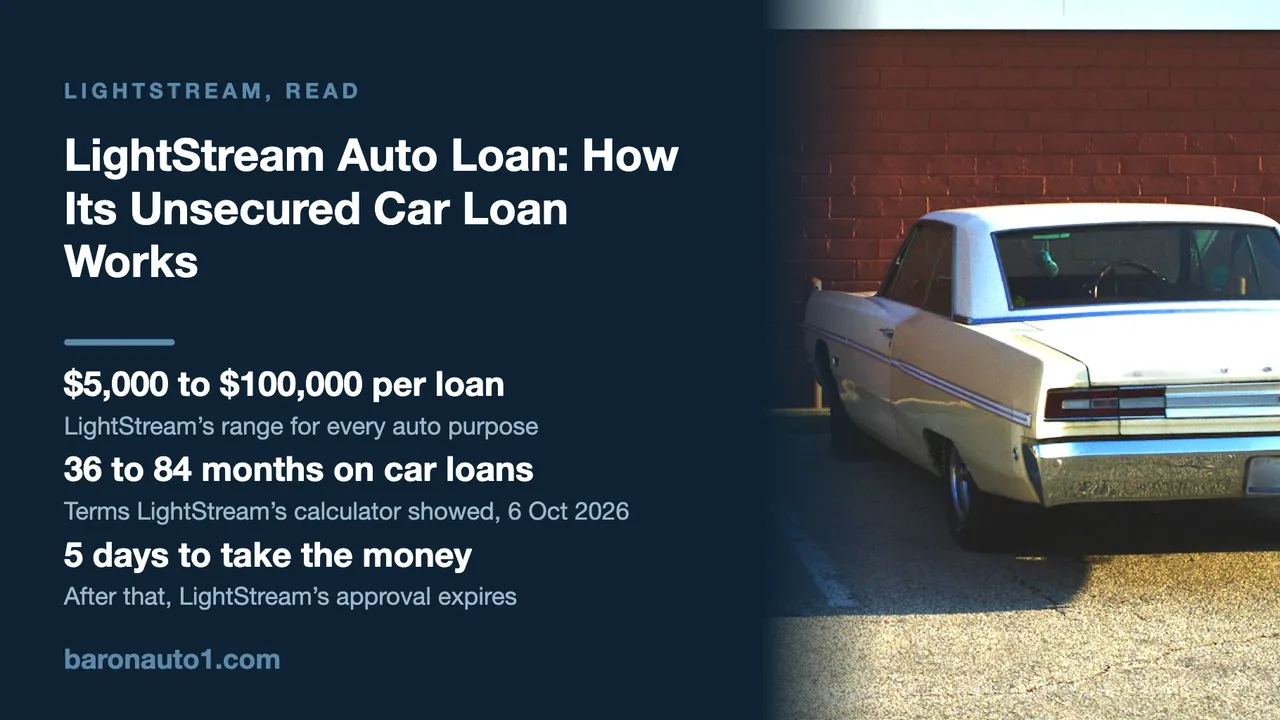
- Loans run from $5,000 to $100,000. On 6 October 2026 LightStream’s calculator showed car loans of 36, 48, 60, 72 and 84 months for new and used cars from dealers, private-party purchases, lease buyouts and refinances, with no limit on the car’s age or mileage.
- There is no pre-approval and no soft-pull preview of your own rate: the application “pulls a hard inquiry from TransUnion or Equifax,” and LightStream says it approves only good-to-excellent credit.
- The Rate Beat Program beats a competing rate by .10 percentage points only for an unsecured offer on the same terms. It “excludes secured or collateralized loan offers from any lender,” which rules out an ordinary dealer, bank or credit union car loan.
- LightStream says its loans “do not have any fees” and no prepayment penalty. Still costing money: paying by invoice instead of AutoPay (0.50 percentage points on the rate), Florida’s documentary stamp tax, and any wire fee your own bank charges.
- Once approved, the money must reach your account within 5 days or the approval expires. LightStream offers no GAP coverage. Its “guaranteed” loan experience has no published terms: the guarantee page now redirects to About Us.
A LightStream auto loan is an unsecured loan you use to pay for a car in cash: LightStream deposits the money, you buy the car, and the title carries no LightStream lien. On 6 October 2026 we read LightStream’s auto loan page, its FAQ, its Rate Beat terms and its rate calculator for all five auto loan purposes; the LightStream pages Truist hosts on truist.com; the passages about LightStream in Truist Financial Corporation’s annual reports; and the CFPB complaint file for Truist. LightStream’s loan agreement is not published, so we could not read it. We applied for nothing, and this site has no commercial relationship with LightStream, Truist or any lender.
How a LightStream auto loan works: cash in your account, no lien on the car
LightStream is a brand, not a separate lender. Its FAQ: “LightStream unsecured loans are a lending product offered by Truist Bank.” You do not need to bank with Truist, and LightStream says it serves customers “across all 50 states.” The same loan pays for a boat, a pool or a timeshare; for a car you pick one of five auto purposes in the application: New Auto Purchase, Used Auto Purchase from Dealer, Used Auto Purchase from Individual, Auto Lease Buyout or Auto Loan Refinance.
The money comes to you, not to the seller. “Be a cash buyer and get any car you want,” the auto loan page says. “LightStream deposits funds directly to your account, which saves time at the dealer, and gives you the power to negotiate a better deal with any dealer or private seller.” The FAQ widens it: “You can buy any vehicle (new or used) from anyone (dealer or individual).” The loan must be used “for the loan purpose that you selected in your loan application.”
Because the loan is not tied to the car, LightStream skips the checks a car lender makes on the vehicle. Its pages say “No appraisal, or restrictions on age or mileage,” and the FAQ says that whether you are buying or refinancing, it places no restrictions on the vehicle’s year, make, model or mileage. It also says: “We do not require any down payment for your vehicle purchase; you may apply for a loan for the full amount of the vehicle.”
The title question is answered on Truist’s own LightStream page: “An unsecured new car loan is a personal loan that is not tied to collateral. This means the car you purchase is yours from day one.” No lienholder is named on the title for this loan, and no lender looks at the car, so checking it is your job. Use our guides to checking a used car’s title and history and to a pre-purchase inspection before the money moves.
The application page adds: “Please remember to include any additional tax, titling, or registration fees in your requested loan amount.” If the out-the-door price comes in above the loan, the difference comes from your savings.
Unsecured vs secured: what changes when the car is not collateral
A dealer-arranged car loan is secured by the car. The CFPB’s auto loan glossary describes the lender who buys a dealer’s loan this way: “The assignee has a lien on the vehicle and can repossess if you don’t pay.” A LightStream loan has no lien and no vehicle to repossess. The CFPB’s teaching guide on the two kinds of credit explains the trade:
- Secured: “Secured loans require the borrower to provide collateral (something of value like a car, a boat, a home, etc.) that the bank or lending institution can take to get their money back if the borrower can’t pay back the loan.”
- Unsecured: “These loans require no collateral, so the bank or lending institution is trusting that these borrowers will pay them back.” And: “Because unsecured loans put lenders at higher risk, they may have a higher interest rate than secured loans.”
No repossession does not mean no consequences. If an unsecured loan goes unpaid, the CFPB guide says, “the lender can report late or missing payments to the credit reporting companies, can engage in debt collection, and might sue the borrower.” The risk moves from the car to your credit. Our guide to what happens in a repossession covers the secured side.
Truist sells both kinds of car loan. Its auto loan page: “Depending on your location, you can choose between a secured car loan (with collateral) or an unsecured car loan (no collateral).” The unsecured one is LightStream. On its private-party page Truist sets the two side by side and says of the secured loan, “Your car secures your loan, so interest rates tend to be lower,” and of LightStream, “An unsecured loan does not have collateral. Because of that, it may have a higher interest rate compared to a secured loan.”
| Feature | Truist secured auto loan | LightStream unsecured loan |
|---|---|---|
| Collateral | The car | None |
| Where available | Eligible dealerships nationwide; branches in 17 states and DC | Nationwide, online only |
| Vehicle age | Up to 20 prior model years | No restrictions |
| Mileage | Up to 120,000 miles | No restrictions |
| Loan amounts | $3,500 to $400,000 (minimum may vary by state) | $5,000 to $100,000 |
| Longest term | Up to 84 months | Up to 84 months |
| Fees | No prepayment penalties; late and returned-payment fees “vary by state” | “No origination fees, no pre-payment penalties, and no late fees” |
| Ways to pay | Digital, AutoPay, mail, phone, in branch | Digital: AutoPay or invoice |
| Rate held after approval | 30 days | 30 days (but see the 5-day funding rule below) |
The same choice shows up on LightStream’s application page, which tells applicants: “In your area, Truist offers additional loan options which may include different underwriting guidelines, product terms, fees and pricing.” In a branch state, a secured loan may exist under the same bank’s name, and a credit union car loan is the other common secured comparison. On the day we read both tables, Truist’s secured private-party loan started at a lower APR than LightStream’s private-party loan, as Truist’s own wording predicts.
Loan amounts, terms and the one rate we quote
Every LightStream auto page gives the same range: “from $5,000 to $100,000.” The site-wide footnote says “Loan terms range from 24 - 240 months depending on the loan type,” but the 24-month and 240-month ends belong to other purposes. For each of the five auto purposes, at $10,000, $25,000, $50,000 and $100,000, the calculator on 6 October 2026 offered the same five terms: 36, 48, 60, 72 and 84 months.
The FAQ says the fixed rate depends on loan purpose, term, amount, your credit profile and payment method. The calculator shows only the “with AutoPay and excellent credit” figure: a floor, not your quote.
On 6 October 2026, the lowest APR LightStream’s calculator showed for any auto purpose was 9.99%, for a new car or a used car bought from a dealer on a 36-month term at every amount we tried (and at 48 months on a $10,000 loan). That figure assumes AutoPay and excellent credit; without AutoPay LightStream says “Rates without AutoPay are 0.50% points higher,” and its disclosures add that “Advertised rates and terms are subject to change without notice.” LightStream also prints that “At least 33.00% of approved applicants applying for the lowest rate qualified for the lowest rate available,” based on its data from 1 April to 30 June 2026.
Three patterns in the calculator matter more than any single figure. A new car and a used car from a dealer were priced identically at every amount and term. Private-party purchases, lease buyouts and refinances were also priced identically to one another, and their floor sat 0.25 percentage points above the dealer floor by our arithmetic. And the APR rose with the term on every purpose.
| Term | Monthly payment | Total of payments | Paid above the $25,000 borrowed | Extra over the 36-month loan |
|---|---|---|---|---|
| 36 months | $807 | $29,052 | $4,052 | $0 |
| 48 months | $635 | $30,480 | $5,480 | $1,428 |
| 60 months | $536 | $32,160 | $7,160 | $3,108 |
| 72 months | $478 | $34,416 | $9,416 | $5,364 |
| 84 months | $437 | $36,708 | $11,708 | $7,656 |
Stretching the same $25,000 from 36 to 84 months cut the payment by $370 a month and added $7,656 in total cost, by our arithmetic. Our guide to how the loan term changes the price works through that trade. LightStream’s application page also prints an undated payment example at an APR far below anything the calculator showed; it is not an offer.
Who LightStream lends to: its credit standard and the hard pull
LightStream’s application help panel: “LightStream only approves good-to-excellent credit profiles.” The FAQ: “We require a good-to-excellent FICO score as a qualifier to be reviewed. However, a high FICO score does not necessarily mean applicants will be approved.” No LightStream page we read prints a minimum score, income or debt ratio. The application lists one basic requirement: “You have Good Credit including sufficient income and assets to support your existing debt obligations and requested loan amount.”
Instead of a score, LightStream describes what it looks for. For excellent credit, the FAQ lists four traits:
- Credit history: “Five or more years of significant credit history with a variety of account types” such as cards, installment loans, vehicle loans and a mortgage.
- Assets: “A proven ability to save,” shown by retirement, investment, checking and savings accounts.
- Income against debt: stable income and assets to repay current debts easily, “including little, if any, revolving credit card debt.”
- Payment history: “An excellent payment history with no delinquencies or other problems repaying debt obligations.”
For good credit the bar is “Several years of credit history” and “few, if any, delinquencies.” The test behind both, in LightStream’s words, is “whether we conclude that there is a high likelihood our loan will be repaid in a complete, timely manner.” On joint applications, “We equally review each party on the application as each individual is equally responsible for the loan.” Two groups are excluded outright: “LightStream loans are not available to non-resident aliens,” and the application says “We do not accept military residential addresses.”
The bigger practical point is the credit check. Some car lenders let you pre-qualify with a soft inquiry first; Capital One’s auto loan is one. LightStream does not (our pre-approval guide explains the difference). Its FAQ: “The LightStream loan application process pulls a hard inquiry from TransUnion or Equifax.” And: “LightStream by Truist does not provide loan pre-approvals nor do we take application information by phone, fax or email.” The calculator shows a floor for excellent credit; your own rate arrives only after the hard pull. You are not bound by it: “if you are approved for a loan, you are under no obligation to accept the loan.”
Keep the LightStream application inside the same short window as your other loan applications (see rate shopping without hurting your score); LightStream does not say whether its inquiry counts as a car-loan inquiry.
The Rate Beat Program, condition by condition
LightStream advertises that it beats competitors’ rates. Its consumer loan page asks, “How many will beat your lowest qualifying rate, from any lender? We will.” The binding version is on the Rate Beat page, read 6 October 2026:
“LightStream will offer a rate .10 percentage points lower than the rate offered on any competing lender’s unsecured loan provided that you were approved for that lower rate (with the same loan terms offered by LightStream) no later than 2 p.m. Eastern time two business days prior to loan funding. The Rate Beat Program excludes secured or collateralized loan offers from any lender, and the competitive offer must be available to any customer with a similar credit profile. Terms are subject to change at any time.”
Read as a checklist, a competing offer qualifies only if all six hold:
- An approval, not an estimate.
- Unsecured: no secured or collateralized offer, from any lender.
- The same loan terms LightStream offered you.
- In time: approved by 2 p.m. Eastern two business days before LightStream funds the loan.
- Not a special deal: available to any customer with a similar credit profile.
- Submitted by you through “Submit Rate Beat Request” in your account, with “the required documentation.”
A normal car loan offer will not trigger Rate Beat. A dealer, bank or credit union auto loan is secured by the car (the CFPB: the lender “has a lien on the vehicle”), and LightStream’s program “excludes secured or collateralized loan offers from any lender.” Only another unsecured personal loan on the same terms can be beaten. If your credit union offers a lower secured rate, the comparison is simply which loan to take, not a match.
We did not submit a request, so we cannot say what documents LightStream asks for or how it judges “a similar credit profile.” The program’s value is as a tie-breaker between two unsecured lenders, not as a way to pull a car-loan rate into a personal loan.
The guarantee LightStream advertises but does not define
LightStream’s auto loan page opens with a promise that ends in the word “guaranteed,” and its consumer loan page says “We even guarantee” that a LightStream loan will be the borrower’s greatest loan experience ever. We looked for the terms.
We found none on any live page. The address lightstream.com/guarantee redirects to /customer-experience-guarantee, which on 6 October 2026 redirected again to the About Us page. That page prints no guarantee terms: no remedy, amount, deadline or condition, and none of the auto loan pages we read on truist.com mentions one. Review sites describe a cash payment for unhappy borrowers, but those are not LightStream’s documents, and an archived copy of the old page could not be retrieved on the day. Until LightStream publishes terms, treat “guaranteed” as a slogan: ask in writing what the guarantee gives you, and keep the answer.

Fees: what “no fees” covers and what still costs money
LightStream’s FAQ answers the fee question in one line: “LightStream loans do not have any fees.” Its About page: “There are no fees or charges, nor penalties for early payment.” Truist’s LightStream pages spell it out: “No origination fees. No late fees. No pre-payment fees.” We could not check those promises against a loan agreement, which LightStream does not publish. Four costs sit outside the promise:
- Paying by invoice. “If you choose to pay by invoice, your rate will be 0.50% points higher.” The AutoPay discount “is only available prior to loan funding,” so the choice you make before funding sticks.
- Florida’s documentary stamp tax. LightStream must collect it, “slightly more than .0035 times your loan amount (or just over $35 for a $10,000 loan),” and it “will be added to your loan amount.” “The tax amount is not included in the quoted APR.” On a $25,000 loan that is slightly more than $87.50, by our arithmetic.
- Your own bank’s wire fee. For a wire, LightStream asks you to check with your bank about “any special wire instructions or wire fees.”
- The car’s own charges. Truist’s LightStream page: “You’ll only be responsible for any interest on the loan, along with any standard taxes, title, and registration fees required by the dealership or your state.”
Paying cash removes dealer financing from the deal, not the documentation fee or add-ons; see our guide to dealer fees. On taxes, LightStream’s FAQ says “We do not issue a 1098 on our loans” and points borrowers to a tax advisor about deducting interest.
GAP is the other missing piece. “No, we do not offer Guaranteed Auto Protection (GAP) insurance,” the FAQ says, and “If you are refinancing an existing loan that has GAP coverage, the coverage will not transfer.” Because the loan is not tied to the car, the balance stays due whatever happens to the car. If the car would be worth less than you owe, read our guide to what GAP covers and ask your insurer what it offers.
Funding: same day, a 5-day window and a 30-day rate
After approval you “e-sign your loan agreement and set up your loan for funding.” Same-day funding is possible by wire: the footnote says you can fund today “if today is a banking business day, your application is approved,” and you finish three steps “by 2:30 p.m. Eastern time”: e-sign the agreement, give your funding and banking details, and complete final verification. The FAQ words the wire deadline as logging in “before 2:30 p.m. Eastern Time” and scheduling “by 3 p.m. Eastern Time”; treat 2:30 p.m. as the cutoff.
For a direct deposit by ACH, the FAQ says you must log in “before 5:30 p.m. Eastern Time and schedule funding by 6 p.m. Eastern Time on the day prior to your desired receipt date.” Funding runs “Monday through Friday except on a banking holiday,” and “Funds must be deposited into your personal bank account,” never a business or third-party account.
The deadline that catches car buyers is the approval window. LightStream’s FAQ: “When approved for a LightStream loan, the funds must be transferred into your account within 5 days. After 5 days, the loan approval will expire and a new loan application will be required.” A new application means a new hard inquiry. Truist’s LightStream pages, by contrast, badge a “30-day interest lock guarantee” and say “the interest rate is valid for 30 days as long as there are no changes to your application or loan terms.” The two do not fit together: a rate held 30 days does little if the approval itself lapses after 5. Plan the purchase first, apply when the car is chosen, and take the money within the shorter window.
For a private sale, our guide to the private-party loan sequence shows the order of payment and title transfer; with LightStream there is no lender to name on the new title.
Paying it off early: the 18-day rule and principal-only payments
LightStream’s loans are simple interest at a fixed rate: “Simple interest accrues on a daily basis, based on the unpaid principal balance,” and each payment covers accrued interest first, then principal. Prepaying is allowed: “LightStream by Truist does not charge any penalties for prepaying your loan, in whole or in part.” Three rules decide whether an extra payment does what you meant:
- Early is not on time. “Payments made 18 or more days before your payment due date will be applied as an extra payment and your regularly scheduled payment will still be due.” With a due date on the 25th, a payment received on or before the 7th counts as extra, by our arithmetic, and the regular payment is still owed on the 25th.
- Principal-only payments have a set date. “To ensure the extra payment is allocated to your principal only, you must schedule your extra payment to occur on the same date as your regularly scheduled monthly payment.”
- The due date is fixed after funding. “No, once the loan has funded, you may no longer change the due date.”
Payments must come from “your personal bank account,” and same-day payments are not possible: “You must sign into your account at least two business days before your desired payment date.” Invoice borrowers pay by mail or bank bill-pay; “You cannot make payments at Truist Bank branches.”
Refinancing a LightStream loan later is possible only elsewhere: the FAQ says “You may not use your loan proceeds to refinance an existing LightStream loan.” Using LightStream to refinance another lender’s car loan is allowed, but “We do not provide any loans for cash out refinance purposes,” and Truist adds that “the vehicle title must be in your name, and you’ll need a copy of your current registration before you can refinance your existing loan.” Paying off a secured loan with LightStream money should end with the old lender releasing its lien, leaving no lender on the title. Our guide to the ways a refinance costs you money applies here too, and our reviews of RateGenius, Caribou and AutoPay cover three refinance services. For a lease, see our lease buyout guide.
What Truist’s filings and the CFPB file show
Truist’s annual reports
None of the Truist reports we read gives LightStream’s balance, volume or losses separately. The annual report for 2025, filed with the SEC on 24 February 2026, names LightStream twice. It lists LightStream inside the “other consumer” loan portfolio as “an online platform which originates fixed-rate, unsecured lending to consumers with strong credit.” And it explains 2025 loan growth in part by “a $2.8 billion increase in other consumer portfolio driven by growth of higher-return point-of-sale lending or online portfolios (Service Finance and LightStream).” That $2.8 billion covers the whole portfolio, not LightStream alone.
The year before ran the other way. The 2024 annual report says average loans in Truist’s Consumer and Small Business Banking segment fell $8.0 billion, or 6.0%, driven partly by “a decrease in LightStream loans and home equity lending.” Truist’s two 2026 quarterly reports, to 31 March and 30 June, do not mention LightStream at all, and the 2025 report’s legal proceedings note describes no LightStream matter.
The same 2025 sentence gives the context for the complaint counts below: Truist also grew its “indirect auto portfolio” by $2.6 billion. The report describes that book as “secured indirect installment loans to consumers for the purchase of new and used automobiles,” originated “through approved franchised and independent dealers throughout the Truist market area and nationally through Regional Acceptance Corporation.” Truist’s car-loan complaints come from all of these, not only LightStream.
CFPB complaint counts for Truist
The CFPB complaint database held 1,663 vehicle loan or lease complaints naming TRUIST FINANCIAL CORPORATION, received from 27 February 2020 through 5 October 2026: 6.6% of the 25,015 complaints naming Truist across all products, by our arithmetic. Complaints are unverified consumer reports, and the CFPB says the database “is not a statistical sample of consumers.” Counts grow with a lender’s size, and the file names only the parent company, so it cannot separate LightStream from Truist’s other auto lending. The CFPB has served no narratives since 30 September 2026; these are counts only.
| Issue | Complaints | Share |
|---|---|---|
| Managing the loan or lease | 613 | 36.9% |
| Problems at the end of the loan or lease | 306 | 18.4% |
| Repossession | 205 | 12.3% |
| Getting a loan or lease | 202 | 12.1% |
| Incorrect information on your report | 127 | 7.6% |
| Struggling to pay your loan | 124 | 7.5% |
| Four smaller issues | 86 | 5.2% |
The repossession line is a reminder that these counts include Truist’s secured lending: a LightStream loan has no car to repossess. Yearly counts rose from 266 in 2024 to 368 in 2025, up 38.3% by our arithmetic, with 311 in 2026 to 5 October. Truist closed 155 complaints with monetary or non-monetary relief (9.3%), and 221 carried a Servicemember tag. Among 1,152 companies named in vehicle loan or lease complaints, Truist had the 17th-largest count. LightStream’s loans are personal installment loans, and the file also holds 602 installment-loan complaints naming Truist under two personal-loan product names; none is labelled LightStream. Complaints filed under SUNTRUST BANKS, INC. and BB&T CORPORATION, which the file lists as separate companies, are not counted here. A web search of consumerfinance.gov on 6 October 2026 surfaced no enforcement action about LightStream or Truist’s auto lending: a search result, not a clearance.
Before you apply for a LightStream auto loan
- Choose the car first. The approval lapses unless funds reach your account within 5 days, and a new application means a new hard inquiry.
- Price the whole purchase. Include tax, title, registration and dealer fees in the amount you request; LightStream lends one sum.
- Get a secured quote too. A credit union or bank car loan may cost less, and Rate Beat will not match it.
- Pick the right purpose. Dealer, private-party, lease-buyout and refinance loans were priced differently, and proceeds must match the purpose.
- Choose AutoPay before funding. Invoice billing adds 0.50 percentage points, and the discount is not available after funding.
- Collect any unsecured competing offer early. Rate Beat needs an approval dated by 2 p.m. Eastern two business days before funding.
- Check the car yourself. No lender inspects it, appraises it or checks its title; run the history and get an inspection.
- Arrange GAP elsewhere if you need it. LightStream offers none, and existing GAP does not carry into a LightStream refinance.
- Ask about the guarantee in writing. No terms are published.
For other lenders’ own terms, our reviews of Capital One, Navy Federal and Ally auto loans read each company’s documents the same way.
Common questions
How does a LightStream auto loan work?
You apply online for an unsecured loan of $5,000 to $100,000 for an auto purpose. If approved, you e-sign the agreement, LightStream deposits the money in your bank account (as soon as the same day), and you pay the seller as a cash buyer. LightStream takes no lien on the car.
Is LightStream hard to get approved for?
LightStream says it “only approves good-to-excellent credit profiles” and that a high FICO score “does not necessarily mean applicants will be approved.” Applying is a hard inquiry with TransUnion or Equifax, and there is no pre-approval.
Does LightStream put a lien on the car title?
No. The loan is unsecured: Truist’s LightStream page says it is “not tied to collateral” and that the car “is yours from day one.” The flip side, in the CFPB’s words, is that an unpaid unsecured lender can report late payments, use debt collection and “might sue the borrower.”
Can I use LightStream to buy a car from a private seller?
Yes. “Used Auto Purchase from Individual” is one of LightStream’s five auto purposes, and its FAQ says you can buy any vehicle “from anyone (dealer or individual)” with no limit on age or mileage. On 6 October 2026 the private-party floor sat 0.25 percentage points above the dealer floor.
Does a LightStream auto loan have fees or a prepayment penalty?
LightStream says its loans “do not have any fees” and charges no penalty for prepaying “in whole or in part.” Paying by invoice raises the rate by 0.50 percentage points, Florida borrowers pay a documentary stamp tax added to the loan, and your bank may charge for a wire.
Can LightStream refinance my current car loan?
Yes, if another lender holds it: Auto Loan Refinance is an auto purpose, with no cash out, and the title must be in your name. LightStream will not refinance its own loans, and existing GAP coverage “will not transfer.”
Sources and further reading
- CFPB consumer complaint database
- CFPB auto loan resources
- CFPB: what is Guaranteed Asset Protection (GAP)?
- CFPB: what is a credit score?
- CFPB: how does a lender decide what interest rate to offer me on an auto loan?
- FTC vehicle repossession
Recall, complaint and safety-rating figures on this page were retrieved from the federal databases above on August 19, 2026. Federal data changes — re-check any VIN before you rely on it.
Published October 6, 2026 · last updated October 6, 2026. Found something out of date or wrong? Tell us and we will correct it.