Consumer Portfolio Services Review: Login, Rates and Record
Consumer Portfolio Services buys subprime car loans from dealers and posts no rates, but its 10-K does: a 20.0% average APR on 2025 contracts. How to log in, pay and get a payoff quote, what extensions cost, the 2014 FTC order and 3,925 CFPB complaints.
The short version
- Consumer Portfolio Services (CPS, Nasdaq: CPSS) is a subprime auto lender that buys contracts from dealers and collects the payments. To log in or pay, use the customer portal at customers.consumerportfolio.com or call CPS’s helpline, (888)469-4520.
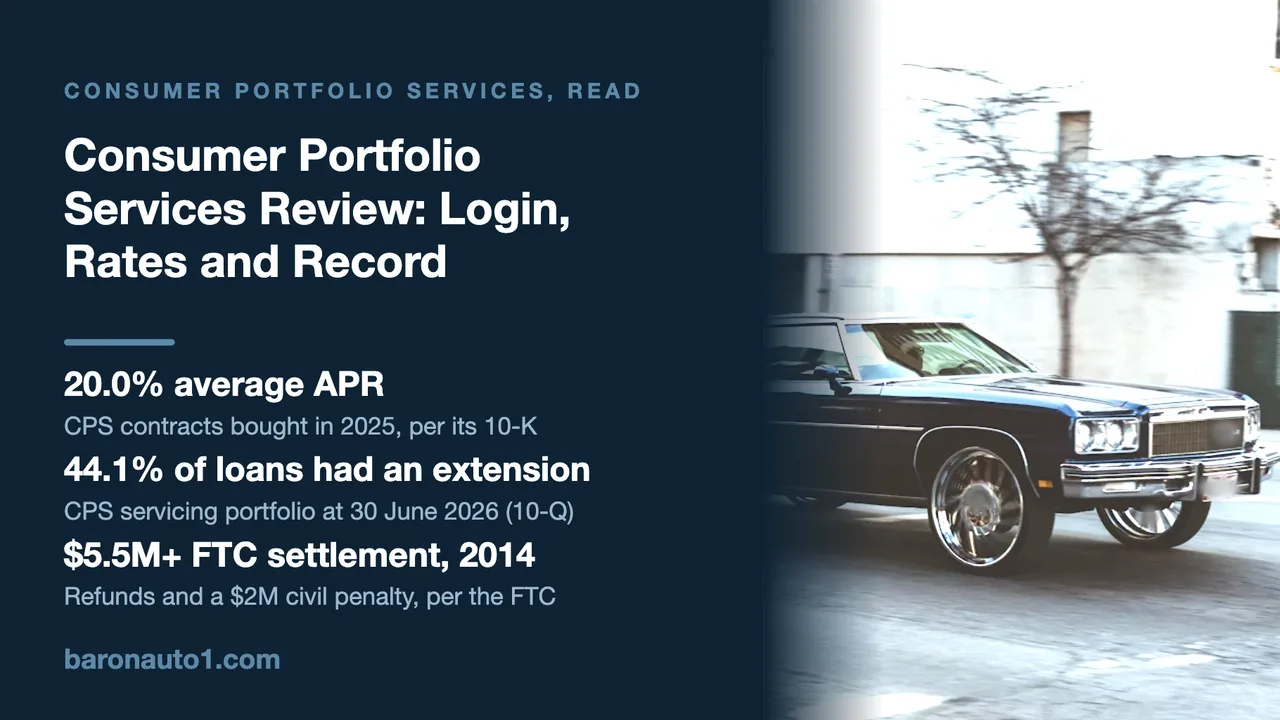
- CPS’s website shows no rates, but its 10-K does. Contracts it bought for its own portfolio in 2025 carried a weighted average APR of 20.0%, with an average of $22,652 financed over 71 months.
- You can pay off early: the 10-K says all CPS contracts “may be prepaid at any time without penalty.” CPS says payoff quotes are available in the portal around the clock.
- Extensions are common and not free. CPS moves the due date a month, interest keeps accruing, and it allows two in 12 months and eight over the loan. At 30 June 2026, 44.1% of the contracts it serviced had received at least one, by our arithmetic.
- The 2014 case was the FTC’s, not the CFPB’s: CPS agreed to refund or adjust more than $3.5 million on 128,000 accounts and pay a $2 million civil penalty, without admitting the allegations. In 2023 it settled with the Massachusetts Attorney General for $1.24 million plus trustee costs, also without admitting wrongdoing.
- The CFPB database holds 3,925 complaints naming CPS, 53.6% of them about credit reports. BBB rates CPS A+ and lists it as accredited, with 254 complaints in 3 years and a 1.13 review average from 56 reviews.
Consumer Portfolio Services is a licensed lender (NMLS #96016) that buys car loans from dealers, mostly for borrowers with damaged or thin credit. On 7 October 2026 we read CPS’s public website, including its state disclosures, its online privacy policy, its dealer FAQ and the January 2026 dealer guidelines it posts; its 10-K for 2025 and 10-Q to 30 June 2026; the FTC’s 2014 case and the court order that settled it; and its CFPB and BBB counts. We entered no login, payment or application, and this site has no commercial relationship with CPS or any lender.
How CPS financing works: the dealer writes the contract, CPS buys it
CPS is an indirect lender: its 10-K says it provides “indirect financing to the customers of dealers who have limited credit histories or past credit problems, who we refer to as sub-prime customers.” Your contract is with the dealer first; once CPS buys it, you pay CPS.
The decision is mostly automated. In 2025 CPS received 3.3 million applications, and its system gave an initial decision “within seconds on approximately 99%” of them. CPS orders “two credit reports” plus an alternative-data score and builds internal scores partly from “house/rental payment, length of employment, residence stability and total income.” Some 43% of its applications were pass-throughs from other lenders that had declined them. Since May 2021 CPS has also bought some contracts “for immediate sale to a third-party” and services them, so the company collecting your payments may not own your loan.
Before it buys a contract, CPS checks your file. Its dealer guidelines say it “will verify employment, insurance, and references prior to purchasing each contract” and “conducts a Welcome Call interview with the Applicant”; if what it verifies differs from the application, “the contract may not qualify to be purchased.” Answer the call, and compare what you hear with what you signed. Because the guidelines require that you have the car at funding, you may drive away before CPS has finished checking.
Self-employed and gig-work applicants are verified through digital bank statements: CPS’s instructions say you get a link by text or email and “will need to enter the exact same credentials” and security questions you use for online banking on a third-party verification page, with “three (3) attempts.” Decide whether you are comfortable handing a bank login to a verification vendor. The separate consent to autodialed calls and texts says that consent to texts is not required “as a condition of credit.”
The dealer is paid, or charged, for placing the loan. The 10-K reports an average net acquisition fee “charged (paid) to dealers”; in 2025 CPS paid dealers an average of $209 a contract. Its guidelines tell dealers they “are not permitted to pass along, charge, or otherwise specifically recoup” any discount or fee from you. Our reviews of Exeter Finance and Credit Acceptance read those lenders’ dealer terms the same way, and our page on buy here pay here lots covers dealers that keep the loan themselves.
CPS login, payments and phone numbers
CPS’s customer portal is at customers.consumerportfolio.com, linked as “Log In” from its home page. CPS lists what you can do there: “Make an online payment,” “View and print a recent statement,” “Get mailing instructions,” “View your payment history,” “Get a payoff quote” and “See frequently asked questions,” as well as check a new application and submit loan documents. The portal is closed to outside readers, so we did not open it.
CPS’s Michigan licence notice says “Customers may make payments 24/7 through the online customer portal or by phone.” The 10-K adds an automated phone system for account information and payments, and chat with a collector “while logged into our website.” For a mailed payment, use the mailing instructions in the portal or on your statement rather than an address copied from the web.
| What for | Number or address | Where CPS prints it |
|---|---|---|
| Customer helpline | (888)469-4520 | Home page and customer contacts page |
| Payoff and customer service | 888-718-7823 | CPS Quick Contacts, a sheet for dealers |
| Lien release and titles | 800-400-4491 | CPS Quick Contacts |
| Lienholder and insurance address | P.O. Box 57071, Irvine, CA 92619-7071 | Quick Contacts, dealer guidelines, insurance form |
| Online account, payments, payoff quote | customers.consumerportfolio.com | Home page “Log In” link |
Does paying cost extra? CPS’s public pages print no payment fee; its funding checklist describes the contract only as “Simple Interest with Late Fees.” One protection is on the public record: among the practices the 2014 court order covered later in this review prohibits is “Failing to disclose, when requesting payment by a method requiring a transaction fee, the costs and availability of all payment methods available to consumers.” If a representative steers you to a paid method, ask which methods are free. Our Westlake Financial review shows how one lender’s payment fee ended up in court.
Who CPS lends to: eight programs and the average borrower
CPS describes its customers as “individuals with past credit problems, low incomes or limited credit histories.” Its dealer FAQ advertises “No minimum FICO score” and accepts “Freshly filed Chapter 7 BK’s that are still open.” The 10-K says CPS has offered eight financing programs, priced “according to the relative credit risk.” Most of its money goes to the upper five, which made up about 90% of 2025 purchases for its own portfolio.
| Program (highest to lowest credit quality) | Share of 2025 amount financed |
|---|---|
| Meta | 4.8% |
| Preferred | 18.2% |
| Super Alpha | 19.3% |
| Alpha Plus | 19.5% |
| Alpha | 27.4% |
| Standard | 7.4% |
| Mercury / Delta | 1.4% |
| First Time Buyer | 1.2% |
| Third parties | 0.9% |
For 2025 purchases the 10-K reports an average household income of $76,433, an average age of 41, an average of 5 years in the current job, an average down payment of 10.6%, and a 7-year-old car with an average purchase price of $20,906. Used cars made up about 90% of 2025 contracts.
The dealer guidelines, effective January 2026, set the floor. You generally need “a minimum of six months of continuous, permanent employment,” and “Cash income is not acceptable.” Repossessions “less than one year old” disqualify you, and CPS “does not finance customers who have a previously charged off CPS account.” A co-signer will not rescue a weak file: CPS “does not consider co-signers or guarantors for Applicants not meeting minimum requirements,” and “Each Applicant on the contract is fully responsible for the loan.” Our guide to the credit score you need to buy a car explains why lenders rarely publish a minimum.
What CPS charges: APR, term and how much it will lend
CPS publishes no rate for car buyers; the dealer writes the APR into the contract. The nearest thing to a rate sheet is the 10-K, which prints the weighted average APR on the contracts CPS bought each year.
| Year | Weighted average APR | Average net acquisition fee |
|---|---|---|
| 2021 | 17.8% | CPS paid dealers $65 (0.3% of amount financed) |
| 2022 | 18.4% | CPS paid dealers $150 (0.7%) |
| 2023 | 20.9% | CPS charged dealers $98 (1.3%) |
| 2024 | 20.4% | CPS paid dealers $50 (0.2%) |
| 2025 | 20.0% | CPS paid dealers $209 (0.9%) |
The 2025 average is 2.2 points above 2021, by our arithmetic, and averages hide a wide range: the 10-K says the lowest tiers pay higher rates. One ceiling is on the record. CPS’s South Carolina Maximum Rate Schedule, issued 30 January 2026 and valid to 31 January 2027, posts a maximum of 28% fixed for new and used vehicle credit sales in that state, and notes that a creditor “may be willing to grant you credit rate that are lower.” That is a South Carolina filing, not a nationwide cap.
CPS will lend more than the car is worth. Its funding guidelines “generally limit the maximum principal amount” to “125% of wholesale book value” for used cars, or 125% of invoice for new ones, “plus, in each case, sales tax, licensing” and any service contract or GAP-type product. On a car with a $15,000 wholesale book value, that allows $18,750 before tax and add-ons, by our arithmetic. CPS generally does not finance cars “more than 15 model years old or have more than 200,000 miles,” and “The maximum term of a purchased contract is 78 months.” Above 100% of value you owe more than the car is worth from the first day; see our guide to negative equity.
What does 20.0% mean in dollars? By our arithmetic, CPS’s 2025 averages ($22,652 financed at 20.0% over 71 months) give a payment of $546.56 a month and $16,154 in interest, $38,806 in all. That is an illustration of averages, not a CPS offer. Bring a pre-approval from a bank or credit union to compare, and see how term length changes the rate.
Payment extensions: what CPS allows and what they cost
CPS’s public pages do not mention extensions, but its 10-K describes them in detail. CPS “will grant obligors one-month payment extensions to assist them with temporary cash flow problems.” In general, a borrower gets no “more than two such extensions in any 12-month period and no more than eight over the life of the contract.” The only change is that the next due date moves, “generally by one month,” and the maturity date moves with it. “There are no other concessions such as a reduction in interest rate, forgiveness of principal or of accrued interest,” and after an extension the account stays subject to CPS’s normal rules “for interest accrual, reporting delinquency and recognizing charge-offs.”
So interest keeps running. CPS’s contracts are simple-interest contracts, and on a hypothetical $20,000 balance at 20.0%, interest accrues at about $10.96 a day, so a one-month extension adds roughly $329 of interest, by our arithmetic. An extension may also require “all or a portion of a past due payment,” the 10-Q says. A collector recommends it, a supervisor approves it, and CPS states the test plainly: whether an extension would be “delaying an inevitable repossession and liquidation.”
Extensions are routine. In the first half of 2026 CPS granted an average of 11,152 a month, 4.8% of its accounts each month. At 30 June 2026, 104,054 of the 235,760 contracts in its servicing portfolio had received at least one: 44.1%, by our arithmetic. At the end of 2025, 58.4% of the extended contracts the 10-K counted had received two or more.
| Year granted | Extensions granted | Account active or paid off | Charged off more than 6 months later | Charged off within 6 months |
|---|---|---|---|---|
| 2014 | 25,773 | 40.4% | 56.2% | 3.4% |
| 2018 | 121,531 | 45.7% | 44.3% | 10.0% |
| 2021 | 47,010 | 66.0% | 31.4% | 2.6% |
| 2024 | 90,484 | 71.2% | 25.9% | 2.9% |
| 2025 | 110,200 | 88.5% | 8.1% | 3.4% |
Recent years look better partly because those accounts have had less time to fail. Of the 293,836 extensions CPS granted from 2014 through 2017, 58.5% were on accounts later charged off, by our arithmetic from CPS’s table. CPS counts later charge-offs as “at least partially successful,” because it collected more first. For a borrower, an extension buys time; it does not change the debt.
Get any extension in writing, with its cost. The 2014 court order bars CPS from changing a loan’s terms “through an extension of the loan term or otherwise, without express, informed consent, in writing,” which includes disclosing “all fees and costs” and whether the change “will reduce or eliminate the ongoing assessment of any fees, including but not limited to late fees.” Ask for that disclosure, check how much more interest the extension adds, and count how many of your two-a-year and eight-a-loan extensions you have used.

Late payments, collections and repossession
CPS counts a contract as delinquent when less than 90% of a payment arrives by the next due date. It tries to call “from one to 20 days after their monthly payment due date,” and an outside call center with about 80 agents supplements its collectors. A collector will ask for a payment or a promise to pay, “generally not to exceed one week from the date of the call.”
Repossession is a supervisor’s call, “Generally” made “between the 60th and 90th day past the customer’s payment due date, but could occur sooner or later.” “Prior to sale, the customer has the right to redeem the vehicle by paying the contract in full,” and CPS “may return the vehicle” if you pay all, or what it deems enough, of the past-due amount. After the sale, “proceeds usually are insufficient to pay the customer’s obligation in full, resulting in a deficiency,” and CPS may pursue it “for up to several years after charge-off” or sell the account to a debt buyer. It charges an account off at the end of the month it becomes five installments past due, or after a repossessed car is sold or has sat in inventory more than three months. CPS’s own experience is that once a contract is more than 90 days past due, “it is more likely than not” to end in a charge-off. Our guides to getting a repossessed car back and what you owe after the sale explain your rights.
| As of | Balance 31+ days delinquent | Delinquent or in repossession | Net charge-offs, share of average portfolio |
|---|---|---|---|
| 31 December 2023 | 12.3% | 14.5% | 6.5% (2023) |
| 31 December 2024 | 12.1% | 14.8% | 7.6% (2024) |
| 31 December 2025 | 11.8% | 14.8% | 7.8% (2025) |
| 30 June 2026 | 9.97% | 12.16% | 7.3% (second quarter, annualized) |
At 30 June 2026 about $429.6 million of a $4.3 billion portfolio was 31 days or more past due, and $523.9 million counting cars in repossession, by our arithmetic.
Insurance is part of the contract. CPS’s insurance form says “$1,000 maximum deductible” and “Comprehensive and collision coverage for the vehicle is required,” with CPS on the policy as first lienholder and additional insured. If you change insurers, send the new declarations page to the lienholder address above.
Paying off a CPS loan and getting your title
Early payoff carries no penalty: “All automobile contracts may be prepaid at any time without penalty,” the 10-K says. Get a payoff quote in the portal; CPS’s dealer contact sheet says “Payoff quotes on the website 24/7” and lists 888-718-7823 for payoffs and customer service.
Your title should show CPS as first lienholder, and the dealer is responsible for that. The dealer guidelines require the title to “reflect Consumer Portfolio Services, Inc. as the first lienholder within the time specified in the Dealer Agreement,” and the 10-K says that if CPS does not receive the state registration “within three months,” it works with the dealer and otherwise “generally will require the dealer to repurchase” the contract. After payoff, the lien release goes through CPS’s titles line, 800-400-4491. In the CFPB database, 25 complaints naming CPS are tagged “Unable to receive car title or other problem after the loan is paid off.”
Refinancing is less clear. CPS’s January 2026 dealer guidelines say “CPS does not refinance vehicles owned by the Applicant(s),” yet its 10-K says that in December 2025 it “began to originate loans directly to consumers for the refinancing of an existing loan from other lenders.” We found no public CPS page describing that program. To move a CPS loan to another lender, the car usually has to be worth close to what you owe; our guide to refinancing and loan-to-value explains why.
The 2014 FTC order, the 2023 Massachusetts settlement and lawsuits
On 29 May 2014 the FTC announced that CPS would “pay more than $5.5 million to settle Federal Trade Commission charges that the company used illegal tactics to service and collect consumers’ loans.” CPS “agreed to refund or adjust 128,000 consumers’ accounts more than $3.5 million and forebear collections on an additional 35,000 accounts,” and to pay “another $2 million in civil penalties.” The Justice Department filed the complaint for the FTC in the federal court for the Central District of California on 28 May 2014.
The charges, as the FTC described them, included “Misrepresenting fees consumers owed,” “Unilaterally modifying contracts by, for example, increasing principal balances,” “Failing to disclose financial effects of loan extensions,” “Misrepresenting that consumers must use particular payment methods requiring service fees,” “making unauthorized debits from consumer bank accounts,” “falsely threatening car repossession” and disclosing debts to third parties. These were allegations. The Stipulated Order for Permanent Injunction and Civil Penalty Judgment (Case 8:14-cv-00819, filed 11 June 2014) says “CPS neither admits nor denies any of the allegations in the Complaint.”
The order’s terms still matter to borrowers. It entered a $2,000,000 civil penalty, $1 million each for alleged violations of the Fair Debt Collection Practices Act and the Fair Credit Reporting Act’s Furnisher Rule. It required refunds or balance adjustments for overcharges in listed categories, among them NSF fees, late fees, legal fees, field chase fees and “Finance charges that accrued on principal balance increases related to loan extensions”; paid-off borrowers who overpaid more than $1.00 were to get refunds within ninety days. On charged-off accounts, CPS could instead forbear for good, “by never 1) reporting the account to a consumer reporting agency, 2) seeking to collect a deficiency balance on the account, or 3) selling the account.” It also required a data integrity program with independent assessments every two years “for ten (10) years,” plus the extension and payment-method rules described above.
The research brief for this page described a 2014 CFPB consent order. The documents say otherwise: the case was the FTC’s, CPS’s 10-K describes it as an FTC inquiry and “proposed remedial action against us in 2014, to which we consented,” and on 7 October 2026 the CFPB’s enforcement index returned no action under the titles “consumer portfolio” or “CPS.” CPS is subject to CFPB “supervision and examination,” which is not an enforcement action.
CPS’s 10-K for 2023 says it received a civil investigative demand from the Massachusetts Attorney General in September 2021 “relating to the Company’s communications with and repossession notices sent to Massachusetts customers.” On 28 December 2023, “without admitting any wrongdoing,” CPS entered an assurance of discontinuance to “settle and fully resolve allegations” of noncompliance with Massachusetts law. It agreed to pay $1.24 million to an independent trust for payments to eligible consumers, implementation costs and the Attorney General’s investigation costs, plus $75,000 for a trustee. We did not find the assurance itself on mass.gov, so these terms are as CPS reports them.
CPS’s 10-K for 2024 also described a Connecticut cross-claim, filed 16 October 2019, “alleging that our deficiency notices were not compliant with Connecticut law” and seeking class relief; summary judgment went to CPS and was appealed on 25 October 2024. We read no docket, and the 10-K for 2025 no longer describes the case. That 10-K says consumers “can and do initiate lawsuits” over collections, which CPS contests or settles “for immaterial amounts,” and that CPS “is not currently a party to any such material legal proceedings.”
| Date | What happened | Source |
|---|---|---|
| 28 to 29 May 2014 | FTC complaint filed by the Justice Department; settlement announced (more than $3.5 million refunded or adjusted, $2 million civil penalty); allegations | FTC release |
| 11 June 2014 | Stipulated order filed; CPS neither admits nor denies the allegations | Court order on ftc.gov |
| September 2021 | Massachusetts Attorney General’s civil investigative demand on communications and repossession notices | CPS 10-K for 2023 |
| 28 December 2023 | Massachusetts assurance of discontinuance, without admitting wrongdoing: $1.24 million to a trust plus $75,000 for a trustee | CPS 10-K for 2023 |
| 7 October 2026 | CFPB enforcement index shows no action under “consumer portfolio” or “CPS” | CFPB enforcement page |
CFPB complaints and BBB: what 3,925 reports show
The CFPB’s public database held 3,925 complaints naming Consumer Portfolio Services, Inc., received from 20 June 2012 to 2 October 2026, pulled on 7 October 2026. They are unverified reports that consumers submit and the company answers, and their number grows with the size of a lender’s book, so they show what people complain about, not how likely a problem is. The CFPB stopped publishing complaint narratives on 30 September 2026; only counts are used here.
Most are about credit reports: 2,103 (53.6%) fall under the three credit-reporting labels the CFPB has used, led by “Improper use of your report” (1,226) and “Incorrect information on your report” (684). Another 858 (21.9%) are filed as vehicle loan complaints, plus 230 under the CFPB’s older “Consumer Loan” label, and 710 (18.1%) concern debt collection. Within the vehicle loan complaints, the largest issues are managing the loan (267, led by billing problems at 120), repossession (164, or 19.1%), struggling to pay (129, with 69 about a denied request to lower payments), getting the loan (126, including 22 tagged “Loan opened without my consent or knowledge”) and the end of the loan (74). CPS closed 3,895 complaints “with explanation,” 19 with monetary relief and 11 with non-monetary relief.
| Year | All complaints | Vehicle loan or lease |
|---|---|---|
| 2020 | 181 | 61 |
| 2021 | 228 | 45 |
| 2022 | 254 | 64 |
| 2023 | 391 | 75 |
| 2024 | 551 | 99 |
| 2025 | 899 | 194 |
| 2026 to 2 October | 753 | 199 |
Complaints in 2025 were 3.94 times the 2021 count, by our arithmetic, while the portfolio CPS manages grew 1.73 times from the end of 2021 to the end of 2025. So the rise is not only a bigger book.
BBB rates CPS A+ and lists it as accredited since 23 February 2018, with 254 complaints in the last 3 years and 74 closed in the last 12 months; its 56 customer reviews average 1.13 out of 5. We read the profile once on 7 October 2026. We did not use Trustpilot figures, because Trustpilot’s terms bar collecting its content by automated means, including AI agents.
Who CPS is, what it files, and the fine print
CPS was incorporated and began operating in March 1991 and trades on Nasdaq as CPSS. The brief for this page placed it in Irvine, California; its website calls Irvine its “operational headquarters,” but the 10-K says “Our principal executive offices are in Las Vegas, Nevada,” with most operations in Irvine and servicing branches in California, Nevada, Virginia, Florida and Illinois. At 30 June 2026 CPS said it serviced a managed portfolio of about $4.4 billion for about 243,000 active customers, with 994 employees.
Its dealer pages are out of date: the dealer home page still claims “over $12 billion in loans purchased since 1991,” against “over $25.9 billion” in the profile on the same site.
Your loan probably sits in a trust: CPS has done 109 term securitizations since 1994, 19 of them active at 30 June 2026. Those bonds are not SEC-registered: the 10-K says all such debt was issued “in private placement transactions to qualified institutional investors,” and the trusts have no SEC file of their own, so no pool-level data is public and none is used here. CPS keeps servicing the loans for a fee “equal to 2.5% per annum” of the balance, so you keep paying CPS. The offerings CPS does register with the SEC include renewable unsecured subordinated notes sold to retail investors, which are not car-loan pools.
CPS’s online privacy policy (effective April 2025) says it may collect information from “employers, landlords, and personal references,” that “All personal information is collected, processed, sold and/or disclosed” under the Gramm-Leach-Bliley Act, and that it collects the location of the device you use on its website and app; California and Vermont residents get a narrower sharing rule. CPS is licensed as NMLS #96016 and posts state notices, including a Michigan licence (No. RL 0014663, effective 1 January 2007) and its South Carolina supervised lender licence. Its public site links no terms of use.
Before you sign a contract that will go to CPS
- Get a second quote first. CPS publishes no rate, and the contracts it bought in 2025 averaged 20.0%. A pre-approval from a bank or credit union gives you a number to compare; our reviews of Chase and Bank of America auto loans read those banks’ published terms.
- Read the APR, term and total of payments. CPS allows terms up to 78 months; a longer term lowers the payment and raises the total.
- Compare the amount financed with the car’s value. CPS may finance up to 125% of wholesale book plus tax, licensing and add-ons; ask for the out-the-door price in writing.
- Price each add-on separately. GAP and service contracts are financed at your APR; see how GAP works.
- Answer the welcome call. CPS uses it to confirm you understand the terms; if anything differs from your contract, say so then.
- Think before sharing a bank login. CPS verifies some income through a third-party page that asks for your online banking credentials.
- Keep full coverage with a deductible of $1,000 or less. It is a condition of the loan, and CPS must be listed as lienholder.
- Ask which payment methods are free, and get any extension in writing. Have the car checked with a pre-purchase inspection too.
Common questions
How do I log in to my Consumer Portfolio Services account?
Use the “Log In” link on consumerportfolio.com, which goes to customers.consumerportfolio.com. CPS says the portal lets you make an online payment, view statements and payment history, get mailing instructions and get a payoff quote. Otherwise, call (888)469-4520.
What is the Consumer Portfolio Services phone number?
CPS’s home and contact pages give one customer number, (888)469-4520. Its contact sheet for dealers lists 888-718-7823 for payoffs and customer service and 800-400-4491 for lien releases and titles.
Does CPS charge a fee to pay online or by phone?
CPS’s public pages print no payment fee, and the fee terms sit in your contract and the portal, which we did not open. Under the 2014 court order, CPS must disclose the cost and availability of all payment methods when it asks you to pay by a method that carries a transaction fee, so ask which methods are free.
Can I get a payment extension from CPS?
Sometimes. CPS’s 10-K describes one-month extensions for temporary cash-flow problems, generally no more than two in any 12 months and eight over the loan. Interest keeps accruing and nothing is forgiven.
How do I get my title after paying off CPS?
Pay the amount on a current payoff quote from the portal before it expires, then follow up on the lien release with CPS’s titles line, 800-400-4491. CPS contracts can be paid off early without penalty. Keep your payoff confirmation until the title arrives.
Has Consumer Portfolio Services been sued or fined?
Yes, by the FTC in 2014: CPS paid a $2 million civil penalty and refunded or adjusted more than $3.5 million on 128,000 accounts, neither admitting nor denying the allegations. In 2023 it settled a Massachusetts Attorney General investigation for $1.24 million plus $75,000 in trustee costs, without admitting wrongdoing. The CFPB’s enforcement index listed no action against CPS on 7 October 2026.
Sources and further reading
- CFPB auto loan resources
- CFPB consumer complaint database
- CFPB: how does a lender decide what interest rate to offer me on an auto loan?
- FTC vehicle repossession
- CFPB, Repossession in Auto Finance (January 2025)
- CFPB: what is Guaranteed Asset Protection (GAP)?
Recall, complaint and safety-rating figures on this page were retrieved from the federal databases above on August 19, 2026. Federal data changes — re-check any VIN before you rely on it.
Published October 7, 2026 · last updated October 7, 2026. Found something out of date or wrong? Tell us and we will correct it.