TitleMax Review: Who Owns It, What It Charges, What Regulators Found
TitleMax sells title loans, title pawns or a title pledge depending on the state, and since 2023 belongs to CCF Holdings, now part of Nasdaq-listed Katapult. What its own pages print, what its owner tells the SEC about 10% to 15% monthly fees and repossession, and what the CFPB and three states alleged, ordered or settled.
The short version
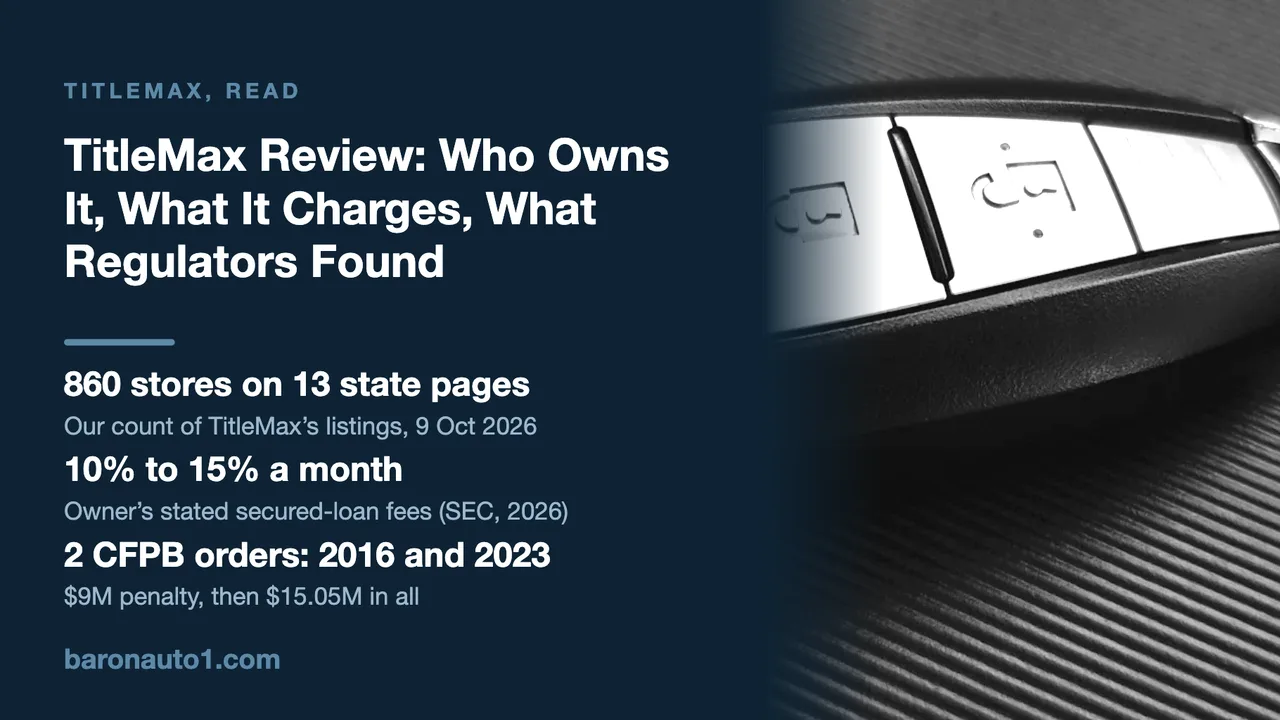
- TitleMax lends against a car or motorcycle you own outright. On 9 October 2026 its 13 state pages listed 860 stores; what it sells depends on the state: title pawns in Georgia and Alabama, a title pledge in Tennessee, credit services for a third-party lender’s loan in Texas, title loans or title-secured loans elsewhere.
- Since 2 October 2023 TitleMax has belonged to CCF Holdings, the group behind Speedy Ca$h and Check into Cash, which bought it for $189.3 million in cash. On 11 August 2026 CCF merged into Katapult Holdings, a Nasdaq-listed company.
- TitleMax’s fee schedules sit on web paths its own robots.txt closes to crawlers, so we did not read them. Its owner’s SEC filing says fees on its direct secured loans “generally” run 10% to 15% a month, which is 120% to 180% over a year before any renewal (our arithmetic, not an APR).
- The CFPB has ordered TitleMax’s parent twice: in 2016 over payback guides that did not explain the cost of renewing ($9 million penalty), and in 2023 over 2,670 prohibited loans to military families and an insurance fee charged on about 15,000 loans ($5,050,000 redress plus a $10,000,000 penalty). The company consented both times without admitting or denying the findings.
- If you fall behind, TitleMax can repossess the car. Whether you get back any sale money above the debt depends on your state: the owner’s filing lists repaying “excess proceeds” as a rule only “in certain states.”
- Its own pages disagree with each other on store counts (850+, over 900, 1,000+), on the number of states (13, 14, 16) and on whether it runs a credit check.
TitleMax is one of the largest vehicle title lenders in the United States: you borrow against a car or motorcycle you own outright, TitleMax records a lien on the title, and you keep driving while you repay. This review is TitleMax’s own record; our car title loans guide covers title loans in general. On 9 October 2026 we read TitleMax’s state pages, FAQ articles and payment guide, the SEC filings of its owners past and present, the CFPB’s case pages and orders, a federal appeals court opinion and records from regulators in Pennsylvania, Nevada and California. We have no relationship with any lender and applied for nothing.
Who owns TitleMax
In 2012 TitleMax was one man’s company. TMX Finance LLC, its holding company, told the SEC in its annual report for that year that it had 1,035 company-owned stores in 12 states and about 470,000 customers. On 30 September 2012 Tracy Young moved his membership interests to a new parent, TMX Finance Holdings Inc., and the report says “Mr. Young is the sole beneficial owner” of it. That report, filed on 27 March 2013, is the last annual report in TMX Finance’s SEC file; its last filing of any kind is dated 10 July 2013.
The sale came on 2 October 2023. According to the financial statement notes in Katapult’s July 2026 proxy statement/prospectus, Project Trident Purchaser, LLC, a subsidiary of CCF Intermediate Holdings LLC, bought the TitleMax, TitleBucks and InstaLoan businesses from TMX Finance Holdings Inc for $189.3 million in cash. On that day the business “operated in 16 states including 948 retail locations in 15 states and internet operations in 11 states.” CCF says the deal took its own retail footprint to “approximately 1,600 locations.”
CCF Holdings, formed in 2018 to succeed Community Choice Financial Inc., says that as of 31 March 2026 it “owned and operated 1,593 retail locations in 25 states,” with online lending licenses in 29 states. Its 14 brands include TitleMax, TitleBucks and InstaLoan beside Speedy Ca$h, Check into Cash, Check$mart and Cash Central. The prospectus also confirms that TMX Finance, LLC is still one of CCF’s subsidiaries.
The latest step closed on 11 August 2026, when Katapult Holdings, Inc. completed a business combination with CCF Holdings LLC and Aaron’s: a Katapult subsidiary merged into CCF, which survived, and the prospectus says CCF would become “a wholly owned indirect subsidiary of Katapult.” Former CCF owners came out with about 79.8% of Katapult’s shares, which trade on Nasdaq as KPLT; Katapult’s Form 8-K gives its head office as Atlanta, Georgia.
| Date | Owner | Size printed at the time | Source |
|---|---|---|---|
| 31 December 2012 | TMX Finance LLC, wholly owned (through TMX Finance Holdings Inc.) by Tracy Young | 1,035 stores in 12 states | TMX Finance LLC Form 10-K for 2012 |
| 26 September 2016 | TMX Finance LLC | About 1300 storefronts in 18 states | CFPB case page |
| 23 February 2023 | TMX Finance LLC | “more than 1,000 stores,” using its trade names in 20 states during the period the order covers | CFPB consent order |
| 2 October 2023 | CCF Holdings (bought for $189.3 million in cash) | 948 retail locations in 15 states | Katapult proxy statement/prospectus |
| 11 August 2026 | Katapult Holdings, Inc. (Nasdaq: KPLT), through CCF Holdings LLC | CCF overall: 1,593 stores in 25 states (31 March 2026) | Katapult Form 8-K and prospectus |
| 9 October 2026 | Same | 860 store listings on 13 state pages (our count) | TitleMax state pages |
Set side by side, the store counts fall from 1,035 in 2012 and about 1300 in 2016 to 860 listings today, 440 fewer than in 2016 (our arithmetic). One page has not caught up with the new owner: CCF’s investors page, read the same day, still introduces “CCF Holdings Inc.” and says, “As a private company, our financial statements are not posted publicly.”
Title loan, title pawn or credit services: what TitleMax sells in each state
TitleMax uses different words in different states because state law decides what the product is. Its title loans page explains that “The term title pawn is used due to state regulations,” and that in a pawn “The structure, fees, and terms are governed by state pawn laws instead of consumer loan laws.” The table below is what each state page printed on 9 October 2026, with our count of the stores it listed. We left out store addresses and phone numbers.
| State | What the page offers | Stores listed | What the page says about its size, or other terms |
|---|---|---|---|
| Texas | Credit services for title loans and personal loans from an unaffiliated lender | 240 | “more than 200 Texas store locations”; proof of income in some stores |
| Georgia | Car and motorcycle title pawns | 171 | “nearly 175 locations” |
| Tennessee | Title pledge paid in installments; secured and unsecured lines of credit | 92 | Combined maximum $6,500: pledge up to $2,500 plus secured line up to $4,000; unsecured line $100 to $2,500 |
| Alabama | Car and motorcycle title pawns | 87 | “nearly 100 stores”; borrower must be 19 |
| South Carolina | Title-secured loans; personal loans | 79 | Minimum $601 in store, $610 for an online personal loan |
| Arizona | Title loans; personal loans | 70 | “Nearly 100” locations; motorcycle maximum $2,500 |
| Missouri | Title-secured loans; in-store personal loans | 58 | “Many Convenient Locations” |
| Nevada | Title loans; in-store personal loans | 24 | Proof of income required for a title loan |
| Utah | Title loans; personal loans | 12 | – |
| Kansas | Title loans; unsecured personal lines of credit | 11 | Line of credit $100 to $4,000 |
| Mississippi | Title loans; in-store personal loans | 7 | Maximum approval $3,250 |
| Wisconsin | Title-secured loans; personal installment loans | 6 | – |
| Delaware | Title loans; in-store personal loans | 3 | – |
Texas, Georgia, Tennessee and Alabama account for 590 of the 860 listings, or 68.6% (our arithmetic). TitleMax’s sitemap lists 860 store pages too, but some state pages overstate: Alabama’s promises “nearly 100 stores” and lists 87, Arizona’s says “Nearly 100” and lists 70.
Texas works differently. TitleMax’s footer says it is “registered as a Credit Service Organization and licensed as a Credit Access Business to assist customers in obtaining a loan through an unaffiliated third-party lender.” Its owner’s prospectus says the program arranges loans “with a maximum term of 180 days,” that CCF does “not originate the loans or act as a direct lender,” and that it provides “guaranties or other credit enhancements” to those lenders. So in Texas the loan contract is with another company and TitleMax’s services are fee-based. Our car title loans guide covers the Texas rules.
The footer adds that amounts “may vary by state, store, product or based on the results of an ability to repay analysis (where applicable)” and that motorcycle loans top out at $3,000 outside Arizona and Tennessee.
States TitleMax has left
TitleMax still keeps payment pages for states where it no longer lends, and each says when it stopped:
- California: “On October 10, 2019, Governor Newsom signed a new law” effective 1 January 2020, and TitleMax “is no longer offering new loans” there. California’s regulator settled with TitleMax on 16 December 2019, two weeks before the law took effect (see state regulators).
- Virginia: no new loans effective 1 January 2021. The page still says TitleMax of Virginia, Inc. is licensed by the State Corporation Commission, license VTL-11.
- Illinois: no new loans effective 23 March 2021, the date Illinois’s 36% rate cap took effect, as our state law section explains.
- Idaho: the payment guide says TitleMax stopped new loans there on 20 September 2023; its Idaho heading refers to personal loans.
- New Mexico: TitleMax’s New Mexico page now forwards to its home page.
- Pennsylvania residents: TitleMax has no stores in Pennsylvania and, a federal appeals court noted, “is not licensed as a lender in the Commonwealth,” but it lent to Pennsylvanians who borrowed at its stores in other states. The court recorded in 2022 that TitleMax “stopped making loans to Pennsylvania residents after receiving the subpoena” from the state’s banking department.
Each exit page adds that the change “doesn’t change the terms of any existing/outstanding loans,” so borrowers there still owe on the original contract; MoneyGram payments carry “A fee of $1.99 to $12.99.”
How a TitleMax loan works, and whether it checks your credit
TitleMax describes a title loan as “a short-term, secured loan where you use your lien-free vehicle title as collateral,” and says “you temporarily surrender your physical vehicle title to the lender.” You need a lien-free title in your own name, a government-issued ID and “some type of income (unemployment, disability, retirement income, etc),” though not a job. The amount depends on “your need, credit history and the appraised value of your vehicle.”
You can start online, and in several states the appraisal can be done by phone through TitleMax’s Fast Track Appraiser app, for which the applicant “must share their location with the app, and allow the app to use the microphone and camera.” The state pages still describe a final store visit, with the car and title, to sign. When the debt is paid, TitleMax “will release its interest in your vehicle by removing its lien,” and the title returns “after it is processed by your state department of motor vehicles.” Until then the lien shows on the title; our guide to checking a car for a lien explains that record.
Does TitleMax run your credit? Its current pages say yes: “While we do perform a credit check, your motor vehicle title helps secure your account, so we accept most credit types,” and the footer lists a “credit check” among its conditions. Two FAQ articles still on the site say the opposite (“There is usually no credit check required”), matching TMX Finance’s 2012 report: “We do not run a credit check on the customer when approving the loan application for our first lien title loan product.” Assume a check today.
Can you get more money on an existing title loan? TitleMax’s FAQ says “in certain cases we can refinance the title loan you already have” with another lender, but “Refinances not available in all states or for all products.”
What TitleMax says about rates and fees
Very little, on the pages we could read. Every page says “Rates, terms and conditions apply,” and several state pages link fee schedules such as “Texas Schedule of All Fees.” Those links lead to a separate host whose robots.txt reads “Disallow: /” for every crawler, and TitleMax’s own robots.txt closes its /disclosures/ and /loans/ paths. We follow those rules, so we did not read the fee schedules or TitleMax’s Terms of Use, and no rate from them appears here.
The readable pages say you can “always pay early without penalty,” that “late penalties will differ depending on the state,” that stores do not take personal checks or credit cards, and that a typical title-secured loan runs “between $1,000 and $10,000,” repaid “with a single payment, or on an installment plan,” depending on the state.
The clearest statement of price comes from TitleMax’s owner. CCF’s July 2026 prospectus says its direct secured loans, where the customer pledges collateral “such as a motor vehicle title,” “typically range from $750 to $5,000 with a maturity of 90 days to 48 months,” and that “Fees charged vary from state to state, generally ranging from 10% to 15% per month.” Those loans stood at $546.4 million on 31 March 2026 and earned 39.5% of CCF’s first-quarter revenue, across all its brands. At those rates one month’s fee on $1,000 is $100 to $150, and twelve months is 120% to 180% (our arithmetic): a simple figure, not an APR, since installment balances fall and renewals add cost. Compare the APR in your contract.
| Source | Date | What it says |
|---|---|---|
| CCF (owner), proxy statement/prospectus | 31 March 2026 | Direct secured loans: $750 to $5,000, 90 days to 48 months, fees “generally ranging from 10% to 15% per month” |
| TitleMax website | 9 October 2026 | Typical title-secured loan $1,000 to $10,000; “up to $25,000 in certain markets”; no prepayment penalty |
| CFPB order (2023) | 23 February 2023 | Loans “typically range from $100 to $10,000 over terms that range from 30 days to 48 months” |
| Third Circuit opinion | 24 January 2022 | Loans to Pennsylvanians: “an interest rate as high as 180%” |
| Pennsylvania Order to Show Cause | 14 June 2024 | Alleged: loan agreements with rates “as high as 720 percent”; at least 5,270 loans to Pennsylvania residents, July 2008 to September 2017 |
| CFPB order (2016) | 26 September 2016 | Alabama and Georgia: monthly pawnshop charge of 9.99% to 24.99% of principal; Tennessee: 2% a month interest plus a monthly fee of 10.99% to 21.99% |
| TMX Finance 10-K | 31 December 2012 | Title loans of $100 to $5,000 |
The older rows show how prices were structured, not what you would pay now; CCF notes that its states “generally regulate the maximum allowable fees and other charges.”

If you fall behind: default, repossession and any surplus
TitleMax’s customer pages say little about default. The payment guide says late penalties differ by state, that “paying on time avoids default and collection efforts,” and asks anyone who will miss a payment to contact their store. An FAQ article states the general rule: “If a borrower defaults on a secured loan, the lender can take possession of the asset to cover the loss of the loan.” No page we could read explains TitleMax’s own repossession notices or sale.
Filings fill some of the gap. The CFPB’s 2016 order found that if a borrower “does not repay at least the accrued finance charge by the deadline set forth in the contract,” the company “may repossess the consumer’s car in accordance with state law requirements for repossession.” TMX Finance’s 2012 report called repossession “a last resort” and said it typically waited until an account was “at least 14 days past due,” a statement by the former owner, not a promise today. The current owner’s prospectus says that when recovery efforts fail, “with respect to secured loans, we may attempt repossession on the applicable collateral.”
The scale is visible in CCF’s accounts. Across all its brands, CCF took in repossessed collateral carried at $123.4 million in 2025, up from $115 million in 2024, and sold repossessed assets carried at $129.2 million in 2025 (our conversion of figures its notes give in thousands). Those are carrying values, set at “the lower of the finance receivable balance prior to repossession or the estimated net realizable value,” not sale prices.
Whether you get any money back after a sale depends on your state and your product. CCF lists among the state laws it must follow “prompt remittance of excess proceeds for the sale of repossessed automobiles in certain states in which CCFI operates as a secured lender.” Certain states, not all. The FTC warns that “In some states, lenders can keep all the money they get from selling the vehicle, even if they get more than you owe.” Pawn products such as Georgia’s and Alabama’s title pawns run under state pawn laws, which TitleMax says govern “The structure, fees, and terms” instead of consumer loan laws. Before you sign, ask TitleMax in writing which state’s law governs your contract and whether it pays a surplus after a sale.
For an ordinary secured loan, Article 9 of the Uniform Commercial Code sends sale money to the lender’s costs, then the debt, and says the lender “shall account to and pay a debtor for any surplus,” while you owe any shortfall. Some of TitleMax’s states change that: Delaware requires a workout offer, with at least 10 business days to accept, before the car is taken and bars any deficiency after the sale, and Wisconsin requires 20 days’ notice and bars most deficiency claims. Our car repossession guide covers notices, redemption and the sale.
TitleMax and the Military Lending Act
The Military Lending Act rule makes it unlawful for a nonbank creditor to lend to a covered borrower when it “uses the title of a vehicle as security for the obligation,” and caps the Military Annual Percentage Rate at 36 percent. A covered member is on active duty under a call or order that does not specify a period of 30 days or fewer, and spouses and dependents are covered too. TitleMax’s footer says: “Applicant cannot be an active-duty member of the Military, or that person’s spouse or dependent,” and its title loans page adds, “We do not accept military IDs.”
The CFPB’s order of 23 February 2023 found the policy was not followed. Between 3 October 2016 and 17 September 2021, the order says, TitleMax “made 2,670 prohibited loans to Covered Borrowers,” 2,655 of them title loans, 2,569 with MAPRs above 36%, many with APRs “in excess of 100%.” It found that in some cases TitleMax “changed consumers’ personally identifiable information” to get answers from the MLA database saying borrowers were not covered, and that it “repossessed and sold the Covered Borrowers’ vehicles” in certain instances. It also found TitleMax’s contracts required arbitration unless the borrower opted out, generally within 60 days, and a 30-day written notice before any legal action. TitleMax consented “without admitting or denying any of the findings.”
The owner’s prospectus says TMX Finance “paid $10.0 million in 2023” as the penalty, set aside $5.1 million for consumers and “has distributed all checks during 2025,” that it has policies and procedures in place to prevent lending to covered borrowers, and that TMX Finance stays bound by the order “for a period of five years from the effective date.” Veterans and retirees are outside the ban. Our title loans guide explains the MLA in full.
The CFPB’s two orders against TMX Finance
The first order, of 26 September 2016 (docket 2016-CFPB-0022), covered TitleMax’s sales pitch for 30-day loans. The CFPB’s case page says staff offered a “monthly option” and a “Voluntary Payback Guide” showing smaller payments over a longer period, which “did not explain the true cost of the loan if the consumer renewed it multiple times,” and that staff revealed borrowers’ debts while “visiting their homes, references, or places of employment.” The order banned payback guides and in-person collection visits and imposed a $9 million penalty. Our title loans guide has the findings.
What the CFPB’s file adds is how long that order lasted. Six later orders each moved its end date, the first one “to extend the termination date,” and the last set it to end the day after the CFPB issued its second order:
| Modification | Signed | New end date |
|---|---|---|
| First | 21 June 2021 | 25 March 2022 |
| Second | 31 January 2022 | 25 September 2022 |
| Third | 15 September 2022 | 23 December 2022 |
| Fourth | 12 December 2022 | 27 January 2023 |
| Fifth | 26 January 2023 | 10 February 2023 |
| Sixth | 9 February 2023 | 24 February 2023 |
Each modification kept a condition: if the CFPB sued over a violation before the end date, the order would run 5 more years from that suit. None says why the dates kept moving, and the case page now lists the 2016 matter as “Expired/Terminated/Dismissed.” The second order, of 23 February 2023 (2023-CFPB-0001), is covered above; it also found a non-file insurance fee, “typically $35,” charged on 15,386 loans whose liens were already recorded. Its case page reads “Post Order/Post Judgment,” and the owner says it stopped using non-file insurance in June 2021.
State regulators: Nevada, California and Pennsylvania
Nevada (2016, order). The Nevada Financial Institutions Division announced on 15 August 2016 that an order of 12 August, issued after an administrative hearing, required TitleMax of Nevada to stop offering its Grace Period Payments Deferment Agreement and “return all principal and interest collected under every GPPDA entered into after December 18, 2014.” The Division cited a Nevada statute that, it said, allows only a 30-day title loan, extendable up to six times, or a 210-day loan that cannot be extended; under the GPPDA, borrowers got another 210 days, with the first seven payments covering interest only. The order imposed a $307,000 fine with $257,000 held in abeyance “provided the company’s ongoing compliance with Nevada law,” leaving $50,000 outside it (our arithmetic). We could not read any later record of the case: Nevada’s court websites answered our reader with bot checks, so we do not say whether the order still stands.
California (2019, settlement). On 16 December 2019 the Department of Business Oversight announced a settlement with TitleMax of California, Inc. delivering “nearly $700,000 in refunds to more than 21,000 TitleMax customers” and a $25,000 penalty “to resolve allegations that it routinely charged excessive and illegal interest rates and fees.” The department’s examination found TitleMax used fees, including fees owed to the DMV, to push loan amounts above $2,500, “the threshold at which state interest rate limits no longer apply.” TitleMax then had 64 California branches and told the department it would stop new loans there on 1 January 2020.
Pennsylvania (pending). Pennsylvania’s Department of Banking and Securities subpoenaed TitleMax over loans to Pennsylvanians made at its stores in other states. On 24 January 2022 the U.S. Court of Appeals for the Third Circuit (No. 21-1020) held that applying Pennsylvania’s usury laws to TitleMax does not violate the dormant Commerce Clause and directed judgment for the department. On 14 June 2024 the department’s Compliance Office filed an Order to Show Cause (docket 24-0032) against TitleMax companies, TMX Finance and CCFI Companies. It alleges at least 5,270 loans to Pennsylvania residents from July 2008 to September 2017 above the 6 percent cap in the state’s Loan Interest and Protection Law, says TitleMax “is not and has never been licensed by the Department,” and asks for a civil penalty of $10,000 per offense plus restitution. At that rate the request could reach $52.7 million (our arithmetic). These are allegations; the Order to Show Cause itself orders no payment. According to the owner’s July 2026 prospectus, the hearing examiner issued a proposed decision on 14 April 2026 “in favor of the Respondent Entities, and adverse to DOBS, as to all counts,” and the Banking and Securities Commission is deciding whether to accept it. We did not read a Pennsylvania record of that step.
Complaints filed with the CFPB
The CFPB’s database files TitleMax complaints under two company names. “TMX Finance LLC” has 1,229 complaints, received from 17 April 2013 to 7 January 2024; 823 of them (67%) sit under a title-loan label. Of those 823, fees or interest the consumer did not expect account for 308 (37.4%), struggling to pay for 185, and the vehicle being repossessed or sold for 137 (16.6%). 129 carry a Servicemember tag, and 6 closed with monetary relief. The busiest year was 2023, with 387 complaints, 305 of them about title loans. After the sale, title-loan complaints appear under “CCF Intermediate Holdings LLC,” the parent of the company that bought TitleMax: 9 in 2023, 205 in 2024, 274 in 2025 and 172 in 2026 to 26 September; of its 669 title-loan complaints since 2022, 132 concern repossession. That name also covers CCF’s other brands, so those counts are not TitleMax’s alone. Pulled on 9 October 2026, these are unverified consumer reports, they grow with a company’s size, and the CFPB has served no complaint narratives since 30 September 2026.
Where TitleMax’s own pages disagree
- Size. The About page says “over 900 locations spanning 14 states” and then names 13 states; the same page says “over 850”; the title loans page says “13 states with over 850+”; two FAQ articles say “more than 1,000 locations in 16 states” and “1,000+ locations.” Its state pages list 860 stores.
- Credit checks. State pages and the footer say TitleMax checks credit; two FAQ articles say it usually does not.
- Alabama. The Alabama page sells title pawns, then sets the minimum age “to be approved for a car title loan or a motorcycle title loan.” The About page says Georgia stores offer pawns “instead of the traditional title loan” and lists Alabama among motorcycle title loan states.
- Loan size. “Up to $10,000*” on the title loans page, “up to $25,000 in certain markets” in the footer, “between $1,000 and $10,000” as typical on another page, and “$750 to $5,000” as typical in the owner’s SEC filing.
- Ownership. CCF’s investors page still calls it “a private company” two months after its merger into a Nasdaq-listed company.
Before you sign with TitleMax
- Read your state’s fee schedule. Several state pages link one; ask the store for a printed copy.
- Find the APR and total cost in the contract, not just the monthly payment, and whether it is a loan, a pawn, a pledge or (in Texas) a third-party loan plus TitleMax’s fee.
- Ask what happens after default: how many days late before repossession, what notice you get, and whether any surplus from a sale is paid to you.
- Check the arbitration clause and its opt-out window; the 2023 order found contracts allowing an opt-out “generally by written notice in the first 60 days.”
- Ask whether a GPS or starter-interrupt device comes with the loan. TitleMax’s pages do not mention one; the FTC says some title lenders insist on them, and our buy here pay here guide explains how they work.
- If you or your spouse is on active duty, TitleMax says you cannot borrow; the law agrees.
- Confirm early payoff costs nothing extra, as TitleMax says, and get the lien release in writing when you finish.
Common questions
Who owns TitleMax?
CCF Holdings LLC, the Community Choice Financial group, bought the TitleMax, TitleBucks and InstaLoan businesses on 2 October 2023 from TMX Finance Holdings Inc, which TMX Finance’s 2012 report said was owned by Tracy Young. On 11 August 2026 CCF merged into Katapult Holdings, Inc., which trades on Nasdaq as KPLT.
Does TitleMax run your credit?
Its state pages say it does perform a credit check, while accepting “most credit types” because the vehicle secures the loan. Lines of credit in Kansas and Tennessee bring a credit inquiry at application.
What is TitleMax in Texas?
A credit services organization and credit access business. It arranges a loan from an unaffiliated lender for a fee and, its owner says, provides “guaranties or other credit enhancements” to that lender. Its owner puts the maximum term at 180 days.
How much can you borrow from TitleMax?
It advertises up to $10,000, and up to $25,000 “in certain markets.” State caps apply: $3,250 in Mississippi, and $6,500 combined in Tennessee. The amount depends on your car’s appraisal, your need and, in some states, your ability to repay.
Can TitleMax take my car?
Yes, if you default. Repossession follows state law, and whether you receive any money left over after the sale depends on the state.
Does TitleMax lend to military members?
Not to active-duty members or their spouses and dependents; federal law bars it. The CFPB found in 2023 that TitleMax made 2,670 such loans between 2016 and 2021 and ordered redress.
Sources and further reading
- CFPB consumer complaint database
- FTC vehicle repossession
- UCC Article 9, part 6 — default (uniform text)
- 12 CFR §1026.4 (Regulation Z, finance charge)
- SEC EDGAR company facts API
Recall, complaint and safety-rating figures on this page were retrieved from the federal databases above on August 19, 2026. Federal data changes — re-check any VIN before you rely on it.
Published October 9, 2026 · last updated October 9, 2026. Found something out of date or wrong? Tell us and we will correct it.