OneMain Financial Review: Car-Secured Loans, Add-Ons and Lawsuits
Many OneMain loans are secured by the borrower’s car: a first lien, insurance OneMain can buy and bill to you, and fees that vary by state. What its own pages, its SEC filings, the 2023 CFPB order on add-on products and the 2026 lawsuit by 13 states say.
The short version
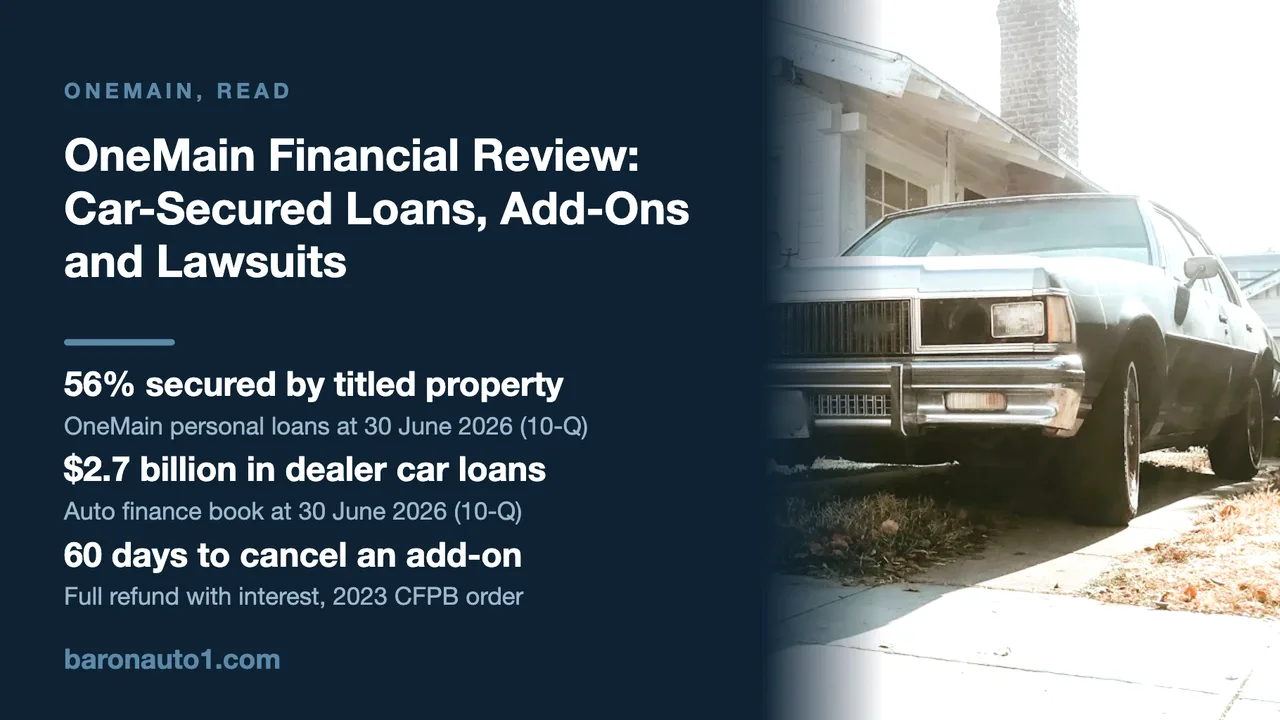
- OneMain Financial lends $1,500 to $30,000 to borrowers its annual report calls “primarily considered nonprime,” and much of it rides on cars: at 30 June 2026, 56% of its $21.3 billion personal-loan book was secured by titled property, and its dealer car loans (the Foursight business it bought in 2024) added $2.7 billion.
- A larger OneMain loan needs a first lien on a car no more than ten years old, titled in your name and insured. If the insurance lapses, OneMain says it may buy cover and add the cost to your monthly payment.
- OneMain’s fee page prints origination fees of $25 to $500 flat or 1% to 10% of the loan, late fees of $5 to $30 or 1.5% to 15%, and returned-payment fees of $10 to $50, all by state. On 9 October 2026 its loan page printed APRs of 11.99% to 35.99%.
- In 2023 the CFPB found OneMain misled borrowers about add-on products such as credit insurance. OneMain settled without admitting or denying the findings, and must now refund add-ons cancelled within 60 days in full, interest included.
- In March 2026 New York and 12 other states sued OneMain in federal court over add-ons, including GAP sold on car-secured loans in Colorado. These are allegations; no court has decided them.
- OneMain’s 7-day cancellation does not undo a car purchase, and its website terms bind visitors to arbitrate claims about any OneMain loan while leaving OneMain free to repossess first.
OneMain Financial is a large installment lender to people with fair or poor credit, and for a car owner the useful review is what happens to the car. On 9 October 2026 we read OneMain’s fee, lending-process, personal loan, auto purchase and auto refinance pages, its Help Center answers on collateral and payments, its 7-Day Okay and military pages, its website Terms of Use and its Utah “title loan” disclosure; OneMain Holdings’ 2025 annual report and its report for the quarter to 30 June 2026; the CFPB’s 2023 consent order; the March 2026 complaint by 13 states; and the CFPB’s complaint counts. OneMain’s terms forbid linking to its site without written permission, so its pages are named here, not linked. We applied for nothing, and this site has no commercial relationship with OneMain or any lender.
What OneMain is, and how much of it rides on cars
OneMain Holdings, Inc. is the listed parent; the loans are made by subsidiaries such as OneMain Financial Group, LLC. Its 2025 annual report describes two kinds of consumer loan: personal loans, made through branches and online, and “auto finance,” meaning car-purchase contracts written at dealerships. Its customers “are primarily considered nonprime and therefore a higher credit risk,” it says. “As a result, we generally charge these customers higher interest rates.” OneMain’s website says it lends in 44 states; it does not lend in Alaska, Arkansas, Connecticut, the District of Columbia, Massachusetts, Rhode Island, Vermont or the U.S. territories.
The annual report says the personal loans “are secured by automobiles, other titled collateral, or are unsecured,” and the secured share has risen:
| Date | Personal loans | Share secured by titled property | Auto finance (dealer) loans | Auto finance receivables |
|---|---|---|---|---|
| 31 December 2024 | $20.8 billion (about 2.4 million loans) | 50% | about 127 thousand | $2.1 billion |
| 31 December 2025 | $21.4 billion (about 2.4 million loans) | 53% | about 148 thousand | $2.5 billion |
| 30 June 2026 | $21.3 billion (about 2.4 million loans) | 56% | about 157 thousand | $2.7 billion |
By our arithmetic, about $11.9 billion of personal loans were secured by titled property at 30 June 2026; with the dealer loans that is about $14.6 billion, roughly 61% of the $24 billion in the two books. “Titled property” also covers boats, campers, RVs and trailers, and the filings do not split it further.
The dealer side is new. The annual report says that on 1 April 2024 OneMain bought Foursight Capital LLC from Jefferies Financial Group, Inc. “for $125 million in cash,” describing it as “an automobile finance company that purchases and services automobile retail installment contracts primarily made to near-prime borrowers across the country,” with contracts “sourced through an extensive network of dealers.” Auto finance receivables went from $745 million at the end of 2023 to $2,467 million at the end of 2025, 3.3 times as much by our arithmetic. Since 2023, the report adds, the CFPB has supervised OneMain’s whole consumer business because it is a “larger participant” in auto financing.
Three ways a car ends up in a OneMain loan
At a participating dealer. OneMain’s auto purchase page tells buyers to ask whether the dealer is “a OneMain participating dealership.” The dealer submits the application, and “once your loan is approved, money is sent directly to your dealer.” The FAQ says “you should also be prepared to secure your loan by using the vehicle you purchase as collateral,” and a car from a non-participating dealer cannot be the collateral. Residents of Hawaii, Nebraska, New Jersey, Nevada, North Dakota, Oregon, Texas, Virginia and West Virginia cannot apply or close at a dealership; their loans close at a OneMain branch and are paid by check.
From a private seller. “If you’re buying a car from a private seller, a OneMain personal loan might work for you.” Checking for offers is a soft credit pull; applying means “consenting to a hard credit pull (this may affect your credit),” the lending-process page says. Money can arrive within 1 hour of closing on a bank-issued debit card, or in about 1-2 business days by ACH. See our guide to the order of payment and title in a private sale.
Against a car you own. OneMain sells auto refinance and “cash-out auto refinance” loans as personal loans. For cash-out, its FAQ says equity is judged from “make, model, year, mileage, and Vehicle Identification Number (VIN),” that “your vehicle may also be inspected,” and that the loan “uses the borrower’s car as collateral.” OneMain’s own pages warn that “refinancing for a longer time could end up costing you more overall” and to count “any refinancing, application, origination and title transfer fees.” Our guides to refinance traps and negative equity apply.
What pledging your car means: lien, insurance and title
A secured OneMain loan puts OneMain on your title. Its lending-process page: “We require a first lien on the eligible vehicle which must be titled in your name, have valid insurance, and meet our valuation, also known as ‘loan-to-value,’ requirements.” Its fee page adds that “larger loan amounts require a first lien on a motor vehicle no more than ten years old.” Typical collateral is “cars, trucks, and motorcycles.” A first lien puts OneMain’s claim ahead of any other on the title; our guide to what a lien on a car is explains how it shows.
Why pledge? OneMain says “APRs are generally higher on loans not secured by a vehicle,” and its Help Center states the trade: “You keep the use of your vehicle while repaying your loan, but if you stop paying, we have the right to take the collateral.”
Insurance OneMain requires, and insurance it can buy for you
“Vehicles used as collateral must be insured against physical damage for the term of the loan,” the Help Center says; it calls this full-coverage insurance. If you drop it: “OneMain may get insurance on your behalf. The cost will be added to your monthly loan payment.” The annual report says OneMain requires “collateral protection insurance, at the customer’s expense,” when borrowers fail to keep required cover, and OneMain’s own Triton Insurance Company is licensed to write “collateral protection insurance” in 50 states. The insurer behind cover added to your loan can belong to your lender’s group. Keep your own policy in force and send OneMain proof at each renewal; our guide to a lapse in car insurance covers the state penalties too.
Lien fees, and getting the title back
OneMain “charges fees associated with perfecting its lien on a motor vehicle’s certificate of title,” passed through “without mark-up.” After payoff, the Help Center says: “We do our best to release motor vehicle liens within approximately 15 business days. Timing may vary depending on your state’s laws.” If the release has not reached your title office after that, ask the branch for it in writing.
Who cannot pledge a car
“Active-duty military, spouses, and certain dependents covered by the Military Lending Act (MLA) may not pledge a vehicle as collateral. If covered by the MLA, you are not eligible for a secured loan.” Our title loan guide explains that federal rule and its 36 percent cap.
Rates, fees and late charges OneMain prints
OneMain does not publish its loan agreement, and its fee page says the page “does not supersede the fee disclosures which are printed on your Loan Agreement and Disclosure Statement.” What it printed on 9 October 2026: loans of $1,500 to $30,000, terms of 24-60 months, fixed APRs of 11.99% to 35.99%, and one example: $6,000 at 24.99% APR over 60 months costs $176.07 a month, which is $10,564.20 in all, or $4,564.20 above the amount borrowed, by our arithmetic. Across the whole book, the annual report puts the 2025 consumer-loan yield (finance charges as a share of average receivables) at 22.61%.
| Fee | What OneMain prints | Where it appears on your loan papers |
|---|---|---|
| Origination | A flat $25 to $500, or 1% to 10% of the loan, “subject to certain state limits”; also called a loan processing, document preparation or credit investigation fee | First page of the Loan Agreement and Disclosure Statement, under “Prepaid Finance Charges” |
| Late payment | After any state grace period: a flat $5 to $30, or 1.5% to 15% of the payment or of its unpaid part | First page, “Truth in Lending Disclosures,” row “Late Charge” |
| Returned payment | $10 to $50 per returned check or ACH debit, where state law allows | Loan agreement |
| Lien | What the state or county charges to record OneMain’s lien | Loan agreement |
| Prepayment | None: “you can pay off your OneMain personal loan at any time without a prepayment fee” | Not charged |
On a $5,000 loan the percentage range runs from $50 at 1% to $500 at 10% before any state cap, by our arithmetic; OneMain adds that “in some cases, OneMain limits these fees, even when state law allows us to charge more.” Ask for the fee in dollars before you sign, as you would the dealer’s own charges (see dealer fees).
State law sets the edges. The fee page lists minimum loans of $2,100 in Alabama, $3,000 in California, $3,100 in Georgia, $2,000 in North Dakota and Ohio and $2,600 in Virginia, and maximums of $11,000 in North Carolina, $7,000 in Maine and $13,500 in West Virginia, with car and powersports loans from select dealerships exempt. The Help Center adds a Mississippi maximum of $12,000 that the fee page leaves out, so ask which applies. OneMain’s New Mexico sheet shows the detail state rules reach: a late fee of 5% of the installment with a maximum of $10.00, and a processing fee of 10% of the amount financed with a maximum of $200.00.
Some OneMain loans use precomputed interest, “calculated up front when a loan is opened,” and others daily simple interest; on the latter, the Help Center says, “paying late can increase the amount of interest you owe.” Your agreement says which you have.
One state’s full price list: OneMain’s Utah “title loan” disclosure
OneMain’s Disclosures page links one document with a complete schedule for its car-secured loans: “Important Information about Utah Title Loans” (Rev. Aug. 2024), which covers “personal loans secured by a vehicle made in the state of Utah.” It prints APRs of 18.00% to 35.99%, loans of $1,500 to $20,000 over 24 to 60 months, a prepaid finance charge of 5% of the amount financed ($250 on $5,000, by our arithmetic), a $20 returned-payment fee, and a late fee of “the greater of $30 or 5% of the past due portion of the payment after 10-day grace period.” On a missed $197.86 payment, 5% is $9.89, so the $30 applies.
| Amount | Term | APR | Monthly payment | Finance charge | Total of payments |
|---|---|---|---|---|---|
| $5,000 | 48 months | 18.00% | $146.87 | $2,049.76 | $7,049.76 |
| $5,000 | 48 months | 35.99% | $197.86 | $4,497.28 | $9,497.28 |
| $20,000 | 60 months | 18.00% | $507.87 | $10,472.20 | $30,472.20 |
| $20,000 | 60 months | 35.99% | $722.46 | $23,347.60 | $43,347.60 |
On $5,000 over 48 months the top of the range costs $50.99 a month and $2,447.52 more in finance charges than the bottom; on the largest row the finance charge is 117% of the amount borrowed (our arithmetic). One row does not add up: for $1,500 over 24 months at 18.00% the sheet prints a finance charge of $397.36 beside a total of payments of $1,797.36, but the total less the $1,500 borrowed is $297.36, a $100 gap. Every other row checks out.
The label matters. A OneMain resources article dated 28 April 2026 calls a title loan “a short-term, high-interest loan that uses your car title to secure the loan” and offers secured personal loans among the “safer alternatives to title loans.” In Utah, OneMain’s own disclosure files that car-secured personal loan under the title-loan heading. Printed terms side by side, with no prices compared:
| Term | OneMain personal loan | OneMain in Utah | LightStream auto loan | Car title loan (FTC) |
|---|---|---|---|---|
| Amount | $1,500 to $30,000 | $1,500 to $20,000 | $5,000 to $100,000 | 25% to 50% of the car’s value |
| Length | 24 to 60 months | 24 to 60 months | 36 to 84 months | Typically 15 or 30 days |
| The car | First lien for larger loans, or unsecured | Secured by the vehicle | No lien: “yours from day one” | The vehicle is collateral |
See our car title loan guide and, for a car loan with no lien, our LightStream review.

Add-on products: credit insurance, GAP and membership plans
OneMain’s annual report lists credit life, credit disability and credit involuntary unemployment insurance, which pay off the loan or make payments if the borrower dies, is disabled or loses a job; term life policies; “optional membership plans from an unaffiliated company”; and GAP, “to cover the shortfall between the customer’s auto loan balance and the payment amount made by the customer’s primary auto insurance.” The credit insurance comes from OneMain’s own insurers, American Health and Life Insurance Company and Triton. The CFPB’s order describes the non-insurance products as offering “roadside assistance, identity theft protection, and discounts on entertainment.”
The cost runs past the sticker price. The CFPB order says premiums and fees “are added to Customers’ loans and are subject to a finance charge,” and that OneMain pays the providers “but keeps the interest.” In 2025 OneMain booked $445 million of insurance revenue and $198 million of insurance policy benefits and claims, 44.5% by our arithmetic; that is not a regulator’s loss ratio, since it mixes every line, but it shows how much went back out. For a car loan, GAP deserves the hardest look: our guides to how GAP works and when it is worth buying show how to judge it, and your own insurer may sell it.
The 7-day cancellation, and what it does not undo
OneMain’s 7-Day Okay promise lets you cancel the loan within 7 calendar days of the loan agreement’s date if you return the money. For a car buyer the catch is in the next line: “If you purchased a vehicle or other item with your loan, OneMain does not require the seller to cancel the sale or release the funds back to you.” Credit insurance “will be canceled with the loan,” but a membership plan or non-credit product you keep must still be paid for.
What the CFPB found in 2023, and what the order requires
On 31 May 2023 the CFPB issued a consent order (docket 2023-CFPB-0003) against OneMain Financial Holdings, LLC and four affiliates. Its enforcement page says the Bureau found deceptive practices in “misleading consumers into believing they must purchase add-on products to receive loans and that they could cancel the add-on products within a prescribed time period without cost,” plus unfair and abusive practices. OneMain consented “without admitting or denying any of the findings of fact or conclusions of law.” The order requires at least $10,000,000 in consumer redress and a $10,000,000 civil money penalty. Its findings include:
- A “Full Refund Period,” “typically 30 or 45 days from purchase,” in which customers who cancelled non-insurance products got the fee back but not its interest: “more than 25,000 Customers collectively paid Respondent approximately $10 million in interest” that was never refunded.
- For credit insurance on precomputed loans, an average refund of $827 between 20 May 2019 and 20 May 2021, “$337 of which was attributable to precomputed interest” (about 41%, our arithmetic).
- A sales expectation of add-ons per loan: “In 2019, the CPL was 1.3 Optional Add-On Products with each loan.” Former employees described adding products “before showing the paperwork to the consumer.”
OneMain’s customer FAQ about the order frames it more narrowly, as a review of refunds of interest on optional products “canceled within the first 30 days,” and says “less than one percent of our customers over the last four years will be eligible.” The order is the binding text. It runs 5 years from its effective date, so to 31 May 2028 at the earliest by our arithmetic, and requires OneMain to:
- Give a written loan offer without add-ons, one you can keep, before selling any; never market a lower rate as a reason to buy one, or raise the rate because you cancel.
- Refund an unused add-on cancelled within 60 days in full, “plus all interest attributable to” it; after 60 days, the unearned part plus its interest.
- Send, within 72 hours of the sale, each product’s total cost with interest, the payment and payoff date without it and the cancellation deadline, then make a recorded call more than 48 hours after the sale.
- Accept cancellation “verbally and directly with Respondent in-person, by phone, by letter, or by email,” processed within three business days.
Check the closing papers for add-ons before you sign. The CFPB found that some OneMain customers learned a product was on their loan only from a letter after closing. Ask for the add-on-free written offer the order requires, compare its payment with the one in front of you, and cancel anything unwanted within 60 days, while the refund still includes the interest.
The 2026 lawsuit by New York and 12 other states
On 16 March 2026 New York and 12 other states (Colorado, Maryland, Nevada, New Hampshire, New Jersey, North Dakota, Oklahoma, Pennsylvania, South Dakota, Virginia, Washington and Wisconsin) filed a complaint in the Southern District of New York, Case No. 1:26-cv-2117, against OneMain Holdings, Inc. and five affiliates. The New York release says they “allege that OneMain exploits its vulnerable customers by loading their already high-cost loans with expensive and often useless additional products,” including “home and auto membership clubs.” Everything below is an allegation. We did not read the docket, so any ruling on a motion is not confirmed here, and OneMain’s report for the quarter to 30 June 2026 does not name the suit.
The car-specific part is Colorado’s GAP claim. The complaint says OneMain sold GAP waivers “uniformly priced at $300 per policy” until 10 October 2021, then switched to GAP insurance written by its own Triton, after which “the average GAP premium rose from $300 to $1,149.72, with some premiums reaching as high as $6,326.08.” It says average loan-to-value rose from about 137% to about 177%; that Colorado’s statute, effective 1 January 2024, bars GAP above 150%; and that “in 2024, approximately 63% of OneMain’s loans exceeded” it. Its example: an $8,774.46 loan with a $1,128.01 GAP premium, refinanced nine months later on the same car to a $23,098.08 balance with a $4,342.46 premium. Among the relief sought: for vehicle-secured loans with add-ons, that OneMain release the liens and “convey proper and rightful vehicle title” within thirty days.
Missed payments, repossession and the arbitration clause
OneMain’s Help Center says late or missed payments “may stay on your credit report for up to seven years” and may bring late fees. Its annual report says OneMain may offer a deferment for a temporary hardship, or a re-age that brings a delinquent account current; get any such change in writing. On a secured loan the car is the backstop: the report lists “repossessing and re-marketing of titled collateral” among OneMain’s central operations, and it writes off loans “beyond seven payments (approximately 180 days) contractually past due,” which ends the accounting, not the debt. State law governs notices, the sale and any balance left; see our guide to what happens in a repossession. OneMain’s military page lists a 6% interest-rate cap and protection from non-judicial repossession for servicemembers who entered active duty after the loan began.
OneMain’s loan agreement is not published, but its website Terms of Use say that by “accessing or using the site” you agree to an arbitration clause that reaches well past the website:
- Scope: claims about “any aspect of the relationship” with OneMain, including any loan, and about “any insurance product, service contract, membership plan, or warranty” bought with one.
- Precedence: where it conflicts with the clause in a loan signed before you accepted the terms, the website clause “shall govern.”
- Repossession first: OneMain need not arbitrate before using “self-help remedies” or court remedies such as repossession, while your damages claims about it must be arbitrated.
- What you keep: a small-claims option, a $1,000 minimum recovery if the arbitrator awards more than OneMain’s last written offer, and 30 days to reject a later change by written notice. Jury trials and class actions are waived.
Whether the website clause binds a given borrower is a legal question we cannot answer; your loan agreement will carry its own.
CFPB complaints: what OneMain borrowers report
The CFPB complaint database held 12,644 complaints naming OneMain Finance Corporation received from 16 May 2020 through 8 October 2026. Complaints are unverified consumer reports, the CFPB says the database “is not a statistical sample of consumers,” and counts grow with a lender’s size; OneMain had about 2.4 million personal loans at 30 June 2026. The CFPB has served no narratives since 30 September 2026, so these are counts only.
Consumers pick the product label, and many describe a OneMain car-secured loan as a title loan: 822 complaints carry a title-loan label and 504 sit under vehicle loan or lease, together 1,326, or 10.5% of the total (our arithmetic). Under the title-loan labels OneMain Finance Corporation had the second-largest count of 414 companies, one behind TMX Finance LLC (823).
| Issue | Complaints | Share of 822 |
|---|---|---|
| Charged fees or interest you didn’t expect | 243 | 29.6% |
| Struggling to pay your loan | 197 | 24.0% |
| Problem with the payoff process at the end of the loan | 89 | 10.8% |
| Vehicle was repossessed or sold the vehicle | 64 | 7.8% |
| Vehicle was damaged or destroyed the vehicle | 46 | 5.6% |
Across all labels, 145 complaints raised a repossession issue and 332 were filed as a “Problem with additional add-on products or services.” Yearly counts rose from 2,625 in 2024 to 3,423 in 2025, up 30% by our arithmetic. OneMain closed 1,020 with monetary or non-monetary relief (8.1%), and 1,185 carried a Servicemember tag. Older complaints sit under two other OneMain names (2,646 and 300), for 15,590 across the three; Foursight Holding LLC had 181.
Before you sign a OneMain loan secured by your car
- Ask for the offer without add-ons first. The CFPB order requires a written one you can keep; compare its payment with any offer that includes insurance or a plan.
- Get every fee in dollars. Origination, late, returned-payment and lien fees vary by state; they are on the first page of the Loan Agreement and Disclosure Statement.
- Check which interest method applies. Precomputed and daily simple interest treat late and early payments differently.
- Keep your own full-coverage insurance in force. Otherwise OneMain may buy cover and add it to your payment.
- Price GAP elsewhere before accepting it. Your car insurer may sell it.
- Diary day 60. Until then an unwanted add-on comes off with its interest refunded.
- Do not count on the 7-day cancellation to undo a car purchase. OneMain says it does not require the seller to cancel the sale.
- After payoff, chase the lien release if it has not reached your title office in about 15 business days.
For other lenders read the same way, see our reviews of Credit Acceptance and LightStream, and our credit union car loan guide.
Common questions
Does OneMain Financial do auto loans?
Yes. At participating dealers OneMain makes auto purchase loans secured by the car, paid straight to the dealer, and its Foursight subsidiary buys car contracts from dealers. For a private sale it offers a personal loan. At 30 June 2026 its dealer auto finance book was $2.7 billion.
Does OneMain put a lien on my car title?
On a secured loan, yes: it requires “a first lien on the eligible vehicle,” titled in your name and insured, and passes the state’s lien fees on to you. After payoff it says it aims to release the lien within approximately 15 business days.
Do I need full coverage insurance on a OneMain secured loan?
Yes. OneMain says vehicles used as collateral “must be insured against physical damage for the term of the loan,” and that if you have no insurance it “may get insurance on your behalf” and add the cost to your payment.
Can I cancel OneMain credit insurance or other add-ons?
Yes. Under the 2023 CFPB consent order, an unused add-on cancelled within 60 days must be refunded in full with its interest, and you can cancel in person, by phone, by letter or by email. Later cancellations return the unearned part plus its interest.
What is the OneMain lawsuit about?
In March 2026 New York and 12 other states sued OneMain in federal court in New York, alleging it packed loans with add-on products such as credit insurance, membership plans and, in Colorado, GAP. The claims are allegations and have not been decided.
What happens if I stop paying a OneMain car-secured loan?
OneMain says it has the right to take the collateral, late payments may stay on your credit report for up to seven years, and late fees vary by state. Call before you miss a payment; its annual report says it may offer a deferment for a temporary hardship.
Sources and further reading
- CFPB consumer complaint database
- CFPB auto loan resources
- CFPB: what is Guaranteed Asset Protection (GAP)?
- FTC vehicle repossession
- UCC Article 9, part 6 — default (uniform text)
Recall, complaint and safety-rating figures on this page were retrieved from the federal databases above on August 19, 2026. Federal data changes — re-check any VIN before you rely on it.
Published October 9, 2026 · last updated October 9, 2026. Found something out of date or wrong? Tell us and we will correct it.