Omega Auto Care Review: Who Owes the Repair and What Its Contracts Say
EGV Companies owes the repair on most Omega Auto Care contracts; in four states its insurer does. What the three sample agreements say about the $100 deductible, the $12,500 cap, refunds and transfers, beside a 2019 Maine order and a robocall suit dismissed on the pleadings.
The short version
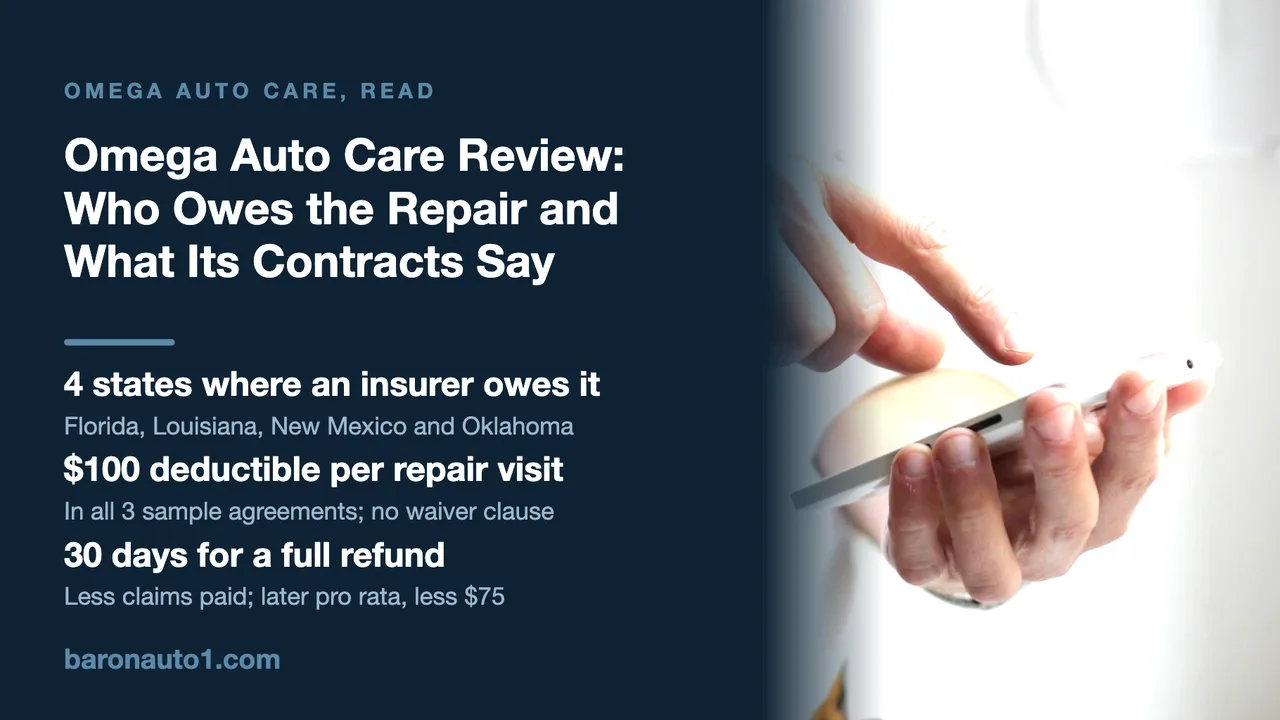
- Omega Auto Care is the brand of EGV Companies, Inc., which administers the contracts and, in most states, owes the repair. In Florida, Louisiana, New Mexico and Oklahoma the sample agreements make Lyndon Southern Insurance Company the obligor instead.
- Whoever sold you the contract, a marketer or a dealer, “is not a party to this Agreement and has no obligations to You,” according to the agreements.
- All three sample agreements print a $100 deductible per repair visit and cap total claims at the car’s value when bought or $12,500, whichever is greater. None prints a price or a waiting period in days or miles.
- Cancel within 30 days and you get the full price back less any claims paid; after that, a pro rata refund less a $75 fee. If a payment plan is unpaid, the funding company gets the refund.
- Only the original buyer can transfer a contract, by selling the car directly to another person within 30 days and paying $50. Dealer trade-ins are excluded.
- Maine fined EGV $1,250 in 2019 for administering contracts before registering. A 2017 robocall lawsuit naming Omega was dismissed on pleading grounds, with no finding. We found no FTC or state attorney-general action naming Omega.
Omega Auto Care sells and administers vehicle service contracts, often called extended car warranties, and many people meet it through a sales call, a mailer or a contract left over from a used car’s previous owner. What you are owed is in the agreement, not the pitch. On 16 October 2026 we read the three sample agreements linked from Omega’s Coverage page, its benefits, claims, FAQ, about, contact and privacy pages, a 2019 Maine consent agreement, a 2020 federal appeals opinion, a 2020 California Department of Insurance release and SEC filings on the insurer behind the contracts. Omega publishes no terms of use. We requested no quote, and this site has no commercial relationship with Omega or any seller of service contracts.
Who owes you the repair on an Omega contract
A service contract has a seller, an obligor that owes the repair, an administrator that runs claims, and often an insurer behind the obligor. Our guide to who owes you the repair explains why the obligor matters most. Omega’s samples name the parties on their first two pages, and the answer depends on your state:
| Where the contract is sold | Obligor (owes the repair) | Insurer named |
|---|---|---|
| Most states | EGV Companies, Inc. | Lyndon Southern Insurance Company |
| Florida, Louisiana, New Mexico, Oklahoma | Lyndon Southern Insurance Company | Lyndon Southern Insurance Company |
| New York, Rhode Island, Wisconsin | EGV Companies, Inc. | Atlantic Specialty Insurance Company |
| Georgia | EGV Companies, Inc. | Insurance Company of the South |
| California | Omega says it does not offer auto coverage to California residents | |
The seller is not on the hook. Every sample says “The Seller (issuing party) is not a party to this Agreement and has no obligations to You in regards to the benefits provided.” EGV Companies, Inc. is the administrator everywhere. If a telemarketer or a dealer sold you an Omega plan, claims go to EGV, not to the company that took your payment.
The insurer is a backstop with a clock. Your benefits are “insured by an insurance policy with Lyndon Southern Insurance Company,” and if they are “not provided within sixty (60) days after You provide proof of loss,” you may claim directly against Lyndon Southern. In New York, Rhode Island and Wisconsin the policy is issued by Atlantic Specialty Insurance Company, and Georgia residents are guaranteed by Insurance Company of the South. Look the obligor up on your state’s service contract register before you pay.
The website says something simpler. Omega’s contact page says: “As the administer and obligor of our own plans, we’re with you every step of the way.” In the four states where Lyndon Southern is the obligor, Omega is the administrator only. The name on your own agreement is the one that counts. One clause does reach the seller: the arbitration provision defines “We” to include “any retailer or distributor of its products,” so a dispute with the seller goes to the same arbitration.
Who Omega Auto Care is, and who stands behind it
The company. Omega’s privacy policy is written in the name of EGV Companies, Inc., which it says “markets Omega products in auto, home, electronics, and device protection.” The agreements give EGV a Jacksonville, Florida address. Maine’s 2019 consent agreement adds that EGV “is domiciled in Missouri” and that “Ensurety, Inc. legally changed their name to EGV Companies, Inc., effective February 16, 2016.” A 2020 appeals opinion names a related company, “Ensurety Ventures, LLC, d.b.a. Omega Autocare.” An unfinished Omega page, “Our Family of Products,” lists six brands, among them Drive America, EFS Companies and Driven Solutions.
How long it has operated depends on the page. The banner on every page reads “Servicing Vehicle Owners for Nearly Two Decades!” and the contact page says “nearly 20 years,” while the about page says “Since 1968.” Maine’s order dates EGV’s administration of Maine contracts from September 3, 2014.
The insurer’s group. Lyndon Southern Insurance Company and Insurance Company of the South are on the subsidiary list (Exhibit 21.1) that The Fortegra Group, Inc. filed with the SEC on January 29, 2024, which says all listed subsidiaries are wholly owned by Fortegra. Tiptree Inc., Fortegra’s parent, still listed Lyndon Southern as a subsidiary on December 31, 2025. Tiptree agreed on September 26, 2025 to sell Fortegra to DB Insurance Co., Ltd. of Korea by merger, and its 8-K reports the deal closed on May 29, 2026, with Fortegra now “a wholly owned subsidiary” of DB Insurance. Nothing we read says Fortegra or DB Insurance owns Omega or EGV.
Payment plans and reinsurance. A credit agreement of Fortegra’s premium-finance companies, dated October 6, 2023 and filed as Exhibit 10.7 to Fortegra’s registration statement, defines two agreements that touch Omega. One, dated August 5, 2019, has South Bay Funding LLC acquiring “Warranty Service Payment Plan Agreements,” with EFS Companies, LLC as subservicer and “EGV Companies, Inc., as Administrator.” The other is an “Indemnity Reinsurance Agreement dated May 7, 2013” between Lyndon Southern and “Ensurety Reinsurance, Ltd.” A lender’s agreement does not say how many Omega plans are financed or reinsured. It does explain an FAQ answer: asked who receives a monthly payment, Omega offers to help you find “your contract provider and payment information.” If you pay monthly, the company collecting may not be Omega.
Who owns Omega. None of the documents we read names the owners of EGV Companies or Ensurety Ventures, and an EDGAR full-text search found no SEC filing by either. We did not use news reports or business directories for ownership.
Who sells Omega contracts, and the marketing calls
The agreements define the seller only as “The entity that sold this Agreement to You,” named on the declarations page. Omega’s pages point to three channels: direct marketing (the privacy policy mentions information “from our marketing partners and other third parties,” and a post on the site is an RSVP page for a “2025 Agent Summit Reception”); dealers (an “Auto Dealer Customer Service and Claims” line on every page, and an “OAC Dealer Services” unit that designs “F&I product programs”); and Omega’s own quote form, which we did not use.
Omega’s pages say nothing about robocalls or about third-party marketers using its name. The one court record we read is about exactly that: in Hirsch v. Ensurety Ventures, LLC, a consumer sued in 2017 under the Telephone Consumer Protection Act, alleging, in the appeals court’s summary, that the defendants “find and hire non-party call centers, and instruct those entities to make the calls to consumers.” Those were allegations; the case was dismissed with no finding about who made any call (see regulators and courts).
If an Omega plan is offered on a call you did not ask for, ask for the sample agreement and declarations page before giving card details, and check the obligor against the table above. The FTC’s alert on extended warranty calls lists the warning signs. California is different: Omega says “We currently do not offer auto coverage to residents of California,” and the California Department of Insurance says service contracts “can only be sold through dealerships licensed by the Department of Motor Vehicles. Direct sales to consumers are illegal.” See mechanical breakdown insurance in California.
The plans, who qualifies, and what each one covers
Omega’s Coverage page offers three programs, with Powertrain sold at three levels. Its 5 sample links lead to 3 distinct agreements, all with form codes ending 0319 and saved as PDFs on 31 July 2020. Eligibility depends on the car’s age in model years and its odometer reading:
| Plan | Cars Omega says qualify | How the sample agreement defines cover |
|---|---|---|
| New Exclusionary | Current model year + 7 model years, under 100,000 miles at purchase | All assemblies and parts except a printed list |
| Used Stated | Current model year + 10 model years, under 150,000 miles | Named parts under 13 system headings |
| Powertrain | Current model year + 15 model years, under 250,000 miles | Engine, transmission, transfer case and drive axle parts, plus hybrid drive parts |
| Powertrain Plus | As Powertrain | Powertrain plus 9 named A/C and electrical parts |
| Powertrain Enhanced | As Powertrain | Powertrain Plus plus 23 named A/C, cooling, fuel and electrical parts |
New Exclusionary covers “all assemblies and parts” except a list that includes paint, trim, body panels and glass; all exhaust components and the catalytic converter; the battery, spark plug wires, fan belts and non-metallic hoses; shock absorbers and the clutch assembly; tires and wheels; airbags; and all maintenance services, naming brake pads, rotors, alignments and tune-ups.
Used Stated covers only the parts it names, under 13 headings from engine and transmission to brakes, electrical and hybrid. It warns that “The vehicle systems listed are NOT Covered Parts”: a heading covers only the parts listed beside it. The factory radio and speakers are covered up to $300.
Powertrain covers the engine’s block, heads and internally lubricated parts, turbocharger, timing chain or belt and water pump; the transmission case, internal parts, torque converter and valve body; the transfer case; and drive axle parts. “Leaking seals and gaskets are not Covered Parts,” and “Constant velocity joint boots are not covered under any circumstances.” Powertrain Plus adds 9 parts, such as the A/C compressor, alternator and starter. Powertrain Enhanced adds 23 more, from the A/C dryer and fuel pump to power window motors and manually operated switches. Hybrid drive parts are covered, but “Batteries are excluded.” The Exclusionary and Used Stated samples also offer an Enhanced Electronics Package paying $750.00 toward factory radios, screens and similar equipment, if you paid for it on the declarations page.
What every Omega agreement excludes
- Anything still under the factory warranty, or covered by a recall, special policy or technical service bulletin: repairs are excluded “IF THE VEHICLE IS STILL IN THE MANUFACTURER’S BASIC WARRANTY PERIOD.”
- Anything that broke before cover started, before the purchase date “OR THE DATE COVERAGE TAKES EFFECT,” or before “THE COMPLETION OF THE VALIDATION PERIOD.”
- Missing maintenance records for “THE LENGTH OF OWNERSHIP,” wear within the carmaker’s published tolerance, and gradual loss of performance.
- Contamination, corrosion, sludge, carbon build-up, detonation and the wrong fuel; and damage from continuing to drive an impaired car.
- Some uses and cars, whatever you pay: police, taxi, limousine, shuttle, delivery and racing use “REGARDLESS OF WHETHER THE BUSINESS USE OPTION WAS PURCHASED,” and salvage or branded-title, grey-market, lifted and exotic vehicles or anything over 1 ton. See salvage and branded titles.
- Modifications such as oversized tires and lift kits, and breakdowns outside the United States or Canada.
Two exclusions can swallow an engine claim. Every sample excludes “A BREAKDOWN CAUSED BY OR FOR DAMAGES RESULTING FROM OVERHEATING REGARDLESS OF CAUSE,” and a breakdown “OF A COVERED PART BY A NON-COVERED PART.” An uncovered hose that bursts and overheats the engine can fall under both. Ask the administrator in writing how it applies them before you buy.
Omega’s FAQ is candid about denials: “In many cases the component your repair shop is asking to repair or replace is not specifically listed in your contract for coverage.”
When cover starts: the samples print no waiting period
None of the three samples includes a declarations page, and none prints a waiting period in days or miles. The agreements still refer to one: the emergency-repair rules tell you to check there is no “wait period in effect,” and the exclusions mention a “VALIDATION PERIOD” they never define. What is printed:
- First payment first. “YOU must make your first monthly payment per the payment plan agreement before claims can be paid.”
- An oil change within 60 days of purchase, unless you have a receipt from the 6 months before; then every 6 months or 5,000 miles, whichever comes first, or on the carmaker’s schedule.
- The maintenance perks begin 30 days after purchase and end 13 months after it.
Before paying, ask for the declarations page you will receive and read the waiting period on it. Other sellers print theirs there; see CarShield’s and CARCHEX’s.
Deductible, price and the most Omega will pay
The deductible. All three samples state: “A one hundred dollar ($100) DEDUCTIBLE per repair visit will apply.” Omega’s home page adds: “Use one of our RepairPal certified shops and we’ll waive your deductible.” No sample agreement contains that waiver, so get it in writing if it matters to you.
The price. No Omega page or sample prints one; a figure means filling in the quote form. Our guide to why service contracts have no sticker price explains what drives the quote. Omega’s home page calls the product “insurance for when your vehicle inevitably becomes damaged due to mechanical failure”; the documents are Vehicle Service Agreements, and Maine registered EGV as a service contract provider. See why a service contract is not a warranty.
The cap. Total claims “shall not exceed the actual cash value of YOUR VEHICLE at time of AGREEMENT purchase, or $12,500, whichever is greater.” On a car worth less than $12,500 the cap is $12,500 for the whole contract; on a car worth more, it is the car’s value when you bought the plan, not when it breaks. See how the cap changes the arithmetic.
The number on the Coverage page. Omega asks, “Do you have $11,535 for vehicle repairs?” The same page lists an “average repair cost” for 12 systems, from $1,420.41 for the engine and $1,186.09 for the transmission to $603.00 for brakes. By our arithmetic the 12 averages add up to $11,535.82, using the top of the electrical range. The headline is what you would pay if all 12 systems failed at once, not the cost of a typical breakdown.
How a claim works, and where the car can be repaired
“Authorization from Omega Autocare is strictly required before any repairs can begin,” says the claims page. The agreements set out the sequence:
- Protect the car. Damage from “THE CONTINUED OPERATION OF AN IMPAIRED VEHICLE” is excluded; roadside assistance can tow it.
- Take it to a licensed shop and have the shop call the administrator before any work. You authorise the diagnosis: “If the failure is not a Covered BREAKDOWN, then YOU are responsible for this charge.”
- Wait for the authorization number. The administrator may inspect the car first, and “Repairs performed without prior approval will not be honored” except emergency repairs.
- The repair is paid at guide rates. Labor is checked against the Motor’s, Mitchell and All Data guides; parts may not exceed the maker’s list price and may be “new, remanufactured or used.”
- You pay the $100 deductible, and Omega pays the shop by “direct credit card payment” once the repair is invoiced, its FAQ says.
Which shop. Omega’s FAQ says “Any licensed repair facility.” The agreements define a repair facility as one “authorized by the ADMINISTRATOR,” and if the administrator decides the shop cannot diagnose or repair the car, or the two disagree, it may move the car to a facility of its own choice.
Emergencies and records. If the administrator is closed, you may authorise a repair needing 2 hours or less of labor and costing no more than $500, then call within 5 business days; the FAQ mentions the two hours but not the $500. And “WE will not reimburse for repair costs or expenses if YOU cannot provide accurate records proving that You have maintained the failed COVERED PART.” Keep every oil-change receipt. Our guide to how a service contract claim works covers the general pattern.

Rental car. The benefits page gives every plan “$30 per day, maximum of $150 per occurrence.” The agreements add that on claims over $3,000 the limit is $240 for up to 8 days, plus 3 more days ($90) if parts are delayed: $330 at most for one breakdown, by our arithmetic. You need the rental agency’s receipt; no deductible applies.
Trip interruption. If a covered repair strands you overnight more than 100 miles from home, lodging and meals are paid at up to $75 a day for 3 days, $225 per breakdown.
Roadside assistance is limited to $100 per occurrence. The agreements name United States Auto Club, Motoring Division, Inc. as the provider; Omega’s roadside page names Driven Solutions. Both say help from any other source “IS NOT COVERED AND IS NOT REIMBURSABLE” without prior authorization, and “THIS IS NOT A ROADSIDE ASSISTANCE REIMBURSEMENT SERVICE,” although the benefits page lists “Reimbursement: up to $100 per occurrence.” Call the number on your contract first.
Tires and maintenance. Road-hazard tire repairs are paid up to $20 per tire and replacements up to $100 per tire, $400 in all, if the tire has more than 3/32 inch of tread and the work is pre-authorised. Omega’s maintenance page, not the agreements, adds up to 3 oil changes at $40.00 each ($120 by our arithmetic), $100.00 or $130.00 toward brake pads, a $100.00 battery credit and one cooling-system service, claimed within 45 days; that page says refunds take 3-4 weeks, the claims page 2-3 weeks.
Cancelling, refunds, and transferring an Omega contract
The agreements let you cancel “by returning it to the Seller or directly to US,” with an odometer statement; Omega’s FAQ says to contact Client Services. What the samples print:
| Situation | What the agreement says |
|---|---|
| You cancel within 30 days | The entire purchase price back, less any claims paid |
| You cancel after 30 days | Pro rata by days or miles, whichever gives the smaller refund, less claims and a $75 fee, “except where state law provides otherwise” |
| Financed, or a payment plan not paid off | The finance or funding company is entitled to the refund |
| You miss monthly payments | It may be cancelled “and no refund will be due”; a plan stopped for non-payment shrinks the term to the part paid for |
| The car has a lienholder | The lienholder is named on the refund check |
Two clauses are easy to miss. The refund is split: the obligor refunds its share, and “The Seller agrees to pay the unearned portion of the commission,” so part of your money comes back from whoever sold the plan. And the cancellation form says to mail the agreement’s front page “to the Seller listed on the declarations page,” though you may also contact the administrator. Write to both, with the date and odometer reading. Unlike the CarShield and CARCHEX samples, Omega’s 30-day refund does not require that no claim was made; claims paid are deducted instead. See how to cancel an extended warranty.
Selling your car. “This AGREEMENT will terminate when YOU sell YOUR VEHICLE unless transferred.” A transfer works only if you are the original purchaser and sell “directly to another individual (excluding dealer trade-ins),” notify the administrator in writing within 30 days and pay $50 ($40 in Florida). Any payment plan must be paid off or taken over, you must hand over proof of maintenance, and the new owner is covered only on “Confirmation of the transfer acceptance by US.” The coverage “cannot be renewed.”
Found an Omega contract on a used car? Under the samples’ wording it covers you only if the previous owner sold you the car directly and Omega confirmed a transfer made within 30 days. If the car was traded in to a dealer, the transfer is excluded and the contract terminated on that sale. Call the administrator with the contract number before relying on it. Our Zurich page shows how differently other forms treat transfers.
Regulators, courts, and a different “Omega”
Maine, 2019. In a consent agreement with the Maine Bureau of Insurance and the Maine Attorney General’s office (Docket No. INS-19-227), resolved “without resort to an adjudicatory proceeding,” EGV agreed to these facts: the Bureau received a complaint in March 2018 about “a vehicle service agreement marketed as Omega Auto Care,” bought on January 12, 2017; EGV had administered 662 Maine contracts since September 3, 2014, 284 still active; and it did not register as an administrator until April 18, 2019. EGV accepted a civil penalty of $1,250 and agreed to keep its registration current. The order is about registration, not claims or sales.
The robocall lawsuit. Hirsch v. Ensurety Ventures, LLC, d.b.a. Omega Autocare was filed on October 30, 2017 in the Middle District of Florida (No. 3:17-cv-01215) against Ensurety Ventures and Fortegra Financing Corporation under the Telephone Consumer Protection Act. The Eleventh Circuit’s unpublished opinion (No. 19-13527, March 18, 2020) summarises the claim that Ensurety, trading as Omega Autocare, and Fortegra, “which provides underwriting services to Omega,” were responsible for calls advertising Omega policies. A later complaint named seven defendants, including EGV, Lyndon Southern and Insurance Company of the South. The district court dismissed it with prejudice as an “impermissible shotgun pleading,” and the appeals court affirmed, noting that “Hirsch did not allege that either Fortegra or Omega had made any of the subject calls.” No court found that anyone made unlawful calls.
A different company called Omega. On May 4, 2020 the California Department of Insurance announced a cease and desist order against “Omega Vehicle Services, LLC doing business as Delta Auto Protect” for “allegedly selling illegal Vehicle Service Contracts” (release 041-2020). Nothing we read connects that company to EGV or Omega Auto Care. Search results often mix the two, so check the company name on any record you find.
What we did not find. Searches of the FTC, CFPB and Justice Department sites and for state attorney-general releases on 16 October 2026 found no action naming Omega Auto Care, EGV or Ensurety; that is a search result, not a clearance. Omega’s home page shows “BBB Accredited with an A+ rating”; BBB’s site blocked our request, so we have not checked it. Compare the FTC’s 2024 order against CarShield and what regulators have done in this industry.
Disputes. Every sample requires binding arbitration before one arbitrator under the American Arbitration Association’s expedited rules, with no jury and no class action. On written request the company will advance “all or part” of the fees, and the arbitrator decides who finally pays. Florida buyers can also use the Florida CFO’s service agreement page.
Is Omega Auto Care worth it, and how its printed terms compare
Whether any service contract is worth buying depends on the car, the cap and the price; see when an extended warranty is worth it. Omega prints no price, so this compares printed terms only, beside two sellers whose samples we have read. It ranks no one.
| Term | Omega Auto Care | CarShield | CARCHEX |
|---|---|---|---|
| Who owes the repair (most states) | EGV Companies, Inc. | American Auto Shield, Ltd | American Auto Shield, Ltd |
| Insurer named behind the obligor | Lyndon Southern (others in NY, RI, WI and GA) | None on the car term samples outside Florida | American Bankers Insurance Company of Florida |
| Waiting period printed | No days or miles printed | 30 days and 1,000 miles, or 90 days and 200 miles | First pair blank, or 90 days and 200 miles |
| Full refund window | 30 days, less any claims paid | 1 month, if no claim made | 30 days, if no claim made |
| Cancel fee, then transfer fee | $75, $50 | $75, $50 | $75, $50 |
| Rental, per day | $30 | $60 | $60 |
Read our CarShield and CARCHEX reviews for their full terms, and our pages on Endurance, Zurich and EasyCare for other forms. Buying a used car? A pre-purchase inspection says more about its future repair bills than any contract.
- Get the declarations page before you pay: it names the seller and sets the term, price and any waiting period.
- Check the obligor and insurer against the state table and your state’s register.
- Read the plan’s own parts list; on Used Stated and Powertrain, only listed parts are covered.
- Change the oil within 60 days of buying and keep every receipt after that.
- Get authorization before any repair, and agree in writing who pays for a teardown.
- Get any deductible waiver in writing.
- Cancel in writing to the seller and the administrator, and ask who holds any payment plan.
- Transfer within 30 days of a private sale; a dealer trade-in cannot carry the contract.
Common questions
Is Omega Auto Care legit?
Omega Auto Care is the brand of EGV Companies, Inc., which administers its own plans, and its sample agreements name an insurer behind them in every state they cover. Maine fined EGV $1,250 in 2019 for administering contracts before registering there, and a 2017 robocall suit was dismissed on pleading grounds without any finding. We found no FTC or attorney-general action naming it. Judge the contract you are offered, not the call.
Who underwrites Omega Auto Care?
The samples say Lyndon Southern Insurance Company insures the obligations in most states, Atlantic Specialty Insurance Company in New York, Rhode Island and Wisconsin, and Insurance Company of the South in Georgia; Lyndon Southern is itself the obligor in Florida, Louisiana, New Mexico and Oklahoma. SEC filings place Lyndon Southern in the Fortegra group, which DB Insurance Co., Ltd. acquired on May 29, 2026.
Does Omega Auto Care have a waiting period?
The agreements refer to a “wait period” and a “validation period,” but none of the three samples prints one in days or miles, because they include no declarations page. Claims also wait for your first monthly payment. Ask for your declarations page before paying.
How do I cancel Omega Auto Care?
Return the agreement to the seller or the administrator with an odometer statement. Within 30 days you get the full price back less any claims paid; after that, a pro rata refund less claims and a $75 fee. If a payment plan is unpaid, the finance or funding company receives the refund.
Can I transfer an Omega Auto Care contract when I sell my car?
Yes, if you are the original purchaser and sell directly to another person: notify the administrator within 30 days and pay $50 ($40 in Florida). Dealer trade-ins are excluded, and the new owner is covered only once Omega confirms the transfer.
What is the Omega Auto Care deductible?
All three samples print $100 per repair visit. Omega’s home page says it will waive it at RepairPal certified shops, but that waiver is not in the agreements, so get it confirmed in writing.
Sources and further reading
- FTC: auto service contracts and warranties
- FTC consumer alert — auto service contracts and extended warranty scams
- FTC: a businessperson’s guide to federal warranty law
- 15 U.S.C. § 2301 (Magnuson-Moss definitions)
- Florida CFO — motor vehicle service agreements, Chapter 634
Recall, complaint and safety-rating figures on this page were retrieved from the federal databases above on August 19, 2026. Federal data changes — re-check any VIN before you rely on it.
Published October 16, 2026 · last updated October 16, 2026. Found something out of date or wrong? Tell us and we will correct it.