Wells Fargo Auto Loan: Dealer-Only Lending, Payoff and Title
Dealer-only: no direct application, no refinancing and no published rate. How Wells Fargo Auto handles payments, payoff, lien release, title and GAP refunds, what its filings show, and the 2018 and 2022 orders.
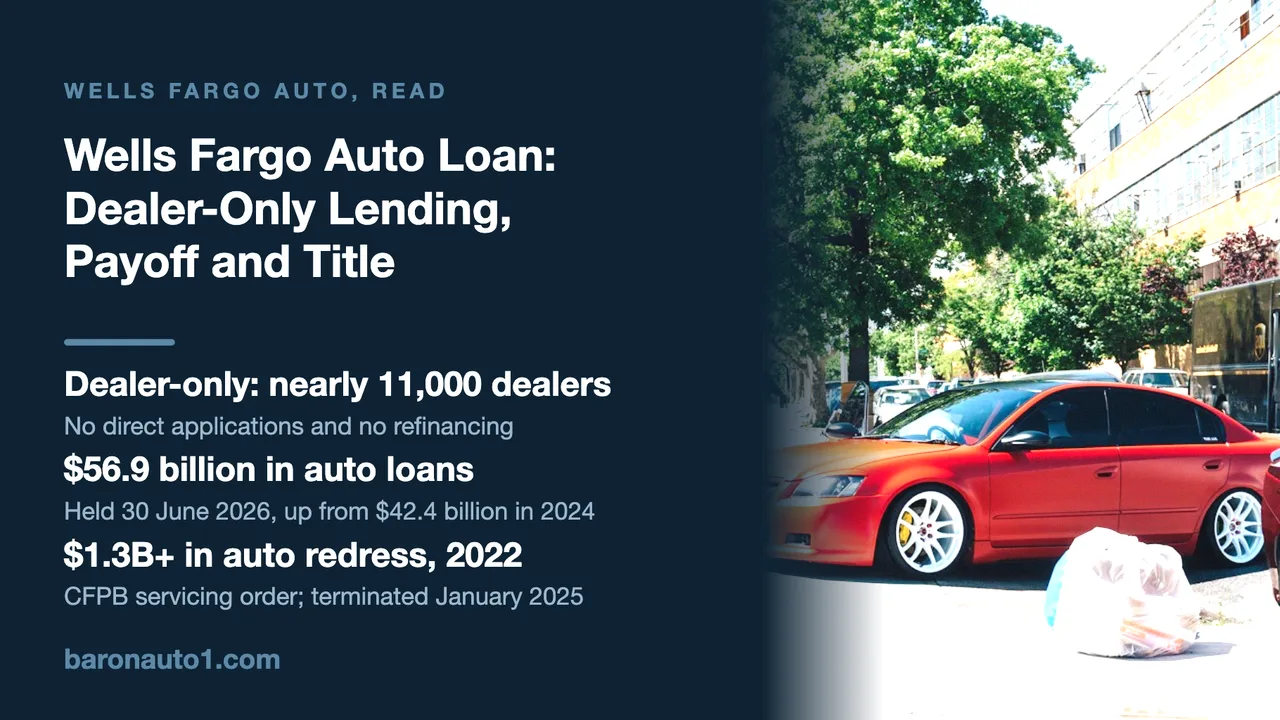
The short version
- Wells Fargo makes car loans only through dealers: its auto loans “are only available through our network of nearly 11,000 dealerships,” and “We don’t offer refinancing for auto loans at this time.” There is no direct application.
- Wells Fargo publishes no auto loan rate. The dealer submits your application and writes the rate into the contract, so bring a pre-approval from another lender to compare.
- New Volkswagen and Audi loans arranged at the dealer since 1 May 2025 are Wells Fargo loans sold as Volkswagen Retail Finance and Audi Retail Finance; VW Credit keeps leases and older loans.
- Payoff: a quote online, on your statement or by phone; payoffs under $5,000 can be paid online; the lien release “is typically initiated within 10 days” after the payoff posts, and no title after 60 days means calling your motor vehicle department.
- Its filings show a U-turn: auto loans fell from $56.7 billion (end of 2021) to $42.4 billion (end of 2024) under “credit tightening,” then rose to $56.9 billion by 30 June 2026.
- The CFPB’s 2022 order recorded $1.3 billion of auto remediation to more than 11 million accounts for misapplied payments, wrong fees, wrongful repossessions and unpaid GAP refunds. That order and the 2018 insurance orders have ended. The CFPB file holds 4,847 vehicle loan or lease complaints.
You cannot apply to Wells Fargo for a car loan. A Wells Fargo auto loan is arranged by a dealer: the dealer sends your application, and if Wells Fargo funds the loan, Wells Fargo Auto services it until it is paid off. On 7 October 2026 we read Wells Fargo’s auto pages (the Auto loans page, its vehicle financing, payment and payment-help pages, and the Auto loan FAQs), its page for auto dealers, its 2025 annual report and June 2026 quarterly report, the CFPB and OCC orders on its auto lending, and the CFPB complaint counts. Wells Fargo’s website terms bar linking to its pages for a public purpose, so we name them without links. We applied for nothing, and this site has no commercial relationship with Wells Fargo or any lender.
Does Wells Fargo still make auto loans? Only through dealers
Yes, but not to you directly. Wells Fargo’s Auto loans page and FAQ give one answer to “How do I apply for a Wells Fargo auto loan?”: “Wells Fargo auto loans are only available through our nationwide network of nearly 11,000 dealerships. Be sure to ask your dealership if Wells Fargo auto financing is available. If your loan is funded by Wells Fargo Auto, we’ll service your account.” No page we read offers an online application, prequalification or branch car loan; older forum threads describing a Wells Fargo online auto application describe a route the bank no longer lists.
Refinancing is out too: “We don’t offer refinancing for auto loans at this time.” A cheaper rate on a Wells Fargo loan has to come from another lender; see our guide to refinancing a car loan. A dealer-only lender cannot finance a private sale either; see where private-party car loans come from. And the network is closed to newcomers among independents: Wells Fargo’s page for dealers says “We are not enrolling new independent dealers at this time.”
Two names confuse searches. Many reviews still say “Wells Fargo Dealer Services”; the consumer pages now say “Wells Fargo Auto,” and the old wellsfargodealerservices.com address did not resolve on our reading day. The one car-related loan you can apply for yourself is an unsecured personal loan the bank markets for repairs, “a personal loan used to finance car maintenance and repair costs,” from $3,000 to $100,000 over 12 to 84 months. It is not purchase financing.
At the dealer: who sets the rate and what gets added
Wells Fargo’s page for dealers describes the process from the lender’s side: “Once a credit application is received in our system, the best financing option for a customer is determined. (Financing options are based on customer needs and ability to pay.) Dealers receive updates on customer applications by credit and rate tiers.” The finance office sees that answer, not you, and the rate in your contract is the one the dealer writes. The same page lists “Dealer reserve statements” among the work of its Dealer Desk; a dealer reserve is what a lender pays a dealer for placing a loan, and it can come from a markup on the rate. Wells Fargo does not say how its reserve is set. Our guide to the buy rate and the contract rate explains the mechanism.
No minimum credit score is printed; the vehicle financing page says “a specific FICO® Score or Wells Fargo credit rating does not guarantee a specific loan rate, approval of a loan, or an upgrade on a credit card.” Its advice on terms: “Car loans generally range from 36 to 72 months. Longer terms can lower your monthly auto loan payment but can also cost you more over the life of the loan.”
Then come the extras: “state and local taxes, or aftermarket products such as an extended warranty, can be part of your loan amount.” Wells Fargo’s list is GAP, service contracts, anti-theft protection, surface protection and maintenance packages, and its FAQ is plain: “The purchase of aftermarket products is optional and isn’t required to receive approval for your loan.” Compare the out-the-door price, read our guide to dealer fees, and sit down with a pre-approval from a credit union, bank or online lender so the dealer has a number to beat. If the dealer sends your application to several lenders, keep the checks inside a short rate-shopping window.
Wells Fargo auto loan rates: none published
None of the Wells Fargo auto pages we read on 7 October 2026 shows an auto loan rate, an “as low as” APR or a calculator. With dealer-only lending, the rate depends on your credit, the car, the term and what the dealer writes into the contract, so anyone quoting “today’s Wells Fargo auto loan rate” is not quoting Wells Fargo. Two figures on its own documents get mistaken for a rate; the table shows why neither is an offer.
| Item | What the documents say |
|---|---|
| Advertised auto loan APR | None printed on any auto page |
| Where to apply | “Only available through our network of nearly 11,000 dealerships” |
| Refinancing | “We don’t offer refinancing for auto loans at this time” |
| Late fee and grace period | Not printed; “Grace periods vary from state to state,” and your contract sets both |
| Paying through MoneyGram or Western Union | “Third-party fees may apply” |
| Average yield on the whole auto book | 5.53% in 2025 and 5.84% in the second quarter of 2026: what the bank earned across all its auto loans, not an offer |
| Auto repair personal loan | “Starting at 6.74% APR” for an unsecured loan of at least $10,000 over a 3-year term, including a 0.25% relationship discount, with rates “as of 07/10/2026” |
Interest is simple and daily, so timing changes the cost: “If you pay your loan early, the amount of interest will be less, and if you pay your loan late, the amount of interest will be more.” The auto pages mention no prepayment penalty. Our used car loan rates guide shows what moves a dealer’s number.
Volkswagen and Audi buyers: Wells Fargo behind the brand name
Many Wells Fargo borrowers never chose Wells Fargo: they financed a Volkswagen or an Audi at the dealer. VW Credit’s bond prospectus for the Volkswagen Auto Lease Trust 2026-B says that on 16 September 2024 VW Credit and Wells Fargo “announced a multi-year co-branded agreement under which Wells Fargo will be the preferred purchase financing provider for the Volkswagen, Audi, and Ducati brands in the U.S. market. This new relationship began for Audi and Volkswagen dealers and consumers in May 2025 and for Ducati dealers and consumers in September 2026.”
Volkswagen’s account page sets the date: “For auto financing on or after May 1, 2025, your account is powered by Wells Fargo,” and its FAQ says “Auto finance accounts are owned and serviced by Wells Fargo.” Audi’s pages say the same of Audi Retail Finance. So the payment, payoff, title and GAP rules on this page apply to those loans. A lease, or a loan started before that date, stays with VW Credit; see our VW Credit review. Wells Fargo’s own filings credit auto growth to “a financing partnership launched in second quarter 2025” without naming it, and its auto pages do not mention either brand.
Paying the loan: methods, fees and where each dollar goes
To manage the loan online you set up access first, and “You’ll need your Social Security number and date of birth to get started.” Only 12 months of auto statements stay online, so download the ones you need. The FAQ lists these ways to pay:
- Autopay from checking or savings. To change it you cancel and set it up again, allowing “at least 3 business days before the automatic payment is scheduled to withdraw.”
- Online or in the app, now or scheduled up to 30 days ahead, or by phone through the automated system at 1-800-289-8004, at any hour.
- By mail, a check or money order payable to Wells Fargo Auto, to the address on your statement. Mail can take “up to 5 days,” and a payment that lands after the due date and any grace period can bring a late fee.
- In person at any Wells Fargo banking location, with or without a Wells Fargo account; or through your bank’s bill pay, MoneyGram or Western Union.
Wells Fargo prints no fee amounts: “Your contract has information about late fees, finance charges, and other fees or charges.” A post-dated check “will be processed on the date it’s received.” A bounced payment may be presented once more, and your bank “may charge a fee each time the payment is returned.”
Where the money goes depends on whether you are current. A payment that is due goes to accrued interest, then principal, then “Fees and other charges (if applicable).” A past-due payment goes to interest and principal only: “Fees and other charges won’t automatically be paid if you’re past due,” so an old late fee can linger after you catch up. Extra money advances the due date, but “You can pay your account up to 3 months in advance”; after that it only cuts principal.
Wells Fargo’s own example shows daily simple interest at work: at 9% on $10,000, interest is $2.47 a day, and a $250 payment made 30 days after the last one puts $73.97 toward interest, leaving $9,823.97. At $2.50 a day, 30 days of interest is $75.00 and 40 days is $100.00. Both reproduce exactly, by our arithmetic; see how loan interest accrues. You may move your due date once in the life of the loan, by no more than 15 days, after the first payment, and only if you are current or no more than 10 days past due. And on taxes, the FAQ says the new car-loan interest deduction (Sec. 70203) “may allow individuals to deduct interest paid on a loan used to purchase a qualified vehicle,” with a Form 1098-VLI starting with tax year 2026; ask a tax adviser.

Wells Fargo auto loan payoff, lien release and title
Start with a quote: sign on and choose “Get payoff quote,” read the payoff amount and daily interest on your monthly statement, or call 1-800-289-8004. “If you choose to pay off your account after the date provided, please call us for an updated quote.” Before paying, Wells Fargo says to stop Autopay or bill pay “at least 3 business days prior to payoff,” to consider a cashier’s check or money order, which “can help you receive your certificate of title faster,” and to make sure Wells Fargo Auto and your motor vehicle department have your current address.
A payoff can go online only “If your payoff amount is less than $5,000.” Larger ones go by mail (with “Payoff” on the memo line and your 10-digit account number or 17-digit VIN), by wire, at any Wells Fargo banking location, or through MoneyGram or Western Union, where limits vary and fees may apply. Take the address and wire details from your own quote or statement.
| Step | Timing Wells Fargo gives | Note |
|---|---|---|
| Lien release starts | “Typically initiated within 10 days after your payoff has posted,” or as state rules require | A paid-in-full letter follows |
| Paper title arrives | Varies by state; none after 60 days from the paid-in-full date means contacting your motor vehicle department | Electronic-title states release the lien electronically |
| Overpayment refund | “Typically takes 2 to 3 weeks” by check | Common when the money arrives before the quote date |
| Credit report shows paid in full | “Up to 120 days” | Reported to Equifax, Experian, TransUnion and Innovis |
| Unused GAP refund | “May take up to 120 days” | Some GAP products are not refundable |
One snag stops the chain: “If Wells Fargo Auto isn’t listed as the lienholder on the certificate of title at the time of payoff, we won’t be able to release the lien.” The title has to be corrected first. Title questions have their own line, 1-888-329-4856; our guide to checking for a lien on a car shows how to confirm the release reached the state. To sell privately, “your loan must be paid in full” first. On a trade-in, “The dealership will contact us to pay off the loan on your behalf. Continue to make your monthly payment until your payoff is received.” If you need a paper title from an electronic one, the FAQ says it “could take up to 6 weeks” in one answer and “at least 4-6 weeks” in another; allow the longer figure.
Insurance, GAP and refunds on add-ons
The contract requires insurance for the life of the loan, and “Your insurance policy must name Wells Fargo Auto as the loss payee.” After an accident, “You’re responsible for making your regular monthly payments until the loan is paid off.” Driving abroad needs written permission, for trips “not to exceed 60 days for non-military travel,” with insurance covering 80% of the balance or the car’s actual cash value.
GAP, Wells Fargo says, “covers any ‘gap’ between the amount owed on the loan and the vehicle’s value in the event of a total loss.” In its example the insurer pays $10,000 on a $13,000 balance and GAP may cover the $3,000 left, though “GAP may not cover late payments, late fees, or deferred payments.” It “isn’t transferable” and “typically ends when the loan is refinanced or paid off.” After an early payoff, or after a repossessed car is sold, “we’ll initiate cancellation of your GAP product”; the refund goes to you if the balance is zero, or to principal if not, and “won’t reduce your monthly payment amount.” Our guides to how GAP works and GAP refunds go further.
Track the GAP refund yourself. Unpaid GAP refunds are what the CFPB recorded in 2022: until July 2021, the order says, Wells Fargo did not ensure that borrowers on loans it “did not originate but subsequently owned and serviced” received GAP refunds they were eligible for after an early payoff or a repossession. Keep your payoff letter, and if no refund or principal credit appears within 120 days, ask in writing.
For other add-ons, the dealer or the product’s administrator handles cancellation, with Wells Fargo as backstop: to cancel GAP, credit life or credit accident and health insurance, “contact the dealership, or call us at 1-800-289-8004, and we can start the cancellation process for you,” and if a dealer “has refused to cancel the product, or is out of business,” call Wells Fargo. Products already applied, such as surface protection or etching, “can’t be canceled.” If you do not remember buying one, “All purchased products require a signature”: ask the dealer for the signed contract.
Behind on payments: deferment, SCRA and repossession
Wells Fargo’s payment-help page offers four options: change the due date, defer a payment, make payment arrangements, or surrender the car. A deferment “pushes out your due date and extends the loan maturity date,” and interest keeps running; its 10-K describes these as “insignificant payment deferrals over the loan term (e.g., three months or less).” Servicemembers can ask about the SCRA, which “may allow us to adjust the interest rate on your auto loan to 6%.” Credit damage starts at a known point: “If your payment is 30 or more days late, it may show up on your credit report.” A Right to Cure letter says how to “cure” a default before repossession; call before its deadline.
After a repossession, “you can ‘redeem’ your vehicle by paying the full amount outstanding (plus repossession costs), or ‘reinstate’ your account by paying the outstanding monthly payments (plus repossession costs)” in some cases. Otherwise the car is sold at auction, and “If the proceeds from the sale aren’t enough to pay the full amount you owe us, you may be responsible for paying the remaining balance.” A voluntary surrender ends the same way. The bank charges off an auto loan “when the loan is 120 days past due,” but that is an accounting entry, not forgiveness. See our guides to getting a repossessed car back and what you can still owe.
What Wells Fargo’s 10-K and 10-Q show about its auto lending
Wells Fargo & Company reports car loans as their own class, “Auto,” so its filings speak directly about this business. Across five years they show a lender that pulled back hard and then turned around.
| Year or period | Auto loans held | Auto loans made | Net charge-offs (share of average loans) | 30+ day delinquency |
|---|---|---|---|---|
| 2021 | $56.7 billion | $33.9 billion | $181 million (0.35%) | 1.84% |
| 2022 | $53.7 billion | $23.1 billion | $422 million (0.76%) | 2.64% |
| 2023 | $47.8 billion | $17.2 billion | $478 million (0.93%) | 2.80% |
| 2024 | $42.4 billion | $16.9 billion | $356 million (0.80%) | 2.31% |
| 2025 | $50.5 billion | $30.5 billion | $204 million (0.46%) | 1.52% |
| First six months of 2026 | $56.9 billion (30 June) | $19.4 billion | $117 million (0.44%) | 1.31% (30 June) |
The 2022 annual report blamed a smaller auto business on “credit tightening actions and rising interest rates,” and higher charge-offs on auto losses “driven by loans originated in 2021.” The 2024 report: “paydowns exceeded originations reflecting our actions related to credit tightening.” By our arithmetic the book shrank $14.3 billion, or 25.2%, from the end of 2021 to the end of 2024, and 2024 originations were 50.1% below 2021’s.
Then it flipped. Originations reached $30.5 billion in 2025, an 80% rise as printed, and $19.4 billion in the first half of 2026 against $11.5 billion a year earlier: more in six months than in all of 2024. The filings credit “growth across the portfolio, including the impact of a new financing partnership.” By our arithmetic the book grew $14.6 billion, or 34.4%, from the end of 2024 to 30 June 2026. Charge-offs fell 57.3% from their 2023 peak to 2025 and the 30-day delinquency rate fell to 1.31%, though the June 2026 10-Q reports “higher losses in our auto portfolio” than a year earlier and an allowance for auto losses of $948 million, 1.67% of auto loans.
The borrower mix moved too. Wells Fargo tables auto loans by updated FICO, the borrower’s current score. By our arithmetic, 55.7% of the book scored 740 or more at the end of 2024 and 11.2% sat below 620; on 30 June 2026 the shares were 53.9% and 10.7%. The newest loans show it more sharply: of the 2024 loans held at the end of 2024, 2.3% scored below 620; of the 2026 loans held on 30 June 2026, 10.2% did. The two groups are measured at different ages and on current scores, so read this as a direction: since 2025 Wells Fargo has lent further down the credit range than it did in 2024, which makes an outside pre-approval more useful, not less. For two other big banks read the same way, see Bank of America and Chase. PNC, by contrast, says it is “not currently offering auto loans”; see our PNC auto loan page.
The 2018 and 2022 auto orders, how they ended, and the complaint record
Two sets of federal orders concern Wells Fargo’s car loans. In both CFPB orders Wells Fargo consented “without admitting or denying any of the findings of fact or conclusions of law,” except jurisdiction; below is what the regulators found, in their words.
2018: force-placed insurance on car loans
On 20 April 2018 the CFPB (2018-BCFP-0001) and the OCC (AA-EC-2018-15) acted together, in part over collateral protection insurance that Wells Fargo bought for borrowers who appeared to lack coverage and charged to their loans. The CFPB’s order says that since 2005 the bank force-placed insurance for “about 2 million borrowers”; that “roughly 28%” of the policies were canceled as duplicating insurance the borrower already had; that premiums were “typically just over $1,000 a policy”; and that “for at least 27,000 customers” the cost “could have contributed to a default that resulted in the repossession of their vehicle.” It found unfair practices from 21 July 2011 through 30 September 2016, and assessed a $1 billion penalty, reduced by the $500 million paid to the OCC; that penalty also covered mortgage rate-lock fees.
Both 2018 orders are over. The OCC’s termination order, signed 13 February 2025, directs that its 2018 order “be, and it hereby is, TERMINATED.” The CFPB modified its order on 20 December 2022 so it would end within three years of that date, and its action page now reads “Expired/Terminated/Dismissed.”
2022: payments, fees, repossessions and GAP
On 20 December 2022 the CFPB issued a consent order (2022-CFPB-0011) covering auto loans, mortgages and deposit accounts. Its auto finding: the bank’s servicing systems “experienced a number of failures that caused Respondent to incorrectly apply borrowers’ payments; charge borrowers incorrect fees, interest, or other amounts; and repossess borrowers’ vehicles,” and the bank lacked processes to refund fees paid upfront to dealers “when warranted.” From at least 2011 through 2022, it “repossessed vehicles despite the borrower having made a payment or entering into an agreement to forestall the repossession.”
| Finding | Accounts | Remediation |
|---|---|---|
| All auto servicing issues | More than 11 million | $1.3 billion |
| Payment-application errors (misapplied, late-posted, wrong Autopay amounts) | Almost 6 million | Roughly $565 million |
| Other improper fees and charges | Almost 4.5 million | At least $424 million |
| Repossession-related harm | Nearly 850,000 | More than $246 million |
| Deferment dates entered wrongly, causing late fees | More than 688,000 | $26.5 million in late fees |
| Repossessed cars not sold in a commercially reasonable time | At least 38,000 instances | More than $40 million |
| Late GAP refunds under Texas rules (2017 to 2020) | Nearly 90,000 | More than $25 million |
For each wrongful repossession, remediation includes $1,500 for transportation costs, $2,500 for other costs, repossession fees, any shortfall if the car sold below market value and refunds of deficiency payments. On GAP, the order found Wells Fargo “obtained such GAP fee refunds when it would benefit Respondent,” as after a default, but did not ensure refunds to borrowers who paid off early; it required refunds of unused GAP “regardless of state law.” The $1.7 billion penalty covered all three product areas; the CFPB’s release put auto redress at “more than $1.3 billion” of more than $2 billion. Wells Fargo’s 2024 annual report describes it as an order “that the Company announced was terminated on January 28, 2025,” and the CFPB lists it as “Expired/Terminated/Dismissed.” The 2025 annual report lists no auto matter among its legal actions, though its risk factors still mention auto collateral protection insurance and unused GAP. Of the nine CFPB actions naming Wells Fargo on our reading day, only these two list auto finance servicing. We did not read state attorney-general records or class-action dockets.
CFPB complaints about Wells Fargo auto loans
On 7 October 2026 we pulled CFPB complaint counts for “WELLS FARGO & COMPANY” under “Vehicle loan or lease,” received through 6 October 2026: 4,847, from 24 April 2017 to 30 September 2026, of which 4,724 concern loans and 121 leases. That is 2.8% of the 175,922 complaints naming the company, by our arithmetic, and the sixth-largest count among 1,153 companies in the category. The yearly count jumped from 372 in 2022 to 1,636 in 2023, 4.4 times as many, the year after the 2022 order; it was 388 in 2024, 531 in 2025 and 515 in 2026 to 6 October. The data do not say why.
| Issue | Complaints | Share | Largest sub-issue |
|---|---|---|---|
| Managing the loan or lease | 1,958 | 40.4% | Billing problem (812) |
| Struggling to pay your loan | 768 | 15.8% | Lender trying to repossess or disable the vehicle (290) |
| Problems at the end of the loan or lease | 675 | 13.9% | Unable to receive car title or other problem after the loan is paid off (347) |
| Repossession | 455 | 9.4% | Account reinstatement or redemption after repossession (83) |
| Getting a loan or lease | 437 | 9.0% | Fraudulent loan (139) |
Wells Fargo closed 719 (14.8%) with relief and most of the rest with an explanation; the CFPB marks 4,638 (95.7%) as answered on time. Complaints are unverified consumer reports, not findings, and counts grow with a lender’s size: Wells Fargo held $56.9 billion of auto loans on 30 June 2026. The CFPB has served no complaint narratives since 30 September 2026, so these are counts only.
Before you sign, and after you pay off
- Get a pre-approval elsewhere first. Wells Fargo publishes no rate, so you need your own number to judge the dealer’s.
- Ask who the lender is. On a new VW or Audi financed at the dealer since 1 May 2025, it is Wells Fargo.
- Strike the add-ons you did not ask for. Wells Fargo says they are optional and not needed for approval.
- Find the late fee and grace period in your contract. Wells Fargo’s pages do not print them.
- Before payoff, get a fresh quote and stop Autopay at least 3 business days ahead.
- After payoff, watch the clock. Lien release typically starts within 10 days; no title after 60 days means calling your motor vehicle department; GAP refunds can take up to 120 days.
- If you fall behind, call before any Right to Cure deadline, and ask about a deferment or, if you serve, the SCRA rate.
Common questions
Can I apply for a Wells Fargo auto loan directly?
No. Wells Fargo says its auto loans “are only available through our network of nearly 11,000 dealerships” and tells buyers to ask the dealer whether its financing is available. There is no online application on the pages we read.
Can I refinance my car with Wells Fargo?
No: “We don’t offer refinancing for auto loans at this time.” You need another lender, and GAP on the old loan ends when it is paid off. See our guide to refinancing a car loan.
What are Wells Fargo auto loan rates today?
Wells Fargo publishes none. The rate comes through the dealer and depends on your credit, the car and the term. Its annual report shows its whole auto book yielded 5.53% in 2025, which is not an offer.
How do I get my Wells Fargo auto loan payoff amount?
Choose “Get payoff quote” after signing on, check the payoff amount on your monthly statement, or call 1-800-289-8004. Payoffs under $5,000 can be paid online; larger ones go by mail, wire, branch, MoneyGram or Western Union.
How do I contact Wells Fargo about my car loan?
Call 1-800-289-8004, staffed Monday to Thursday from 7 am to 10 pm, Friday from 7 am to 9 pm and Saturday from 7 am to 5:30 pm Central Time; the automated system answers at any hour. Title questions go to 1-888-329-4856.
How long after payoff does Wells Fargo send the title?
The lien release “is typically initiated within 10 days after your payoff has posted,” and timelines vary by state. With no title 60 days after the paid-in-full date, Wells Fargo says to contact your motor vehicle department.
Sources and further reading
- CFPB consumer complaint database
- CFPB auto loan resources
- CFPB: what is the difference between dealer-arranged and bank financing?
- CFPB: what is Guaranteed Asset Protection (GAP)?
- CFPB Supervisory Highlights: Auto Finance (October 2024)
- FTC vehicle repossession
- UCC Article 9, part 6 — default (uniform text)
Recall, complaint and safety-rating figures on this page were retrieved from the federal databases above on August 19, 2026. Federal data changes — re-check any VIN before you rely on it.
Published October 7, 2026 · last updated October 7, 2026. Found something out of date or wrong? Tell us and we will correct it.