Navy Federal Auto Loan: Terms, the Title Rule, GAP and Fees
Navy Federal auto loans are for members only and run 12 to 96 months. Its own documents add a title deadline that can switch your rate, a $499 GAP fee refundable only for 60 days, and a 2016 CFPB collections order.
The short version
- You must join Navy Federal Credit Union before you can apply. Membership is open to servicemembers, veterans, Department of Defense civilians and contractors, and their immediate family and household members, and needs a savings account with a $5 minimum balance.
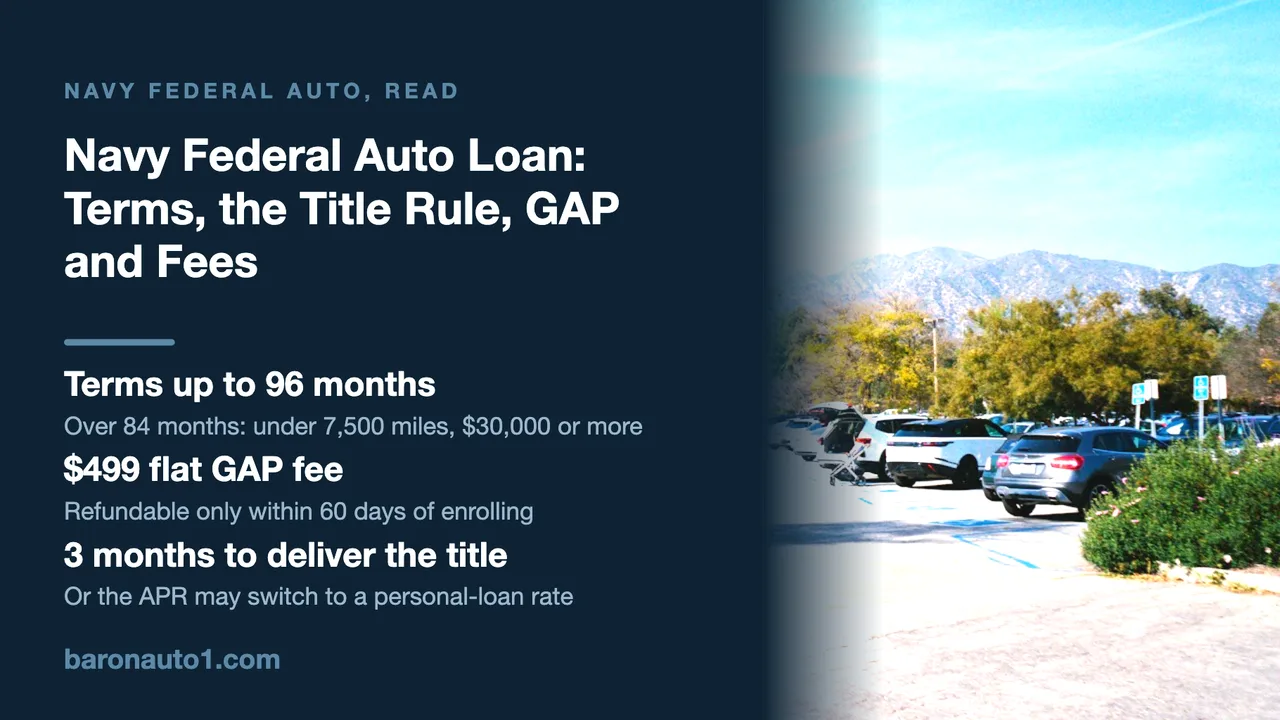
- Terms run from 12 to 96 months. Over 84 months is only for vehicles with fewer than 7,500 miles and loans of at least $30,000; used cars stop at 84. The maximum rate is 18.00% APR.
- The preapproval is a check that only dealerships accept, and the dealer must validate it by phone. The instructions printed with it cap the loan at 125% of the car’s NADA Retail Value.
- Get the title to Navy Federal within 3 months. If it is late, Navy Federal says your APR “may be converted” to its signature/personal loan rate, “which is typically higher.”
- GAP costs a flat $499, refunded only if you cancel within 60 days. After that the fee is “fully earned and non-refundable,” even if you pay off or refinance and the coverage ends.
- In 2016 the CFPB ordered Navy Federal to provide $23 million in redress and pay a $5.5 million penalty over false collection threats and account freezes; it consented without admitting or denying the findings. The CFPB database holds 1,890 vehicle loan or lease complaints naming Navy Federal, received through 5 October 2026.
A Navy Federal auto loan is a members-only credit union loan for new and used cars, with terms from 12 to 96 months, no application fee and no prepayment penalty, plus conditions spread across its own documents that change what it costs: a title deadline that can convert your rate, a $499 GAP fee refundable only for 60 days, and value limits printed on the preapproved check. On 6 October 2026 we read Navy Federal’s auto loan, rates, FAQ, preapproval, titling, GAP, Car Buying Service, membership, fee and SCRA pages, its GAP Agreement and Disclosure, the dealer instructions sent with every preapproved check, its 2025 Annual Report, the CFPB’s 2016 and 2024 orders and CFPB complaint counts. We applied for nothing, so no rate or payment here is ours. This site has no commercial relationship with Navy Federal or any lender.
Who can get a Navy Federal auto loan: membership comes first
Navy Federal’s FAQ is blunt: “Yes, you need to become a member before you can apply for an auto loan.” Its eligibility page gives three routes in. Servicemembers in every branch qualify, from Active Duty and the National Guard to reservists, the Delayed Entry Program, ROTC and “Veterans, retirees and annuitants.” Department of Defense civilian employees and retirees qualify, as do government employees and DoD contractors assigned to DoD or government installations. The third route is family: parents, grandparents, spouses, siblings, children, grandchildren and household members.
The membership FAQ stretches that last route further than many readers expect: “Immediate family and household members (including roommates) of current and retired members of the armed forces, DoD personnel and current Navy Federal members are eligible to join.” It suggests a household applicant share the member’s address “for at least 30 to 60 days” first. If the servicemember in your family has died, “you’re still eligible for membership.” Joining takes a Social Security number, a home address, ID and a way to fund the account, and “A Membership Savings Account with a $5 minimum balance is required to establish and maintain membership.” Members must be 18 or older to apply in most states; our guide to credit union membership covers the rest. USAA, a bank rather than a credit union, also lends only to members; our USAA auto loan page reads its terms.
Navy Federal’s audited 2025 Annual Report, released on 12 May 2026, counts 15,139,001 members and $197.2 billion in assets at the end of 2025. Members took out “500,000 purchase and refinance loans,” it says, “driving our auto originations to total $15.2 billion for the year and auto loan outstandings to $33.1 billion,” and it refinanced “about 97,000 auto loans” from other lenders. That is about $30,400 per loan, by our arithmetic.
Rates, terms and the vehicle rules that decide which ones you get
Navy Federal prints one rate table for new and used cars on its auto loan, rates, refinance and Car Buying Service pages. On 6 October 2026 (“Rates as of Oct 06, 2026 ET”) the lowest “as low as” rates were 3.89% APR for a new vehicle and 4.79% APR for a used one, both for terms of 12 to 36 months. Navy Federal says those rates “assume excellent borrower credit history”; the table does not say they include the military discount below, and “Rates subject to change.” Its payment example, a $20,000 new-car loan for 36 months at that lowest rate, comes to $591 a month.
Your rate depends, Navy Federal says, on “credit and financial history,” the “amount financed,” the term, the “car’s model year” and the “car’s exact mileage reading.” The loan comes “with a maximum 18.00% APR,” matching the temporary 18% ceiling the NCUA Board has extended for federal credit unions through 10 September 2027, which our credit union rate guide explains.
| Term | New vehicles | Used vehicles | Conditions printed |
|---|---|---|---|
| 12 to 36 months | Offered | Offered | Credit and collateral approval |
| 37 to 60 months | Offered | Offered | Credit and collateral approval |
| 61 to 72 months | Offered | Offered | Credit and collateral approval |
| 73 to 84 months | Offered | Offered | The rates page alone says the $30,000 minimum starts at 84 months |
| 85 to 96 months | Offered | Not offered (“N/A”) | Fewer than 7,500 miles; loans of $30,000 or more |
Navy Federal’s definitions, not the dealer’s, decide which column you are in. A “new” vehicle is a 2025 or newer model year “with (a) under 7,500 miles, or (b) between 7,500 and 30,000 miles (late model used vehicles),” so a 2025 model with 20,000 miles counts as new for pricing. A “used” vehicle is a 2024 or older model year, or any model year over 30,000 miles. Vehicles 20 years or older are “classic or antique” and move to “Other Eligible Vehicle rates,” which we did not read. The auto loan does not cover motorcycles or “a commercial or business vehicle.”
“We don’t require a set credit score,” Navy Federal says, and a down payment “isn’t required,” though it “may improve the loan-to-value ratio.” The annual report backs the score claim in aggregate: by balance, of the secured consumer loans it scores by FICO, which it describes as auto loans, 47.5% were at 720 or above at the end of 2025, 21.1% at 660 to 719 and 31.4% below 660, about $10.7 billion, by our arithmetic. A lower score still costs more; our guides to rate shopping and how the term changes the cost explain why.
One marketing claim needs its footnote. Navy Federal says members’ average used auto loan rates are “26% lower than the industry average” and new rates “about 11% lower,” but the footnote compares members “at approvable credit tiers” with “all credit tiers of finance industry” in Experian’s Q4 2025 report. The two groups are not alike.
Discounts: the military rate cut, SCRA and the Car Buying Service
The auto pages advertise an “Exclusive rate discount for Active Duty and retired military members” without its size. The military-discount page gives it: “Active Duty or retired military members can get a 0.25% APR discount on loans.” Three conditions apply. “Direct Deposit is required.” You must apply by phone or at a branch, because the “Offer does not apply to online applications.” And “This military special may expire at any time.” On a $30,000 balance a quarter of a point is about $75 of interest in the first year, by our arithmetic, less as the balance falls. Applying online forfeits it.
Servicemembers with a loan from before Active Duty get more. The Servicemembers Civil Relief Act caps interest at 6% on pre-service debt; Navy Federal goes further “by capping pre-Active Duty debt at 4% and waiving account fees,” a lower cap its FAQ dates to 1 April 2022. It covers consumer loans “such as auto loans” taken out before Active Duty only, and the application is due “no later than 180 days after your Active Duty end date.”
“TrueCar operates the Navy Federal Car Buying Service,” and the key disclosure is in a footnote: “Navy Federal Credit Union receives compensation from TrueCar when members purchase vehicles through the Navy Federal Car Buying Service.” Navy Federal says members paid “an average of $2,749 below MSRP on new vehicles in 2025” across 3,093 reported sales, while warning that MSRP “may not reflect the price at which vehicles are generally sold” because “many vehicles are sold below MSRP.” Compare the out-the-door price instead. We found no APR discount for using the service on any page we read; its extra incentives are manufacturer offers whose “Availability and amount” are “subject to change.”
Borrowers also get “Two CARFAX Vehicle History Reports” while a preapproval stays open, an offer that “may expire at any time”; our guides to checking a car’s history and a pre-purchase inspection cover the other checks.
Preapproval: a check, 90 days, and dealers only
Navy Federal offers preapproval but says “we don’t offer prequalification at this time,” and its preapproval is an application on which “the lender performs a hard credit inquiry, which can slightly impact your FICO Score.” The FAQ adds that rate shopping within 45 days “generally has little-to-no impact on your credit score,” and the preapproval page suggests being preapproved “by 2 or more lenders.” Applying takes “less than 10 minutes,” costs nothing, and approval “doesn’t obligate you to use the funds.”
If approved, you collect a check at a branch or have it mailed (“there may be a fee depending on delivery type”; the fee schedule lists overnight delivery at $12.00 on weekdays, $20.00 on Saturdays). It is good for “90 calendar days from the date of the check,” and its amount is a ceiling: “You’ll only be responsible for the amount you’re applying toward the purchase.” Navy Federal advises: “don’t reveal to them the maximum amount of financing you’re preapproved for.”
Three limits are easy to miss. First, “preapprovals are only accepted by dealerships and can’t be used for purchase through a private seller,” and “some overseas dealers may not accept” them; for a private sale you apply with the car chosen. Second, the dealer must phone Navy Federal to validate the check before depositing it and write a 4-digit code on the back. It is printed “Not a Cashier’s Check,” and Navy Federal “may dishonor this item in its sole discretion.”
Third, the dealer instructions printed with the check (form NFCU 478) restrict the car. The check “cannot be used” where the title shows the vehicle as “commercial/business (including vehicles used for hire or taxi services), salvaged, lemon, refurbished, or rebuilt,” nor for recreational vehicles, classic or antique cars or several vehicles at once. And they cap the loan against value: “The vehicle must have a value of at least 100% of the amount financed. The value is determined using the NADA Retail Value. To cover the additional costs of taxes, title charges, and tags, the loan may reach a maximum of 125% of the vehicle’s NADA Retail Value.” A car with a $20,000 NADA Retail Value supports at most $25,000, taxes, title and tags included, by our arithmetic.
That cap is the real limit on rolling old debt into a new loan. Trading in a car Navy Federal already finances, the instructions tell the dealer not to send a payoff, and say Navy Federal “will account for any negative equity associated with the deal so long as the requested loan amount meets loan-to-value guidelines.” Our guides to negative equity and to using a preapproval at the dealer’s desk cover the rest.
The title deadline that can change your rate
This condition is the likeliest to cost a careful borrower money, and it is not in the rate table. “Within 3 months of purchasing or refinancing your car,” a title naming Navy Federal “as the first lien holder must be submitted to Navy Federal. If the lien-recorded title isn’t received within that time frame, your loan’s APR may be converted to Navy Federal’s rate for signature/personal loans, which is typically higher.” The refinance FAQ adds that this “can increase the monthly payment.” The FAQ and preapproval pages give the deadline as “within 90 days of purchase.”
A dealer “may complete your registration paperwork,” after which the DMV sends the lien-recorded title to Navy Federal. After a private sale, “most states require you to take the title, bill of sale and a copy of your loan promissory note to your local DMV” yourself. In Kansas, Kentucky, Maryland, Michigan, Minnesota, Missouri, Montana, New York, Oklahoma and South Dakota you upload a copy of the title once it lists Navy Federal as lien holder. If Navy Federal files for the title it “will debit the DMV titling fees from your account”; its fee schedule lists lien placement at $4.00 to $95.00 by state.
Do not let the title drift past 2 months. Navy Federal asks you to call if “it’s been more than 2 months since purchasing your vehicle” and the title has not arrived. Chase the dealer or DMV before the 3-month deadline, keep the bill of sale and DMV receipt, and ask Navy Federal to confirm when the lien-recorded title arrives.
After payoff, the title is released “within 10 business days of Navy Federal receiving your payoff” in most situations, and delivery “can take up to 7 to 10 business days”: up to 20 business days in all, by our arithmetic. For an electronic title, Navy Federal’s letter explains the steps. It will also release a title to you for 30 days to register the car in another state or change the names on it.
GAP: $499, a 60-day window, and no refund after that
GAP may cover what you still owe after your insurer pays out on a car that is totaled or stolen and not recovered. Navy Federal charges “a flat enrollment fee of $499,” paid up front or added to the loan. Its GAP page says financing it means “your monthly payment would probably increase by only a few dollars”: $8.32 a month over 60 payments or $6.93 over 72, before interest, by our arithmetic. The GAP Agreement is plainer: adding the fee “will increase the cost of the Program due to interest charged.” California Active Duty and Active Reserve Duty servicemembers cannot finance it.
The Agreement (form NFCU 23A, for enrollments dated from 29 August 2026) is the binding document. It says “GAP is not insurance coverage”; the fee schedule calls it “a debt cancellation product.” Coverage ends, with nothing paid, if the loan is paid in full or charged off, if you default, or if “You refinance Your underlying Loan with Us or another financial institution.”
| Term | What the documents say |
|---|---|
| Fee | $499 flat, paid up front or financed; financing adds interest |
| Cancel within 60 days | Full refund of fees “and associated interest (if applicable)”; you may re-enroll once |
| After 60 days | “fully earned and non-refundable, and GAP will not be canceled” |
| Loan paid off, charged off or refinanced | Coverage ends automatically; no refund is provided for |
| Deductible | Covered up to $1,000 |
| Maximum paid | $50,000 |
| Not covered | Past-due payments, interest or fees after the loss, refundable add-ons such as service contracts |
| Vehicle | Personal cars, vans, pickups and motorcycles no older than the current model year plus seven; no rideshare or delivery use |
| Loan | Not for loan-to-value below 70%, or loans of $7,500 or less unless the term is longer than 12 months |
| Claim deadline | Within one year of the final insurance settlement |
The refund rule is the fact to weigh. “After sixty (60) days of enrollment, the Program fee is fully earned and non-refundable, and GAP will not be canceled.” Pay off, sell or refinance in year two and the protection stops while the $499 stays with Navy Federal. Our guide to GAP refunds when a loan ends early explains why that matters, and the GAP explainer covers whether you need it; Navy Federal suggests it for low down payments, fast-depreciating models and drivers covering “more than 15,000 miles a year.”
The Agreement’s first example shows what GAP leaves you owing. A car worth $10,000 is totaled, the insurer pays $9,500 after a $500 deductible, and $13,000 is owed, including a $550 past-due payment: “GAP will pay $2,950, and the past due payment of $550 will remain Your responsibility to pay.” You keep paying while a claim is processed, which is “usually processed within 5 business days” of complete paperwork. Navy Federal’s GAP sheet says “many car dealers charge up to $1,100 for the same protection,” citing no source.

Payments, fees, paying early and refinancing
The first payment is due “between 30 and 60 days from when the loan is finalized,” and that date is permanent: “Loan payment due dates cannot be modified.” You can schedule transfers from Navy Federal or external accounts, and “Loan payments can only be made at Navy Federal-owned ATMs.”
Interest is calculated “daily, using the simple interest method,” and each payment pays accrued interest first. Navy Federal will not take a principal-only payment: “Can I designate a payment as a principal reduction payment? No.” Extra money “will reduce the loan balance but are a partial payment toward the next payment due,” and your next due date “could be a month or more in the future.” Because interest accrues daily, keep paying monthly rather than skipping the month you are ahead.
| Item | Fee |
|---|---|
| Application or origination fee | None |
| Prepayment penalty | None |
| Consumer loan late fee | $29.00 |
| Returned loan payment | No charge |
| Overnight delivery of the loan check | $12.00 weekday, $20.00 Saturday |
| Certified mail | $5.83 |
| Lien placement | $4.00 to $95.00, by state |
| Lien recording for loans secured by a vehicle | Varies by state |
| Duplicate title | $2.00 to $95.00, by state |
| GAP (optional) | $499.00 |
Paying off early carries no penalty, once you clear “all accrued unpaid interest, charges or fees”; federal credit union rules require that anyway, letting a member repay early “without penalty.”
Refinancing into Navy Federal from another lender has no waiting period and no application or origination fees, but the same 3-month title deadline and rate-conversion risk. Navy Federal also advertises a cash bonus for refinancing a loan from elsewhere, a promotion with its own minimums that “may end at any time.” Refinancing a loan it already holds is narrower: the loan “must be at least 12 months old with at least 6 payments remaining,” by branch or phone. Our guide to what a refinance lender asks for covers the paperwork.
The CFPB’s 2016 order on collections, and the 2024 order
On 11 October 2016 the Consumer Financial Protection Bureau issued a consent order against Navy Federal (docket 2016-CFPB-0024) over its debt collection. Navy Federal consented “without admitting or denying any of the findings of fact or conclusions of law,” except the facts needed for jurisdiction, so what follows are the CFPB’s findings, not a court’s. The order is not specific to car loans; it covers collection on delinquent Navy Federal accounts generally, which is what a car-loan borrower who falls behind would meet.
The CFPB found that from January 2013 to July 2015 Navy Federal sent letters to “approximately 193,000 consumers” implying it would sue, while it “filed fewer than 5,000 debt collection lawsuits against its members”; the message “pay or be sued” was “inaccurate about 97% of the time.” Many letters threatened wage garnishment, “a remedy generally unavailable to Respondent without a court judgment.” About 115 consumers were told a loan document would go “to your commanding officer,” and “there is no evidence” any were contacted. About 68,000 consumers were told they would find it “difficult, if not impossible, to obtain additional credit.”
The finding closest to daily life is the account freeze. Restrictions “were applied at the member level, meaning that a delinquency or overdraft on one account would trigger a freeze” of electronic access to all of a member’s accounts, disabling debit and ATM cards and online banking except payments to the delinquent account. About 36,000 consumers were frozen after 1 to 5 days of delinquency, 480,000 after 6 to 16 days and 180,000 after 17 or more. Navy Federal stopped in mid-2015, during the investigation, and the order requires it to keep that policy.
Navy Federal had to set aside $23,000,000 for redress, with at least $1,000 for each recipient of the commanding-officer letter, and pay a $5,500,000 civil money penalty: $28.5 million in all, the figure in the CFPB’s announcement. The order ran 5 years, to 11 October 2021 by our arithmetic absent a later action, and is now listed “Expired/Terminated/Dismissed,” meaning no “ongoing compliance obligations.”
The second order is not about cars. On 7 November 2024 the CFPB issued a consent order (2024-CFPB-0014) over overdraft fees on checking accounts, again without admission, with a $15,000,000 penalty and redress of at least $80,689,100. Navy Federal said it “fully cooperated.” On 1 July 2025 the Bureau “terminated the order and waived any alleged non-compliance therewith,” redress section included. The CFPB’s enforcement list returned these two actions, and no other, for “navy” on 6 October 2026.
| Date | Docket | What it concerned | Outcome, in the documents’ terms |
|---|---|---|---|
| 11 Oct 2016 | 2016-CFPB-0024 | Collection letters and calls threatening suits, garnishment and commanding officers; member-level account freezes after any delinquency | Consent order “without admitting or denying”; $23 million redress, $5.5 million penalty; now “Expired/Terminated/Dismissed” |
| 7 Nov 2024 | 2024-CFPB-0014 | Overdraft fees on checking accounts (not car loans) | Consent order “without admitting or denying”; terminated by the Bureau on 1 July 2025 |
What CFPB complaints about Navy Federal car loans are about
The CFPB’s consumer complaint database held 49,783 complaints naming Navy Federal Credit Union across all products, received through 5 October 2026, when we pulled the counts on 6 October 2026. Of those, 1,890 (3.8%) are filed under “Vehicle loan or lease,” and another 217 car-loan complaints sit under the older “Consumer Loan” label: 2,107 in all, by our arithmetic. A further 362 debt-collection complaints are tagged auto debt. Complaints are consumers’ own unverified reports, and a count grows with a lender’s size and with how many people use the CFPB form, so it is not a rate. The CFPB has published no narratives since 30 September 2026; these are counts only.
| Issue | Complaints | Largest sub-issues |
|---|---|---|
| Managing the loan or lease | 615 | Billing problem 287; problem with the interest rate 147; add-on products 90; fees charged 60 |
| Getting a loan or lease | 468 | Credit denial 181; confusing or misleading advertising 91; fraudulent loan or loan opened without consent 115 |
| Problems at the end of the loan or lease | 279 | Unable to receive the title after payoff 147; paying off the loan 52; refinancing 46 |
| Repossession | 233 | Notice to repossess 52; reinstatement or redemption 36 |
| Incorrect information on your report | 115 | Account status incorrect 46 |
| Struggling to pay your loan | 109 | Denied request to lower payments 59 |
Vehicle-loan complaints about Navy Federal rose from 157 in 2022 to 268 in 2023, 345 in 2024 and 430 in 2025, and stood at 365 by 5 October 2026. Such complaints about every company rose from 8,639 to 20,769 over 2022 to 2025, so Navy Federal’s share went from 1.8% to 2.1% by our arithmetic. The database cannot say why.
Navy Federal answered every vehicle-loan complaint on time, closing 1,476 “with explanation,” 272 with non-monetary relief and 68 with monetary relief, with 74 in progress; those are its own response categories, not findings. 553, or 29.3%, carry the CFPB’s servicemember tag. If you fall behind, our guide to car repossession covers the rules most states apply.
Where Navy Federal’s own documents disagree
On 6 October 2026 Navy Federal’s pages differed in places a borrower could trip over.
| Topic | One document | Another document |
|---|---|---|
| Where the $30,000 minimum starts | Rates page: “for terms of 84-96 months” | Auto loan, refinance and Car Buying Service pages: “for terms of 85-96 months” |
| What GAP is | GAP Agreement: “GAP is not insurance coverage”; fee schedule: “a debt cancellation product” | Managing Your Auto Loan page: “GAP insurance” |
| Lien holder codes | Auto FAQ: California “HVH,” Pennsylvania “53-011370501” | Dealer instructions: California “W33,” Pennsylvania “53-011670501” |
| Value of the free CARFAX report | CARFAX page: “a $40 value” | Car Buying Service page: “a $45 value for each” |
| How fast a decision comes | Auto FAQ: “a decision in seconds” | How to Apply page: “5 minutes or less” |
| GAP vehicle age | GAP page: “no older than 7 years” | GAP Agreement: “the current model year plus seven years” |
| Auto loans outstanding | Annual report highlights: $33.1 billion | Annual report notes: secured consumer loans “(auto loans)” of about $34.4 billion, not reconciled |
Two have practical consequences. If you want an 84-month loan below $30,000, ask which minimum applies before you sign. If you title the car yourself in California or Pennsylvania, ask Navy Federal which lien holder code to give the DMV. And when anyone calls a GAP product insurance, remember that Navy Federal’s binding document says its own is not.
Before you apply or sign
- Join first, with the $5 membership savings account; you cannot apply until you are a member.
- Active Duty or retired? Apply by phone or at a branch with direct deposit set up, or you lose the 0.25% discount.
- Check which column your car is in. Model year and exact mileage decide “new” or “used”; over 84 months needs fewer than 7,500 miles and $30,000.
- Get a second preapproval from another lender and finish shopping within 45 days.
- Buying privately? The preapproval check will not work; apply with the car’s VIN and exact mileage.
- Check the value before agreeing a price: the loan cannot exceed 125% of NADA Retail Value, taxes and fees included.
- Diary the title for 2 months after purchase, and confirm it reached Navy Federal well inside 3 months.
- Decide on GAP within 60 days; after that there is no refund if you pay off, sell or refinance.
- Pay extra if you can, but keep paying monthly.
Our pages on PenFed auto loans and Capital One auto loans read those lenders’ documents the same way. For anything account-specific, Navy Federal’s member line is 1-888-842-6328, or start from navyfederal.org.
Common questions
Is it hard to get an auto loan through Navy Federal?
Membership is the first hurdle: you need a military, veteran, DoD, family or household connection, and you must join before applying. Beyond that Navy Federal sets no minimum credit score, and 31.4% of the balance of its scored secured loans at the end of 2025 was owed by borrowers below a 660 FICO. Approval still depends on credit, income and the car.
What credit score do you need for a Navy Federal auto loan?
None is published: “We don’t require a set credit score to qualify for an auto loan with us.” Your score mainly moves the rate. The lowest advertised rates “assume excellent borrower credit history,” and the maximum is 18.00% APR.
How long is a Navy Federal preapproval good for?
The check is good for 90 calendar days from its date. It works at dealerships only, and the dealer must phone Navy Federal to validate it. Preapproval is a hard credit inquiry; Navy Federal does not offer prequalification.
Does Navy Federal do 84- or 96-month car loans?
Yes: up to 96 months for new vehicles and 84 for used. Over 84 months needs fewer than 7,500 miles and a loan of at least $30,000; one Navy Federal page says that minimum starts at 84 months, three others at 85.
What happens if Navy Federal doesn’t get my title in time?
If the lien-recorded title is not received within 3 months of purchase or refinance, Navy Federal says your APR “may be converted to Navy Federal’s rate for signature/personal loans, which is typically higher.” Call it after 2 months if the title has not arrived.
Can I cancel Navy Federal GAP and get a refund?
Only within 60 days of enrolling, when you get a full refund including any interest on a financed fee. After that the $499 fee is “fully earned and non-refundable,” and paying off or refinancing ends the coverage without a refund.
Sources and further reading
- CFPB consumer complaint database
- CFPB auto loan resources
- CFPB: what is Guaranteed Asset Protection (GAP)?
- 12 CFR 701.21 — loans and lines of credit to members
Recall, complaint and safety-rating figures on this page were retrieved from the federal databases above on August 19, 2026. Federal data changes — re-check any VIN before you rely on it.
Published October 6, 2026 · last updated October 6, 2026. Found something out of date or wrong? Tell us and we will correct it.