Can-Am VIN Decoder: Four Codes, and None of Them Says Can-Am
The whole parent entry is four codes, and they are not all filed as the same kind of vehicle.
The short version
- There is no Can-Am-only decoder and there does not need to be one. Every vehicle certified for this market carries the same seventeen-character number, and one federal register resolves the manufacturer prefix on all of them.
- Nothing at all is registered under the name Can-Am. The register holds zero manufacturer codes against the badge, so a search on the brand name is not a search that can succeed.
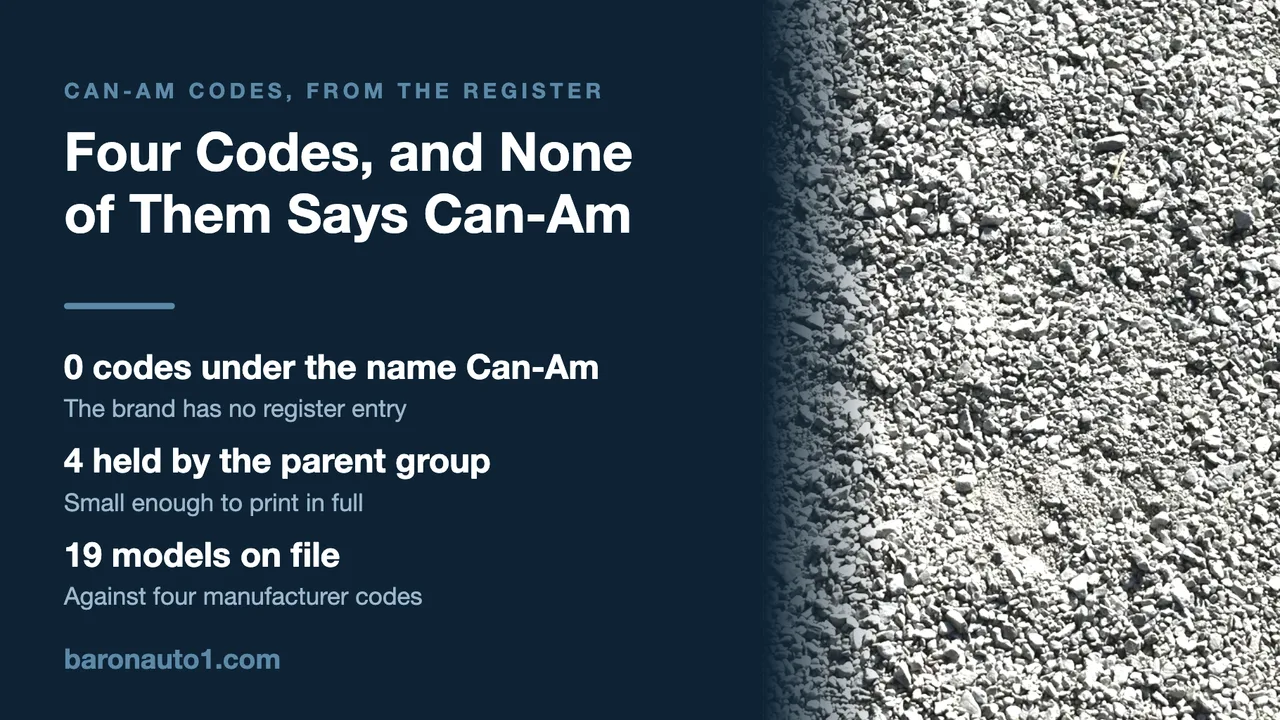
- The codes a Can-Am number opens with sit under the parent entry, filed to BOMBARDIER RECREATIONAL PRODUCTS INC. That entry holds four codes, which is small enough to set out in full on this page rather than summarise.
- Those four codes are not all filed as the same kind of vehicle. Two are Motorcycle, one is Off-Road Vehicle and one is Trailer. Three different federal classifications sit behind one badge, and none of those three words is a model name.
- Two of the four codes are recorded against Canada. The other two carry no country at all. Where a country is present it describes where the registering entity filed, not where a machine was assembled.
- The register holds nineteen model names for the make. Several of them are odd-looking strings rather than tidy marketing names, and this page prints them as filed.
- What no decode carries, on this make or any other: service history, the condition of the machine in front of you, and whether a recall that shows as open was ever actually done.
Search for a Can-Am VIN decoder and you will find a page of identical input boxes, most of them arranged to imply that this badge needs a reader built specially for it. It does not. The number stamped on the frame is built to the same federal standard as the number on a saloon car or an articulated lorry, and the register that turns the first three characters into a manufacturer is the same register for every one of them.
What is genuinely specific to this make is what that register holds, and here the answer is unusual enough to be worth a page. Under the name Can-Am there is nothing. No manufacturer codes, and no stray false matches either. The codes a Can-Am number actually begins with are filed under the parent, and the parent entry is small — four codes in total. This page works from that entry, and the whole of it fits on the screen.
That smallness is an advantage. On a large manufacturer, a page like this can only summarise: codes split across countries and company names, sampled rather than printed. Four codes can be laid out one at a time, and when you do that the interesting thing about this entry becomes visible immediately. The four are not filed as four of the same thing. The register classifies them three different ways, and that is the single most useful fact a Can-Am owner can know before running a decode.
One federal system reads every VIN, this badge included
The vehicle identification number is a federal standard and its layout does not change with the badge. Positions one to three are the world manufacturer identifier, assigned to the legal entity that builds the vehicle. Positions four to eight describe the vehicle in a scheme the manufacturer designs for itself. Position nine is a check digit computed arithmetically from the other sixteen characters. Position ten carries the model year. Position eleven identifies the assembling plant. The final six are the serial.
Our guide to reading a VIN position by position sets out the full layout, and the by-make index collects what the register holds for each manufacturer we have read.
Where a brand-specific decoder would earn its keep is the middle block, and this is where we have to be straight about a gap. Positions four to eight are the manufacturer’s own descriptor scheme, and the federal register does not publish the key to it. The register records who holds a prefix, which vehicle class the prefix is filed under, which country the entity is registered in, and when the code was opened. It does not record that a particular character in position six means one frame on one machine and something different on another.
So this page prints no position-by-position table for Can-Am and no plant-code list, because we hold neither from a source we would defend. Tables of that kind are published in several places. None of them is the register, and we do not hold one from a source we would defend. Decoding a real number returns the descriptor fields as the federal system resolves them for that specific machine, which is a different and considerably more reliable thing than a printed key somebody assembled from a forum thread.
Nothing is filed under the name Can-Am
Most make pages on this site open with a count of codes. This one opens with a zero. The register holds no world manufacturer identifier under the name Can-Am, and the make does not register in its own right.
That is not a data error and it is not rare. Of the thirty-six makes we have read into this archive, eight hold no code of their own, and their numbers are issued under a parent’s filing instead. A world manufacturer identifier is applied for by a legal entity, not by a marketing name, and there is no requirement anywhere that the entity be named after the badge on the tank. Where a group runs several badges out of one registered company, one filing covers the lot and the individual badges appear nowhere in the code list.
The practical effect is that a brand-name lookup fails in a particular and confusing way. You type the badge into a manufacturer search, the register returns nothing, and the natural conclusion is that something is broken — the site, the query, or the machine. Nothing is broken. The query asked a question the register has no field for. The codes exist and are perfectly ordinary; they are simply filed under a name you did not search for.
This matters most when a decode of a real number comes back. The manufacturer field will not say Can-Am. It will name the registered entity, spelled as filed, and a reader who expected the badge reads that as evidence of a misdescribed machine. It is not. The manufacturer field is answering a narrower question than it appears to be answering: which registered entity issued this number. It is not telling you who designed the machine, who sells it, who warrants it or whose name is above the dealership door.
The parent entry, printed in full
The parent entry in our archive is filed under a single company name, BOMBARDIER RECREATIONAL PRODUCTS INC, and it holds four world manufacturer identifiers. Four is small enough that this page does not have to sample, summarise or select. Here is the whole list, with what each one is filed as and the company each is registered to.
2BV is filed as Motorcycle, with no country recorded. 2BX is filed as Motorcycle, recorded against Canada. 2BZ is filed as Trailer, recorded against Canada. 2BW is filed as Off-Road Vehicle, with no country recorded. That is the entry. There is no fifth code held back, and the counts confirm it from the other direction: the entry’s own breakdown by vehicle type reads two Motorcycle, one Trailer and one Off-Road Vehicle, which is four, and its breakdown by country reads two against Canada and two unattributed, which is also four.
Here the aggregates and the list agree at four, and a reader who runs the same query themselves will see the same four rows. Nothing on this page needs to be taken on trust.
One pattern is visible immediately and worth stating carefully. All four codes begin with the same two characters, 2B. The register does not explain that, and this page will not invent an explanation for it, but it is a useful thing to have in your head when a number arrives by text message and you want a first sanity check on whether it is plausibly what the seller says it is. It is a weak check rather than a strong one — the first three characters are the least specific part of the number — but it costs nothing.
Among the eight makes in our archive that hold no code of their own, this is comfortably the smallest parent entry to sit behind a badge. The next smallest of the eight holds thirty-four codes, and the largest holds a hundred and ten. That is a comparison across the thirty-six makes we have read rather than across the whole register, and it is worth stating plainly for that reason: it tells you this page can be exhaustive where most cannot, and nothing more than that.
Three vehicle types across four codes
Here is the part of the entry that repays reading slowly. The four codes are not filed as four of the same thing. The register puts two of them under Motorcycle, one under Off-Road Vehicle and one under Trailer, and those are three separate federal classifications sitting behind one badge.
Query the register for the vehicle types it associates with this make and it returns exactly those three words: Motorcycle, Trailer, Off-Road Vehicle. Of the thirty-six makes read, only three return Off-Road Vehicle at all, and this is the only one of the thirty-six whose entry lists both Trailer and Off-Road Vehicle together. Again, that is a count across what we have read rather than a claim about the register entire.
The reason this matters to somebody about to decode a number is that the vehicle type field is one of the first things a decode returns, and the word it returns depends on which of the four codes issued the number. Two machines under the same badge can come back classified differently. That is the filing showing through, not a contradiction, and it is not evidence that one of them has been misdescribed.
It is worth keeping the class field in proportion in the other direction too. These are federal vehicle categories with regulatory consequences — they determine which safety standards a vehicle was certified against — and they are not descriptions a salesperson would use or words an owner would recognise. Off-Road Vehicle is a classification, not a review. Motorcycle is a classification, not a statement about how many wheels are on the ground. A decode returning one of those three words is telling you how the machine was certified. It is not telling you the body style, the seating layout or what the thing is for.
The Trailer code deserves a sentence of its own, because it is the one that surprises people. 2BZ is filed under Trailer, recorded against Canada, under the same company name as the other three. The register does not record why any code was issued, so this page does not speculate about it. What it does mean, concretely, is that a number opening with those three characters will resolve with Trailer in the vehicle type field, and a reader who was expecting one of the other two words should not treat that as a failed lookup. Trailers carry seventeen-character numbers and decode like everything else.
And the class field does not cross-check the badge for you. It tells you what the register expects of numbers issued under that code. Confirming that one specific machine matches its advert is still a job for a decode of that machine’s own number, read against the listing, and then for your own eyes on the thing itself.
Canada on two codes, and nothing on the other two
Two of the four codes carry Canada in the country field. The other two carry nothing — the field is simply empty, and our archive records those as unattributed rather than guessing at them. The only country the entry names anywhere is Canada.
Two cautions go with that, and both are the sort of thing this field is routinely used to say and cannot support.
The first is that the country field records where the registering entity filed. It is not an assembly location. It describes a piece of paperwork rather than a building, and treating it as a factory address is the most common way this field is misread. Where a group registers one entity in one country and builds in several, the country against a code will not tell you which of those buildings a given machine came out of. The federal data holds nothing that would let anyone refine it. Position eleven of an individual number is the plant character, but the register does not publish the key that turns it into a plant name, which is why this page prints no plant table.
The second is that an empty country field is missing data, not a country. Two of these four codes have nothing recorded, and the honest reading of that is that the register does not say. It does not mean the entity is stateless, it does not mean the code is provisional, and it certainly does not mean the machine was built somewhere the seller is hiding. A blank field is a blank field. Where a decode returns no country for a Can-Am number, that is the register being incomplete rather than the machine being suspicious.
Put those together and the honest use of the first three characters is narrower than it is often described, and still worth having. They tell you which entity issued the number and, on two of the four codes here, which country that entity is registered in. Everything more specific about the machine sits from position four onward, in fields only a decode of the actual number will return.
The entry carries no registration dates, so this page prints none
Most make pages on this site are able to say when each code was opened, and several of them use that sequence as a rough timeline of where a group has been setting up to issue numbers. This entry does not carry it. The archived read behind this page holds a code, a company name, a vehicle type and a country for each of the four, and no date against any of them.
So there are no dates on this page, and there will not be any until a read of the register returns them. That is a smaller point than it sounds and a more important one than it looks. The rule this site works to is that we publish what the archived read contains. Reciting a plausible-looking set of years from memory would be indistinguishable, to a reader, from reporting the data, and it would be indistinguishable, to a reader, from reporting the data. Where we have the dates, we print them. Here we do not, so you get the gap instead.
It is worth saying what such a date would and would not mean, because the misreading is common wherever the field does appear. A registration date is the date a code was entered in the register. It is not a build date, not a sale date, and not a model year. Codes are routinely opened in advance and can sit unused for a period, so a date of that kind is evidence about a filing and nothing else. The model year of a specific machine lives at position ten of its own number and is read against our model-year chart, which is the only place that question is properly answered.
Nineteen model names, exactly as the register spells them
The register holds nineteen models for the make. That is the decoder’s vocabulary here — the set of names a decode can return when it resolves a specific number. Because we hold the roster rather than only the count, here it is, spelled as filed: Canyon, Commander, DS, Defender, Defender/Traxter, Electric Commander, Maverick, Maverick R, Maverick Trail/Maverick Sport, Maverick X3, Origin, Outlander, Pulse, Renegade, Ryker, Ryker Rally Edition, Spyder, Spyder F3 and Spyder RT.
Read that list as a list and its shape tells you something about how the register stores names. Several entries are a base name plus a qualifier held as a separate record rather than as a variant of one: Spyder, Spyder F3 and Spyder RT are three entries, not one entry with two options; the same goes for Maverick, Maverick R and Maverick X3, and for Ryker and Ryker Rally Edition. Two entries pair two names with a slash, Defender/Traxter and Maverick Trail/Maverick Sport, which is the register carrying a compound string rather than resolving it. And one entry, DS, is two characters long.
We have printed those exactly as they appear, including the slashes and the short one, because tidying them would make this page disagree with the thing it is describing. A decode that returns Defender/Traxter has returned the model name the register holds. It has not returned a formatting error, and a buyer who sees it in a result and a clean name in an advert is looking at a difference in presentation rather than a discrepancy worth arguing about.
The count is not the useful part anyway. What a buyer wants is the model returned for one specific machine, and that comes from decoding that machine’s number rather than from any roster. The list only ever tells you what the register knows about the make in general; the decode tells you what it holds about the thing you are being asked to pay for.
And a model name, however it arrives, is not a specification. The register knows the model line. It does not know which engine option, which drive configuration, which suspension, which wheel or which accessory package a particular machine left the factory with, and on used machines those are exactly the distinctions that move the price.
Searching the register for the badge returns nothing at all
Make pages on this site carry a warning about the same trap. The register’s name endpoint matches company names as text rather than resolving brands. Ask it for a common word and it drags in every small builder, trailer shop and specialist converter whose registered name happens to contain that string, and a reader of the raw result can easily conclude a badge holds a dozen codes it has nothing to do with. That noise is one reason code counts disagree between sites.
Querying for this badge returns zero. Not zero real codes and a pile of strangers — zero of everything. Nothing on the register is filed under a name that catches the string, so there is no list to filter and nothing to subtract. The badge simply does not appear.
That is a clean failure and, once you know what it means, an informative one. A brand-name query returning a mixed list leaves you to work out which rows belong to the make. A brand-name query returning nothing tells you immediately that you are searching the wrong field: the codes are filed under a parent name, and the parent name is what you need. Our by-make index shows how far that pattern runs across the makes we have read, and how many badges sit above a registered name that looks nothing like them.
It also means nobody should be running a brand-name lookup as a check on a specific machine. It cannot confirm anything, because it returns nothing to confirm against. The check that works is decoding the number itself, which resolves the prefix against the register directly and does not care what the badge says.
Off-road machines and the paperwork that is not the VIN
One of the four codes is filed as Off-Road Vehicle, and that classification comes with a practical problem that has nothing to do with decoding. The decode works. The paperwork around it is where off-road machines get difficult.
Road vehicles arrive with a title, and a title is a chain of custody that a buyer can pull and read. Where an off-road machine has no title behind it, that is not a decoding problem and no decoder solves it. It means the record a buyer would normally lean on may be thin or absent, and the checks that remain — reading the number off the machine, matching it to whatever paperwork exists, running the free lookups — carry more weight than they would on a car. Our guide to ATV VIN lookups covers what does and does not decode on off-road machines and where the titling rules bite.
Two of the four codes are filed as Motorcycle, and machines under those codes sit in a different but equally particular position. Our motorcycle VIN guide covers where the number is stamped, what the record typically holds and what it typically does not.
The theme common to both is that a machine which is light and easily moved is a machine where the identification plate matters more than on a car, and is also more exposed. A plate that is missing, damaged or obviously disturbed is a serious finding on any vehicle. On a machine that may not have a title behind it, it can be the difference between a registration you can complete and one you cannot.
What the decode does not carry
This is the section that does the most work, because it is where the gap between what people expect from a VIN and what a VIN actually holds is widest.
The number is a build identity. It exists so a regulator can tie a recall campaign to a batch, an insurer can tie a policy to an object, and a state can tie a title to that same object. It was never designed to describe the condition of a machine today, and it has no field for any of the following.
Service history. Nothing about oil changes, belt or chain condition, coolant, valve clearances or the last time anything was looked at reaches the register, and none of it is encoded in the number. On a machine maintained by an independent workshop or by an owner in a garage, there may be no central record anywhere — only a folder of receipts, which is worth asking for and worth reading properly when it appears.
Whether a recall was actually done. This one is worth being careful about. The federal recall lookup will tell you whether a campaign is recorded as open against a specific number, which is genuinely useful and free. What no decode does is confirm that a previous owner ever presented the machine. A campaign showing as remedied means a remedy was recorded; one showing as open means the work is outstanding as far as the system knows, which is not quite the same as knowing it was never done. Our guide to checking for open recalls covers how to read the result properly, including the cases where the flag and the reality diverge.
Condition, and damage that never reached a record. A decode reads the build. Damage enters a file only where an insurer or a state filed something, and a repair paid for privately leaves no trace at all. On machines that are frequently used hard and repaired informally, the proportion of history that never reaches any record is larger than it is on a road car, which is an argument for inspection rather than for a better database.
What is currently fitted. A build record can describe how a machine was configured when it was made, and how much of that is recoverable varies by manufacturer. What no historical decode shows is a change made afterwards — an accessory added, a component swapped, a part replaced with something from a different machine. Original specification and current specification are two different claims, and only the first has any chance of living in a record.
Reading the number off the machine
Whatever the listing says, the number to work from is the one physically on the machine. Read it yourself rather than copying it from an advert, and read it from more than one place where more than one exists.
On a car the two dependable locations are the plate through the base of the windscreen and the certification label in the driver’s door aperture. On motorcycles and off-road machines the number is usually stamped into the frame — commonly around the steering head on a motorcycle — with a separate label carrying the certification details. Our guide to where the VIN is covers the wider set of locations, including the ones worth checking on something you suspect has been apart.
Two readings that disagree is a finding in itself rather than a transcription problem to be shrugged off. So is a label that looks newer than the metal around it, a stamping that has been polished or ground, or fixings that have clearly been disturbed. Where numbers on a machine do not agree with each other or with the paperwork, our page on VINs that do not match covers what that means and what to do next.
Before anything else, run the check digit. Position nine is computed from the other sixteen characters, so a mistyped number usually fails arithmetically before it has cost anybody a journey. Our validator page explains how to run that check by hand, and it is worth doing on any number that arrived by text message or was read off a photograph of a screen.
The records that sit around the number
The decode is the cheap part and the fast part. The record is where used-machine money is won and lost, and the record is retrieved rather than decoded — it lives in title files, insurer reports and recall databases, keyed to the number rather than encoded inside it.
The recall lookup is free, per-vehicle and authoritative on open campaigns, and it is the first thing to run. The theft check is also free and answers a question that ends a purchase outright; our guide to checking whether something is stolen covers running it, and it carries more weight than usual on machines that are light enough to be lifted into a van.
Where a title exists, the title history is the retrieval that repays paying for: the brands, the state-by-state chain, and the readings that entered the record at each titling. Our title-check page explains what comes back and, just as usefully, what structurally cannot. Where a machine has never been titled, that whole layer is missing, and no amount of decoding replaces it.
Know the boundaries of the free tools before leaning on them. Our page on what a free VIN check actually returns sets out what each one covers, because a clear result from a database that only includes participating members is a weaker statement than it looks. Free checks start the enquiry. They do not finish it.
A sequence for buying one used
Put together, the order looks like this, and none of the first four steps requires leaving home.
Get the full seventeen characters from the seller and validate the check digit. A number that fails is a transcription error until proved otherwise, and finding that out early costs nothing.
Decode it. Confirm that the model and the model year returned agree with the advert. Note which code issued the number and read the manufacturer name for what it is — the registered entity, which will not say Can-Am, and which is not a claim about the badge. Note the vehicle type as well, and remember that Motorcycle, Off-Road Vehicle and Trailer are all classifications this entry legitimately produces.
Run the free lookups. Recalls and the theft flag are per-vehicle, free and fast, and either can settle the matter from the kitchen table.
Pull the title history if a title exists, and read the chain rather than the headline. If no title exists, establish what paperwork does exist and who it names, and treat a seller who cannot produce anything as the risk that it is.
Then do the part no record covers. Read the number off the machine with your own eyes, compare it character by character with the number you decoded and the number on any paperwork, ask for the service folder and read it, and get the thing inspected. Our guide to pre-purchase inspections is written around cars, and the principle transfers unchanged: the condition of a specific machine is the one thing this entire page has been telling you the number cannot carry.
Common questions
Is there an official Can-Am VIN decoder?
Not a separate one, and none is needed. These machines carry the same seventeen-character number as everything else certified for this market, and one federal register resolves the manufacturer prefix for every make on the same terms. A general decoder handles the badge.
How many manufacturer codes does Can-Am have?
None under that name. The register holds zero world manufacturer identifiers filed as Can-Am. The codes a Can-Am number opens with sit in the parent entry, filed to BOMBARDIER RECREATIONAL PRODUCTS INC, which holds four.
What are the four codes?
2BV, filed as Motorcycle with no country recorded. 2BX, filed as Motorcycle and recorded against Canada. 2BZ, filed as Trailer and recorded against Canada. 2BW, filed as Off-Road Vehicle with no country recorded. That is the whole entry as we read it on 5 September 2026, and the entry’s own counts by type and by country both come to four, so nothing has been left out.
Why does my decode name a company that is not Can-Am?
Because the manufacturer field reports the registered entity that issued the number, not the badge on the machine. Nothing is filed under the brand name, so the entity a decode names will be the parent company as spelled in the register. The result is correct and the machine is not misdescribed.
Why does my decode say Trailer?
Because one of the four codes, 2BZ, is filed under that vehicle type. A number opening with those characters will resolve with Trailer in the type field. The register does not record why any code was issued, so this page does not speculate; what matters is that the word is the filing rather than a fault.
Does the country field tell me where my machine was built?
No. It records where the registering entity filed, which is a fact about paperwork rather than about a building. Two of the four codes here name Canada and two record nothing at all. Position eleven of an individual number is the plant character, but the register does not publish the key that turns it into a plant name, so no plant table appears on this page.
Why is the country blank on some codes?
Because the register does not record one. A blank field is missing data, not a country and not a warning sign. Where a decode returns no country, that is the register being incomplete rather than the machine being suspicious.
When were the codes registered?
The archived read behind this page carries no dates against these four codes, so none are printed here. Where such a date does appear on other entries it records when a code was entered in the register — not when a machine was built, sold or first titled.
How many models does the register hold?
Nineteen, and this page prints all of them in the models section, spelled as filed. Some are stored as compound strings with a slash and one is only two characters long; those are the register’s spellings and have been left alone. Decoding a specific number returns the model for that machine, which is the answer a buyer actually needs.
Can a VIN check show whether a recall was completed?
It shows whether a campaign is recorded as open or remedied against that number, which is free and worth running. It does not prove that a previous owner ever presented the machine, and it does not show work done outside the campaign system. Read the campaign text rather than only the flag.
Will a decode tell me the service history or the condition?
No. The number is a build identity. Service history, current condition, and damage repaired without an insurer or a state recording it are all outside every historical decode, on this make and on every other. Those questions are answered by the paperwork the seller can produce and by an inspection.
Sources and further reading
Recall, complaint and safety-rating figures on this page were retrieved from the federal databases above on August 19, 2026. Federal data changes — re-check any VIN before you rely on it.
Published September 5, 2026 · last updated September 5, 2026. Found something out of date or wrong? Tell us and we will correct it.