Ferrari VIN Decoder: Three Codes, and One Is Not Filed as a Car
Not every code is filed as a passenger car. The type is a federal classification, not a description of the car.
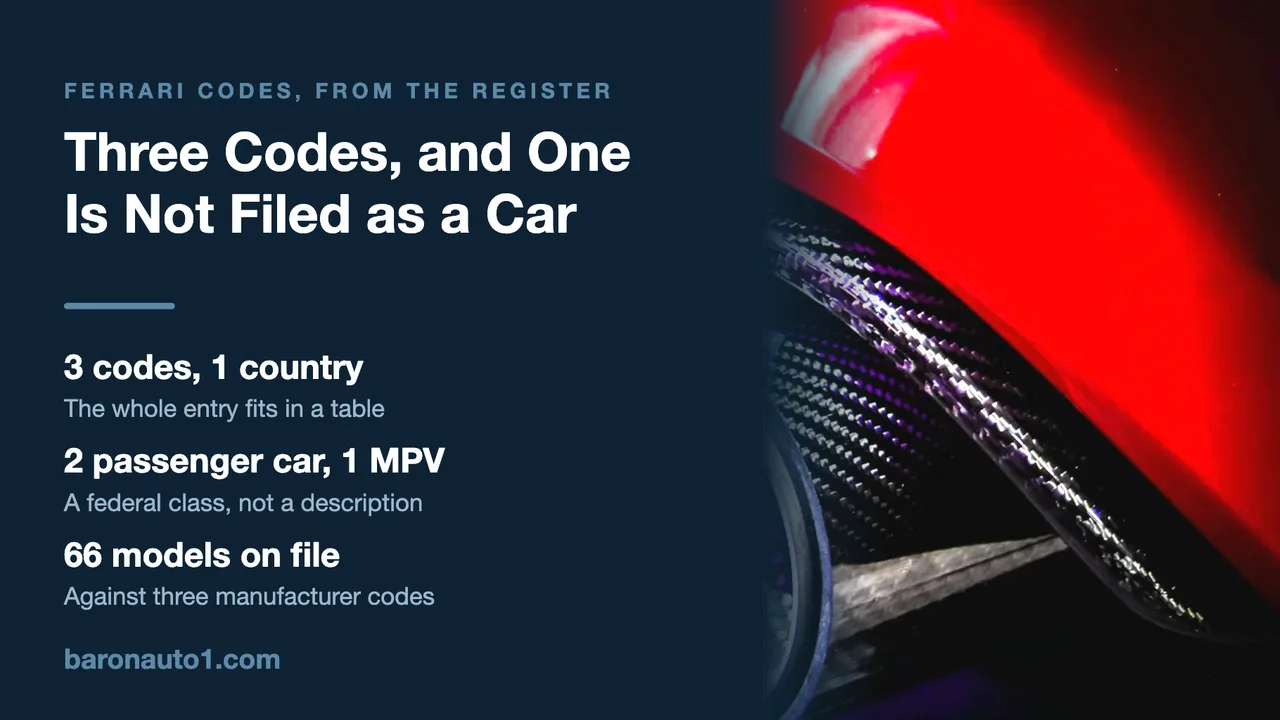
The short version
- There is no Ferrari-only decoder and there is no need for one. Every vehicle certified for this market carries the same seventeen-character number, and one federal register resolves the manufacturer prefix on all of them.
- The whole entry is three world manufacturer identifiers — ZFF, ZFD and ZSG. That is short enough to print in full rather than summarise, and this page prints it.
- Two of the three are filed as Passenger Car and one as Multipurpose Passenger Vehicle. That word is a federal classification, not a description of the car, and a decode returning it has not gone wrong.
- Two registered company names hold the three codes: FERRARI S.P.A. and FERRARI NORTH AMERICA, INC. A decode reports the registrant, not the badge.
- Italy is recorded against two of the codes and the third records no country at all. That field says where the registering entity filed, which is not the same question as where a car was assembled.
- The codes were registered in June 2015, January 2017 and April 2023. Those are filing dates. They are not build dates, not model years, and they do not tell you when anything was sold.
- What no decode carries, on this make or any other: service history, present condition, and whether a recall that was issued was ever actually carried out.
The phrase “VIN decoder” suggests a tool built for one marque. No such thing exists. It does not. The number stamped into a Ferrari is built to the same federal standard as the number on a delivery van, and the register that turns its first three characters into a manufacturer is the same register that does the job for every other make.
What is actually worth reading is the register entry itself, because it is unusually short. Most of the pages in this series have to summarise: a make with thirty or forty codes gets counted and grouped, because printing the list would fill the screen without teaching anything. Ferrari’s entry has three codes in it. The whole thing fits in a small table, so instead of describing it we can simply show it and then talk about what each column means.
This page works from the federal entry. Three codes, two registered company names, two vehicle classes, one country recorded and one blank, and sixty-six models held by the decoder. Nothing here is a manufacturer briefing or a history of the company. It is a public filing, read line by line, with the limits pointed at rather than smoothed over.
One register reads every VIN, this make included
The vehicle identification number is a federal standard and its layout does not change with the badge. Positions one to three are the world manufacturer identifier, assigned to the legal entity that issues numbers. Positions four to eight are a descriptor block the manufacturer designs for itself. Position nine is a check digit, computed arithmetically from the other sixteen characters. Position ten carries the model year. Position eleven identifies the assembling plant. The final six are the serial.
Our guide to reading a VIN position by position works through the full layout, and the by-make index collects what the register holds for each manufacturer we have read.
Where a genuinely brand-specific decoder would earn its keep is the middle block, and this is the point at which honesty is more useful than another table. Positions four to eight are the manufacturer’s own descriptor scheme, and the federal register does not publish the key to it. The register records who holds a prefix, what vehicle class the prefix is filed under, which country the entity filed in, and the date the code was opened. It does not record what a particular character in position six means on one body style as against another.
So this page prints no position-by-position breakdown for Ferrari and no plant-code list, because we do not hold either from a source we would stand behind. Decoding a real number returns the descriptor fields as the federal system resolves them for that specific vehicle, which is a different and far more dependable thing than a printed key assembled from somewhere else. Position ten, the model year character, is the one part of the middle of the number that is standardised across makes, and our VIN year chart covers it.
Three codes, and the whole entry printed rather than summarised
A VIN opens with three characters the manufacturer does not choose for itself. They are assigned centrally, published in full, and they identify the entity that filed for the right to issue numbers. Under Ferrari there are three of them: ZFF, ZFD and ZSG.
That table is not an excerpt. It is the entry. Every code the federal register holds under this make is on it, together with the class each one is filed under and the month the filing was received. There is no second page, no continuation, and nothing has been left out for reasons of space.
It is worth being explicit about that. On a make with thirty or forty registered codes, the honest version of this section is a set of counts and a note that the list runs long. Here the counts and the list are the same thing. Anyone who wants to check this page against the source can do it by reading three rows, which is the standard we would prefer every page on this site could be held to.
All three codes begin with the same letter. What the leading character does not do is tell you which specific building a car was assembled in; that is a separate question, and the federal data does not answer it.
“Vehicle type” is a classification, not a description
This is the column that sends people to a search box convinced the lookup has failed, so it is worth taking slowly.
Every world manufacturer identifier is filed under a vehicle type. On this make the three codes divide two to one: two are filed as Passenger Car, and one is filed as Multipurpose Passenger Vehicle, which most decoders abbreviate to MPV. Those are not adjectives somebody chose to describe the vehicles. They are categories out of the federal motor vehicle safety standards, and they exist because the rules that apply to a vehicle depend on which category it falls into.
The distinction the regulations draw turns on construction and capability rather than on marketing. A passenger car, in that scheme, is a motor vehicle with motive power, excluding the other defined categories. A multipurpose passenger vehicle is also designed to carry ten or fewer, but is constructed either on a truck chassis or with special features for occasional off-road operation. The test is about how the vehicle is built and what it is engineered to do, and the answer determines which safety standards it has to meet.
Nothing in that definition mentions price, performance, prestige, body shape as a buyer would describe it, or the word an owner would use in conversation. A vehicle can be classed as a multipurpose passenger vehicle and still be nothing whatsoever like the mental image the phrase produces. The category is a regulatory bucket. The register writes down which bucket the filing sits in, and stops.
When a decode returns a word the owner would not use
The practical consequence follows directly. Run a number that opens with the code filed as MPV, and a decoder that faithfully reports the register will return “Multipurpose Passenger Vehicle” in the vehicle type field. For a great many owners that is the first time they have seen their car described that way, and the instinctive reading is that something is wrong — wrong car, wrong number, broken decoder, or a seller who has misdescribed what is being sold.
None of those conclusions follows. The decoder is reporting a federal classification exactly as filed. The field is answering the question “which regulatory category does this manufacturer code sit in?” and it is answering it correctly. It is not answering “what would you call this car?”, and it was never built to.
The same trap is set on other entries in this series. The Porsche register entry divides across the identical two classes, one code each, and the Land Rover entry leans the other way, with more of its codes filed as multipurpose passenger vehicles than as passenger cars. In each case the pattern is the same: a word from the regulations arrives in a field a reader is treating as a description, and the mismatch reads as an error when it is nothing of the kind.
The useful habit is to read the vehicle type field as metadata about the code rather than as a statement about the individual car. If you want to know what you are looking at, look at the car. If you want to know which federal category the manufacturer filed the prefix under, read the field. Those are genuinely different questions and the register only answers the second one.
Two registered names hold the three codes
The register records, against every code, the name of the entity that filed for it. On this make there are two such names: FERRARI S.P.A. and FERRARI NORTH AMERICA, INC. Two of the three codes are held by the first and one by the second.
A decode returns that registered name character for character, because reporting the registrant is precisely what the field is for. It is telling you which filed entity is entitled to issue that number. It is not telling you who designed the vehicle, who sold it, who warrants it, or whose name is above the showroom door. Where the registered names contain the badge, the distinction passes unnoticed. Here it surfaces only in the mild sense that two different corporate names appear where a reader might have expected one.
We are not going to narrate anything past that, because the register does not carry it. A filing supplies a name, sometimes a country, and a date. It does not record how entities relate to one another, who owns what, or why a second name was registered at all, and this site does not supply that kind of detail from memory. What can be said with confidence is what is written down: two names, three codes, and a two-to-one split between them.
Italy on two codes, and nothing at all on the third
Two of the three codes have Italy recorded against them. The third has no country recorded at all — the field is empty, and a decoder that reports the register honestly will either say so or leave the field blank.
That is not a gap somebody forgot to fill, and it is not evidence that the code is irregular. The country field records where the registering entity filed. It is a fact about a filing cabinet, not a fact about a production line. A code can be registered by an entity in one country and used on vehicles built somewhere else entirely, and the register neither prevents that nor comments on it.
An empty country field is therefore an unremarkable outcome rather than a defect. Counting across the 46 make entries we have read for this site, 14 of them hold at least one code with no country recorded — makes large and small alike. It means only that the field was not populated for that filing. Nothing in the federal data lets anyone fill it in afterwards, so this page does not guess at it.
The practical upshot for a buyer is narrow and worth stating plainly: do not treat the country against a manufacturer code as an assembly location, and do not treat a blank one as a warning sign. If where a car was built matters to you, that belongs to the documentation and the physical certification label on the vehicle, not to this field.
Three filing dates, in the order the register received them
Each code carries the date its registration was recorded. In order, the entry runs June 2015, January 2017 and April 2023.
Those are registration dates. They are not build dates, not model years, and not the date any vehicle went on sale. A code has to exist before numbers can be issued under it, so a filing date sets an outer boundary and nothing finer. It does not tell you that vehicles started appearing that month, and it certainly does not tell you anything about volumes or about what the company was doing at the time. The register records that a filing was received and when. Everything past that is inference, and this page does not make it.
Reading the dates as an ordering is legitimate and mildly useful. They tell you which of the three codes is the oldest filing in the entry and which is the most recent, and that the most recent of the three is the one filed under the multipurpose passenger vehicle class. That is a fact about the sequence of filings. It is not a fact about the sequence of cars, and the two should not be run together.
If you want the model year of a specific vehicle, that is position ten of the individual number rather than anything in the register entry, and it is standardised across manufacturers. The year chart converts the character.
Sixty-six models in the decoder, and no list on this page
Separately from the manufacturer codes, the federal decoder holds a roster of model names for each make. For Ferrari that roster runs to sixty-six entries, covering what the decoder knows across all years rather than any current line-up.
This page does not print those names. The archived pull behind it carries the count and not the list, and we would rather say so than reconstruct a roster from somewhere else and present it as though it came from the register. Naming models we cannot cite is exactly the failure this site tries not to commit, and a list that looks authoritative while being sourced from nowhere is worse than no list.
It matters less than it might appear, because the count is not the thing a buyer needs. Decoding an actual number returns the model for that specific vehicle, resolved by the federal system from the characters in front of it. That is the answer worth having, and it does not depend on any roster being reprinted here.
The gap between three codes and sixty-six model names is itself the point worth taking away. A manufacturer code is a registration; a model name is a catalogue entry. There is no requirement that the two scale together, and on this make they very obviously do not.
Nothing filed under a parent, and no false matches
Two administrative points, both of which can be stated flatly.
First, this make registers under its own name. Some makes covered on this site do not — their codes are held by a parent group and querying the badge alone returns nothing, which is a genuine source of confusion on those pages. That situation does not arise here. The codes are filed under names that contain the make name, and there is no parent entry sitting behind them.
Second, a name query against the register returns zero unrelated matches for this make.Counting those name matches in, or filtering them out, changes the total. Here the count of such matches is zero. That is the ordinary result across the makes we have read rather than anything remarkable, and it means the three codes above are the complete set with nothing to filter out.
What the decode does not carry
Everything above concerns what the register holds. This section concerns what it does not, and for anyone about to hand over money it is the more important half.
A VIN decode does not carry service history. It will not tell you when the car was last looked at, what was done, whether it was done by someone competent, or whether anything was skipped.
A decode does not carry condition. It resolves what the vehicle was specified as when the number was assigned. It says nothing about what has happened since — wear, damage, repairs, replacements, or anything fitted, removed or swapped after the vehicle left the factory. A number is a fixed record of an origin, not a live description of an object.
A decode does not tell you that a recall was carried out. It is worth separating these two, because the recall lookup and the VIN decode feel like the same operation. They are not. A recall check against a specific number will show whether a campaign is recorded as open or as remedied against that vehicle, which is free, quick and always worth running — our guide to checking a car for open recalls covers how. What it cannot show is whether a previous owner ever actually presented the car, nor any work done outside the campaign system. Read the campaign text rather than only the status flag.
And a decode does not carry title status, mileage history or the record of what has been reported against the vehicle over its life. Those live in different systems and need to be asked separately. A free VIN check is a reasonable first pass, and a title check by VIN covers the branding questions that a decode is structurally incapable of answering.
Using all of this on a specific car
Put together, the sensible sequence on an individual vehicle is short.
Start by checking that the number on the car matches the number on the paperwork, in every character, on every document.
Then decode the number and read the result for what it is. The manufacturer prefix will resolve to one of the three codes above and return a registered company name and a federal vehicle class. Expect the company name to be a registered entity rather than the badge. Expect the vehicle class to be a regulatory word, possibly one you would never use yourself. Neither is a fault.
Then check the model year character against the advert, run the recall lookup, and run the title check. Those three take a few minutes between them and they address the questions that actually decide whether a car is worth pursuing.
Finally, treat everything the decode cannot reach as a documentation problem rather than a data problem. Service records, evidence that recall work was done, and an inspection by somebody who knows the marque are what fill the gap.
If you are the one selling
The same material is useful from the other side of the transaction. A buyer who runs a decode and gets back a registered company name, or a vehicle class that reads oddly, may well arrive with a question that sounds like an accusation.
The answer is the one this page has been making throughout: the register records a registrant and a federal classification, and neither is a description of the car. Being able to say that calmly, and to point at the entry it comes from, tends to close the question rather than open it. A seller who understands their own paperwork is a seller who looks worth dealing with, which is a useful impression to have established before the price comes up.
Common questions
Is there an official Ferrari VIN decoder?
Not a separate one, and none is needed. Vehicles carry the same seventeen-character number regardless of badge, and the federal register resolves the manufacturer prefix on the same terms for every make. A general decoder handles this marque.
How many manufacturer codes does Ferrari have?
Three: ZFF, ZFD and ZSG. That is the complete entry, not a selection from a longer list.
Why does my decode say “Multipurpose Passenger Vehicle”?
Because one of the three codes is filed under that federal classification, and a decoder reporting the register faithfully will return it. It is a regulatory category defined by how a vehicle is constructed and what it is engineered to do, not a description of body shape or character. Seeing it is not evidence of an error, a wrong number, or a misdescribed car.
What is the difference between Passenger Car and MPV in a decode?
They are two different categories in the federal safety standards. Both cover vehicles. The multipurpose category additionally requires construction on a truck chassis or special features for occasional off-road use, and the classification determines which standards apply. On this make, two codes are filed as Passenger Car and one as Multipurpose Passenger Vehicle.
Why does one code show no country?
Because the field was not populated for that filing. The country recorded against a manufacturer code describes where the registering entity filed, not where any vehicle was assembled, and a blank one is an unremarkable outcome: 14 of the 46 make entries read for this site hold at least one such code. Nothing in the federal data allows it to be filled in afterwards, so this page does not guess.
Which company name will a decode return?
One of two: FERRARI S.P.A., which holds two of the codes, or FERRARI NORTH AMERICA, INC., which holds one. A decode reports the registered entity that issued the number rather than the badge on the car. The register gives those entities a name, sometimes a country and a date, and nothing more, so nothing more is claimed here.
What do the registration dates mean?
They record when each code’s filing was received: June 2015, January 2017 and April 2023. They are not build dates, not model years, and not sale dates. They order the filings and set an outer boundary on when numbers could be issued under each code, and that is the whole of their meaning.
Does a Ferrari VIN tell me which factory built the car?
Not from the federal data. Position eleven of an individual number is the plant character, but the register does not publish the key that converts it into a plant name, so no plant-code table appears on this page. The country recorded against a code describes the registrant’s filing.
How many models does the decoder hold?
Sixty-six, across all years rather than as a current line-up. The archived pull behind this page carries the count and not the list of names, so no model list is printed here. Decoding a specific number returns the model for that vehicle, which is the answer a buyer needs.
Will a decode tell me the specification or options?
No. It resolves what the federal system holds for the number — manufacturer, class, model year and the model line as filed. Options, fitted equipment and anything changed after the vehicle was built sit outside every historical decode, on this make and on all others.
Can a VIN check prove a recall was completed?
It can show whether a campaign is recorded as open or remedied against that specific number, which is free and worth running. It cannot prove a previous owner presented the vehicle, and it does not capture work done outside the campaign system. Read the campaign text, not just the flag.
Does Ferrari register under a parent company?
No. The codes are filed under the make’s own names, and a register query on the name returns zero unrelated matches, so the three codes listed here are the complete set with nothing to filter out.
For sale near you
Dealer listings, checked liveFinding used Ferrari cars near you…
Sources and further reading
- NHTSA VIN decoder
- NHTSA recall lookup
- NMVTIS (US Department of Justice)
- 49 CFR Part 567 — Certification
Recall, complaint and safety-rating figures on this page were retrieved from the federal databases above on August 19, 2026. Federal data changes — re-check any VIN before you rely on it.
Published September 5, 2026 · last updated September 5, 2026. Found something out of date or wrong? Tell us and we will correct it.