Jayco VIN Decoder: One Code, and a Name Query That Adds Another
One code of its own, plus an unrelated company the name query drags in. Counting the second one is how totals go wrong.
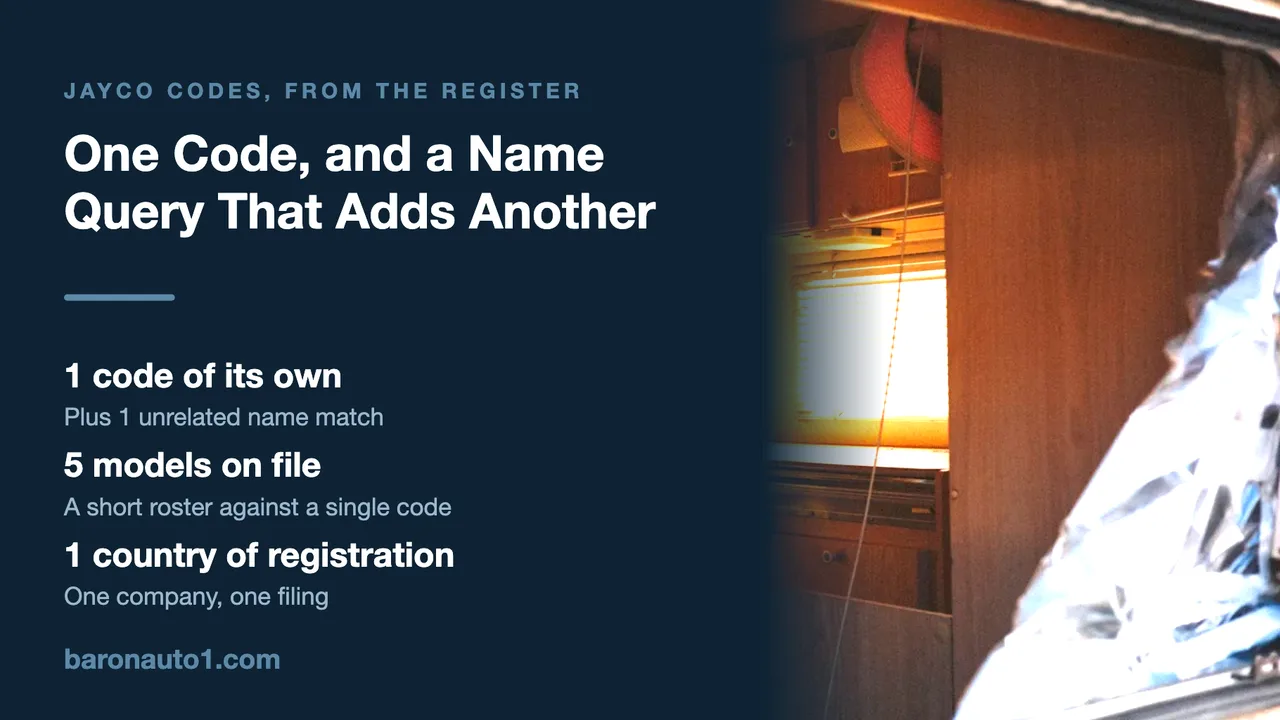
The short version
- There is no Jayco-only decoder and there is no need for one. Every vehicle certified for this market carries a number built to the same federal layout, and one federal register resolves the manufacturer prefix on all of them — towed vehicles included.
- The entry is a single world manufacturer identifier: 1UJ, filed under the company name JAYCO, INC., recorded against UNITED STATES (USA), classified as a Trailer, and registered on 23 November 2015.
- A query on the name returns one further row that is not part of that entry: the six-character code 1J9573, filed under the name JAYCO TRAILER COMPANY, also classified Trailer, with no country recorded and a registration date of 5 June 2024.
- The decoder holds five model names, and they are: Hybrid Trailer, JAYCO TRAILER COMPANY, Jayco, RV Trailer, Sport Utility Trailer. Not one of them is a floorplan or a series name.
- A registration date is the date a code was opened on the register. It is not a build date and not a model year. The country field records where the registrant filed, which is a different question from where anything was assembled.
- The make registers under its own name. There is no parent group in this entry, so nothing is hiding beneath another company’s filing and nothing needs adding to the count.
- What no decode carries, here or on any other make: service history, present condition, and whether a recall that was issued was ever actually carried out.
The number stamped or plated on a towed vehicle is built to the same federal standard as the number on a saloon, and the register that turns its opening characters into a manufacturer is the same register that does the job for everything else certified for sale here. There is no separate machine to find.
What is worth reading is the register entry itself, and on this make it is short enough to print rather than summarise. One manufacturer code, one filed company name, one country, one vehicle class, one registration date, and a model roster of five names. Read from NHTSA’s vPIC register and archived in this site’s data file, that is the whole of it. Counting across the fifty-seven make entries read for this site, four hold exactly one code, and this is one of the four.
A thin entry is not a broken entry, and it does not mean a decode is worthless. It means the decode answers fewer questions than a buyer expects, and it means the questions it leaves open have to be settled from documents and from the vehicle. Saying precisely which questions those are — and which ones a towed-vehicle decode was never built to reach — is more useful than another input box.
One federal system reads every VIN, towed vehicles included
A vehicle identification number runs to seventeen characters in a layout that does not change with the badge or with whether the thing has an engine. Characters one to three are the world manufacturer identifier, assigned to the legal entity that issues numbers. Characters four to eight are a descriptor block the manufacturer designs for its own use. Position nine is a check digit computed arithmetically from the other sixteen. Position ten carries the model year. Position eleven identifies the plant. The final six are the serial.
Because that structure is common to everything certified for sale in this market, a general decoder reads a travel trailer exactly as readily as it reads a hatchback. Our guide to reading a VIN position by position works through the full layout, and the by-make index collects what the register holds for each manufacturer we have read.
There is one thing a genuinely make-specific decoder would add, and naming it stops its absence looking like an oversight. Positions four to eight are the manufacturer’s own descriptor scheme, and the federal register does not publish the key to it. The register records who holds a prefix, which vehicle class the prefix is filed under, which country the registrant filed in, and the date the code was opened. It does not record that a given character in position six means one length of body on one product and something else on another.
So this page prints no position-by-position table for the make and no plant-code list, because we hold neither from a source we would defend. Decoding a real number returns the descriptor fields as the federal system resolves them for that specific vehicle, which is a different and far more dependable thing than a printed key assembled from elsewhere. Position ten is the exception, because the model year character is standardised across manufacturers, and our VIN year chart converts it.
One code, and that is the entry
Under this make the register holds a single world manufacturer identifier: 1UJ. It is filed under the company name JAYCO, INC., recorded against UNITED STATES (USA), classified as a Trailer, and its registration was recorded on 23 November 2015. There is no second code in the entry, no second filed name, no second country and no second vehicle class.
That has an immediate consequence for anyone reading a decode. On a make with several codes, the opening three characters carry information: they can separate one registrant from another, or one country of registration from another, and the reader has to work out which. Here they cannot. Every number covered by this entry opens with the same three characters, so those characters confirm which register row the number resolves against and tell you nothing that distinguishes one trailer from the next one on the same forecourt.
The reverse case is worth stating just as plainly. If a number in front of you opens with three characters other than 1UJ, this entry does not describe it. That is not automatically a problem. It is a fact about which row the number resolves against, and the honest response is to read what the decode of that specific number actually returns rather than to assume it should have matched a page written about a badge. Numbers are decoded on their own terms.
The single filed name deserves a note too. JAYCO, INC. is the registrant as the register spells it, and that is the whole of what the field claims. It is telling you which entity holds the right to issue numbers under that prefix. It is not telling you who designed the vehicle, who sold it, who warrants it, or whose name is over the dealership door. On makes with several filed names those two things visibly come apart. Here they line up, which makes the entry easy to read but does not make it say any more than it says.
The second row a name query returns, and why it is not in the count
Query the register for the make name as a piece of text and a second row comes back. It is worth setting out exactly what that row contains, because a name query and a manufacturer-code lookup are two different operations that produce two different answers.
The row is the code 1J9573, filed under the name JAYCO TRAILER COMPANY, classified as a Trailer, with no country recorded against it, and a registration date of 5 June 2024. That is one further match, and the count of such matches on this make is one. Counting across all fifty-seven make entries read for this site, forty-three return no name matches at all, so a single match sits at the quiet end of the range rather than anywhere unusual.
Two things about that row explain why this page keeps it separate from the entry above. The first is its length. 1UJ is three characters; 1J9573 is six. The register issues six-character codes to low-volume builders, where the first three characters sit at the front of the number and the remaining three sit at positions twelve to fourteen. Our count for every make on this site includes three-character codes only. Any total for a make needs its counting rule stated beside it, and that is ours.
The second is that the register does not explain the relationship between two filings, and this page will not invent one. What is written down is a name, a class, sometimes a country, and a date. Whether two entities that file under similar names are connected, and how, is not a question the register answers, and nothing in the federal data lets it be answered afterwards. The useful takeaway is procedural rather than corporate: a name query is a text search, so it returns rows that match the string, and a total assembled from one is not the same total as a list of manufacturer codes.
Set out that way, the entry is three numbers and no ambiguity. It also shows why the model roster, not the code list, is where the interesting limitation on this make sits — which the section below comes to.
Filed as Trailer, and what that word is doing
The register files every code under a vehicle type, and here the single code is filed as Trailer. Across the fifty-seven makes read for this site, five have all of their codes filed wholly under that class, and of those five this make holds the fewest codes.
What the field is reporting deserves precision, because it is easy to over-read in both directions. The word is a federal classification recorded against the code. It is a regulatory category, not a description of the product, not a body style, not a statement of length or weight, and not a claim about what may lawfully be towed by what. A decode returning Trailer is telling you how the code was classified when it was filed.
The distinction the classification turns on is whether the vehicle is designed to be drawn by another vehicle rather than to move under its own power. That is why the class matters more to a buyer than it might first appear: it separates the towed from the self-propelled, and a great deal of what follows — which records exist, what the paperwork looks like, what a decode can even be asked — follows from which side of that line the vehicle sits on. A motorhome and a travel trailer are not the same kind of object in the federal data, and they do not decode to the same kind of answer.
What the class field cannot do on this make is any sorting work. On an entry whose codes split across several classes, a mismatch between the class and the advert is at least a question worth asking. Here there is one code and one class, so the field agrees with itself and moves on. Our trailer VIN lookup guide covers the towed side of this in general, and the camper and RV lookup guides deal with the neighbouring cases where the same buyer is often comparing across the line.
Five model names, and what they are not
Separately from the manufacturer codes, the federal decoder holds a roster of model names for each make. On several of the pages in this series that roster runs into the hundreds and the count is all we hold, so no names are printed. Here the roster is five names long and we hold the names themselves, so this page prints them exactly as the register spells them.
They are: Hybrid Trailer, JAYCO TRAILER COMPANY, Jayco, RV Trailer and Sport Utility Trailer. That is the complete roster and it is not an excerpt.
Read the list again and the shape of the problem appears. Three of the five are category words: a hybrid trailer, an RV trailer, a sport utility trailer. One is the make name on its own. One is a company name in capitals — the same string that appears as the registrant on the six-character row described above, which is a coincidence of text this page will note and not explain. What none of the five is, is a series or a floorplan: no name in that roster identifies one product against another the way a model name ordinarily does.
This is the sharpest practical consequence in the whole entry, so it is worth slowing down on. On most makes the model field is the field a used buyer leans on hardest. It either agrees with the advert or it does not, and a disagreement between the model a number decodes to and the model in the listing is the cheapest way there is to end a conversation before anyone has driven anywhere. That check works because the roster holds many distinct names and only one of them comes back.
Here the roster holds five entries and none of them is specific enough to do that job. A decode that returns the model as “RV Trailer” has confirmed that the number resolves against this entry and has described a category. It has not confirmed which trailer you are standing in front of, because there is no floorplan name it could have returned instead. The field is doing its job and its job is small.
So the verification a buyer would ordinarily get free, from the model field, has to be obtained another way on this make. That does not mean going without it. It means taking it from the number as read off the vehicle itself, from the seller’s documentation, from the federal certification label, and from a physical look at the thing. Each of those is more work than reading a model name off a screen, and on this entry there is no way round it.
What a towed-vehicle decode reaches, and where it stops
It is worth being concrete about the boundary, because the gap between what a decode is expected to carry and what it carries is wider on a towed vehicle than on a car.
What the decode does reach: the manufacturer prefix, resolved to a filed company name; the federal vehicle class the code sits under; the model as the decoder holds it, which on this make is one of the five words or phrases above; and the model year character at position ten. It reaches the check digit, which is arithmetic on the number itself and will flag a number that has been mistyped or invented. That is a real and useful set of answers, and running it costs nothing.
What it does not reach is longer, and on a towed vehicle it is nearly everything a buyer actually chooses between. The decode does not return length. It does not return the number of axles, the weight ratings, the tyre and rim specification, the floorplan, the berth count, the fit-out, the fabric of the awning, or which options were fitted at the factory. It does not return the tow rating a buyer needs to match against a vehicle. There is no field for any of it in the manufacturer-code data.
Nor does the decode describe the vehicle as it stands now. A number is a fixed record of an origin. Everything a towed vehicle accumulates afterwards — water ingress, delamination, a repaired panel, replaced running gear, a new axle, a resealed roof — sits entirely outside it. That is not a shortcoming in this make’s entry.
One more distinction matters on the towed side. Because a trailer is drawn rather than driven, the odometer record that gives a used car buyer a rough sense of use does not exist for it. The mileage that was covered belongs to whatever was pulling it. Anyone used to reading a car’s history should notice that a familiar column is simply absent here rather than empty, and plan the inspection around that.
The label on the vehicle carries what the decode does not
The federal certification label is a separate document from the number, and on a towed vehicle it is the more informative of the two. It carries the vehicle identification number, the gross vehicle weight rating, the gross axle weight ratings, and the tyre and rim information the ratings assume. Those are exactly the figures a decode cannot produce, and they are the figures that decide whether a given tow vehicle and a given trailer belong together.
So the sequence for anyone looking at one of these is: read the number, decode it, and then go and read the label with at least as much attention. The number tells you which register row you are on. The label tells you what the thing was certified to weigh and carry. Photograph it. A seller who cannot produce a legible label has handed you a question worth pursuing before the price comes up.
The number itself is required to appear on the forward half of the left side of a trailer, which is where to look before assuming it is missing. Check it character for character against every document in the folder.Our page on reading the number covers what each position is doing while you are in front of it.
One country, one date, and what neither of them means
The single code is recorded against UNITED STATES (USA), and this is the field that carries the least weight of any on the page. What it records is where the registering entity filed. It is a fact about a filing, not a fact about a production line, and it should not be treated as a statement of assembly location. The six-character row described earlier has no country recorded against it at all, which is likewise a fact about how that filing was populated rather than evidence of anything irregular.
The registration date on the manufacturer code is 23 November 2015. That is the date the code’s registration was recorded. It is not a build date, not a model year, and not the date anything went on sale. A code has to exist before numbers can be issued under it, so a filing date sets an outer boundary and nothing finer. Reading it as the start of anything — a product, a range, a period of trading — is inference the register does not support, and this page does not make it.
The same applies to the 2024 date on the six-character row. It records when that filing was received. Two dates in a register entry are two administrative events, and the interval between them is the interval between two filings rather than a story about vehicles.
If you want the model year of a specific trailer, that is position ten of its own number rather than anything in the register entry, and it is standardised across manufacturers. The year chart converts the character. Be aware that a model year and a build date are themselves two different things, and that the number gives you the first.
No parent group, and nothing to subtract
Two administrative points, both of which can be stated flatly.
First, this make registers under its own name. Some makes covered on this site do not: their codes are held by a parent group, and a query on the badge alone returns nothing at all, which is a genuine source of confusion on those pages. That situation does not arise here. The code is filed under a name containing the make name, and there is no parent entry sitting behind it.
Second, the count above is stated with its rule attached. One three-character manufacturer code belongs to the entry. One six-character row is returned by a text query on the name and is reported separately. Nothing has been quietly added or quietly dropped to make a number look tidier, and anyone checking this page against the source is checking two rows.
What the decode does not carry at all
Everything above concerns what the register holds. This section concerns what it does not, and for anyone about to hand over money it is the more important half.
A decode does not carry service history. It will not tell you when the vehicle was last looked at, what was done, whether it was done competently, or whether anything was skipped.On a towed vehicle, where the questions that matter most are about sealing, structure and running gear, that absence is the whole ball game.
A decode does not carry condition. It resolves what was specified when the number was assigned and says nothing about what has happened since — wear, damage, repairs, replacements, or anything fitted or removed afterwards.
A decode does not tell you that a recall was carried out. The recall lookup and the VIN decode are separate operations against the same number, and they answer separate questions. A recall check against a specific number shows whether a campaign is recorded as open or as remedied against that vehicle, which is free, quick and always worth running — our guide to checking for open recalls covers how. What it cannot show is whether anyone ever actually presented the vehicle, nor any work done outside the campaign system. Read the campaign text rather than only the status flag.
And a decode does not carry title status or the record of what has been reported against the vehicle over its life. Those live in different systems and have to be asked separately. A free VIN check is a reasonable first pass, and a title check by VIN covers the branding questions a decode is structurally incapable of answering. Titling rules for towed vehicles are set by each state rather than federally, so what comes back can look different from what a car returns, and an empty result is not by itself an answer.
A sequence for a used one
Put together, the order of operations on an individual vehicle is short and it is worth doing in this order.
Start with the number on the vehicle against the number on every document, character by character. Then decode it, and read the result for what it is: expect the manufacturer prefix to resolve to 1UJ and return the filed company name, expect the class to read Trailer, and expect the model field to return a category rather than a floorplan. None of those is a fault or a sign that the lookup has failed.
Then check the model year character against the advert, run the recall lookup, and run the title check. Those three take a few minutes between them and they address the questions that actually decide whether a vehicle is worth pursuing.
Then read the certification label for the weight ratings, and match them honestly against what you intend to tow with. Finally, treat everything the decode cannot reach as an inspection problem rather than a data problem. Roof and seams, walls for soft spots, floor around the wet areas, axles, brakes, bearings and tyre dates: none of that is in any register, and all of it decides what the vehicle is worth.
If you are the one selling
The same material is useful from the other side. A buyer who decodes the number and gets back a filed company name, the single word Trailer, and a model field reading “RV Trailer” may arrive with a question that sounds like an accusation: the decode does not name the model, so is something wrong?
Nothing is. The answer is the one this page has been making throughout: the register records a registrant, a federal classification and a short roster of names, and none of those is a description of an individual vehicle. Being able to say that calmly, and to point at the entry it comes from, tends to close the question rather than open it. Have the certification label clean and legible, have the paperwork in one folder, and the gap the decode leaves gets filled by you rather than by the buyer’s imagination.
Common questions
Is there an official Jayco VIN decoder?
Not a separate one, and none is needed. Vehicles carry a number built to the same federal layout regardless of badge, and the federal register resolves the manufacturer prefix on the same terms for every make. A general decoder handles this one.
How many manufacturer codes does the register hold under this make?
One: 1UJ, filed under JAYCO, INC. That is the complete entry rather than a selection from a longer list. A text query on the name returns one further row, the six-character code 1J9573 filed as JAYCO TRAILER COMPANY, which is reported separately here because our count includes three-character codes only.
Why does my decode return “RV Trailer” instead of a model name?
Because that is one of the five names the decoder holds for this make. The roster is: Hybrid Trailer, JAYCO TRAILER COMPANY, Jayco, RV Trailer, Sport Utility Trailer. None of them is a series or floorplan name, so the model field returns a category. That is the register reporting what it holds, not a failed lookup.
Will the VIN tell me the floorplan, length or berth count?
No. None of those is in the manufacturer-code data, and no field exists for them. The decode reaches the manufacturer, the federal class, the model as filed and the model year character. Length, layout, weights and fit-out have to come from the certification label, the seller’s documentation and the vehicle itself.
What does the vehicle type “Trailer” mean in a decode?
It is the federal classification the code was filed under, and it turns on the vehicle being designed to be drawn by another vehicle rather than to move under its own power. It is a regulatory category, not a description of the product and not a statement about size, weight or what may tow it.
What does the registration date mean?
It records when the code’s registration was received: 23 November 2015 for 1UJ, and 5 June 2024 for the six-character row returned by a name query. Those are filing dates. They are not build dates, not model years and not sale dates, and they set an outer boundary on when numbers could be issued under each code rather than telling you anything about vehicles.
Does the country field tell me where the trailer was built?
No. The code is recorded against UNITED STATES (USA), and that field records where the registering entity filed. It is a fact about a filing rather than about a production line. Where a specific vehicle was assembled is a documentation question, not a question this field answers.
Why does a name search return a company I was not expecting?
Because a name query matches company names as text, so any registrant whose filed name contains the string comes back. Here it returns one further row, JAYCO TRAILER COMPANY, against a six-character code with no country recorded. The register records names, classes, sometimes countries and dates. It does not record how filed entities relate to one another, and this page does not guess.
Does this make register under a parent company?
No. The code is filed under the make’s own name and there is no parent entry behind it, so nothing is hiding under another company’s filing and the single code above is not an undercount.
Can a VIN check prove a recall was completed on a trailer?
It can show whether a campaign is recorded as open or remedied against that specific number, which is free and worth running. It cannot prove anyone ever presented the vehicle, and it does not capture work done outside the campaign system. Read the campaign text, not just the flag.
Does a trailer VIN carry mileage?
No, and it could not. The number is a fixed record of origin, and a towed vehicle accumulates no odometer reading of its own — the distance belongs to whatever pulled it. Anyone used to reading a car’s history should expect that column to be absent rather than empty, and weight the physical inspection accordingly.
Where is the number on a towed vehicle?
The federal requirement places it on the forward half of the left side, and the certification label carries it alongside the gross vehicle weight rating, the axle ratings and the tyre and rim information. Check the number against every document before anything else, and photograph the label while you are there.
What should I run alongside the decode?
A recall lookup, a title check and a general history check, each against the specific number rather than the badge. The decode establishes what the vehicle was filed as; those establish what has been reported about it since. Neither replaces an inspection of the roof, seams, floor and running gear.
Sources and further reading
- NHTSA VIN decoder
- NHTSA recall lookup
- NMVTIS (US Department of Justice)
- 49 CFR Part 567 — Certification
Recall, complaint and safety-rating figures on this page were retrieved from the federal databases above on August 19, 2026. Federal data changes — re-check any VIN before you rely on it.
Published September 6, 2026 · last updated September 6, 2026. Found something out of date or wrong? Tell us and we will correct it.