Kawasaki VIN Decoder: Seven Codes, Five Countries, One Vehicle Type
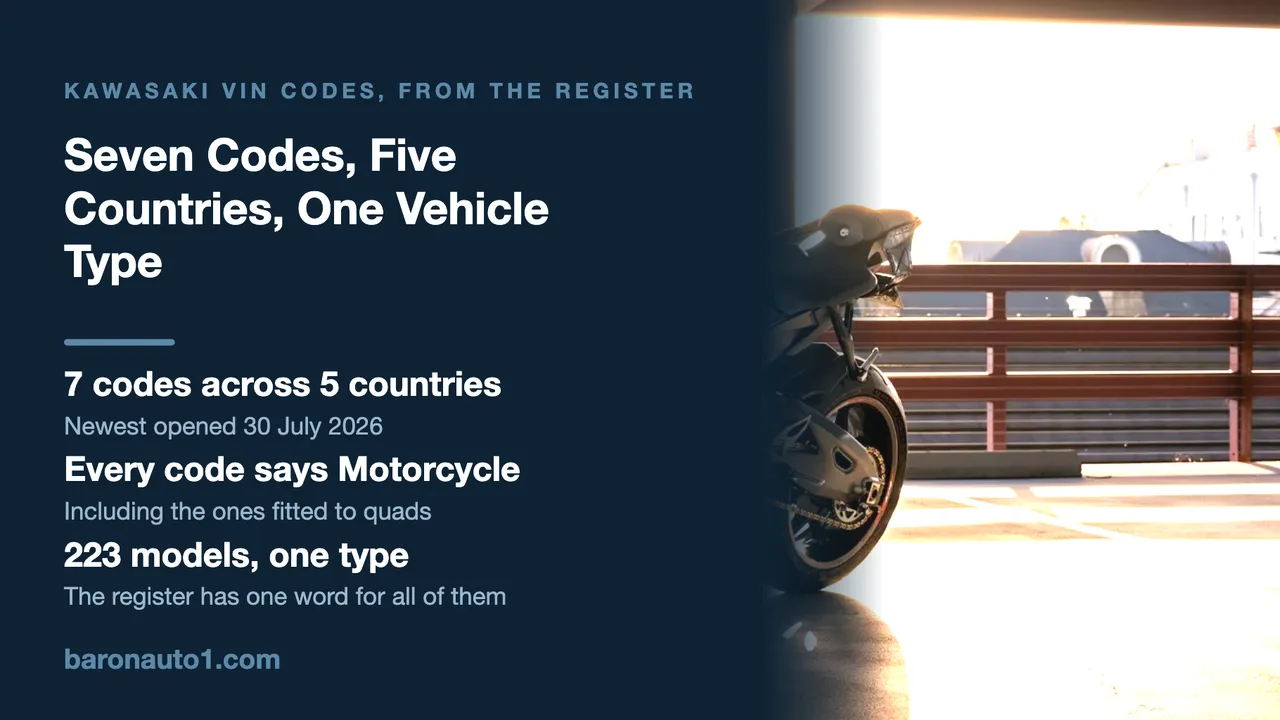
Every one of the seven codes is filed as a motorcycle, including the ones that end up on quads. The newest was opened weeks ago, in India.
The short version
- There is no Kawasaki-only decoder. One federal register reads every VIN ever issued, and a Kawasaki-branded lookup page is that same query wearing a badge.
- What is genuinely Kawasaki-specific is the register entry: 7 world manufacturer identifiers, held between 2 company names, against the 223 models the federal decoder holds for the make.
- JKA, JKB, JK1 and JK8 all open with the same two characters, and the register answers the country question three different ways across them — United States, nothing recorded at all, and Japan.
- That field describes where a filing was made, not where a machine was assembled. It is the single clearest reason two decoders can disagree about the same bike.
- All 7 codes are filed under one vehicle type, Motorcycle. The 223 models include quads and side-by-sides, so a result reading Motorcycle is not proof of what is standing in front of you.
- The geography of the codes is a manufacturing map: Indonesia and Thailand in 2019, India on 30 July 2026 — about five weeks before this page was written.
- The decode is the build as filed. Service history, a straightened frame and a swapped engine are all outside it, and on a motorcycle that gap is wider than on a car.
The phrase “VIN decoder” suggests a tool built for one marque. No such thing exists. Behind almost all of them sits the same federal register, answering the same question, for every make on the road. Nothing about the box is Kawasaki-specific.
What is Kawasaki-specific is the register entry itself: which codes the company has filed, under which names, in which countries, and on which dates. That is a small set of facts, it is public, and it is more useful than it sounds — because reading it explains why decoders disagree with each other about Kawasaki machines more often than they disagree about cars.
This page works from a single pull of NHTSA’s vPIC register, read on 5 September 2026 and archived alongside the site’s other make data. Every figure here traces to that file. Where the federal data does not answer a question a Kawasaki buyer would reasonably ask, the page says so rather than filling the gap.
Seven codes, two names, five countries
A VIN opens with three characters the manufacturer does not choose. They are the world manufacturer identifier, assigned centrally and published in full, and they identify the entity that filed for the right to issue numbers. Under Kawasaki there are 7 of them.
Two corporate names hold the set. Most of it is filed under Kawasaki Motors, Ltd. The exception is ML5, filed under Kawasaki Motors Enterprise Thailand Co., Ltd. — a separate legal entity registering in its own right, which is the ordinary pattern once a manufacturer builds in a country at scale.
Across the 7 codes the register records 5 countries. That is a wide spread for a make this size, and every one of the entries earns its place through a filing rather than through a badge decision. A machine wearing Kawasaki green does not tell you which of the 7 codes issued its number. The first three characters do, and nothing else on the bike does.
One more thing worth recording, because it is unusual. Querying the register for the name returns 0 false matches. On many makes the same query drags in unrelated companies whose registered names happen to contain the word, because the endpoint matches company names as text rather than resolving brands — our page on VIN decoders by make covers why that produces different code counts on different sites. Kawasaki has none of that noise, and it registers under its own name rather than being filed beneath a parent group. The 7 codes are the 7 codes.
The decoder is federal, and it is the same one for everything
NHTSA operates the register and the decoding service behind it. Manufacturers submit their information as part of safety certification, and the resulting system decodes any seventeen-character VIN free of charge, whatever the badge. A Kawasaki goes in through the same door as a pickup truck.
So a Kawasaki VIN decoder is that system with a Kawasaki-shaped page around it. This matters for a practical reason rather than a pedantic one: if two sites give different answers about the same bike, the difference is almost never in the decoding. It is in how each site presents fields the register left thin, and in whether it is reading the register at all or inferring from a pattern it has learned.
The corollary is that a decode is worth exactly what the manufacturer submitted. Identification comes back well on modern machines — make, model, model year, body class, engine and displacement. Everything about the individual machine, from its mileage to its history, comes from other records entirely. Our guide to reading a VIN sets out which parts of the number are fixed by standard and which are the manufacturer’s to define.
The J-codes disagree with each other, and that is the most useful fact here
Look again at the register rows. JKA and JKB were both opened on 3 June 2015, and the country field on both reads United States. JK1 was opened on 19 October 2015 and its country field is empty — not another country, not unknown, simply nothing recorded. JK8 was opened on 3 August 2016 and reads Japan.
Four codes. The same opening letter. Three different answers to the question a buyer thinks they are asking.
The resolution is that the field is not answering that question. It records something about the registration — who filed, and where the filing sat — and it does not follow a machine from a production line to a crate. A code filed under a United States address can carry numbers for machines built elsewhere. A code with an empty country field is not a mystery about a factory; it is a blank in an administrative record. Treat the country line in a decode result as a fact about paperwork, and the contradiction stops being a contradiction.
This also explains a thing that puzzles people who cross-check their bike on several sites. One decoder prints a country, another prints a different one, a third prints nothing. All three can be reading the same register honestly, because the register itself gives the JK family three answers. A site that prints a confident single country for every Kawasaki is adding certainty the source does not contain. There is no country the register will confirm for a JK1 machine, and no amount of looking will produce one.
The honest use of the first three characters is narrower and still worth having: they tell you which entity issued the number, which is the anchor for everything else. Which factory built the machine is a separate question, and the federal data does not answer it.
Indonesia, Thailand, and a code opened five weeks ago
Read the opening dates in order and the register turns into a rough timeline of where the company has been setting up to issue numbers.
The Japanese code arrives in the register in 2016. Then a pair in 2019: MH4 for Indonesia on 29 May, ML5 for Thailand on 5 November. Then a long gap, and MAA for India on 30 July 2026 — a filing made about five weeks before this page was written.
Two consequences follow, and both are practical. The first is for anyone decoding a recent machine: the Indonesian and Thai codes are old enough now that bikes carrying them are already circulating in the used market, and a code that is unfamiliar is not a red flag by itself. The register is public, and a code that appears in it is a code that was properly assigned.
The second is a matter of timing. A code opened in the middle of 2026 will not show up on a used listing for years. Machines have to be built, sold, ridden and traded before they reach a second owner, and the register entry precedes all of that. A reader decoding a bike today will not meet MAA. A reader decoding one at the end of the decade might, and by then it will be as ordinary as the Thai code is now.
What the dates do not tell you is when a given factory opened or what it makes. A filing date is the date of a filing. Reading it as a production milestone is exactly the error the country field invites, one column over.
Every code says Motorcycle. Not every Kawasaki is one
The register files vehicles under a small set of types, and this is the strongest single-word summary of Kawasaki’s entry: all 7 codes are Motorcycle. There is no second type. No car, no truck, no separate off-road registration.
Set that against the 223 models the decoder holds for the make, and the tension is immediate. Kawasaki does not build 223 motorcycles. It builds quads and side-by-sides too, and every one of them has to be registered under one of those 7 codes, because there is no other code to use. The register has one word available and it uses it for everything.
So the consequence for a reader is blunt. A quad’s VIN decodes under a code that is filed as Motorcycle, and the decode result will say Motorcycle. That word is describing how the manufacturer registered the code, not what is parked in the garage. It is not an error in the lookup and it is not evidence that the seller has misdescribed the machine.
Kawasaki is not alone in this, though the registers do differ. Our Yamaha register page covers a make that does hold a separate off-road registration alongside its motorcycle codes, which is the arrangement Kawasaki does not have. What the register cannot tell you, for either make, is which machines were built under which code. It records the filing, not the production line.
Where this matters most is titling, not decoding. A four-wheeled machine that decodes as a motorcycle can meet state rules written for one category while being sold under another, and the paperwork consequences are real. Our ATV VIN lookup guide covers the titling side, which is consistently the harder half of buying an off-road machine used.
Seventeen characters, read on two wheels
A motorcycle VIN is built to the same standard as a car’s: seventeen characters, the same check digit, the same model-year character in position ten. What differs is where the number lives and what surrounds it.
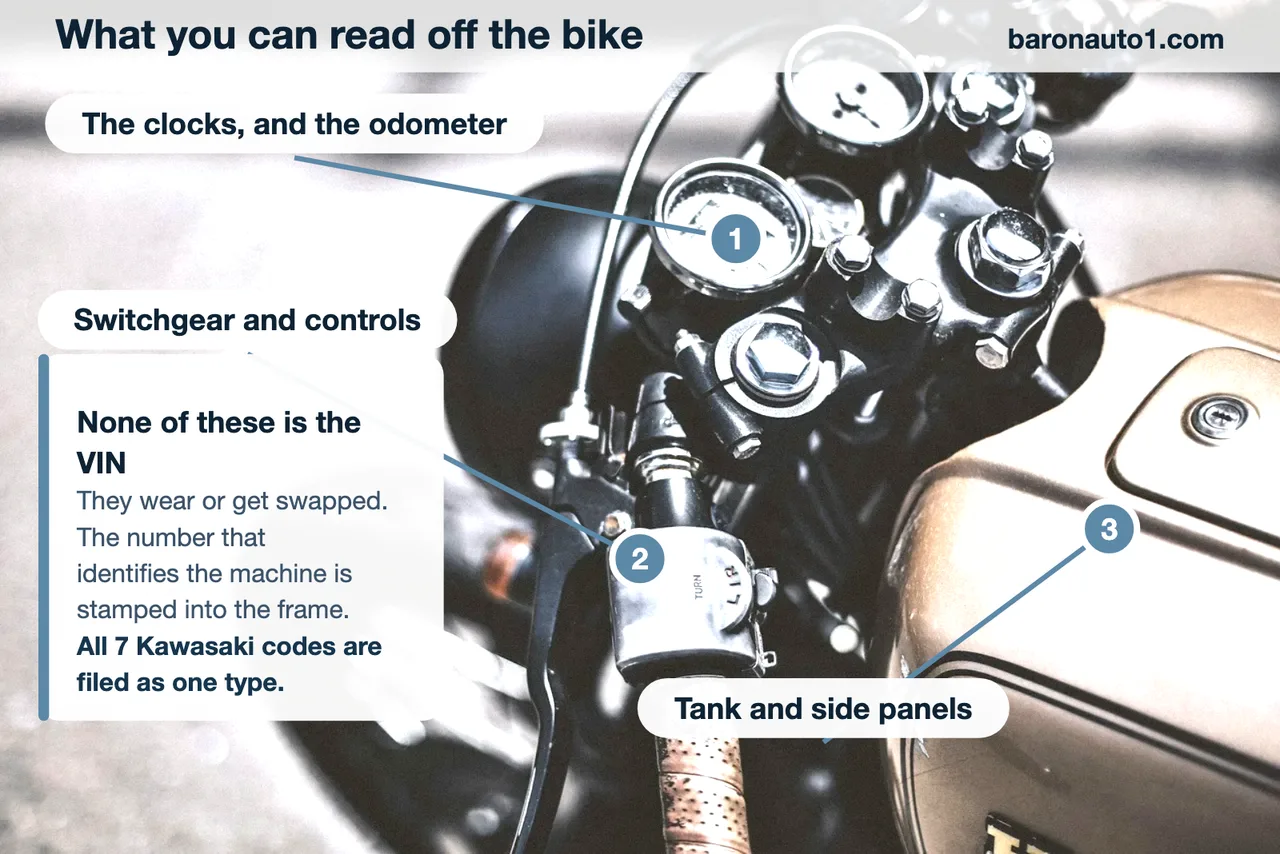
On a bike the number is stamped into the frame rather than printed on a dashboard visible through the windscreen, and it is usually read off the steering head. It is often dirty, sometimes painted over, and frequently transcribed badly into listings by people crouching beside a machine with a phone. That makes the check digit unusually valuable here. It is a self-test built into the number, and a VIN that fails it is a typo or something worse before anything else has been spent on the enquiry. Our VIN validator page explains the arithmetic and how to run it.
The model-year character matters here too, and for a reason particular to bikes. Motorcycles sit unsold and unregistered for longer than cars, and they hibernate through winters, so first-registration dates drift away from model years routinely. The character in position ten is the filed fact. Our year chart converts it, and where an advert’s year and a title’s year disagree it is the letter that settles the argument.
Beyond that, this page does not repeat what the site already covers at length. Our motorcycle VIN lookup guide handles the cross-marque version of where to look, what a stamping should look like, and what to do when it does not, and the general guide to VIN locations covers the four-wheeled equivalents.
The frame number and the engine number are not the same number
This is the distinction that catches out buyers coming to bikes from cars, and no decoder will flag it for you.
The frame carries the vehicle’s legal identity. The engine carries its own separate identifier, cast or stamped into the case. On a car those two are rarely separated in practice, because pulling an engine is a workshop job with a bill attached. On a motorcycle they come apart far more readily, and they do so legitimately — engines are rebuilt, replaced and transplanted between frames as ordinary maintenance culture, and have been for decades.
The federal decode answers for the frame number and only the frame number. It does not know what engine is fitted, whether the engine matches the one the machine left the line with, or whether the two components have any documented relationship at all. When a decode says the machine is a given model with a given displacement, it is repeating what the manufacturer certified for that frame identity. It is not looking at the metal.
The practical habit that follows is simple and worth doing on every used bike. Read the frame number directly off the steering head rather than copying it from the title. Read the engine number separately and write it down. Ask the seller to account for any difference between the engine that is fitted and the machine as described. A documented rebuild or a period-correct replacement is ordinary and disclosed easily; an engine nobody can explain, on a bike priced as original, is a reason to stop.
Where the stamping itself looks wrong — ground, restamped, filled, freshly painted at the neck alone — that is a finding in its own right and outweighs anything a lookup returns. The free theft check described in how to check if a car is stolen is the next query, and it costs nothing.
What the decode will not tell a buyer
The site’s standing position is that a decode and a history are different things, and on motorcycles the distinction does more work than usual. Here is what the federal decode is silent about, stated plainly.
It does not carry service history. Nothing about oil changes, valve clearances, chain and sprocket replacement or the last time the forks were serviced reaches the register, and on a machine whose maintenance is often done by the owner in a garage, there may be no record anywhere except a box of receipts.
It does not know whether the frame has been straightened. A bike that has been down the road and been rebuilt carries the same identity it always did, and if no insurer wrote it off, no record exists to find. This is the failure mode that matters most on sport machines, and it is invisible to every lookup on the internet. It is visible to a competent inspector with the bike on a stand and a straightedge.
It does not know whether the engine and the frame belong together, as set out above.
It does not know mileage. Odometer records enter the system at registration and inspection events, and motorcycles pass through fewer of both than cars do — our page on checking mileage by VIN covers where the readings come from and why a bike’s trail is thinner.
What it does tell you is the identity as filed, and that is the anchor for every other query. Every record you retrieve afterwards is retrieved against that number.
The records that sit around the number
Once the number is validated and decoded, the useful checks run in a fixed order, and the free ones come first.
The federal recall lookup takes the VIN and answers for that specific machine, at no cost. It is the one check that can end a purchase from a kitchen table before anyone has travelled. Our guide to checking open recalls covers how to read a result, including the case where a campaign is listed as remedied.
The insurance-bureau theft check is also free and also takes a VIN. A clear result is a weak signal on its own, because it covers participating members only, and it starts the checking rather than ending it. Our page on what a free VIN check actually returns sets out the boundaries of each free tool.
The title record is the one that costs money and the one that carries the brands: salvage, theft recovery, flood, and the state-by-state chain of who titled the machine and when. Our page on checking a title by VIN explains what that record contains and, more importantly, what it structurally cannot contain.
Then the physical inspection, which on a used bike is not the last resort but the largest share of the evidence. Records are thinner on two wheels for reasons that have nothing to do with the machines: fewer inspection regimes, patchier insurance participation, more owner servicing. A thin report on a motorcycle is normal and proves very little either way, which is precisely why the metal has to carry the weight. Our guide to the pre-purchase inspection makes the general case; on a bike, find someone who knows the model family.
A sequence for a used Kawasaki
Put together, the order looks like this, and none of the first four steps requires leaving home.
Get the full seventeen characters from the seller and validate the check digit. A number that fails is a transcription error until proved otherwise, and it is better to find that out before making arrangements.
Decode it. Confirm that the model, year and displacement that come back match the advert. Note which of the 7 codes issued it, and read the country field for what it is — a record of a filing, which may be blank, and which is not a claim about a factory.
Run the recall lookup and the free theft check. Both are per-vehicle, both are free, and either can end the conversation.
Pull the title record and read the chain rather than only the headline. A short chain with long ownerships reads well. A machine that has crossed several states in a short time is asking a question, and the seller should be able to answer it without effort.
Then go and look at it. Read the frame number off the steering head with your own eyes and compare it, character by character, with the number you decoded and the number on the title. Read the engine number. Check the stamping area for grinding or fresh paint. And have someone competent look at the frame, the forks and the wheels, because that is the check no record on earth substitutes for.
Selling one
The same facts run in reverse, and using them is close to free.
Photograph the frame stamping clearly and put it in the listing. Buyers who know bikes will ask for it, and supplying it unprompted marks the seller as one of them. State the decoded model and year rather than the description on the badge or the paint. If the machine carries an engine that is not the one it left the line with, say so and say why — a documented rebuild disclosed up front costs nothing, and the same fact discovered during an inspection costs a negotiation.
If the bike carries one of the codes with a blank or surprising country field, expect the question and be ready to answer it the way this page does. A seller who can explain that the register describes a filing rather than an assembly line looks like a seller who has read their own paperwork, which is the impression worth having.
Common questions
Is there a Kawasaki-specific VIN decoder?
No. The federal register decodes every make through one system, and Kawasaki-branded decoder pages are that system with a different heading. What is Kawasaki-specific is the register entry: 7 codes, 2 company names, 223 models, one vehicle type.
Where is the VIN on a Kawasaki?
Stamped into the frame, usually on the steering head, and repeated on a label on many machines. Read it off the frame rather than off the title, and treat grinding, restamping or fresh paint at the stamping as a finding in itself.
Does the VIN tell me where my Kawasaki was built?
Not reliably, and this page’s central finding is why. The register records a country against a code, but JKA and JKB read United States, JK1 has no country recorded at all, and JK8 reads Japan — three answers across codes sharing the same opening characters. The field describes the filing, not the factory.
Why do two decoders give different countries for the same bike?
Because the underlying register gives inconsistent answers across the Kawasaki codes, and different sites handle that inconsistency differently. One prints the field as it stands, one leaves it blank, one substitutes a guess. A site that prints a confident country for every Kawasaki is adding certainty the source does not hold.
My quad decoded as a motorcycle. Is that wrong?
No. All 7 Kawasaki codes are filed under the vehicle type Motorcycle, and there is no second type for the make. A four-wheeled machine has to be registered under one of those codes because no other code exists for it. The type field is reporting how the code was registered, not what the machine is.
What is the newest Kawasaki manufacturer code?
MAA, filed for India on 30 July 2026, which is about five weeks before this page was written. Machines carrying it will not reach the used market for years.
Can a VIN decode tell me if the engine is original?
No. The decode answers for the frame identity only. The engine carries its own separate number, and the register holds no relationship between the two. Read both numbers and ask the seller to account for any difference.
Will a decode show me service history or crash repairs?
No. A decode is the machine as certified when it was built. Servicing, a straightened frame, replaced bodywork and every other event in the machine’s life are outside it, and on motorcycles many of those events never enter any record at all. That is what the inspection is for.
Does Kawasaki register under a parent company?
No. It files under its own name, and a register query on that name returns 0 unrelated matches, so the codes listed above are the whole set. The 7 codes are the whole set.
Sources and further reading
Recall, complaint and safety-rating figures on this page were retrieved from the federal databases above on August 19, 2026. Federal data changes — re-check any VIN before you rely on it.
Published September 5, 2026 · last updated September 5, 2026. Found something out of date or wrong? Tell us and we will correct it.