GovDeals Cars: Fees, Deadlines and Titles in Its Own Terms
GovDeals is the marketplace, not the seller, and each agency’s terms override its own. What its User Agreement says about the premium, the payment and pickup clocks, titles and default, and where its documents disagree.
The short version
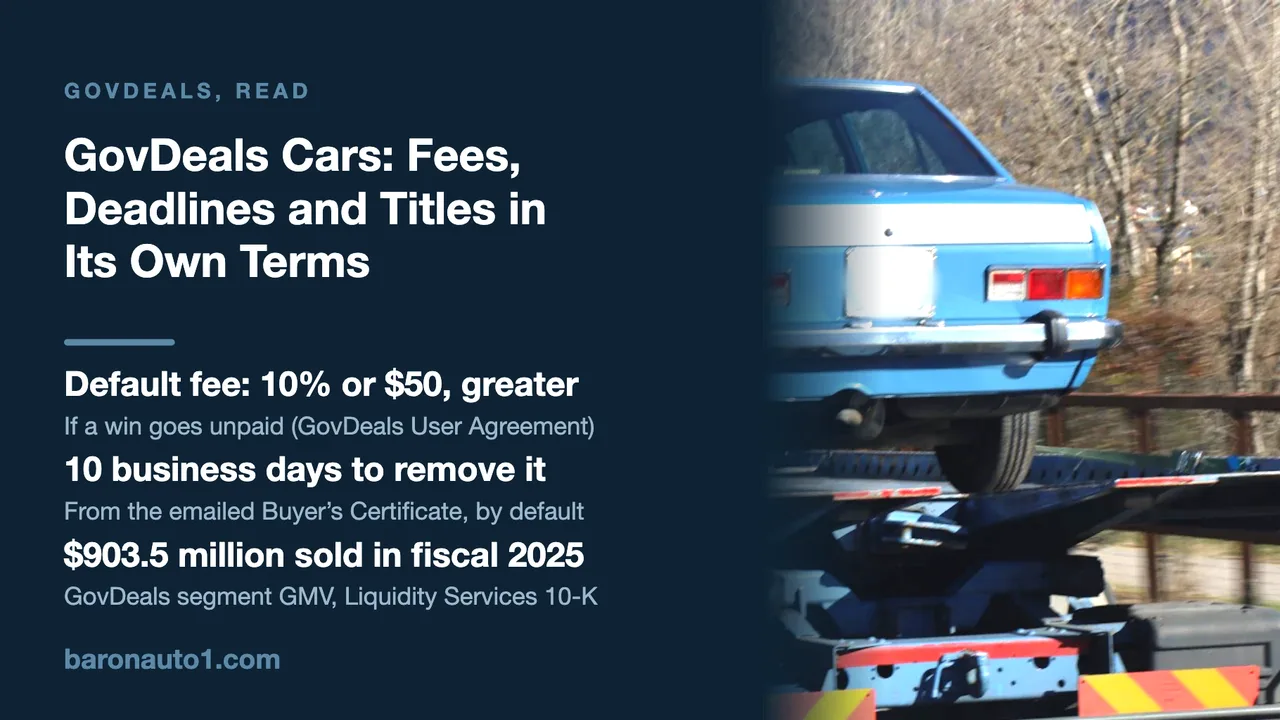
- GovDeals is run by Liquidity Services, Inc. (Nasdaq: LQDT). Its fiscal 2025 10-K lists govdeals.com among the company’s domains and reports a GovDeals segment that sold $903.5 million of goods in the year, for agencies from cities to federal departments and for some commercial sellers.
- GovDeals is not the seller. Its User Agreement says the sale contract “is directly between the Seller and the Buyer,” and each seller’s own Terms and Conditions, linked in the listing’s bid box, override GovDeals’ defaults.
- The buyer’s premium is set listing by listing. No GovDeals document we read prints a standing rate.
- Default clocks: pay by the listing’s deadline, or within 5 days of notice that the seller accepted your bid, with “No extensions”; then remove the car within 10 business days of the emailed Buyer’s Certificate. You load and haul it.
- Miss a payment and GovDeals’ copy of the agreement allows a fee of 10% of the price or $50, whichever is greater, with your account locked until it is paid: $400 on a $4,000 car, by our arithmetic.
- Cars are sold “AS IS, WHERE IS AND WITH ALL FAULTS,” a description complaint must come before removal starts, and a car sold as salvage can come with no title at all.
GovDeals is an online auction marketplace where public agencies, and some commercial and nonprofit sellers, sell surplus property, including cars, pickups, police cruisers and fire trucks. It is owned by Liquidity Services, Inc., listed on Nasdaq as LQDT. On 9 October 2026 we read GovDeals’ User Agreement (effective 1 April 2021) and the copy on liquidityservices.com, GovDeals’ buyer pages and FAQ, the Terms and Conditions of two sellers (a North Carolina school district and the State of Ohio), four GovDeals blog posts, and Liquidity Services’ fiscal 2025 Form 10-K, its 10-Q for the quarter to 30 June 2026 and the fiscal 2008 10-K that records the purchase of GovDeals. We did not register, bid or open a listing. This site has no relationship with GovDeals, Liquidity Services or any seller.
Who runs GovDeals, and who sells on it
Liquidity Services’ 10-K for the year to 30 September 2025 lists GovDeals first among its three reportable segments. The segment “provides solutions that enable government entities including city, county, state and federal agencies located in the United States and Canada and related commercial businesses to sell surplus property and real estate assets through its GovDeals, Bid4Assets and Sierra marketplaces.” Another segment “enables commercial businesses to sell surplus assets on our AllSurplus and GovDeals marketplace.”
So the seller of a GovDeals car is usually a public body, but not always. GovDeals’ blog, in a post dated 15 July 2026, lists cities, counties, state agencies, school districts and universities, public utilities, transit authorities, airports, fire and police departments, fleet organizations, and “Nonprofits and other commercial organizations.” The Why Buy page counts “more than 15,000 government and commercial sellers in over 200 asset categories.” Federal surplus also moves through the government’s own auction site, covered in our GSA Auctions guide.
GovDeals predates its owner. Liquidity Services’ fiscal 2008 10-K says that “On January 1, 2008, we completed the acquisition” of GovDeals’ parent for about $9.4 million net of cash, adding “approximately 1,400 new government agency clients, approximately 80,000 new registered buyers.” On 1 January 2024 it added Sierra Auction Management, “a full-service auction company specializing in the sale of vehicles, equipment and surplus assets,” now reported inside the GovDeals segment. GovDeals listings are “automatically cross listed to AllSurplus.com.”
The User Agreement is offered by Liquidity Services Operations LLC. The blog says “GovDeals does not own or sell the items listed on the marketplace,” but the agreement allows one exception: a Seller can be “Liquidity Services, when we are reselling an Asset purchased by us to which we hold title.” It also warns that “a Seller may be identified with a user ID rather than its actual legal entity name.” The seller’s name appears on its Terms and Conditions page.
How a GovDeals vehicle sale works
Registration is free, and the agreement requires users to be “at least eighteen (18) years old.” The 10-K says each new buyer “must accept our User Agreement (Terms and Conditions) to proceed” and is screened against restricted-party lists, with flagged registrations reviewed by hand, “typically within 24 hours.”
New buyers start on probation. A blog post of 24 July 2025 says the old “multi-level 90-day probation period” is gone. A buyer on probation “can participate in up to 3 (three) active auctions or sales at a time” and “can only make credit card payments up to $1,000.” Probation ends once you spend a total of $5,000, pay for and pick up 3 transactions, or submit a $1,000 bid deposit; then “Your credit card limit increases to $5,000.”
The How To Buy page describes four formats: an online auction, where the “Highest bid at or above the reserve wins the lot” and the reserve can be “Hidden or open”; Buy Now, at a fixed price; Make an Offer, where “Offers are binding for seven days”; and sealed bids, where “Seller can select the winning bid.” It adds: “No matter who places bids from your account, you are the party responsible.”
The agreement’s Listing Contract Policy sets the mechanics. A listing is only an invitation; your bid is “an unconditional offer to enter into a Listing Contract with the Seller,” and the seller must accept it. The State of Ohio’s terms say “Some Auctions/Sales are subject to Seller approval prior to award to the high bidder.” Until you have paid and started removal, a seller may revoke its acceptance, and you get “a full refund of the purchase price and any Buyer’s Premium paid but shall not be entitled to any other remedy.” Liquidity Services also reserves the right to “delay or rescind the sale of any Asset for any reason.”
Three more rules shape a bid. If a seller corrects a material error, you may withdraw, and a change within 48 hours of closing can extend bidding. “Oral statements by either Seller or Buyer are non-binding unless such statements are reduced to writing in a revised Listing.” And restricted sales exist: a listing open only to law enforcement agencies is void for a buyer who cannot prove at pickup that it is one, and that buyer is “liable to Seller for all reasonable costs and expenses.”
The buyer’s premium and the other charges in GovDeals’ terms
The User Agreement defines the Buyer’s Premium as “the Service fees charged by Liquidity Services to a Buyer as expressly stated in a Seller’s Listing,” and adds: “Generally, a Buyer’s Premium is required and is typically expressed as a percentage of the sale price.” Both sellers’ terms say a premium shown in the listing’s bid box is added to the final price “in addition to any taxes imposed,” and Ohio’s also allows “Additional Fees” as a percentage “or a specified amount.”
The rate is a property of each listing, not of GovDeals. No standing document we read prints one, so this page quotes none; unofficial guides that do are not GovDeals documents. Read the bid box, and add the premium and sales tax to your ceiling before you bid. The charges the standing documents do print:
| Charge | What the document says | Document |
|---|---|---|
| Buyer’s premium | Set in the listing; “typically expressed as a percentage of the sale price” | User Agreement; both sellers’ terms |
| Sales or use tax | Buyer pays unless exempt; exemption papers due within 24 hours of notice; no refund for late papers | User Agreement |
| Rejected credit card | “a $25.00 fee for any rejected credit card transaction” may be charged | User Agreement |
| Late payment | Interest at “18% per annum or the maximum rate permitted by applicable law,” plus collection costs | User Agreement |
| Default for non-payment | Greater of 10% of the purchase price or $50 | User Agreement (govdeals.com copy) |
| Storage after the removal deadline | “storage fees may apply”; $10.00 a day (school district) or $25.00 a day (Ohio) | User Agreement; sellers’ terms |
| Unwanted items left behind | Disposal cost “plus a fee equal to 10% of the cost” | User Agreement |
| Registration | Free | Why Buy and How To Buy pages |
The 10-K says Liquidity Services’ consignment revenue is “composed of buyer’s premiums” and/or sales commissions: “In addition to seller commissions, we also collect buyer premiums.” When it acts as the seller’s agent, the agreement caps its liability to you at “the total Buyer’s Premium paid to us by the Buyer.”
Paying and picking up: the two clocks
The agreement’s default payment rule: pay “by the deadline set by the Listing or if no deadline is set in the Listing, within five (5) days after Buyer is notified that Seller has accepted Buyer’s offer to purchase. No extensions of the payment period will be granted.” Its default method is a bank wire; “Cash payments are not permitted,” cards are allowed below a limit set on the site, and Liquidity Services “will not accept third-party funds of any kind” other than a cashier’s check or money order. The How To Buy page says checkout passes to the processor Flywire, where options “can include” direct debit, credit card and bank wire. A card chargeback can get the account “immediately and permanently” deactivated.
Once you have paid, GovDeals emails a Buyer’s Certificate, released “only upon receipt of payment” and only if your account is in good standing, and the removal clock starts: “All Assets must be removed by Buyer within ten (10) Business Days from the time and date of the delivery of Buyer’s Certificate by e-mail,” unless the listing says otherwise. Sellers’ terms decide the details, and the two we read do not start their clocks at the same moment:
| Term | User Agreement default | Elizabeth City - Pasquotank Public Schools (N.C.) | State of Ohio |
|---|---|---|---|
| Payment due | Listing deadline, or 5 days after notice of acceptance | 5 business days from the Buyer’s Certificate | 5 business days from the close of the auction |
| Methods named | Bank wire; card below the site limit | PayPal, wire, four card brands; PayPal and cards only below $5,000.00 | See the listing’s payment instructions |
| Removal | 10 business days from the emailed Buyer’s Certificate | 10 business days from issue of the Buyer’s Certificate | 10 business days from the close of the auction |
| Storage after that | “may apply” | $10.00 a day may be charged | $25.00 a day may be charged |
| Title handed over | At removal | On receipt of payment; no open titles, no replacements | On removal of the vehicle |
Getting the car home is your job: “Absent the express written agreement of Seller, Seller will not perform the role of shipper or exporter,” and the same goes for Liquidity Services. You may need to book a pickup appointment. Whoever collects must carry insurance, since “a Buyer and its agents must maintain adequate automobile and commercial general liability insurance.” Once you have paid and begun removal, “all risk of loss shifts to Buyer.” If you hire a carrier, our guide to car shipping companies explains the federal rules; book it before the clock runs, not after.
For perspective, here is GovDeals’ default clock beside the printed terms of two auctions this site has already read. These are terms, not prices, and nobody is ranked.
| Auction | Who may buy | Payment | If unpaid or not collected |
|---|---|---|---|
| GovDeals (User Agreement default) | Registered buyers 18 or older | Within 5 days of notice of acceptance, unless the listing says otherwise | Greater of 10% or $50; 10 business days to remove |
| Copart (U.S. non-licensed fees) | Members, subject to state rules | Within 3 business days, sale day included, or a $50 late fee | Relisted after 8 calendar days; fee of 10% of the price, at least $600 |
| CarMax Auctions | Licensed dealers only | By close of business on the day after the sale | Removal also by close of business the day after the sale; left beyond 48 hours, removed at the dealer’s expense |

Inspection and as-is: what the description is worth
The agreement’s default is blunt: “BUYER AGREES TO ACCEPT SUCH ASSETS AS IS, WHERE IS AND WITH ALL FAULTS,” and the seller and Liquidity Services disclaim “ANY IMPLIED WARRANTIES OF MERCHANTABILITY, FITNESS FOR A PARTICULAR PURPOSE.” The buyer even agrees “TO REPAIR, AT BUYER’S COST, ANY ASSET PURCHASED TO A SAFE OPERATING CONDITION.” Photos and text “ARE NOT INTENDED AS REPRESENTATIONS OR WARRANTIES.” And the agreement says who it was written for: buyers “are expected to be sophisticated,” and the services “are not suitable for personal, family or household use.”
There is one narrow promise: by posting a listing, a seller gives “a limited representation and warranty of description.” You can lose even that. If the seller offered an inspection, bidding waives it, and the waiver “applies even if Buyer does not avail itself of the opportunity for inspection.” If the seller only shows the car at pickup, the waiver bites when removal starts: “No disputes will be processed after commencement of removal of the Assets.” The school district’s terms say the same in plain words: “Any claim for misdescription must be made prior to removal of the property,” and if the seller agrees, it “will keep the property and refund any money paid.” They also warn that “Most items offered for sale are used and may contain defects not immediately detectable.”
GovDeals’ marketing is warmer. A blog post of 18 February 2025 says government cars “are often in better condition than typical used cars” and that “Many government vehicles come with detailed maintenance records.” Those are blog claims, not terms of sale. If a listing mentions records, ask for them and get the answer into the listing. Then inspect: our pre-purchase inspection guide covers what a mechanic should check, and a vehicle history check and odometer check by VIN cover the car’s past.
Titles from public agencies
The seller promises to “deliver good and marketable title to its Assets, free and clear of all liens and encumbrances” once the sale is complete, which happens when you have paid in full and begun removal. The default rule for cars reads:
“Seller will provide a certificate of title or ownership to Buyer at the time of Buyer’s removal of any vehicle the title to which is evidenced by a certificate of title. Titles may be subject to such restrictions as may indicated in the Asset description on the Site. In certain instances, a vehicle may be sold without title as salvage, in which case no title will transfer, caveat emptor applies, and a Buyer must satisfy for itself whether it can obtain a certificate of title from a governmental agency without Seller’s support if it desires a certificate of title.”
The two sellers differ. The school district “will issue a title or certificate upon receipt of payment,” says “Open titles cannot be issued,” and “will not issue replacement titles.” Ohio issues the title “upon removal of the vehicle.” Both point to the asset description for restrictions, so that is where a salvage brand or a missing title will show up. What follows:
- No title means a project. You would apply to your own state alone; see registering a car without a title and bonded titles, before you bid.
- Salvage carries a brand. See what a salvage title means.
- “Open titles cannot be issued” matters for resale. The title is assigned to you; our page on title jumping explains why, and GovDeals’ blog notes that “selling a certain number of vehicles per year may require a dealer’s license.”
- Do not lose it. At least one seller will not replace a title. Our title transfer guide and bill of sale guide cover the paperwork, and a title check by VIN shows brands from other states.
If you do not pay, or do not pick up
GovDeals’ copy of the agreement defines a “Buyer Default” broadly, as failing any “payment, removal, bidding, registration, Seller Required Documents (‘SRDs’), or other terms and conditions.” For any default, the seller may “cancel the applicable sale, reclaim the Asset, and relist, remarket, or resell the Asset without further notice or liability to Buyer.” Then the money:
- Not paying. “Liquidity Services may assess a default administration fee equal to the greater of (i) ten percent (10%) of the purchase price of the affected Asset, or (ii) $50,” and the account “shall remain suspended or locked until the default administration fee has been paid in full.”
- Paying but not collecting. Liquidity Services “may retain the applicable Buyer’s Premium and refund any remaining amounts paid by Buyer.”
- Per car. Fees and premiums are assessed “on a per-Asset (or per-lot) basis.”
- Deposits. A bid or registration deposit “may be retained and shall not be refundable” if a purchase is not completed.
- Harsher listings. Some listings may carry other default rules, “including the forfeiture of all amounts paid by Buyer.”
Both sellers’ terms add that a default “may result in termination of the contract and suspension from participation in all future sales until the default has been cured.” The same agreement sets a stiffer fee on Liquidity Services’ retail site, Liquidation.com: the greater of 15% or $200.
| Purchase price | 10% of price | Fee charged |
|---|---|---|
| $300 | $30 | $50 (the minimum) |
| $500 | $50 | $50 (the two arms meet) |
| $1,500 | $150 | $150 |
| $4,000 | $400 | $400 |
| $12,000 | $1,200 | $1,200 |
Two versions of the default rule carry the same date. The User Agreement on govdeals.com and the copy on liquidityservices.com both say “Effective as of April 1, 2021” and matched paragraph for paragraph when we compared them on 9 October 2026, except for the buyer-default section. The liquidityservices.com copy still says an unpaying buyer owes “the Buyer’s Premium that would have been paid” and that an uncollected car can incur “a $50 daily storage fee” or be declared abandoned, with “the greater of $200 or the amount of its Buyer’s Premium” deducted. This page follows the copy GovDeals links in its own footer. Save a copy of the terms on the day you bid.
Disputes: who you can pursue, and where
Liquidity Services writes that its support team “may help facilitate the resolution of disputes,” but that “we have no control over and do not guarantee” the quality or legality of items, the accuracy of listings, or “that a Buyer or Seller will actually complete a Transaction.” Between buyer and seller, “Each User is solely responsible for its direct interactions with other Users,” and Liquidity Services “reserves the right, but has no obligation, to monitor disputes between Users.”
If the seller is at fault, the agreement gives you a procedure: send written notice; if the seller does not cure the breach within 5 business days, you may “Terminate the Listing Contract, in which case Buyer will be refunded all amounts paid to Seller or Liquidity Services.” For disputes with the seller, governing law and venue “will be in accordance with the Listing Contract.” For disputes with Liquidity Services, the agreement picks “the laws of the State of Maryland” and courts “located in Montgomery County, Maryland,” with a “MANDATORY CLASS ACTION/JURY TRIAL WAIVER” that commits users to a bench trial on an individual basis. California residents may report complaints, under Cal. Civ. Code §1789.3, to the state’s Department of Consumer Affairs. The agreement can change on posted notice of “no less than thirty (30) days.”
The 10-K’s legal-proceedings note lists two lawsuits by former employees and no case brought by buyers, and says no pending claim would, in management’s judgment, have a material adverse effect.
What Liquidity Services’ filings say about GovDeals
The 10-K reports GovDeals’ gross merchandise volume (GMV), “the total sales value of all transactions for which we earned compensation,” and its revenue. The figures are the 10-K’s, converted from thousands; the last column is our arithmetic.
| Fiscal year | GMV | Segment revenue | Revenue as a share of GMV (our arithmetic) |
|---|---|---|---|
| 2025 | $903.5 million | $87.4 million | 9.7% |
| 2024 | $836.3 million | $76.6 million | 9.2% |
| 2023 | $726.1 million | $62 million | 8.5% |
That revenue share mixes buyer’s premiums, seller commissions and other fees across every category, real estate included, so it is not a premium rate. In fiscal 2025 the 10-K says GovDeals revenue rose 14.2% on “a $67.2 million, or 8.0%, increase in GMV,” “partially offset by lower market prices for vehicles sold.” A year earlier growth came “particularly in the vehicle and heavy equipment categories.” By our arithmetic GovDeals was 57.5% of the company’s GMV in fiscal 2025 but 18.3% of its revenue, because the company books the whole sale price as revenue only when it owns what it sells.
The 10-Q shows quarterly GovDeals GMV of $274 million to 30 June 2026, up 8.6%, and $714.6 million for nine months against $667.8 million a year earlier, about 7% more by our arithmetic. Across all its marketplaces the company counted 6.0 million registered buyers at 30 September 2025 and 6.4 million at 30 June 2026. The 10-K’s risk factors warn that lower “market values of surplus assets, including used vehicles” could harm the business and that vehicle supply “may be impacted by ongoing tariffs.” The latest filing, an 8-K of 1 October 2026, reports the purchase of Auction Holdings for a base price of $80 million; it does not mention GovDeals.
Where GovDeals’ own documents disagree
When documents conflict, the agreement ranks them: the listing controls the seller’s terms, which control GovDeals’ defaults. The disagreements we found:
- Two agreements, one date. As above, the govdeals.com and liquidityservices.com copies share “Effective as of April 1, 2021” but print different default remedies.
- A FAQ with one answer. On 9 October 2026 all 36 FAQ questions, including Title, Payment, Refunds, Shipping and Bid Deposit Refund Process, opened onto the same default-fee paragraph; through a text reader every answer read “undefined.” We could use none of them.
- Personal use. The agreement says the services “are not suitable for personal, family or household use”; the blog addresses readers “shopping for a personal car,” and the Transportation page says “Buy personal and commercial vehicles for competitive prices on GovDeals.”
- Condition. The blog says “government sales are transparent, so buyers can be more confident in what they’re getting”; the agreement sells with all faults and says descriptions are not representations.
- When GovDeals was bought. The blog post of 15 July 2026 says “In 2012, GovDeals was aquired by Liquidity Services”; the fiscal 2008 10-K puts it on 1 January 2008, 4 years earlier.
- How many buyers. The About page claims “more than 1 million registered buyers” and “over 4.8 million potential buyers” across the network; Why Buy, “5M+”; the blog, “More than 6 million”; the 10-Q, 6.4 million. They count different things, and the About and Why Buy pages date none of them.
- Who sells. The About page calls GovDeals “specifically created for, and dedicated to, government agencies”; Why Buy, the blog and the 10-K describe commercial sellers too.
- PayPal. The school district’s terms list PayPal; the How To Buy page lists direct debit, card and wire through Flywire, and no PayPal.
- When the payment clock starts. Notice of acceptance (agreement), the Buyer’s Certificate (school district) or the close of the auction (Ohio). The agreement defines that certificate as the document that “confirms that the Assets have been paid in full,” so a payment deadline counted from it is hard to read.
- Two probation policies. A post of 2 May 2023, still online, describes three probation levels of at least 30 days and a $1,000 deposit held 60 days and returned less a $25 fee; the 2025 post says the levels are gone.
- A missing section. The new default text cites “this Section 20”; the agreement’s numbered sections run from 1 to 12.
Before you bid on a GovDeals car
GovDeals’ documents put nearly every risk on the buyer, so the work comes first. If you are weighing other channels, our page on repossessed car auctions sorts out which sales are repossessions.
- Open the seller’s Terms and Conditions. Linked in the bid box, they override GovDeals’ defaults on payment, pickup, storage and titles. Save a dated copy.
- Read the bid box for the premium and fees. Add them and your sales tax to your ceiling. GovDeals prints no standing rate.
- Check for seller approval. Some sales need it, and a seller can back out until you have paid and started removal.
- Inspect, or accept that you waived it. Bidding waives the description warranty when an inspection was offered. Book a mechanic for the inspection window.
- Get answers in writing. Oral answers bind nobody unless they appear in a revised listing.
- Read the title line. No title, salvage or bill of sale only each change what you are buying.
- Arrange payment that fits. On probation, card payments stop at $1,000; afterwards at $5,000. Wires must come from your own account.
- Book pickup before you win. Ten business days pass fast, nobody ships for you, and the collector needs automobile and general liability insurance.
- Check the VIN. Run an open recall check and a title check by VIN; nothing in the terms says either was done.
Common questions
Is GovDeals legit, and who owns it?
GovDeals is operated by Liquidity Services, Inc., listed on Nasdaq as LQDT, which reports to the SEC. Its fiscal 2025 10-K lists www.govdeals.com among its domains and reports GovDeals as a segment with $903.5 million of goods sold that year. The cars belong to the selling agencies, except where Liquidity Services resells assets it bought itself. Whether a given car is a good buy depends on its listing and the seller’s terms.
Can anyone buy a car on GovDeals?
Registration is free for anyone 18 or older who passes restricted-party screening, and new buyers start on probation: 3 active auctions and card payments up to $1,000. Some listings are restricted, such as law-enforcement-only sales, and some need seller approval. The agreement says the services are “designed to serve business and governmental Buyers,” although GovDeals’ blog invites personal buyers.
How much is the buyer’s premium on GovDeals?
It depends on the listing. The agreement defines the premium as the fee “as expressly stated in a Seller’s Listing,” typically a percentage of the sale price, and some sellers add other fees. The rate is in each listing’s bid box; no standing rate appears in any GovDeals document we read on 9 October 2026, so we quote none.
What happens if you win on GovDeals and don’t pay?
Under the govdeals.com copy of the agreement, Liquidity Services may charge a default fee of 10% of the price or $50, whichever is greater, and lock your account until it is paid. The seller may cancel and relist, and may bar you from its future sales. Overdue sums can carry 18% a year in interest. By our arithmetic, walking away from a $1,500 car costs $150; from a $300 car, $50.
Do GovDeals cars come with a title?
Usually, but read the listing. By default the seller hands over the title at removal, and some sellers issue it on payment. A vehicle “may be sold without title as salvage, in which case no title will transfer,” leaving you to apply for one yourself, and one seller we read will not replace a lost title.
Does GovDeals ship cars, or take returns?
No to both, by default. Neither the seller nor Liquidity Services acts as shipper without a written agreement, and you have 10 business days from the emailed Buyer’s Certificate to collect. A claim that the car does not match its description must be made before removal starts; if the seller agrees, the remedy is a refund, not a repair.
Sources and further reading
Recall, complaint and safety-rating figures on this page were retrieved from the federal databases above on August 19, 2026. Federal data changes — re-check any VIN before you rely on it.
Published October 9, 2026 · last updated October 9, 2026. Found something out of date or wrong? Tell us and we will correct it.