GSA Auctions: How to Buy a Government Car, Rules and Fees
GSA sells through two channels: GSA Auctions for other agencies’ surplus and GSA Fleet for its own leased cars. What the federal sale rule, Standard Form 114C and GSA Fleet’s terms say about bidding, paying, collecting, the SF-97-1 title and default.
The short version
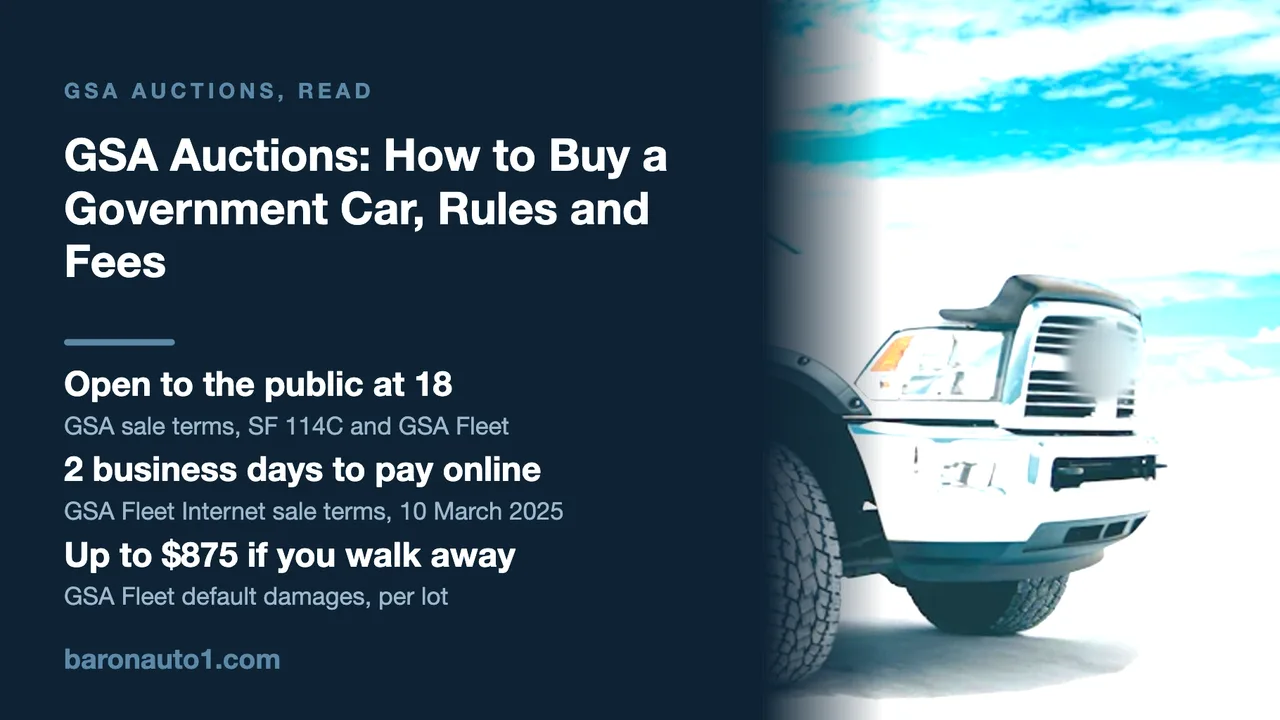
- Yes, the public can buy. The federal sale rule lets GSA sell to “anyone of legal age,” and GSA’s sale terms set that at 18. GSA sells vehicles through two channels: GSA Auctions, for other agencies’ surplus and forfeited property, and GSA Fleet Vehicle Sales, for the cars and trucks GSA leased to agencies.
- You register first, with a Social Security or taxpayer ID number. GSA Fleet checks identity through Experian and screens bidders against the federal debarment list; a bidder with an unpaid default cannot bid.
- Everything is sold as is. GSA Fleet warrants only that a vehicle matches its written description, with 15 calendar days after the removal date to claim. At inspection you may start the engine, but the vehicle “cannot be driven.”
- An online GSA Fleet win must be paid within 2 business days and collected within 10 calendar days. Credit cards are capped at $24,999.99 a transaction, and the government offers no financing.
- You leave with a federal certificate, the SF-97-1, not a state title; your state titles and registers the vehicle.
- Walking away costs money: GSA Fleet keeps the award amount, up to $875 a lot, and its terms say “Defaults never expire.”
GSA auctions are how the federal government’s General Services Administration sells property it no longer needs, cars and trucks included, to anyone 18 or older. On 9 October 2026 we read GSA’s buying pages on gsa.gov, the Standard Form 114C general sale terms GSA says it sells under, the current and 2025 texts of the federal sale rule (41 CFR part 102-38) and the 16 December 2025 rule that rewrote it, two GSA privacy impact assessments, the GSA Fleet Vehicle Sales site with its Internet and Live sale terms dated 10 March 2025, and USA.gov’s vehicle auction page. GSA Auctions’ own site, gsaauctions.gov, refused every request we made, so its online terms are not quoted here. We registered for nothing, bid on nothing, and have no relationship with any seller.
Can anyone buy at a GSA auction?
Yes, with a short list of exceptions. The federal rule, 41 CFR § 102-38.80, says an agency “may sell Federal personal property to anyone of legal age” but “must not enter into a contract with persons or entities debarred or suspended from purchasing Federal property” without “a compelling reason to do so.” Standard Form 114C makes legal age a number: each bidder warrants they are not “under 18 years of age.” The GSA Fleet sales site puts it plainly, “GSA vehicle sales are open to the public,” and tells buyers to ignore signs at auction houses barring the public: “they do not apply to GSA Fleet auctions.” Attending is free.
Who is excluded:
- GSA staff and their families. “A GSA employee, or a spouse or minor child of a GSA employee, or their agents, may not bid on federal personal property.” GSA Fleet adds “auction contractors, subcontractors, and members of their immediate households.”
- Some other federal employees. They may bid unless their own agency forbids it, but not on property they have “nonpublic information” about (§ 102-38.85).
- Debarred and sanctioned bidders. GSA Fleet checks registrants “against the bidders debarred list” and follows the Treasury’s sanctions list.
- Anyone who owes GSA. “Indebted bidders will be ineligible for contract awards.”
Foreign buyers are not excluded (“Bidding is not limited to U.S. citizens exclusively”), though they register with two forms of identification and “All payments shall be made in U.S. currency.” Nor do you need a dealer license; the only dealer rule we found is that a licensed dealer buying for a customer needs no power of attorney, “although the requirement to provide a TIN remains.”
GSA Auctions and GSA Fleet Vehicle Sales are two different sellers
GSA Auctions sells for other agencies: “GSA can sell agency surplus, exchange/sale, and forfeited personal property through GSA Auctions or offline sales,” from office furniture to “heavy machinery, airplanes, vehicles, etc.” Property reaches the public last: “If this property cannot be donated to a state or public agency, or nonprofit organization, the general public can buy it.”
GSA Fleet Vehicle Sales sells GSA’s own vehicles. “GSA Fleet lease non-tactical vehicles to other federal agencies. When we determine that a vehicle meets replacement criteria we offer it to the public for sale.” The sales site says it sells “more than 30,000 vehicles through online and live auctions” a year and that “None of the vehicles are tactical military or repossessed vehicles.” GSA’s privacy assessment for its sales systems explains the live sales: “The GSA Office of Fleet Management contracts with vehicle auction houses to auction GSA Fleet vehicles.” The same document says those auction houses can “select GSA Fleet Vehicles for sale on GSA Auctions,” so a fleet vehicle can appear on either site.
USA.gov sums them up: fleet sales are “auctions of government-owned vehicles that are in good condition and ready to drive,” GSA Auctions sells “vehicles and other types of government-owned excess property.” Seized cars are neither: “Seized vehicles are sold by the U.S. Marshals Service and the Department of the Treasury.” State and local governments sell on their own platforms, covered in our GovDeals guide; lender sales are in our guide to repossessed car auctions.
| Question | GSA Auctions | GSA Fleet Vehicle Sales |
|---|---|---|
| What is sold | Agency surplus, exchange/sale and forfeited property, vehicles among it | GSA’s own leased vehicles once they meet replacement criteria |
| Where you bid | gsaauctions.gov, plus offline live, sealed-bid, spot-bid, drop-by, fixed-price and negotiated sales | GSAFleet.gov online, and live auctions at auction houses GSA contracts |
| Sale terms we read | SF 114C plus each sale’s invitation; the site’s own terms were unreachable | Internet and Live terms dated 10 March 2025, which incorporate SF 114C |
| Pay and collect by | “within the time prescribed for each sale” | Online: 2 business days to pay, 10 calendar days to collect; live: the catalog dates |
| If you do not pay or collect | gsa.gov: up to $325 (5% above $100,000); SF 114C: the greater of 20% or $25 | The award amount, capped at $875 per lot |
| Title document | SF 114C: “Standard Form 97” | An SF-97-1 certificate and a purchaser’s receipt |
| Buyer’s fee | None mentioned on the gsa.gov pages we read | “no buyer’s fees,” says GSA Fleet’s FAQ |
Which vehicles GSA Fleet sells, and how old they are
“GSA Fleet adheres to minimum replacement criteria,” and a vehicle is offered for sale once it “meets replacement criteria.” They are what GSA publishes about the age and mileage of what it sells. Each is a pair of end points, and a vehicle qualifies at whichever it reaches first: a car sold at 5 years may show far fewer than 60,000 miles, and one sold at 60,000 miles may be younger than 5 years.
| Vehicle class | Fuel | Eligible for replacement at |
|---|---|---|
| Passenger vehicles | Gas or alternative fuel | 5 years or 60,000 miles |
| Passenger vehicles | Hybrid or electric | 5 years and 60,000 miles, or 7 years, or 85,000 miles |
| Light trucks | Non-diesel | 7 years or 65,000 miles |
| Light trucks | Diesel | 8 years or 150,000 miles |
| Light trucks | Hybrid or electric | 7 years or 90,000 miles |
| Medium trucks | Diesel | 10 years or 150,000 miles |
| Medium trucks | Non-diesel | 10 years or 100,000 miles |
| Heavy trucks | Non-diesel | 12 years or 100,000 miles |
| Heavy trucks | Diesel | 12 years or 250,000 miles |
| Ambulances | Non-diesel | 7 years or 70,000 miles |
| Ambulances | Diesel | 7 years or 100,000 miles |
| School and adult work buses | Any | 10 years or 250,000 miles |
| Light-duty shuttle buses | Any | 7 years or 100,000 miles |
| Medium-duty buses | Any | 8 years or 150,000 miles |
| Heavy-duty shuttle buses | Any | 20 years or 1,000,000 miles |
| Intercity coaches | Any | 15 years or 1,000,000 miles |
The hybrid and electric car row needs care: GSA prints “5 years and 60,000 miles, OR 7 years and any miles, OR any years and 85,000 miles.” The sales FAQ gives a shorter version, “At the conclusion of its lease (typically 3-5 years), GSA Fleet will sell a vehicle,” and describes the result as “cars, trucks and other vehicles with low miles and only one previous owner.” That is GSA’s claim; each listing’s odometer reading is the figure to check. Medium and heavy trucks are sold “exclusively online on a monthly basis.”
GSA Auctions publishes no such criteria, because its vehicles come from many agencies on their own schedules, and GSA Fleet’s FAQ is candid about those: “We cannot attest to the condition of vehicles we sell for other Federal agencies, however known deficiencies will be listed.”
Registering: an ID number, an identity check and one account
“In order to participate in any GSA Fleet sale (online or live auction), you must be a registered bidder with GSAFleet.gov,” and GSA Auctions likewise lets only “registered participants” bid. Registration asks for:
- Your Social Security or taxpayer ID number. Citing the federal Debt Collection Improvement Act, the Fleet terms say “Bids will not be considered for award from anyone not providing this information.” GSA’s privacy assessment for its sales system (approved 22 February 2024) says of GSA Auctions: “Registration will not be considered if your TIN is not provided.”
- Your birth date, which GSA Fleet says “will be used only to verify bidder’s eligibility.”
- An Experian identity check. GSA Fleet uses Experian’s Precise ID “with credit card verification and knowledge based questions” for individuals and BizID for companies. A GSA “soft inquiry” may appear on your Experian file; the terms say “Soft inquiries do not affect credit scores” and the entry “will generally be removed from the credit report after 25 months.” For GSA Auctions, “A user’s SSN is sent to the Experian PreciseID service for identity proofing / verification during account creation.”
- One account each. GSA Fleet may limit individuals “to one for each individual,” the GSA Auctions system uses the SSN “to prevent users from registering more than one account with the same SSN,” and GSA Fleet deactivates accounts unused for one year.
To buy for someone else, “you must furnish their Social Security Number or Tax Identification Number” and a power-of-attorney letter; our power of attorney guide explains how such letters work at the DMV. You agree to the terms “by marking the required box,” and your login is yours to guard: a bidder who lets someone else use it “will be responsible for any contracts awarded to their account.” At live sales, “Registration with the auction facility prior to sale is required.”
How bidding works
The rule leaves the format open: sales may be “sealed bid sales, spot bid sales, auctions, or negotiated sales” held in person or “through any electronic media that is publicly accessible” (§ 102-38.35(b)). gsa.gov lists seven methods: online sales, where you “browse, bid for, and pay for awarded items online,” and six offline ones (live auctions, drop-by sales, fixed-price sales, negotiated sales, sealed-bid sales by post, and spot-bid sales, “a silent auction, with bids written down rather than voiced”). For sealed bids, “Late bids are not accepted under any circumstances.”
GSA Fleet’s Internet terms set out the online mechanics:
- Proxy or flat bids. A proxy lets the system “incrementally bid on the bidders behalf up to the maximum amount entered”; if proxies tie, “The Proxy bid that is entered into the system first will be the winning bid.”
- Whole dollars, Central time. “Bids are only accepted in whole U.S. Dollar amounts,” times are “in Central time,” and “certain auctions are designed to extend the closing time if there is bidding activity.”
- No take-backs. “Bidders cannot cancel bids,” and “Bidding on the incorrect vehicle does not constitute grounds to be released from the award of that vehicle.”
- A hidden reserve. “Auctions may have a reserve price which is not disclosed to the general public,” though the sales contracting officer “may accept a submitted bid that is lower than the reserve price.”
- Money ready in advance. “GSA is not obligated to wait for bidders to arrange for financing.”
The award goes “to the bidder with the highest responsive bid” (§ 102-38.90), and the terms bind you “once a bid is accepted” (§ 102-38.75). Ignore anything said at the lot that the paperwork does not say: under SF 114C, an oral statement changing the terms “is unauthorized and shall confer no right upon the Bidder or Purchaser.”
Inspection, as-is terms and the one promise GSA Fleet makes
SF 114C puts the burden on you: “The Bidder is invited, urged, and cautioned to inspect the property prior to submitting a bid.” Property is sold “as is” and “where is,” and the government “makes no warranty, express or implied, as to quantity, kind, character, quality, weight, size, or description of any of the property, or its fitness for any use or purpose.” gsa.gov repeats it (“GSA does not guarantee the condition of sale items”) and dismisses the folklore: “Stories about $100 yachts or exotic cars sold for little or nothing are pure fiction.”
The rule says agencies “should provide at least 7 calendar days to ensure potential buyers can perform needed inspections,” normally (§ 102-38.65). At GSA Fleet sales “you can start a vehicle to check the performance of its engine, air conditioning, heater, and other accessories. However, the vehicle must stay parked and cannot be driven.” Photos “should not be relied upon in place of written item descriptions or as a substitute for physical inspection.” Our pre-purchase inspection guide covers what to check in that window.
GSA Fleet replaces the as-is clause with a narrower promise, which its terms call a limited description warranty:
- What it covers. The vehicle “will conform to its description only. Condition of property is not guaranteed.” The promise covers the listing’s words, not the vehicle’s condition.
- What silence means. “the absence of any indicated deficiencies does not mean there are none.”
- How to claim. You must still own and possess the vehicle, give written notice “within 15 calendar days of the date specified for removal,” keep it in the condition you removed it in, and you “may be required to submit an independent estimate of repairs from a reputable repair facility.”
- What you can recover. At most “the purchase price of the mis-described property,” and nothing for “loss of profit or any other monetary damages.”
Two descriptions deserve a second look. Online, GSA may vary the stated mileage by up to 500 miles (and weight by 25%), with the price “adjusted upward or downward” to match. And “Vehicles with known open recalls have been identified, but additional outstanding recalls may be possible”; for heavy trucks, buses and ambulances, “There is no central source for recall information.” GSA’s recall page points buyers to NHTSA’s recall lookup, and our guide to checking for open recalls walks through it. A leftover fleet telematics device is dead: the devices “have been rendered permanently non-operational.” Where a factory warranty still runs, “manufacturer’s warranties are transferable.”
Paying: two business days online, and no financing
gsa.gov lists wire transfers, “U.S. federal, state, or local government checks,” and the major credit cards processed through the Treasury’s payment service: “Credit card purchases are restricted to a maximum of $24,999.99, and one card per transaction.” “Checks, bank drafts, and debit cards with dollar limitations and/or PIN Number requirements, are not acceptable,” and, most important for a car buyer, “The government does not provide any form of financing.”
GSA Fleet’s Internet terms add the deadline: payment within “2 business days from the time and date of the award e-mail notification of sales results,” and “Bid results will not be furnished via telephone or fax.” A card payment over $24,999.99 cannot be split to get round the limit, and “no more than two credit cards may be used to render payment for any one vehicle.” At live sales the catalog sets the date, photo ID must be shown at payment, “Cash may not be accepted at all auction locations,” and “Personal or company checks will only be accepted when accompanied by a bank letter guaranteeing payment.” Sales tax, where it applies, “will be collected by the GSA Fleet contracted auction house, or the Department of Motor Vehicles”; our registration cost by state guide covers what the DMV adds.
On fees, GSA Fleet’s FAQ says “with no buyer’s fees, pre-owned vehicles from GSA usually sell for substantially less than from other sources”; the absence of a buyer’s fee is its stated policy, the price comparison is its claim. None of the gsa.gov pages we read mentions a buyer’s fee for GSA Auctions, but its own terms were out of reach, so we cannot confirm one is never charged. Either way GSA expects “a fair market price.”
Do not use a card dispute as a shortcut. GSA “will make every effort to deny the chargeback” and may restrict the account, and an unpaid debt goes to the Treasury for collection “If the payment for the debt has not been received within 120 days.”
| Seller | Pay by | Collect by | If you do not pay |
|---|---|---|---|
| GSA Fleet Vehicle Sales, online (read 9 October 2026) | 2 business days after the award e-mail | 10 calendar days after the award e-mail | The award amount, up to $875 per lot, and no bidding until cured |
| Copart (read 7 October 2026) | “within 8 calendar days (including the day of sale)” | Daily storage after three business days, by its Phoenix yard page | Relisted; “10% of the final sale price with a minimum of $600” |
| CarMax Auctions, dealers only (read 9 October 2026) | “by close of business on the day after sale” | Same deadline | “may result in suspension of auction privileges” |
Removal deadlines and storage
Winning makes you the mover. Under SF 114C, “The Purchaser must make all arrangements necessary for packing, removal, and transportation of property,” at the buyer’s expense, and gsa.gov adds that buyers “cannot remove merchandise before paying.” For GSA Fleet’s online sales, “Property must be removed within ten (10) calendar days from the date and time of award e-mail notification”; at live sales, by the catalog date. “The Government does not provide nor arrange for the transportation of purchased vehicles,” so line up a carrier before you bid; our guide to car shipping companies explains brokers and carriers.
Whoever collects needs a driver’s license or other government photo ID (the terms warn that “Access to some Federal facilities is now impacted by the Real ID Act”), plus “a valid gate pass issued by the auction” at a contracted auction house. For a vehicle bought online, “the credit card used to make payment must be displayed at time of removal,” or a notarized letter from the cardholder must name “the individual or transport company authorized to remove the property.”
Storage after the deadline is not GSA’s business: any extra time at an auction house “is between the buyer and the auction house and the buyer assumes all risk of damages and costs associated with storage.” Under SF 114C, an extension comes only if a contracting officer finds in writing that the delay “arose out of causes beyond the control and without the fault or negligence of the Purchaser,” and the government may still charge “a reasonable storage charge.” Until removal, the holding agency pays “the care and handling costs” (§ 102-38.20) and, under SF 114C, the government carries the risk of loss.
The title paperwork: SF 97, SF-97-1 and your DMV
A government vehicle has no state title to sign over, so GSA issues a federal certificate instead. SF 114C says title passes “as and when removal is effected,” and promises “a certificate of release, Standard Form 97” for each licensed vehicle. GSA Fleet’s terms describe what you actually receive:
- The documents. “A United States Government Certificate to Obtain Title to a Vehicle, Standard Form 97-1 (SF-97-1) and a purchaser’s receipt.”
- What it is not. “The SF-97-1 is not a motor vehicle registration. It is evidence of title only,” and it waives no registration fees or “county or State taxes.”
- Where it works. “The SF-97-1 is accepted in all 50 states and U.S. territories”; GSA “makes no claims” for anywhere else.
- Whose name. It “can only be made out to the registered bidder purchasing the vehicle,” and a duplicate request may carry a fee.
- Branded vehicles. “A branded SF-97-1 will be issued for vehicles sold junk, salvage, or junk flood damage,” and “A subsequent SF-97-1 will not be issued regardless of repairs made.” See what a salvage title means and branded titles.
There is no blank to download: GSA’s forms library lists form SF97-1 (revised April 2012) and says “U.S. Government Departments, Agencies, and Offices can place an order for this form.” You take the certificate and receipt to your state’s motor vehicle agency; our guides to title versus registration and title transfer cover that visit.
The rule behind the form changed recently. The 2025 edition required: “For sales of vehicles, you must issue to the purchaser a Standard Form (SF) 97, the United States Government Certificate to Obtain Title to a Vehicle, or a SF 97A, the United States Government Certificate to Obtain a Non-Repairable or Salvage Certificate, as appropriate.” GSA’s rule of 16 December 2025, which “Removed procedural instructions” from this part, replaced it with § 102-38.100: “No specific form or format is designated for transferring title,” only “a bill of sale or another document as evidence of transfer of title.” GSA Fleet’s terms still promise the SF-97-1; for a vehicle on GSA Auctions, check the invitation for the title document before you bid.
If you do not pay or collect: damages, default and the bidding bar
A winning bid is a contract. Asked “Can I refuse a vehicle after my bid was accepted?”, GSA’s FAQ answers “No, successful bidders are contractually bound to pay for and remove their vehicles.” GSA prints three schedules for what happens next:
- SF 114C, condition 9: after “a 15-day written notice of default,” liquidated damages of “the greater of (a) 20 percent of the purchase price” or “(b) $25,” with interest on amounts unpaid 30 calendar days after a written demand.
- gsa.gov’s “How to purchase” page: “the government can collect damages,” and the fee is the award amount below $325, “$325” for awards “between $325 and $100,000,” and “5% of the award amount” above that. The page does not say which sales this covers.
- GSA Fleet’s terms, which say condition 9 “is deleted and replaced”: the award amount for awards under $875, and $875 for anything larger. “Purchaser will automatically be placed in default,” loses the vehicle, and pays “EACH and EVERY lot” in default. “GSA does not grant extensions of time for payment and removal.”
| Award | GSA Fleet terms | gsa.gov page | SF 114C, condition 9 |
|---|---|---|---|
| $500 | $500 | $325 | $100 |
| $5,000 | $875 | $325 | $1,000 |
| $25,000 | $875 | $325 | $5,000 |
| $150,000 | $875 | $7,500 | $30,000 |
The bar on bidding outlasts the bill. “Purchasers in default are not eligible to bid on future sales until all defaults are cured,” and “Defaults never expire.” GSA Fleet may restrict an account for “Defaulting on a previously awarded GSA Fleet or GSA Auctions contract,” so a default on one site follows you to the other, and the GSA Auctions system uses the SSN “to prevent users from bidding if that SSN is defaulted.”
Read the award e-mail the day it arrives. Online, GSA Fleet allows 2 business days to pay and 10 calendar days to collect, sends results only by e-mail, and grants no extensions. A missed deadline is an automatic default, costs up to $875 per lot, and blocks all bidding until it is paid.
Debarment is a separate, heavier sanction: the rule bars sales to anyone “debarred or suspended from purchasing Federal property” (§ 102-38.80), and the 2025 edition sent agencies to “the Federal Acquisition Regulation (FAR) subpart 9.4” for the procedure. GSA Fleet checks “the bidders debarred list” and points to SAM.gov for the government-wide list.
Where GSA’s own documents disagree
- How many vehicles a year? gsa.gov says “30,000+” and the sales site “more than 30,000”; the sales FAQ says “approximately 35,000 vehicles this coming year,” without saying which year.
- Three default schedules. SF 114C, the gsa.gov page and GSA Fleet’s terms each print a different charge, and only the Fleet terms say which one they replace.
- SF 97 or SF-97-1? SF 114C and GSA Fleet’s FAQ say “Standard Form 97”; the Fleet terms say “Standard Form 97-1” and, a sentence later, “SF-97”; the forms library lists SF97-1. The federal rule required an SF 97 or SF 97A until 16 December 2025 and now names no form.
- Citations to rules that moved. The Fleet terms of 10 March 2025 send state and local buyers to “FMR 102.38.350”; the December 2025 rewrite removed that section, and its 30-day payment rule now sits in § 102-38.125. SF 114C still says it is “Prescribed by GSA FPMR (41 CFR) 101-45.3.”
- Identity check or credit check? The Fleet terms describe an identity check whose soft inquiry does “not affect credit scores”; GSA’s privacy assessment for GSAFleet.gov (approved 13 February 2025) says SSNs go to Experian “to determine a user’s credit worthiness to purchase a vehicle.”
- Will GSA tell you about defects? gsa.gov says “GSA will inform a customer of any deficiencies prior to sale”; the Fleet terms say “the absence of any indicated deficiencies does not mean there are none.”
Before you bid on a government vehicle
- Know which seller and which terms. “Each sale location may have Special Terms and Conditions” that override the general ones; read the invitation or catalog.
- Have the money ready. No financing, 2 business days to pay online, $24,999.99 per card transaction, at most two cards per vehicle.
- Inspect in person. Start it, run the heater and air conditioning, look underneath; you cannot drive it.
- Check recalls by VIN yourself on NHTSA’s lookup, or with the manufacturer for trucks, buses and ambulances.
- Read the history. A branded SF-97-1 means junk or salvage; our guide to checking a used car’s history covers the rest.
- Book transport before you win. You have 10 calendar days online, and GSA moves nothing.
- Plan the DMV visit. Bring the SF-97-1 and receipt, and budget for tax and registration; see the out-the-door price guide.
Common questions
Can anyone buy a car at a GSA auction?
Anyone 18 or older can, except GSA employees and their households, GSA Fleet’s auction contractors, federal employees whose agency forbids it, debarred or suspended bidders, and anyone who owes GSA for an earlier purchase. You register first with a Social Security or taxpayer ID number. No dealer license is needed, and non-U.S. citizens can register with passport or visa details.
What is the difference between GSA Auctions and GSA Fleet Vehicle Sales?
GSA Auctions sells surplus and forfeited property for many federal agencies, vehicles among it. GSA Fleet Vehicle Sales sells GSA’s own leased vehicles once they meet its replacement criteria, online and at live auctions run by auction houses GSA contracts. Their deadlines and default charges differ, and a fleet vehicle can occasionally appear on GSA Auctions.
Do GSA auctions charge a buyer’s fee?
GSA Fleet’s FAQ says its sales have “no buyer’s fees,” and attending is free. The gsa.gov pages we read mention none for GSA Auctions, but its own terms were unreachable, so read them before bidding. Sales tax and registration fees still apply.
How long do I have to pay for and pick up a GSA vehicle?
For GSA Fleet’s online sales, 2 business days to pay and 10 calendar days to collect, both from the award e-mail. Live sales and GSA Auctions sales print their own dates in the catalog or invitation. GSA Fleet grants no extensions and arranges no transport.
What title do you get from a GSA auction?
Not a state title. GSA Fleet issues an SF-97-1 certificate and a purchaser’s receipt, “evidence of title only,” made out to the registered bidder and accepted in all 50 states and U.S. territories, where your motor vehicle agency issues the title and registration. Junk and salvage vehicles get a branded certificate that is never reissued.
What happens if I win a GSA auction and do not pay?
Under GSA Fleet’s terms you are placed in default automatically, lose the vehicle, owe the award amount up to $875 for each lot, and cannot bid again until the default is cured. Other GSA sales use SF 114C’s formula (the greater of 20% or $25) or the gsa.gov schedule, depending on their terms.
Sources and further reading
Recall, complaint and safety-rating figures on this page were retrieved from the federal databases above on August 19, 2026. Federal data changes — re-check any VIN before you rely on it.
Published October 9, 2026 · last updated October 9, 2026. Found something out of date or wrong? Tell us and we will correct it.