IAA Auction (IAAI) Fees: What a Public Buyer Pays and Who Can Buy
IAA prints its buyer fees as images, its other charges under a later date and its state rules in two grids. We added up its own numbers and list where its documents disagree.
The short version
- IAA sells to the public, but the state decides which cars. IAA’s own grid lets a public buyer bid without a broker on clear and salvage titles in 16 states, on one of the two or under a yearly cap in 10 more, and on neither in 24.
- Bidding needs a $225 registration fee that renews automatically each year and, the Auction Rules say, is not refunded even if you are not approved. Registering only for government fleet (GSA) cars is free.
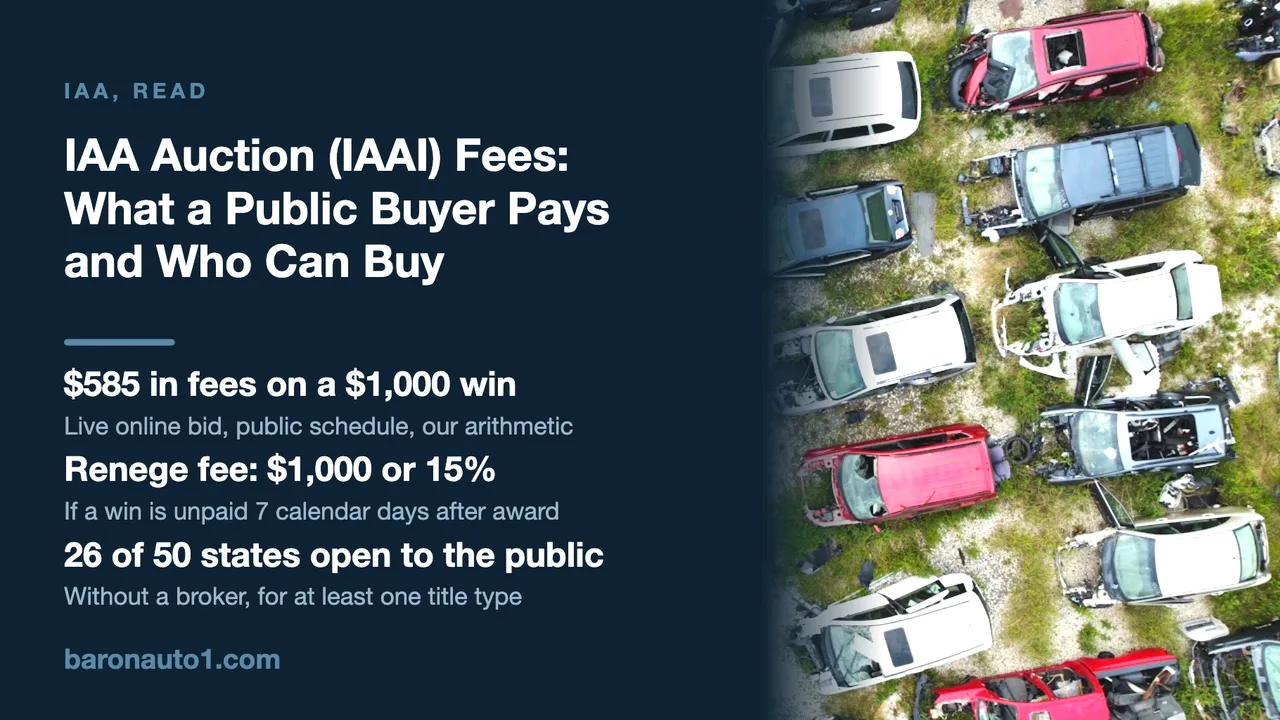
- Every win carries at least four IAA charges: a buyer fee set by the price, an internet or proxy bid fee, a $105 service fee and a $20 title-handling fee. By our arithmetic a $1,000 car won with a live online bid costs $585 in fees, before a surcharge IAA lists without an amount.
- Pay by 5 p.m. on the second business day after the award or owe $50 or 2% of the price, whichever is greater. Unpaid after 7 calendar days, the renege fee is $1,000 or 15%: on a $1,000 car, as much as the car.
- Storage is set by branch. Phoenix and Dallas both give free storage through the day of the award plus four days, then charge $50 a day.
- Every car is sold as is, with no warranty; disputes go to binding individual arbitration unless you opt out within 30 days of registering; and IAA has belonged to RB Global since 20 March 2023.
IAA (Insurance Auto Auctions) is a salvage and total-loss auction that sells online to licensed businesses and, in about half the states, to the public. What it costs and who can buy are set out in its own documents, which do not always agree. On 9 October 2026 we read IAA’s Buyer Agreement and Auction Rules, its Terms of Use (revised 4 December 2025), its non-licensed and licensed fee pages with the fee tables they show as images, its public-buyer, registration and payment pages, two branch pages, ten help-center articles, and RB Global’s 2025 Form 10-K, filed 25 February 2026. We did not register, sign in or bid, and this site has no relationship with IAA or any broker.
Can the public buy at IAA?
Yes, with an active registration and a state that allows it. The Auction Rules require individuals to be “18 years of age or older,” and “Only registered Buyers in good standing may bid on vehicles.” A free guest account can watch sales, but the glossary says “you cannot bid.” Public buyers, IAA’s public-buyer page says, are “those without a qualifying business license,” and, its registration page adds, they bid “at auctions that are open to the public (varies by state).” Registering from a state that bars public buying, you are told you “cannot bid in your state” and offered a broker or a business account. Each car’s page has a “Who Can Bid” list, which IAA says is where to confirm a car “is available for public purchase.” One group is open everywhere: “GSA inventory is open to all public buyers in all states.”
RB Global’s 10-K lists IAA’s buyers as body shops, rebuilders, dealers, wholesalers, exporters, dismantlers, recyclers, brokers “and the general public,” and its list of vehicle suppliers starts with “insurance companies.” For lender repossessions, see our repossessed car auctions guide; title lender TitleMax, for one, has its own fee page on IAA’s site (see our TitleMax review). SalvageBid, a broker that buys at IAA for the public, is read on our SalvageBid review.
Which states let a public buyer bid without a broker
IAA’s help center has two state guides. “Buyer Eligibility by State” (dated 8 August 2025) is a 50-row grid with columns for dealers and for “PUBLIC/ NON-AUTO LICENSE BUSINESS,” each split into clear and salvage titles. “Public Buyer State by State Eligibility” (7 August 2025) lists the 27 states whose branches sell something to the public, and both send buyers to their DMV. We grouped the grid’s public columns:
| Public buyer may bid directly on | States | Count |
|---|---|---|
| Clear and salvage titles | Alaska, Arizona, Arkansas, Hawaii, Idaho, Indiana, Iowa, Kentucky, Minnesota, Montana, Nebraska, North Carolina, North Dakota, Oklahoma, Oregon, Washington | 16 |
| Clear titles; salvage “Limited per year” | Ohio | 1 |
| Clear titles only | Michigan, Utah | 2 |
| Salvage titles only | Colorado, Georgia, Kansas, Mississippi, West Virginia; Tennessee and Texas “limited per year for in-state buyers” | 7 |
| Neither (broker for both) | Alabama, California, Connecticut, Delaware, Florida, Illinois, Louisiana, Maine, Maryland, Massachusetts, Missouri, Nevada, New Hampshire, New Jersey, New Mexico, New York, Pennsylvania, Rhode Island, South Carolina, South Dakota, Vermont, Virginia, Wisconsin (recreational vehicles excepted), Wyoming | 24 |
That is 26 of 50 states open to a public buyer for at least one title type. The caps are specific: Texas buyers “have a limit of purchasing 5 salvage vehicles per calendar year,” Tennessee buyers “a purchase limit of 5 vehicles over 365 days” plus a disclosure form per car, and in Utah a non-auto business may buy up to 5 salvage vehicles “per any 12-month period” while the public needs a broker. Five states (Alabama, Michigan, Nevada, Utah and Wisconsin) also require a state buyer card or license for some purchases. On Texas, check the law: section 2302.204 of the Texas Occupations Code, as our Copart fees guide quoted it on 7 October 2026, exempts a person who buys “fewer than five” salvage vehicles in a casual sale at auction, one fewer than IAA’s wording suggests. We did not read the Texas DMV rules that implement it.
The same state, two auction houses, two answers
Our Copart guide also read Copart’s grid for private individuals. Set against IAA’s public columns, the two agree in 35 of 50 states and differ in 15:
| State | IAA: clear / salvage | Copart: titled / salvage |
|---|---|---|
| Alaska, Indiana, Kentucky, North Dakota | Yes / Yes | Broker / Broker |
| Hawaii, Washington | Yes / Yes | Broker / Yes |
| Ohio | Yes / Limited per year | Broker / Yes |
| Louisiana, Pennsylvania, Vermont, Wyoming | Broker / Broker | Yes / Yes |
| Missouri | Broker / Broker | Yes / Broker |
| Mississippi | Broker / Yes | Yes / Yes |
| Tennessee | Broker / Yes, limited per year | Broker / Broker |
| West Virginia | Broker / Yes | Broker / Broker |
Neither grid is the law; Copart calls its own “a general guideline.” The comparison shows that each auction applies its own reading of state rules, which RB Global’s 10-K says “limit who can purchase damaged and total loss vehicles.” The vehicle page decides.
Brokers
Where the grid says Broker, IAA points to its broker list and, abroad, to “Market Alliances.” Its glossary defines brokers as “registered buyers who purchase vehicles on behalf of other people” who “charge a fee for their services and have their terms and conditions.” The public-buyer page promises you can “Buy without needing to register or have a license” but prints no broker fee. We did not open the directory and name no broker. A broker’s charges sit on top of IAA’s fees, under the broker’s contract; our AutoBidMaster review shows how one broker’s terms read, though we have not checked whether it buys at IAA.
Registering: the $225 fee and the renewal
“A $225 registration fee is required to bid on all IAA inventory,” IAA’s registration page says, payable by credit card or PayPal; “debit cards are not accepted.” Registering only for government fleet cars is “completely free.” An individual needs a driver’s license, state ID or passport, plus proof of address if the ID lacks one, and “A mobile phone will be required to complete the identity verification step.” Business buyers add a license and, to buy tax-free, resale certificates.
Read the renewal terms first. The Auction Rules say membership “WILL AUTOMATICALLY RENEW ANNUALLY,” can be cancelled “UPON 30 DAYS’ NOTICE PRIOR TO THE END” of the period, and that fees “CANNOT BE REFUNDED, EVEN IF A PROSPECTIVE BUYER IS NOT APPROVED.” IAA may also “deny or cancel Buyer’s account at any time for any reason or for no reason at all.” The registration page says IAA “offers three membership tiers” and points to “the chart below,” but no chart was on the page, and the Terms of Use mention a “Premium Guest” registration billed “EACH MONTH” with no amount. We did not open the sign-up form, so check the checkout screen before entering a card.
How IAA’s buyer fee schedule is built
IAA sets fees by “final sale price, license type, and volume of inventory purchased,” in four segments: licensed, non-licensed, heavy vehicle (a weight rating of “10,001 lbs. and higher”) and Rec Rides (powersports). A member of the public pays from the “Standard IAA Non-Licensed Buyer Fees” page, whose tables are dated “Effective November 4, 2024” and are images, so we transcribed them from the files. The buyer fee has 39 bands: $25.00 under $50, $375.00 at $1,000, $775.00 at $5,000, a flat $1,000.00 from $10,000 to $14,999.99, and “7.5% of sale price” from $15,000. Unlike Copart’s, it has one fee column, with no separate rate for card payment.
- A license alone changes nothing. The licensed “Standard Volume” table, for licensed buyers with “24 or fewer units purchased” or under $75,000 of purchases in 12 months, matches the non-licensed one in all 39 rows. Only the 41-row “High-Volume” table, which needs “25+ units purchased AND a total sale price of $75,000+” and fewer than 5 bidder accounts, is lower: $250 instead of $375 at $1,000, and 6.0% instead of 7.5% from $15,000.
- Band edges cost real money. By our arithmetic a $9,999.99 sale carries a $945 buyer fee and $10,000 carries $1,000, a $55 step for one cent. At $14,999.99 the flat $1,000 is 6.7% of the price; at $15,000 the fee is $1,125, a $125 step.
The schedule pays. RB Global’s 10-K says “Transactional buyer revenue increased 8%, while total GTV increased 2%, primarily due to changes to our buyer fee structures, which were implemented in late-2024 and early-2025.” IAA says its fees “are on par with those charged in the salvage industry”; we compare no prices (our Copart fees guide reads Copart’s schedule).
The fees on every win, and what they add up to
The buyer fee is only the first line. The fee pages add an internet bid table and, under a heading dated “Effective October 1, 2026,” five more charges; the Auction Rules name others without prices.
| Fee | Amount | When it applies |
|---|---|---|
| Buyer fee | $25.00 to $1,000.00 in 39 bands; 7.5% from $15,000 | Every vehicle sold |
| Live Online Bid fee | $0 under $100; then $50.00 to $160.00 | Won with a live internet bid |
| Proxy Bid fee | $0 under $100; then $40.00 to $140.00 | Won with a pre-set maximum bid |
| Service fee | $105 per unit | “imaging, pull-out, and/or loading” |
| Title-handling fee | $20 | “all purchases” |
| Premium Imagery Set fee | $10 per unit | Eligible vehicles only |
| EH&S and Fuel Surcharge | No amount printed | Listed with the other fees |
| Storage | By branch ($50 a day at Phoenix and Dallas) | After the free period |
| Late fee | $50 or 2% of the price, whichever is greater | Missed payment deadline |
| Renege fee | $1,000 or 15% of the price, whichever is greater | Unpaid after 7 calendar days |
| Card fee, NSF fee, additional bidder fee | No amount printed | Named in the Auction Rules or How to Pay |
The internet fee has 9 bands, and the live fee is $10 to $20 higher than the proxy fee in every paid band, so a pre-set maximum is the cheaper way to win the same car. “Buy Now” sales at a set price carry “All standard buyer fees,” the glossary says.
Four lines (buyer fee, internet or proxy fee, $105 service fee, $20 title fee) give what a public buyer pays IAA on top of the bid. The totals below are our arithmetic on the printed tables. They exclude the EH&S and Fuel Surcharge, which has no printed amount, so each is a floor; they also exclude tax, storage, card fees and transport.
| Winning bid | Buyer fee | Live online bid: total fees | Proxy bid: total fees |
|---|---|---|---|
| $500 | $205 | $395 (79%) | $385 (77%) |
| $1,000 | $375 | $585 (58.5%) | $575 (57.5%) |
| $2,500 | $610 | $845 (33.8%) | $835 (33.4%) |
| $5,000 | $775 | $1,025 (20.5%) | $1,010 (20.2%) |
| $10,000 | $1,000 | $1,285 (12.9%) | $1,265 (12.7%) |
| $20,000 | $1,500 | $1,785 (8.9%) | $1,765 (8.8%) |
One cell, step by step: a $1,000 car sits in the “$1,000 – $1,199.99” band, a $375 buyer fee; the live online bid fee for “$1,000 – $1,499.99” is $85; add $105 and $20. That is $585, so the car costs $1,585 before tax, the surcharge and getting it home. Fees weigh most on cheap cars: the $105 service fee alone is 21% of a $500 bid. IAA’s own Cost Calculator, the Auction Rules warn, “should not be relied upon as the final calculation or verification of total fees.”
A dealer must show you an all-in price (see our out-the-door price guide); at an auction, adding it up is your job, and for a damaged car the repair estimate belongs in the sum. Our guide to when a salvage car is defensible covers that side.
Deadlines: late, renege, cancellation and storage fees
The clocks start at the award. The Auction Rules say payment is due “within three business days” (“auction day plus two business days”), so a Monday win is due by close of business Wednesday; the help center and branch pages put the cut-off at 5 p.m. local time. Buyers outside the US get longer: “four business days after” on the public-buyer page, “auction day plus four days” in the help center.
- Late fee: “$50 or 2% of the selling price of the vehicle, whichever is greater.” The 2% only exceeds $50 above a $2,500 sale, so a late $1,000 car costs $50 and a late $10,000 car $200 (our arithmetic).
- Renege fee: unpaid “within seven (7) calendar days inclusive of the day the vehicle is awarded,” and you owe “$1,000 or 15% of sale price, whichever is greater,” plus IAA’s collection costs. Bidding is suspended until it is paid, and a second renege “may have bidding privileges revoked.” The 15% only exceeds $1,000 above $6,666.67, so walking away from a $1,000 win costs $1,000, 100% of the price, and from a $10,000 win $1,500.
- Cancellation fee: pay but leave the car more than 30 calendar days, and the fee is “the Renege Fee plus IAA’s reasonable and customary daily storage fee” until IAA can resell, plus retitling costs if you already hold the title.
- Storage: set by “the time allowed by the branch”; “Every branch location page lists the rates,” the help center says.
We read two branch pages, Phoenix and Dallas, and both print the same terms: payment by 5 p.m. on the day of award plus two days, the same late fee, “Number of free storage days: Day vehicle was awarded + 4 day(s),” then “Storage Fee: $50/day.” A week of storage is $350 by our arithmetic; neither page says whether weekends count. Both say purchases “must be secured within 5 business days,” after which IAA may move the car to its nearest facility at your cost. Under the Auction Rules’ set-off clause, IAA may apply a payment meant for a car to an outstanding renege, cancellation, late or NSF fee first.
How you pay matters as much as when. Cards are capped online at “$2,500 for Public Accounts” a day ($20,000 for licensed businesses), exclude American Express, need “One year of established purchase history,” must be in the buyer’s name, and carry “a processing fee” IAA does not quantify. Cash is capped at $500 a day per branch; cashier’s and certified checks have no limit; wires are accepted only from the buyer, owner or an additional bidder. A first-time public buyer of anything but a cheap car is therefore likely to pay by wire or cashier’s check, so set that up before the auction.
Pickup, transport and the title
The car is your risk from the award: “Risk of loss on a purchased vehicle passes to Buyer once the vehicle has been awarded,” and cars left after the sale are “at the sole risk of Buyer.” “Vehicles can be picked up on sale day,” and yards close earlier than offices “to allow extra time for pullout/loading.” The facility rules ban anyone under 18, cameras, bags and any work on a car beyond preparing it for transport. IAA’s loaders lift cars onto your transporter (part of the $105 service fee), but the buyer directs and secures the load, and the Phoenix and Dallas pages say loaders will not lift anything over 11,000 lbs. IAA Transport can be booked at checkout under “separate terms and conditions,” which we did not read; our guide to car shipping companies covers hiring your own carrier.
The title travels separately. Beyond the $20 title-handling fee, IAA charges “a small fee,” unpriced, to send a title by FedEx. The help center mentions a “30-day pickup window,” after which a missing title becomes a case for buyer services, and says documents without a valid US address are held “for 1 year from the sale date,” then “securely shredded,” with any duplicate at the owner’s cost. The Auction Rules require you to “promptly title vehicles” in your name, with no “title skipping.”
Government fleet cars differ. For GSA Fleet sales through IAA, buyers “shall not be charged buyer fees by IAA,” must pay within 2 days and remove the car within 10, and receive a Standard Form 97-1 (SF-97-1) certificate instead of a state title, because they are “not contracting with IAA but rather GSA.” RB Global’s 10-K says the GSA contract was expanded in November 2025. Our GSA Auctions guide covers the government’s own sales site and our GovDeals guide state and local sellers.
What IAA says, and does not say, about a car’s condition
The Auction Rules carry 17 numbered disclaimers, and the first governs: every vehicle is sold “AS IS, WHERE IS,” with no warranty. Item 4 has the buyer agree “NOT TO BASE A BID OR OTHERWISE RELY ON ANY INFORMATION PROVIDED BY IAA,” from year and make through mileage, title, airbags, keys and “WHETHER OR NOT A CAR STARTS OR RUNS,” and tells buyers who care about mileage to get a history report first (see our guide to checking a used car’s history). The listing’s labels describe the car on arrival, not at sale:
- Run & Drive: the engine started “(EITHER WITH OR WITHOUT A JUMP),” both gears engaged and the wheel turned a full rotation each way, “AT THE TIME OF ARRIVAL.” Starts: it started and idled. Stationary: it “will not start, has engine damage, or was not tested upon arrival.” Our guide to auction records shows how these labels spread to other sites.
- Airbags “INTACT” is IAA’s judgment that they looked undeployed; IAA “DOES NOT INSPECT OR CONDUCT TESTING ON THE AIRBAGS.”
- Keys “present” means noted at check-in; “IAA IS NOT RESPONSIBLE FOR MISSING PARTS.”
- Damage labels are not exhaustive, photos do not show the whole condition, and cars may hide frame, water or “BIOHAZARD DAMAGE.”
- Actual Cash Value comes from the seller and IAA “does not represent the accuracy or validity of this value”; the IAA Vehicle Score is “a subjective estimate.”
The title disclaimers matter most. Item 12: “VEHICLES SOLD WITH A CLEAR TITLE MAY HAVE A SALVAGE HISTORY.” Item 16: a clear-title car may later appear as “JUNK/SALVAGE” in NMVTIS reports. Item 14: IAA does not promise any car can be registered, and a car bought on a clear document in one state may have to be sold on a salvage document in another. See our guides to salvage, rebuilt and clean titles, the NMVTIS report and insuring a salvage-title car. Item 17 warns of open safety recalls; check NHTSA’s recall lookup.
Inspect before you bid. The Phoenix and Dallas branches open for preview from 10 a.m. to 2 p.m. the day before an auction, and IAA’s glossary recommends a third-party inspection while saying IAA does not “endorse or warrant” it; our pre-purchase inspection guide covers cars you cannot drive. A visitor not signed in sees 11 characters of a lot’s VIN with the last 6 masked, as our BidFax guide recorded on 3 October 2026. And once an online bid is accepted, “it cannot be deleted,” only reduced to the current high bid; if the seller counters within your proxy maximum, the system accepts for you.
Disputes: no condition arbitration, but binding legal arbitration
Some wholesale auctions let a buyer return a car over an undisclosed defect within a set window; our CarMax auctions guide describes one. IAA’s Auction Rules have no such window. Their “arbitration” is how a legal claim against IAA is heard:
- Notice first: written notice “at least thirty (30) days in advance,” with complaints “to IAA and not to its sellers.”
- Binding arbitration under the American Arbitration Association in Cook County, Illinois, though a single-vehicle dispute “may be heard in the county in which the IAA Facility involved with the claim is located.” Claims over $100,000 may go to three arbitrators; Illinois law applies; small claims court remains open.
- Costs: IAA pays as much of the fees as the arbitrator deems necessary “to prevent the arbitration from being cost-prohibitive,” and the prevailing party recovers reasonable attorneys’ fees.
- Individual only, no class actions. Opt out with a signed written notice “within thirty (30) days of when you first register,” and disputes go to a Cook County court instead.
- One year to file any claim, “or be forever barred.”
- The ceiling: “BUYER’S SOLE REMEDY FOR CLAIMS SHALL BE FOR RESCISSION OF THE SALE,” liability cannot exceed what you paid for the car, and repair, transport, storage, DMV and inspection costs are excluded.
IAA keeps an exit. Every award is “subject to approval by the vehicle’s consignor,” and IAA may “rescind, postpone or cancel a sale or withdraw an awarded vehicle at any time before Buyer receives the assigned title,” including over pricing errors, with the buyer releasing any claim. A buyer who “contacts or tracks down a vehicle owner or seller in any manner will immediately be banned.”
Who owns IAA
IAA belongs to RB Global, Inc., formerly Ritchie Bros. Auctioneers (EDGAR records the name change in May 2023). Its 10-K says: “On March 20, 2023, the Company completed its acquisition of IAA, Inc.” for about $6.6 billion. IAA had been spun off from KAR Auction Services, which distributed 100% of its shares on 28 June 2019. IAA’s About page calls itself “IAA Holdings, LLC (IAA), an RB Global company,” with buyers in “over 170 countries.” Your contract, though, is with “Insurance Auto Auctions, Inc.,” the party named in the Terms of Use and Auction Rules; Exhibit 21.1 to the 10-K lists both it and IAA Holdings, LLC as 100%-owned RB Global subsidiaries.
Describing the salvage segment, the 10-K says: “We primarily compete with Copart, Inc.” The 10-K and the 10-Q for the quarter to 30 June 2026 both report “no material legal proceedings pending, other than ordinary routine litigation.” RB Global’s 8-Ks of 15 September and 8 October 2026 concern a buyback and a new chief financial officer, not any sale of IAA. A web search on 9 October 2026 found no enforcement release naming Insurance Auto Auctions, so this page cites none.
Where IAA’s own documents disagree
| Topic | One IAA document says | Another says |
|---|---|---|
| What a clear title means | Blog (26 October 2023): clear-title vehicles “have never been deemed a total loss by an insurance company” | Auction Rules: a clear-title vehicle “MAY HAVE A SALVAGE HISTORY” |
| Traveler’s checks | Auction Rules: accepted | How to Pay: not accepted since 7 July 2025 (its cash paragraph still lists them) |
| Card limit | How to Pay: $2,500 a day online for public accounts | Phoenix and Dallas, in person: “less than $250” |
| Does a license lower fees? | Registration page: a non-auto licensed business “benefits from a Licensed Business Buyer fee structure” | Fee tables: Standard Volume equals the non-licensed table in all 39 rows |
| Membership | “three membership tiers” in “the chart below” | No chart; $225 is the only price; the Terms of Use mention a monthly Premium Guest fee |
| Number of schedules | Help center: “four different fee schedules,” then six names | Fee index: four segments, five tables, plus a TitleMax page |
| When storage starts | Public-buyer page: daily storage “once the time limit is reached” for payment | Phoenix and Dallas: free through the day of award plus four days |
| Arbitration | Terms of Use: costs shared “equally,” held “only in Cook County” | Auction Rules: IAA pays to avoid cost-prohibitive arbitration; single-vehicle disputes may be heard near the branch |
On arbitration the Terms of Use settle it: nothing in them may “override any Auction Rules” for a registered buyer. Elsewhere, treat the Auction Rules as the contract and the branch page holding the car as the local schedule. The clear-title disagreement can cost most: a clear title from IAA does not prove the car was never a total loss. Our guides to what a clean title proves and total-loss checks by VIN explain how to look behind it.
Before you bid
A bid is a commitment. Once IAA’s system accepts an online bid, it “cannot be deleted.” Win and leave it unpaid for 7 calendar days, award day included, and the renege fee is $1,000 or 15% of the price, whichever is greater, with bidding suspended until you pay.
- Check eligibility on the car. The “Who Can Bid” list decides; IAA’s and Copart’s state grids disagree in 15 states.
- Add four fees to your maximum: buyer fee, live or proxy fee, $105 service fee, $20 title fee, then the unpriced surcharge, tax and transport. Watch the band edges at $10,000 and $15,000.
- Bid by proxy if you can set a maximum in advance: the fee is $10 to $20 lower.
- Arrange payment before the sale: public card payments are capped at $2,500 a day and need a year of history.
- Read the branch page for free storage and the daily rate, and book transport early.
- Decide on arbitration within 30 days of registering, and run the history checks: our guide to auction damage codes, earlier auction records and the rebuilt-title inspection.
Common questions
Can anyone buy from IAA?
Anyone 18 or older who registers and pays $225 can bid, but only on cars open to the public where they sit. By our count of IAA’s grid, the public can bid directly on clear and salvage titles in 16 states, on one of the two or under a yearly cap in 10 more, and needs a broker for both in 24. GSA fleet cars are open to the public everywhere, and that registration is free.
What are IAA’s buyer fees?
For a public buyer, a buyer fee from $25 to $1,000 by price band (7.5% from $15,000), a live online bid fee of up to $160 or a proxy bid fee of up to $140, a $105 service fee and a $20 title-handling fee. By our arithmetic that is $585 on a $1,000 live-bid win and $1,025 on a $5,000 one, before the unpriced EH&S and Fuel Surcharge.
How long do I have to pay at IAA?
Until 5 p.m. local time on the second business day after the award, “auction day plus two business days” in the Auction Rules. Late payment costs $50 or 2%, whichever is greater; after 7 calendar days the renege fee is $1,000 or 15%.
What happens if I win and do not pay?
You owe the renege fee plus collection costs, and bidding is suspended until it is paid; a second renege may cost your account. Paying but not collecting within 30 days brings a cancellation fee: the renege fee plus daily storage.
Can I return a car bought at IAA?
The Auction Rules have no return window. Cars are sold “AS IS, WHERE IS,” and the “SOLE REMEDY” for a claim is rescission, through binding arbitration or small claims court within one year. IAA itself may cancel a sale before you receive the title.
Who owns IAA?
RB Global, Inc., formerly Ritchie Bros. Auctioneers, which completed its purchase of IAA, Inc. on 20 March 2023 for about $6.6 billion, according to its 10-K. The company named in IAA’s terms is Insurance Auto Auctions, Inc., an RB Global subsidiary.
Sources and further reading
- NMVTIS (US Department of Justice)
- 28 CFR Part 25 Subpart B — NMVTIS reporting rules (eCFR)
- NHTSA recall lookup
Recall, complaint and safety-rating figures on this page were retrieved from the federal databases above on August 19, 2026. Federal data changes — re-check any VIN before you rely on it.
Published October 9, 2026 · last updated October 9, 2026. Found something out of date or wrong? Tell us and we will correct it.