Christian Brothers Automotive: Warranty, Care+ and Who Owns It
A chain of 326 franchised repair shops, employee-owned since April 2026. What its Nice Difference Warranty, Care+ plan and franchise filing say.
The short version
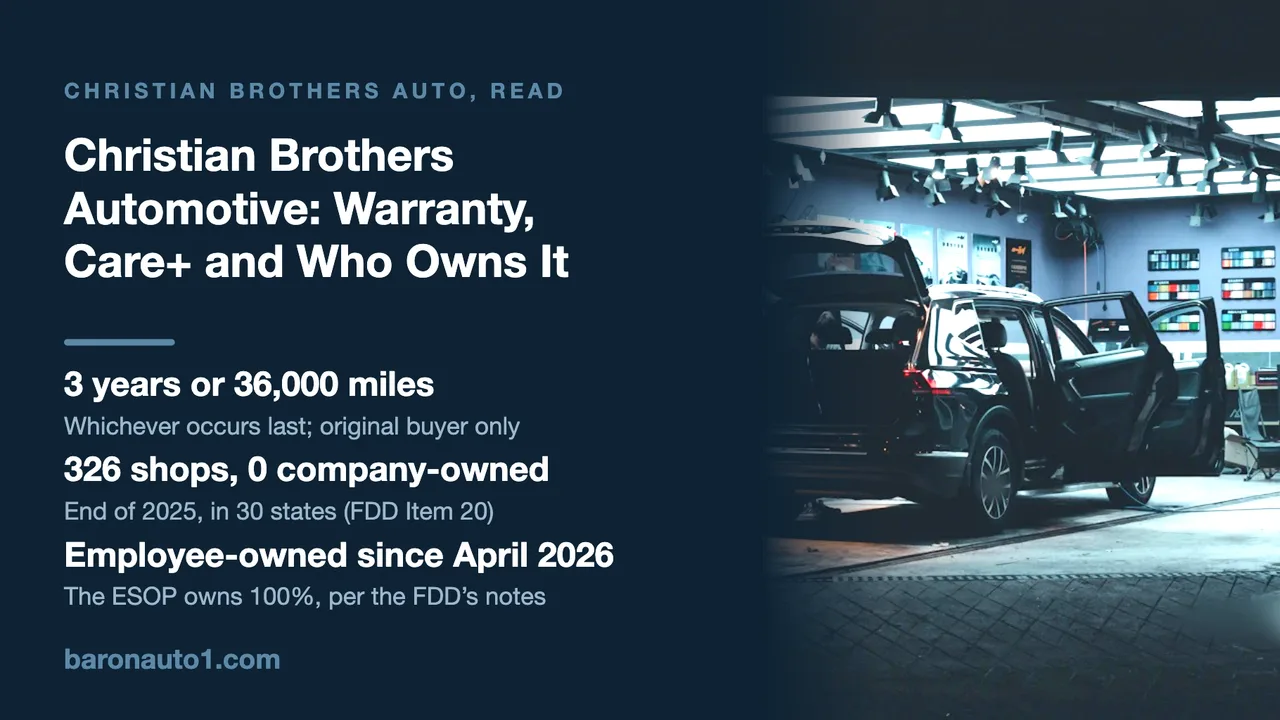
- Christian Brothers Automotive is a chain of 326 franchised repair shops in 30 states at the end of 2025, with no company-owned outlets, says its April 2026 franchise disclosure document. The franchisor has been 100% owned by its employee stock ownership plan since 2 April 2026.
- The Nice Difference Warranty covers parts and labor for 3 years or 36,000 miles, “whichever occurs last,” not first. It covers defects in new parts and their installation, for the original purchaser only.
- Its exclusions are long: internal engine and transmission repairs, clutches, batteries, tires, preventive maintenance and normal wear and tear are all outside it, though several service pages say it covers “all the work that we do.”
- Within 25 miles of the shop that did the work, a claim goes back to that shop. Farther away, another Christian Brothers shop within 25 miles, or the Warranty Administrator before any work starts.
- Nice Difference Care+ is a separate monthly vehicle service contract. Its obligor is Northcoast Warranty Services, Inc.; it has a 30-day, 300-mile waiting period and a deductible that falls from $400 to $0 at Christian Brothers shops.
- The courtesy inspection is free and visual. Prices, diagnostic fees and coupons are set by each shop.
Before you hand your keys to a Christian Brothers Automotive shop, it helps to know three things: what the Nice Difference Warranty really covers, who you are dealing with at a franchised shop, and what Care+, the company’s monthly plan, is. On 9 October 2026 we read the company’s warranty page and its limitations and exclusions, its FAQ, service, shuttle and inspection pages, its Terms of Use, the Care+ page and sample contract, the franchise disclosure document (FDD) Christian Brothers Automotive Corporation filed in Minnesota, issued 17 April 2026, and a Fifth Circuit opinion from 30 September 2026. This site has no commercial relationship with Christian Brothers Automotive or any repair chain.
Who owns Christian Brothers Automotive
The franchisor is Christian Brothers Automotive Corporation, or CBAC, of Houston. Item 1 of its FDD says it was “incorporated in the state of Texas on March 25, 1982” and that “CBAC does not have any parent entity.” Its About page tells the founding story: in August 1982 Mark Carr and a partner opened a repair shop in Mission Bend, a Houston suburb. The company began franchising in 1996, and Don Carr has been its CEO since July 2021, per Item 2.
The ownership news is not on the company’s website, whose newest press release dates from November 2018. It is in the audited notes inside the FDD. CBAC set up an employee stock ownership plan (ESOP) in July 2021. Then:
“On April 2, 2026, the Company completed a transaction to transition ownership of the Company to 100% employee ownership through its Employee Stock Ownership Plan (the ESOP).”
The notes say CBAC redeemed “all outstanding shares held by existing shareholders” for “approximately $286.1 million,” paid with seller notes, and issued shares to the ESOP trust. They also describe CBAC as “a Texas subchapter S corporation.”
| When | What happened | Source |
|---|---|---|
| 25 March 1982 | Incorporated in Texas | FDD, Item 1 |
| August 1982 | First shop opens in Mission Bend, near Houston | About page; FDD, Item 1 |
| January 1996 | Franchising begins, in Texas | About page; FDD, Item 1 |
| 1 October 2019 | Earliest effective date of the current Nice Difference Warranty | Limitations and exclusions page |
| July 2021 | ESOP established; Don Carr becomes CEO | FDD notes; Item 2 |
| March 2024 | CBAC forms Nice Difference Care+ | FDD notes |
| August 2024 | CBAC takes a 44% controlling stake in Foedus Sui, LLC, which buys franchise shops | FDD notes |
| 2 April 2026 | The ESOP becomes the 100% owner | FDD notes |
| 30 September 2026 | Fifth Circuit affirms judgment for CBAC in a would-be franchisee’s suit | Court opinion |
By our arithmetic the company is 44 years old in 2026 and has franchised for 30 of them, which squares with the “more than 40 years” on its pages.
Franchisees, the on-site owner and who you contract with
The shop you visit is a franchise. Item 20 of the FDD counts 265 franchised outlets at the start of 2023, 302 at the end of 2024 and 326 at the end of 2025, with zero company-owned outlets in every year: growth of 61 shops in three years, by our arithmetic. In 2025, 24 opened and none were terminated, not renewed or reacquired. Texas had 101 of the 326, or 31%, by our arithmetic, and 30 states had at least one, matching the About page’s “30 states.” The FDD also lists 97 franchises sold but not yet open and projects 28 openings in 2026.
Three documents say who your contract is with:
- The website’s Terms of Use. Repairs happen “at one of our franchisee locations under the standard terms and conditions of that franchisee location.”
- The franchise agreement. Section 12.01: “Franchisee is an independent contractor. Franchisor and Franchisee are completely separate entities.” Section 10.27 requires each shop to exhibit a notice “in a conspicuous place at the Premises” that it operates under a franchise.
- Each store page. The footer reads: “All Christian Brothers Automotive franchise locations are independently owned and operated.”
The brand promises an owner you can talk to. The shuttle page says “We have an owner/operator on site at all times.” Item 15 of the FDD is narrower: the “Principal Operator” must “personally supervise the Franchised Business,” which “must also be supervised by your Service Manager,” and the shop must be open from 7:00 AM to 6:00 PM Monday through Friday.
Not every franchised shop is a separate business in the plain sense. The audited notes say CBAC holds a 44% stake in Foedus Sui, LLC, controls it and consolidates it, and that Foedus subsidiaries bought the assets of franchise shops in 2024 and 2025, transactions that “included reacquiring the Company’s franchise rights.” We count 13 such deals in the notes, 4 in 2024 and 9 in 2025, one of them the Mission Bend shop on 30 June 2025. Item 20 still lists no company-owned or reacquired outlets.
Franchisees are also chosen by faith: the Fifth Circuit wrote on 30 September 2026 that the company “is a faith-based auto-repair business that franchises only to Christians” (see public records below).
The Nice Difference Warranty: 3 years or 36,000 miles, whichever occurs last
The warranty page leads with its headline term: “3 YEARS / 36,000 MILES - WHICHEVER OCCURS LAST.” Most repair warranties end at the first limit reached; Christian Brothers says its warranty “is the opposite” and “doesn’t expire until the later of the two limits.” The page gives two examples:
“if it takes you four years to put 36,000 miles on your car, your warranty will still be valid that fourth year, up until you’ve hit 36,000 miles. On the other hand, if you put 50,000 miles on your car in two years, your warranty will still be valid until the end of the third year.”
So the end point is the later of two dates: three years after the repair, or the day the car has covered 36,000 more miles. A high-mileage driver gets the full three years whatever the odometer says. A low-mileage driver keeps coverage past three years: at 6,000 miles a year, the page’s reading would keep a repair covered for 6 years, by our arithmetic. Whatever the end point, the limitations page caps what a claim can pay: “Warranty coverage will not exceed the dollar amount of the original repair.”
What it promises is narrower than its headline. The limitations and exclusions page defines it as “a 3-year/36,000-mile limited warranty on new components and their installation against defects in manufacturer workmanship and materials.” It protects against a part that was faulty or badly fitted, not against a part wearing out. The same paragraph excludes “Normal operational wear, excessive, abusive or abnormal use, misuse, neglect, accident, performance modifications, and commercial use,” and “Incidental or consequential damages” except where the law requires them.
Four more terms on that page matter at the counter:
- Original purchaser only. “Warranty coverage is extended only to the original purchaser and is not transferable if the vehicle is sold.” A used car with recent Christian Brothers repairs brings no warranty to its next owner.
- Your invoice wins. “Any limitations and exclusions detailed in your specific repair invoice are in addition to the following and take precedence over the general Terms, Limitations, and Exclusions.” Read the invoice, not just the website.
- Repairs from 1 October 2019 on. “The earliest effective date of the Warranty is 10/1/2019.”
- A reimbursement ceiling. “Warranty coverage will be paid at $165/hour max at Posted Labor Times and 50% parts margin (Excluding heavy line repairs).” That caps what the warranty pays a shop for warranty work. It is not a price you are charged, and the company prints no labor rate for customers.
“Limited” is also a legal label: under 15 U.S.C. 2303, a written warranty that falls short of the federal minimum standards “shall be conspicuously designated a ‘limited warranty’.”
What the warranty covers, and what it leaves out
The limitations page lists 16 kinds of eligible repairs and a longer list of exclusions. Side by side:
| Area | Eligible | Not covered |
|---|---|---|
| Engine | Engine performance and drivability repairs, cooling system, fuel system, ignition, emission controls, engine computers | “Any internal repairs or replacement of internal components, or replacement of engine assembly” |
| Transmission and driveline | Wheel bearings; CV joints, half-shafts and drive shafts | Internal transmission or transaxle repairs needing removal or disassembly; clutches; internal drive axle and differential repairs; pinion seals |
| Brakes, steering, suspension | “Brake System(s)”; “Steering/Suspension Systems” | “Normal Wear & Tear” |
| Electrical | Starting and charging systems; electrical systems; cruise control; body and other on-board computers | “Batteries” |
| Comfort and exhaust | Air conditioning, heating and climate control; exhaust systems | Body, paint and molding repair |
| Routine work | “Other Minor Repairs” | “Preventive Maintenance Services”; “Tires” |
| Parts and use | New parts fitted by the shop | Used or salvaged parts; performance parts and accessories; commercial vehicles |
The two lists sit together uneasily. Brakes are eligible, but brake pads are friction parts that wear, and normal wear is excluded; the warranty helps if a new caliper leaks or a pad was fitted wrongly, not when pads wear thin on schedule. Our guide to brake jobs and rotors explains which parts of a brake job wear out. Oil changes are preventive maintenance, which is excluded, though the oil-change page’s FAQ answers “Do you offer a warranty?” with a warranty “on all the work that we do.”
Three groups get less than the headline. On ten kinds of vehicle, among them motor homes, ambulances, tow trucks, taxis, police vehicles, snow plows and “Any vehicle over a one (1) ton capacity,” the warranty is limited to the part maker’s own written warranty and “Labor reimbursement is not eligible.” Rebuilt engines and transmissions are different too: “Remanufactured engines, transmissions, differentials, and transfer cases are warrantied only by the remanufacturer.” And if you bring your own part, “Customer-supplied parts are void of all written, promised, and implied warranties,” may be fitted “as-is” at “a higher published installation labor rate,” and are accepted only at some shops.
Making a warranty claim, at home or on the road
The warranty page’s first rule is paperwork: “To seek service under warranty, You MUST keep and present a copy of the original repair invoice.” After that, where you go depends on distance:
- Within 25 miles of the shop that did the work: “you must return your vehicle to that location and present your copy of the invoice.”
- Farther away, but within 25 miles of another Christian Brothers shop: “you will need to go to that closest Christian Brothers location.” The page’s example is a repair done in Amarillo that fails on a road trip through Atlanta.
- No Christian Brothers shop within 25 miles: call the Warranty Administrator “prior to any Warranty work being performed,” from 8am to 8pm Eastern Time on weekdays. The administrator directs you to a participating shop or, if there is none, lets you use another one; if that shop will not bill the administrator, you pay and submit both invoices.
Far from any shop, Christian Brothers “may utilize a third-party warranty provider.” Either way, in capitals: “ALL WARRANTY SERVICE MUST BE AUTHORIZED BY THE ORIGINATING CHRISTIAN BROTHERS FACILITY IN ADVANCE.”
Get the authorization before the repair, not after. The limitations page says “REPAIRS PERFORMED WITHOUT PRIOR AUTHORIZATION WILL NOT BE ELIGIBLE FOR COVERAGE OR REIMBURSEMENT.” If a repaired part fails away from home, call the original shop or the Warranty Administrator first, keep the original invoice with you, and write down who approved the work and when.
The FAQ is looser than this. It says the warranty “will be honored at any location, regardless of which branch did the initial work.” Any shop can be the right shop, but only in the order the warranty page sets, and only with the originating shop’s advance approval.
The free courtesy inspection, diagnostics and the shuttle
Christian Brothers’ standing free services are an inspection, a digital report and a ride. The courtesy inspection page says technicians “will visually inspect” a list of 25 items, from gauges and warning lights to belts, fluids, hoses, the battery and its cables, lights and wipers, tires, axle boots, shocks and struts, the exhaust, steering and suspension parts, and “Brakes and rotors for normal wear.” It is optional: “We give a free courtesy inspection to every visitor who wants it. You do not have to get the inspection.”
Results arrive as a Digital Vehicle Inspection, or DVI. The shop says it “will text you a digital vehicle inspection report, containing pictures and videos,” tells you “how urgent each service/repair recommendation is,” and leaves each one to you: “you have the ability to approve or decline each recommended service.” Asked whether you must pay for every issue found, the page answers: “No ... We never will perform a service without your approval.”

A visual check is not a diagnosis, and the brake page draws that line. Christian Brothers “offers free visual brake inspections on most vehicles,” but a soft pedal, grinding, vibration or a warning light calls for “a comprehensive diagnostic” that “may involve component removal or road tests and is priced based on the complexity of the diagnostic required.” No diagnostic fee is printed anywhere; ask the price before you approve one. Our guide to steady and flashing check engine lights covers what the light can and cannot tell you, and the company’s own page agrees that a flashing light means coming in “immediately.”
The shuttle is the other standing perk, with two conditions in its own wording. “If your car requires repairs that will take longer than a day, we are happy to transport you to your destination,” and “If the location is within the designated distance, we will be glad to provide alternate transportation.” The distance is not published. The FDD shows these are system rules, not local favors: the confidential Operations Manual’s contents list “Courtesy Shuttle,” “Courtesy Inspections” and “Nice Difference Warranty” among what every shop provides.
Prices, coupons and paying: set by each shop
Christian Brothers prints no national prices. The contact page sends anyone “looking for pricing information” to the local shop, and the oil-change, brake, check-engine and pre-purchase inspection pages each offer “Call For a Quote.” The oil-change page does describe the service: conventional, blend or full-synthetic oil to your owner’s manual, and “every oil change will include a new oil filter.” How often to change it is a question for the manual; see our guide to oil-change intervals and keeping records.
Coupons are per store. The Mission Bend shop’s special-offers page carried four printable coupons when we read it, each marked “Offer only valid at the Mission Bend location.” We record no amounts, because store offers change.
We found no standing financing program on the national site: no store card, no named lender. Store pages list “Special Financing” among their amenities, and one store’s coupon advertises payment plans without naming who provides them. If you need to spread a repair bill, ask the shop who the lender is and read that lender’s terms before you sign.
Nice Difference Care+: a monthly service contract, not the repair warranty
Care+ is not the Nice Difference Warranty. The Care+ page calls it “a subscription-based vehicle care plan,” and its FAQ is precise: “In order to enroll in Nice Difference Care+®, you will sign a vehicle service contract.” Federal rules at 16 CFR 700.11 say an agreement that “calls for some consideration in addition to the purchase price” is a service contract, and the FTC’s consumer guide adds that such a contract “is not a warranty as defined by federal law.”
The FDD’s notes say CBAC formed Care+ in March 2024 and owns it outright. The contract names who carries the risk. Its obligor, the company that owes you the benefits, is “Northcoast Warranty Services, Inc.”; its administrator, which approves claims, is “CBA Warranty Admin, LLC”; and Northcoast’s obligations are insured by “ARI Insurance Company,” or Wesco Insurance Company in Idaho and Minnesota, with a right to claim from the insurer if a covered claim goes unpaid for 60 days. The FAQ names a different word for the backing, “the A-rated carrier, AmTrust”; we did not check how these companies are related. Care+ “is not available to residents of Alaska, California, Maine, Maryland, Massachusetts, New Jersey, New York, Oregon, & Utah.”
We read the 18-page sample contract the Care+ site links to, form “M2MVSCXXX - NRF,” which warns that “final agreements may differ depending on your state.” Its main terms, beside the web page:
| Question | Care+ web page and FAQ | Sample contract |
|---|---|---|
| Which cars | “up to 15 years old and up to 165,000 miles,” after a free inspection valid 30 days | You must cancel when the car reaches 200,000 miles or 20 years of age, or is sold |
| When cover starts | “30 days after enrollment and once you’ve driven 300 miles”; elsewhere, “instant coverage” | A 30-day, 300-mile waiting period; failures during it count as pre-existing |
| Deductible at a Christian Brothers shop | $400 in months 0 to 6, $200 in months 7 to 12, $100 in months 13 to 24, $0 from month 25 | The same schedule, by the number of monthly payments made |
| Deductible elsewhere | “The standard $400 deductible” | $400 at any non-Christian Brothers shop; no repair without pre-authorization |
| What is never covered | Batteries, collisions, branded titles, aftermarket alterations, unrepaired pre-existing conditions | Also shocks, struts, springs, brake rotors and drums, exhaust systems, catalytic converters, tires, wheels, and maintenance items such as brake pads, belts and hoses |
| Most it will pay | Not stated | All benefits together capped at the car’s average trade-in value or $10,000, “whichever is greater” |
| Extras | Roadside help and rental reimbursement after a covered breakdown; a $50 oil change credit every four months | Rental $50 a day for up to 5 days ($250); trip costs $150 a day for up to 3 days ($450) more than 100 miles from home; roadside up to $125 a time; no oil change credit in the text |
| Cancelling | “cancel at any time for any reason, free of charge” | Full refund within 30 days if no claim; after that no refund, unless your state’s disclosure in the contract gives a pro rata one; cancel 7 days before the next payment |
| Selling the car | Not stated | Transferable to a private buyer for $75, at the administrator’s discretion |
Parts are replaced with new, non-original, remanufactured “or used parts at the ADMINISTRATOR’S sole discretion,” and labor is paid by “a Nationally Published estimating guide.” If a claim needs the engine taken apart to find the cause, “YOU will be responsible for these charges if the failure is not covered.” Maintenance has to be proven: if you service the car yourself you must keep a log and receipts, and without records “the ADMINISTRATOR may deny coverage.” Problems flagged at the inspection are covered only once fixed, and “ALL PRE-EXISTING repairs MUST be completed at a Christian Brothers Automotive SERVICE CENTER.”
The oil change credit deserves a question before you sign. If the web page’s promise holds, $50 every four months is 3 credits and $150 a year, by our arithmetic, but we found no oil change credit anywhere in the sample contract, and the contract says it is the “entire VEHICLE SERVICE CONTRACT.” Ask for the credit in writing.
Care+ prices are quoted per car; we entered no vehicle, so we print none. Whether any service contract is worth buying is covered in our guide to whether an extended warranty is worth it.
Bringing an extended warranty, or a car still under its factory warranty
Many customers arrive with a service contract bought elsewhere. Christian Brothers’ FAQ says “we work with all major extended warranty providers”; its extended-warranty page says “most” and offers a list of 14 lines, “just a few of the providers some of our stores have worked with,” with Warranty Direct named twice, so 13 companies. “Some of our stores” is the operative phrase: your contract’s administrator, not the shop, decides whether a repair is paid. The FTC’s guide puts it plainly: “Administrators make the decisions about authorizing the payment of claims under the contract.” Before work starts, check whether your contract needs the administrator’s pre-approval, as the FTC suggests asking, and have the shop get it.
If your car is still under its maker’s warranty, using an independent shop for maintenance does not by itself void that warranty. Under 15 U.S.C. 2302(c), no warrantor may condition its warranty on your using a service “identified by brand, trade, or corporate name” unless that service is free under the warranty, and the FTC’s interpretation at 16 CFR 700.10 adds that “No warrantor may condition the continued validity of a warranty on the use of only authorized repair service and/or authorized replacement parts for non-warranty service and maintenance.” The FTC’s consumer advice is to “Keep records of repairs and maintenance like oil changes, tire rotations, belt replacement, new brake pads, and inspections.” Repairs the maker’s warranty pays for are different: if the warranty says the work is free, the FTC notes, “the dealer or manufacturer can make you use repair facilities it chooses.”
Shopping for a used car? Christian Brothers sells pre-purchase inspections too; our pre-purchase inspection guide explains what one can find.
What courts and regulators have recorded
Item 3 of the 2026 FDD, the litigation item, lists two matters, neither about a customer’s repair:
- Domanic v. Christian Brothers Automotive Corporation. Filed on or about 7 February 2022 in the Southern District of Texas (No. 4:22-cv-00386), it alleged that CBAC violated 42 U.S.C. 1981 and the Texas Deceptive Trade Practices Act “by declining to extend him the opportunity to purchase a CBAC franchise.” On 26 September 2025 the court granted CBAC summary judgment and dismissed the case with prejudice; Mr. Domanic appealed on 1 November 2025. The FDD, issued in April, calls the appeal “ongoing.” It has since been decided. In its opinion of 30 September 2026 (No. 25-20486), the Fifth Circuit described the district court’s ruling that the company’s franchise policy “constituted not racial but religious discrimination, which is not cognizable under § 1981,” and concluded: “We therefore AFFIRM.”
- Christian Brothers Automotive Corporation v. Seek 1st LLC. An American Arbitration Association case (No. 01-22-00005109) against a former franchisee; on 17 January 2023 the panel found “that CBAC properly terminated the franchise agreement.”
Item 3 ends: “Except as described above, no litigation is required to be disclosed in this Item.” We found no Federal Trade Commission case: the FTC’s Cases and Proceedings list, filtered on “Christian Brothers,” returned “No results found for these filters.” Web searches turned up no state attorney-general action naming the company. The Better Business Bureau’s site blocked our reader, so no rating is reported here.
One more line in Item 20 is worth knowing if you read franchisee reviews: “In some instances, current and former franchisees sign provisions restricting their ability to speak openly about their experience with CBAC.”
Where Christian Brothers’ own documents disagree
We recorded 14 places where the company’s pages, its Care+ contract and its FDD say different things. The ones that matter to a customer:
- “All the work that we do.” The FAQ and service pages say the 3-year, 36,000-mile warranty covers all work; the brake page says “Every service is backed by” it. The limitations page excludes preventive maintenance, normal wear, batteries, tires and major internal repairs.
- Any shop, or yours. The FAQ says any location honors the warranty “regardless of which branch did the initial work”; the warranty page sends you back to the original shop if you are within 25 miles of it, and the limitations page requires that shop’s advance approval.
- How many shops. “More than 310” on the home page, “over 310” as of 2019 on the About page, “more than 315” on the Care+ page, and 326 at the end of 2025 in the FDD.
- Independently owned. Store pages say every franchise location is independently owned; the FDD’s audited notes describe a CBAC-controlled company buying franchise shops, including Mission Bend.
- Care+ start date. “Instant coverage” in one FAQ answer; a 30-day, 300-mile waiting period in another and in the contract.
- Care+ extras. A $50 oil change credit every four months on the web page, absent from the sample contract; a $0 deductible for service members “and their spouses” on the web page, while the contract’s $0 deductible names veterans, active-duty military and first responders only.
- Ask for a written estimate and the price of any diagnostic before you approve it; the courtesy inspection is the only free check.
- Read the warranty lines on your invoice. They take precedence over the website, and the invoice is your claim document for as long as the warranty runs.
- Know your end point: three years from the repair, or 36,000 more miles if that comes later, for parts that fail through a defect or bad fitting, while you own the car.
- Away from home, find the nearest Christian Brothers shop within 25 miles, or call the Warranty Administrator, before anyone touches the car.
- Skip customer-supplied parts if you want the warranty; they carry none.
- Before buying Care+, get the actual contract for your state, check the 30-day, 300-mile wait, the excluded parts list, the $10,000-or-trade-in cap, and whether the oil change credit is written in.
For how other chains word their repair promises, see our pages on Midas’s lifetime parts guarantee and Firestone Complete Auto Care’s repair warranty, and in the same series Meineke, Goodyear Auto Service and Tires Plus.
Common questions
What is the Christian Brothers Automotive warranty?
The Nice Difference Warranty: 3 years or 36,000 miles, whichever occurs last, on new parts and their installation against defects in workmanship and materials. It covers the original purchaser only, cannot exceed the cost of the original repair, and excludes wear, maintenance, batteries, tires and major internal engine and transmission work.
Is the Christian Brothers warranty nationwide?
Yes, with an order of steps. Within 25 miles of the original shop you return there; otherwise you go to the nearest Christian Brothers shop within 25 miles, or call the Warranty Administrator before any work if there is none. All warranty service must be authorized in advance by the originating shop.
Who owns Christian Brothers Automotive?
Its employees, through an employee stock ownership plan that became the 100% owner of Christian Brothers Automotive Corporation on 2 April 2026, according to the audited notes in its April 2026 FDD. All 326 shops counted in the FDD are franchised.
Is Christian Brothers Automotive expensive?
The company publishes no prices; each franchised shop quotes its own, and its pages say “Call For a Quote.” Ask for a written estimate and the diagnostic price before approving work. The warranty’s length is a separate part of what you are buying.
What is Nice Difference Care+?
A monthly vehicle service contract sold through Christian Brothers, with Northcoast Warranty Services, Inc. as obligor and CBA Warranty Admin, LLC as administrator. It takes cars up to 15 years old and 165,000 miles, starts after 30 days and 300 miles, and has a deductible that falls from $400 to $0 at Christian Brothers shops. It is not sold in nine states, including California and New York.
Sources and further reading
Recall, complaint and safety-rating figures on this page were retrieved from the federal databases above on August 19, 2026. Federal data changes — re-check any VIN before you rely on it.
Published October 9, 2026 · last updated October 9, 2026. Found something out of date or wrong? Tell us and we will correct it.