Firestone Complete Auto Care: Warranties, Road Hazard and Owner
Bridgestone runs Firestone Complete Auto Care as company-owned stores. What its repair warranty, lifetime brake and alignment cover, prorated road hazard certificate, price match and credit card say, and where its own pages disagree.
The short version
- Firestone Complete Auto Care is run by Bridgestone Retail Operations, LLC, “a subsidiary of Bridgestone Americas,” which also runs Tires Plus, Hibdon Tires Plus and Wheel Works. The Firestone credit card comes from its own bank, Credit First National Association.
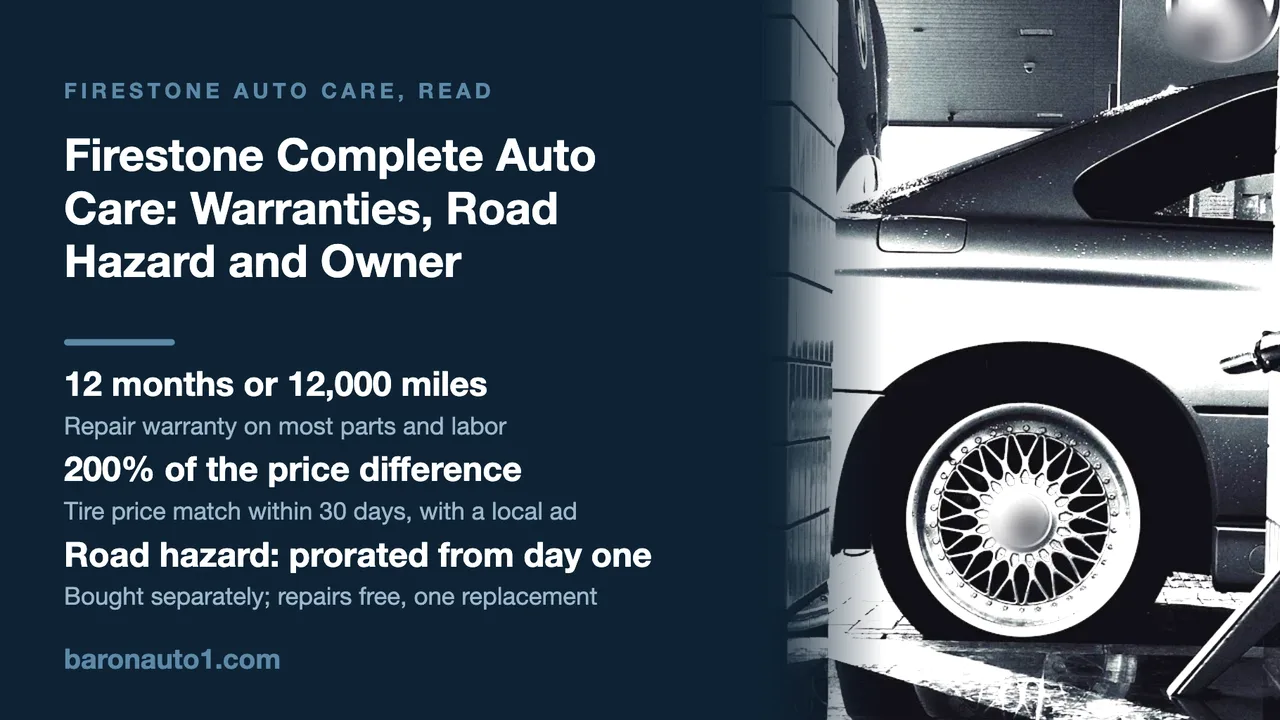
- Most repairs and parts carry a 12-month or 12,000-mile limited warranty, honored at Firestone stores the company owns. Oil changes get 3 months or 3,000 miles.
- “Lifetime” brake pads, alignments and balancing last only while the original buyer owns the car. Lifetime pads come with 12 months or 12,000 miles of labor, and rotors are never lifetime.
- Road Hazard Protection is bought separately and is prorated from the first mile: you pay for the share of tread already used. Repairs are free, with one replacement and two repairs per tire.
- The Priced Right guarantee refunds 200% of the difference if you find the same tire cheaper within 30 days with a current local ad. Tires carry their maker’s warranty, and batteries DieHard’s or Duralast’s.
- Firestone’s documents disagree in 11 places we found. The main one: the warranty page still lists lifetime brake labor that a second copy of the page says was discontinued on 1 June 2022.
Firestone Complete Auto Care is Bridgestone’s chain of company-owned tire and repair shops, and its written promises come in three layers. The store’s repair warranty covers most parts and labor for 12 months or 12,000 miles, and some brake, suspension, alignment and balance work for life, with conditions. The Triple Promise adds a re-do of faulty work, a tire price match and a discount if your car is late. Tires carry their maker’s warranty, and road hazard cover is an extra you buy. On 9 October 2026 we read Firestone’s service warranty page (Effective Date 11/13/2024) and a second copy of it, the Triple Promise and Priced Right pages, the Road Hazard Protection certificate (Effective Date 01/01/2025), its tire, battery, brake, alignment, rotation and credit-card pages and its Terms of Use, plus Bridgestone Americas’ pages and its release of 4 June 2026. This site has no commercial relationship with Firestone, Bridgestone or any tire maker.
Firestone’s Terms of Use say “You cannot and shall not mirror, scrape, or deep link any content,” so we name its documents without linking them. Most sit under the “Warranties” or “Firestone” menu in the footer of Firestone’s website.
Who owns Firestone Complete Auto Care, and who stands behind each promise
The service warranty ends with “GIVEN BY: Bridgestone Retail Operations, LLC, ... doing business as Firestone Complete Auto Care.” Bridgestone Americas’ release of 4 June 2026 calls that company “a subsidiary of Bridgestone Americas and operator of the largest network of company-owned automotive service providers in the world,” and says “Bridgestone Americas, Inc. is the U.S.-based subsidiary of Bridgestone Corporation, a global leader in tires and rubber.” The stores, the Bridgestone and Firestone tire brands and the warranty on those tires sit in one corporate family.
Bridgestone Retail Operations, or BSRO, runs “more than 2,200 tire and vehicle service centers,” the release says, including “Firestone Complete Auto Care, Tires Plus, Hibdon Tires Plus and Wheel Works store locations,” and “Credit First National Association and Firestone Complete Fleet Care operations are also part of BSRO.” The Firestone network “comprises more than 1,800 stores across 48 states.” Bridgestone Americas’ own page on the chain still says “over 1,700 neighborhood locations.” Both trace the business to 1926.
Because the stores are company-owned rather than franchised, ownership shapes three things below: who honors the warranty, how the price match is worded, and who registers your tires.
| What you are relying on | Who the document names | Where it is honored |
|---|---|---|
| Repair and parts warranty | Bridgestone Retail Operations, LLC | The selling store or “any other Firestone Complete Auto Care Store in the United States” owned by that company |
| Road Hazard Protection | Bridgestone Americas Tire Operations, LLC and Bridgestone Retail Operations, LLC (in its disclaimer) | Firestone Complete Auto Care, Expert Tire, Tires Plus, Hibdon Tires Plus, Michel Tires Plus or Wheel Works |
| Price match and late-car discount | “a Bridgestone company-owned store” | “any company-owned store” |
| Bridgestone and Firestone tire warranty | Bridgestone Americas Tire Operations, LLC, the tire maker | Any authorized Bridgestone or Firestone retailer |
| Batteries | “the battery manufacturer (DieHard or Duralast)” | Under the battery maker’s terms |
| Firestone Credit Card | Credit First National Association, “operated and funded by the credit division of Bridgestone Retail Operations, LLC” | Firestone, Tires Plus, Hibdon Tires Plus and Wheel Works stores |
| The website | Bridgestone Americas, Inc. “or its affiliated companies” | Arbitration and Tennessee law under the Terms of Use |
The repair warranty: 12 months or 12,000 miles, and what changes it
Firestone calls it the Limited Nationwide Service Warranty: “Parts and services purchased at Firestone Complete Auto Care are covered by a limited warranty of twelve (12) months or 12,000 miles, whichever comes first, unless otherwise described below.” Cover stops at the first anniversary of the work or 12,000 miles later, whichever arrives first. A failed covered part “will be replaced free of any additional charge for parts or labor.” The warranty “does not apply to” parts bought through the Firestone Off-Road Shop (their installation is covered), “tires,” “wheels,” “batteries,” or “damage caused by abuse or accident.”
The “unless otherwise described below” is a table of shorter and longer terms by job, read on the page Firestone links from its menus:
| Job | Parts | Labor |
|---|---|---|
| Oil change and oil filter | 3 months / 3,000 miles | 3 months / 3,000 miles |
| Air, fuel, cabin air and transmission filters | 6 months / 6,000 miles | 6 months / 6,000 miles |
| New or remanufactured starters and alternators | 24 months / 24,000 miles | 12 months / 12,000 miles |
| Standard brake service (shoes, disc pads) | Lifetime | 12 months / 12,000 miles |
| Standard brake service with brake fluid exchange | Lifetime | 24 months / 24,000 miles |
| “Lifetime Brake Service” (shoes, pads, calipers, wheel cylinders, hardware) | Lifetime | Lifetime (see the warning below) |
| Shocks and struts; steering and suspension parts | Lifetime | 12 months / 12,000 miles |
| Lifetime alignment service | N/A | Lifetime |
| Lifetime wheel balance | Lifetime | Lifetime |
For oil-change intervals, see our guide on how often to change oil.
Conditions apply to every line. The warranty “covers only the original purchaser,” and “The original invoice” must be presented. If the odometer did not work when the job was done, or does not work when you claim, “that vehicle is ineligible for coverage.” Commercial and racing use, “all electronic components of any part(s)” and air-conditioning refrigerant are excluded. Claims go to the selling store “or any other Firestone Complete Auto Care Store in the United States (subject to availability, qualifications, and equipment) owned by Bridgestone Retail Operations, LLC.”
Disputes can go to arbitration: “either you or we can choose to have any Claim resolved by binding arbitration,” with no class actions, though injury and property-damage claims are carved out, and Firestone will “advance the first $250 of the filing and hearing fees” on request. The warranty also disclaims implied warranties “TO THE EXTENT PERMITTED BY LAW”; federal law says a seller that gives a written warranty on a consumer product may not disclaim them, only limit their length (15 U.S.C. 2308). The Triple Promise’s Fixed Right leg restates this warranty: a job “performed improperly” is redone “at no additional charge to you, during the established warranty period.”
“Lifetime” brakes, alignment and balance: what lifetime means here
Every lifetime line carries the same footnote: “All lifetime limited warranties are only valid for as long as the original lifetime service purchaser owns the vehicle.” Lifetime means your ownership of that car. Sell or trade it and the cover ends; the next owner gets nothing.
Lifetime brakes
Firestone’s brakes page offers a standard brake service with a “12,000-Mile/12-Month Service Warranty on Labor” and a “Lifetime Limited Nationwide Service Warranty on Parts,” and a brake service with fluid exchange that carries a “24,000-Mile/24-Month Service Warranty on Labor” with the same parts cover. The fluid exchange doubles the labor cover, by our arithmetic.
The lifetime part is narrow: it covers the pads or shoes. A footnote says “Costs of additional brake system components, including master cylinders, rotors, drums and all additional labor, are warrantied for a period of twelve (12) months or 12,000 miles, whichever comes first.” If lifetime pads need replacing in year three, the pads fall under the lifetime line, but by the table’s terms the labor to fit them, and any rotor the job needs, is outside the cover. Our brake pad cost guide explains why rotors often join the bill.
Two versions of the same warranty page disagree on lifetime brake labor. The page Firestone links from its menus still lists a “Lifetime Brake Service” with lifetime parts and lifetime labor. A second copy, listed in Firestone’s sitemap but marked not to be indexed by search engines, says: “Effective June 1, 2022, Bridgestone Retail Operations, LLC discontinued and removed from sale the Lifetime Brake Labor Warranty package.” Lifetime labor bought before that date is still honored, it says. If a store offers lifetime labor today, get it on the invoice in those words.
Lifetime alignment
“Firestone lifetime alignment” is one of the chain’s most searched services. In the warranty table it is labor only; the parts column reads “N/A.” Its footnote sets three limits: “If parts are required to restore vehicle to manufacturer’s alignment specifications, then those parts and the labor required to install them are not covered”; it is “Subject to in-store equipment availability and employee qualifications to align vehicle”; and it holds only while the suspension or body height “has not been modified or damaged to be outside of OEM specifications.”
The alignment page suggests checks “every 6,000 miles or at least once a year” and shows prices only after you enter a vehicle, which we did not do. Whether lifetime alignment pays depends on how often you would otherwise align and how long you keep the car; our guide to when an alignment is needed helps with the first half.
Lifetime balance “is only warrantied so long as originally balanced tires remains on wheel,” so new tires end it. Lifetime shocks and struts exclude “air shocks and air springs.”
The Triple Promise: the price match and the late-car discount
The Triple Promise page heads itself “Fixed Right, Priced Right, Right on Time” and closes with “Restrictions and limitations apply.” Fixed Right is the repair warranty above. The other two have their own small print.
Priced Right: 200% of the difference on tires
The headline says Firestone “will match any current, locally advertised price on tires. If you find a better price within 30 days of purchase, we’ll refund you 200% of the price difference.” The footnote, printed on the Priced Right page, under the Triple Promise and on the service warranty page, extends “within thirty (30) days after the date of purchase, a refund of 200% of the difference between a competitor’s current, delivered non-sale price and the price of the same tire purchased from a Bridgestone company-owned store.” On a hypothetical $10 gap per tire, that is $20 back per tire, by our arithmetic. The conditions:
- A current, local advertisement for the same tire, at a “non-sale price.” The guarantee “excludes wholesale, clearances, closeouts, catalogs and rebate prices.”
- Buy 3, Get 1 offers: Firestone’s own is compared only with a competitor’s “Buy 3, Get 1 offer,” not a single-tire price.
- A real retailer: “an authorized reseller of the product and selling it through their own, non-auction channel.”
- Nothing stacked: the refund is “not to be combined with any other offer or used to reduce outstanding debt.”
The buy-online page prints a shorter footnote that mentions only “a current local advertisement” and “wholesale, clearance and closeout prices.” Rely on the longer version, which appears in three places, and keep the receipt and the ad together.
Right on Time: 10% off the next visit
“If your vehicle isn’t ready at the time we promised, we will offer a 10% discount on your next purchase (discount cannot exceed $25.00).” The 10% reaches its $25 cap on a $250 purchase, by our arithmetic. It is valid “at any company-owned store,” the second visit must be “within one year of the original service,” and it cannot reduce outstanding debt. Ask the store to write the promised time on the work order.
The tire warranty is Bridgestone’s, not the store’s
People searching “Firestone tires warranty” usually mean the maker’s promise, and the store’s service warranty excludes tires. Firestone’s tire-warranty page restates the maker’s terms and says “This Limited Warranty is given by Bridgestone Americas Tire Operations, LLC.” Our comparison of tire makers’ warranties read Bridgestone’s 2024 manual (Effective Date 01/01/2024) on 7 October 2026. The terms that matter at the counter, copied from that reading:
- Firestone brand tires (the Gold Pledge): replacement “either free of charge or for a prorated amount” for defects “within 5 years from the date of purchase (proof of purchase required) or 6 years from the date of manufacture,” free for “up to (a) 3 years from the date of purchase.” Bridgestone brand tires (the Platinum Pact) have the same periods.
- After the free period, “the percent worn, based on used tread wear, is multiplied by DEALER’S current selling price,” and mounting, balancing and disposal fees “may still apply.” See how prorating works.
- The 90-Day Buy & Try Guarantee exchanges a full set “within 90 days of purchase” for credit toward another Bridgestone or Firestone set, “one set of tires per vehicle within any 12-month period.”
- Keep rotation receipts: you must have tires “regularly inspected and rotated” and “furnish proof of same.”
Firestone’s page has fallen behind the manual: it says the warranty applies if “The tire was purchased and primarily used in the US after December 31, 2018,” while the 2024 manual covers tires “purchased ... after December 31, 2023.” The page links separate manuals by purchase date; use the one for the date on your invoice. Tires of other brands carry their own makers’ warranties.
Tire registration: the store should do it for you
Federal tire registration rules depend on who owns the dealer. 49 CFR 574.3 defines an independent dealer as “one whose business is not owned or controlled by a tire manufacturer or brand name owner.” An independent dealer can hand you a registration card. A dealer that is not independent must, under 49 CFR 574.8(b), “submit ... the information specified in § 574.7(a)(4) to the manufacturer of the tires sold” at least “every 30 days” (a seller of fewer than 40 tires may wait, but not beyond six months): your name and address, the tire identification number and the seller.
Our reading: a store run by a subsidiary of Bridgestone Americas is owned by a tire maker’s group, so it should register every new tire it sells, whatever the brand. Firestone’s pages do not mention registration, so check your name and address on the invoice and ask the store to confirm. Registration is how a maker reaches you in a recall; our tire life guide explains recall checks.
Road Hazard Protection: bought separately and prorated from the first mile
Bridgestone’s tire warranty covers defects, not nails and potholes. For those, Firestone sells Road Hazard Protection. The certificate, headed “Road Hazard Protection” with “Effective Date 01/01/2025,” opens: “This TIRE REPAIR OR REPLACEMENT is optional protection that can be purchased and is ONLY EFFECTIVE WHEN THE ORIGINAL INVOICE IS PRESENTED WITH THIS WARRANTY FORM.” A sourcing note: Firestone’s robots.txt, the file that tells automated readers what they may fetch, bars a road hazard PDF on Firestone’s own site, and we did not request it. We read the copy on Adobe’s Scene7 service that Firestone’s tire-warranty page links to; that page repeats the key replacement terms.
This is not free replacement. Firestone “will prorate any tire covered by this certificate if it should become unusable prior to wearing down to 2/32nds of an inch of remaining original usable tread for any reason resulting from road hazard (e.g. cut, snag, bruise, impact or puncture).” The price you pay is “the percent of used treadwear ... multiplied by the retail store’s current selling price for the replacement tire(s).” On hypothetical figures, our arithmetic: a tire 40% worn when a pothole ruins it costs you 40% of the store’s current price for the replacement, with the other 60% credited. Mounting and balancing are free, but “appropriate taxes, disposal fees and other service charges may be added.” The share is measured from the first mile. The formula uses the store’s current price, yet the next sentence says “your purchase price is credited for the unused amount of tread”; ask which figure the store applies.
Repairs are free: “If the tire is repairable, the tire will be repaired free of charge at the discretion of Firestone Complete Auto Care in compliance with the auto manufacturer’s policy.” The limits:
- Once and twice: no tire is eligible “for replacement more than one time or repair more than twice during the coverage period.” Cover on the replacement tire is a new purchase.
- Ends at 2/32 inch of tread (how to check tread depth).
- First buyer, first car: it “only applies to the original purchaser,” “is not transferable,” and covers “the original vehicle identified on the original invoice.”
- Exclusions: tires branded “NA” or “NO ADJ” and tires in commercial service are out, and five listed examples of causes not covered include “Continued use while flat,” collision or vandalism, and ignored maintenance advice. “Repair of a speed-rated tire voids the tire’s speed rating,” it warns.
No page or document we read prints a price or price basis for Road Hazard Protection. The buy-online page says checkout offers “additional protections like a Road Hazard Warranty or Lifetime Wheel Warranty,” and we found no terms for the wheel product. The certificate calls itself a “Limited Warranty” designated “In accordance with Federal Law,” but it is a separate purchase; federal law defines a service contract as “a contract in writing to perform, over a fixed period of time or for a specified duration, services relating to the maintenance or repair (or both) of a consumer product.” Our guide to why a paid plan is not a warranty explains the difference.
Firestone’s own explainer describes different cover. Its “Understanding Your Tire Warranty” page says “A limited road hazard warranty covers you for the first year after purchase” and “If the tire can be repaired, the warranty won’t cover it.” The certificate runs to 2/32 inch and repairs free. The explainer agrees on one thing: the cover “doesn’t automatically come with your tires.” Ask for the certificate at the counter, get the per-tire charge in writing, and check that any road hazard line on your estimate is one you asked for.
Firestone’s road hazard terms beside other sellers
The table copies other sellers’ wording from this site’s own pages, with read dates. It compares terms, not prices, and ranks no one.
| Seller | Included or bought | How a ruined tire is paid for |
|---|---|---|
| Firestone Complete Auto Care | Bought: “optional protection that can be purchased” | Prorated from the first mile on the store’s current price; repairs free |
| Discount Tire | Included: “Every tire we sell comes with a FREE prorated road hazard warranty”; optional Certificates on top | Prorated; Certificates are “optional coverage” added at purchase or up to 30 days after |
| Walmart | Bought: the “OPTIONAL Road Hazard Warranty” | Free for the first year or 25% of tread life, then prorated; free flat repair |
| Costco | Included for members: “5 year road hazard warranty” | Credit “by multiplying the usable remaining tread by the price you paid” |
| Tire Rack | Included: “2 years of free road hazard protection” | “No proration” for 24 months; not transferable |
Our pages on Mavis and Pep Boys read two more chains’ terms.
What comes free with tires, inspections and batteries
Firestone’s tires page promises “free tire repair and maintenance services with every tire purchase,” then lists three items: tire mounting; “free tire rotations for life when you need them at participating Firestone Complete Auto Care locations. *Check stores for conditions and terms”; and an alignment check of “suspension, steering, tire conditions, and alignment settings.” The rotation page is firmer: “Tires purchased at Firestone Complete Auto Care include tire rotation services for the lifetime of the tire,” and rotations “will also be performed on any Bridgestone or Firestone tire regardless of purchase location.” It suggests rotating “around every 5,000 miles, but no more than 7,500 miles”; our rotation guide covers why your manual may differ.
Flat repair is not on the list. The tire-repair page says “A simple plug or patch on basic touring tires can be as low as $30” and repairs only “Single punctures in the tread, ≤ 1/4″ (6 mm).” On the documents we read, free repairs come with Road Hazard Protection, not with the tire.
Two inspections are free with conditions. Firestone offers “a free vehicle inspection with each and every repair and maintenance service,” starting “with a free battery test.” The brakes page offers “a free brake inspection,” with an asterisk: “*With an eligible coupon.”
Batteries carry the battery maker’s warranty. Firestone says “Battery limited warranty is provided by the battery manufacturer (DieHard or Duralast). Claims and guarantees are those of the battery manufacturer, and not Firestone Complete Auto Care.” Ask which brand you are getting; our battery warranty guide covers Duralast and DieHard.
Fees, “no hidden fees” and the Firestone credit card
The buy-online page promises: “No hidden fees ... the price you see is the price you pay.” Fine print elsewhere adds charges to expect. Tire offers say “In-store installation required and costs extra,” and the same fine print, repeated on the credit-card page, sets a “Shop supply fee of 8-10% of labor costs (up to $40) added to invoices over $35, includes cost and profit, and is not charged if prohibited.” By our arithmetic the fee hits its $40 cap at $400 of labor at 10%, or $500 at 8%. Ask for an out-the-door figure that includes installation, this fee and tire disposal.
The only standing financing route Firestone lists is its own card; its financing link redirects to the card page, and no other lender or pay-later option appeared on the pages we read. Approval decides the product: “you may be eligible for either a Firestone Credit Card or a Firestone Mastercard.” The issuer, Credit First National Association, is “operated and funded by the credit division of Bridgestone Retail Operations, LLC.” The store card works at “participating automotive retail locations”; the Mastercard works anywhere Mastercard is accepted.
The card’s standing feature is deferred interest, not zero interest: “$149 Minimum purchase required. If the purchase balance is not paid in full within 6 months, interest will be imposed from the purchase date.” The minimum finance charge is $2.00. The card page, read 9 October 2026, prints a store-card rate of 34.990% and a variable Mastercard rate of 33.240% “effective as of January 31, 2026” that “will not exceed 34.990%.” On the 6-month plan, divide the balance by six and pay at least that each month; the minimum payment may not clear it.
What public records say about these stores
We looked for attorney-general, Federal Trade Commission and other enforcement records involving Firestone’s stores and read two official releases. Both describe settled cases; we state them as the releases do.
Washington, 2005. On 1 December 2005 the Washington Attorney General announced “a settlement with Firestone Tire & Service Centers, resolving allegations that the company sold road hazard warranties with its tires without informing consumers that the warranties were optional.” The agreement, filed in King County Superior Court, required “BFS Retail and Commercial Operations, which owns and operates Firestone Tire & Service Centers,” to refund customers who asked, for warranties bought from 1 January 2003 to 1 December 2005, and to pay $10,000 in civil penalties ($5,000 suspended) plus $20,000 in costs and fees. The release says the state’s complaint alleged the company “automatically included the cost of the warranty or certificate in its tire estimates” and that “Consumers were sold certificates at a cost typically equal to 12 percent of the tire price.” “The settlement does not include an admission or finding of wrongdoing.” We found no Bridgestone document linking that company name to today’s, but the lesson fits the current certificate, which calls itself optional: read the estimate line by line.
California, 2022. On 7 February 2022 the Alameda County District Attorney announced that “a judge ordered $2.865 million in civil penalties to be paid by Bridgestone Retail Operations, LLC, the company that does business as Firestone Complete Auto Care at more than 150 locations in California.” In the case, which the district attorney brought with 28 other prosecutors, the complaint “alleged that the automotive repair company did not properly manage hazardous waste,” and the settlement “also resolves allegations that the company failed to redact or shred confidential customer information before throwing the paperwork in the trash.” With $350,000 for the investigation and $725,000 for compliance and training, the total is $3.94 million by our arithmetic, the release’s “nearly $4 million.” The release says Firestone “cooperated with prosecutors.”
We found no FTC action about these stores’ current promises. The FTC’s and the Better Business Bureau’s websites blocked our reader, so neither is used.
Where Firestone’s own documents disagree
We found 11 places where Firestone’s or Bridgestone’s documents disagree. Beyond the six covered in the sections above:
- Who gives the tire warranty: Bridgestone Americas Tire Operations, LLC on one page; Bridgestone Firestone North American Tire, LLC on the warranty supplement page.
- Store counts: more than 1,800 stores and 9,500 technicians in 2026, against over 1,700 locations and 4,000 ASE certified technicians on Bridgestone Americas’ page.
- Which chains honor what: company-owned Firestone stores (service warranty), 6 chains (road hazard certificate), 4 chains (2026 release).
- Price match: a long footnote in three places, a shorter one online.
- Rotations: “at participating” stores on one page, included “for the lifetime of the tire” on another.
Before you buy tires or a repair at Firestone
- Ask for an out-the-door figure that includes installation, the shop supply fee and tire disposal.
- Read each estimate line and remove Road Hazard Protection or any lifetime product you did not ask for.
- For road hazard cover, get the per-tire charge in writing and keep the certificate with the original invoice.
- For lifetime brakes or alignment, check which parts are lifetime, how long labor is covered, and that cover ends when you sell.
- For the price match, bring a current local ad for the identical tire within 30 days.
- Have the promised time written on the work order.
- Check your name and address on the invoice and ask whether the tires were registered.
- Keep every invoice and rotation receipt; all three warranties ask for them.
Common questions
Who owns Firestone Complete Auto Care?
Bridgestone Retail Operations, LLC, which Bridgestone calls “a subsidiary of Bridgestone Americas,” itself a subsidiary of Bridgestone Corporation. It also runs Tires Plus, Hibdon Tires Plus and Wheel Works, and the stores are company-owned.
What is the Firestone Complete Auto Care warranty on repairs?
12 months or 12,000 miles, whichever comes first, on most parts and labor, at Firestone stores Bridgestone Retail Operations owns. Oil changes get 3 months or 3,000 miles; some brake, suspension, alignment and balance work is lifetime while the original buyer owns the car. Tires, wheels and batteries are excluded.
What does Firestone’s lifetime alignment cover?
Alignment labor while the buyer owns the car. Parts needed to reach factory specifications, and fitting them, are not covered, and modified or damaged suspension can end the cover.
What is the Firestone tire warranty?
The maker’s Gold Pledge from Bridgestone Americas Tire Operations, LLC: defects covered for 5 years from purchase, free replacement for the first 3, then prorated. It does not cover nails or potholes. See our tire maker warranty comparison.
What does Firestone’s road hazard warranty cover?
It is an optional purchase that replaces a tire ruined by a road hazard on a prorated basis, from the first mile to 2/32 inch of tread, and repairs it free up to twice. One replacement per tire; not transferable.
Who issues the Firestone credit card?
Credit First National Association, part of Bridgestone Retail Operations. Its 6-month plan on purchases of $149 or more is deferred interest, charged from the purchase date if the balance is not cleared in time.
Sources and further reading
- 15 U.S.C. § 2301 (Magnuson-Moss definitions)
- 15 U.S.C. § 2308 (Implied warranties)
- 49 CFR Part 574 — Tire Identification and Recordkeeping
Recall, complaint and safety-rating figures on this page were retrieved from the federal databases above on August 19, 2026. Federal data changes — re-check any VIN before you rely on it.
Published October 9, 2026 · last updated October 9, 2026. Found something out of date or wrong? Tell us and we will correct it.