Water Pump Replacement Cost: What Drives It Decides It
An invoice showing a recent timing belt but no pump is worth a question. The labour to reach both was already paid for once.
The short version
- There is no figure on this page, and for this particular repair the omission is the argument rather than an evasion. “Water pump replacement” is not one job. It is several quite different jobs sharing a name, and which one applies to your car was settled by an engine designer years before anybody quoted you.
- What settles it is what turns the pump. A pump spun by the accessory belt is front-of-engine work. A pump spun by the timing belt cannot be reached until that belt is off, so the sensible repair is the pump and the belt kit in one visit and the real price is the price of a timing belt service. A pump turned by the timing chain, or mounted inside the engine and driven off it, is dearer again. Some newer engines use an electric pump, which fails on entirely different terms and is diagnosed with a scan tool rather than a hand on a pulley.
- That single fact is why two cars of similar age, similar value and similar mileage come back with quotes that are multiples apart for what sounds like identical work. Establish the drive type before you compare any two prices, because until you have, you are comparing different jobs.
- The small hole underneath the pump housing is not a defect. It is a deliberate drain that sends a failing seal to the outside world instead of into the bearing, and a coloured crust trailing away from it is the pump filing a report on its own condition. Hardly anybody looks at it.
- A pump goes in with a thermostat and fresh coolant rather than on its own. The coolant is consumed by the job, and the thermostat is the other inexpensive part in the same circuit whose failure would produce the identical complaint and require the identical drain.
- The buying point, and it is a specific one: on an engine whose pump rides the timing belt, a service invoice showing a belt and no pump is worth one direct question. Somebody has already paid for the access. The pump behind that cover is now the component nobody will lay eyes on again for a very long time.
Ask two owners what they paid to have a water pump replaced and you can get answers that do not appear to describe the same event. One of them had the car back the same morning. The other lost it for a day, got an invoice with a page of line items on it, and is still slightly unsure what half of them were. Neither is exaggerating and neither was overcharged. They own engines that put the pump in different places, and the part they were both quoted for is close to the least significant thing on either bill.
That is the whole subject in miniature. It is also why a page about a coolant pump belongs on a site about buying used cars rather than in a workshop manual. The pump itself is a modest component: an impeller on a shaft, a bearing, a seal, a housing. What varies enormously is what has to be dismantled to get at it, and that is decided by how the engine chose to turn it. Four arrangements are in common use on the sort of car that turns up in a used listing, and each produces a different repair, a different set of symptoms and a different thing to establish before you buy.
The rest of this page works through that figure and then does something with it. What the pump actually does and where it lives; how each drive arrangement changes the job; the failure modes, including the one that leaks nothing and makes no noise; why there is a hole in the bottom of the housing and what a stain around it is telling you; why the thermostat and the coolant travel with the pump rather than being added to the bill; how to separate a genuine “while it is apart” recommendation from a padded one; and, at the end, what all of that means when you are standing next to a car with a folder of receipts in your hand.
Why no number appears here
Repair prices do not get printed on this site. The general objection is that a number, once typeset, goes on looking confident for years after it has stopped being correct, and nothing on the page ever admits that it has aged.
The specific reason is stronger here than almost anywhere else on the site. A published range for this repair would have to span every one of the arrangements above, and a range that wide communicates nothing except that the writer did not know which car you have. Worse, it invites exactly the wrong comparison. A reader who arrives with a quote and a remembered range will conclude that they are being overcharged, when what has actually happened is that their engine needs its timing drive removed and the remembered range was built around engines that do not.
So the question worth answering is not what it costs. It is what your quote is a quote for. Almost every variable below can be established on a specific car, by a specific owner, before anybody starts work — and a reader who establishes them will understand their own invoice better than any published range could have helped them to.
What the pump does, and where it is hiding
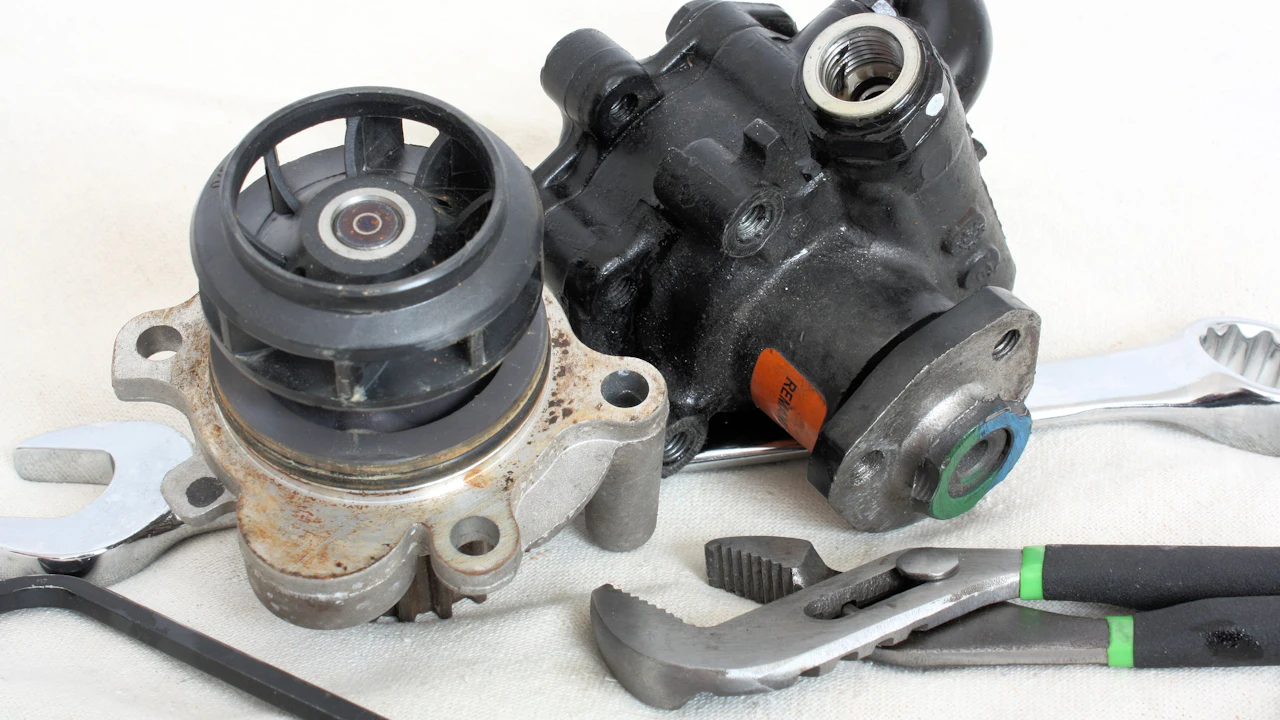
A water pump is a centrifugal pump and a simple one. An impeller sits on a short shaft. The shaft runs in a bearing. The impeller lives in a cavity in the housing, and when it spins it flings coolant outward and away, which draws more coolant in behind it. That is the entire mechanism. There are no valves, no timing, nothing to adjust.
Being precise about what the pump is and is not responsible for matters here, because the two get run together constantly. The pump creates flow. It does not create the system pressure. That pressure comes from coolant expanding as it heats in a sealed circuit, held in by the cap, and it exists to raise the boiling point of the coolant so that the engine can run hot enough to be efficient. A pump with a wrecked impeller can leave the system fully pressurised, fully topped up and completely stagnant, and that combination is exactly why the failure is missed.
Flow matters because coolant does nothing useful standing still. Heat moves out of the metal into the coolant, and the coolant then has to physically carry that heat to the radiator and come back. Slow the circulation and the coolant in the hottest passages — around the exhaust valve seats, between the cylinders — sits there absorbing heat until it boils locally, and a pocket of vapour transfers almost no heat at all. Local boiling in a system that reads as full is one of the more destructive things that can happen inside an engine and it produces no external evidence whatsoever.
There is a design compromise built into every mechanically driven pump that is worth understanding, because it explains a symptom later on. If the pump is turned by the engine, its speed is tied to engine speed. At a standstill in traffic the engine is turning slowly, so the pump is moving the least coolant it will ever move — which is also the moment when there is no air passing through the radiator except what the fan provides. At sustained speed the situation inverts: air is abundant, but the engine is producing its maximum heat and the pump has to keep up. A pump that has lost some of its capacity will usually cope with one of those conditions and fail at the other.
Where the pump physically sits varies more than most people expect. On a longitudinal engine it is commonly at the front, on the centre line, behind the pulley and the fan, and it is visible with the bonnet up. On a transverse engine it is at one end of the block, tucked towards a wing, often behind the accessory drive or behind the timing cover, and frequently invisible without removing something. On a number of vee engines it lives in the valley between the banks, under the intake manifold, driven off the chain — a position that is excellent for packaging and appalling for anybody who has to replace it.
The impeller itself is worth a sentence, because it is a real variable. Some are stamped steel, some are cast iron, some are aluminium, and a great many are moulded composite. The composite ones are lighter, quieter and cheaper to make, and they are the ones that erode at the vane tips or, occasionally, work loose on the shaft and start turning less than the shaft does. A loose composite impeller is the classic silent failure, and you cannot see any of this from outside the housing.
What turns the pump, and what each arrangement does to the job
Here is the spine of the subject. Everything expensive about this repair follows from what has to be dismantled to reach the pump, and that is decided entirely by the drive.
Driven by the accessory belt
The friendliest version. The pump has a conventional pulley on the outside of the engine, turned by the same ribbed belt that runs the alternator and the rest of the accessories. Reaching it means draining the coolant, releasing the belt, unbolting the pulley and then the pump, cleaning the mating face properly, fitting a new gasket or O-ring, refitting, refilling and bleeding the system.
Everything on that list is front-of-engine work, and none of it requires disturbing anything that has to be timed. It is the shortest version of this job by a wide margin. The variables that remain are access ones: on a crowded transverse bay the belt itself may sit behind a wheel arch liner and, on some cars, an engine mount that has to be supported and dropped. That access work is shared with any other job on the same drive, which is the argument our guide to what the accessory belt actually drives makes at length from the belt’s side of the problem.
Two consequences of this layout matter beyond the invoice. The first is that if the belt goes, circulation stops immediately — the same failure that would merely strand a car on a different engine starts a clock on this one. The second is a fitting detail that catches people out: on some routings the pump is turned by the smooth back face of the belt rather than the ribbed side, which means it rotates the opposite way to the accessories. Pumps for those engines have impellers designed for that direction, and a superficially identical part fitted the wrong way round will circulate coolant badly while looking entirely correct.
Driven by the timing belt
Now the arrangement that produces the quotes people refuse to believe, which turns out to be perfectly logical once you have seen why.
Here the pump does not have a pulley on the outside of the engine at all. It has a toothed sprocket, it sits behind the timing covers, and it is turned by the same belt that drives the camshafts. Sometimes it does more than that: on a number of engines the pump body is what the belt tensioner bears against, so the belt tension is set by rotating the pump in its bore.
The practical consequence is unavoidable. To touch the pump you have to take the covers off and get the timing belt off, and getting a timing belt off and back on correctly is the job in its entirety. The pump is then a few bolts at the end of it. So the labour on this repair is not water pump labour. It is timing belt labour with a pump fitted while everything is open.
Which produces the rule that governs this whole layout: on these engines the pump and the belt kit are replaced together, and any competent workshop will quote them together. The logic runs in both directions and it is worth spelling out, because owners regularly try to economise in one direction or the other.
Fit the pump alone and you have removed a belt that has already done whatever mileage it has done, and put the same belt back. The part cost you saved is trivial. The exposure you accepted is that if the belt goes, you pay the entire access job a second time. Fit the belt alone and you have paid for full access to a pump you then chose not to touch, and left an original component with a bearing and a seal in the one place nobody will look again until the next belt service. Neither version is dishonest and both get done. Both are expensive in a way that only becomes visible later.
Everything above is about reaching the pump, which is where this page’s interest in timing belts begins and ends. The belt has its own considerations that have nothing to do with coolant, and they are dealt with on their own terms elsewhere on the site.
Driven by the timing chain
A chain-driven pump sounds like it should be cheaper than a belt-driven one, and on the individual repair it is usually the reverse. The reason is not mechanical. It is scheduling.
A timing belt has a service interval, which means there is a planned occasion on which the covers come off anyway, and a pump fitted during that occasion costs almost nothing in additional labour. A chain has no such occasion. Nobody is ever going to be in there for another reason, so when the pump fails, the entire disassembly exists solely to reach the pump and every hour of it lands on that one repair.
The disassembly is often heavier, too. Chain covers are large, they frequently carry the crankshaft seal, and on many engines they are sealed with an anaerobic compound rather than a gasket — which means the mating faces have to be scraped and cleaned properly and re-sealed properly, and a rushed job here produces an oil leak from the front of the engine that was not there before. Where the pump lives inside the timing case or in the valley of a vee, add whatever has to come off to reach that: an intake manifold, brackets, occasionally the accessory drive entirely.
The buying consequence is straightforward and slightly counter-intuitive. A chain engine is often described as the lower-maintenance choice, and on the timing drive itself that is a defensible claim. On the water pump specifically, it is not. The chain engine has a pump that is just as mortal and considerably more awkward, with no scheduled visit during which to deal with it cheaply.
Electric pumps
An electric pump replaces the mechanical drive entirely: a motor and an impeller in one housing, plumbed into the coolant circuit and controlled by the engine management. Some engines use one as the main pump. Many more use a small auxiliary electric pump alongside a mechanical one, to keep coolant moving through a turbocharger after shutdown, or to feed the heater core when the engine is not running.
The engineering reason is that decoupling flow from engine speed is genuinely useful. The management can slow or stop circulation during warm-up so the engine reaches temperature faster, increase flow under load without waiting for revs, and keep running after the key is out to soak heat out of components that would otherwise cook.
What matters to an owner is that the failure profile changes completely. There is no belt to shed, no pulley to wobble and, on a sealed unit, often no weep hole to inspect. What there is instead is an electrical component with a connector, a supply, a control strategy and a place in the diagnostic system. It can fail silently and completely, and when it does the car will usually know: a coolant temperature that behaves oddly, a warm-up curve that is wrong, an overheating condition arriving with a stored fault code rather than with a noise. Diagnosis is a scan tool and a look at what the module commanded against what happened, not a hand on a shaft.
Two practical notes follow. The part is typically a larger share of the bill and the labour a smaller one, which inverts the usual arithmetic. And an auxiliary pump failing produces a symptom that reads as something else entirely — most commonly heat that disappears at a standstill on a car whose engine is perfectly warm, which is very easily filed under a thermostat or a blend flap and is not either of those things.
The hole in the bottom of the pump, and what a stain around it means
This is the part of the page that repays reading most closely, and it is very rarely explained anywhere, so it gets done properly here.
Look at a conventional mechanical pump and there is a small drilled hole through the underside of the housing, between the pulley and the impeller cavity. Various names attach to it — weep hole, vent hole, telltale hole — and they all describe the same thing. It is deliberate. It was designed in.
The reason it exists is a sequencing problem. The pump shaft has coolant on one end and a bearing on the other, and between them sits a mechanical face seal: two very flat faces held together, one turning with the shaft and one fixed in the housing. That seal is a wear item. It is doing an unreasonable job — sealing a liquid across a spinning shaft, through thousands of heat cycles, in a fluid whose corrosion inhibitors deplete over time — and eventually it starts to pass.
If there were no hole, the coolant that got past the seal would have exactly one place to go: into the bearing cavity. It would wash the grease out, corrode the races, and the bearing would fail. That failure is fast, it is loud only briefly, and at the end of it the shaft has play, the impeller can contact the housing, and on a timing-belt-driven pump a seized bearing takes the belt with it.
The hole prevents that sequence. It gives seal leakage a path to atmosphere at the lowest point of the housing, so the coolant runs out onto the block and the bearing survives. That is why the hole is not a fault and why finding it wet does not mean somebody drilled through your engine.
Because the hole exists, the pump gives you something no other cooling component does: a designed-in telltale that reports on the condition of a seal you cannot see. Reading it is a matter of knowing what each state means.
| What you find | What it means | What to do with it |
|---|---|---|
| Clean and dry, housing dry below it | Nothing to report today. The seal is doing its job, or the evidence has been washed off | Note it and move on, but treat a suspiciously clean engine bay as an absence of evidence rather than a good result |
| A dry, crusted, coloured trail running down from the hole | The most common and most missed finding. The seal has been passing coolant; the water evaporated off the hot housing and left the additive package behind as crust | The pump is on notice. This is a finding to price in, and on a belt-driven engine it is the trigger for the whole conversation about timing |
| Actively wet with the engine warm and the system pressurised | The seal is passing now, at working pressure | Treat as a live leak with a limited future. Coolant loss with an engine that runs hot is not a wait-and-see item |
| The hole itself packed solid with dried deposit | Worse than wet, not better. The escape path has closed and the coolant that gets past the seal now has nowhere to go but the bearing | Assume the seal has been leaking for a long time and the bearing has been drinking it |
| Wet with oil rather than coolant | On layouts where the pump bolts to a cover that also carries oil, this is a different fault at the same location | Establish which fluid before pricing anything. Our guide to identifying what is on the ground and where it came from separates them |
Two honest limits on all of that. A weep hole can only report on the seal, so a pump with a corroded or loosened impeller passes this inspection perfectly while being finished internally. And a seal that leaks only when hot and pressurised will show nothing on a cold engine in a car park, which is one more reason a cold static check is a screen rather than a verdict.
There is also a trap in the other direction, and it catches careful people. A weeping seal sometimes appears to heal itself, because the deposit left behind by evaporating coolant builds up in the leak path and temporarily plugs it. The leak stops. The stain stays. An owner who noticed the drip, watched it stop and concluded the problem went away has in fact watched a failing seal accumulate scale, and the crust trail on the block is the record of it.
How a pump announces itself, in the order you are likely to meet them
The pump has an unusual property among engine components: its failure modes have almost nothing in common with each other. One leaks, one is noisy, one does neither, and the last one is not a symptom of the pump at all but a consequence of having ignored the first three.
Weeping from the vent hole
Covered above, and worth naming as the first symptom in most pumps’ lives rather than the last. It is the earliest, cheapest, most actionable evidence available and it requires nothing but a torch and knowing where to point it.
Bearing noise
A dry pump bearing growls, or whines, the note climbing and falling with engine speed and staying entirely deaf to whatever you switch on. That deafness is the useful property, because it separates a bearing from a belt that is slipping. Slip answers to load. A bearing answers only to revolutions.
What it does not separate is which bearing. On an accessory-driven pump the noise sits in a crowd of other candidates — the tensioner pulley, the idlers, the alternator — all turning at similar speeds within a few inches of each other. Pinning it down takes a stethoscope and a practised ear, and the full catalogue of noises that drive can make belongs to our page on the accessory belt and what it turns. What matters here is risk rather than identification. An audible bearing at the front of an engine has started down the road to seizing, and when it arrives it will destroy whatever belt is wrapped around it.
On a timing-belt-driven pump the same noise carries a different weight entirely, because the belt it can destroy is the one that keeps the camshafts in step with the crankshaft. A growl from behind the timing cover is not a noise to live with for a few weeks.
Play in the pulley
With the engine off, cold, and the belt released, a pump pulley should sit perfectly rigid on its shaft and turn smoothly with no roughness in it. Grip it top and bottom and try to rock it. Any movement you can feel means the bearing has gone, which makes this one of the small handful of checks on a car that returns a straight yes or no with nothing left to interpret.
Note the asymmetry this creates for a buyer. On an accessory-driven pump the check is available, at least to a mechanic on a lift with a few minutes. On a timing-belt or chain-driven pump it is not available at all without opening the cover, which is precisely the labour the whole job is about. The engines where the pump is most expensive to replace are the engines where its condition is least knowable in advance.
Coolant loss with nothing on the ground
This is the case that generates the most wasted money, because the obvious diagnostic step returns nothing. The level drops, the owner tops it up, and there is no puddle anywhere. A driveway is checked. A cardboard sheet is left out overnight. Nothing.
Several things produce that picture and only some of them are the pump. Coolant escaping onto a hot surface evaporates before it can drip. A heater core leaks inside the car and never reaches the road at all. A cap that no longer holds pressure vents coolant as vapour. And a leak that goes inwards, into a cylinder or into the oil, leaves nothing outside the engine to find, by definition. Establishing which is a process, and it belongs to our guide to what a car that overheats is actually telling you, which sets out the tests in the order that costs least.
The pump’s specific contribution to this list is worth isolating, though. A pump that weeps onto a warm block in small quantities can lose a meaningful amount of coolant over months without ever producing a drip on the floor, and on the engines where the pump is behind a cover, the crust trail that would have given it away is behind that cover too. Coolant that is going somewhere, on a car whose pump is not visible, is a specific reason to get it on a lift rather than to keep topping it up.
Overheating, which arrives last
Overheating is where most people meet this component, and by then the useful decisions have already been made or missed. It is worth saying plainly that a pump does not usually fail suddenly from perfect health. It weeps, or it whines, or it quietly loses impeller efficiency, for a long time before it produces a temperature reading anybody notices.
The version that skips the warnings is impeller failure, and it is the reason this component gets diagnosed late. A pump with eroded vanes, or an impeller slipping on its shaft, is silent, dry and outwardly immaculate. It moves enough coolant at low engine speed to keep a car happy in town, and not enough at sustained speed to keep up with the heat the engine is making. The car overheats on a long run with a completely full cooling system, which is a combination that sends people looking at radiators and thermostats first.
What to do in the minutes after a gauge starts climbing is a subject with real consequences and it is dealt with properly on the overheating page rather than summarised here. The short version relevant to this page is that the damage done by continuing is what turns a pump into an engine, and that is the entire difference between the two invoices.
The coolant that killed the pump
One mechanism connects the pump’s life directly to the maintenance record, and it is worth carrying into a viewing. Coolant does considerably more than stop the water freezing. The additives blended into it are there to inhibit corrosion, they have a finite working life, and once they are spent the fluid turns mildly acidic and begins attacking the metals it was supposed to protect. Pump seals and impellers are on that list.
The related mechanism is cavitation. Coolant that has lost its inhibitors, or a system that has been run low or with an ineffective cap, allows vapour bubbles to form at the low-pressure side of the impeller vanes and collapse violently against them. Those collapses erode metal, which is why a pump recovered from a neglected system sometimes has vanes that look chewed rather than worn. Neither mechanism is visible at a viewing. Both are inferable from a service history that has no coolant change in it, which is why our guide to which maintenance items on a used car are worth the money treats coolant as one of the omissions that costs real money later.
Why the pump is not fitted on its own
An invoice for a water pump that lists only a water pump is unusual, and the additions are less negotiable than they look.
The coolant. It has to come out to do the job, and it is not going back in. Old coolant recovered from a drain pan carries whatever was in the system plus whatever it picked up on the way out, and its inhibitor package has already done however many years it has done. New coolant is not an upsell. It is a consumable consumed by the repair, and its cost is a function of what the car specifies, which is not always the cheapest thing on the shelf.
The thermostat. This one is a judgement call that almost always goes the same way, and the reasoning is about risk rather than wear. The thermostat is a mechanical valve in the same circuit, frequently within inches of the pump and sometimes in the pump housing itself. It is inexpensive. It has a finite life. And its failure produces the same headline symptom the customer has just paid to eliminate.
Consider what happens if it is skipped and then fails a few months later. The system is drained again, the front of the engine is opened again, the labour is paid again, and the customer — entirely reasonably — believes the original repair was botched. The asymmetry is stark: including the part costs the price of the part, and excluding it risks the price of the whole visit. That is why it goes on.
The gasket or seal. Not optional in any sense. The pump seals to the block or the cover with a gasket, an O-ring or a bead of sealant depending on the engine, and the mating faces have to be cleaned back properly. A pump fitted onto a face that was scraped in a hurry leaks from the joint, and the joint is inside the same disassembly the whole job was about.
The bleed. This is the part that has no visible presence on an invoice and does most of the damage when it is rushed. Modern cooling systems are not simple loops; they have heater circuits, expansion tanks, turbo feeds and high points where air collects, and many of them require a specific filling procedure, sometimes with a vacuum filler, sometimes with bleed screws opened in a defined order. An air pocket left in the system is an insulating void that carries no heat, and it produces the two classic post-repair complaints: the heater that has gone lukewarm, and the temperature that creeps up on the drive home. A car that overheats shortly after a pump job has very often not had a pump failure. It has had a fill failure.
“While it is apart”: when the argument is real
Every repair with substantial access labour attracts a list of additional parts justified on the grounds that everything is already open. Sometimes that is the most sensible advice in the trade. Sometimes it is a list. The way to tell them apart is not to guess at the shop’s motives but to apply three questions, and they work on any repair rather than just this one.
- Does the extra part come out of the same disassembly? If reaching it requires nothing beyond what is already being removed, the marginal labour is minutes and the case starts strong. If it needs a separate teardown, the argument is just a bundle.
- If the extra part failed later, would this same access job have to be repeated? This is the question that carries the most weight, because it converts the decision from a comparison of parts into a comparison of labour. A cheap part whose failure repeats an expensive access job should almost always be replaced now.
- Is its remaining life shorter than the interval until somebody is next in here? On an engine where nobody has a scheduled reason to open the timing cover for years, a component with less life than that has effectively been condemned by the calendar.
Run the usual additions through those questions and they sort themselves cleanly.
On a timing-belt-driven pump, the belt, the tensioner and the idlers score yes on all three, decisively. They come out in the same operation, their failure repeats the entire job, and nobody is opening that cover again for a long time. This is the strongest “while it is apart” case on a modern car, and a quote that leaves any of them out is the quote to query.
The thermostat scores yes on the first two, as set out above. Fresh coolant is not a candidate at all, because it is consumed rather than added. A new pressure cap is cheap, holds the pressure that keeps the whole system from boiling, and is a reasonable inclusion on any car old enough to be having this work done.
Radiator hoses on an elderly car are defensible without being compelling. The system is drained, so the messy part is already done, and hardened rubber at the clamped ends is a genuine end-of-life indicator. But a hose can be changed later at the cost of a partial drain rather than a full one, so this belongs in the category of a fair recommendation rather than a necessary one, and the honest version of it is offered with a reason attached: somebody looked at the hoses and did not like them.
A radiator, on the other hand, is where the argument gets thin. It is not in the way, it does not share the disassembly beyond the drain, and its failure does not repeat the pump job. Recommending one is fine if there is evidence — a stained seam, a damaged core, cold patches across a hot face — and the right response is simply to ask what the evidence was. On an accessory-belt engine, replacing an old serpentine belt while it is off is a reasonable inclusion by the same logic, and it is the same argument the belt page makes from the other end.
For a used-car buyer this framework has a second use, which is reading somebody else’s invoice. A receipt that names the belt, the tensioner, the idlers, the pump and the coolant is a receipt for a job that somebody thought about. A receipt naming a belt alone is a receipt for a belt. Neither settles anything on its own, but between two otherwise similar cars, the first document is a far better guide to how the vehicle has been looked after than any quantity of oil-change stamps.
What actually moves the number
Set the part aside; on most cars it is the smallest line on the invoice. What follows is what the bill is really made of, and nearly all of it is establishable on a specific vehicle before anybody starts.
| What varies | What it does to the job | How to settle it on a specific car |
|---|---|---|
| What drives the pump | The single biggest factor by a distance. It decides whether this is front-of-engine work or a timing drive removal | The manual, a franchised parts department, or the belt route with the bonnet up. Establish it before comparing any quotes |
| Whether the timing service is due anyway | On a belt engine, a pump fitted during a belt service costs the part and minutes. The same pump fitted alone costs the whole belt job | Check the service history for a belt date and mileage, then work out where the car sits relative to it |
| Where the pump physically sits | Bolted to the outside of the block is one thing. Inside the timing case or in the valley of a vee, under an intake manifold, is another | Ask what has to come off. A shop that answers in specifics has done the engine before |
| How the cover is sealed | A gasket goes back. An anaerobic sealant means scraping, cleaning and re-sealing two large faces, and a rushed job leaves an oil leak | Ask whether the front cover is disturbed and how it is sealed |
| What has to be moved first | Engine mounts supported and dropped, wheel arch liners out, brackets and pipes off. On crowded bays this is the job rather than a preliminary | Ask what the quoted labour actually covers, item by item |
| The filling procedure | A gravity refill on a simple system is quick. A vacuum fill or a defined bleed sequence is real time, and skipping it produces a comeback | Ask how the system is bled. Any shop that does this engine regularly will answer immediately |
| What coolant the car specifies | Specification is set by the manufacturer, not chosen by the shop, and the required fluid is not always the cheap one | The manual or the cap. Mixing chemistries is a false economy with a long tail |
| Mechanical or electric | Inverts the arithmetic. Electric units are usually a larger share of parts and a smaller share of labour, and diagnosis is a scan tool rather than a hand test | Establish whether the car has a belt-driven pump at all before assuming a labour-heavy job |
| Whether it was caught early or ran on | A pump replaced on a weep is a pump. A pump replaced after the engine overheated may not be the end of the bill | Ask what the temperature gauge did, and whether it was driven afterwards |
Read down that last column and notice how few of those questions a workshop has any reason to dodge, and how many an owner can settle without help. That is the argument against publishing a span of figures. A span conceals the one thing that matters, which is the end of it your car belongs to, and here those two ends are not even in the same conversation.
What the public safety archives will and will not support
Two independent datasets brush against this subject. Neither measures the thing a reader instinctively wants measured, and both are worth using anyway, carefully.
The first is the complaint archive. When an owner files a safety complaint with the federal road safety regulator, the intake record sometimes captures what the odometer read that day. Sorted by component category, engine and engine cooling holds 97 of those readings and their midpoint sits at 98,000 miles. That is the highest of all fifteen categories, set against a midpoint of 60,000 across the entire archive. The plain engine category, the biggest group in the file at 200 readings, comes in at 58,000.
That figure is not a water pump lifespan
It is not close to being one, and the gap matters. There is no water pump category in that archive; there is a broad cooling heading that a pump shares with radiators, hoses, thermostats, fans and housings, and nothing in the record separates them. Each reading came from an owner who had reached the point of writing to a safety regulator, which happens a long way downstream of a part beginning to weep. A pump that seeps quietly for two years before anyone notices contributes nothing to the file until the day it produces something frightening. Then add the censoring described in the note above, which bites hardest at exactly the high end where this figure sits. The honest reading is narrow: cooling trouble reaches the threshold of a federal complaint later than anything else in the archive. That is a statement about sequence, and it is the only statement this data supports.
Sequence is still worth something to a buyer, and here is why. If cooling complaints arrive last in the ordering — later than the electrical system, later than brakes, later than the engine heading itself, later even than the fuel system at 89,000 — then this is a class of fault that lands on a second or third owner rather than the first. Which is to say it lands on the person reading this page. The car being viewed is somewhere in that band, its cooling system has been quietly ageing for its whole life, and none of that ageing appears anywhere in a service folder.
The second archive is the recall record, and it earns a mention here for one specific reason.
NHTSA files each campaign against a colon-delimited component path, and the engine and engine cooling family in our archive holds eight campaigns drawn from four manufacturers. Four part paths are recorded beneath it. One names an exhaust gas recirculation valve, with two campaigns. One is the bare heading COOLING SYSTEM, with two. One is ENGINE, with one. And one is COOLING SYSTEM:PUMP, with a single campaign against it.
That last entry is small and it is the point. The regulator’s own component vocabulary carries a node for the pump specifically, and a manufacturer has conceded a defect under it. This is a component that has been the subject of a safety recall, not merely of owner grumbling, and the remedy for a campaign is carried out at a franchised dealer for nothing, however long the queue of previous owners. The lookup takes a couple of minutes against the registration or the VIN. Do it before paying anybody to diagnose a cooling fault, because the answer occasionally makes the diagnosis somebody else’s expense.
At a viewing: what is actually knowable
Cooling systems are among the hardest things on a car to assess from a car park, and the pump is the hardest part of the cooling system. You cannot see the impeller, you cannot hear a seal, and a gentle twenty-minute test drive is precisely the condition under which a marginal pump performs perfectly. So the useful checks here are indirect, and the most valuable one involves no tools at all.
Establish the drive type first
Before anything mechanical, settle which of the arrangements above this engine uses. It reframes everything else you find. On a belt-driven engine the pump is a scheduled item riding on a service you can ask about and price. On a chain engine it is an unscheduled event with no natural moment attached. On an accessory-belt engine it is comparatively cheap and comparatively inspectable. On an electric pump it is a different sort of component altogether.
The answer is usually a couple of minutes of looking: the manual, a franchised parts department given the engine code, or the belt route with the bonnet up. It is the single highest-value fact you can carry away from a viewing, and it costs nothing.
Static checks, on an engine nobody has run today
- The expansion tank. Level against the marks, and the state of what is in it. Rusty, milky or sludgy contents are a finding about the whole system rather than the pump, and what each of those appearances implies is set out in the overheating guide linked above.
- Find the pump if the engine lets you. On an accessory-driven layout it is often visible with a torch. Look for the weep hole and read it against the table above. A coloured crust trail on the block below the pump is worth more than anything the seller will tell you.
- Look at the joint as well as the hole. A stain following the outline of the pump housing rather than running from the hole is a gasket rather than a seal, which is the same repair but a different story about how it got there.
- Feel underneath with the back of a hand and look at what comes off. Slippery and coloured, rinsing off with water, is coolant. Slick and stubborn is oil.
- Check the ground and the undertray. Most modern cars carry a full-width tray that catches coolant and holds it for months, which is why a clean parking space is much weaker evidence than it feels. What a puddle and its position can tell you is covered in our guide to reading a leak by where it lands.
- Note whether the bay has just been washed. A pressure-washed engine bay is not proof of anything, but a crust trail is exactly the sort of evidence a wash removes, and its absence on a freshly cleaned engine proves nothing at all.
With it running
- Listen to the first few seconds of a cold start, before the bay warms and before anybody starts talking. Bearing noise is at its most audible then.
- Listen for what ignores the switches. Turn things on and off while it idles. Anything that tracks engine speed while remaining indifferent to load is a bearing rather than a belt, and that is the finding worth writing down.
- Let it reach temperature and check the heater. Poor heat at idle on a fully warm engine can mean several things, most of which are not the pump, and the overheating page sorts them. It belongs on the list because it is one of the few flow symptoms available at a standstill.
- Drive it in both conditions. A route that mixes a long steady stretch with some stop-start crawling puts both halves of the cooling system to work. A test drive offering only one of those conditions has left the other half unexamined.
- Look again afterwards. Some seals only pass once everything is hot and the system is at pressure. A second look under the bonnet at the end of the drive occasionally finds what the first look missed.
None of that adds up to a diagnosis, nor is it meant to. All it settles is whether the cooling system deserves a specific instruction on the brief you hand to an independent pre-purchase inspection. A lift, a pressure test and ten minutes with a stethoscope will resolve in one visit what a person standing beside a wing can only wonder about, and on any car whose pump lives behind a cover that inspection is doing work you have no way of doing yourself.
The receipt that shows a belt and no pump
This is the specific check this page was built to hand you, and it takes one question.
On an engine whose pump is turned by the timing belt, a belt service is the single moment in that car’s life when the pump is cheap. Everything is off. The pump is a few bolts and a gasket. A shop that has the covers open and does not fit one has left the most awkward component on the engine in place at the exact moment it was easy.
So when a seller produces paperwork for a timing belt, read what is actually on it. If there is a belt, a tensioner, idlers, a water pump and coolant, that is a job done properly and it is a real point in the car’s favour. If there is a belt and nothing else, ask.
There are only a few explanations, and they are not equally comfortable.
- This engine’s pump is not on the timing belt. Entirely possible, and it settles the question rather than raising one. It is also why establishing the drive type comes first: without it you cannot tell whether the gap on the invoice means anything at all.
- The pump was inspected and left. A defensible decision on a low-mileage engine with a pump that showed nothing, and some good shops make it. What it means for you is that the pump behind that cover now carries the age of the belt job plus everything since, and the next scheduled occasion on which anybody looks at it is a long way off.
- It was quoted and declined. The most common version by a distance, and nobody in it behaved badly. A customer looked at a number, took the part off the list, and drove away with a new belt. The saving was real and it was borrowed against the future.
- It was never offered. Which says something about where the work was done, and by extension about the rest of the folder.
Every one of those except the first leaves the same object in the same place: an original pump, with an original seal and an original bearing, behind a cover that has just been closed. If it gives up before the next belt service, the labour somebody has already bought once gets bought again, by whoever holds the keys at the time.
Where the folder is thin, or missing, the documented history is the substitute for it. Spend two minutes to check what the car’s recorded past actually contains before taking anybody’s word for the work this engine has supposedly had.
The question, and how to ask it
“Was the water pump done at the same time as the belt?” That is the whole thing. Then ask to see the invoice rather than arguing about a recollection: the paperwork for this job either names a pump or it does not, and thirty seconds of reading beats ten minutes of discussion. An owner who had both done tends to know it, because the number was larger. An owner who is unsure is giving you the honest answer, which is that nobody explained it to them either. Neither response is a reason to leave. Both are a reason to price an original pump behind a closed cover into what you offer.
The inverse turns up occasionally and deserves the same attention. A car with a recent water pump and no timing belt on an engine that uses one is the same problem the other way round: a pump failed early, the belt kit was declined, and a used belt has been off and back on. And a pump replaced at an unusually low mileage on any engine is worth one more question, which is whether it was fitted as maintenance or as a consequence. A pump renewed after an overheating event sits in a different story entirely, and what that event may have left behind in the engine is the subject of the overheating guide rather than this one.
Putting it into the decision
None of this turns a water pump into a reason to reject a car. It is a known component with a known failure pattern, it is not open-ended in the way a transmission or a cylinder head is, and every car with a mechanical pump will need one sooner or later. Refusing a vehicle over it would be an odd way to shop.
What it offers instead is a rare thing: a repair whose cost is largely predictable in advance, from facts you can establish before you buy. Very few items on a used car work that way. Most of them depend on how the car was driven, which you cannot know. This one depends mostly on how the engine was designed, which is a matter of record.
- Establish what drives the pump before you look at anything else. It reframes every other finding on this list.
- Find the weep hole if the layout allows, and read the crust rather than looking for a drip.
- On a belt-driven engine, find out when the belt was last done and whether the pump went with it. Ask for the invoice.
- Treat coolant loss with nothing on the ground as a reason to get underneath, not a reason to keep topping up.
- Listen to a genuine cold start, and listen for the noise that ignores every switch you press.
- Check the service history for a coolant change. Its absence is the mechanism behind half of what goes wrong in here.
- Put the cooling system on the inspection brief explicitly, especially on any engine whose pump sits behind a cover.
- Check for open recalls against the VIN before paying anyone to diagnose a cooling fault.
Keep the whole thing in proportion at the end. A pump is a bounded, foreseeable cost, and the point of understanding it is not the pump. It is that the same fact which decides the pump’s price — what is behind the timing cover, and when anybody was last in there — decides a good deal else about what the next few years of that car will cost. An engine whose front end has been opened, inspected and put back properly is a different proposition from one that has never been opened at all, and the difference does not show up in the mileage.
The costs with no upper bound are never the consumables. They are the things that happened to this particular car before you set eyes on it, and a pump housing keeps no memory of any of them. That history lives in paperwork and databases, so it is worth the few minutes it takes to pull the record filed against the vehicle’s number before a price is agreed. A shunt that flattened a radiator and bent a cooler line does not reliably find its way into a service folder, and the steady, unglamorous care that keeps a cooling system honest — the same discipline our guide to oil change intervals on a used car argues for on the lubrication side — is not a thing a seller can demonstrate by pointing at a clean engine bay.
Common questions
How do I find out whether my water pump is driven by the timing belt?
Three routes, in order of speed. The owner’s manual or the workshop data for the engine will say so directly. A franchised parts department, given the engine code, can answer it in seconds because the parts catalogue is organised around exactly this distinction. Failing both, open the bonnet and trace the accessory belt: if you can see a pump pulley on that belt, the pump is on the accessory drive; if the belt runs the alternator and the compressor and there is no pump anywhere on it, the pump is behind the timing cover and you need to establish whether that cover contains a belt or a chain. It is worth the effort, because every price you are about to be quoted depends on the answer.
There is a dried coloured stain under my water pump. How urgent is that?
It means the shaft seal has been passing coolant and the small hole under the housing has been doing its job of routing the leak outside instead of into the bearing. It is not an emergency and it is not something to leave indefinitely either. A weeping seal does not repair itself, the loss tends to increase, and coolant escaping past the seal is coolant that eventually finds the bearing once the hole clogs with deposit. Treat it as a repair to plan rather than a repair to rush — and on an engine whose pump rides the timing belt, treat it as the moment to work out where the car stands relative to its belt service, because those two decisions belong together.
Should the water pump always be replaced with the timing belt?
Where the belt drives the pump, the case is close to overwhelming, and the reason is labour rather than wear. Reaching the pump requires the entire belt job, so fitting one during that job costs the part and a few extra minutes, while fitting one later costs the whole access a second time. The pump also has a bearing and a seal sitting behind a cover nobody will open again until the next belt service, which means declining it is a decision to run that pump for a full further interval unseen. On an engine where the pump is not on the timing belt, the argument disappears entirely — there is nothing shared, and bundling them would just be a bundle.
Can I keep driving with a failing water pump?
It depends which failure it is having, and the honest answer is that you usually cannot tell from the driver’s seat. A seal that weeps a little is a repair to book rather than a car to abandon, provided the level is checked frequently and topped up. A bearing that has become audible is different: it has started down the road to seizing, and when it gets there it will take out whatever belt is wrapped around it — which on a timing-belt-driven pump is a far more serious event than a cooling failure. If the temperature gauge has started to move at all, the argument is over. Continuing is what converts a pump into a cylinder head, and that conversion is measured in minutes of running rather than in distance covered.
Why does replacing a water pump also mean a thermostat and new coolant?
The coolant has to be drained to do the work and it is not worth putting back, so new fluid is consumed by the repair rather than added to it. The thermostat is a separate calculation and it comes out the same way almost every time: it is a cheap mechanical valve in the same circuit, it has a finite life, and if it fails a few months later the system is drained again, the same area is opened again and the same labour is paid again — while the customer quite reasonably concludes the first repair was botched. Including it costs the price of a small part. Excluding it risks the price of the whole visit.
What changes if the car has an electric water pump?
Most of your assumptions. There is no belt to shed, no pulley to test for play, and frequently no weep hole to inspect, so the free physical checks that work on a mechanical pump have nothing to act on. Instead the pump is an electrical component with a connector, a supply and a control strategy, which means it can fail abruptly and silently and will generally announce itself through the diagnostic system rather than through a noise. The cost profile inverts too: the part tends to be a larger share of the bill and the labour a smaller one. Note also that many cars with a conventional mechanical pump also carry a small auxiliary electric one, and when that fails the symptom is usually heat disappearing at a standstill rather than anything resembling overheating.
What does federal complaint data actually tell me about water pumps?
Nothing about pumps specifically, and that is worth stating rather than glossing. There is no water pump heading in that archive; there is a broad engine and engine cooling category that a pump shares with radiators, hoses, thermostats and fans, and nothing separates them. What the file does show is where that category falls relative to the others: 97 readings with a midpoint of 98,000 miles, the latest of all fifteen categories, where the archive taken as a whole sits at 60,000. Every entry is a mileage at which an owner wrote to a federal safety regulator, which happens a great deal later than a part beginning to fail, and because the sample stops short at the high end the real midpoint is a floor rather than an estimate. Used as a lifespan it is meaningless. Used as a statement about sequence — cooling trouble surfaces late, on a later owner’s watch — it is genuinely useful to somebody deciding what to inspect.
Sources and further reading
- NHTSA Office of Defects Investigation complaint database
- NHTSA recall lookup
- FTC used car buying guide
Recall, complaint and safety-rating figures on this page were retrieved from the federal databases above on August 19, 2026. Federal data changes — re-check any VIN before you rely on it.
Published August 28, 2026 · last updated August 28, 2026. Found something out of date or wrong? Tell us and we will correct it.