Lendbuzz Review: No-Credit Car Loans, Rates, Terms and Record
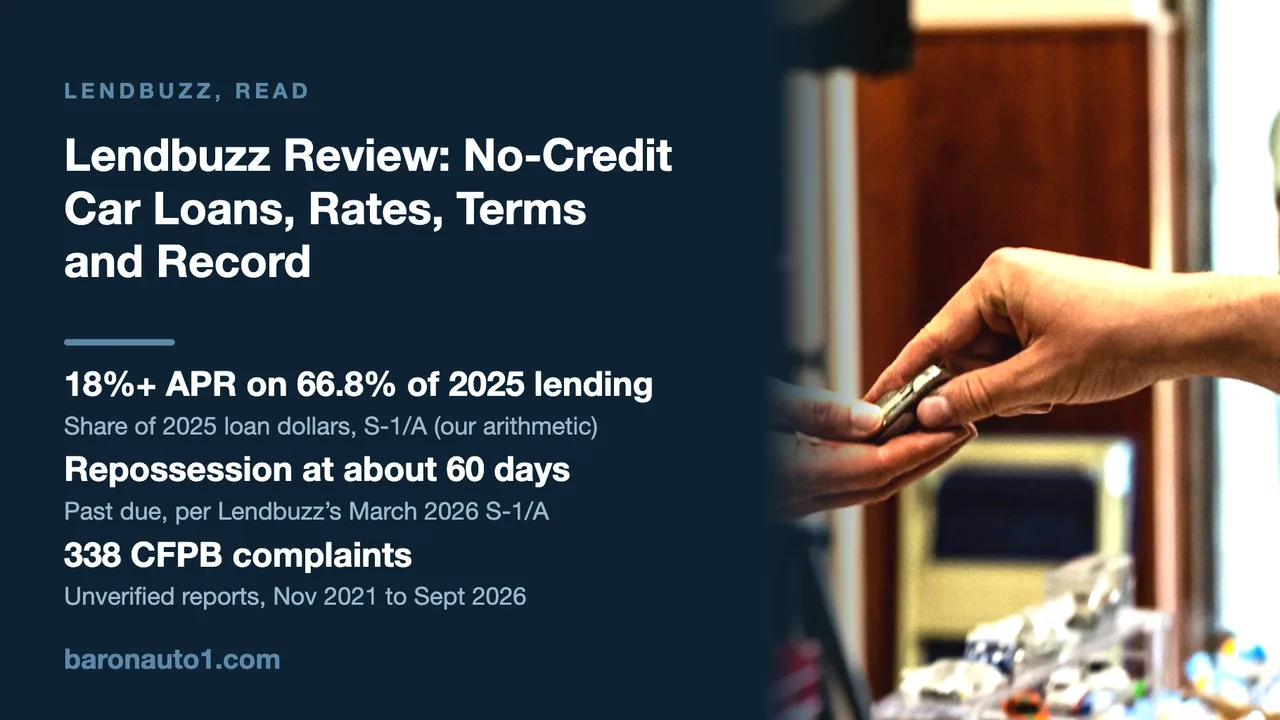
Lendbuzz Funding lends at the dealer to borrowers with thin or no US credit, including ITIN holders. Its March 2026 IPO filing puts 66.8% of 2025 lending at 18% APR or more and 67.3% on 72-month terms, with repossession around 60 days late. Its arbitration terms, two state licensing orders and 338 CFPB complaints.
The short version
- Lendbuzz lends to people with thin or no US credit, including borrowers without a Social Security number. You apply at a dealer, but the loan is Lendbuzz’s: “All loans are made by Lendbuzz Funding, LLC” (NMLS 1636296), and its SEC filing says they “are directly originated by the Company.”
- At 31 December 2025, about 57% of its borrowers had a credit score (averaging between 640 and 650) and about 30% had no credit file. Lendbuzz says it does “not verify the immigration status” of borrowers.
- Its website prints no rates. Its March 2026 IPO filing claims “an average of 18%”; by our arithmetic, 66.8% of the money it lent in 2025 carried an APR of 18% or more, and 67.3% went out on 72-month terms.
- Interest accrues daily and there is “no early termination fee.” A late fee can apply after 15 days, the credit bureaus hear after 30, and repossession typically starts “around 60 days past due.”
- Its Terms of Use send disputes to binding individual arbitration with a class-action waiver; you can opt out in writing within 30 days of first accepting them.
- Washington (2018) and Connecticut (2024) entered consent orders against Lendbuzz Funding over lending without a state licence, without admission. The CFPB database holds 338 complaints naming Lendbuzz Inc.
Lendbuzz is a licensed auto lender: Lendbuzz Funding, LLC makes car loans through dealers to people the credit bureaus barely know, and Lendbuzz Inc. services them. On 10 October 2026 we read its borrower FAQ, application and refinance pages, Terms of Use, privacy policy, credit consent, state disclosures, rate schedules and borrower Service Level Agreement; Lendbuzz Inc.’s Form S-1/A, the IPO registration statement filed 6 March 2026; its 2026 securitization filings; two state consent orders; and its CFPB complaint counts. We entered no application, login or bank link, and this site has no commercial relationship with Lendbuzz or any lender.
How a Lendbuzz loan works: you shop at a dealer, but Lendbuzz is your lender
The dealer sends your application through Lendbuzz’s portal or through Dealertrack or RouteOne. Then come two texts. “An initial text message introduces Lendbuzz as an auto lender and asks the consumer to link their bank account via a third-party API,” the S-1/A says; after approval, “a second text message notifies the consumer of the approval and provides a link to DocuSign their contract.”
That contract is with Lendbuzz, not the dealer. Lendbuzz’s borrower SLA calls its business “direct consumer automotive financing to individuals,” and an accountants’ report filed with its July 2026 securitization names the loan documents as a “Consumer Loan and Security Agreement” and a “Truth-in-Lending Disclosure Statement,” with Lendbuzz Funding’s security interest on the title. You pay the down payment to the dealer, and Lendbuzz pays the dealer the rest.
Approval is conditional until your bank data checks out: a borrower must “pass a credit score cutoff,” “have their income verified,” “have their identity verified,” and “pass a fraud screen.” Once the paperwork is complete, “we typically fund over 74% of loans within eight hours,” the filing says. The FAQ promises less: “A loan can get approved within 2 business days, start to finish.”
Dealers are paid in some cases. “For loans from franchise dealerships, we typically pay a commission, as a percentage of the loan amount,” while independent dealers typically get none; the average is “approximately $540 per loan.” Some dealers share the risk instead: under a recourse relationship, “the dealership agrees to pay a fixed reserve amount for each loan originated,” which Lendbuzz draws on when a repossession sale falls short ($37.6 million held at the end of 2025). Lendbuzz also pays dealers whose stock it finances “a small incentive fee of approximately $100” when a Lendbuzz borrower buys one of those cars. The person arranging your loan may have a reason to choose Lendbuzz, so get a second quote.
| Term | Lendbuzz (S-1/A) | Credit Acceptance | Exeter Finance |
|---|---|---|---|
| Who the loan is with | “directly originated by the Company” | “originated by the Dealer and assigned to us” (2025 10-K) | Contracts “indirectly originated by dealers for assignment to Exeter” (2026-4 prospectus) |
| Does the dealer share losses? | Recourse with “certain dealerships”: a reserve per loan | Not compared here | “generally without recourse to the dealers” |
| Tracking or disabling devices | “a requirement that a large portion of our loans have GPS systems installed” | Proposed New York consent order and judgment (filed 17 September 2026): continue “not disabling defaulted borrowers’ vehicles through a starter interruption device” | Not compared here |
We read Credit Acceptance, Exeter Finance, Westlake Financial, United Auto Credit and First Investors the same way.
Who Lendbuzz lends to: no Social Security number, thin files and near prime
The FAQ says Lendbuzz lends to “deserving borrowers, including those without a social security number, no credit history or thin credit,” and its prequalification page names “ITIN Holders & Visa Workers.” The founders’ story explains why: they “immigrated to the U.S. for graduate school,” could not get a car loan without a US credit history, and “launched Lendbuzz in 2015.”
The S-1/A defines its market as “credit invisibles” and people “traditionally called near prime (consumers with VantageScores® of 601-719).” At 31 December 2025, “approximately 57% of our customers had a credit score,” averaging “between 640 and 650,” and “approximately 30% of our consumers have no credit file.” Toyotas were 18% of 2025 loans and Chevrolets 11%. Lendbuzz accepts photo IDs “that may be issued by non-U.S. governments ... but we do not verify the immigration status of our consumers,” and it warns investors that immigration enforcement “could in the future, also result in increased delinquencies and losses on our loans.”
What score do you need? One page gives two answers: “If you have a credit score of 580 or above, you can pre-qualify,” and Lendbuzz “does not have a strict minimum credit score requirement.” The S-1/A says the cutoff that matters is “our internal AIRA® cutoff,” Lendbuzz’s own score. Our guide to the credit score you need to buy a car explains why lenders rarely publish a floor.
Location limits who can borrow. The FAQ says Lendbuzz does “not currently offer loans in” 14 states: Alaska, Delaware, Hawaii, Idaho, Kentucky, Louisiana, Mississippi, Montana, North Dakota, Oklahoma, South Dakota, Vermont, West Virginia and Wyoming. That leaves 36 by our arithmetic; the S-1/A counted “35 states plus the District of Columbia” at the end of 2025, and said it “operated primarily in six states: California, Florida, Massachusetts, New Jersey, New York and Texas.” Florida held 29.1% of its balances. The car must be “less than 10 years old” in one FAQ answer and from “the last 9 years” in another, with no more than 120,000 miles and no salvage title.
What documents Lendbuzz asks for, page by page
Lendbuzz tells dealers it needs “two simple requirements: a government-issued ID, and bank account.” The bank account replaces pay stubs: “We typically require consumers to link their bank accounts via a third-party API allowing us to acquire up to 18 months of a consumer’s bank account transactions,” the S-1/A says, and the privacy policy names Plaid. It then matches the name and address on your application, ID and bank account, so mismatches will slow you down. Its borrower pages list more.
| Page | What it lists |
|---|---|
| Buying from a dealer | VIN, sale price, down payment amount, bank account information, dealership contact information |
| Private seller, title in hand | VIN, sale price, bank account information |
| Private seller, car still financed or leased | VIN, sale price, GVW from the door sticker, odometer photo, colour, bank account information |
| Refinancing | VIN, a 10- or 15-day payoff letter, GVW, odometer photo, colour, bank account; its questions add “a government-issued ID” and say “No paper pay stubs, W-2s, or tax returns are required” |
| ITIN article (19 February 2026) | “A valid ITIN issued by the IRS,” “Proof of income (pay stubs, bank statements, or tax returns),” “Proof of residence in the United States,” a driver’s licence or state ID, and a down payment |
The ITIN article contradicts the dealer pitch and itself: a few paragraphs above that list, it promises “No need to gather pay stubs, utility bills, or track down personal references.” Bring proof of income and address anyway. The credit consent says Lendbuzz “may also ask to see your driver’s license, passport or other identifying or supporting documents at any time” and may check your application with “your college and any prior employers”; the Terms let it “scan the license” and keep the image.
Two rules apply before funding. “We will not be able to finalize and fund your loan unless there is an active insurance policy for the vehicle,” and the application “requires a Vehicle Identification Number (VIN).” The prequalification page says you need no car to prequalify; “Final approval happens when you select a vehicle and the dealer submits the full deal,” and a prequalification offer “is typically valid for 30 days.”
What Lendbuzz charges: rates, terms and fees in its own filings
Lendbuzz publishes no rate, and the S-1/A gives two averages that do not match. It says competitors charge thin-file borrowers state maximums of “17% to 36%” and that Lendbuzz charges “an average of 18%.” Elsewhere: “Our interest rates have averaged 16.42%.” Neither states a period. Its table of originations by APR band is clearer, and it shows rates rising.
| APR band | 2023 | 2024 | 2025 |
|---|---|---|---|
| Less than 9.0% | 3.5% | 1.7% | 1.4% |
| 9.0% to 11.9% | 10.3% | 6.2% | 5.4% |
| 12.0% to 13.9% | 7.8% | 8.5% | 5.9% |
| 14.0% to 15.9% | 6.8% | 5.2% | 3.9% |
| 16.0% to 17.9% | 43.3% | 27.6% | 16.6% |
| 18.0% to 19.9% | 27.3% | 46.0% | 51.0% |
| 20.0% or more | 1.0% | 4.8% | 15.8% |
By our arithmetic, 66.8% of 2025 lending carried an APR of 18% or more, up from 28.3% in 2023. The weighted average APR of its securitized loans rose from 14.0% in the 2023-1 deal to 16.6% in the 2025-2 deal. “After the Federal Reserve stopped increasing interest rates in 2023, we continued to increase pricing which has expanded margins,” the filing says, while the average AIRA score of new loans “has been declining throughout 2024 and into 2025.”
Terms are long: 67.3% of 2025 originations ran 72 months, the longest band listed, and 28.3% ran 60. The FAQ still frames the choice as “3-year loans” against “5-year loans,” which describes few of the loans Lendbuzz now makes. See how term length affects the rate.
On fees the documents disagree most. The S-1/A says “we charge each borrower an origination fee that is capitalized into the loan amount,” averaging “approximately $700.” The FAQ calls it “a fee charged in certain cases,” and the refinance page says Lendbuzz charges no “origination fees ... on refinanced loans.” Because the fee is financed, it counts in the APR, not the interest rate. Add-ons are financed too: “The price of GAP waivers, VSCs, and GPS units, if Lendbuzz charges for one, are included in the loan amount,” and they earned Lendbuzz $560 a loan on average.
| Item | Missouri schedule (undated) | South Carolina schedule (issued 02/25/2026, expires 01/31/2027) |
|---|---|---|
| Maximum APR | 21% | 27% (secured loans of $5,000 to $115,000) |
| Maximum origination fee | $100 | Not on the schedule |
| Maximum GAP waiver fee | $995 | Not on the schedule |
| Maximum late fee | $50 | Not on the schedule |
| Lien perfection fee | $6.00 | Not on the schedule |
These are state ceilings, not prices; the South Carolina form says a creditor may charge less “depending on the amount, terms, collateral and your creditworthiness.”
In dollars: by our arithmetic, Lendbuzz lent an average of $29,156 per loan in 2025 (total originations divided by loans made). At 18% over 72 months that costs $664.98 a month and $18,723 in interest; at 16.42%, $639.21 a month and $16,867, a $1,856 gap that shows how much hangs on which average is right. These are illustrations, not offers, so bring a pre-approval from a bank or credit union to compare.
Payments, late fees, payoff and your title
Interest “accrues on the principal balance of your loan (and only the principal balance, not on any previously accrued interest), at a daily amount equal to 1/365 times your annual interest rate,” the FAQ says. On the $29,156 average loan at 18%, that is $14.38 a day at the start, by our arithmetic, so a late payment costs interest as well as any fee, and an early one saves it. Many borrowers pay by automatic debit, and the S-1/A says “early-stage delinquencies are often due to consumers switching bank accounts,” so update the account before closing an old one. Allow “3-5 business days” for a payment to post; Lendbuzz reports to all three credit bureaus monthly.
“If you are more than 15 days late, we may charge you a late fee, and if you are more than 30 days late we will report your delinquency to a credit reporting agency,” the FAQ says, without a fee amount (Missouri’s posted cap is $50). If you cannot pay, it says to call, and “An account representative will review any available assistance options with you.” The borrower SLA (February 2024) promises an “initial result not later than 20 business days” on a debt-restructuring request once it has your documents, so ask early and in writing.
Paying off early is free: “No, we have no early termination fee.” Pay a payoff letter’s amount “within 10 days” by wire or cashier’s check; for a trade-in, Lendbuzz needs “a signed Payoff Authorization form.” The SLA says Lendbuzz “shall release its security interest in Collateral not later than 10 days, or as required by applicable law,” after payment in full. Even then, “A lien remains attached to the VIN in the state’s system of record until you, the registered owner, request that it be removed,” so take the released title to your motor vehicle office. If you move, Lendbuzz releases the title to the new state “within 7 business days” of that agency’s request.

Repossession, GPS units and how often Lendbuzz loans fall behind
“If consumers are unable to pay, since our loans are secured by vehicles, we typically begin repossession proceedings around 60 days past due,” the S-1/A says. Loans are charged off “when they reach 120 days past due,” and repossession, done by “a nationwide network of licensed providers,” does not wait for that. Lendbuzz says recoveries “have historically averaged over 70%,” partly because of “a requirement that a large portion of our loans have GPS systems installed to locate the vehicle.” Neither the filing nor the pages we read say whether the devices can disable a car, so ask the dealer what is fitted, what it does and who pays. Our guide to GPS trackers and starter interrupters covers state rules.
Sixty days is not much room. On Lendbuzz’s own timeline, a late fee can apply after 15 days, the credit bureaus hear after 30, and repossession typically begins around 60, roughly two missed monthly payments. Ask for help before the second payment is due: the SLA gives Lendbuzz up to 20 business days to answer a restructuring request. Keep your own insurance in force too; a South Carolina notice on Lendbuzz’s disclosures page says of one kind of coverage, “THE INSURANCE COVERAGE YOU ARE PURCHASING IS FOR THE BENEFIT OF THE CREDITOR. IT WILL NOT REIMBURSE YOU FOR DAMAGES TO YOUR VEHICLE.”
| Year ended 31 December | 2023 | 2024 | 2025 |
|---|---|---|---|
| Loans originated | 40,062 | 56,026 | 76,464 |
| Amount originated | $1.1 billion | $1.5 billion | $2.2 billion |
| Active dealerships (fourth quarter) | 1,366 | 1,788 | 2,344 |
| 31+ day delinquency rate | 3.22% | 4.13% | 7.17% |
| Annualized net charge-off rate | 1.59% | 2.54% | 3.05% |
By our arithmetic, the delinquency rate at the end of 2025 was 2.23 times its 2023 level. At 31 December 2025, 92.8% of balances were current, 5.0% were 31 to 60 days late, 1.0% were 61 to 90 days late and 1.2% were more than 90 days late. Lendbuzz says it tightened underwriting in 2023, “marginally unwound that tightening” in early 2025, and has since “adjusted pricing” in response to higher delinquencies. If a repossession happens, see our guides to getting the car back and what you owe after the sale; our GAP guide covers the waiver Lendbuzz sells.
Lendbuzz’s terms: arbitration, calls and your data
The Terms of Use (effective 18 August 2026) say “all Covered Claims will be resolved exclusively by binding individual arbitration, rather than in court.” The main points:
- Notice first. Either side must try to settle a claim informally “for at least thirty (30) days.”
- Who decides. The American Arbitration Association “or any other organization subject to Lendbuzz’s approval,” “on a documents-only basis, without live testimony or oral argument” where the law allows. Lendbuzz will not seek its fees from you unless your claim is found frivolous or the law allows it, and awards are confidential.
- No class actions or juries. Claims go “only in an individual capacity.” Small-claims court stays open, and 25 or more similar demands brought with the same law firm are “treated as related” for administration and fees.
- Opt-out. Send written notice to Lendbuzz’s legal department “within thirty (30) days after you first accept these Terms of Use,” with your name, mailing address, email and a clear statement. It does not affect “any other agreement to arbitrate” you have with Lendbuzz.
The loan contract may say something else: where the Terms conflict with “any loan documents, the other terms will control.” Lendbuzz publishes no sample loan agreement, so read yours for its own arbitration clause and any opt-out. Giving Lendbuzz a phone number lets it call you “even if your telephone number is on the ‘Do Not Call’ list,” including by “autodialed technology,” about servicing and collections, though marketing consent “is not required as a condition of obtaining credit.” If Lendbuzz finds an error in your “interest rate, APR or origination fee,” it says it will “notify you and provide you with the correct rate.”
The privacy policy (updated 30 May 2026) says chatbot conversations are “Recorded, Used, and Shared” and names Google, Meta, Microsoft, StackAdapt, Zolve and Heap as the third parties running advertising trackers on the site. The credit consent lets Lendbuzz pull your credit report “For a period of up to 12 months following your initial request,” including for “follow-up Lendbuzz loan offers.”
State regulators: Washington in 2018, Connecticut in 2024
We could read two state consent orders. Both concern lending before Lendbuzz Funding held the state’s licence, not how loans were disclosed or collected.
Washington. The Department of Financial Institutions’ consent order C-18-2365-18-CO01, entered 27 September 2018, finds that Lendbuzz “has never obtained a consumer loan license” there and, “From at least April 24, 2017, through November 20, 2017,” lent “to at least 14 Washington State residents.” Its conclusions of law state that Lendbuzz violated the Consumer Loan Act. Lendbuzz agreed to a $15,000 fine and a $2,042.69 investigation fee and “neither admits nor denies any wrongdoing”; the order let the department keep processing its licence application.
Connecticut. The Banking Commissioner’s consent order of 6 December 2024 rests on allegations that “from May 2018 to the present, Lendbuzz engaged in small loan activities by making six small loans to Connecticut borrowers” without a licence, and that “from March 2017 to the present” it collected payments as an unlicensed sales finance company. Lendbuzz consented “without admitting or denying the allegations” and agreed to cease and desist, pay a $10,000 civil penalty and $5,200 in back licensing fees, and refund borrowers amounts paid “in excess of an annual percentage rate of 12%” while unlicensed. The exhibit listing those refunds is not in the public copy, and the order bars Lendbuzz from publicly “denying, directly or indirectly, any allegation” in it.
| Date | What happened | Source |
|---|---|---|
| 27 September 2018 | Washington consent order: unlicensed loans to at least 14 residents in 2017; $15,000 fine and $2,042.69 fee; neither admits nor denies | Washington DFI |
| Not read | New Hampshire lists a consent order with Lendbuzz Funding, case 19-224 | NH Banking Department listing |
| 6 December 2024 | Connecticut consent order on alleged unlicensed lending: $10,000 penalty, $5,200 fees, refunds above 12% APR; without admitting or denying | Connecticut Department of Banking |
| 6 March 2026 | S-1/A: Lendbuzz is “not presently a party to any legal proceedings” it considers material | SEC EDGAR |
| 10 October 2026 | The CFPB’s enforcement index shows no action under the title “lendbuzz” | CFPB |
New Hampshire’s Banking Department lists a third order, case 19-224, naming “Lendbuzz Funding LLC (a/k/a Lendbuzz Funding, LLC).” The file returned no readable text to us, so we do not describe it. The S-1/A says actions by state enforcement authorities and other agencies “have in the past” brought “civil money penalties, consumer remediation, and increased compliance costs,” without naming them. We read no court docket and describe no lawsuit.
Who owns Lendbuzz, and where its IPO stands
Lendbuzz Inc., a Delaware company based in Boston, is run by co-founders Amitay Kalmar (chief executive) and Dan Raviv (chief technology officer). Lendbuzz Funding, LLC is the lender, and Lendbuzz Inc. acts “as servicer and administrator to Lendbuzz Funding LLC,” the privacy policy says. The S-1/A names four holders of 5% or more: Nir Arkin (with Arkin Communications Ltd.), Mivtach Shamir Technologies (2000) Ltd., entities affiliated with the venture firm 83North, and OG Tech Ventures International Ltd.
EDGAR shows a confidential draft registration on 6 February 2024 and eight amendments, a public Form S-1 on 12 September 2025, and Amendment No. 1 on 6 March 2026, which says Lendbuzz has “applied to list our common stock on the Nasdaq Global Select Market under the symbol ‘LBZZ’,” with Goldman Sachs, J.P. Morgan, RBC Capital Markets and Mizuho leading. The shares “may not be sold until the registration statement ... is effective,” and as of 10 October 2026 EDGAR lists no later amendment, no notice of effectiveness and no final prospectus. For 2025 the filing reports net income of $23.7 million on total revenue of $372.8 million, and 444 employees in the US and Israel.
Your loan may not stay on Lendbuzz’s books. It has issued “approximately $2.2 billion of bonds ... in ten transactions,” its latest senior notes rated AAA by Kroll, and it sold $1,285.6 million of loans to outside buyers in 2025 “on a servicing retained basis,” so you keep paying Lendbuzz. Its 2026 SEC filings add Lendbuzz Securitization Trust 2026-1 in January and, in July, a new Lendbuzz Nonprime Finance Securitization Trust 2026-1, with 8,641 loans in its data file as of 19 July 2026. For 2025, Lendbuzz Funding checked the box for no repurchase activity under Rule 15Ga-1. Lendbuzz also appears on at least one refinance marketplace: when we read Caribou’s credit authorization on 6 October 2026, it named “Lendbuzz Funding, LLC” as a lending partner.
CFPB complaints: what 338 reports show
The CFPB’s public database held 338 complaints naming Lendbuzz Inc., received from 10 November 2021 to 26 September 2026 (pulled 10 October 2026 for complaints received through 9 October). They are unverified reports that consumers submit and the company answers, and they grow with a lender’s size, so they show what people complain about, not how likely a problem is. The CFPB stopped publishing narratives on 30 September 2026; only counts are used here.
Most concern the loan itself: 188 (55.6%) are filed under vehicle loan or lease, 115 (34%) under credit reporting and 30 (8.9%) under debt collection. Within the vehicle-loan complaints, the largest issues are managing the loan (64, including 21 about add-on products bought with the loan and 20 billing problems), repossession (45, or 23.9%), getting the loan (43, including 11 tagged “Loan opened without my consent or knowledge”) and struggling to pay (11, of which 10 concern a denied request to lower payments). Lendbuzz closed 337 “with explanation” and 1 with monetary relief. Florida, with 29.1% of Lendbuzz’s balances, accounts for 108.
| Year | All complaints | Vehicle loan or lease |
|---|---|---|
| 2021 | 2 | 1 |
| 2022 | 7 | 4 |
| 2023 | 9 | 5 |
| 2024 | 36 | 16 |
| 2025 | 119 | 65 |
| 2026 to 9 October | 165 | 97 |
Complaints in 2025 were 3.31 times the 2024 count, by our arithmetic, while lending grew 1.45 times and the loan count 1.36 times; the 165 received in 2026 through 9 October already exceed all of 2025. So the rise is not only a bigger book. Lendbuzz advertises “a 4.9 star review average” from a reviews widget we did not read; BBB blocked our requests, so no BBB figure is used.
Before you sign a Lendbuzz loan at the dealer
- Get a second quote first. Lendbuzz prints no rates, and 66.8% of its 2025 lending was at 18% APR or more. A credit union or bank pre-approval gives you a number to compare; our first-time buyer guide covers the rest.
- Read the APR, term and total of payments. Most 2025 loans ran 72 months; a shorter term costs more each month and less overall.
- Find the origination fee. The filing says each borrower pays one, about $700 on average, added to the balance.
- Price every add-on separately. Ask for the payment with and without GAP, a service contract or a GPS unit, and get the out-the-door price in writing; compare it with our list of dealer fees.
- Link the bank account you will keep, with the same name and address as your ID and application.
- Keep your own insurance in force. Lendbuzz will not fund without “an active insurance policy.”
- Decide on arbitration. Opt out of the website Terms in writing within 30 days if you want to keep court open, and read the loan agreement’s own clause.
- Have the car checked with a pre-purchase inspection; the loan says nothing about its condition.
Common questions
What is Lendbuzz Funding LLC?
The company that makes Lendbuzz loans: “All loans are made by Lendbuzz Funding, LLC,” licensed under NMLS ID 1636296, and it is the lien holder on your title. Lendbuzz Inc., its Boston parent, services the loans. If a Lendbuzz Funding loan you do not recognise appears, raise it in writing; 11 CFPB complaints are tagged “Loan opened without my consent or knowledge.”
Can I get a Lendbuzz loan without a Social Security number?
Lendbuzz says yes. Its FAQ includes borrowers “without a social security number,” its prequalification and refinance pages name ITIN holders, and its S-1/A says it does “not verify the immigration status” of borrowers. Expect to link a bank account and bring proof of income and address.
What credit score do you need for Lendbuzz?
There is no single answer: one line says “580 or above,” another says no “strict minimum.” Approval rests on Lendbuzz’s own AIRA score, built largely from bank transactions. At the end of 2025, about 30% of its borrowers had no credit file, and those with a score averaged between 640 and 650.
How do I log in to Lendbuzz or reach customer service?
Click “My Account” on lendbuzz.com, then “Need help signing in?” and enter the email you applied with; Lendbuzz emails a link to set a password. The FAQ says email replies come “within two business hours” and lists support hours of 9 a.m. to 9 p.m. Eastern; the SLA promises to acknowledge a written complaint within 10 business days.
Is Lendbuzz going public?
It has filed to: a Form S-1 on 12 September 2025 and an amendment on 6 March 2026, applying to list on Nasdaq as “LBZZ.” As of 10 October 2026, EDGAR lists no later filing and no notice that the registration is effective. An IPO would not change your loan; Lendbuzz services it either way.
Has Lendbuzz been fined or sued?
It has settled with state regulators over licensing. Washington’s 2018 consent order carried a $15,000 fine and a $2,042.69 investigation fee; Connecticut’s 2024 order a $10,000 penalty, $5,200 in back licensing fees and refunds above 12% APR, both without admission. New Hampshire lists a third, case 19-224, that we could not read. The CFPB listed no enforcement action, and the S-1/A reports no material lawsuit.
Sources and further reading
- CFPB auto loan resources
- CFPB consumer complaint database
- CFPB: how does a lender decide what interest rate to offer me on an auto loan?
- 12 CFR §1026.4 (Regulation Z, finance charge)
- FTC vehicle repossession
- UCC Article 9, part 6 — default (uniform text)
- CFPB: what is Guaranteed Asset Protection (GAP)?
Recall, complaint and safety-rating figures on this page were retrieved from the federal databases above on August 19, 2026. Federal data changes — re-check any VIN before you rely on it.
Published October 10, 2026 · last updated October 10, 2026. Found something out of date or wrong? Tell us and we will correct it.