United Auto Credit Review: Fees, Grace Period, Vroom and Record
United Auto Credit buys car loans from dealers and is owned by Vroom, whose 2024 Chapter 11 case did not include it. What UACC charges to pay by card, why a payment is late at one day, how fast titles are released, the 2021 Massachusetts settlement and 1,695 CFPB complaints.
The short version
- United Auto Credit Corporation (UACC) is a non-prime auto lender that buys loan contracts from dealers and collects the payments. Vroom, Inc. has owned it since 1 February 2022. Vroom went through a prepackaged Chapter 11 case from 13 November 2024 to 14 January 2025, and its filings say UACC was not part of it.
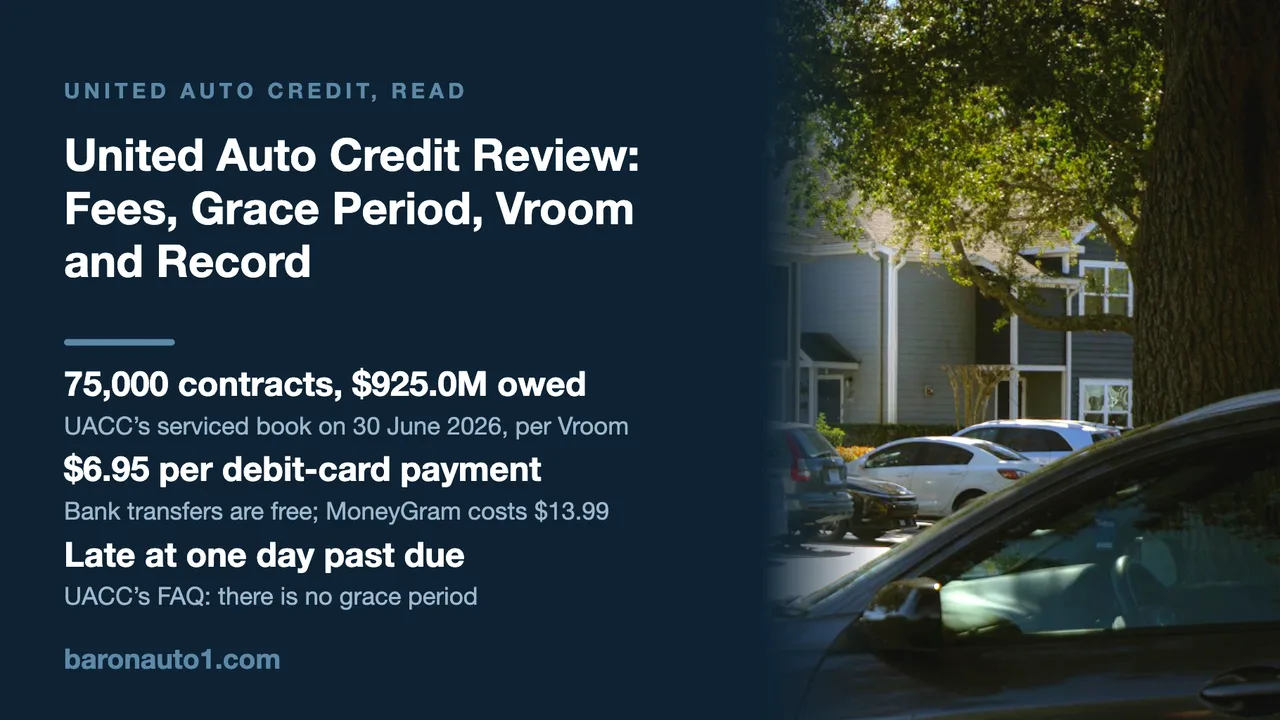
- Paying from a bank account (ACH) is free. UACC lists $6.95 for debit card, PayPal, Cash App and Venmo payments and $13.99 for MoneyGram. A debit-card AutoPay every two weeks comes to $180.70 a year, by our arithmetic.
- There is no grace period: UACC’s FAQ says a payment is “delinquent at one day past due,” and interest accrues daily on the full principal. Payments cover accrued interest first, and you can change your due date once over the life of the contract.
- UACC publishes no rates. Vroom’s filings show about 75,000 contracts and $925.0 million of principal on 30 June 2026, and an average FICO score of 577 in UACC’s 2026-1 loan pool.
- In a 2021 Massachusetts assurance of discontinuance, UACC settled the Attorney General’s allegations about two dealers and a surrender-form release, while denying wrongdoing; the itemised relief adds up to about $793,423, by our arithmetic. A Division of Banks examination begun on 14 November 2024 had no public outcome by 10 October 2026.
- The CFPB database has no company named United Auto Credit. There are 1,695 complaints under United PanAm Financial Corp., the former name of a Vroom subsidiary, and 2025’s 484 were 2.1 times the 2024 count.
United Auto Credit is a licensed lender (NMLS ID 2001) that finances people with weak or thin credit, only through dealers. Its parent, Vroom, came out of bankruptcy in January 2025; UACC was never in it. On 10 October 2026 we read UACC’s own pages, terms and privacy notices; Vroom’s 10-K, 10-Q, earnings presentation and 8-Ks on EDGAR; the Massachusetts Attorney General’s 2021 assurance; the FTC’s 2024 release on Vroom; and CFPB complaint counts. UACC’s Terms of Use bar linking to its site without permission, so we name its pages without linking them. We entered no login, payment or application, we print no phone numbers, and this site has no commercial relationship with UACC or any lender.
How United Auto Credit works: a lender you meet through the dealer
UACC lends only through dealers. Vroom calls it “an indirect lender that offers vehicle financing under the UACC brand to consumers through a network of motor vehicle dealers, focusing primarily on the non-prime market.” You sign a retail installment contract at the dealership, the dealer sends your application to UACC, and if UACC buys the contract you pay UACC from then on. The dealer stays on the hook for a while: Vroom’s 10-K says “UACC’s dealer agreement typically requires the selling dealership to buy back a motor vehicle retail installment contract if the consumer fails to timely make the first scheduled payment.” UACC grades each dealer, a grade “which impacts the pricing and availability of consumer loans for a dealer,” and the 10-Q says UACC charges dealers fees when it buys their contracts. So the price you are offered depends partly on the lot you are standing on.
The 10-K lists four programs. The Preferred Program is “the standard program for most non-prime applicants,” leaning on “ability-to-pay requirements, asset quality, cash down payments, number of open vehicle loans, restricted term lengths, and limited amount financed.” The Bankruptcy Program takes applicants with open bankruptcies or one discharged within one year (Chapters 7 and 13, says the dealer page). The Commercial Program covers non-passenger vehicles up to 14,500 lbs. gross vehicle weight rating. The Near-Prime Program, started in mid-2024, needs “a minimum FICO of 600” and is “a small percentage of our portfolio.” The dealer FAQ says UACC lends in 49 states, “up to $35,000.”
Vroom is open about the cost: UACC “may charge higher interest rates than most traditional motor vehicle financing sources.” Neither UACC’s website nor Vroom’s filings print a contract APR. The only rate in the record is from the 2021 Massachusetts release, which says UACC financed loans there “at the statutory maximum 21 percent interest rate”; other states set other caps. Your APR, term and late charge are in the contract the dealer writes. Our guide to reading the APR explains the disclosure box, and a pre-approval from a bank or credit union gives you a rate to compare. We have also reviewed Credit Acceptance, Westlake Financial, Exeter Finance and American Credit Acceptance, which also buy dealer contracts.
Who owns United Auto Credit: Vroom, the 2024 wind-down and Chapter 11
UACC has lent “since 1996,” it says. Vroom’s 10-K records that on 1 February 2022 Vroom bought Unitas Holdings Corp. (now Vroom Finance Corporation), “including its wholly owned subsidiaries United PanAm Financial Corp. (now known as Vroom Automotive Financial Corporation) and United Auto Credit Corporation.” Two years later Vroom stopped selling cars. On 22 January 2024 it announced a “value maximization plan” and stopped trading through vroom.com, and by 29 March 2024 the used-car business was substantially wound down. Its 8-K said UACC and CarStory, Vroom’s data business, “will continue to serve their third-party customers, with their operations unaffected.”
The bankruptcy belonged to the parent. On 13 November 2024 Vroom, Inc. filed a prepackaged Chapter 11 case in the U.S. Bankruptcy Court for the Southern District of Texas, In re Vroom, Inc., Case No. 24-90571 (CML), to restructure “$290 million of unsecured convertible notes due in 2026.” The court confirmed the plan on 8 January 2025 and Vroom emerged on 14 January 2025, 62 days after filing, by our arithmetic. Vroom’s 8-K said “None of Vroom, Inc.’s subsidiaries are expected to commence Chapter 11 proceedings,” and the 10-K confirms “Neither UACC nor CarStory were party to the Company’s Prepackaged Chapter 11 Case.” Nothing in these filings changes your contract or whom you pay.
The plan changed who owns Vroom. About $290 million of debt was discharged, former noteholders received 92.94% of the new stock and old shareholders 7.06%, and the shares began trading on the Nasdaq Global Market as VRM on 20 February 2025. The 10-K says Mudrick Capital Management, L.P. and its affiliates owned 76.5% of the stock, enough to “control the outcome of all actions requiring stockholder approval.” Mudrick is also a lender: the 10-Q says Vroom, UACC and a UACC subsidiary borrow from it under a facility secured by “asset backed residual certificates in certain UACC securitization trusts.” UACC’s Terms of Use still name it “United Auto Credit Corporation d/b/a Vroom Financial Services.”
UACC funds its loans by pledging contracts to warehouse lines and then selling them in “private securitization transactions targeted to institutional investors.” It has done 17 since 2012, “with over $3 billion in issued securities,” and its three warehouse lines had $600 million of capacity on 30 June 2026. An August 2026 amendment extended one line’s commitment “from August 28, 2026 to September 30, 2026,” and no later filing on it had appeared on EDGAR by 10 October 2026. A securitized contract stays with UACC for collection: the 10-K says “UACC continues to service each pool.”
UACC’s loan book, as filed with the SEC
UACC publishes no loan data, so Vroom’s filings are the closest public record. The 10-K counted “approximately 76,000 retail installment sales contracts with an aggregate principal outstanding balance of approximately $950 million” at 31 December 2025; the 10-Q gives about 75,000 contracts and $925.0 million at 30 June 2026, roughly $12,333 per contract by our arithmetic. The August 2026 presentation shows the gross serviced portfolio falling from $998 million to $923 million over the year to June 2026, down 7.5% by our arithmetic, while UACC originated $120 million of contracts through dealers in the second quarter of 2026 and $481 million in 2025.
A slide in that presentation, filed with the SEC, gives the weighted-average credit score of each securitized pool. Every pool from 2020-1 to 2026-1 averaged below 600, the Near-Prime minimum. The contracts eligible for UACC’s next deal as of 31 July 2026 averaged 616, which the slide calls a “39 point increase.”
| Pool | WA FICO |
|---|---|
| 2020-1 | 580 |
| 2021-1 | 585 |
| 2022-1 | 579 |
| 2022-2 | 569 |
| 2023-1 | 571 |
| 2024-1 | 576 |
| 2025-1 | 576 |
| 2026-1 | 577 |
| Current eligible pool, 31 July 2026 | 616 |
Losses have been heavy. The 10-K says “UACC is currently experiencing increasing credit losses on its finance receivables.” Realized and unrealized losses, net of recoveries, were $104.5 million in 2025, up from $98.6 million in 2024, “driven by an increase in the number and severity of delinquencies as well as lower recoveries.” The 10-Q reports $10.8 million for the second quarter of 2026 against $20.9 million a year earlier, crediting “lower loss assumptions on finance receivables originated since September 2025.” That quarter Vroom reported $0.6 million of net income from continuing operations, a first for the company, its presentation says.
Two cautions. Unpaid principal on nonaccrual status, “90 days or more past due,” was $10.4 million of $898.5 million in fair-value principal at 30 June 2026 (1.16%, by our arithmetic). That counts only the oldest arrears, and the 10-Q gives no figure for shorter ones, so it is not a delinquency rate. And UACC’s deals are private: its depositor files only Forms ABS-15G, the latest for United Auto Credit Securitization Trust 2026-2 on 28 September 2026, so no public filing gives a pool APR or term. Lenders that register their deals publish those tables, as our Exeter Finance review shows.
Paying United Auto Credit: methods, fees and cut-off times
UACC’s payment page prints a dollar fee for each method. You can pay with just your account number, or through the website or app, which need your “seventeen (17) digit” account number. On 10 October 2026 UACC printed:
| Method | Fee, per UACC | Credited the same day if made by |
|---|---|---|
| Checking or savings account (ACH), one-time | “FREE” | 7 p.m. Pacific |
| AutoPay, bi-weekly or monthly | ACH free; debit $6.95 per transaction | Scheduled date |
| Debit card, PayPal, Cash App or Venmo | $6.95 | 7 p.m. Pacific |
| Automated phone line | ACH free; debit $6.95 | 7 p.m. Pacific |
| Phone payment with a representative | ACH free; debit $8.95 | 7 p.m. Pacific |
| PayNearMe (cash at a store) | $4.99 | 7 p.m. Pacific |
| CheckFreePay (at a store) | $3.95, “prices vary by agent” | 6 p.m. Pacific |
| Western Union Quick Collect | $12.99 | 4 p.m. Pacific |
| MoneyGram | $13.99 | 4 p.m. Pacific |
| Mail, with the statement stub, to a Dallas PO box | Postage | Allow five days |
Fees “are subject to applicable law,” the page adds, and they add up: by our arithmetic, a monthly debit-card payment costs $83.40 a year, a monthly phone payment through a representative $107.40, and MoneyGram $167.88. Debit-card AutoPay every two weeks means 26 withdrawals and $180.70 a year; bank-account AutoPay costs nothing. UACC says an ACH withdrawal “may take three to five business days” to leave your bank, though your account shows it on the scheduled date, and asks for cancellations “at least 48 hours before the withdrawal date.”
Statements arrive “approximately two weeks prior to their scheduled due date.” The customer FAQ’s phone hours (7 a.m. to 10 p.m. Central, Monday to Thursday) are longer than those the dealer FAQ prints for the same department. One customer-FAQ answer, about billing statements, prints a number one digit off from the customer-service number used everywhere else, so take numbers from your statement or the app.
No grace period: late charges, payment order and hardship
UACC’s FAQ answers in one word: “Is there a grace period for late payments? No. All payments are due on or before the scheduled due date, and are considered delinquent at one day past due. Finance charges will accrue on the full outstanding principal balance until the date your payment is received and posted to your account. Late charges are assessed to your account after a certain number of days past due, according to state law or your contract.” UACC prints no late-charge amount, so check your contract and your state’s limits; our guide to late fees on car loans explains where caps come from. “Interest on interest is not charged.” Vroom’s 10-K says UACC’s servicing income includes “late and other fees.”
Each payment goes first to “accrued interest due,” then to principal for any past-due, current and next scheduled payment, then to “outstanding unpaid fees (i.e., late payment charges),” then to principal. Because interest comes first, every late day shifts more of the payment to interest. Other lenders that buy dealer contracts word these terms differently:
| Lender | Grace period | A payment goes first to | Changing the due date |
|---|---|---|---|
| United Auto Credit | “No.” Delinquent “at one day past due” | “accrued interest due” | “once during the life of your contract” |
| American Credit Acceptance | Late fees and grace periods “vary from state to state” | “Miscellaneous fees (e.g., repossession fee)” | “Depending on the status of your account” |
| Exeter Finance | Late means “Paid after the due date but before the billing cycle ends (may incur a late fee)” | “the interest that has accrued since the last payment” | “if your account qualifies” |
| Credit Acceptance | “No.” | Not in our Credit Acceptance record | The due date is “set by the dealer” |
On hardship, UACC’s FAQ offers only “Communication is the key. The sooner you let us know, the more options we have to offer.” The 10-K is more concrete: for borrowers with “temporary disruptions in their ability to make payments, collection representatives may offer solutions ... such as extensions and due date changes.” Servicemembers whose active duty began after the contract “may qualify for SCRA relief,” the FAQ says.
An extension can cost you twice. Interest keeps accruing on the full principal while you are behind, and UACC’s FAQ says the GAP benefit, which reduces what you owe if the car is totaled, “depends on various factors such as delinquent payments, whether you have received extensions, and more.” Ask UACC in writing how any extension changes your payoff and GAP coverage. UACC’s pages say nothing about refinancing; to lower your rate another lender must pay UACC off, and our guide to refinancing and loan-to-value explains why that is hard when you owe more than the car is worth.

Insurance, GAP and service contracts
UACC’s FAQ says “You are required to have full coverage on the vehicle with a maximum Comprehensive and Collision deductible of $1,000” for the whole contract, with every buyer listed as a driver and UACC as “lien holder/loss payee.” After an accident, it asks you to contact your insurer “and us right after.”
UACC also earns money on add-ons sold at the dealership. The 10-K says a vehicle service contract’s price “is included in the total amount financed and is itemized on the retail installment contract,” that “Dealers earn a commission on the sale of each VSC,” and that “UACC earns a fee on the sale of each VSC.” “UACC sells, administers and services its own GAP product,” a “debt waiver product,” and dealers earn a commission on that too. Each is “cancellable by the customer.” UACC’s warranty and GAP income rose 72.8% to $13.5 million in 2025, partly from “charging higher fees.” So ask the dealer to remove any add-on you did not choose; our out-the-door price guide shows how to read the itemization. GAP “does not cover repair costs or required maintenance,” and a claim starts once UACC has the insurance settlement and “can take up to 30 days.” If you pay off early, ask for the unearned part of each add-on back; see our guides to cancelling GAP and cancelling a service contract.
Repossession, impound and the balance after the sale
UACC’s customer pages say little beyond telling you to call its reinstatement team. The 10-K describes the process: UACC uses “national and regional third-party suppliers to recover vehicles,” “some accountholders demonstrate a sufficient level of commitment to reinstate their account,” and other cars are sold “through a network of third-party auto auctions.” Any shortfall is charged off, and “Charged-off UACC accounts are transferred to UACC’s recovery department for additional collections work.” A repossession does not end the debt; our guides to getting the car back and what you owe after the sale cover the general rules.
The 2021 Massachusetts assurance adds detail, but as allegations. Its “Statement of Allegations by the Attorney General” says that once an account is “more than 91 days past due, UACC seeks to repossess,” and that UACC “employs legal counsel to file lawsuits against consumers who fail to pay deficiency balances” and seeks wage garnishment on unpaid judgments. UACC stated in the same document that these practices “are not always employed for every such consumer,” and it denied wrongdoing. Treat 91 days as Massachusetts history, not a promise: under UACC’s FAQ you are delinquent from the first day late.
The assurance also exposed a form. From about August 2017 until June 2020, UACC’s Voluntary Surrender Agreement offered repossession fees “at least $100 less” than an involuntary repossession, in return for releasing UACC from “any and all claims,” including about “the origination and terms of the Customer’s Contract.” UACC said it stopped using it on or about 15 June 2020. Read any surrender agreement for a release of claims. If your car is impounded, call UACC at once; the FAQ says acting quickly can mean “potentially saving yourself hundreds of dollars.”
Payoff, title release and moving states
Your payoff balance is in the online account or app. How you pay it changes how fast the title comes: UACC says certified funds (“cashier’s check/cash payment at a designated payment site”) allow “a quicker release of your title after 3 business days,” while a personal check or ACH means “10 business days,” plus mail. If 20 business days pass with no title, contact UACC. In electronic-title states UACC removes its lien with the state, and in Florida and Ohio “you must go to your local DMV to obtain the paper title.” UACC recommends applying for a lien-free title afterwards; our page on checking for a lien shows how to confirm it is gone.
One gap: UACC’s FAQ says owners in seven states (KY, MD, MN, MT, MO, NY and SD) hold their title and get only a lien release from UACC, but its list of 27 electronic-title states also includes Maryland, New York and South Dakota. If you live in one of those three, ask which applies. UACC releases a title “only after the contract has been satisfied in full,” and releasing it to anyone but the registered owner needs a request “in writing at the time of final payment.” On a trade-in, “you will remain contractually obligated for payments, interest, and late fees until a payoff is received,” so keep paying until UACC confirms it. When you move, your new state’s DMV asks UACC for the title, and UACC says to “allow a minimum of three (3) weeks” for it to be received and processed.
The regulator record: Massachusetts, the CFPB, and Vroom’s own cases
The one enforcement action we found against UACC itself is from Massachusetts. On 27 May 2021 the Attorney General announced that UACC would provide “nearly $800,000 in debt relief and refunds to Massachusetts consumers to settle allegations that it facilitated the sale of defective and unsafe vehicles by two used car dealerships in Westport and Fall River.” The assurance of discontinuance, signed on 24 May 2021 and filed in Suffolk Superior Court, followed a civil investigative demand sent on 5 October 2018. The release says the investigation “found” that UACC financed the dealers “despite knowing of hundreds of consumer complaints,” but the assurance calls those points a “Statement of Allegations,” and in it UACC “denies the Attorney General’s factual allegations of wrongdoing.”
UACC paid $250,000 to the Attorney General, waived about $336,414.77 of deficiencies owed by borrowers who signed its 2017 surrender form and about $162,024.36 owed by the two dealers’ customers, released those customers’ liens, forgave about eight judgments totalling about $31,050.56, and paid restitution of about $5,097.52, $4,972.44 and $3,863.28: about $793,423 in all, by our arithmetic. It also committed to state rules on collection calls and wage garnishment. The assurance also quotes UACC’s contracts as carrying the federal Holder notice, “Any holder of this consumer credit contract is subject to all claims and defenses which the debtor could assert against the seller,” with recovery capped at “amounts paid by the debtor hereunder,” so a claim against the dealer can be raised against UACC.
A second Massachusetts matter is unresolved in public. Vroom’s FY2025 10-K says the Division of Banks “commenced a routine compliance examination of UACC” on 14 November 2024 and “intends to issue findings of compliance violations and impose penalties, but the extent and scope are still unknown.” The Q2 2026 10-Q does not mention it, and the Division’s enforcement index (page dated 9 October 2026) lists no UACC action, so its outcome is unknown. Federally, the 10-K says UACC “is subject to supervision and examination by the Consumer Financial Protection Bureau,” and on 10 October 2026 the CFPB’s enforcement index returned nothing for “united auto credit,” “vroom” or “united panam” (the same filter does return Credit Acceptance Corporation).
Two other cases involve Vroom’s former online used-car business, not UACC’s loans. On 2 July 2024 the FTC announced a complaint and proposed order requiring Vroom to pay $1 million for refunds, alleging it misrepresented that it “thoroughly examined all vehicles” and failed to get consent to shipping delays. And the Texas Attorney General’s April 2022 petition against Vroom, Inc. and Vroom Automotive, LLC ended in an agreement approved on 13 December 2023: $2 million in civil penalties and $1 million in attorneys’ fees, “without any admission of wrongdoing,” Vroom’s 10-K says.
Vroom’s 10-K also says “The Company has incurred fines in certain states,” naming none. We found no other official action naming UACC and read no court docket, so we describe no private lawsuit.
CFPB complaints: 1,695 reports, filed under another name
The CFPB’s complaint database has no company called United Auto Credit; company searches for “united auto credit,” “UACC” and “vroom” return 0. The complaints sit under “United PanAm Financial Corp.,” the former name of the Vroom subsidiary now called Vroom Automotive Financial Corporation, and the CFPB does not record which subsidiary each concerns. We pulled 1,695, received from 13 September 2013 to 9 October 2026, on 10 October 2026. They are unverified consumer reports that grow with a lender’s size, so they show what people complain about, not how likely a problem is. The CFPB stopped publishing narratives on 30 September 2026; we use counts only.
By product, 799 (47.1%) fall under credit-reporting labels, 489 (28.8%) concern the vehicle loan and 324 (19.1%) debt collection. Within the car-loan complaints, managing the loan leads (121, including 37 about add-on products), then repossession (120, or 24.5%, with 56 about the balance left after the sale), getting a loan (71, including 34 about a fraudulent loan or one opened without consent), struggling to pay (69, including 19 “Denied request to lower payments”) and the end of the loan (41, including 18 about the title after payoff). The company closed 1,586 (93.6%) “with explanation” and 20 with monetary relief; the CFPB marks 61 (3.6%) as answered late.
| Year | All complaints | Vehicle loan or lease | Credit reporting | Debt collection |
|---|---|---|---|---|
| 2022 | 99 | 22 | 61 | 15 |
| 2023 | 142 | 49 | 71 | 19 |
| 2024 | 230 | 76 | 122 | 30 |
| 2025 | 484 | 134 | 246 | 100 |
| 2026 (to 10 October) | 397 | 113 | 197 | 84 |
By our arithmetic, 2025’s count was 2.1 times 2024’s, and 2026 had reached 82% of the 2025 total by 10 October, while the gross serviced portfolio shrank 7.5% over the year to June 2026, so the rise did not come from a bigger loan book. Trustpilot, Reddit and BBB are not used here.
The fine print, and a checklist before you sign
UACC’s Terms of Use (last updated 29 April 2022) govern its website and apps, not your loan. They choose California law, cap UACC’s liability for the site at the greater of what you paid in the previous “TWELVE (12) MONTH PERIOD” or “US $1,000.00,” and can change “at any time without prior notice.” We read them in full and found no arbitration clause, jury waiver or class-action waiver. Your loan contract is a separate document on the dealer’s form, and UACC publishes no sample, so read it for an arbitration clause and any opt-out deadline. UACC’s e-sign consent (last revised 28 December 2021) says “You are not obligated to use or accept electronic records or electronic signatures for the financial transaction” and that you have “the right to receive Documents in paper form.”
The privacy notice (Rev. 12/2025) says UACC shares your information for its own marketing and “joint marketing with other financial companies,” which you cannot limit; you can limit sharing with affiliates and non-affiliates for their marketing, and sharing can start “thirty (30) days” after a new customer gets the notice. Its online privacy policy (updated 17 July 2026) says the site records “keystrokes, mouse movements, form field entries, recordings of chat sessions.”
- Bring your own financing quote. UACC publishes no rates and “may charge higher interest rates than most traditional” lenders, Vroom says. A bank or credit-union offer is the simplest way to judge the dealer’s APR.
- Read the APR, term, late charge and any arbitration clause before signing. UACC’s website gives none of them; the contract does.
- Strike add-ons you did not choose. Dealers earn a commission on each service contract and GAP product UACC finances. Each is itemized and cancellable.
- Pay from a bank account, on or before the due date. ACH is free, a debit card costs $6.95 a time, and a payment is delinquent at one day past due.
- Keep insurance at a deductible of $1,000 or less, with UACC as lienholder and loss payee, for the whole contract.
- Pay off with certified funds and track the title. UACC says release starts after 3 business days for certified funds and 10 for a personal check or ACH; call if 20 business days pass.
Common questions
Who owns United Auto Credit?
Vroom, Inc., a Nasdaq-listed company that bought UACC’s parent on 1 February 2022. Vroom’s FY2025 10-K says Mudrick Capital Management, L.P. and its affiliates own 76.5% of Vroom’s stock.
Did United Auto Credit go bankrupt?
No. Vroom, Inc., the parent, filed a prepackaged Chapter 11 case on 13 November 2024 to restructure about $290 million of notes and emerged on 14 January 2025. Its filings say “Neither UACC nor CarStory were party to” the case, and UACC kept servicing its loans.
How do I pay United Auto Credit, and does it charge fees?
Online or in the app with your 17-digit account number, by phone, at a store, or by mail with your statement stub. Bank-account (ACH) payments, including AutoPay, are free. UACC lists $6.95 for debit card, PayPal, Cash App and Venmo, $8.95 for a debit payment through a representative, $4.99 for PayNearMe, $3.95 for CheckFreePay, $12.99 for Western Union and $13.99 for MoneyGram.
Does United Auto Credit have a grace period?
No. Payments “are considered delinquent at one day past due,” and finance charges accrue on the full principal until your payment posts. Late charges follow “state law or your contract”; UACC prints no amount.
Is United Auto Credit legit, and has it been sued or fined?
It is a licensed lender (NMLS ID 2001), lending through dealers since 1996 by its own account and supervised by the CFPB, per Vroom’s 10-K. In 2021 it settled the Massachusetts Attorney General’s allegations about two dealers and a surrender-form release while denying wrongdoing. A Division of Banks examination begun in November 2024 had no public outcome by 10 October 2026. The FTC and Texas cases were against Vroom’s former used-car business.
How long does United Auto Credit take to release the title after payoff?
UACC says 3 business days if the final payment is certified funds and 10 business days for a personal check or ACH, plus mailing time. In electronic-title states it removes its lien with the state. If 20 business days pass with no title or release, contact UACC’s title department.
Sources and further reading
- CFPB auto loan resources
- CFPB consumer complaint database
- CFPB: what is the difference between dealer-arranged and bank financing?
- CFPB Supervisory Highlights: Auto Finance (October 2024)
- FTC vehicle repossession
- CFPB: what is Guaranteed Asset Protection (GAP)?
Recall, complaint and safety-rating figures on this page were retrieved from the federal databases above on August 19, 2026. Federal data changes — re-check any VIN before you rely on it.
Published October 10, 2026 · last updated October 10, 2026. Found something out of date or wrong? Tell us and we will correct it.