Veros Credit Review: Payments, Fees, Payoff, Title and Record
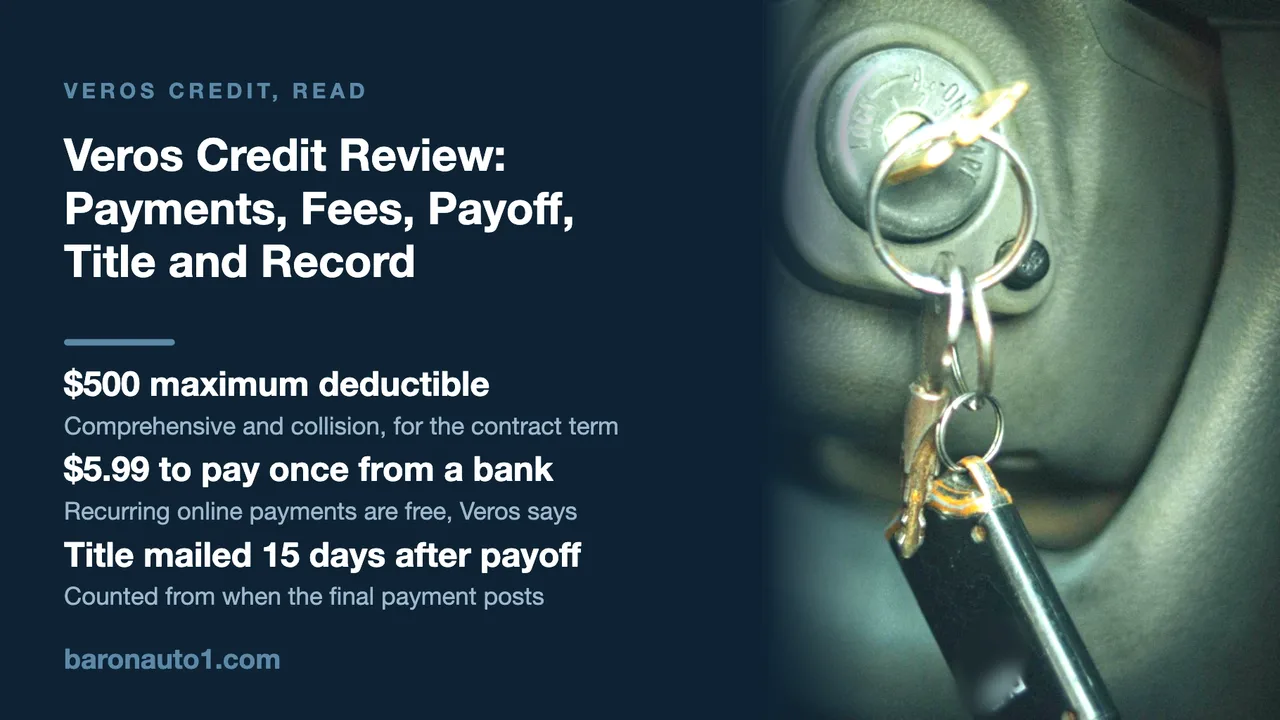
Veros Credit buys car loan contracts from dealers and collects the payments. What it charges to pay ($5.99 one-time, recurring free), its 4:00 p.m. Pacific cut-off, the $500 deductible rule, titles mailed 15 days after payoff, nine securitizations and 749 CFPB complaints.
The short version
- Veros Credit, LLC is a Santa Ana, California finance company that buys car loan contracts from franchise and independent dealers and then collects the payments. The accountants’ reports on its 2025-1 and 2026-1 securitizations also note loans “directly originated by Veros” with no dealer involved. It calls itself privately held; in April 2025 it announced an investment from ITOCHU International that “may result in” a minority stake.
- Recurring online payments are “Free of charge.” A one-time payment costs $5.99 from a bank account or debit card, $6.99 by PayPal, Venmo or Cash App Pay and $4.99 in cash through PayNearMe; MoneyGram charges $9.95 to $12.95. Twelve one-time bank payments come to $71.88 a year, by our arithmetic.
- Weekday payments made before 4:00 p.m. Pacific (7:00 p.m. Eastern) post the same day. Veros warns that paying at or after 4:00 on your last day “may still” bring a late charge. It prints no grace period and no late-charge amount: both are in the contract the dealer wrote.
- You must carry comprehensive and collision insurance for the whole contract with “a maximum deductible of $500.00.” After payoff, “Titles are mailed out 15 days after the payment posts to the account.”
- Veros has filed reports on nine securitizations with the SEC since 2017. The latest trust, 2026-1, held 17,908 loans on 31 December 2025, and where the accountants saw a title image, Veros was named as secured party.
- The CFPB database holds 749 complaints under “Veros Credit, LLC” (pulled 17 October 2026): 211 in 2025, 2.05 times the 2024 count, and 205 so far in 2026. Neither the CFPB’s enforcement list nor the Texas OCCC’s names Veros.
Veros Credit is a subprime and near-prime auto lender that many borrowers meet only after signing at a dealership, when a letter or statement arrives with its name on it. On 17 October 2026 we read Veros’s customer FAQ, payment, contact, account-transfer, privacy, dealer and state-licence pages and the licence certificates it posts; its Forms ABS-15G and the accountants’ reports filed with them on SEC EDGAR; its April 2025 release about ITOCHU; the CFPB and Texas enforcement lists; and CFPB complaint counts. Veros’s robots.txt bars its leadership page and its make-payment paths, so we used nothing from them. We entered no login, payment or form, we print no phone numbers, and this site has no commercial relationship with Veros or any lender.
How a dealer’s contract ends up with Veros
Veros describes its business in one line: “We specialize in the acquisition and servicing of motor vehicle retail installment contracts through our vast network of franchise and independent automobile dealers.” In practice you sign a retail installment contract at the dealership, the dealer sends the deal to Veros, and if Veros buys it you pay Veros from then on. Its dealer page lists four programs: auto financing for “Subprime, Near Prime, and Prime borrowers” with loan amounts of $5,000 to $75,000; luxury vehicles from $100,000 to $1,000,000; commercial light-duty vehicles (“Classes 1-3 up to GVWR 14,000 lbs”) up to $100,000; and powersports. Its dealer checklist adds “First Time Buyers OK” and “Prior Bankruptcies OK.”
The dealer page also shows how much of your deal is shaped at the dealership. Its “24/7 Underwriter tool” lets dealers “Instantly adjust terms, APR, fees, and amount financed, day or night,” and applications are “approved in seconds without calling an underwriter.” Veros pays dealers within “48 business hours” of a funding notice, and its dealer FAQ refers to accounts in “Buyback status,” a sign that some contracts are sold back to the dealer. Veros prints no rates anywhere, so the APR on your contract is whatever the dealer and Veros agreed. Our guides to reading the APR and the dealer’s share of the rate explain the disclosure box, and a pre-approval from a bank or credit union gives you a number to compare before you sign.
Not every Veros loan comes from a dealer. The accountants’ reports for the 2025-1 and 2026-1 securitizations say “certain loans were directly originated by Veros and thus there was no dealer involved,” and Veros’s April 2025 release describes “direct vehicle lending” alongside contract buying. Some borrowers also arrive by transfer. A Veros page for people who received a transfer notice says “Your account has been transferred to Veros Credit,” tells them to “direct all payments starting from September 1, 2023, to Veros Credit,” and says a “formal notification letter” went out. It does not name the earlier lender. If you got such a letter, the letter, not this page, is your record of who holds the loan.
We have reviewed other companies that buy dealer contracts the same way: Credit Acceptance, Westlake Financial, Exeter Finance, American Credit Acceptance, United Auto Credit, First Investors, Lobel Financial and First Help Financial. Each prints its own terms, and none of them is described here.
Who owns Veros Credit, and where its loans go
Veros’s dealer page says “We’re a privately held nationwide automotive finance company,” “headquartered in Orange County California,” with “branch offices throughout the Western United States.” It files no annual report with the SEC (its EDGAR record holds 12 filings, all Forms ABS-15G), and none of its pages names its owners. The one ownership event on the public record is its own release of 9 April 2025, which says Veros “is pleased to announce a strategic investment from ITOCHU International Inc.” and that “The investment may result in ITOCHU acquiring a minority ownership stake in Veros Credit.” We found no ITOCHU statement saying whether the stake was taken or how large it is, so treat the ownership as private, with a possible minority holder. Veros’s SEC forms are signed by Cyrus Bozorgi as “Chief Executive Officer and President,” and EDGAR lists Veros Credit LLC at a Santa Ana business address with Nevada (“NV”) as its state of incorporation.
Veros appears on EDGAR because it sells pools of its loans to investors. Since 2017 it has filed a Form ABS-15G for each Veros Auto Receivables Trust: a pool of contracts packaged into notes sold under a “confidential Preliminary Offering Memorandum.” The offering documents are private, but each form attaches an independent accountant’s report that states how many loans were in the pool. Those counts are the only public measure of Veros’s size.
| Trust | Loans in the final data file | Data as of (or file received) | Filed on EDGAR | Other parties to the report |
|---|---|---|---|---|
| 2017-1 | 17,328 | 30 September 2017 | 17 October 2017 | Deutsche Bank Securities |
| 2018-1 | 17,021 | Received 2 October 2018 | 15 October 2018 | Deutsche Bank Securities |
| 2020-1 | 16,173 | Received 5 February 2020 | 25 February 2020 | Deutsche Bank Securities |
| 2021-1 | 14,361 | 30 April 2021 | 7 May 2021 | Deutsche Bank Securities, Capital One Securities |
| 2022-1 | 12,345 | 28 February 2022 | 11 March 2022 | Deutsche Bank Securities, Capital One Securities |
| 2023-1 | 14,006 | 30 April 2023 | 5 May 2023 | Deutsche Bank Securities, Capital One Securities |
| 2024-1 | 14,277 | 30 April 2024 | 13 May 2024 | Deutsche Bank Securities, Capital One Securities |
| 2025-1 | 16,181 | 30 April 2025 | 8 May 2025 | Deutsche Bank Securities |
| 2026-1 | 17,908 | 31 December 2025 | 12 January 2026 | Deutsche Bank Securities, Fifth Third Securities |
The nine pools add up to 139,600 loans, by our arithmetic, though that counts each pool when it was set up, not loans outstanding today. The 2026-1 pool was 45.1% larger than the smallest, 2022-1, and 10.7% larger than 2025-1, and it reached EDGAR 249 days after 2025-1. Veros’s own pages give other measures: “more than 2000 dealers” on the homepage but a “3250+” dealer counter on the dealer page, and “more than 30 years” on the homepage but a “more than 25 year history” on its About page.
For a borrower, a securitization changes little that you can see. The 2026-1 report lists the contract fields the accountants checked, including the “Annual Percentage Rate (APR)” and the monthly payment, but prints no values. Checking a sample of 160 loans, the accountants say that where they saw a title image, Veros was “named on such image as the Secured Party,” and they noted two contracts whose first payment date and one whose payment and amount financed did not match Veros’s data file. Veros also filed annual Rule 15Ga-1 reports for 2023, 2024 and 2025 with the box ticked for “no activity to report.” Those reports cover investor demands that a securitizer buy back loans, so Veros reported none.
Paying Veros: methods, fees and the 4:00 p.m. cut-off
Veros’s customer FAQ lists every way to pay and what each costs, and adds that “Veros Credit does not expect or require any particular payment method.” The cheapest routes are recurring online payments, which are “Free of charge,” and a check or money order by mail, which carries “No Fee For Processing Checks.” Everything else costs money per payment. The online “Pay Online” and “View My Statement” buttons on Veros’s pages lead to PayNearMe’s site, and a notice on the payment page says Veros has “recently made changes to our online payment portal”: anyone already on automatic payments “will need to update your automated payment schedule.” If you set up AutoPay before that change, log in and confirm it is still running.
| Method | Fee as Veros prints it |
|---|---|
| Online, recurring (automatic payments) | “Free of charge” |
| Online, one time: bank account | $5.99 per transaction |
| Online, one time: debit card | $5.99 per transaction |
| Online, one time: Google or Apple Pay | $5.99 per transaction |
| Online, one time: PayPal, Venmo or Cash App Pay | $6.99 per transaction |
| Cash through PayNearMe (7-Eleven and ACE Cash Express stores) | $4.99 per transaction |
| Phone | “Up to $6.99”; “not assessed in some states” |
| MoneyGram | “$9.95 to $12.95” |
| Mail (check or money order) | No fee; “allow up to 7 business days to be received” |
The fees add up. Paying once a month from a bank account instead of setting up recurring payments costs $71.88 a year, by our arithmetic; by PayPal or Venmo it is $83.88, in cash $59.88, and at MoneyGram between $119.40 and $155.40. The FAQ is not fully consistent about the online one-time fee. Its heading reads “Processing Fee: Up to $6.99,” and it says that “Depending on the state you reside in, you may be assessed a processing fee of $6.99 by a third-party processor,” yet the list beneath charges $5.99 for a bank account. For phone payments, the fee may be charged “by a third-party processor or Veros Credit.” The page shown at checkout is the one that counts, so read the amount before you confirm.
Timing matters as much as the fee. Veros’s payment page says “Payments submitted before 4:00 p.m. Pacific Standard Time (pst) (7:00 p.m. Eastern Time Zone) Monday through Friday (excluding holidays) will be posted to your account the same day,” and later payments post “the following business day.” Mail takes longer: the FAQ asks you to “allow up to 7 business days.” Cash through PayNearMe works at “any of the 17,000 participating 7-Eleven and ACE Cash Express stores,” but you need a barcode first, which Veros’s customer service sets up; barcodes are then “preloaded onto each billing statement.”
Late charges, due dates and payment trouble
Veros’s pages never print a grace period or a late-charge amount. The only mention is a warning on the payment page: “if today is the last day to make your payment without incurring a late charge under the terms of your retail installment contract, and you make a payment at or after 4:00 p.m. PST, your account may still be assessed a late charge.” Two things follow. First, the number of days before a late charge, and its size, are set by your contract and your state’s law; our guide to late fees on car loans explains where the caps come from. Second, the clock is Veros’s posting time, not the moment you press pay: a payment made after 4:00 p.m. Pacific on a Friday posts the next business day.
Veros offers a few servicing changes, each by phone or through its contact form, and prints no conditions for any of them. You can ask for a due date change (“a Customer Service Specialist will be happy to review your request”), make a payment that “reduces your principal balance only and is not applied towards future payment(s),” or pick “Help with Payment Challenges” on the contact form. Veros prints no hardship, deferral or extension policy. Its securitization records do show that extensions happen: when the 2026-1 accountants found a loan whose maturity date did not match their calculation, they “utilized the Customer Service Screen to examine if the loan experienced a due date change or extension.” So ask, and ask for the answer in writing.
A principal-only payment is not the default. Veros says a payment “that reduces your principal balance only and is not applied towards future payment(s)” has to be arranged by phone. If you simply send extra money, ask how it was applied: money credited to future payments does not cut the balance the way a principal payment does. If you are weighing a refinance to lower the rate, another lender has to pay Veros off in full; our guide to refinancing and loan-to-value explains why that is hard when you owe more than the car is worth.
Veros’s privacy notice (revised 03/26) adds that “Late payments, missed payments, or other defaults on your account(s) may be reflected in your credit report,” so check your reports after any late payment, extension or payoff.

Insurance: the $500 deductible rule
Veros sets a low cap on your deductible. Its FAQ says “Veros Credit requires you to maintain Comprehensive and Collision insurance covering loss or damage to the vehicle for the term of your contract with a maximum deductible of $500.00.” A cheaper policy with a $1,000 deductible would not meet it. Price the policy before you sign at the dealership, because a higher premium is part of the real monthly cost of the car.
Veros gives two different addresses for your insurer. The customer FAQ gives a Fort Worth, Texas address for the insurance company, while the page for transferred accounts says to list “Veros Credit LLC” as loss payee at an Atlanta, Georgia address. Use whichever your own Veros letter or statement gives, and ask your insurer to send Veros the declaration page. Veros takes declaration pages by email to its Insurance Department, or through an “Upload Insurance Information” link that leads to a third-party site, myloaninsurance.com. After an accident, the FAQ says to “contact your insurance company as soon as possible” and to ask the insurer to contact Veros’s Claims Department.
Veros prints nothing about what it does if your coverage lapses, and nothing about GAP or service contracts sold with the car. Its payoff form does list “Insurance Claim” as a reason for a payoff, the route a total loss would take. See our guides to cancelling GAP and to what happens when insurance lapses. Other dealer-contract lenders print different rules:
| Lender | Maximum deductible | Title after payoff |
|---|---|---|
| Veros Credit | “a maximum deductible of $500.00” | “mailed out 15 days after the payment posts” |
| United Auto Credit | “a maximum Comprehensive and Collision deductible of $1,000” | Release “after 3 business days” for certified funds, “10 business days” for a personal check or ACH |
| Exeter Finance | “a maximum deductible of $1,000 each” | Not in our Exeter record |
| Credit Acceptance | Not in our Credit Acceptance record | “typically” sent “within 30 days of payoff” |
GPS, starter interrupt, calls and your data
Veros’s public pages say nothing about GPS trackers or starter-interrupt devices, and Veros publishes no sample contract, so we cannot tell you whether a given Veros loan has one. If a device was fitted, the disclosure will be in the paperwork the dealer gave you, usually a separate addendum; look for it before you sign, and see our guide to payment devices for what those addenda usually say. Veros’s California privacy page does tick “Yes” for collecting “Geolocation data,” described as “Physical location or movements,” without saying how. The CFPB’s complaint form has a sub-issue called “Lender trying to repossess or disable the vehicle,” and 16 Veros complaints carry it; the label is the CFPB’s own and does not show that any device was used.
Veros’s contact forms come with conditions. Each requires you to tick “I have read and agree to the Terms of Service,” although Veros publishes no Terms of Service: its sitemap lists none and four likely addresses answered with a 404 error when we checked. The box also gives consent to contact “by e-mail, text message, and/or voicemail, and by using prerecorded/artificial voice messages and automatic telephone dialing systems.” Its AI chatbot, Vera, is “now active on our customer service and collections departments.”
The privacy policy says your information is not used for “mailing lists, telemarketing for promotional offers, or targeted advertising,” but it can pass to a buyer “in the event of a sale, merger, transfer, or exchange” of Veros’s assets, and California residents are told it is kept “for the duration of your relationship with us plus 10 years.”
Impound, repossession and what Veros prints about default
Veros prints almost nothing about default. For an impounded or seized car, it has “Impound Specialists” and a form, and the FAQ asks you to have ready the “date and city of incident, reason, and if any holds have been placed,” so call as soon as you know where the car is. If the car “has been repossessed,” the contact page says only to “call our Customer Service department.” Its complaint form has a category for “Issues after Repossession.” Veros publishes no reinstatement, redemption, voluntary-surrender or deficiency policy.
That leaves your contract and state law. In most states a lender can repossess without going to court once you default, must send notice before it sells the car, and can then bill you for any shortfall. Our guides cover getting the car back and what you owe after the sale, and the FTC’s consumer page on repossession explains the basics. Get every reinstatement figure in writing, including fees, and ask for any personal property left in the car straight away.
The CFPB’s counts show where Veros borrowers say things went wrong. Of 230 vehicle-loan complaints, 56 (24.3%, by our arithmetic) are about repossession: 18 about the balance left after the car was sold, 9 about reinstating the account or redeeming the car, 7 about damage or lost belongings, 5 about voluntary repossession and 4 about the notice to repossess. Debt-collection complaints add 58 alleging attempts to collect a debt not owed and 43 about threatened or actual “negative or legal action.” Keep the repossession notice, the sale notice and the final balance statement.
Payoff and title release
Veros does not publish an online payoff figure. The FAQ says to get a payoff quote by phone (“option 3, option 1” on its customer-service menu), and the contact page has a payoff form whose reasons are “Early Payoff,” “Insurance Claim,” “Refinanced” and “Trade In.” Ask for the quote in writing with its good-through date; the 4:00 p.m. Pacific posting cut-off applies to a payoff too.
On the title, Veros’s customer and dealer FAQs say the same thing: “Titles are mailed out 15 days after the payment posts to the account.” Veros prints no faster route for certified funds and says nothing about electronic-title states, where the lien is usually released with the state rather than on paper. Its title form lists the problems it expects: “Title Not Received/Lien Release Request,” “Moving Out of State,” “Title Correction” and “Dealer Out of Business/No Registration.” The last one matters if your dealer never registered the car: when no title image was available for a contract dated fewer than 60 days before the data date, the 2026-1 accountants accepted “a copy of a title application” instead, a reminder that a new title can take weeks to issue. Our guide to checking for a lien shows how to confirm the lien is gone before you sell.
State licences and the regulator record
Veros’s footer gives NMLS #1841224 and “CA Finance Lender License #60DBO-131029,” and its State Licenses page says Veros “is posting the following regulatory licenses as required by state law or regulation” for 11 states. That is a list of states that require a posted licence, not of every state Veros lends in: CFPB complaints come from consumers in Florida (128) and Georgia (54), for example, and neither is on the page. Veros posts certificate files for seven of the 11 states.
| State | Licence | Number | Dates printed |
|---|---|---|---|
| Arizona | Sales Finance Company | SF-0923015 | In force “until surrendered, revoked or suspended” |
| California | Finance Lenders Law licence | 60DBO-131029 | Posted file is an image; number from Veros’s footer |
| Illinois | Sales Finance Agency License | SF.0001726 | Issued 16 January 2026; expires 31 December 2026 |
| Michigan | Sales Finance Company | SF 0026920 | Effective 19 September 2025 |
| Missouri | Motor Vehicle Time Sales Act registration | 365-25-8550 | 1 January to 31 December 2025 |
| Oklahoma | Notification, Oklahoma Consumer Credit Code | 86152 | Effective 10 October 2025; expires 31 January 2027 |
| Texas | Regulated Lender License | 18252-173267 | Issued 18 February 2025; “ACTIVE” |
| Texas | Motor Vehicle Sales Finance License | 18252-66556 | Issued 11 January 2014; “ACTIVE” |
| Maryland, Minnesota, Wisconsin, New Jersey | No certificate posted | None given | Veros points to NMLS Consumer Access (New Jersey: the state’s own search) |
Two caveats. The posted Missouri certificate ended on 31 December 2025, 290 days before we read it; that shows only that the posted copy is old, not that the registration lapsed. And we could not check any licence against a state register: NMLS Consumer Access and Indiana’s and Missouri’s lists answered with bot-check pages, and the other lookups are search forms, which we do not fill in. Look Veros up on NMLS Consumer Access yourself with NMLS #1841224.
We found no regulator or court action naming Veros. The CFPB’s enforcement list returns “no results” for “veros” (the same filter does find Credit Acceptance), the Texas Office of Consumer Credit Commissioner’s enforcement list does not mention Veros, and web searches on 17 October 2026 turned up no attorney-general, FTC or California DFPI action. That is a search result, not a clean bill of health: we could not read every state’s list. Veros’s transfer page says it is “accredited by the Better Business Bureau” with “an A+ rating”; the BBB’s site blocked our request, so that is Veros’s claim, not something we checked.
CFPB complaints: 749 reports, rising fast
The CFPB’s database files Veros complaints under one name, “Veros Credit, LLC,” the only match its company suggester returns for “veros.” On 17 October 2026 it held 749 complaints received from 6 June 2015 to 2 October 2026. Complaints are unverified consumer reports, and counts grow with a lender’s size, so they show what people complain about, not how often borrowers have trouble. No narratives have been published since 30 September 2026; these are counts only.
| Year | All complaints | Vehicle loan or lease | Credit reporting | Debt collection |
|---|---|---|---|---|
| 2015 | 2 | 0 | 0 | 0 |
| 2016 | 13 | 0 | 0 | 6 |
| 2017 | 13 | 6 | 1 | 5 |
| 2018 | 20 | 6 | 4 | 9 |
| 2019 | 15 | 8 | 2 | 4 |
| 2020 | 24 | 8 | 13 | 2 |
| 2021 | 36 | 9 | 22 | 5 |
| 2022 | 58 | 18 | 32 | 7 |
| 2023 | 49 | 16 | 28 | 3 |
| 2024 | 103 | 18 | 69 | 16 |
| 2025 | 211 | 59 | 99 | 50 |
| 2026 (to 2 October) | 205 | 82 | 83 | 39 |
The trend is the headline. Complaints in 2025 were 2.05 times the 2024 count, and 2026 had already reached 97.2% of the 2025 total by early October, by our arithmetic. Vehicle-loan complaints so far in 2026 (82) are 1.39 times all of 2025 (59). Some of that may reflect growth (2026-1 was the largest of the nine pools), but the filings give no total loan count to measure it against.
By product, 353 complaints (47.1%) are about credit reporting, 230 (30.7%) about the vehicle loan itself, 146 (19.5%) about debt collection, and 20 carry older or other labels. Among vehicle-loan complaints, “Managing the loan or lease” leads with 76 (42 of them billing problems), then repossession (56), getting the loan (32, of which 20 allege a fraudulent loan or one opened without the consumer’s knowledge) and struggling to pay (23, of which 8 say a request to lower payments was denied).
Veros closed 742 complaints (99.1%) “with explanation” and 6 with non-monetary relief; none is recorded with monetary relief, and 17 responses (2.3%) were not timely. Consumers in California filed 275 complaints (36.7%), followed by Florida (128), Texas (94) and Georgia (54), and 39 complaints (5.2%) carry the CFPB’s “Servicemember” tag. Veros’s own complaint form covers credit reporting, fraud or identity theft, issues after repossession and contract questions; the CFPB’s portal is the other route.
If you have a Veros loan, or are about to sign one
Most of what decides your cost is not on Veros’s website: the APR, the term, the late charge and any device addendum are in the contract the dealer writes. Our guide to the out-the-door price shows how to read that contract line by line. The rest of this list comes from what Veros does print.
- Read the contract’s late-charge clause. Veros prints no grace period or late fee; your contract and state law set both.
- Ask about tracking devices. Veros’s pages are silent on GPS and starter interrupt. If the dealer fits one, get the addendum.
- Price insurance first. You need comprehensive and collision with a deductible of $500 or less for the whole contract.
- Use recurring online payments. They are free; one-time payments cost $4.99 to $6.99 each and MoneyGram $9.95 to $12.95.
- Beat the cut-off. Pay before 4:00 p.m. Pacific on a weekday, and mail checks at least 7 business days ahead.
- Re-check AutoPay. Veros changed its payment portal and says old automatic schedules need updating.
- Arrange extra payments. Principal-only payments are set up by phone; otherwise extra money may go to future payments.
- Get the payoff in writing. Then expect the title about 15 days after the final payment posts, and use the title form if it does not come.
- Watch your credit reports. Veros reports late and missed payments, and credit reporting is the most common CFPB complaint about it.
Common questions
Who owns Veros Credit?
Veros says it is “privately held.” Its April 2025 release says an investment from ITOCHU International Inc. “may result in ITOCHU acquiring a minority ownership stake.” Its SEC forms are signed by its Chief Executive Officer and President, Cyrus Bozorgi. No public filing names its other owners.
How do I pay Veros Credit, and are there fees?
Recurring online payments and mailed checks are free. One-time payments cost $4.99 to $6.99 depending on the method, phone payments up to $6.99, and MoneyGram $9.95 to $12.95. Weekday payments before 4:00 p.m. Pacific post the same day.
Does Veros Credit have a grace period?
Veros does not print one. Its payment page refers to the last day to pay “without incurring a late charge under the terms of your retail installment contract,” so the grace days and late fee are whatever your contract and state law allow. Paying at or after 4:00 p.m. Pacific on that last day may still bring a late charge.
How long does Veros take to send the title after payoff?
Veros says “Titles are mailed out 15 days after the payment posts to the account.” If nothing arrives, use the title form on its contact page.
What insurance does Veros Credit require?
Comprehensive and collision coverage for the whole contract, with “a maximum deductible of $500.00.” Send the declaration page to Veros’s Insurance Department and list Veros as loss payee at the address on your own statement or letter.
Is Veros Credit legit, and has it been sued or fined?
It is a licensed finance company (NMLS #1841224) that posts state licences and files securitization reports with the SEC. We found no CFPB, Texas OCCC, attorney-general or FTC action naming it as of 17 October 2026. The CFPB database holds 749 consumer complaints under its name, which more than doubled from 2024 to 2025.
Sources and further reading
- CFPB auto loan resources
- CFPB consumer complaint database
- CFPB: what is the difference between dealer-arranged and bank financing?
- FTC vehicle repossession
- UCC Article 9, part 6 — default (uniform text)
- CFPB Supervisory Highlights: Auto Finance (October 2024)
Recall, complaint and safety-rating figures on this page were retrieved from the federal databases above on August 19, 2026. Federal data changes — re-check any VIN before you rely on it.
Published October 16, 2026 · last updated October 16, 2026. Found something out of date or wrong? Tell us and we will correct it.