Airstream VIN Decoder: Six Codes, Every One Filed the Same Way
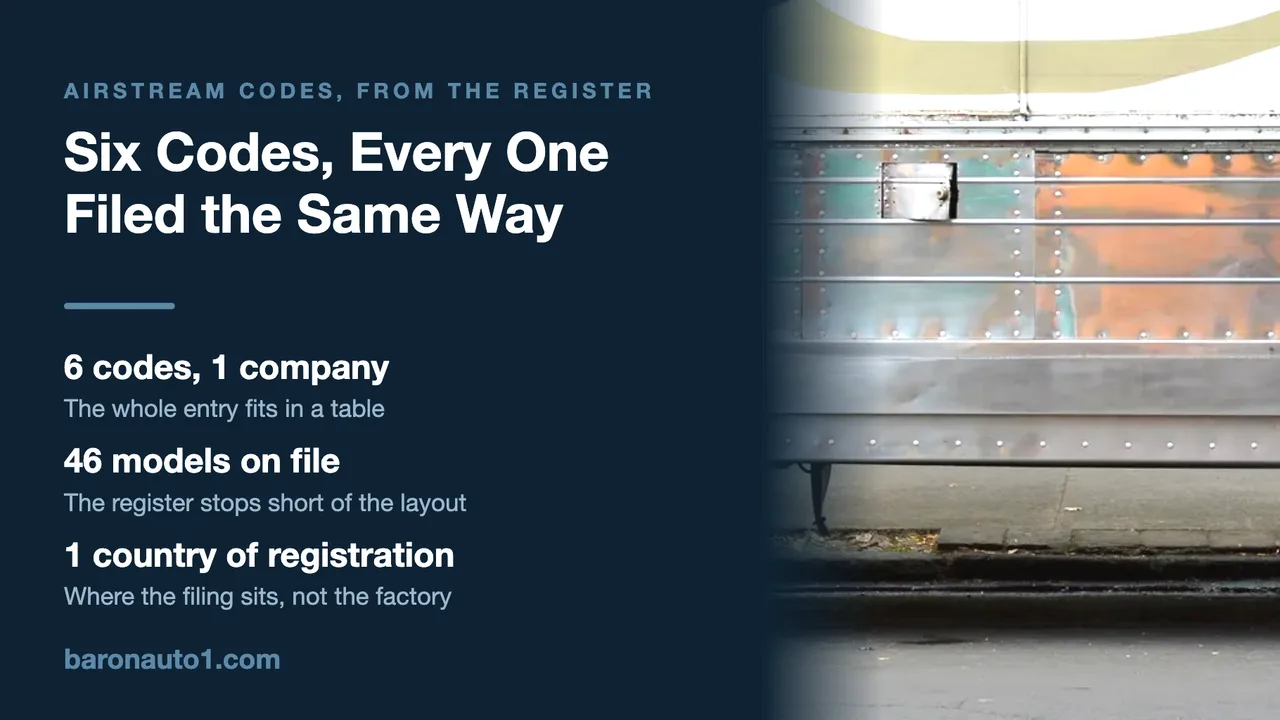
Six codes, one company, one vehicle type. The decode names the builder and the category and stops there.
The short version
- There is no Airstream-only decoder and nothing about this make requires one. Every vehicle certified for this market carries the same seventeen-character number, and a single federal register resolves the manufacturer prefix on all of them.
- The whole entry is six world manufacturer identifiers — 1AB, 1ST, 1SC, 45Z, 4UJ and 1SM. That is short enough to print in full rather than summarise, and this page prints it.
- All six are filed under one vehicle type: Trailer. That word is a federal classification rather than a description, and it is the ceiling of what the type field can tell you.
- One registered company name holds all six codes: AIRSTREAM INC. A decode returns the registrant, not the badge, and here the two happen to read alike.
- The United States is recorded against every code. That field says where the registering entity filed. It is not a statement about where anything was built.
- All six codes carry the same registration date, 21 July 2015. That is a filing date — not a build date, not a model year, and not a sale date. Counting across the 57 make entries read for this site, only one other make with more than one code has every code on a single date.
- A name query against the register returns zero unrelated matches, there is no parent entry behind this make, and the decoder holds 46 models. What no decode carries, here or anywhere: service history, present condition, and whether a recall that was issued was ever actually carried out.
Searching for an “Airstream VIN decoder” implies there is a tool built for this one badge, sitting apart from the tool that reads everything else. There is not. The number riveted to a towable is written to the same federal standard as the number on a saloon car, and the register that turns its first three characters into a manufacturer is the same register that does that job for every make on the road.
What is worth reading instead is the federal entry itself, and this one is unusual in a way that makes it easy to read: it is completely uniform. Six manufacturer codes, one vehicle type, one country, one registered company name, one registration date. Counting across the 57 make entries archived for this site, only six of them are that consistent on all three of type, country and registrant at once, and this is the largest of those six by number of codes. Most entries need summarising. This one can simply be shown.
That uniformity is also what limits the entry. When every code says the same thing, the decode confirms who filed and what category the filing sits in, and then it stops — well short of the questions a buyer is actually weighing up when choosing between one towable and another. This page reads the entry line by line and is equally specific about where it runs out.
One federal system reads every VIN, towed vehicles included
The vehicle identification number is a federal standard, and its layout does not change with the badge or with whether the vehicle has an engine in it. Positions one to three are the world manufacturer identifier, assigned to the legal entity that issues numbers. Positions four to eight are a descriptor block the manufacturer designs for its own purposes. Position nine is a check digit, computed arithmetically from the other sixteen characters. Position ten carries the model year. Position eleven identifies the assembling plant. The last six characters are the serial.
Because that structure is identical across everything certified for sale here, a general decoder handles a towable as readily as it handles a car, and the phrase “Airstream VIN decoder” describes a way of searching rather than a distinct piece of software. Our guide to reading a VIN position by position works through the full layout, and the by-make index collects what the register holds for each manufacturer we have read.
Where a genuinely make-specific decoder would earn its keep is the middle block, and this is the point at which being honest is more useful than printing another table. Positions four to eight are the manufacturer’s own descriptor scheme, and the federal register does not publish the key to it. The register records who holds a prefix, which vehicle class the prefix is filed under, which country the entity filed in, and the date the code was opened. It does not record what a particular character in position six means on one build as against another.
So there is no position-by-position breakdown for this make on this page, and no plant-code list, because we do not hold either from a source we would stand behind. Decoding a real number returns the descriptor fields as the federal system resolves them for that specific vehicle, which is a different and far more dependable thing than a printed key assembled from nowhere in particular. Position ten, the model year character, is the one part of the middle of the number that is standardised across manufacturers, and our VIN year chart converts it.
Six codes, and the entry printed rather than summarised
A VIN opens with three characters the manufacturer does not invent for itself. They are assigned centrally, published in full, and they identify the entity that filed for the right to issue numbers under them. Under this make there are six: 1AB, 1ST, 1SC, 45Z, 4UJ and 1SM.
That table is not an excerpt. It is the entry. Every code the federal register holds under this make appears on it, along with the class each one is filed under and the month the filing was received. There is no continuation, and nothing has been dropped for reasons of space.
It is worth being explicit about that, because it is not the normal case. On a make with forty or sixty registered codes the honest treatment is a set of counts and a note that the list runs long; the reader is asked to trust the arithmetic. Here the counts and the list are the same object. Anyone who wants to check this page against the source can do it by reading six rows.
Four of the six codes begin with the character 1 and two begin with 4. What that leading character does not do is identify a building, a production line or a specific site. The register does not answer that question at all, and neither does this page.
Note also that the six codes are not sequential and were never meant to be. A manufacturer code is a registration, not a serial number. Holding six of them says that six filings exist; it does not say that six of anything else does. Across the 57 entries read for this site the median holding is four codes, so six is a middling number rather than a notable one.
“Trailer” is a federal classification, not a description
Every world manufacturer identifier is filed under a vehicle type. On this make the answer is the same on all six rows: Trailer. There is no split, no second category, and no code filed as anything else.
That word is not an adjective anyone chose in order to describe these vehicles. It is a category out of the federal motor vehicle safety framework, and categories exist because the rules that apply to a vehicle depend on which one it falls into. The classification is doing regulatory work. It is not doing descriptive work, and it was never built to.
The practical meaning of that filing is narrow and useful: it says the vehicles issued numbers under these codes are towed rather than self-propelled, as the federal system categorises them. That is a genuine distinction and it matters — it separates a towable from a vehicle that drives itself, which is a different regulatory animal with a different set of standards attached. It is also, on this entry, the entire content of the type field.
Because the field is uniform, it carries no information that distinguishes one code from another. On a make whose codes divide across two or three types, the type column at least tells you something about which part of the range a number belongs to. Here it tells you the same thing six times. That is not a fault in the data; it is simply the shape of this entry, and reading it as though it were finer-grained than it is leads nowhere.
Counting across the 57 make entries archived for this site, four have every one of their codes filed as Trailer: this make with six, Coachmen with five, Forest River with four and Jayco with one. This is the largest of those four by code count. Our Forest River entry reads the same way on the type column and diverges on almost everything else.
One registered name, on all six codes
The register records, against every code, the name of the entity that filed for it. On this make there is one such name and it appears six times: AIRSTREAM INC.
A decode returns that registered name character for character, capitalisation included, because reporting the registrant is exactly what the field is for. It is telling you which filed entity is entitled to issue that number. It is not telling you who designed the vehicle, who sold it, who warrants it, or whose name is on the paperwork now.
On many makes that distinction is where confusion starts, because the registered name and the badge are different words and a decode appears to return the wrong company. That does not arise here. The registered name contains the make name, so the field reads the way a reader expects it to, and the six codes all point at the same filed entity.
What the register does not carry is anything about that entity beyond the name, the country and the date. It does not record corporate structure, relationships between companies, or anything about how the business is arranged. This site does not fill those in from memory, so the section stops where the data does: one name, six codes, no split.
The United States on every code, and what that field actually records
The country column reads UNITED STATES (USA) on all six rows. A decoder that reports the register faithfully will return it that way, and there are no blanks and no second country in the entry.
Here is the correct reading of that field, and it is narrower than it looks. The country recorded against a manufacturer code says where the registering entity filed. It is a fact about a filing rather than a fact about a production line. A code can be registered by an entity in one country and appear on vehicles put together somewhere else, and the register neither prevents that nor comments on it.
So the honest summary of the country column on this entry is: one country, recorded consistently, describing where the registrant filed. Anything beyond that — where a particular unit was assembled, which site it came out of, whether any part of it travelled — is not in this data and cannot be extracted from it by reading harder.
If assembly location genuinely matters to a purchase, the place to look is the physical certification label on the vehicle and the documentation that came with it, not the manufacturer prefix. That label is a legal requirement rather than a manufacturer courtesy, which is what makes it a dependable place to look.
Six codes, one registration date
Each code carries the date its registration was recorded. On this entry all six carry the same one: 21 July 2015.
That is a registration date. It is not a build date, not a model year, and not the date anything went on sale. A code has to exist before numbers can be issued under it, so a filing date sets an outer boundary and nothing finer. It does not say that vehicles began appearing that month, it says nothing about volumes, and it does not describe what the business was doing at the time. The register records that a filing was received and when. Everything past that is inference, and this page does not make it.
The single shared date is genuinely unusual, and since that is a comparison rather than an observation, here is the count behind it. Across the 57 make entries archived for this site, 40 hold more than one code. Of those 40, exactly two have every one of their codes recorded on a single date: this make, with six codes on 21 July 2015, and Peterbilt, with six codes on 14 April 2015. Every other multi-code entry spreads its filings across at least two dates.
What that shared date supports is one modest reading: these six registrations entered the register together rather than accumulating one at a time. What it does not support is any conclusion about the vehicles themselves. Six codes sharing a filing date tells you about a batch of paperwork. It does not date a product, a range, or a change of any kind, and reading it as though it did is the single easiest mistake to make on this entry.
The consequence for a specific vehicle is that the registration date is not the field to reach for. If you want the model year of a particular unit, that is position ten of its own number, standardised across manufacturers, and the year chart converts the character.
Zero unrelated name matches, and no parent entry
Two administrative points, both of which can be stated flatly and neither of which needs dressing up.
First, a name query against the register returns zero unrelated matches for this make. The register matches company names as text, so on some makes a query on the badge drags in small builders whose own registered names happen to contain the same word, and counting those in or filtering them out changes the total the make appears to hold. Here that number is zero. Across the 57 entries read for this site, 43 come back with zero unrelated matches, so this is the ordinary result and not a distinction. The practical effect is simply that the six codes above are the complete set with nothing to subtract.
Second, this make registers under its own name. Some makes covered on this site do not — their codes are held by a parent group, and a query on the badge alone returns nothing at all, which is a real source of confusion on those pages. That situation does not arise here. There is no parent entry sitting behind these six codes, so there is no second list to reconcile against the first.
Together those two facts mean the entry needs no interpretation before it can be used. What you see in the table is what the register holds. That is worth knowing, because it means any figure that disagrees with six is counting something other than what this page is counting.
Forty-six models in the decoder, and no list on this page
Separately from the manufacturer codes, the federal decoder holds a roster of model names for each make. For this one that roster runs to 46 entries, covering what the decoder knows across all years rather than any current range.
This page does not print those names. The archived pull behind it carries the count and not the list, and we would rather say so than reconstruct a roster from elsewhere and present it as though it had come from the register. Naming models we cannot cite is precisely the failure this site tries to avoid, and a list that looks authoritative while being sourced from nowhere is worse than no list at all.
It matters less than it might appear. Decoding an actual number returns the model for that specific vehicle, resolved by the federal system from the characters in front of it, which is the answer worth having and does not depend on any roster being reprinted here.
The gap between six codes and 46 model names is itself the useful takeaway. A manufacturer code is a registration; a model name is a catalogue entry. There is no requirement that the two scale together, and on this make they plainly do not. Six filings sit underneath a roster more than seven times their number.
Builder and category confirmed, layout not
This is the section that matters most for anyone weighing up a specific towable, so it is worth being blunt about it.
Run a number that opens with one of these six codes and a faithful decode gives you two things with confidence: the registered entity that issued the number, and the federal category the code is filed under. Both are real answers. Neither is the answer a buyer is actually working on.
What a buyer is choosing between, when comparing one towable against another, is the internal arrangement — where the bed sits, whether the layout suits two people or a family, how long the body is, what it weighs loaded, how many axles are under it, what is fitted inside and what has been changed since. The federal register carries none of that. The type field says Trailer on all six codes; it does not divide them by size, by layout or by fit-out, because that is not what a vehicle type is for.
The decode is therefore a confirmation step rather than a research step. It confirms that the number resolves to the builder shown on the advert and to a category consistent with a towed vehicle. If it does not, that is a genuine finding and worth stopping over. If it does, you have verified the frame of the claim and none of its contents.
The contents come from three other places. The certification label on the vehicle is required to carry information the number does not encode, weight ratings among it, and a weight rating is the sort of fact that decides whether a given tow vehicle is suitable at all. The paperwork carries the ownership and title questions. The vehicle itself, inspected properly, carries condition. Our guides to trailer VIN lookups, RV VIN lookups and camper VIN lookups cover where the number is physically located on towed and habitable vehicles, how the numbering differs from what car-oriented decoders expect, and what to do when the number you are shown is shorter than seventeen characters.
What the decode does not carry
Everything above concerns what the register holds. This section concerns what it does not, and for anyone about to hand over money it is the more important half of the page.
A VIN decode does not carry service history. It will not tell you when the vehicle was last looked at, what was done, whether it was done competently, or whether anything was skipped. There is no field for it in the federal data and no decoder can conjure one.
A decode does not carry condition. It resolves what the vehicle was specified as when its number was assigned. It says nothing about what has happened since — wear, water ingress, damage, repairs, replacements, or anything fitted, removed or swapped afterwards. On a towable that gap is wide, because a great deal of what determines whether one is worth buying is a question about the last decade rather than the first day.
A decode does not tell you that a recall was carried out. It is worth separating these two, because the recall lookup and the decode feel like a single operation. They are not. A recall check against a specific number shows whether a campaign is recorded as open or as remedied against that vehicle, which is free, quick and always worth running — our guide to checking a vehicle for open recalls covers how. What it cannot show is whether a previous owner ever presented the vehicle, nor any work done outside the campaign system. Read the campaign text rather than only the status flag.
And a decode does not carry title status, mileage history or the record of what has been reported against the vehicle over its life. Those live in separate systems and have to be asked separately. A free VIN check is a reasonable first pass, and a title check by VIN covers the branding questions a decode is structurally incapable of answering.
A sensible sequence on a specific vehicle
Put together, the order of operations on an individual unit is short and does not take long.
Start by finding the number on the vehicle itself and reading it with your own eyes. Compare it character by character against the number on the title and against whatever the advert says.
Then decode it and read the result for what it is. The prefix will resolve to one of the six codes above, return AIRSTREAM INC. as the registrant, and return Trailer as the vehicle type. Expect the registrant field to give you a filed company name. Expect the type field to give you a regulatory word. Neither is a description of the vehicle, and neither is a fault.
Then check the model year character against what the seller has claimed, run the recall lookup, and run the title check. Between them those three take a few minutes and they address questions that genuinely decide whether a vehicle is worth pursuing further.
Then read the certification label properly, ratings included, and read them against what you intend to tow with. Finally, treat everything the decode cannot reach as a documentation and inspection problem rather than a data problem. Service records, evidence that recall work was done, and a look over by somebody who knows towables are what fill that gap. No decoder fills it.
If you are the one selling
The same material is useful from the other side of the transaction, and it costs nothing to prepare.
A buyer who decodes the number will get back a registered company name and the word Trailer, and may arrive with a question about why the decode says so little. The answer is the one this page has been making throughout: the register records a registrant and a federal classification, and neither was ever a description of the vehicle. Being able to say that plainly, and to point at the entry it comes from, tends to close the question rather than open it.
The more useful step is to supply what the decode cannot. Photograph the certification label clearly enough to read, ratings included. Have the title to hand with the number visible. Keep the service folder in order. A seller who anticipates the questions the number cannot answer looks like a seller worth dealing with, which is a helpful impression to have established before the price is discussed.
Common questions
Is there an official Airstream VIN decoder?
Not a separate one, and none is needed. Vehicles carry the same seventeen-character number regardless of badge and regardless of whether they are towed or self-propelled, and the federal register resolves the manufacturer prefix on the same terms for every make. A general decoder handles this one.
How many manufacturer codes does Airstream have?
Six: 1AB, 1ST, 1SC, 45Z, 4UJ and 1SM. That is the complete entry rather than a selection from a longer list, which is why this page prints all of it.
Why does my decode say “Trailer”?
Because all six codes are filed under that vehicle type, so any number opening with one of them returns it. It is a category from the federal safety framework, describing a towed rather than self-propelled vehicle, and a decoder reporting the register faithfully will return it. Seeing it is not evidence of an error or a wrong number.
Will the decode tell me the floorplan or the length?
No. The register holds the registrant, the vehicle type, the country of filing and the registration date, and nothing about internal layout, body length, weight or fit-out. Those come from the certification label on the vehicle and from the documentation, not from the manufacturer prefix.
Which company name will a decode return?
AIRSTREAM INC., on all six codes. A decode reports the registered entity entitled to issue the number rather than the badge, and on this make the two read alike. The register gives that entity a name, a country and a date, and nothing further, so nothing further is claimed here.
Why do all six codes show the same date?
Because all six registrations were recorded on 21 July 2015. That is a filing date, not a build date, a model year or a sale date, and it means the six entered the register together. Across the 57 make entries read for this site, only one other make with more than one code has every code on a single date.
Does the country field tell me where a trailer was built?
No. It records where the registering entity filed, which is a different question. Every one of the six codes has the United States recorded against it, and that is the whole of what the field asserts. For assembly information, read the certification label on the vehicle.
Does Airstream register under a parent company?
No. The codes are filed under the make’s own registered name, there is no parent entry behind them, and a name query on the register returns zero unrelated matches. The six codes listed here are therefore the complete set with nothing to filter out.
How many models does the decoder hold?
Forty-six, across all years rather than as a current range. The archived pull behind this page carries the count and not the list of names, so no model list is printed here. Decoding a specific number returns the model for that vehicle, which is the answer a buyer actually needs.
Where is the number on a towable?
Usually on the certification label, which is a legal requirement rather than a manufacturer courtesy and is therefore a dependable place to look, and often stamped or plated on the frame as well. Our trailer VIN lookup guide covers where to look and what to do when the number you are shown is not seventeen characters.
Can a VIN check prove a recall was completed?
It can show whether a campaign is recorded as open or remedied against that specific number, which is free and worth running. It cannot prove a previous owner ever presented the vehicle, and it does not capture work done outside the campaign system. Read the campaign text, not just the status flag.
Will a decode tell me the specification or what has been changed?
No. It resolves what the federal system holds for the number — manufacturer, vehicle class, model year and the model line as filed. Fitted equipment, later modifications and anything altered after the vehicle was built sit outside every historical decode, on this make and on all others.
Sources and further reading
- NHTSA VIN decoder
- NHTSA recall lookup
- NMVTIS (US Department of Justice)
- 49 CFR Part 567 — Certification
Recall, complaint and safety-rating figures on this page were retrieved from the federal databases above on August 19, 2026. Federal data changes — re-check any VIN before you rely on it.
Published September 6, 2026 · last updated September 6, 2026. Found something out of date or wrong? Tell us and we will correct it.