Forest River VIN Decoder: Four Codes Against Hundreds of Models
Four codes against 379 models. The decode names the builder and the category, then stops short of the floorplan.
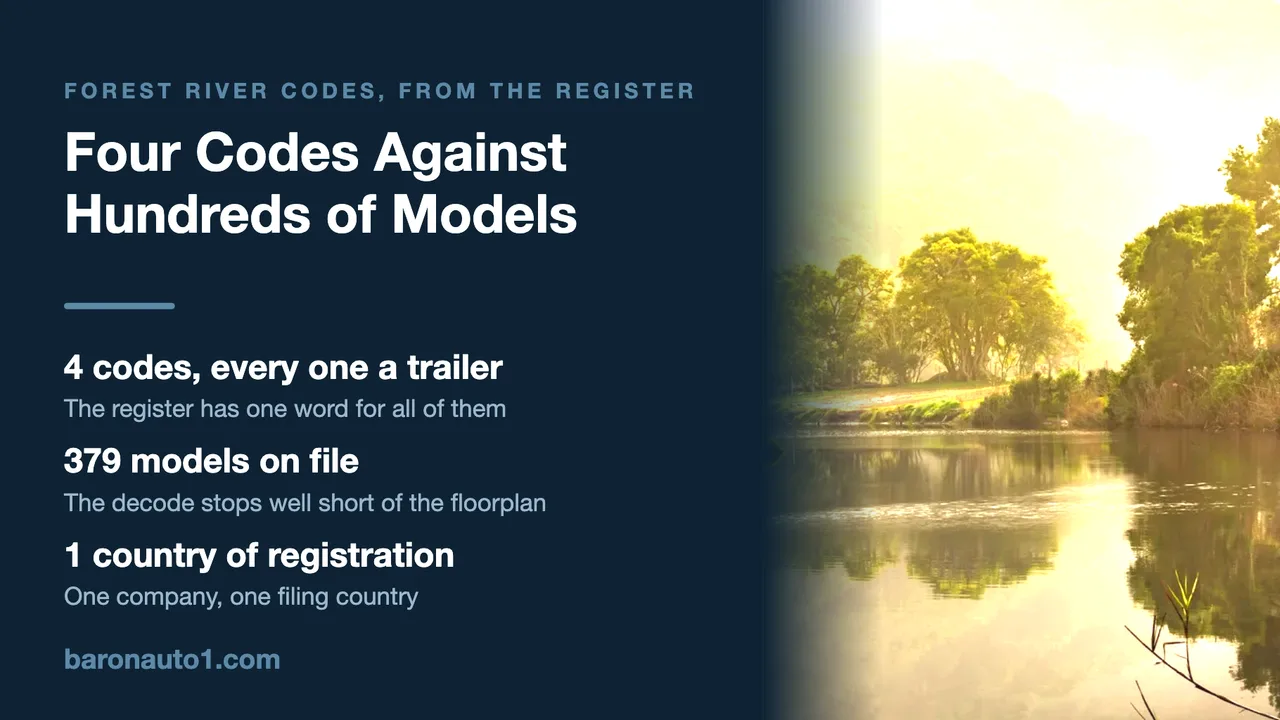
The short version
- There is no Forest River-only decoder, and none is needed. One federal register reads the manufacturer prefix on every vehicle certified for sale here, on the same terms, whatever the badge says.
- The whole entry is four world manufacturer identifiers — 4X4, 5NH, 5ZT and 7L5 — every one of them filed under a single company name, FOREST RIVER, INC., and every one recorded against the United States.
- Every code is also filed under one vehicle type: Trailer. The type column does not move anywhere in this entry, so the class a decode returns is settled before you start.
- 4X4 is an identifier, not a specification. The three characters of a manufacturer code are assigned, not descriptive, and nothing in them describes drive, axles or size.
- Against those four codes the decoder holds 379 model names, gathered across all years rather than as a current range. Four codes and 379 models is the shape of the problem: the decode confirms the registrant and the category, then stops.
- Three codes were registered within three weeks in mid-2015 and the fourth, 7L5, on 28 April 2026. Those are registration dates — not build dates, not model years.
- What no decode carries: service history, whether a recall was actually completed, the condition of the unit in front of you, or the fit-out it left the factory with.
Search for a Forest River VIN decoder and you are offered input boxes, most of them arranged to suggest that this name needs a reader of its own. It does not. The seventeen characters stamped on a towed vehicle are built to the same federal standard as the number on a saloon or a pickup, and the register that turns the first three of them into a manufacturer is one register, serving all of it.
What is worth reading is what that register actually holds for the make, because the shape of this particular entry decides what a decode can and cannot settle. This page works from the entry as it stood when we read it in September 2026: four manufacturer codes, one registered company name, one country, one vehicle type and 379 models. That is the whole of it. None of what follows is a manufacturer briefing, and nothing has been added from memory to make the entry look fuller than it is.
The reason to be careful about that boundary is the gap it exposes. A buyer looking at a towed vehicle is choosing between things — a layout, an axle count, a weight rating, a fit-out, a condition — and almost none of those distinctions live in the number. The decode is genuinely useful for what it does. Being precise about where it stops is more useful still.
One register reads every VIN, towed vehicles included
The vehicle identification number is a federal standard and its layout does not vary by badge. Positions one to three are the world manufacturer identifier, assigned to the legal entity that issues numbers. Positions four to eight describe the vehicle in a scheme the manufacturer designs for itself. Position nine, where the number carries one, is a check digit computed arithmetically from the other sixteen characters. Position ten carries the model year character. Position eleven identifies the plant. The last six are the serial.
Our guide to reading a VIN position by position sets out the full layout, and the by-make index collects what the register holds for each manufacturer we have read.
Where a brand-specific decoder would earn its keep is the middle block, and this is the point at which the honest answer is a gap. Positions four to eight are the manufacturer’s own descriptor scheme, and the federal register does not publish the key to it. What the register records is narrow and reliable: which entity owns a prefix, what vehicle class the prefix is filed under, which country the entity is registered in, and the date the code was opened. It does not record what any given character in position five means.
So this page prints no position-by-position table and no plant-code list, because we hold neither from a source we would defend. A decode of a real number returns the descriptor fields as the federal system resolves them for that specific vehicle, which is a different and far more dependable thing than a printed key. If the number in front of you belongs to a motorhome rather than a towed unit, our RV VIN lookup guide covers how a decode behaves on that class, where the chassis and the body can be two different registrations.
The whole entry: four codes, one name, one country
A VIN opens with three characters the manufacturer does not choose for effect. They are assigned centrally and published in full, and they identify the entity that filed for the right to issue numbers. Under this make there are four of them, and the entry is short enough to print rather than summarise.
4X4, registered on 19 May 2015. 5NH, registered on 5 June 2015. 5ZT, registered on the same day. 7L5, registered on 28 April 2026. All four carry the same registrant name in the register — FOREST RIVER, INC. — and all four are recorded against the United States. There is one name in the divisions list and one country in the country list, and no code sits outside either.
That uniformity is worth stating plainly because it removes a category of worry before it starts. On makes whose codes are spread across several registered entities, a decode can return a company name that does not match the badge, and a name that does not match the badge is easy to mistake for a lookup that has failed. Nothing of that kind can happen here. Whichever of the four codes issued a number, the registrant field returns the same name.
It records where the registering entity filed, not where a vehicle was assembled. It is a fact about a filing cabinet. A register entry that shows one country tells you the entity behind all four codes is registered in one country, and it does not license any statement about which building a particular unit was put together in. The federal data holds nothing finer, and this page will not invent it.
4X4 is an identifier, not a specification
One of the four codes reads like a description of the vehicle. It is not. 4X4 is a world manufacturer identifier, drawn from the same pool of assigned three-character strings as 5NH, 5ZT and 7L5, and its characters carry no more meaning about drive, axles or capability than theirs do.
That matters more than a curiosity, because a number opening 4X4 invites being read as confirming a drivetrain. It confirms a registrant. The characters were allocated; they were not composed to say anything. Anyone building an expectation on a coincidence of shape is building it on nothing, and a decode of the actual number will settle the vehicle’s attributes far better than a pattern spotted in three characters.
The same discipline applies to the leading character across the entry. Read the four codes in order and the first character varies — 4, 5, 5 and 7 — while the country recorded against every one of them is identical. On this make, therefore, the leading digit cannot be used to sort or group anything. It does not separate one country from another here, because there is only one country in the entry, and it does not separate one class from another, because there is only one class. Two numbers that open with different characters can be equally ordinary numbers from the same registrant.
That is a narrow finding and a useful one. Where the leading character does track something is across the register as a whole, not within an entry like this one. Reading it as a within-make signal is the error, and this entry is a clean example of why.
Every code filed the same way: Trailer
The register files every manufacturer code under a vehicle type, and this is where the entry is at its most uniform. Four codes, one type: Trailer. The chart above has a single bar because the data has a single category. There is no passenger-car code, no truck code, no multipurpose code and no motorcycle code in this entry.
What that word is doing is worth being precise about. Trailer is a federal vehicle classification, not a description a seller would use. It is the class the register files the code under, with consequences for which standards and which labelling rules apply. It says the vehicles issued numbers under that code are towed rather than driven. It does not say how long they are, how many axles they run, what they weigh, what they are lined with, or what they were built to carry.
The practical consequence is a decode that arrives already agreed with itself. Whichever of the four codes issued the number, the class comes back the same, so the class field is confirming a category rather than distinguishing between units. That is a real answer to a real question — is this a towed vehicle from this registrant, filed as such in the federal register — and it is not an answer to any question about which towed vehicle it is.
Our trailer VIN lookup guide covers the class in general: how numbers are assigned on towed vehicles, what the certification label is required to carry, and the cases where a small builder’s number is structured differently from the pattern most decoders expect. If you are working on something towed and are not certain a full seventeen-character number even exists on it, start there rather than here.
Four codes, 379 models, and where the decode stops
Put the two counts next to each other and the shape of this entry is obvious. Four manufacturer codes. 379 model names in the decoder’s vocabulary for the make. The codes are the part a VIN’s first three characters can resolve on their own; everything that separates one model from another sits further along the number, in fields the register does not publish a key for.
This is the honest summary of what a decode delivers here: it confirms the category and the registrant, and then it stops — well short of the layout, the axle count, the weight rating or the fit-out. Those are the differences that move the price on a used towed vehicle, and none of them is a field in the manufacturer register.
Two of the numbers in that figure deserve reading together. Four codes against 379 models means the register’s coarse identifiers are doing very little discriminating work, and the decode of a specific number is doing nearly all of it. A code tells you the family the number came from. The decode of the whole number is what returns a model name for the unit you are looking at.
The third number is zero, and it is the count of unrelated companies returned when the register is queried by name. That is covered properly further down; the short version is that there is nothing to subtract from this entry.
Where the useful answers actually live, on a towed vehicle, is the federal certification label rather than the decode. Labelling rules require that label to carry information the number does not encode — weight ratings among it — and a weight rating is the kind of fact that decides whether a vehicle can legally be towed by the car sitting on the drive. Read the label. It is answering a different question from the decode, and often the more consequential one.
379 models, and why this page names none of them
The federal decoder holds 379 models for the make. That is the vocabulary available to a decode of a specific number: the set of model names the system can return when it resolves one.
The pull this page works from carries that count and not the roster of names, so no model list is printed here. That is a rule rather than an omission. Every make page on this site works from one archived read of the register, and we publish what that read contains. Reciting model names from memory would look, to a reader, exactly like reporting the data, and it would not be the data.
One qualification travels with the count, and it comes from the dataset itself: the model figure is what the register holds for the make across all years, not a current line-up. A name in that vocabulary may belong to something built long ago. The count measures the decoder’s reach across the whole history of the entry, not a catalogue you could shop from.
The count is not the useful part in any case. What a buyer wants is the model returned for one specific vehicle, and that comes from decoding that vehicle’s own number. A list would only ever describe the make in general; the decode describes the thing you are being asked to pay for.
And a model name is not a specification. The register knows the model line as filed. It does not know which options were fitted, which layout was chosen, what was added afterwards or what has been replaced since. Our pages on trim level by VIN, options by VIN and build sheets set out how far that can be pushed across manufacturers and where it reliably stops.
Three codes in 2015, one in 2026
Read the four opening dates in order and the entry has an unusual profile. 4X4 was registered on 19 May 2015. 5NH and 5ZT were both registered on 5 June 2015, seventeen days later. Then nothing in the entry for close to eleven years, until 7L5 was registered on 28 April 2026.
What that sequence supports is narrow and it is worth keeping it narrow. It records the order in which four filings were made and the dates on which they were made. The register does not record how many vehicles were issued numbers under any code, so the dates rank the filings and nothing else. A code opened in 2015 is not thereby a bigger code than one opened in 2026, and the gap between them is a gap in filings, not a gap in anything else.
A registration date is also not a build date and not a model year. A code can be opened before any number is issued under it, and can sit in the register unused. Where a specific vehicle’s year is the question, position ten of its own number is the field that answers it, read against our model-year chart. A date attached to a manufacturer code is evidence about a filing and nothing more.
The 2026 code carries one practical consequence that applies to any read of the register, this one included. 7L5 did not exist as a registered code before 28 April 2026, so any read taken before that date resolves three codes for this make rather than four, and would return nothing at all for a number opening 7L5. The lesson is to check the date of whatever register read you are relying on. Ours is stated at the top of this page for exactly that reason, and it will need refreshing in its turn.
No parent group, and nothing to subtract
Two structural facts about the entry are worth recording, mostly because they are the ones that go wrong elsewhere.
The first is that the register’s name endpoint matches company names as text rather than resolving brands. Ask it for a common word and it drags in every unrelated builder whose registered name happens to contain that string, so a raw result can look far larger than a make’s real entry. Querying for this make returns zero such matches. Nothing else on the register is filed under a name that catches the string, so the four codes above are the entry and there is nothing to filter out by hand.
The second is that the make registers under its own name. There is no parent group in this entry and no codes sitting under a parent’s filing. That is not true of every badge — several well-known marques hold no codes in their own right at all, and a search on the badge name returns almost nothing useful for them. Here the badge and the register entry line up, and a decode names the entity you would expect.
One counting rule sits underneath both facts. The four codes here are three-character world manufacturer identifiers. The register also issues six-character codes to low-volume builders, and a raw name query can return those alongside the three-character ones. Our count includes the three-character codes only. Any total for a make needs its counting rule stated beside it, and that is ours.
What the decode will not tell a buyer
This is the section that does the most work on a page like this, because the gap between what people expect a VIN to carry and what it actually carries is widest here.
The number is a build identity. It exists so a regulator can tie a recall campaign to a batch, an insurer can tie a policy to an object and a state can tie a title to that same object. It was never designed to describe a vehicle’s condition today, and it has no field for any of the following.
Service history. Nothing about bearings, brakes, seals, roof maintenance or the last time anything was greased reaches the register, and none of it is encoded in the number. On a vehicle maintained by independent workshops or by an owner on a driveway there may be no central record anywhere — only a folder of receipts, which is worth asking for and worth reading line by line when it appears.
Whether a recall was actually completed. The federal recall lookup will tell you whether a campaign is recorded as open against a specific number, which is free and genuinely worth running. What no decode does is prove that anyone ever presented the vehicle. A campaign showing as remedied means a remedy was recorded; one showing as open means the work is outstanding as far as the system knows. Our guide to checking a vehicle for open recalls covers reading the result properly, including the cases where the flag and the reality diverge.
The fit-out. A decode returns a model as filed. It does not return the layout inside, the appliances, the upholstery, the wiring, the axle rating or anything else that distinguishes one unit from another with the same model name. Nor does it show a change made afterwards — a component swapped, a system upgraded, a fixture removed. Original specification and current specification are two separate claims, and only the first has any chance of living in a record.
Condition and damage that never reached a record. A decode reads the build. Damage enters the file only where an insurer or a state filed something, and work paid for privately leaves no trace at all. Water ingress deserves a specific mention on anything with a roof and sealed joints, because it is progressive, expensive and easy to miss on a forecourt. Our pages on accident checks by VIN and flood damage checks set out which events reach the record and which never do.
Reading the number off the vehicle
Whatever the advert says, the number to work from is the one on the vehicle. Read it yourself rather than copying it from a listing, and read it from more than one place.
On a towed vehicle the number appears on the federal certification label, which is a legal requirement rather than a manufacturer courtesy and is therefore a dependable place to find it. The frame is the other place to look. Our guides to trailer VIN lookups and where the VIN is found cover the locations worth checking, including the ones worth checking on something you suspect has been apart.
Two readings that disagree is a finding, not a transcription problem to shrug off. So is a label that looks newer than the panel around it, a label with fixings that have clearly been disturbed, or a frame stamping that has been ground and restruck. Where the numbers on a vehicle do not agree with each other or with the paperwork, our page on VINs that do not match covers what that means and what to do about it.
Before anything else, run the check digit where the number carries one. Position nine is computed from the other sixteen characters, so a mistyped number usually fails arithmetically before it has cost anybody a journey. Our validator page explains how to run that check by hand, which is worth doing on any number that arrived by text message or was read off a photograph of a screen.
The records that sit around the number
The decode is the cheap part and the fast part. The record is where used-vehicle money is won and lost, and the record is retrieved rather than decoded. It lives in title files, insurer reports and recall databases, keyed to the number rather than encoded inside it.
Three retrievals do most of the work. The federal recall lookup is free, per-vehicle and authoritative on open campaigns. The theft check is also free and answers a question that ends a purchase outright; how to check if a vehicle is stolen covers running it. And the title history — the brands, the state-by-state chain, the readings that entered the record at each titling — is the one that repays paying for. Our title-check page explains what comes back and, just as usefully, what structurally cannot.
Know the boundaries of the free tools before leaning on them. Our page on what a free VIN check actually returns sets out what each one covers, because a clear result from a database that only includes participating members is a weaker statement than it looks. Free checks start the enquiry. They do not finish it.
Where a vehicle carries a brand on its title, the brand is the purchase. What a branded title means ranks the brands by how much each should worry a buyer. Titling practice for towed vehicles varies by state, which is one more reason to read the chain itself rather than a summary line at the top of a report.
A sequence for a used one
Put together, the order looks like this, and none of the first four steps requires leaving home.
Get the full number from the seller and validate it. A number that fails the check digit is a transcription error until proved otherwise, and finding that out early costs nothing.
Decode it. Confirm that the model and model year returned agree with the advert. Expect the registrant to come back as FOREST RIVER, INC. and the class to come back as Trailer, because every code in this entry is filed that way, and treat a result that disagrees with either as a question to put to the seller rather than a conclusion about the vehicle. Re-read the number off the label before drawing any.
Run the free lookups. Recalls and the theft flag are per-vehicle, free and fast, and either can settle the matter from the kitchen table.
Buy the title history once and read the chain rather than the headline: which states, in what order, with what readings and what brands. A short chain with long ownerships reads well. Something that has crossed several states quickly is asking a question the seller should be able to answer without hesitating.
Then do the part no record covers, which on a towed vehicle is most of the decision. Read the number off the certification label with your own eyes and compare it character by character with the number you decoded and the number on the title. Read the weight ratings on that label against what you intend to tow with. Ask for the service folder. And get the structure, the seals, the bearings, the brakes and the tyres looked at by somebody who does it for a living — our page on pre-purchase inspections makes the general case, and the specific case here is that the entire register entry above is silent on every one of those items.
Selling one
The same facts, run in the other direction, cost nothing to use and make a listing harder to argue with.
Publish the number. A seller who prints the VIN is telling every serious buyer that the record will survive being checked. Photograph the certification label clearly enough to read, ratings included, because that single photograph answers questions that would otherwise take three exchanges of messages.
State the decoded model and model year rather than a description, and pull the title history yourself before a buyer does. Leading with a clean chain is stronger than defending one under questioning.
And be ready for the question this page exists to answer: why the decode says so little about the unit itself. The answer is that the register holds four codes, one registrant, one class and a model name, and that everything else — the layout, the fit-out, the ratings, the condition — comes from the label, the paperwork and an inspection. A seller who can say that plainly looks like a seller who has read their own documents.
Common questions
Is there an official Forest River VIN decoder?
Not a separate one, and none is needed. The vehicles carry the same seventeen-character number as everything else certified for this market, and the federal register resolves the manufacturer prefix for every make on the same terms. A general decoder handles it.
How many manufacturer codes does Forest River have?
Four, as the register stood when we read it in September 2026: 4X4, 5NH, 5ZT and 7L5. All four are filed under the single company name FOREST RIVER, INC. and all four are recorded against the United States.
Does 4X4 in a VIN mean four-wheel drive?
No. 4X4 is one of the four world manufacturer identifiers in this entry, assigned in the same way as 5NH, 5ZT and 7L5. The characters of a manufacturer code identify the registrant; they do not describe the vehicle, and nothing about drive or axles can be read out of them.
Why do the codes start with different characters?
Because the leading character is not a within-make signature. The four codes here begin 4, 5, 5 and 7 while the country recorded against every one of them is the same. Two numbers opening with different characters can be equally ordinary numbers from the same registrant.
What vehicle type does the register file these under?
Trailer, on all four codes. There is no other class in the entry. That is a federal classification recording that the vehicles are towed rather than driven; it is not a description of size, layout, axle count or purpose.
Which is the newest code?
7L5, registered on 28 April 2026. The other three were registered in May and June 2015. Those dates record when the codes were opened in the register and say nothing about when any vehicle was built or sold.
Why does a decoder not recognise a number starting 7L5?
Check the date of the register read behind it. 7L5 was registered on 28 April 2026, so a read taken before that date resolves three codes for this make rather than four and holds nothing at all for a number opening 7L5. A decode run against a current read of the register is the fix.
How many models does the register hold for the make?
379, and that is a count across all years rather than a current range. The archived pull behind this page carries the count and not the list of names, so no model list is printed here. Decoding a specific number returns the model for that vehicle, which is the answer a buyer actually needs.
Will a decode tell me the floorplan, the axles or the weight rating?
No. The register holds the code, the registrant, the class, the country and a date, and a decode adds the model as filed. Layout, axle count, ratings and fit-out are not fields in it. The federal certification label on the vehicle carries the weight ratings, and it is the document to read for them.
Does Forest River register under a parent company?
No. The entry sits under its own name, with no parent group holding codes on its behalf, and a name query returns zero unrelated companies. The four codes above are the entry in full.
Can a VIN check show whether a recall was completed?
It shows whether a campaign is recorded as open or remedied against that number, which is free and worth running. It does not prove a previous owner ever presented the vehicle, and it does not show work done outside the campaign system. Read the campaign text rather than only the flag.
Does the country in the register tell me where a unit was built?
No. The country field records where the registering entity filed. Every code in this entry is recorded against the United States, which is a fact about the registration rather than a statement about which building any particular vehicle came out of, and the federal data holds nothing finer.
Sources and further reading
- NHTSA VIN decoder
- NHTSA recall lookup
- NMVTIS (US Department of Justice)
- 49 CFR Part 567 — Certification
Recall, complaint and safety-rating figures on this page were retrieved from the federal databases above on August 19, 2026. Federal data changes — re-check any VIN before you rely on it.
Published September 5, 2026 · last updated September 5, 2026. Found something out of date or wrong? Tell us and we will correct it.