Flood Damage Check by VIN: What the Record Can Find, and the Cars It Never Sees
Seven of fourteen states print the word flood on a title; the rest fold it into Salvage. The federal file keeps the code either way — and never sees the uninsured car at all.
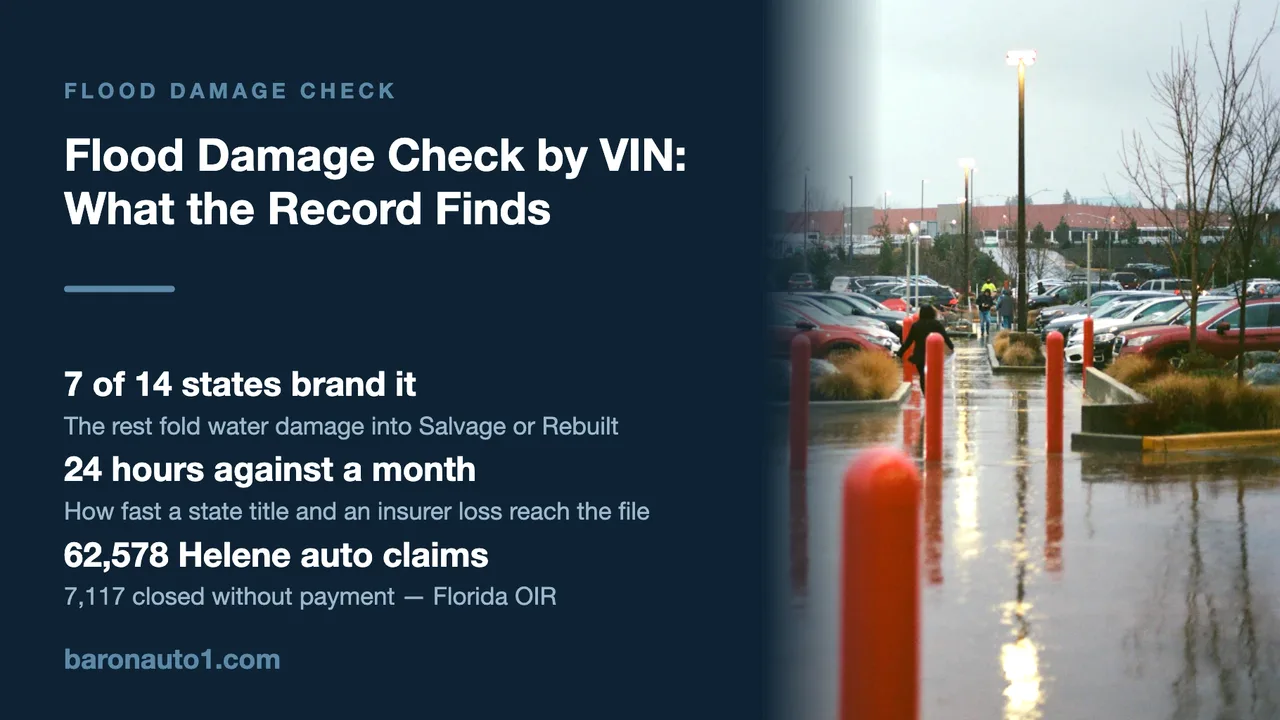
The short version
- A VIN flood check has three possible outcomes, not two: a flood brand on the title, a total-loss record with no cause attached, or nothing at all. Only the first says the word flood.
- That is because two different parties feed the federal record. State titling agencies send every brand at least once every 24 hours. Insurers send total losses monthly, with five required data elements, and the cause of loss is only “strongly encouraged”.
- Of the 14 states we read statute for, 7 print a flood-specific brand. The other 7 fold water damage into Salvage or Rebuilt, or carry it some other way — which is the mechanism title washing runs on.
- The DOJ’s own disclaimer says a car that was never declared a total loss and never branded by a state may not appear in the record at all. The uninsured flood car is the one every check misses.
- Florida’s regulator counted 62,578 private passenger auto claims from Hurricane Helene and 43,397 from Milton. A paid claim is what creates an insurer report; a claim closed without payment usually creates nothing.
- The physical check is therefore not optional. Two annotated images below show where water leaves evidence a record cannot.
Search for a flood check by VIN and the results are mostly input boxes. Type the number, get an answer. What none of them explains is that the answer comes from a record with a specific shape, built by specific parties on specific schedules, and that a great many flooded cars pass through it without ever acquiring the word flood.
This page is about that shape. It works from the federal rule that governs the record, the DOJ’s own description of what a consumer report holds, the statutes of fourteen states, and one open-government storm count. Every figure traces to a page that was fetched and then re-checked by someone told to refute it.
The conclusion is not that the check is useless. It is that a clean result and a dry car are different claims, and the gap between them is where the money is lost.
Two records, not one
The federal title database, NMVTIS, is fed under a rule at 28 CFR Part 25 — issued in 2009 as 74 FR 5776 and amended in 2012 as 77 FR 18916. The rule names flood in its definition of a salvage automobile: one damaged “by collision, fire, flood, accident, trespass, or other event” beyond economic repair, including anything an insurer designates a total loss. That is the only place the word appears in the definitions section. There is no federal definition of a brand, and none of flood damage as a category.
What the rule does define is who reports, and how often.
States must send titling information for every vehicle at least once every 24 hours, and that information must include any and all brands on the certificate of title. This is the lane that carries the word. If a state has put a flood brand on the paper, the federal record has it within a day.
Insurance carriers report monthly, covering vehicles of the current model year and the four before it. Their report carries five required elements: who they are, the VIN, the date the vehicle was designated junk or salvage, who possessed it, and who owned it. The reason — flood, water, collision, fire, theft recovery — is a separate field the rule says carriers are “strongly encouraged” to supply. Encouraged is not required.
Junk and salvage yards also report monthly, with a supplement at disposition or within 30 days of it. Operators handling fewer than five vehicles a year are exempt.
So a car written off for water damage can enter the file two ways. If its state applied a flood brand, the record says flood. If only the insurer reported it, the record says total loss or salvage, and the cause may be blank. Both are real records; only one answers the question you typed.
The DOJ glossary describes a brand as a designation placed on a vehicle ownership document — junk, salvage, and the like — and its consumer FAQ lists the report’s contents as five indicators: current and previous state of title with the title date, brand history, the latest odometer reading, total-loss history and salvage history. Nothing in that list is a cause of loss. See what an NMVTIS report holds for the five indicators in detail.
How fast it arrives, and why the month after a storm is the worst time to check
The cadences above are not trivia. They set the window in which a flooded car can be sold with a clean check.
A state brand is fast, but a brand only exists once a state has retitled the car. An insurer’s total loss reaches the file on a monthly cycle. A yard’s report is monthly too, with 30 days more for the disposition supplement. Reporting for insurers and yards began on March 31, 2009, and the DOJ’s disclaimer notes that while some states report in real time, others send data once every 24 hours or within a period of days.
Put those together and the first weeks after a major flood are exactly when the record is most incomplete. The claim has been filed, the car has been towed, and the file has not caught up. The NMVTIS annual report for the year ending September 2024 says as much about Hurricane Helene: the junk-salvage-insurance figure came in lower than expected despite historic flooding at the end of the reporting period, because the reports had not yet landed.
That report, the sixteenth, gives the scale of what the file is doing the rest of the time: 16.9 million junk, salvage and insurance records in the fiscal year, down 4% from 17.7 million the year before; 15.9 million brand records added; more than 680 million current title records and over one billion title history records; 19 approved data providers running 26 approved websites, with billed consumer transactions up 38% from nineteen to twenty-six million.
What the word flood actually is on the file
A brand travels between states as a number. The DOJ site publishes no list of those numbers — its brand-code address returns a 404 — but the Texas DMV prints a public conversion chart mapping NMVTIS codes to Texas brands, revised 12/2020. On it, code 01 is Flood Damage and code 04 is Salt Water Damage. Their neighbours are 02 Fire Damage, 07 Dismantled, 08 Junk, 09 Rebuilt, 10 Reconstructed and 11 Salvage; code 56, Export Only, was added to the Texas system in a bulletin of 12/14/2020.
The AAMVA data dictionary that defines these codes is an operator document and not public, so it is cited here rather than quoted: it distinguishes fresh-water or unknown-water flooding from salt-water flooding, and it excludes flood from the hazardous-substance code. The distinction matters mechanically — salt is the more destructive — and it matters administratively, because a state with a single flood wording has to translate two codes into one word, and a state with no flood wording has to translate them into something else.
Our guide to what a branded title means orders the brands by how much each should worry a buyer. This page goes one level down, to the code underneath the word, because the code is what survives a change of state.
Fourteen states, fourteen wordings
We read the statute or DMV page for fourteen states. The result is the figure below, and it is the reason the phrase flood title means different things depending on where the car was last titled.
Seven states print a flood-specific brand. Connecticut brands a car “Flood” when it sustained flood damage and an insurer declared it a loss. Maryland carries the conspicuous notation “Flood Damaged” under Transportation 13-507, with salvage set at a 75% repair threshold. Arizona’s ARS 28-2096 authorises a flood or water damage brand. Minnesota’s registrar must record “flood damaged” on the title and every subsequent title. Michigan prints “Flood” on gray-and-yellow paper and carries the brand forward. Wisconsin’s “Flood damaged” has two triggers: water-damage repair above 70% of fair market value, or any submersion at all. New Jersey prints “FLOOD VEHICLE” directly beneath STATUS on the certificate, under N.J.A.C. 13:21-5.6.
Seven do not. California has no separate flood brand; flood is recorded under Salvaged. New York’s salvage definition includes damage from water, or repair above 75% of pre-damage value, but there is no flood word. Nevada uses “Flood Damaged” as a damage type — water above the door sill, or a total-loss water settlement — without flood-specific brand wording on the title. Arkansas prints SALVAGE or REBUILT in the remarks, defining water-damaged as submerged above the door sill. Ohio’s ORC 4505.11, effective June 30, 2021, has no flood brand; the title says REBUILT SALVAGE. Virginia requires an insurer paying a water-damage claim of $3,500 or more to report it, and the Commissioner places an indicator on the record, but we could not find the printed wording on any official text. Georgia issues no flood brand of its own; out-of-state Total Loss, Salvage, Fire, Flood or Water brands carry over onto a Georgia title.
This is the mechanism of title washing, and it is not exotic. A car branded Flood in Michigan is retitled in a state whose paper has no flood wording. The state’s own title now says Salvage, or Rebuilt, or carries the brand only as an imported notation. The NMVTIS record still holds code 01 — brands are permanent in the federal file — which is why the federal check is worth running even when the paper in your hand looks fine. Our used-car history walkthrough covers reading the title itself; this is the part that title cannot show you.
Four ways to run the check, and what each one is asking
The tools that answer to a flood check are not four versions of the same thing. They search different records and a hit means something different in each.
NICB VINCheck is free and takes a VIN. It reports whether a member insurer has recorded the vehicle as stolen and unrecovered, or as salvage or flood-damaged. It searches the member pool and nothing else, which the FTC put plainly in a 2021 alert: the database shows flood damage “but only if the car was insured when it was damaged”. The theft half of the same tool is covered in how to check if a car is stolen.
An NMVTIS approved provider returns the federal consumer report: the five indicators, drawn from every state and every reporting insurer and yard. The DOJ’s FAQ says that as recently as May 2020 fees ranged from $8 to $12.99 per report; a 2018 release put it at approximately $3.00 to $13.00. A hit is a brand, or a total-loss or salvage record — and, as set out above, the second kind may carry no cause. The register of approved consumer providers is public; our provider comparison covers how to read it.
Carfax’s flood check sits on a page titled “How to Avoid Flooded Cars”, under a heading that calls it free. On 3 September 2026 it asked for a plate or a VIN. It searches Carfax’s own records, which is a different population again.
AutoCheck’s Flood Risk Check takes a 17-digit VIN and asks a different question altogether: whether the vehicle was titled or registered in a flood-affected area in the prior 12 months. That is exposure, not damage. A hit means the car was somewhere water was; it does not mean the water reached it. The live page shows no price.
Run the free one and the federal one. The cost is one lookup and one report, and between them they cover the insurer pool and the title file — the two lanes in the first figure. Where the answer is a brand history for a specific car, the title and brand record for that VIN is the place it lives.
What a storm actually produces: claims, not brands
Most flood statistics in circulation are estimates from companies that sell reports. They are not reproduced here. What can be shown is what a state regulator counted.
Florida’s Office of Insurance Regulation publishes catastrophe claims tables by line. For Hurricane Helene, the private passenger auto row stood at 62,578 claims reported as of 10 June 2025, of which 54,822 closed with payment and 7,117 closed without. For Milton, as of 9 December 2025: 43,397 reported, 34,326 closed with payment, 8,946 closed without. Across all lines the totals were far larger — 155,182 for Helene and 385,146 for Milton — but only the auto rows matter here.
The mechanism behind those bars is the whole page in miniature. A claim closed with payment is the event that obliges an insurer to file a total-loss report within its monthly cycle, and may lead a state to apply a brand. A claim closed without payment usually produces neither. And a car whose owner never filed a claim at all — no comprehensive cover, or a flood below the deductible — produces nothing anywhere, unless a state later catches it at retitling.
The federal government has made this point itself. On September 14, 2017, after Harvey and Irma, the DOJ warned that as many as 1 million flood-damaged automobiles could be passed to unsuspecting buyers, and its reporting-entity notice that month described NMVTIS as designed to prevent flood damage being concealed. A 2021 notice, dated October 22, reminded reporters that the Bureau of Justice Assistance may bring civil actions and encouraged daily reporting. For a Florida-specific view of the claim-versus-no-claim branch, the Florida VIN lookup page carries it.
The car the record never sees
Here is the sentence that governs everything above. The DOJ’s consumer access disclaimer, revised September 2022, states that damage may not be included if the vehicle was never determined a total loss or branded by a state. That is the official description of the gap, from the operator of the file.
Which cars fall through it? The uninsured car. The car whose owner paid for the repair rather than claim. The car that flooded below the threshold that makes an insurer total it. The car flooded in a state with no flood brand and then sold before any state retitled it. And the car that was totaled, sold at auction to a rebuilder, and rebuilt in a state whose paper says Rebuilt and nothing about water.
NHTSA’s flood page describes the same population from the other side: a totaled vehicle receives a new title called salvage or flood, and buyers should beware flood-damaged vehicles with clean or lost titles. The FTC’s used-car rule, at 16 CFR Part 455, contains no flood disclosure at all — the words flood, water and history do not appear in it, and salvage appears once. Its only hook is 455.1(a)(1), which makes it deceptive to misrepresent the mechanical condition of a used vehicle. When the Commission amended the rule in 2016 (81 FR 81664, published November 18, effective January 27, 2017), it declined to require dealers to provide NMVTIS reports.
So no federal law makes a seller tell you. The record catches what insurers and states filed. The rest is the physical check.
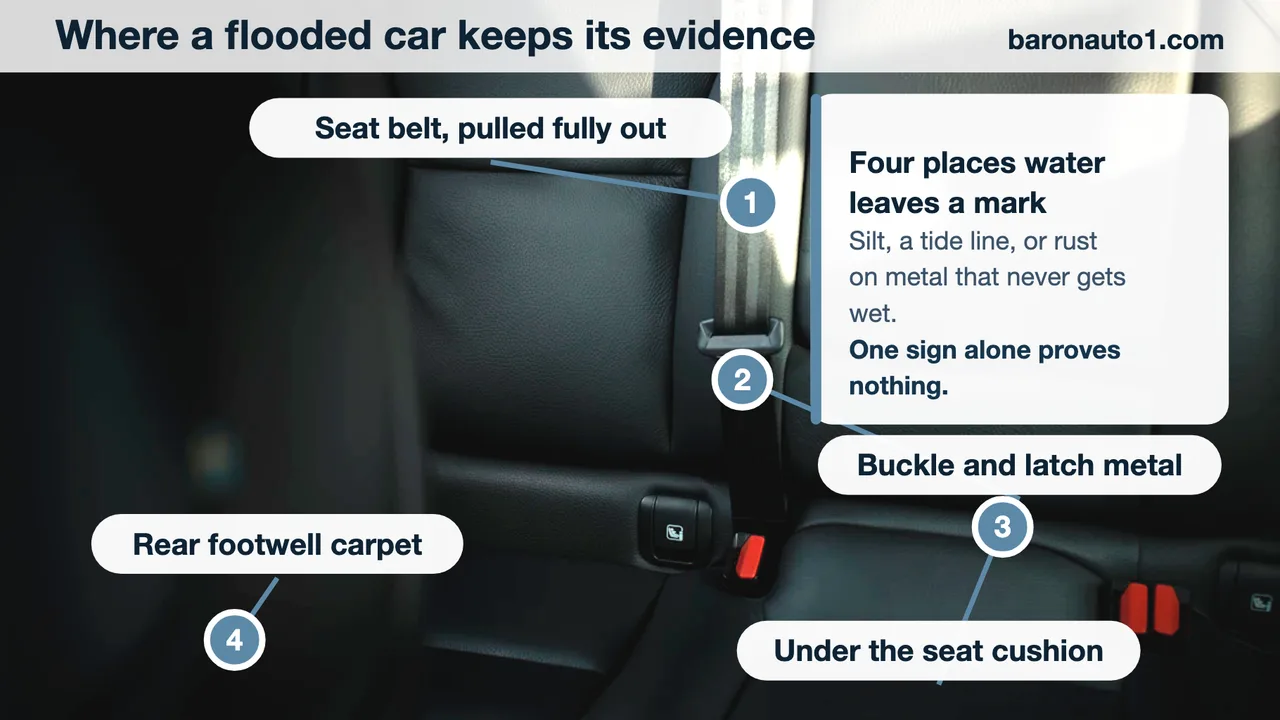
The physical check, keyed to what the record missed
The reason to know how the record is built is to know what to look for when it comes back clean. Water leaves evidence in places a detailer does not reach, and the evidence is the same whether or not anybody filed a claim.
Start with the seat belts. Pull each one out to its full length. Water carries silt, and a belt that sat in it dries with a line across the webbing at the water’s height, often with grit in the weave above the line. The buckle and latch are unpainted metal that never gets wet in ordinary use; rust there is a flag. Lift the edge of the rear seat cushion and look at the seam and the metal beneath it. Pull back the carpet in the rear footwell — it lifts at the sill — and look for mud under it, for a carpet that is newer than the rest of the interior, and for corrosion on the seat-mounting bolts.
NHTSA’s own list runs the same way: a musty smell is a strong indicator of water exposure; mud, dirt and water lines; rust in unusual places. Toyota’s service bulletin T-SB-0229-12, issued November 21, 2012 and revised November 22, 2017, gives a manufacturer’s version of the same idea by grading water damage in five levels by how high the water reached, from the lower edge of the wheel rim upward. The height matters because the repairs a car needs, and the systems that will fail later, depend on it.
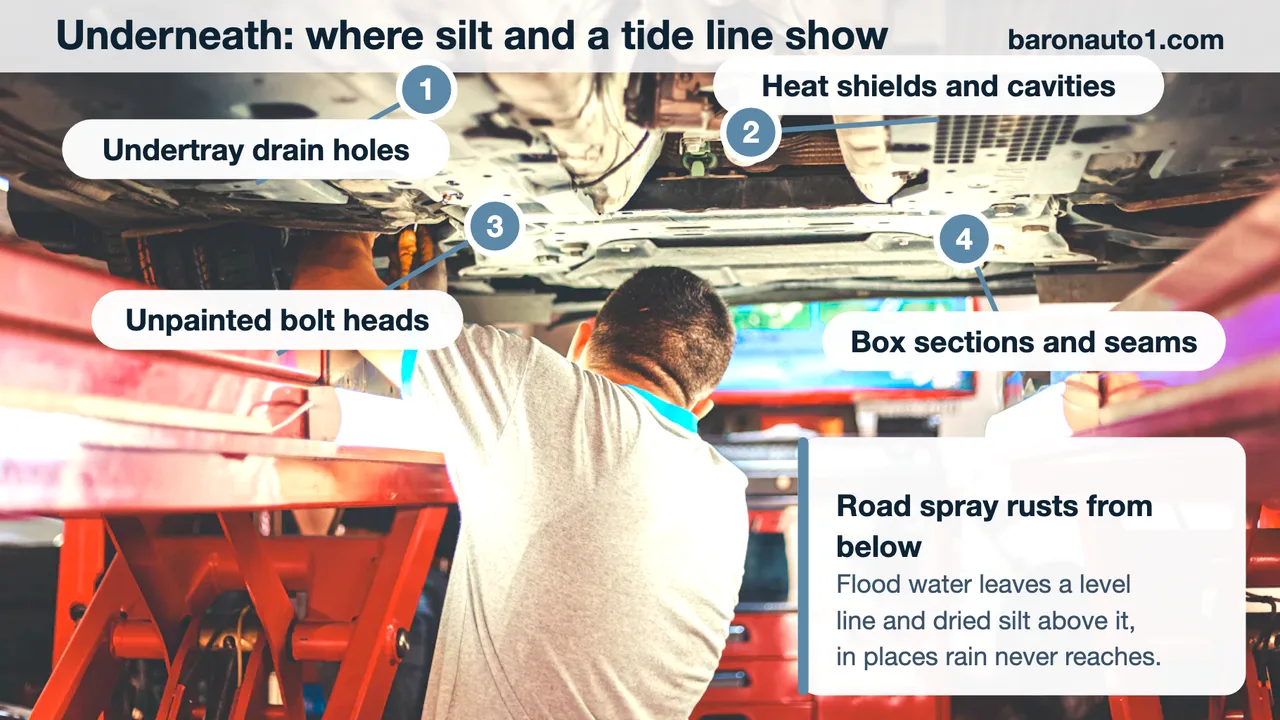
Underneath, the test is direction. Road spray corrodes from below and leaves nothing above the splash line. Flood water leaves a level line, with dried silt on top of it, in places rain never reaches: inside heat-shield cavities, in the drain holes of the undertray, on unpainted bolt heads, along box-section seams. Our guide to rust that is not weather covers the corrosion pattern in detail; the point here is that it is the one form of evidence no record can carry, and no clean check can contradict.
Ordinarily this is where a buyer books a pre-purchase inspection. For a suspected flood car it is not optional: the electrical failures that follow water arrive months later, and an inspector on a lift with a light will see the silt line in a minute.
If the car is electric or hybrid
Water and a high-voltage battery are a different category of problem, and NHTSA’s guidance is unusually direct: do not park a vehicle with a damaged lithium-ion battery in a garage or within 50 feet of a house, other structures or vehicles. The risk is fire, and it can arrive after the water is gone.
A Department of Energy presentation hosted on NHTSA’s site put figures on Hurricane Ian: between 3,000 and 5,000 electric vehicles impacted, around 600 written off as a total loss, and roughly 36 that caught fire, some of them on flatbeds during recovery. Those numbers are the DOE’s, from a January 2024 deck, and are cited here as such.
Manufacturers say the same in their own bulletins. Hino’s SB-21-025 of February 2022 instructs that a flooded vehicle’s battery cables be disconnected immediately and the ignition not be turned on until damage is assessed. For any electrified car with a suspected water history, that bulletin’s logic applies to a buyer as much as a technician: do not test it by driving it.
Water intrusion is a recall subject; storm flooding is not
It is worth separating two things a search for “flood” will return. NHTSA does recall vehicles for water getting where it should not. Campaign 23V337, filed May 11, 2023, covered BMW and MINI Hardtops from 2007 to 2014 and Clubmans from 2008 to 2014 across 29 states and the District of Columbia, for corrosion of the footwell module. Campaigns 18V205 and 18V203 covered the 2018 Alfa Romeo Stelvio for water leaking into the body control module and a liftgate connector. Campaign 25V893 covers 2022 to 2024 Hyundai Tucsons with a Mobis tow-hitch harness, where water reaching a control module carries a park-outside instruction.
Those are design defects that let rain in. They are not the same as a car that sat in a river, and no recall campaign will ever tell you about the second kind. We found no NHTSA-authored count of flood-damaged vehicles on its site; the storm figures that circulate come from insurers and report vendors. Our guide to checking open recalls covers the campaign lookup; for flood, the lookup is a different tool entirely.
What to do with each of the three results
A flood brand is present. Walk away unless you are buying for parts, and price it as parts. The brand is permanent in the federal record and it will follow the car to its next title, whatever a local title says. What a salvage title means covers the insurance and resale consequences.
A total loss or salvage record with no cause. This is the ambiguous result and the common one. Ask the seller directly what the loss was, and ask for the insurer’s paperwork. Then treat the car as a possible flood car and run the physical check above in full, on a lift. A total loss for hail or theft recovery is a different purchase from a total loss for water, and the record will not tell you which.
Nothing at all. A clean check is the beginning, not the end. Cross-check the federal report against the free insurer lookup, because their populations differ. If the car came from a flood state in the year of a named storm, treat the timing as a reason to look harder, not a reason to relax. And do the physical check regardless; it costs a few minutes and it is the only test that catches the uninsured car. Clean is not dry, and that page makes the argument at length.
For the paperwork side of a specific car, the sequence is the free federal decode and recall lookup, the NICB check, then the brand history — a title and brand check against the VIN returns the state-by-state title trail, which is where a washed brand shows as a gap between one state’s wording and the next.
Where these figures come from
The reporting cadences and definitions are from 28 CFR Part 25, Subpart B, read on the eCFR on 3 September 2026. The description of the consumer report, the glossary, the disclaimer and the annual report figures are from the DOJ’s NMVTIS pages, the disclaimer as revised September 2022 and the FY2024 annual report published in August 2025. Brand codes are from the Texas DMV’s public conversion chart. State brand wording was read from each state’s statute or DMV page. The Florida storm rows are the private passenger auto lines of the Florida OIR catastrophe claims tables. The NHTSA guidance, recall campaigns, service bulletins and the DOE presentation were read on nhtsa.gov. The FTC rule and alerts were read on ftc.gov and the Federal Register.
Industry estimates of flood cars in circulation — from report vendors and from the National Insurance Crime Bureau — were reviewed and deliberately not charted, because they are proprietary counts whose method is not published. One is worth a sentence for scale: after Harvey, NICB reported on October 19, 2017 that more than 422,000 insured vehicles had been taken for processing. That is insured vehicles, which is the population the record sees.
Common questions
Does a clean title mean the car was never flooded?
No. A title is one state’s paper. Seven of the fourteen states we read have no flood-specific brand, so a flooded car retitled there can carry a title with no flood word on it. The federal record keeps the brand as a code, which is why the NMVTIS check matters even when the title looks fine.
Can a flood title be removed?
Not from the federal record. Brands are permanent there and the operator may not allow a prior junk or salvage report to be deleted. What can change is the wording on a new state title, which is a different thing and the reason title washing exists.
Can a vehicle history report always detect flood damage?
No, and the DOJ says so in its own disclaimer: damage may not be included if the vehicle was never determined a total loss or branded by a state. Uninsured cars and cars repaired without a claim are outside every record.
Is NICB VINCheck free?
Yes. It takes a VIN and reports whether a member insurer recorded the car as stolen and unrecovered, or as salvage or flood-damaged. It covers member insurers only.
What does a flood title mean?
It depends on the state that issued it. In the states that print one, it means the state recorded flood or water damage on the title; the trigger ranges from an insurer-declared loss to any submersion above the door sill. The federal code underneath it is 01 for fresh or unknown water and 04 for salt water.
Which states brand flood-damaged cars?
Of the fourteen we read: Connecticut, Maryland, Arizona, Minnesota, Michigan, Wisconsin and New Jersey print a flood-specific brand. California, New York, Nevada, Arkansas, Ohio, Virginia and Georgia do not, though several record water damage under salvage or as an indicator.
Does Carfax show flood damage?
Carfax runs a flood check on a page titled “How to Avoid Flooded Cars”, which took a plate or a VIN when we read it and searches Carfax’s own records. Whether a given car appears depends on whether anything about it reached Carfax, which is a separate population from the federal file and from the insurer pool.
What is title washing?
Retitling a branded car in a state whose title wording does not carry the brand, so the paper looks clean. The federal record still holds the code. Checking it, rather than the paper, is the defence.
Sources and further reading
- 28 CFR Part 25 Subpart B — NMVTIS reporting rules (eCFR)
- NMVTIS (US Department of Justice)
- NMVTIS approved data providers
- Understanding an NMVTIS Vehicle History Report
- TxDMV salvage vehicles and title brands
- NHTSA flood-damaged vehicles
- NICB VINCheck
- FTC used car buying guide
- NHTSA recall lookup
- Florida Office of Insurance Regulation — catastrophe claims tables
Recall, complaint and safety-rating figures on this page were retrieved from the federal databases above on August 19, 2026. Federal data changes — re-check any VIN before you rely on it.
Published September 3, 2026 · last updated September 3, 2026. Found something out of date or wrong? Tell us and we will correct it.