VinCheckUp Review: Is It Legit, What It Costs and Who Runs It
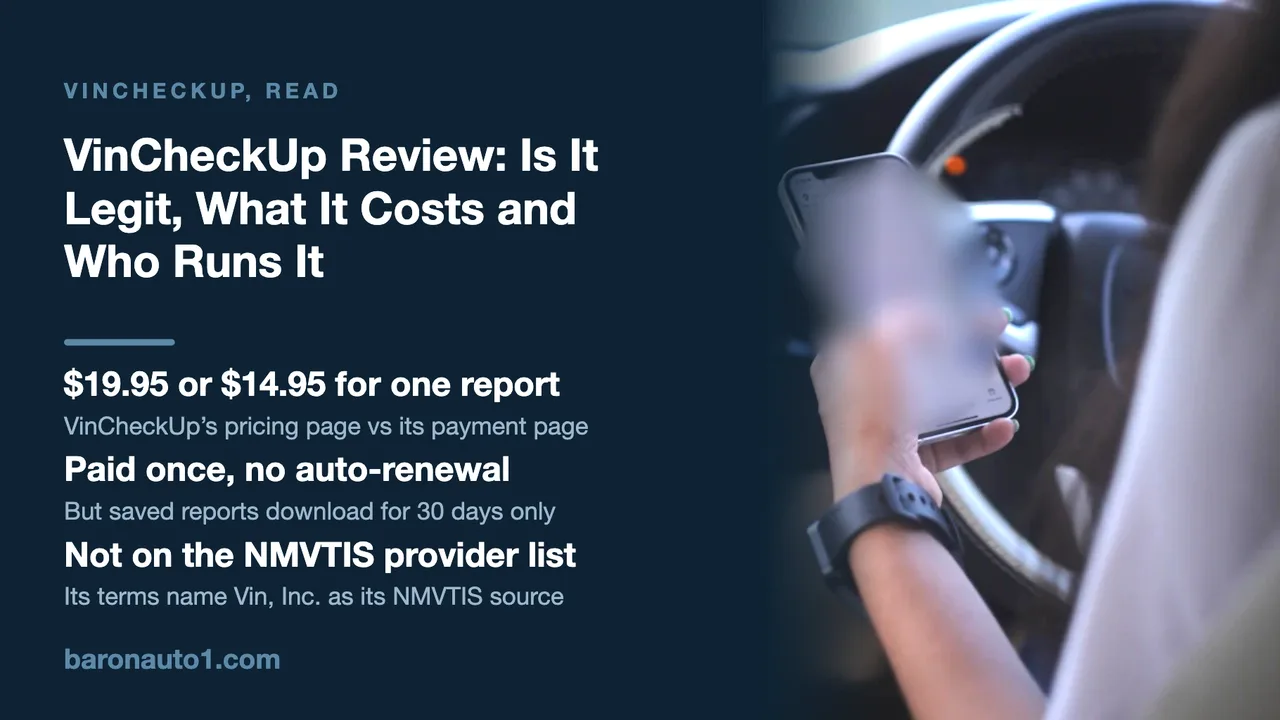
Pay once, no renewal, but two prices for one report ($19.95 and $14.95), a 30-day download window, refunds case by case within four weeks, and a seller not on the NMVTIS list. Read from VinCheckUp’s own terms.
The short version
- VinCheckUp is a long-running VIN report site: its domain was registered in 2012 and its iPhone app dates from 2018. Its own pages name no company. Apple lists the app’s seller as Cartrest LLC, and Google Play lists the developer as Cartrest Labs.
- It is not on the federal NMVTIS approved-provider list as this site has recorded it. VinCheckUp’s terms say its title data comes through “Vin, Inc.”, which they call “the authorized provider of NMVTIS data”.
- You pay once. VinCheckUp’s FAQ, terms and support page say there is no recurring billing or automatic renewal, and the FAQ says there is no trial. Packs come in 1, 3 or 10 reports.
- Its own pages disagree on the price of one report: $19.95 on the pricing page, $14.95 on the register page that carries the card form, both read on 9 October 2026.
- Access runs out. Saved reports can be downloaded for 30 days from purchase, and the privacy policy says search history is deleted after that, so save each report the day you run it.
- Refunds are case by case, for first-time buyers, within four weeks. The terms also say you are charged for every report you order, even one that finds nothing.
Is VinCheckUp legit? It is a real, long-running seller of VIN reports that charges once rather than by subscription, but it is not a federally approved NMVTIS provider in its own name, it says little about who owns it, and its pages print two prices for the same report. Everything below was read on 9 October 2026 from the documents that state it: VinCheckUp’s terms and conditions, FAQ, pricing page, register page, sample report and a dozen other VinCheckUp pages; its App Store, Google Play and BBB listings; and this site’s own records of the NMVTIS provider register. We did not enter a VIN or buy a report, and we have no commercial relationship with VinCheckUp or any report seller.
Is VinCheckUp legit? Who is behind it
VinCheckUp says little about who it is. Its terms, privacy policy, about page and support page call the business “VinCheckUp”, the footer reads “© 2026 VinCheckUp. All Rights Reserved.”, and the contact details are a support email, a phone line and a Las Vegas, Nevada mailing address. No company name with LLC or Inc. after it appears on those pages.
The names turn up elsewhere. Apple’s App Store listing for the VinCheckUp app gives Cartrest LLC as seller, developer and copyright holder, and its privacy link points back to vincheckup.com. The Google Play listing names the developer as Cartrest Labs, and its support address carries a third name, Previlon. That name also appears on VinCheckUp’s own used-car checklist page, inside the referral tag (“Previlon Corp.”) on its links to Edmunds listings. And the terms name a fourth business, Vin, Inc., as the source of their federal title data. VinCheckUp does not explain how these names relate, and we did not search state company registries, so we report only the names and where each appears.
Age is easier to establish. The WHOIS record for vincheckup.com shows the domain was registered on 1 October 2012 (registrant not shown), so it has existed for 14 years (our arithmetic). Apple’s version history starts with version 1.0 on 27 August 2018, and records a “Switch to In-App Purchases” in 2019. The BBB opened a file on VinCheckUp.com in June 2024, rates it A for “Length of time business has been operating”, and shows it is not BBB accredited. The street address BBB lists is in Las Vegas but is not the one on VinCheckUp’s own pages.
So “legit” gets a narrow yes: an established site that sells reports and puts its terms in writing, but without a named company standing behind those terms, which send any dispute to arbitration in Nevada.
Is VinCheckUp an approved NMVTIS provider?
The Department of Justice keeps a public list of businesses approved to sell reports from the National Motor Vehicle Title Information System (NMVTIS), the federal title-history database. This site recorded that list on 31 August 2026, when it named 14 consumer-facing providers and 3 that sell only to dealers, and again on 3 October 2026, when its public section held 12 entries. VinCheckUp is not among the provider names on either reading, and neither is “Vin, Inc.”.
VinCheckUp does not claim to be on that list. Its terms say the title, junk, salvage, insurance and brand records in a report’s “Problem Check” section are “compiled from data in NMVTIS”, that “the process of compiling the report through our connection with NMVTIS has been tested and approved by AAMVA”, and that “Vin, Inc. is the authorized provider of NMVTIS data.” Read together, that describes a reseller buying NMVTIS records through another company. Its FAQ agrees: “We pay for each record, but since we buy data in bulk, we can pass on the savings to our subscribers.”
Reselling is common and not improper in itself; our guide to Carfax alternatives explains why the same records turn up on many storefronts. Two cautions apply. First, the register lists providers by website name, and under some providers it also lists other sites they own; this site’s records do not transcribe every one of those sub-lists, so a mention of VinCheckUp inside one cannot be ruled out. Second, a listing is not an endorsement; the register says providers appear “in alphabetical order with no preference indicated of one provider over another.” If the federal title record is what you mainly want, our NMVTIS report guide explains what it holds and how to buy it from a listed provider.
What the free VinCheckUp check shows, and what needs payment
VinCheckUp’s homepage calls its search box an “Instant free VIN Check USA”. The free part is a first step, not a report. Its how-it-works page says it searches “our preliminary database”, shows a page with your vehicle’s information, and sends you to the register page if you choose any history details: “To view full results you will need to register by providing your personal information.” Registering is where you pay.
The terms set the limits of the free stage in one paragraph headed “Preliminary searches”. The free preliminary and VIN decoder searches “may provide some basic information”, are “intended only to verify basic vehicle information”, and you agree that their results “may not fully match the results obtained from the paid Vehicle History Reports”. We did not run a search (it needs a VIN, which we do not enter, and VinCheckUp’s robots.txt closes its /results/ and /loading/ paths to automated tools), so we describe the free check only in VinCheckUp’s words.
Some things are free without a search: a used-car buying checklist VinCheckUp calls “This free resource”, and loan, lease and depreciation calculators. The window-sticker tool is less clear: its steps end with “View Results Free”, but its FAQ points you to “current pricing and availability details for the Window Sticker Lookup feature”. Our guides to window stickers by VIN and free VIN checks cover the routes that cost nothing.
One phrase needs care. The terms mention an “Unlimited VIN Search Access” and say it “applies to VIN decoder searches only.” Full reports are separate: “Depending on the type of membership purchased our full Vehicle History Report/s may require additional per report payment.” A Google Play review from 4 December 2019 complained that “unlimited searches for 30 days” still meant paying more. One customer’s account proves nothing, but the terms say the same in VinCheckUp’s own words.
How much VinCheckUp costs: two prices for one report
VinCheckUp sells packs of reports, not a plan. Its terms say the price chosen “is always clearly displayed on the checkout page.” Two pages print packs without a VIN being entered: the pricing page, and the register page that the site’s “Register” link opens, which carries the card form. Apple lists the app’s own items. Every figure, as printed on 9 October 2026:
| Pack | Pricing page | Register page (card form) | iPhone app (in-app purchase) |
|---|---|---|---|
| 1 report | $19.95 | $14.95 | “Full Vehicle History Report” $19.99; “Vehicle History Report” $9.99 |
| 3 reports | $29.95, shown as $9.72 a report, “instead of $44.85”, “Save 35%” | Full amount $29.95, shown as $9.72 a report, “35% OFF” | none listed |
| 5 reports | none listed | none listed | $39.99 |
| 10 reports | $49.95, shown as $4.99 a report, “instead of $149.50”, “Save 66%” | Full amount $49.95, shown as $4.99 a report | $49.99 |
One report has two prices. The pricing page says $19.95; the register page, where the card details go, says $14.95, a $5.00 difference (our arithmetic). We did not see the checkout reached after a VIN search (VinCheckUp’s robots.txt closes its /vin-register/ path, and we enter no VINs), so it may show either figure or another one. The figure that binds you is the one beside the card form at the moment you pay.
The per-report figure on the 3-pack is not what the pack costs per report. Both pages print $9.72 a report, but the full amount charged is $29.95, which is $9.98 a report when divided by 3 (our arithmetic). The $9.72 appears to be 35% off $14.95, the register page’s single price. Likewise the “instead of” figures on the pricing page, $44.85 and $149.50, are exactly 3 and 10 times $14.95, not the $19.95 that same page prints for one report. Against its own “instead of” figure, “Save 35%” works out at a 33.2% saving and “Save 66%” at 66.6% (all our arithmetic). The gaps are small: read the full amount, not the per-report line.
The app is priced separately. Apple lists four in-app items that match none of the website’s packs and does not say what each contains.
VinCheckUp’s “how we are different” page says competitors “charge as much as $44.95 per report” while its reports cost “as low as $4.99 each”, naming no competitor, date or source. State sales tax may be added, and the terms say prices can change “at any time without notice.” We do not compare other companies’ prices here; for Carfax’s, see how much a Carfax report costs.
No subscription, no trial, but a 30-day clock
On billing, VinCheckUp’s pages agree with each other. Its FAQ answers “Will my VinCheckUp subscription automatically renew?” with “VinCheckUp.com does not support the practice of monthly billing or automatic membership renewal.” It answers “Do you offer a trial subscription?” with “VinCheckUp.com does not offer any trial subscriptions.” The terms put it most plainly: “you pay only once. You will never be automatically billed on monthly basis.” The support, pricing and register pages repeat it, and no page we read says otherwise.
The terms still use the word “subscription” (“Membership is on a non-recurring subscription basis”), but under its own wording there is nothing to cancel: the register page says “Your membership will automatically deactivate when your 30-day access pass expires.”
That 30-day pass is the catch. The pricing page and the terms say saved reports are “available for download for 30 days from your original purchase date” and that “You must be an active member in order to access your search history.” The privacy policy says search history “is stored for 30 days ... after which time it is deleted.”
Download every report the day you run it. VinCheckUp does not bill you again, but it does not keep your reports either. Its pages tie membership and saved reports to the same 30 days from purchase and do not say that unused report credits outlast them, so plan to use a pack inside that window.
Two more lines in the terms decide what you get for your money. You are charged for each report “regardless of whether such Vehicle History Report yields any results, and regardless of whether such Vehicle History Report or record therein contains incorrect information or no information at all.” And payments go “through a third-party bill processor”; VinCheckUp says it stores no card details itself.
What a VinCheckUp report contains, and where VinCheckUp says the data comes from
VinCheckUp’s FAQ answers “What will my vehicle history report include?” with 34 items: title state and brands, mileage readings and odometer rollback, theft, possible bank liens, sale dates and amounts, number of previous owners, taxi, police, rental and government use, lemon, rebuilt, junk, flood, fire and vandalism checks, repair history, recalls, gray-market and VIN-replacement records and “TMU record Check” (true mileage unknown), “and more...”. The homepage adds that title records cover “over 60 title brands” and that “Vehicle sale listing and auction images may be available”.
The key words are “may include”: this is a menu of record types VinCheckUp can show when a source holds one, not what your report will contain. Its title-check page adds that a title check “cannot reveal unreported accidents or mechanical issues.”
On sources, VinCheckUp names more categories than companies. Gathered from its own pages, it says its data comes from:
- NMVTIS, first. The FAQ says “primarily most of the records and data we obtain from NMVTS” (sic), and the terms say the Problem Check title and brand records are “compiled from data in NMVTIS”, supplied through Vin, Inc.
- Insurance data. The pricing page says title event and accident data is “gathered from NMVTIS and National Insurance registered across all 50 states”; the about page speaks of events “reported by all insurance companies in all 50 US states”.
- Auctions and dealers. The “how we are different” page claims access to “data sourced from dealer-only insurance auctions and broker services”, and images sourced “from popular online car sale websites, insurance, and wholesale auctions”.
- State records. The lien page mentions “DMV records, insurance companies, and salvage yards”, and the history-check page “dozens of private and government data sources” and “live data feeds”.
None of these pages names an insurer, an auction house or a data vendor other than NMVTIS and Vin, Inc. The terms then set the limit on all of it: VinCheckUp “neither enters nor validates the data in NMVTIS”, does not “guarantee the accuracy or completeness of the data presented”, and says “Data availability is largely dependent on sources from which the information is aggregated.” Its lien page advises contacting “your local DMV or relevant governing body to verify this information.” Read a blank section as “no record reached this seller’s sources”, not “nothing happened”, and check a lien with the state, as our lien-check guide explains.
The FAQ and terms also promise that reports “will not contain the vehicle owners name or address”; previous-owner data is limited to the number of owners, how long each kept the car and other “non-owner identifying” details.

The sample report, read line by line
VinCheckUp publishes a full sample report on an open page. It shows a 2019 Hyundai Sonata SE in 16 sections, from specifications and market pricing through ownership, title, accident, total-loss, recall, theft, lien, sale and odometer records to a problem checklist and a warranty check. The summary at the top reports 2 accidents, a salvage title brand, 3 owners, 4 problems and 1 recall.
Read it as a layout, not as a real car’s history. The warranty section shows a different VIN from the one in the header and a “Today’s date” of 15 November 2023. Its total-loss section lists a “Vehicle written off as a Total loss”, while the checklist row “Record of Totaled” reads “No problems found!”. And its bank-lien section prints a debtor’s name and a license-plate number, despite the promise in the terms and FAQ that reports never carry owner-identifying information. These are made-up values, so they prove nothing about real reports, but they reward slow reading. The sample also teaches four things:
- Owner counts are estimates. The ownership section is headed “The number of owners is estimated”.
- Accidents come from “available sources”. That is the accident section’s own caption. A car can be damaged without any source reporting it; see our guide to accident checks by VIN.
- Sale records are listings. The sale section “lists historical sale listing from available independent sources”, with listing prices and mileage. An asking price in an advert is not a recorded sale.
- The checklist is mostly empty by design. The problem checklist has 60 rows; in the sample, 5 flag something and 55 read “No problems found!” (our count). A long run of green rows means those record types were not found, not that the car is clean.
Two smaller signs of an unfinished page: the homepage and the sample both carry the line “Placeholder content for Commercial User History.”, and the checklist lists “Record of Hall damage”. Our walk-through of a sample vehicle history report reads Carfax and AutoCheck samples the same way.
Refunds, the guarantee and the ClickBank route
VinCheckUp’s general sitemap lists no refund page; its refund terms sit in one section of the terms, headed “Satisfaction guarantee”, which opens: “Our service comes with a 30-day satisfaction guarantee for first-time subscribers.” A few lines later: refunds “are handled on a case-by-case basis”, and “Our refund policy is limited to four weeks. We will not be able to issue a refund after the 4-week period”. Four weeks is 28 days, 2 fewer than the 30 in the opening sentence (our arithmetic). Ask inside 28 days and both readings agree.
The same section narrows who can ask. The guarantee “is only applicable to customers subscribing for the first time”, and is “not applicable to any and all users/customers that have declines or are in violation of any of our legal disclosures or policies.” So the register page’s “100% RISK FREE Test Drive” is marketing; the terms decide. They also charge for reports that find nothing, and their opening paragraph says your “remedy for dissatisfaction” is “to stop using the site”. Nothing in the documents makes a refund a right.
To ask, use the contact form on VinCheckUp’s support page, which says it will reply “within 24 business hours”. Include your order number and the search in question, as the support page asks, and write from your account’s email address, which the privacy policy says is how support confirms who you are. The documents disagree on opening hours. The terms say “We’re open every day 9am - 6pm and 11am - 2pm EST on weekends”; the support page lists Monday to Friday 9am to 6pm, Saturday 11am to 2pm, and “Sunday: Closed”.
If ClickBank charged you, a different policy may apply. VinCheckUp’s sitemap lists a second landing page, vincheckup.com/cb/, where ClickBank’s badge reads “ClickBank is the trusted retailer for www.vincheckup.com” and promises “We’ll make it right.” ClickBank’s return policy, dated 26 August 2026, says ClickBank “will, at its discretion, allow for the return or replacement of any product within 60 days from the date of purchase”, that sellers may offer other windows, and that buyers should “refer to a seller’s return policy before purchasing”. We did not reach a ClickBank order form for VinCheckUp, so we cannot say which window applies. Your receipt names the company that charged you; quote that company’s policy.
If you bought inside the iPhone app, the item was an Apple in-app purchase, and VinCheckUp’s terms do not say how app purchases are refunded.
The terms of use, and how disputes are settled
VinCheckUp’s terms carry no effective date, and they reserve “the right to change these Terms and Conditions from time to time without any notice”; continued use counts as acceptance. The clauses that matter if something goes wrong:
- Arbitration in Las Vegas. “Any dispute concerning the Services, the Data, or this Agreement will be settled by binding arbitration in Las Vegas, Nevada, in accordance with the Commercial Arbitration Rules of the American Arbitration Association.” You waive a jury trial. The clause then calls itself “voluntary and not legally required”, wording VinCheckUp does not explain.
- Fees for fee disputes. If either side starts arbitration or a legal action “concerning the payment of our fees or costs advanced hereunder, the prevailing party will be entitled to collect its reasonable attorneys’ fees”. A formal dispute over a charge risks paying the other side’s lawyers.
- As is. Everything is provided “AS IS” and “AS AVAILABLE” without warranty, and the data disclaimer says reports “may not substitute an actual vehicle inspection.” The NMVTIS section of the terms puts it more strongly: a vehicle history report “is NOT a substitute for an independent vehicle inspection.”
- Personal use, one account. You must be 18 or older; you “may not transfer or share your account with anyone”; and apart from “a single copy made for personal use only”, you may not copy or republish anything from the site without permission.
The version we read has no clause capping VinCheckUp’s liability at a fixed sum, no class-action waiver (GoodCar’s terms include one) and nothing about chargebacks. For a small charge, the practical route is the support form inside the four-week window.
VinCheckUp reviews: BBB, the app stores and the affiliate question
These are each platform’s public figures on 9 October 2026: counts and averages, not verified findings.
| Platform | What it shows | What to know before reading it |
|---|---|---|
| BBB rating | A; not BBB accredited | BBB’s only listed reason: “Length of time business has been operating”. File opened June 2024 |
| BBB complaints | 1 in the last 3 years; 0 in the last 12 months | Type “Service or Repair Issues”, status “Answered” |
| BBB customer reviews | Not read | The page served a bot check, which we do not get around |
| Apple App Store | 4.2 from 41 ratings | This site recorded 4.21 from 39 ratings on 2 September 2026 |
| Google Play | 3.7 from 35 reviews; 1K+ downloads | Listing last updated 24 September 2025 |
The one BBB complaint. Filed on 25 June 2024, it says a purchased report listed the wrong engine type, had no service history and showed a truck as accident free, while another company’s report showed a damage record; the customer asked for a full refund. VinCheckUp answered the next day by quoting its disclaimer that reports “may not substitute an actual vehicle inspection”, describing itself as “an information broker”, and saying the order was a bundle of several report credits that the account had gone on using. BBB’s status “Answered” means the business replied but the customer did not accept the response or did not confirm satisfaction. It is one person’s account, not a finding, and BBB says the nature of complaints and responses “are often more important than the number of complaints.”
The app stores. Both ratings rest on a few dozen reviews gathered over years, so they say little either way.
Reading other VinCheckUp reviews. VinCheckUp’s partner page offers “Massive 65% Commissions” to sites that send it buyers: “you will earn 65% commission on the selected purchase price.” It describes a referred buyer’s route: search box, “preliminary/teaser results”, then the register page for payment. When you read a VinCheckUp review elsewhere, check whether its links are referral links. This site is not a VinCheckUp affiliate, and none of our links pay us.
VinCheckUp vs Carfax and GoodCar: the printed terms side by side
We do not rank report sellers or compare their prices. What we can compare is what each company’s own documents say about paying, renewal, refunds, disputes and the federal register, from this site’s records with their read dates. GoodCar is included because it uses the other common model, a subscription.
| VinCheckUp | GoodCar | Carfax | |
|---|---|---|---|
| How you pay | Once, for a pack of 1, 3 or 10 reports | A paid trial, then billing “on a recurring monthly basis unless and until you cancel” | Once, for a package of 1, 2 or 4 reports |
| Renewal | “You will never be automatically billed on monthly basis” | Renews from the “NEXT BILLING DATE”, then “EVERY THIRTY (30) DAYS” | Order page did not use the words subscription, per month, unlimited or trial |
| Refunds | “30-day” guarantee for first-time buyers; case by case; limited to four weeks | Terms: no refund of a month’s unused portion. FAQ: “not guaranteed”, case by case | A representative “will review your request and determine eligibility” |
| Disputes | Binding arbitration in Las Vegas, Nevada; no class-action waiver in the text | Binding individual arbitration with a class-action waiver | Not in this site’s records |
| NMVTIS register | Not a listed provider name; terms name Vin, Inc. as its NMVTIS provider | Listed for “both Commercial & Public Customers” | Listed for commercial customers “in California only”; consumers “CANNOT” get NMVTIS reports from Carfax |
On billing, VinCheckUp is closer to Carfax than to GoodCar: you pay once and nothing renews, though VinCheckUp adds its 30-day download limit. On data, the three are not interchangeable. VinCheckUp says its title records come mainly from NMVTIS through another company; the register says consumers cannot get NMVTIS reports from Carfax at all, which does not mean Carfax lacks title records of its own. Nothing in any of these documents shows two of them return the same records for the same car, so “Is VinCheckUp as good as Carfax?” has no general answer: each will find records the other misses. Our GoodCar and EpicVIN reviews and whether Carfax is worth it cover other sellers, and the two-minute provider check works for any seller.
Before you pay VinCheckUp: a checklist
We do not recommend any paid provider, VinCheckUp included. If you decide to use it, these habits follow from its own documents.
- Run the free federal checks first. The VIN decode, recalls and complaints cost nothing anywhere; see our free VIN check guide.
- Read the price beside the card form, not the pricing page. On 9 October 2026 one report was $19.95 on one VinCheckUp page and $14.95 on the other.
- Judge a pack by its full amount. The 3-pack is $29.95, whatever per-report figure is printed beside it.
- Buy only what you will use within 30 days, and download each report as soon as it is ready. Access and saved reports end 30 days after purchase.
- Expect to pay for empty reports. The terms charge for each report whether or not it finds anything.
- If you want a refund, ask within 28 days, through the support form, from your account email, with your order number. Check who charged you: VinCheckUp or ClickBank.
- Treat a blank section as unknown, confirm any lien with the state, and get the car inspected; our pre-purchase inspection guide explains how.
Common questions
Is VinCheckUp legit?
It is a real, established site: the domain dates from 2012, the iPhone app from 2018, and BBB rates it A for time in business. But its pages name no company (the app stores list Cartrest LLC and Cartrest Labs), it is not a listed NMVTIS provider in this site’s records, and its own pages print two prices for one report. Read its terms before you pay.
Is VinCheckUp free?
The first search is free, but its terms say the free results only “verify basic vehicle information” and may not match the paid report. The history details need a paid pack. Its used-car checklist and calculators are free.
Does VinCheckUp charge monthly or renew automatically?
No. Its FAQ, terms, support page and register page all say there is no monthly billing or automatic renewal (“you pay only once”), and the FAQ says there is no trial. Membership simply lapses after 30 days, and with it access to your saved reports.
How much does a VinCheckUp report cost?
On 9 October 2026 the pricing page listed 1 report at $19.95, 3 for $29.95 and 10 for $49.95; the register page with the card form listed 1 report at $14.95 and the same two packs. The iPhone app sells its own items, from $9.99 to $49.99. VinCheckUp says prices can change without notice, and sales tax may be added.
Is VinCheckUp as good as Carfax?
There is no general answer, and we do not rank sellers. VinCheckUp says its title records come mainly from NMVTIS through Vin, Inc.; the federal register says consumers cannot get NMVTIS reports from Carfax. They draw on different sources, so each can show records the other lacks. Neither replaces an inspection.
Can I get a refund from VinCheckUp?
Possibly, but not as a right. The terms offer a satisfaction guarantee to first-time buyers only, handle refunds case by case, and limit them to four weeks from purchase. Ask through the support form within 28 days, with your order number. If ClickBank charged you, its own return policy may also apply.
Sources and further reading
- NMVTIS (US Department of Justice)
- NMVTIS approved data providers
- Understanding an NMVTIS Vehicle History Report
- 28 CFR Part 25 Subpart B — NMVTIS reporting rules (eCFR)
- FTC used car buying guide
Recall, complaint and safety-rating figures on this page were retrieved from the federal databases above on August 19, 2026. Federal data changes — re-check any VIN before you rely on it.
Published October 9, 2026 · last updated October 9, 2026. Found something out of date or wrong? Tell us and we will correct it.