EchoPark Review: The Fine Print Behind No-Haggle Prices
EchoPark read from its own FAQs, listing disclaimer and Terms, and Sonic Automotive’s SEC filings: the $225 to $699 fee in the Total Transparent Price, the 7-day/250-mile return, the powertrain warranty, no recall repairs, and where EchoPark earns.
The short version
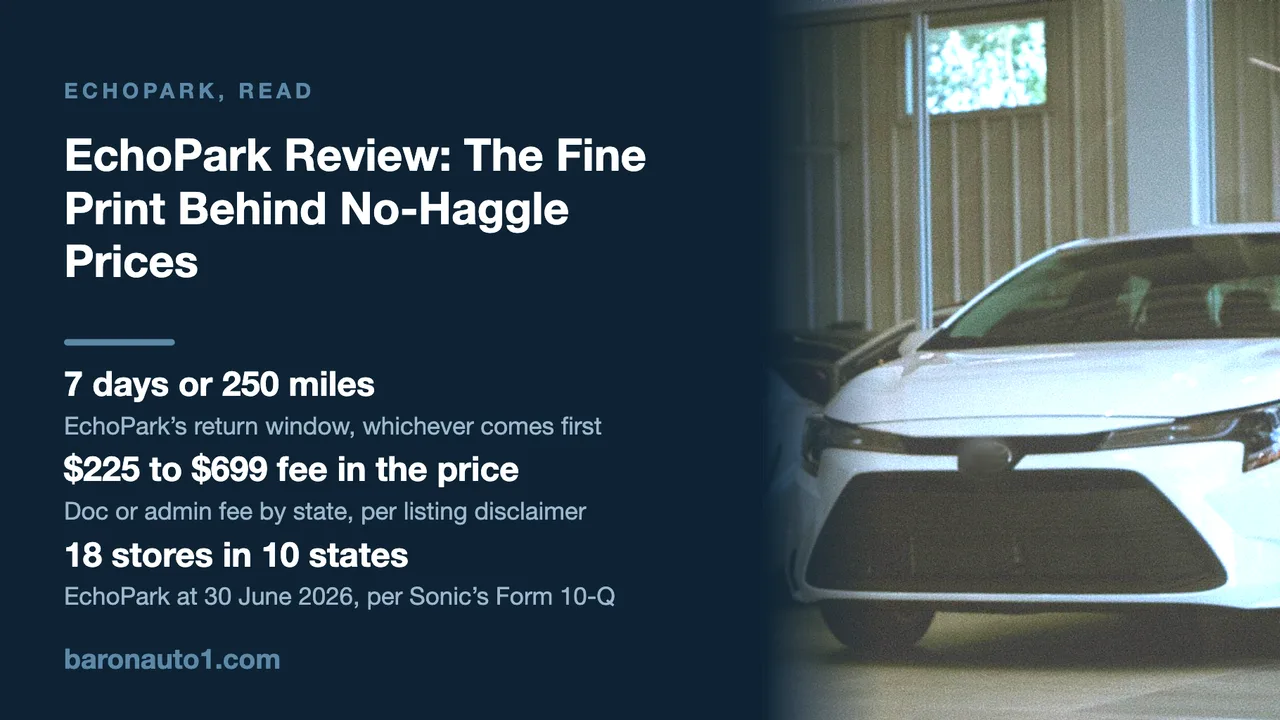
- EchoPark is Sonic Automotive’s used-car chain: 18 stores in 10 states at 30 June 2026, by Sonic’s own count. Its locations page lists 17 places where you can test drive and buy, plus 17 centers that only buy cars. There is no home delivery.
- Prices are no-haggle, but the “Total Transparent Price” on each listing adds a documentary, administrative or service fee of $225 in Texas up to $699 in Alabama, Arizona and Nevada. Taxes, tag and title are extra.
- You can return a car within 7 days or 250 miles, whichever comes first, “in the same condition” for “a refund of the purchase price.” The warranty is a 30-day/1,000-mile limited powertrain warranty.
- EchoPark says it is “not authorized by the manufacturers to perform recall repairs,” and Sonic’s 10-K says its stores do no customer repairs at all. Check open recalls before you sign.
- Sonic tells investors EchoPark aims for total profit “rather than” the usual profit on the car itself. In 2025 that was about $240 of retail gross profit per car against about $3,240 of finance and add-on revenue, by our arithmetic. Expect the protection-plan pitch.
- The online deposit is $500 and “not refundable.” On Trustpilot, EchoPark scored 2.0 from 524 reviews; EchoPark’s own site claims “Over 73,000 five-star reviews” without saying where.
EchoPark is a real, publicly reported business: the used-car segment of Sonic Automotive, whose stock trades on the New York Stock Exchange, selling about 185 cars a day in 2025 by our arithmetic. Whether it suits you depends on details spread across 87 FAQ answers and a disclaimer under every listing. On 6 October 2026 we read EchoPark’s FAQs, inspection, protection plan, financing, sell/trade, about and locations pages, its listing disclaimer and the Sonic Terms of Use that govern its site (last updated 16 October 2025), plus Sonic’s Form 10-K for 2025, 2024 and 2023, its latest Form 10-Q and EchoPark’s Trustpilot profile. Those Terms prohibit “deep linking to pages in the Site,” so we name EchoPark’s pages without linking them. This site has no commercial relationship with EchoPark or any other seller.
What EchoPark is, and how big it is
Sonic Automotive runs three businesses: franchised new-car dealerships, powersports stores, and EchoPark. Its 2025 Form 10-K describes the EchoPark segment in one sentence: it “sells used cars and light trucks and arranges third-party F&I product sales for our guests in pre-owned vehicle specialty retail locations, and does not offer customer-facing Fixed Operations services.” Fixed Operations is industry shorthand for the service and parts department. An EchoPark store sells cars and arranges finance and add-on products; it does not fix customers’ cars.
“Sales operations for EchoPark began in 2014,” the 10-K says, and at 31 December 2025 Sonic “operated 18 stores in the EchoPark Segment in 10 states.” Its state table puts 6 in Texas, 3 in Colorado, 2 in North Carolina and one each in California, Tennessee, Alabama, Georgia, Nevada, Missouri and Arizona. The 10-Q for the quarter to 30 June 2026 gives the same count: “18 stores in 10 states.” EchoPark brought in about 13.7% of Sonic’s 2025 revenue, down from 15.0% in 2024.
EchoPark’s locations page listed 34 places on 6 October 2026. Seventeen carry a “Shop this store” button: Experience Centers, where you can test drive, buy and collect a car. The other 17 are Vehicle Buying Centers, most named after the dealership or auction site that houses them, and the FAQ is blunt: “We do not sell cars or accept trade-ins at these locations.” Buy-only centers reach states with no showroom, among them Florida, Illinois and Virginia. The 10 states with a shop location are exactly the 10 in Sonic’s state table, which counts 18 stores because it groups businesses that “share management and inventory” into one “store.”
EchoPark retailed 67,636 used cars in 2025, 2% fewer than in 2024. In the second quarter of 2026 it sold 19,601, up 17%, and 38,927 in the first half, up 10%. Sonic’s long-term aim is “to reach 90% of the U.S. population at maturity,” with no date attached.
The 2023 suspensions and the stores that closed
EchoPark used to be bigger. Sonic’s 2023 Form 10-K records the turn: “On June 22, 2023, Sonic announced a plan to indefinitely suspend operations at eight EchoPark locations and 14 related delivery/buy centers.” That is 22 sites, by our arithmetic. Sonic also “closed three Northwest Motorsport locations within the EchoPark Segment” in the third quarter of 2023 and, in January 2024, “the remaining seven.” Northwest Motorsport was a pre-owned chain Sonic bought in December 2021 and reported inside EchoPark.
The 2023 10-K counted 25 EchoPark segment stores in 11 states at year end, seven of them Northwest Motorsport. With those closed, the count was 18 in 10 states at the end of 2024 and has stayed there since. Sonic booked about $78.3 million of EchoPark impairment charges in 2023, tied to “our decisions to indefinitely suspend operations at certain EchoPark locations,” and a further $2.7 million in 2024.
| Period | Used cars retailed | Revenue per car | Gross profit per car, car plus F&I | Stores (states) at period end |
|---|---|---|---|---|
| 2022 | 64,107 | $33,019 | $2,657 | Not printed in the filings read |
| 2023 | 73,676 | $29,098 | $2,183 | 25 (11), seven of them Northwest Motorsport |
| 2024 | 69,053 | $26,617 | $3,029 | 18 (10) |
| 2025 | 67,636 | $25,841 | $3,484 | 18 (10) |
| First half of 2026 | 38,927 | $25,451 | $3,396 | 18 (10) at 30 June |
Revenue per car fell from $33,019 in 2022 to $25,841 in 2025, down $7,178 or 21.7% by our arithmetic: EchoPark now sells cheaper cars. The 10-Q says part of that is deliberate, citing “expanding our inventory to include older vehicles, which typically earn a higher gross profit per unit.” The FAQ puts it in sales language: older cars at select Experience Centers are “usually priced well below retail value.”
For a buyer, the closures matter through distance. There is no home delivery, and only cars “within the Denver, Houston, and San Antonio metro areas can be transferred between stores, and may require a non-refundable fee.” If your nearest showroom is far away, so is your return.
No haggling, and what the “Total Transparent Price” includes
EchoPark does not negotiate. “We give you the lowest price upfront (always up to $3,000 less than the competition) and we take pride in our hassle-free, no-haggle, transparent experience,” says the FAQ. Other pages say “consistently up to $3,000 lower than our rivals” and “Low-mileage cars up to $3K less than the competition.” Read “up to” as a ceiling. None of the pages names the competition, the cars compared or the date of the comparison.
Each listing card prints three lines: “Price,” then “Document & other fees (if applicable),” then a higher “Total Transparent Price.” The disclaimer at the foot of the listings says what that last figure holds, state by state, “based on the vehicle’s physical location.”
| State | Fee included | EchoPark’s name for it | Not included |
|---|---|---|---|
| Texas | $225 | Documentary fee | Taxes, tag, title |
| Georgia | $499 | Dealer service fee | Taxes, tag, title, other governmental fees |
| North Carolina | $499 | Administrative fee, “as regulated by” state statute | Taxes, tag, title |
| Tennessee | $499 | Processing fee | Taxes, tag, other governmental fees |
| Missouri | $620.79 | Administrative fee | Taxes, tag, title, other governmental fees |
| Alabama | $699 | Documentary fee | Taxes, tag, title, other governmental fees |
| Arizona | $699 | Documentary fee | Taxes, tag, title, other governmental fees |
| Nevada | $699 | Documentary fee | Taxes, tag, title, other governmental fees |
| California | $85, $37 and $50 (if applicable) | Document processing, electronic filing and emissions testing charges | Government fees and taxes, any finance charge |
| Colorado | None listed | None | Taxes, tag, title, other governmental and registration fees |
The spread is $474 between Texas and the three $699 states, by our arithmetic, and California’s three charges add up to $172 when the emissions charge applies. These 10 states are exactly the 10 with an EchoPark showroom. The fee is printed on every listing, so it is not hidden; but the about page calls EchoPark’s Transparent Pricing “our promise of no hidden fees, and the price you see is the price you can get,” and a listing shows you two prices. Compare the Total Transparent Price, then add your state’s tax and registration, to get to an out-the-door price. Our guide to documentary fees explains what the fee pays for and where states cap it.
The disclaimer adds that “all prices expire at midnight on the date displayed” and that “if transferred to another state, the price may change.” The FAQ promises quoted terms will hold “as long as all the information you provide is accurate and verifiable.” Get the quote in writing, with its date and the car’s store. With the price fixed, what you can still shape is the trade-in, the financing and the add-ons; see our guide to negotiating a used car price.
Why the price can be low: what Sonic tells investors
The plainest explanation of EchoPark’s pricing is in its parent’s annual report. “Our EchoPark operating strategy focuses on maximizing total used vehicle-related gross profit (based on a combination of retail used vehicle unit sales volume, front-end retail used vehicle gross profit (loss) per unit and F&I gross profit per retail unit sold) rather than realizing traditional levels of front-end retail used vehicle gross profit per unit.” Front-end is the profit on the car; F&I is finance and insurance: the commission for arranging your loan, and the service contracts, GAP and other products sold with the car.
The 2025 segment table shows how far that goes. EchoPark made $16.5 million of retail gross profit on $1,747.8 million of used-car sales, and $219.2 million of F&I revenue, on 67,636 cars. Spread across those cars, that is about $240 of front-end profit and about $3,240 of F&I revenue per car, by our arithmetic, so F&I was 93% of the total. (Sonic books F&I net, so “reported F&I revenues and F&I gross profit are the same amount.”) In the quarter to 30 June 2026 the split was about $330 and $2,960, and F&I was 90.1% of the total. These are averages across every car EchoPark sold, not the margin on any car you look at. Our Carvana vs CarMax comparison reads the same kind of figures for those two retailers.
Sonic is open about how it sells F&I. Its 10-K says it emphasizes “menu-selling techniques” to “increase our sales of F&I products at all of our stores.” At EchoPark in 2025, the take-up rate for “other aftermarket” products rose 2,390 basis points “as a result of our efforts to offer a wider range of F&I products.” The FAQ promises “You’ll never have to enter a finance office.” Both can be true: the products come from the Experience Guide or the online checkout instead of a finance manager.
The protection plans page lists six products, each marked “Optional”: a vehicle service contract, appearance, GAP, dent, windshield, and theft plus catalytic converter protection. What the pages print:
- Service contract. From Fidelity Warranty Services, “up to 5 years or 60,000 miles,” with “deductible options as low as $100”; “Coverage may vary for cars older than 5 years.” Repairs at “any licensed repair shop in the U.S. and Canada.” No maintenance.
- Cancelling. “You can cancel anytime and receive a prorated refund for unused coverage (after 60 days, minus a $50 admin fee).” The first 60 days are not explained.
- GAP. “Covers up to $50,000 or your remaining balance, whichever is less.”
- Timing. Plans can go into the loan at checkout, but not “after you make your purchase.”
No page prints a price for any of them. Ask for the deal sheet with and without each product; our guides to whether an extended warranty is worth it and to GAP insurance set out what to weigh. Trustpilot’s AI summary of recent reviews mentions “mandatory add-on packages and hidden fees”; those are Trustpilot’s words about unverified reviews, and EchoPark’s page labels every product optional.
The 7-day Happiness Guarantee, read closely
“All of our cars come with our Happiness Guarantee: Love it or we want it back. If you change your mind about your car purchase within 7 days or 250 miles (whichever comes first), simply return the car to EchoPark in the same condition for a refund of the purchase price.” The FAQ, the inspection page and the about page all give the same limits, and the older-car answer calls it a “7-day money-back Happiness Guarantee.”
The miles bind first for many drivers: 250 miles over 7 days is about 35 miles a day, by our arithmetic. A long commute, or a drive home from a store in another city, can use most of the allowance. The FAQ adds one condition for trade-ins: “If your financing included negative equity from your trade-in, you can either repay the negative equity or finance it with a different vehicle, subject to financing approval.” If you rolled an old loan into the new one, our guide to negative equity explains why returning the car does not make that balance disappear.
What EchoPark’s pages do not say is as important. “A refund of the purchase price” is not defined: nothing says whether the documentary fee, taxes and registration, any protection plans, or the $500 deposit (which the FAQ calls non-refundable) come back. Nothing says when the 7 days start, how the 250 miles are measured, or whether you must return the car to the store that sold it. Ask for the guarantee’s terms in writing before you sign.
| Retailer | Return window | What comes back | Limited warranty |
|---|---|---|---|
| EchoPark | 7 days or 250 miles, whichever comes first; “in the same condition” | “A refund of the purchase price” | 30 days or 1,000 miles, powertrain |
| Carvana | 7 days from the day you receive the car; 400 miles, then $1.00 a mile | “the total price you paid, excluding any nonrefundable shipping charges” | 100 days or 4,189 miles |
| CarMax | 10 days, to the store where you bought it, if the condition is consistent with purchase; no mileage limit printed | Not recorded here | 30 days, “Longer in select states” |
On paper EchoPark’s window allows 150 fewer miles than Carvana’s, by our arithmetic, and a shorter warranty than either rival’s that covers the powertrain only. Our pages on Carvana’s 7-day guarantee and CarMax’s returns carry the full terms. Whichever you choose, the return window is your inspection window: book an independent pre-purchase inspection for the first day or two.
The 190-point inspection, the warranty and open recalls
EchoPark says “All of our cars pass a 190-point inspection,” and that “Not every car makes the cut.” Its inspection page lists eight standards for “Every car at EchoPark”:
- “Meets or exceeds state inspection standards”
- Tires with less than 4/32 tread replaced, and brake pads with less than 4mm replaced
- Scratches longer than 5 inches repaired, paint chips touched up, visible dents repaired
- A cracked or chipped windshield repaired or replaced, and material holes, tears or stains cleaned or replaced
The page then prints its points under eight headings. Counted line by line, the full lists hold 104 items: 18 on the road test, 12 exterior, 40 interior, 11 underhood, 9 for tires and wheels, 6 for brakes, 5 underbody and 3 for hybrids. Some lines bundle several checks; EchoPark does not say how it reaches 190. The FAQ says “You can also ask your Experience Guide for details of the work completed on your specific vehicle.” Ask for that record, and use the free CARFAX report EchoPark offers with our guide to checking a used car’s history. A seller’s inspection is not an independent one.
The warranty is short and narrow: “a 30-day/1,000 mile (whichever comes first) limited powertrain warranty on every vehicle. Plus, many of our vehicles are still covered under the original manufacturer’s warranty.” No page read prints what it covers, its deductible, or where claims are repaired. Sonic’s 10-K says “EchoPark stores do not currently perform customer pay repairs or maintenance work and are not permitted to perform manufacturer-paid warranty repairs,” and that manufacturers allow warranty work “only at franchised dealerships.” The warranty, or an “as is” notice, belongs on the car’s Buyers Guide; our guide to whether a used car comes with a warranty shows how to read it.
EchoPark does not fix recalls. Its FAQ says: “We’re not authorized by the manufacturers to perform recall repairs; however, we will verify recalls with the National Highway Transportation Safety Administration website and provide you with a copy of any outstanding recalls.” The disclaimer under every listing warns that used vehicles “MAY BE SUBJECT TO UNREPAIRED MANUFACTURER RECALLS.” Ask for that recall copy before you pay, run the VIN yourself (our guide to checking a car for open recalls shows how), and book the repair with a dealer for that make.
Buying online: the deposit, pickup and payment
You can start online, but you finish at a store. You choose cash or finance and give details of where you live and work; “Pay $500 and your car is removed from our online inventory.” EchoPark then does “one last availability confirmation” and, if the car has gone, will “initiate a refund.” Does an online purchase guarantee the car? “Most of the time, yes!”
The deposit terms are strict: “No, the $500 deposit is not refundable.” It goes toward the price or the down payment, and “will be returned on financed deals with $0 down.” It holds the car for “3 business days from the time the car is ready to be picked up,” then “the car will be returned to active inventory.” Pay it only when you can collect inside that window.
“We do not offer home delivery.” At pickup you need a driver’s license and proof of insurance, any co-signer with photo ID, and, for a trade, photo ID for everyone on its title; “some steps or paperwork may need to be completed in-store.” Our guide to buying a car online covers what to check when the paperwork is split between a screen and a desk.
On payment, the FAQ contradicts itself. One answer says “In store, we accept cash, debit cards up to $5,000, credit cards up to $500, and cashier’s checks.” Another says “We do not accept credit card or debit card payments for down payments over $500,” then lists debit cards among what the store takes for a down payment. If you plan to put more than $500 on a card, confirm it with the store before you go.
Financing through EchoPark
EchoPark arranges loans; it does not lend. The financing page warns that “Unlike an estimate, this is a formal credit application and may temporarily reduce your credit score.” The FAQ names Ally, Wells Fargo, Capital One and Truist among its lenders, adds “select credit unions,” and says “Many of these programs are only available at EchoPark.” It says there is “no specific minimum score” and that its lenders “work with all levels of credit.” No rate is printed anywhere.
Bringing your own loan is possible, within limits the FAQ states two ways. “We only accept outside loans from banks that issue cashier’s checks,” says one answer; “We also accept draft checks from USAA, PenFed, and Navy Fed,” says the next. If your lender pays by draft or electronically, ask the store before you commit.
The 10-K explains how a dealer earns on the loan it arranges. The commission, called a yield spread premium, “could be zero, a flat fee or an actual spread between the interest rate charged to the consumer and the interest rate provided by the third-party direct financing source,” and Sonic says “We have established caps on the potential yield spread premium our dealerships can earn,” without printing the caps. The practical answer is to arrive with a preapproval from your bank or credit union and compare EchoPark’s offer with it on the same term; our page on used car financing rates gives a benchmark.
Selling or trading a car to EchoPark
EchoPark buys cars whether or not you buy one: “Our offer to buy your car will be the same whether you’re buying a car from us or not.” Get an instant offer online or an appraisal at any Experience Center or Vehicle Buying Center, no appointment needed. The offer “is good for 7 days or 500 miles, whichever comes first,” about 71 miles a day by our arithmetic. An appraiser will “test drive and verify its condition,” then “cut you a check right there on the spot.” The proviso: “Car must be in the same condition as described.” No page says what happens if the appraiser disagrees.
A promotion ran on 6 October 2026: sell within 48 hours of receiving the offer and “we’ll tack on an extra $500.” Four FAQ answers repeat the $500; the answer on an online purchase says “The extra $250 will be applied to your final deal.” Confirm the amount in writing.
Bring photo ID for everyone on the title, the title or payoff details, and all keys. The FAQ says trade-in tax credits are unavailable in “California, Hawaii, Kentucky, Michigan, Montana, Virginia, or Washington, DC.” The Michigan Treasury table our guide uses shows Kentucky with a full credit and Michigan with a capped one, so check the trade-in tax offset in your state. Our guide to where to sell a car sets the other routes side by side.
EchoPark reviews: what the public record shows
EchoPark’s inspection page says “Over 73,000 five-star reviews from happy EchoPark customers say it all,” without naming the platform, and its own reviews page showed no score or count when we read it. The one company-wide profile we could read tells a different story. On 6 October 2026, Trustpilot showed EchoPark Automotive with a TrustScore of 2.0 from 524 reviews: 49% five-star and 33% one-star. Only 32 reviews arrived in the last 12 months. Trustpilot notes that “This company hasn’t invited customers recently, so reviews may not be representative,” and that EchoPark “Hasn’t replied to negative reviews.” Of the 20 newest reviews, 14 were one-star and 3 five-star, all unprompted.
Trustpilot’s AI summary of 33 recent reviews says “most reviewers were unhappy,” citing extra charges and “severe mechanical issues occurring shortly after purchase,” while others praised “exceptionally friendly staff members.” These are unverified consumer reports from a small, self-selected sample, and Trustpilot says it does not “fact-check reviews.” A business selling 67,636 cars a year will collect complaints whatever its rate; the themes still match the fee, add-on and mechanical questions above. Search results for “echopark reviews” are led by single-store dealer-review pages, which we did not read.
BBB’s site blocked our reading of EchoPark’s profile, and we did not work around it. A web search on 6 October 2026 found no FTC, CFPB or state attorney-general action naming EchoPark; that is a search result, not a clearance. Sonic’s 10-K says it is involved in “various legal and administrative proceedings,” with “no significant liabilities related to legal matters as of December 31, 2025.” The website Terms, under North Carolina law, carry a class-action waiver and a one-year limit for claims about the site; the sale is “subject to additional terms of sale” shown during a purchase, which we did not see.
Where EchoPark’s pages disagree, and what to ask
We found seven places where EchoPark’s own documents pull in different directions:
- Card limits. Debit “up to $5,000” in one answer; no card payments “for down payments over $500” in another.
- Outside loans. Only from banks that issue cashier’s checks, yet draft checks from USAA, PenFed and Navy Fed are accepted.
- The trade bonus. $500 in five places; $250 when applied to an online purchase.
- Online buying. “Complete the entire process online,” but some paperwork may be in-store, and every car is collected at a store.
- Availability. All website cars are “available for sale,” but an online purchase secures the car only “Most of the time,” and inventory is “subject to prior sale.”
- Fixed numbers. Quoted terms will not change if your information is accurate, but listing prices “expire at midnight” and “may change” if the car crosses a state line.
- “The price you see.” Each listing shows a “Price” and a higher “Total Transparent Price,” and the “up to $3,000 less” claims do not say which one they compare.
- Compare the Total Transparent Price, not the Price, then add your state’s tax, title and registration.
- Get the quote in writing with its date and the store the car is at; listing prices expire at midnight.
- Pay the $500 deposit only when you can collect within 3 business days. It is not refundable.
- Ask what “a refund of the purchase price” returns: fees, taxes, protection plans and the deposit.
- Plan your miles. The return window ends at 250 miles, about 35 a day over 7 days.
- Book an independent inspection in the first days of the return window.
- Get the open-recall copy EchoPark offers, check the VIN yourself, and book any recall repair with a franchised dealer.
- Bring a loan preapproval and confirm the store will accept how your lender pays.
- Price each protection plan separately and decline what you do not want; each is labelled optional.
- Read the terms of sale before signing, including any arbitration clause.
Common questions
Is EchoPark legit?
Yes. EchoPark is the used-car segment of Sonic Automotive, a NYSE-listed retailer, and it retailed 67,636 cars in 2025 from 18 stores in 10 states, says Sonic’s 10-K. Its Trustpilot rating was 2.0 from 524 reviews on 6 October 2026, a small, uninvited sample.
Why are cars at EchoPark so cheap?
EchoPark says it cuts costs and sells cars “that have already depreciated.” Sonic’s 10-K adds that EchoPark aims for total profit “rather than” the usual profit on the car: in 2025 about $240 of front-end profit against about $3,240 of finance and add-on revenue per car, by our arithmetic. The listed “Price” also leaves out a $225 to $699 fee.
Can you negotiate at EchoPark?
Not on the car’s price: EchoPark sells at a fixed, “no-haggle” price. You still choose your trade-in route, your lender and which optional protection plans to buy, and those decide much of what you pay.
What is EchoPark’s return policy?
The Happiness Guarantee lets you return a car within 7 days or 250 miles, whichever comes first, in the same condition, for “a refund of the purchase price.” EchoPark does not say whether fees, taxes, protection plans or the non-refundable $500 deposit are included, so ask before you sign.
Does EchoPark deliver?
No. “We do not offer home delivery.” You collect the car at an Experience Center. Cars can be moved between stores only within the Denver, Houston and San Antonio metro areas, and that “may require a non-refundable fee.”
How does EchoPark compare with CarMax?
On their own published terms, EchoPark gives 7 days or 250 miles to return a car and a 30-day/1,000-mile powertrain warranty; CarMax gives 10 days with no mileage limit printed and a 30-day limited warranty. CarMax’s figures are from this site’s reading of 30 September 2026. Prices and fees differ by car and state, so compare out-the-door quotes for the cars you want. Our Carvana vs CarMax page and our Carvana review cover the other two large used-car retailers.
For sale near you
Dealer listings, checked liveFinding used cars near you…
Sources and further reading
- SEC EDGAR filings: Sonic Automotive, Inc.
- FTC Used Car Rule
- FTC used car buying guide
- NHTSA recall lookup
- FTC: auto service contracts and warranties
Recall, complaint and safety-rating figures on this page were retrieved from the federal databases above on August 19, 2026. Federal data changes — re-check any VIN before you rely on it.
Published October 6, 2026 · last updated October 6, 2026. Found something out of date or wrong? Tell us and we will correct it.