Ally Auto Loan: How It Works, What It Costs and the 2013 Orders
Most Ally auto loans are dealer contracts Ally buys at a buy rate the dealer can mark up. What its refinance and lease-buyout terms, payment fees, hardship options, 10-K and 10-Q, the 2013 CFPB and Justice Department orders and 7,655 CFPB car-loan complaints show.
The short version
- Most Ally auto loans start at a dealership. The dealer writes the contract and Ally buys it at a “buy rate” set for the dealer. The rate on your contract can be higher, and the dealer shares in the difference.
- Ally’s own online loans are for refinancing another lender’s loan or buying out a lease, over 36 to 75 months, with a $2,000 monthly income minimum. Ally says it does not refinance its own loans to lower the rate.
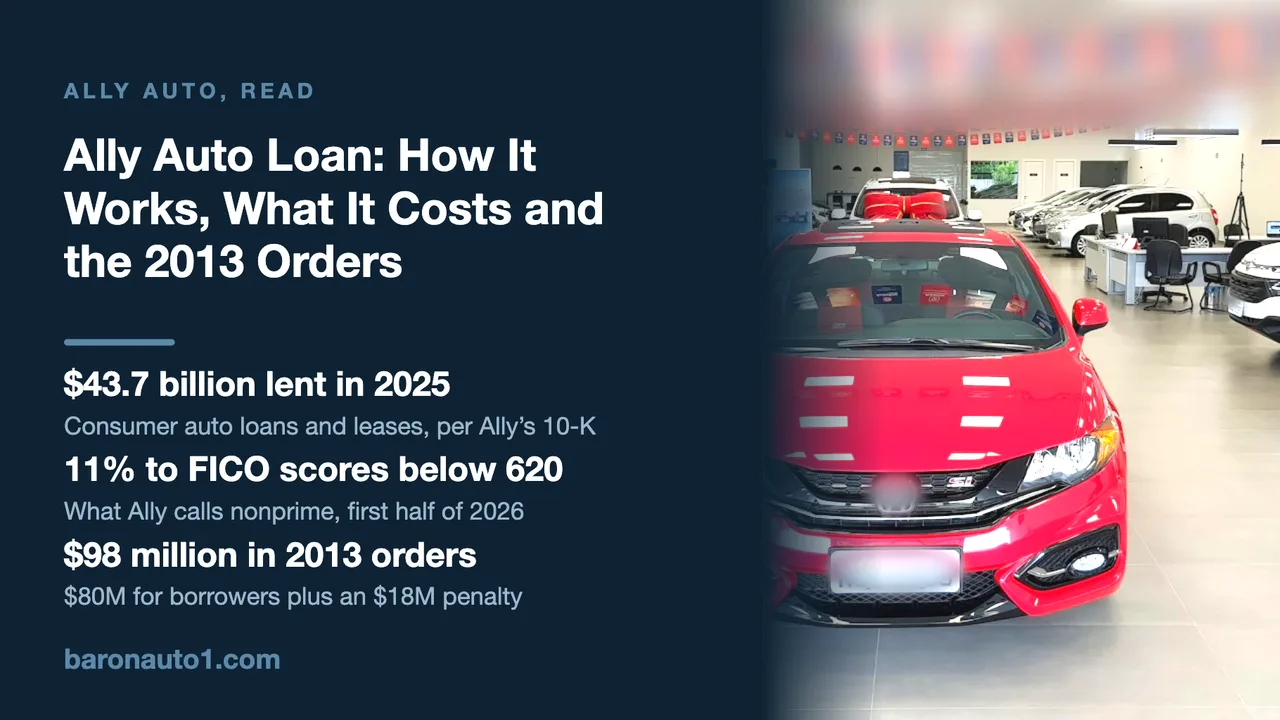
- Ally publishes no dated APR. Its 10-K shows $43.7 billion of car loans and leases originated in 2025, and its 10-Q says 11% of originations in the first half of 2026 went to FICO scores below 620, which Ally calls nonprime.
- Paying from a bank account online, by Auto Pay or by mail is free. A debit card through CheckFreePay costs $3.75 and a phone payment through ACI $4, charged by those processors.
- An extension delays payments, but interest keeps accruing on a retail contract and GAP is not extended. Ally’s 10-K says repossession generally starts at 90 days past due.
- In December 2013 the CFPB and the Justice Department ordered Ally to pay $80 million to borrowers and an $18 million penalty over dealer markups. Ally neither admitted nor denied the findings, and the CFPB now lists the action as expired or terminated.
An Ally auto loan is usually a dealer’s contract that Ally buys: Ally sets the price it will pay, the dealer sets the rate you sign for, and the two can differ. Ally also lends online to people refinancing or buying out a lease. On 6 October 2026 we read Ally’s auto pages, Help Center answers, lease-end pages and two sets of online terms; Ally Financial’s 10-K for 2025 and 10-Q to 30 June 2026; the 2013 CFPB and Justice Department consent orders and the releases about them; and Ally’s complaint counts in the CFPB database. We submitted no application and entered no VIN, and this site has no commercial relationship with Ally or any lender.
How an Ally auto loan works: the dealer writes it, Ally buys it
Ally’s 10-K describes the usual path: a dealer “enters into a retail installment sales contract or operating lease with the customer and then sells” it “to Ally or another automotive finance provider.” You sign with the dealer, and Ally then collects the payments and holds the lien. Ally’s consumer page puts it as “Locate a dealer that offers Ally auto financing.”
The network is large: approximately 21,400 active dealer relationships at the end of 2025 and over 21,600 by 30 June 2026. Ally grew out of General Motors; the 10-K says its dealer ties “primarily were developed through our previous role as a captive finance company for GM and a preferred provider for Stellantis.” GM and Stellantis dealers still supplied 37% of 2025 originations by our arithmetic (24% plus 13%). The other 63% came from other franchised dealers, used-car retailers such as CarMax and EchoPark, and online sellers such as Carvana. Our reviews of GM Financial and Chrysler Capital cover those carmakers’ lenders today.
Ally is no longer only indirect. The 10-K lists “extending automotive loans directly to consumers” among its services and says it operates “an online direct lending platform.” In 2013 Ally told the SEC the opposite: “Ally does not make loans directly to consumers.” Older descriptions of Ally as dealer-only are out of date.
One more path matters if Ally says no. The 10-K says it runs “application pass-through programs” for applications that miss its criteria, earning fees on loans “sold to, and serviced on behalf of third-party lenders.” That serviced balance was $2.2 billion at the end of 2025, up from $1.2 billion. A dealer who sent your application to Ally may come back with a loan Ally services but another lender owns, so read the lender named on the contract.
Rates: the buy rate, the dealer’s markup and what Ally publishes
Ally publishes no APR for dealer-arranged loans. Its financing page says: “Looking for rates? Visit your nearest dealer to see if you qualify.” The 10-K explains why. When Ally buys a contract, it pays the dealer “at a rate (generally described in the industry as the ‘buy rate’) discounted below the rate agreed to by the dealer and the consumer,” and its dealer agreements “limit the amount of the discount that we will accept.” Buy rates reflect interest costs, projected losses, operating costs “and targeted return on equity.”
Each application is sorted into an Ally credit tier, S, A, B, C, D or E, which is “communicated to the dealer that submitted the application.” The 2013 CFPB order describes the rest: Ally gives dealers “discretion to mark up a consumer’s interest rate above Ally’s established risk-based buy rate” and pays them from the extra interest. In 2013 that markup was capped at 250 basis points on contracts of 60 monthly payments or less and 200 on longer ones or the lowest two tiers, 2.5 and 2 percentage points by our arithmetic. We found no current Ally document that states today’s cap.
The two sides describe the buyer’s position differently. In the 2013 court order Ally said customers “negotiate their Annual Percentage Rate and other finance terms with dealers” and that “Ally is not a party to the negotiations.” The Justice Department’s complaint alleged that “The dealers, but not the consumers, learn the buy rate.” No court ruled on that. Either way the remedy is the same: bring a rate from a bank or credit union and ask the dealer to beat it. Ally’s own page says your dealership “may be willing to match or beat quoted rates from other lenders.” See our guides to how dealer-arranged rates are set and getting pre-approved first.
Carmakers sometimes subsidise rates, and the 10-K says Ally is then compensated for the difference from its standard rate; those offers change often, so check any promotion’s end date. The 10-K also prints a 9.18% yield for 2025 on Ally’s whole consumer auto book (9.22% in the second quarter of 2026). That is an average across subsidised and unsubsidised contracts, not the rate you will be offered.
Applying to Ally directly: refinancing and lease buyouts
Ally’s direct loans are online. Its refinance page offers pre-qualification “in minutes without impact to your credit score” through a soft pull, with a hard pull only when you apply, and says “We don’t charge application or document fees.” The lease-buyout page works the same way for a lease with Ally or another lessor.
| Requirement | Refinance | Lease buyout |
|---|---|---|
| Whose loan | “Only” if your current financing is with another lender | Ally leases or another lessor’s |
| Where it is not offered | Nevada, Vermont, District of Columbia | DC, Indiana, Nevada, Vermont, Wisconsin |
| Terms | 36 to 75 months | 36 to 75 months |
| Minimum income | $2,000 a month | $2,000 a month |
| Age | 18, or 19 in Alabama | 18, or 19 in Alabama |
| Vehicle excluded if | Business use, branded title, unrepaired damage, more than one lien, financed less than four months ago | The same list, but financed less than seven months ago |
| Application fee | None | None |
Ally says refinancers “could save an average of $169 a month,” or $2,028 a year, based on “July 2025 – June 2026 customers who refinanced” and excluding optional coverage. That is an average for people who went ahead, and the same page warns that a longer term means “the overall cost of your loan will be higher in most cases.” Our page on when refinancing is worth it shows how to compare total cost, and our reviews of LightStream, RateGenius, Caribou and Autopay read other refinancers’ terms.
If your loan is already with Ally, this product is not for you. The Help Center answers “Can I refinance my auto retail contract to lower my rate?” with “We don’t refinance to lower rates” and points borrowers in difficulty to its hardship options.
On names: Ally’s FAQs say it dropped “Clearlane” from the name of its online financing. We found no consumer page for a product called Ally Clearpass, only an undated awards item in Ally’s newsroom, so make sure any “Clearpass” link lands on ally.com. Ally’s direct-lending terms, last updated 09/26/2023, add that offered rates “may be higher or lower” depending on your credit, car, location and debt-to-income ratio; that “Ally does not guarantee that rates or terms offered are the best terms or lowest rates available”; that a referring comparison site may receive your “loan details”; and that you agree to calls and texts “even if your phone number is on any Do Not Call list.”
Who Ally lends to: credit tiers, FICO scores and what it calls nonprime
The 10-K defines nonprime as loans “with a FICO® Score (or an equivalent score) at origination of less than 620.” By that definition nonprime borrowers took 9% of 2025 loan and lease originations, after 7% in 2024 and 9% in 2023. The 10-Q shows 11% in the second quarter and first half of 2026, which Ally ties to “maximizing risk-adjusted returns across our credit tiers.” Scores below 540 were 2%. Nonprime applications face stricter payment-to-income, debt-to-income and amount limits, and the nonprime book “generally does not include any loans with a term of 76 months or more.” Nonprime loans were $8.6 billion, about 10.1% of consumer auto loans, at the end of 2025, and $9.6 billion, about 10.7%, at 30 June 2026.
| Ally tier | Used-car loans | Average FICO, used | New-car loans | Average FICO, new |
|---|---|---|---|---|
| S | $9.9 billion (37%) | 761 | $6.8 billion (55%) | 771 |
| A | $11.3 billion (42%) | 688 | $4.5 billion (36%) | 687 |
| B | $4.0 billion (15%) | 642 | $0.9 billion (8%) | 650 |
| C | $1.2 billion (4%) | 604 | $0.2 billion (1%) | 614 |
| D | $0.4 billion (2%) | 570 | Not printed | 588 |
| E | $0.1 billion | 550 | Not printed | 573 |
| Total | $26.9 billion | 702 | $12.4 billion | 726 |
The tiers are Ally’s own score, built from past delinquency, credit inquiries, loan-to-value, term and payment- and debt-to-income ratios, so two buyers with the same FICO score can land in different tiers. In the first half of 2026 the average FICO score was 699 on used-car loans and 731 on new. Ally prints no minimum score, and its refinance FAQ says borrowers with limited credit “might” qualify. Our page on what credit score you need explains how tiers become rates.
Long loans are the norm. In 2025, 60% of Ally’s retail loan dollars had terms of 72 to 75 months and 23% ran 76 months or more, 83% in all by our arithmetic; Ally says substantially all of the longest were prime, in tiers S, A or B. About 83% of its used-car loans were for model-year 2019 or newer cars. The 10-K also notes that advances above 100% of the car’s value “are typical in the industry” because taxes, fees and service contracts are financed; our page on negative equity explains what that means later.
What the 10-K and 10-Q show: volume, balances and losses
The 10-K says Ally finances “approximately 4.0 million new and used vehicle contracts” and originated approximately 1.3 million loans and leases in 2025. These are the consumer figures its filings print:
| Measure | 2024 | 2025 | 2026 so far |
|---|---|---|---|
| Consumer auto loan and lease originations | $39,190 million | $43,680 million | $24,746 million (first half) |
| of which used-car loans | $24,542 million | $26,871 million (62%) | $15,841 million (64%) |
| of which new-car loans | $11,057 million | $12,369 million (28%) | $7,447 million (30%) |
| of which leases | $3,591 million | $4,440 million (10%) | $1,458 million (6%) |
| Consumer auto loans held, end of period | $83,757 million | $85,568 million | $89,184 million (30 June) |
| Nonprime share of originations (FICO below 620) | 7% | 9% | 11% (first half) |
| Consumer auto net charge-offs | $1,810 million (2.2%) | $1,664 million (2.0%) | $768 million (1.8%, first half) |
| Bought from Carvana, share of originations | 8% | 11% | 15% (first half) |
Originations grew 11.5% in 2025 and 17% in the first half of 2026 against the first half of 2025, by our arithmetic. The net charge-off ratio is what Ally wrote off after recoveries as a share of average loans; the filings label it “Consumer automotive.” The 10-Q prints 1.6% for the second quarter of 2026, against 1.7% a year earlier. By our arithmetic the quarter’s $344 million was about 0.4% of the $87,524 million average balance, so the printed 1.6% is a yearly rate.
Loans 30 days or more past due fell by $84 million to $4.5 billion at the end of 2025, the 10-K says. At 30 June 2026 the 10-Q’s aging table shows $4,280 million past due by 30 days or more, 4.8% of $89,218 million by our arithmetic. Carvana is now a large source: Ally raised its committed purchase facility to a maximum of $6.0 billion, and Carvana loans were 12.1% of its consumer auto loans by mid-2026, so a Carvana loan may end up with Ally (see our Carvana review). The 10-K names no pending consumer auto case and says Ally does not expect pending matters to be “material to our consolidated financial condition.”

Paying an Ally loan: methods, fees, payoff and title
Ally’s payment FAQ says: “We don’t charge a fee to make a payment, but third-party sites like CheckFreePay, Western Union®, ACI Pay, and MoneyGram will.”
| Method | Fee | Note |
|---|---|---|
| Online or app, from a checking or savings account | None | Same-day credit if scheduled by 11 pm ET |
| Auto Pay | None | Can be cancelled until 3 pm ET on the payment date |
| Your bank’s bill pay, or mail | None from Ally | Your bank may charge for bill pay |
| Pay by text | None from Ally | Reply PAY to the reminder sent seven days before the due date |
| Debit card through CheckFreePay | $3.75 | Charged by CheckFreePay |
| Phone through ACI Payments | $4 | Charged by ACI |
| MoneyGram or Western Union in person | A fee, amount not printed | Ally says to ask them for current fees |
By our arithmetic, paying a 72-month contract by CheckFreePay every month would cost $270 in fees, and by ACI phone payment $288. The free methods do the same job.
How a payment is applied matters more than the fee. Ally says finance charges are “calculated on a daily basis” and each payment goes first to interest accrued since the last one, then to principal. Paying late costs twice: a late fee “in accordance with your contract” plus extra daily interest, which can leave you owing “up to one or more additional monthly payments” at the end. Ally does not publish its late fee or grace period; both are in your contract. Online, you choose whether extra money goes to principal or future payments; by other methods Ally applies it “toward your next regularly scheduled monthly payment,” so pay extra online if you want it on the principal. One leftover: Ally’s Auto Online Services terms, last updated September 25, 2016, still describe Direct Pay, which the Help Center says “we don’t offer this program anymore.”
For payoff, Ally’s title page says the title or lien release is mailed within 4 business days of receiving and processing a cashier’s check or money order, and within 10 business days for an online payment or personal check. In 20 states with electronic titles, Ally can release its lien with the state directly when the record is electronic. If the car is totaled, Ally says you are “responsible for the balance on the account”; that gap is what GAP covers, and Ally’s own example shows $25,000 owed, an insurer paying $20,000 and $5,000 left over.
Falling behind: extensions, modifications, catch-up plans and repossession
The 10-K says collections contact starts when an account is 3 to 7 days past due. Ally then offers three tools, and its pages are clear that none is free.
Extension. An extension delays payments for 30 or 60 days, the 10-K says, and extensions “typically do not exceed 90 days in the aggregate during any 12-month period or 180 days” over the contract, after an upfront payment. Ally’s FAQ says finance charges accrue “at your contracted rate” (not compounded) and no late fees are added, but on a retail contract “you’ll pay more finance charges”; leases carry no extra charge. At the end of 2025, 14.6% of the amount outstanding in Ally’s servicing portfolio had been extended or modified.
Modification. A modification lengthens the contract to “permanently lower your monthly payment,” may add finance charges and adds payments. Ally forgives nothing this way, allows one modification only, and charges no penalty for paying off afterward. The 10-K shows $652 million of consumer auto maturity extensions for borrowers in financial difficulty in 2025, and $8 million of principal forgiveness.
Catch-up plan. A promise to pay the past-due amount over time, which “keeps you out of regular collection activity.” Late fees still apply, Ally reports your actual payment record, the first payment is due within 7 days or by your due date, whichever is sooner, and missing one cancels the plan.
Cancel Auto Pay yourself if you take an extension, and check your GAP dates. Ally says it will not cancel Auto Pay or scheduled payments during an extension, and that deferring payments “won’t extend the duration of GAP, maintenance, life, or disability insurance” in your contract. A total loss late in a stretched loan may fall outside GAP.
If none of that works, the 10-K says Ally “generally” begins repossession once an account is at least 90 days past due, sooner if the car is at risk. You get time to redeem the car or reinstate the contract; otherwise it is sold at auction, and “Generally, the proceeds do not cover the unpaid customer balance,” with the rest pursued by Ally’s asset recovery centers. Our guide to the repossession sale and deficiency explains your rights.
Ending an Ally lease: return, buyout and the wear rules
Ally SmartLease customers get a return kit “about 120 days before your scheduled end date.” You can buy the car for “the purchase option price stated in your lease plus unpaid fees, taxes and any other unpaid amounts due,” return it to your dealer or, if you cannot, to “any franchised dealership authorized to sell or lease your particular vehicle,” or ask for more time, which may carry a daily fee. The 10-K adds that “Neither the consumer nor the dealer is responsible for the value of the vehicle at the time of lease termination”: a car worth less than its residual is Ally’s loss.
After a return, an inspector hired by Ally checks the car “typically within 5 days,” and your lease may let you pay for an independent inspection. Excess miles are charged at your lease’s per-mile rate, and wear is judged against Ally’s Excess Wear Table:
| Area | Normal wear | Excess wear (chargeable) |
|---|---|---|
| Body, bumpers, molding | Damage 2 inches or less (not hail or punctures), or larger damage repairable for $100 or less | Damage over 2 inches that cannot be repaired for $100 or less, or any puncture |
| Interior | Burns, stains or tears 1/2 inch or less; any removable stain | Burns, stains or tears over 1/2 inch |
| Tires | Tread of 1/8 inch or more at the shallowest point | Tread under 1/8 inch, sidewall plugs, cuts or mismatched tires |
| Windshield | Damage 1/2 inch or less | Damage over 1/2 inch, or any hole |
| Lights and lamps | Cracks 2 inches or less | Cracks over 2 inches, or any hole |
| Missing parts | None | Any missing equipment, including keys, remotes and EV charging cables |
Ending early can mean “a substantial charge,” with no refund for prepaid miles, and a security deposit comes back only after the car has been inspected “and it has been sold at auction.” Our pages on financing a lease buyout, wear-and-tear charges and lease takeovers cover the general rules.
The 2013 CFPB and Justice Department orders over dealer markup
The main public enforcement record on Ally’s auto lending is a pair of December 2013 consent orders. The CFPB’s page for the action says it “ordered Ally Financial Inc. and Ally Bank to pay $80 million in damages to African-American, Hispanic, and Asian and Pacific Islander consumers harmed by Ally’s discriminatory auto loan pricing, and $18 million in civil money penalties.” Together that is $98 million, the figure the Justice Department used and the charge Ally said it would take.
| Date | What happened | Document |
|---|---|---|
| September to November 2012 | CFPB examines Ally’s compliance with the Equal Credit Opportunity Act | CFPB consent order |
| 7 and 13 November 2013 | CFPB refers the matter to the Justice Department, which opens its own investigation | CFPB consent order |
| 19 December 2013 | Ally signs the stipulation and the CFPB order is issued, “without admitting or denying any of the findings or conclusions” | Consent order, 2013-CFPB-0010 |
| 20 December 2013 | CFPB order filed; Justice Department files its complaint in the Eastern District of Michigan (2:13-cv-15180) | CFPB page; complaint |
| 23 December 2013 | The court enters the Justice Department consent order, which says there was “no factual finding or adjudication” | Consent order, Doc # 5 |
| 15 June 2015 | CFPB says the settlement administrator will mail eligible borrowers; forms due by 24 October 2015 | CFPB blog |
| Read 6 October 2026 | CFPB lists the action’s status as “Expired/Terminated/Dismissed” | CFPB enforcement page |
The CFPB’s findings, which Ally neither admitted nor denied, were statistical. From over 800,000 contracts bought between April 2011 and March 2012, the agencies found that on average African-American borrowers paid about 29 basis points more in dealer markup than similar non-Hispanic white borrowers, Hispanic borrowers about 20 more and Asian/Pacific Islander borrowers about 22 more. The order puts that at roughly 100,000, 125,000 and 10,000 borrowers paying over $300, $200 and $200 more in interest each. The CFPB’s release counts “more than 235,000 minority borrowers” and called it “the federal government’s largest auto loan discrimination settlement in history.” The order also found that Ally “did not monitor” its portfolio for markup discrimination in that period.
Ally’s press release, filed with the SEC on 20 December 2013, said it “does not believe that there is measurable discrimination by auto dealers.” It agreed to fund the $80 million, to analyse each dealer’s pricing every quarter and its whole portfolio every quarter and year, to act against dealers with disparities, and to pay affected borrowers each year if disparities remained, or to move to non-discretionary dealer pay instead. Each order was to end 90 days after two years of annual analysis, or three if disparities persisted. The CFPB’s 2015 blog says Ally would also refund borrowers “it overcharged after December 2013.”
Two later notes on the CFPB’s pages change the context, not the 2013 record. A joint resolution of Congress signed on 21 May 2018 disapproved the CFPB’s 2013 indirect auto lending bulletin, while “The ECOA and Regulation B are unchanged.” And the enforcement page now cites Executive Order 14281 of 23 April 2025 and says that on 22 April 2026 the Bureau amended Regulation B to “state that ECOA does not authorize disparate-impact liability.” We found no later auto enforcement action against Ally on the CFPB’s site. Ally still buys contracts below the rate the dealer and buyer agree, its 10-K shows, so another lender’s quote is still the best check; our page on dealer fees covers the other places a deal gets padded.
CFPB complaints: what 7,655 car-loan reports are about
The CFPB database holds 30,596 complaints naming Ally Financial Inc. from March 2012 to 5 October 2026, but that name also covers Ally Bank’s deposit accounts, so we use only the car-finance products. Complaints are unverified reports the CFPB passes to the company, and their number grows with a lender’s size: they show what people complain about, not how likely a problem is. The CFPB stopped publishing narratives on 30 September 2026, so only counts are used.
Under “Vehicle loan or lease” there are 7,655 complaints, 6,607 about loans and 1,044 about leases. That is the most of any company in the category, 7.3% of all such complaints by our arithmetic, which partly reflects how many car loans Ally holds; adding 2,058 car complaints under the older “Consumer Loan” label gives 9,713. The biggest issues are managing the loan (2,434, including 1,416 billing problems), problems at the end of the loan or lease (1,579), repossession (863), getting a loan (831) and struggling to pay (823). Two sub-issues match Ally’s own pages: 662 complaints about getting the title after payoff, and 477 about a denied request to lower payments. Of the 7,655, 209 (2.7%) were closed with monetary relief.
| Year | Vehicle loan or lease complaints | All complaints naming Ally |
|---|---|---|
| 2020 | 584 | 1,621 |
| 2021 | 611 | 2,232 |
| 2022 | 693 | 2,714 |
| 2023 | 805 | 3,351 |
| 2024 | 980 | 4,281 |
| 2025 | 1,399 | 5,553 |
| 2026 to 5 October | 1,475 | 4,583 |
Car-loan complaints in 2025 were 2.4 times the 2020 count by our arithmetic, and 2026 had passed 2025 by early October, while Ally’s lending also grew. For lenders read the same way, see our pages on Capital One, CarMax Auto Finance, Toyota Financial Services and Exeter Finance.
Before you sign a contract Ally will buy
- Bring a rate from somewhere else. Ally publishes no dealer rate, and the dealer can mark up Ally’s buy rate. A pre-approval gives you a number to beat.
- Read the lender named on the contract. If Ally declined you, a pass-through lender may own the loan even if Ally services it.
- Check the APR, term and total of payments. Most Ally loans run 72 months or longer, and a longer term costs more in total.
- Ask for the late fee and grace period. Ally does not publish them; they are in the contract.
- Price GAP and service contracts separately. Ask for the payment with and without each one.
- Use the free payment methods. Pay from a bank account online or by Auto Pay, and pay extra online if you want it on the principal.
- Plan the payoff. A cashier’s check gets the title moving within 4 business days, Ally says, against 10 for online or personal-check payoffs.
- Get the out-the-door price in writing before you discuss financing.
Common questions
What is Ally Auto?
Ally Auto is the car-finance business of Ally Financial Inc., whose banking arm is Ally Bank. It mostly buys loans and leases that dealers write, and it lends online to people refinancing another lender’s loan or buying out a lease. Its 10-K counts approximately 4.0 million contracts and $43.7 billion originated in 2025.
Is Ally a good auto lender?
We do not rate lenders. Its filings show it lends mostly to prime borrowers through dealers, its pages are clear about fees and hardship options, and in 2013 it settled federal claims over dealer markup without admitting or denying them. Compare any Ally offer with a quote from a bank or credit union.
What credit score do you need for an Ally auto loan?
Ally prints no minimum. In the first half of 2026 its average FICO score was 699 on used-car loans and 731 on new, and in 2025 it lent in all six of its tiers, down to tier E, where the average used-car score was 550. Scores below 620 face stricter limits and generally no terms of 76 months or more.
Can I refinance my Ally auto loan with Ally?
No. Ally refinances a loan “only” if it is with another lender, and its Help Center says “We don’t refinance to lower rates.” Ally offers extensions and a one-time modification to borrowers in difficulty; to lower your rate you would refinance elsewhere.
Does Ally charge a fee to make a car payment?
Not for payments from a bank account online, in the app, by Auto Pay, by mail or by text. Third parties charge for other methods: $3.75 for a debit card through CheckFreePay, $4 for a phone payment through ACI, and an unprinted fee at MoneyGram or Western Union.
How long does Ally take to send the title after payoff?
Ally says within 4 business days after a cashier’s check or money order payoff is received and processed, and within 10 business days after an online or personal-check payoff. In 20 electronic-title states it releases the lien with the state.
Sources and further reading
- CFPB auto loan resources
- CFPB consumer complaint database
- CFPB: what is the difference between dealer-arranged and bank financing?
- CFPB: what is a credit score?
- 12 CFR Part 1013 — Consumer Leasing (Regulation M)
- FTC vehicle repossession
- CFPB: what is Guaranteed Asset Protection (GAP)?
Recall, complaint and safety-rating figures on this page were retrieved from the federal databases above on August 19, 2026. Federal data changes — re-check any VIN before you rely on it.
Published October 6, 2026 · last updated October 6, 2026. Found something out of date or wrong? Tell us and we will correct it.