Carfax Buyback Guarantee: What It Covers and What It Pays
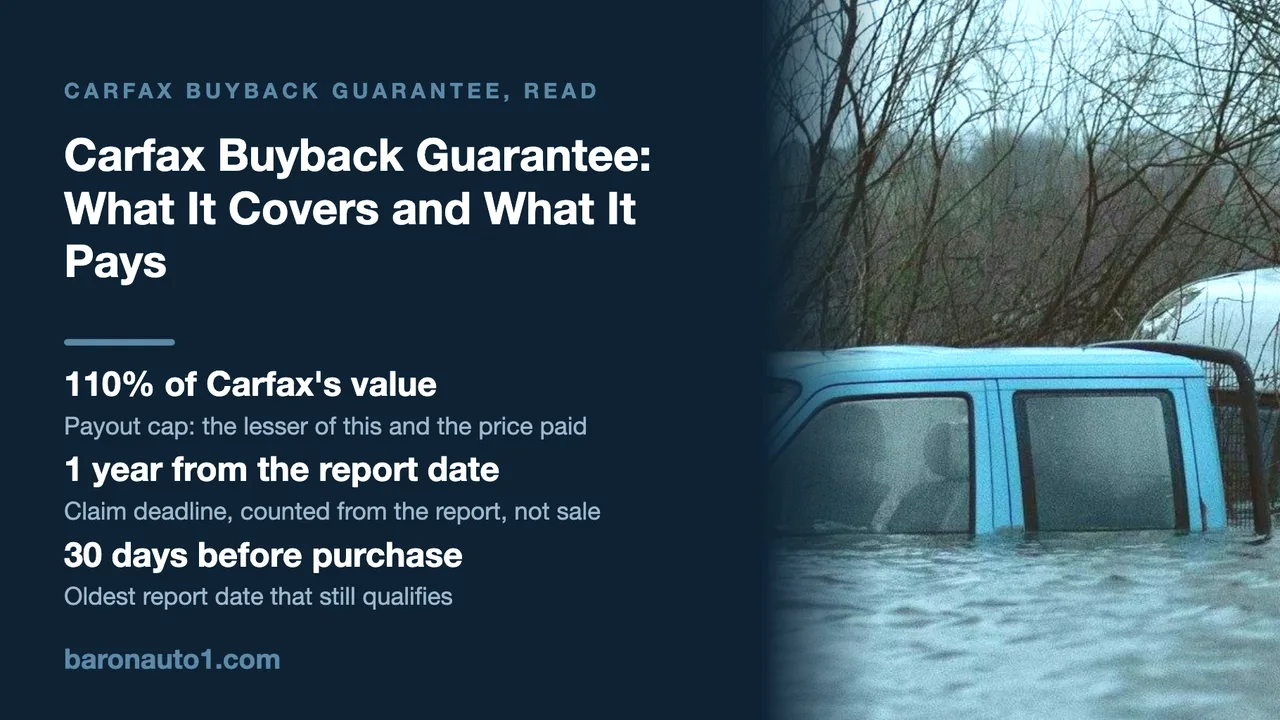
A promise about title brands, not accidents. Carfax pays the lesser of the price and 110% of its own value, and the claim clock starts at the report date, not the sale.
The short version
- The CARFAX Buyback Guarantee pays only when a Carfax report says a car has no branded title and a US state or District of Columbia title carrying a brand already existed, such as salvage, junk, rebuilt, fire, flood, hail, lemon/manufacturer buyback or an odometer brand.
- Accidents, structural damage, a total loss that never became a brand, and odometer readings are outside it. Carfax’s Help Center says: “No, CARFAX does not guarantee odometer readings.” Theft salvage titles and brands issued in error are excluded by name.
- Three dates decide a claim: the brand issued at least 60 days before the report date, the report dated before the purchase and no more than 30 days before it, and the claim made within 1 year of the report date, not the purchase date.
- The payment is the lesser of the car’s price, with fees, taxes and add-ons stripped out, and 110% of Carfax’s current History-Based Value. The terms never say Carfax takes the car.
- You must still own the car when you claim, and accepting a payment releases Carfax from every claim about that report. The terms define the qualifying report by its date, not by who paid for it.
The CARFAX Buyback Guarantee is a promise about title brands, not about a car’s whole history. If a Carfax report says a car has no branded title, and a state had in fact branded it salvage, junk, rebuilt, fire, flood, hail, lemon or with an odometer brand, Carfax will pay the owner the lesser of the purchase price and 110% of its own current value for the car, provided the dates and paperwork in its terms line up. This page uses only Carfax’s own documents: the Buyback Guarantee Terms and Conditions, two Help Center articles, the About page, the How to Read a Carfax Report article, the consumer sample report and Carfax’s sample certificate, all read on 2 October 2026. We have no commercial relationship with Carfax.
Whether a report is worth buying is answered in is Carfax worth it, and how complete Carfax’s records are in how accurate is Carfax. Here the question is narrower: what the guarantee on the report promises, to whom, for how long and for how much.
What the guarantee promises, in Carfax’s words
The Help Center article What is the CARFAX Buyback Guarantee? says it “helps protect consumers from unknowingly buying a vehicle with a DMV-issued title brand” and gives the test: “If you find that any of these title problems were reported by a DMV and not included in a report, you may qualify.” The About page says it “reduces the risk involved in buying a used car.”
The consumer sample report shows where the promise sits. One section, Title History, carries the line “CARFAX guarantees the information in this section.” It lists damage brands and odometer brands, each marked “Guaranteed”, over the statement “None of these title problems were reported by a U.S. state Department of Motor Vehicles (DMV).” No other section carries that label. Our sample vehicle history report guide walks through the rest of a report.
The binding language is in the terms. Section 2 says Carfax “will provide Payment to the Applicant if the Report states that the Vehicle does not have a Branded Title, but a Branded Title exists”, then lists five conditions. Two words carry the weight. “States” makes the guarantee about what the report said: if the report showed the brand, there is nothing to claim. “Exists” means the brand has to be on a real title, and Carfax’s article on branded titles says brands “can only be given by a government agency.” Damage that never became a brand is not a Branded Title, however bad it was.
Which title brands it covers
The terms define a Brand as “a word or symbol indicating that the Vehicle was junked, salvaged, dismantled, rebuilt, reconstructed, flood damaged, fire damaged, hail damaged, bought back by its manufacturer (commonly referred to as a ‘lemon law’ vehicle), odometer exceeds mechanical limits, odometer was not actual mileage or any other word or symbol indicating a similar condition.” That is 11 named conditions and a catch-all. A Title is “a legal document issued by any state of the United States or the District of Columbia that demonstrates ownership of the Vehicle.”
Carfax’s shorter descriptions name fewer conditions. Where the terms are wider than the summaries, the terms are what a claim is judged on.
| Condition | Terms (definition of Brand) | Help Center article | Sample report, Title History | Sample certificate |
|---|---|---|---|---|
| Salvage | Named | Named | Named | Named |
| Junk | Named | Named | Named | Named |
| Rebuilt | Named | Named | Named | Named |
| Reconstructed | Named | Not named | Not named | Named |
| Dismantled | Named | Not named | Not named | Named |
| Fire | Named | Named | Named | Named |
| Flood | Named | Named | Named | Named |
| Hail | Named | Named | Named | Named |
| Lemon / manufacturer buyback | Named | Named | Named (as “Lemon”) | Named (as “Manufacturer Buyback”) |
| Not Actual Mileage | Named | Named | Named | Named |
| Exceeds Mechanical Limits | Named | Named | Named | Named |
| Any other word or symbol indicating a similar condition | Yes | No | No | No |
| Conditions named | 11 | 9 | 9 | 11 |
The sample certificate groups the words under three headings: Severe Damage (Salvage/Junk, Rebuilt/Reconstructed, Dismantled, Fire/Flood/Hail), Odometer Problems (Exceeds Mechanical Limits, Not Actual Mileage) and Lemon History (Manufacturer Buyback).
Severe damage brands usually start with an insurer writing the car off; Carfax says “Vehicles are often branded as a result of an insurance company declaring them a total loss.” Our guides to salvage titles, rebuilt titles and flood checks by VIN cover each one. The lemon brand follows a carmaker buying a car back under a state lemon law, and the names states use for it vary widely; see what a lemon title is. The two odometer brands are the only part of a car’s mileage story the guarantee touches.
The catch-all matters because states do not all use Carfax’s words; our branded title guide lists the variations. The terms give no state-by-state list of equivalents, so treat an unusual brand name as something to raise with Carfax in writing.
What it does not cover
The sample report draws the line itself. Above Title History sits Additional History, headed “Not all accidents / issues are reported to CARFAX”, with 7 rows: Total Loss, Structural Damage, Airbag Deployment, Odometer Check, Accident / Damage, Manufacturer Recall and Basic Warranty. None of it is guaranteed.
The terms then exclude three kinds of brand by name. An Excluded Brand is “(i) a Title originally issued without a Brand, but a Brand was subsequently added to the Title without the Title being reissued, (ii) a Title indicating salvage due to theft or (iii) a Branded Title issued in error.”
Mileage is the case buyers most often get wrong. The Help Center’s odometer article opens: “No, CARFAX does not guarantee odometer readings.” Only a Not Actual Mileage or Exceeds Mechanical Limits brand is covered. A rollback that never produced one is not, however clear the mileage records make it; our odometer check guide covers what you can verify yourself.
| Situation | Inside the guarantee? | The Carfax wording that decides it |
|---|---|---|
| A state issued a salvage, flood or rebuilt title well before your report, and the report shows no brand | Inside | “the Report states that the Vehicle does not have a Branded Title, but a Branded Title exists” |
| An accident or structural damage the report does not show | Outside | “Not all accidents / issues are reported to CARFAX” |
| An insurer total loss that never produced a title brand | Outside | No Branded Title exists |
| Mileage rolled back, with no odometer brand on any title | Outside | “No, CARFAX does not guarantee odometer readings.” |
| A salvage title issued because the car was stolen | Outside | “a Title indicating salvage due to theft” |
| A brand added without a new title being issued, or issued in error | Outside | Excluded Brand, items (i) and (iii) |
| A brand issued less than 60 days before the report date | Outside | “issued at least 60 days prior to the date of the Report” |
| Hail or lemon history in a state that issues no such brand | Outside | No Brand exists to miss |
| A brand on a title issued outside the US states and DC | Outside | Title: issued “by any state of the United States or the District of Columbia” |
| You sold or traded the car before claiming | Outside | “Applicant owns the Vehicle at the time Applicant submits the Claim.” |
A clean Title History is not a clean car. A car can be crashed and repaired privately, flooded without an insurance claim, or wound back on the odometer and still carry a clean title, and then there is nothing for the guarantee to catch. A pre-purchase inspection is the only check that looks at the car itself, and our VIN accident check guide explains why crash records are the patchiest part of any report.
Who can claim, and which report counts
The Applicant is “the person or entity that submits a Claim”, so on the wording a business can claim as well as a private buyer. The Applicant must own the car when claiming, must not be “an employee, or a family member of an employee, of CARFAX or its affiliates”, and must supply “Applicant’s bill of sale for purchase of the Vehicle”. That ties the claim to the claimant’s own purchase: a later owner would need a report dated within the window before their own purchase.
The Report is “the CARFAX Report for the Vehicle that is the subject of the Claim and is dated prior to the date the Vehicle was purchased by Applicant but no more than 30 days prior to such purchase.” The definition is about the date. It says nothing about who ordered or paid for the report.
That matters because many buyers never pay for one. Carfax’s About page says “Every car listing comes with a free CARFAX Report”, and its Help Center article on getting free reports says “A free CARFAX report is often available through dealer websites”. That article does not mention the guarantee, and no Carfax document we read treats a dealer-supplied or free report differently. On the terms as printed, the test is the date. Our pages on free Carfax reports and what a Carfax report costs cover how to get one.
The date is where a dealer’s copy can fail you. A report pulled when the car was first listed may be more than 30 days old by the day you sign, and then it is not a Report under the terms. The sample report prints when its information was current, in a line ending “and available as of” followed by the date and time; check that against your bill of sale. There is also a same-day question: “dated prior to the date the Vehicle was purchased”, read literally, points to a report dated before the day of sale. Pull it the day before, or ask Carfax in writing whether a same-day report counts.
The car has to qualify too. A Vehicle is “any automobile or light truck with a model year no more than 20 years before the date of the Report.” Carfax says its reports are available “from model year 1981 or later”, so plenty of cars with a report fall outside the guarantee. On our reading, for a report dated in 2026 the oldest model year inside the definition is 2006 (our arithmetic: 2026 minus 20); on a car near that line, ask first. And the brand must be on a US title: Carfax’s How to Read article says its data includes “Canadian provincial motor vehicle agencies”, but the guarantee’s Title covers only US states and DC.
The three clocks: 60 days, 30 days, one year
Most wrong assumptions about the guarantee come from thinking its time limits run from the day you bought the car. Three of them run from the report date.
| Clock | What the terms say | What it means for you |
|---|---|---|
| Brand age | The Branded Title “was issued at least 60 days prior to the date of the Report” | A brand issued in the 60 days before the report is outside, even if the report missed it |
| Report age | Dated before the purchase “but no more than 30 days prior to such purchase” | An older listing report does not qualify, nor does one pulled after you bought |
| Claim deadline | “The Claim is submitted within 1 year after the date of the Report.” | The year ends before the first anniversary of your purchase |
| Ownership | “Applicant owns the Vehicle at the time Applicant submits the Claim.” | Selling or trading the car first ends the claim |
| Vehicle age | Model year “no more than 20 years before the date of the Report” | Older cars can have a report but no guarantee |
Put the first three together and two gaps appear. At the front: with a report dated 30 days before you bought, a brand issued up to 90 days before your purchase can sit outside the guarantee (our arithmetic: 60 days plus 30). Carfax does not explain the 60 days, but the effect is that a car branded recently and sold quickly, the case where a buyer most needs the check, is the case the guarantee is least able to cover.
The claim clock starts at the report date, not the day you bought the car. With a report dated 30 days before your purchase, you have 335 days after the purchase to claim, about 11 months (our arithmetic: 365 days minus 30). Diary the deadline from the date printed on the report, and do not sell the car until any claim is settled.
Both gaps shrink the same way: the closer the report’s date is to the sale, the shorter the stretch in which a brand can slip through, and the closer the deadline comes to a full year of ownership. Carfax’s sample certificate prints a coverage window running one year from its own date, consistent with a clock that starts at the report.
What it pays: the lesser of two numbers
The Payment is “the lesser of (i) the purchase price of the Vehicle (which excludes fees, taxes and any ancillary products and services such as warranties, insurance, reconditioning services, aftermarket accessories, parts or services) and (ii) 110% of the current CARFAX History Based Value for the Vehicle.” Two numbers; you get the smaller.
The first is the price of the car alone. On the wording, a payment never returns taxes, fees, a warranty or service contract, insurance, or other add-ons bought with the car such as reconditioning, accessories, parts and services.
The second is a ceiling set by Carfax’s own valuation. For every $1,000 of History-Based Value the ceiling is $1,100 (our arithmetic on the printed 110%, not a value for any car). The ceiling becomes the payment whenever Carfax’s current value is below about 90.9% of the price you paid net of extras (our arithmetic: 100 divided by 110).
Two gaps in the terms decide which side of that line a claim lands on. They say “current” without saying as of when: the day you claim, the day Carfax decides, or the day it pays. And they do not say whether the value is calculated as if the title were clean or with the newly found brand. Carfax’s How to Read article says the History-Based Value “evaluates a car’s current value based on several factors, including service records, open recalls, past accidents, and the number of previous owners”; brands are not in that list, but it is not presented as complete. A salvage or flood brand is exactly the history that pulls a value down, so ask Carfax in writing before relying on a figure. Our page on market value by VIN covers how history moves values generally.
Two more lines affect what you keep. “Applicant is responsible for the payment and discharge of all federal, state and local taxes, if any, which may at any time be found to be due upon or as a result of the Payment.” And a payment can be clawed back: “Applicant will return the Payment to CARFAX should CARFAX discover that Applicant provided any false or misleading information with respect to the Claim.”
A buyback in name, a payment in the terms
The odometer article describes a buyback: Carfax “guarantees that the title brand will be included in the CARFAX Vehicle History Report or we will buy your car, pursuant to the terms and conditions of the CARFAX Buyback Guarantee.”
The terms it points to never describe buying the car. They define a Payment. They ask for copies of your current title and the branded title, not for a title signed over, and say nothing about collecting the car or what happens to it. Read as printed, the guarantee is a capped cash payment. We found no Carfax document that says more, so the honest position is that the terms are silent and Carfax would have to tell you. They are also silent on a financed car whose lender holds the title: they ask for the “Current Title issued to Applicant for the Vehicle” and pay the Applicant.
Acceptance has a consequence worth knowing before you say yes: “By accepting the Payment, Applicant waives and releases CARFAX from all claims, actions, suits, disputes, costs, liabilities and expenses of whatever kind Applicant may have now or in the future with respect to the Report, including but not limited to future CARFAX Reports for the Vehicle.” If you have any other complaint about the same report, decide what to do about it first. The terms also make you indemnify Carfax against anyone “claiming an interest in the Claim”, which on a financed car could include a lender.
How to make a claim
Carfax publishes the conditions and the document list but not the form. None of the pages we read links the “CARFAX Buyback Guarantee Claim Form” the terms require or names a claims address. The Help Center article offers a “Report a Concern” form and a general “Contact Us” form, and says: “We don’t offer phone support out of full dedication to our other help channels.” On that basis:
- Get the branded title. The terms want the “Front and back of the Branded Title”. If the brand was issued in another state, that usually means asking that state for a copy of its title record.
- Check the dates. The brand at least 60 days before the report, and not one of the 3 Excluded Brands; the report before the purchase and no more than 30 days before it.
- Assemble the 5 documents. Claim form, your current title, the report, your bill of sale, and the branded title front and back, each “a true, accurate and complete copy”.
- Ask for the claim form through Carfax’s online contact form, say it is a Buyback Guarantee claim, and keep copies of everything sent and received.
- Submit within 1 year of the report date, and keep the car until the claim is resolved.
Disputes are “governed by and construed in accordance with the laws of the Commonwealth of Virginia”, with jurisdiction “vested exclusively in the state courts in Fairfax County, Virginia or the U.S. District Court for the Eastern District of Virginia, Alexandria Division.” For most buyers that is a long way from home, which is one more reason to get answers in writing before the deadline.
Why the guarantee depends on state title-brand law
The guarantee covers brands, and only governments issue them, so it is only as wide as the branding law of the state that titled the car. Carfax says “Title brands are different in each state and they can only be given by a government agency”, and that “different states may have different definitions for a brand”.
It gives two examples of states not branding at all. On hail: “Many states issue a title brand for hail damage, but some (including Texas) do not.” On lemons, its lemon car article says “more than two-thirds of states don’t require any special title branding for lemons.” Where no brand is issued, no Branded Title exists and the guarantee has nothing to pay on. For lemons Carfax’s advice is to read the rest of the report: “If you see the manufacturer has owned the car after an individual had purchased it or if there are three or four repairs for the same issue in a short period, those are red flags.”
The variation also enables title washing, where the guarantee earns its keep. Carfax’s title washing article says a brand may be removed “by simply relocating the car to a state where that brand isn’t recognized or noted.” The car then has a clean current title, but a branded title still existed, and the terms ask for your “Current Title” and, separately, the “Front and back of the Branded Title”, which reads as if they expect this case.
The federal title system runs alongside. States, insurers and salvage yards report to the National Motor Vehicle Title Information System, and the Justice Department’s approved-provider list states: “Consumers CANNOT receive NMVTIS Vehicle History Reports from Carfax, DMVDesk, or Experian; these entities provide information only to car dealerships.” An NMVTIS report from an approved provider is a separate title check. Our guides to the NMVTIS report, title checks by VIN and Carfax vs AutoCheck cover the options. None replaces reading the paper title.
Where Carfax’s own documents disagree
Carfax’s descriptions are mostly consistent, but they diverge in places a buyer should know. In each case the terms decide a claim.
- Buyback or payment. The odometer article says “we will buy your car”; the terms define a capped Payment and a release, and never mention the car changing hands.
- Odometer accuracy. The odometer article says Carfax does not guarantee readings. The How to Read article, describing Title History, says “Carfax also lets you know if the reported odometer reading is accurate.” The sample report settles it: Odometer Check sits under Additional History, and only the odometer brands sit in the guaranteed section.
- The list of brands. The terms name 11 conditions plus a catch-all; the Help Center article and sample report name 9, without dismantled or reconstructed; the certificate names all 11; the About page offers examples, “such as salvage, fire or flood damage, and odometer problems”.
- Registration. The About page links “CARFAX Buyback Guarantee™ Registration”. On 2 October 2026 it opened the CARFAX Car Care app page, with no Buyback Guarantee text. None of the five conditions in the terms is a registration.
- Reports versus guarantee. Reports go back to model year 1981; the guarantee stops at a model year 20 years before the report date.
Second-hand descriptions drift further. Jeep’s certified pre-owned page says “Coverage lasts one year and is transferable”; Carfax’s terms never use the word transferable and require the claimant to own the car when claiming. Mazda’s certified page says “one-year Buyback Guarantee™ from CARFAX®”, while a Mazda resource article says “three-year Buyback Protection from CARFAX”. Carfax’s terms run 1 year from the report date. If you are buying certified pre-owned, read Carfax’s terms rather than the summary; our Jeep and Mazda pages cover what those programs print.
The terms page’s own metadata gave a modification date of 25 September 2026 when we read it on 2 October 2026. Terms change, so save a copy of the page on the day you buy.
Using the guarantee before you sign
- Check the report’s date. Before your purchase date and no more than 30 days before it. If the dealer’s copy is older, ask for a fresh one or get your own.
- Pull it close to the sale. The day before is the safe choice: it narrows the window for a brand to slip through and stretches your deadline toward a full year of ownership.
- Read Title History, then everything else. Title History is the guaranteed part. Accidents, unbranded total losses, airbags and mileage checks sit in Additional History.
- Look at the paper title. Read its brand fields and ask which states the car was titled in before.
- Check the car’s age. A model year more than 20 years before the report date is outside the guarantee.
- Save the evidence. The report itself, the bill of sale, and a copy of Carfax’s terms page as it reads that day.
- Diary the deadline. One year from the report date, not from the purchase.
- Get the car inspected. The guarantee never looks at the car; a pre-purchase inspection does.
Common questions
Does the Carfax Buyback Guarantee cover accidents?
No. It covers title brands issued by a US state or DC that the report failed to show. Accidents, structural damage and airbag deployments sit in the Additional History section, which Carfax heads “Not all accidents / issues are reported to CARFAX”. An accident only comes into it if it led to a brand such as salvage or rebuilt.
How long does the Carfax Buyback Guarantee last?
The claim must be submitted “within 1 year after the date of the Report”. Because the report can be up to 30 days older than your purchase, the time left after you buy can be as short as 335 days (our arithmetic). You must still own the car when you claim.
Does a free Carfax report from a dealer come with the Buyback Guarantee?
The terms define the qualifying report by its date, before your purchase and no more than 30 days before it, and say nothing about who paid. No Carfax document we read treats a dealer-supplied or free report differently. The risk is age: a report run when the car was listed may be too old by the day you sign.
Will Carfax pay back what I paid for the car?
Not necessarily. The payment is the lesser of the price, with fees, taxes and add-ons excluded, and 110% of Carfax’s current History-Based Value. If that value is below about 90.9% of what you paid net of extras (our arithmetic), you get the lower figure. The terms do not say whether the value reflects the newly found brand.
Is the Carfax Buyback Guarantee transferable?
Carfax’s terms do not use the word. They require the claimant to own the car, to have bought it within 30 days after the report’s date, and to supply their own bill of sale. Some carmakers’ certified pages call the coverage transferable; if you are relying on a previous owner’s report, ask Carfax in writing.
How do I file a Carfax Buyback Guarantee claim?
Gather the five documents the terms list: the claim form, the current title issued to you, the report, your bill of sale and the branded title, front and back. Carfax does not publish the form or a claims address on the pages we read and offers no phone support, so request the form through its online contact form and submit within 1 year of the report date.
Sources and further reading
- NMVTIS (US Department of Justice)
- NMVTIS approved data providers
- 28 CFR Part 25 Subpart B — NMVTIS reporting rules (eCFR)
- California DMV branded titles
- TxDMV salvage vehicles and title brands
- NHTSA odometer fraud
- FTC used car buying guide
Recall, complaint and safety-rating figures on this page were retrieved from the federal databases above on August 19, 2026. Federal data changes — re-check any VIN before you rely on it.
Published October 2, 2026 · last updated October 2, 2026. Found something out of date or wrong? Tell us and we will correct it.