Polaris VIN Decoder: 10 Codes and Three Vehicle Types
A quad or a side-by-side can decode under a code filed as a motorcycle. The type field reports the filing, not the machine.
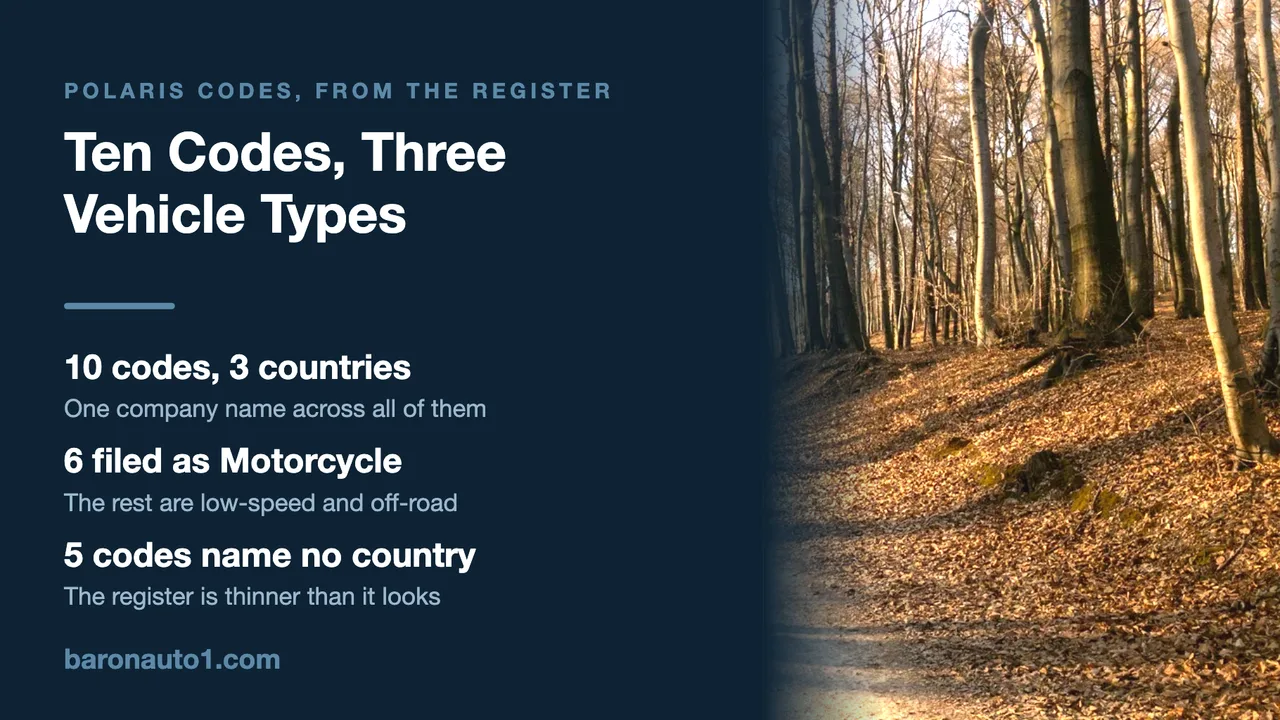
The short version
- There is no Polaris-only VIN decoder, and there is no need for one. Every vehicle certified for this market carries the same seventeen-character number, and one federal register resolves the manufacturer prefix on all of them.
- The register holds ten world manufacturer identifiers under Polaris, and all ten are filed under a single company name: POLARIS INDUSTRIES INC. No parent group sits above the entry, and querying the register for the name returns no false matches.
- The type mix is the interesting part. Six of the ten codes are filed as Motorcycle, two as Low Speed Vehicle (LSV) and two as Off-Road Vehicle. Not one is filed as Passenger Car, Multipurpose Passenger Vehicle or Truck.
- Vehicle type is a property of the code, not of the machine in front of you. A number issued under one of the six Motorcycle codes returns the word Motorcycle whatever the thing is called on the forecourt, and that is the register answering correctly rather than a lookup going wrong.
- Five of the ten codes — half the entry — record no country at all. The blank is not scattered: those five are the five oldest codes, opened in 2015 and 2016, and every code opened from 2021 onward carries a country.
- The five that do carry one record Mexico on two codes, Poland on one and the United States on two. That field records where the registering entity filed, not where a machine was assembled.
- What no decode carries, on this make or any other: service history, present condition, and whether a recall was actually carried out.
Search for a Polaris VIN decoder and the results look like a category of software. They are not. The number stamped on a machine sold here is built to the same federal standard as the number on a saloon car or an articulated lorry, and the register that turns the first three characters into a manufacturer is the same register for all of them. Nothing about this make requires a separate reader, and no page offering one has anything the general lookup lacks.
What is genuinely specific to this make is the register entry, and it is worth reading closely, because it contains a result that reads like a failed lookup and is not one. This page works from the entry: ten codes, one registered company name, three vehicle types, three recorded countries, five blanks where a country would sit, and a hundred and fifty-three models the decoder holds for the make. None of that is a manufacturer briefing. It is a public filing, read carefully, with the gaps stated where they fall.
The gaps matter more than the contents. A buyer looking at a used machine wants to know how it was ridden, what was serviced, whether the recall letter was ever acted on and whether the odometer means anything. Those are not questions seventeen characters were designed to answer, and the useful thing a page like this can do is say so plainly rather than build another input box on top of the silence.
One federal system reads every VIN, this make included
The vehicle identification number is a federal standard and its layout does not change with the badge. Positions one to three are the world manufacturer identifier, assigned to the legal entity that issues the numbers. Positions four to eight are the manufacturer’s own descriptor block, laid out to a scheme the manufacturer designs for itself. Position nine is a check digit, computed arithmetically from the other sixteen characters. Position ten carries the model year. Position eleven identifies the assembling plant. The last six are the serial.
Our guide to reading a VIN position by position sets out the full layout, and the by-make index collects what the register holds for each manufacturer we have read.
Where a make-specific decoder would earn its keep is the descriptor block, and here we have to be honest about a limit that applies to every page of this kind. Positions four to eight are the manufacturer’s own scheme, and the federal register does not publish the key to it. The register records who holds a prefix, what vehicle class the prefix is filed under, which country the entity is registered in, and when the code was opened. It does not record that a particular character in position six means one configuration on one machine and something else on another.
So this page prints no position-by-position table for the make, and no plant-code list, because we hold neither from a source we would defend. Tables of that sort are published in several places. None of them is the register, and we do not hold one from a source we would defend. Decoding a real number returns the descriptor fields as the federal system resolves them for that specific machine, which is a narrower and far more reliable thing than a printed key someone assembled from a forum thread.
Ten codes, and one company name across all of them
A VIN opens with three characters the manufacturer does not choose for itself. They are assigned centrally, published in full, and they identify the entity that filed for the right to issue numbers. Under this make there are ten, and the register lists every one of them against the same registrant: POLARIS INDUSTRIES INC.
That uniformity is worth pausing on, because it removes a problem that dominates most of the other make pages on this site. On large manufacturers the codes are typically split between several filed legal entities, and a decode can return a company name that shares nothing with the badge, which sends a perfectly ordinary result straight to the search box as evidence of fraud. Here the registrant field returns the same three-word answer on every code in the entry. Whatever else this decode is going to surprise you with, it will not be the company name.
The entry is clean in a second way too. The register’s name endpoint matches company names as plain text rather than resolving brands, so asking it for a common word drags in every small builder, trailer shop and specialist converter whose registered name happens to contain that string. That noise is why code counts for the same make differ between websites: different sites filter it differently, or not at all. Querying for this make returns no false matches at all. Ten rows, no strangers attached, nothing for the reader to subtract by hand.
And the make registers in its own right rather than sitting under a parent group. That is not true of every badge — several well-known marques hold no codes at all of their own, and their numbers are issued under a parent’s filing, which is why searching those badge names in the register returns almost nothing. Here the badge and the register entry line up, so the ten codes on this page are the ten codes the company holds.
Six, two and two: how the codes split by vehicle type
Every code in the register is filed under a vehicle type, and this is where the entry stops being ordinary. Six of the ten codes are filed as Motorcycle. Two are filed as Low Speed Vehicle (LSV). Two are filed as Off-Road Vehicle. There is no fourth category. Not one code in the entry is filed as Passenger Car, as Multipurpose Passenger Vehicle or as Truck.
Read that list against the words people actually use for these machines and the mismatch is immediate. A buyer looking at something the advert calls a side-by-side, a quad, a utility vehicle or a trail machine has three federal words available to them in this entry, and two of those three — Motorcycle and Low Speed Vehicle — do not sound like the object they are standing next to. Only one of the three, Off-Road Vehicle, reads the way a rider would expect, and it is filed against two of the ten codes.
Six of the ten codes carry the word Motorcycle, so a decode on this make that comes back saying Motorcycle is a common and correct result. The arithmetic of that is worth stating plainly: any number that opens with one of those six will return Motorcycle, every time, on every decoder, because the type is filed against the code rather than worked out from the machine. There is no fault to find and nothing to report. It is the register answering the question it was actually asked.
We are counting only what is in front of us here, and it is worth saying what the comparison looks like. Across the thirty-six makes archived in this file, twenty-eight hold codes in their own name. Of those twenty-eight, eight have at least one code filed as Motorcycle. Two have a code filed as Off-Road Vehicle. Exactly one — this make — has a code filed as Low Speed Vehicle (LSV), and no other entry in the file combines all three of those types. That is a statement about the thirty-six entries we have read and archived, not about the whole register, and we would rather draw the boundary than imply a bigger one.
What the vehicle type field is actually reporting
Because so much rides on that field here, it is worth being exact about what it is. The vehicle type recorded against a world manufacturer identifier is a federal vehicle class, filed against the code at the point the code was registered. It is a regulatory classification, chosen from a fixed list of categories, and its job is to say which body of rules a number issued under that prefix falls under.
Three consequences follow, and all three routinely trip people up.
The first is that the type belongs to the code and not to the individual machine. When a decode returns Motorcycle, it is reporting the class filed against the prefix that number opens with. It is not looking at the machine, measuring it, counting its wheels or reading a photograph. Two objects that look nothing alike will return the same word if their numbers were issued under the same code, and that is not a bug in the decoder.
The second is that the federal category and the everyday word are different vocabularies that happen to overlap in places. Multipurpose Passenger Vehicle catches a lot of what the market calls an SUV. Low Speed Vehicle is a regulatory class with its own rules, not a description anybody uses in conversation. Off-Road Vehicle is a category in the same list. These words are doing regulatory work, and reading them as if they were the seller’s description will mislead you in both directions.
The third is that the register does not record why any code was filed under one class rather than another. It carries the code, the registrant, the class, the country and the opening date, and it carries no reasons for any of them. We are not going to invent any. If you want to know why a particular prefix sits under a particular word, the honest answer available from this data is that it does, and the filing does not explain itself.
The practical upshot for a buyer is narrow and useful. The class field tells you how numbers issued under that prefix were certified. It does not confirm the body style, the seating layout, the number of wheels or what the machine will be treated as by the office that registers it locally. Our pages on ATV and off-road VIN lookups and on motorcycle VIN lookups cover the two federal words this entry leans on most, including what decodes cleanly under each and which fields come back blank.
Five codes with no country recorded at all
Half of this entry has an empty country field. Five of the ten codes carry a country; five do not. That is not a formatting glitch in our archive and it is not an error in the decode — it is what the register holds, and the honest way to report it is to say the field is blank rather than to guess a plausible answer and print that.
The blanks are not scattered through the entry at random, which is the part worth noticing. Sorted by the date each code was opened, the five with no country are the five oldest: two opened in June 2015, two more the following day, and one in February 2016. Every code opened from 2021 onward carries a country. Whatever accounts for that, the pattern in the entry is clean, and it means an older code in this make is more likely to give you nothing in the country column than a newer one.
It is also worth knowing how unusual half is. Of the twenty-eight makes in this archive that hold codes in their own name, thirteen have at least one code with the country field blank, so a gap of some size is common enough. Two of the twenty-eight have the field blank on half or more of their entry, and this make is one of the two. So the blank itself is ordinary; its share of this particular entry is not.
When you hit one of those five, resist the temptation to fill the gap from a first-character table. A decoder that returns a country against a code the register leaves empty is telling you something the register does not say. A missing field is information. It says the register does not carry that fact, which is a different and more useful statement than a confident guess.
Mexico, Poland and the United States: what the country field records
The five codes that do carry a country record three of them. Two are recorded against Mexico, one against Poland and two against the United States. Three countries, one registered company name, and no split of the entry between separate filed entities.
That combination is uncommon in the set we have read. Of the thirty-six makes archived here, only two hold codes in a single registered company name while recording three or more countries, and this is one of the two. On most large entries a second country arrives with a second legal entity attached to it; here the country field moves and the registrant field does not.
Now the caution the field always needs. The country recorded against a code describes where the registering entity filed. It is not a statement that any machine was assembled there, and it should never be read as one. A code recorded against Poland tells you a filing sits in Poland. A code recorded against the United States tells you a filing sits in the United States. Neither tells you where anything was welded, painted or crated.
The federal data holds nothing that would let anyone tighten that. Position eleven of an individual number is the plant character, but the register does not publish the key that turns a plant character into a named facility, so this page prints no plant-code table. Anyone who does print one is working from somewhere other than the register, and is not telling you where.
What the leading characters do and do not line up with
Written out in full, the ten codes in the entry are 5VP, 57X, 4XA, 3NE, 3NS, TAP, 52C, 5AS, SN1 and S21.
People arrive at a list like that carrying a memorised table of first characters, and on this entry the table will work on some rows and fail on others. The two codes recorded against Mexico both open with 3. The two recorded against the United States both open with S. The one recorded against Poland opens with T. The five with no country at all open with 5, 5, 4, 5 and 5, and no character in any of them fills the empty field.
The lesson is not that first characters are meaningless. It is that this entry gives you the country in its own column, and reading the column beats inferring from the character — especially on an entry where half the column is empty and where the two rows recorded against the United States do not open with the character a memorised table would predict. The register prints what it knows. Where it prints nothing, nothing is known to it.
The same discipline applies one level up. The three characters at the front of a number tell you which entity issued it. On this make that answer is the same on all ten codes, so the prefix is doing less work here than it does on a make split across several filed companies. Everything more specific about a particular machine lives from position four onward, in fields only a decode of that actual number will return.
The order the codes were opened, and what a date is
Sorted by the date recorded against each filing, the entry runs like this. Two codes were opened on 10 June 2015, one filed as Motorcycle and one as Low Speed Vehicle (LSV). Two more followed on 11 June 2015, again one of each type. A fifth, filed as Motorcycle, was opened in February 2016. Then a gap of five years, after which three codes were registered on a single day, 19 March 2021 — the two recorded against Mexico and the one recorded against Poland, all three filed as Motorcycle. The last two are the pair filed as Off-Road Vehicle, opened in July 2022 and January 2023.
Three observations survive that sequence, and only three. The five codes with no country are the five oldest. The three codes registered on one day in March 2021 are the only three in the entry recorded against a country other than the United States. And the two Off-Road Vehicle codes are the newest in the file as well as being the only two recorded against the United States.
Now the warning that belongs beside every one of those dates. A registration date is the date a code was opened in the register. It is not a build date, not a sale date, not a first-titling date and not a model year. Codes can be registered ahead of any production at all, and a code can sit in the register unused for a period. A date in this entry is evidence about a filing and nothing else.
The model year of a specific machine lives somewhere else entirely: position ten of its own number, read against our model-year chart. If you take one thing from this section, take the difference between those two facts. A 2021 registration date does not make anything a 2021 machine, and a code opened in 2015 does not put a ceiling or a floor on the age of anything carrying it.
A hundred and fifty-three models, and why this page names none of them
The federal decoder holds a hundred and fifty-three models for this make. That is the vocabulary a decode can draw on when it resolves a specific number — the set of model names the system knows about across all years, rather than anything resembling a current line-up.
The archived pull this page works from carries that count and not the roster of names, so no model list appears here. That is a smaller point than it sounds and a more important one than it looks. Every make page on this site runs from one archived read of the register, and the rule is that we publish what the read contains. Reciting model names from memory would be indistinguishable, to a reader, from reporting the data, and it would be indistinguishable, to a reader, from reporting the data. Where we hold the roster, we print it. Here we hold the count, so the count is what you get.
The count is not the useful part in any case. What a buyer needs is the model returned for one specific machine, and that comes from decoding that machine’s number rather than from any list. A list would only ever describe what the system knows about the make in general; the decode describes what it holds about the object you are being asked to pay for.
And a model name, however it arrives, is not a specification. The decoder knows the model line. It does not know which engine option, which drive configuration, which suspension, which wheels or which accessory package a particular machine left the line with, and on used machines those differences move the price considerably. Our pages on trim level by VIN and options by VIN set out how far that can be pushed and where it stops.
What the decode will not tell a buyer
This is the section that does the most work, because it is where the distance between what people expect a VIN to carry and what it actually carries is widest.
The number is a build identity. It exists so that a regulator can tie a recall campaign to a batch, an insurer can tie a policy to an object, and a state can tie a title to that same object. It was never designed to describe condition today, and it has no field for any of the following.
Service history. Oil changes, belt and chain wear, clutch work, coolant, the last time anything was properly looked at — none of it reaches the register and none of it is encoded in the number. On a machine maintained by its owner rather than through a dealer, there may be no central record anywhere. What exists is a folder of receipts, worth asking for and worth reading rather than glancing at.
Whether a recall was actually carried out. This one is worth being careful about. The federal recall lookup will tell you whether a campaign is recorded as open against a specific number, which is free and genuinely worth running. What no decode does is confirm that a previous owner ever presented the machine. A campaign showing as remedied means a remedy was recorded. A campaign showing as open means the work is outstanding as far as the system knows, which is not quite the same as outstanding. Our guide to checking for open recalls covers reading the result properly, including the cases where the flag and the reality diverge.
Condition, hours and use. A decode reads the build. It does not read wear, and an indicated figure on a display is not a measure of what a machine has been put through. Nothing in the number reports how a machine was ridden, what it was ridden through, or what has been replaced since.
Damage that never reached a record. Damage enters a file only where an insurer or a state filed something. A repair paid for privately leaves no trace at all, so a file with nothing in it is not the same as a machine nothing has happened to. Our page on what a free VIN check actually returns is blunt about which checks cover what.
Whether the paperwork will work where you live. The federal decode identifies the machine. It says nothing about how your own registering authority will treat it, what documents it will want or whether the machine can be used on a public road. That varies locally, the number does not carry it, and no decoder can tell you.
Reading the number off the machine
Whatever the advert says, the number to work from is the one on the machine. Read it yourself rather than copying it from a listing, and read it from more than one place if the machine offers more than one.
Off-road and recreational machines carry their identification differently from cars, and the plate is often on a frame member rather than behind a windscreen. Find it, clean it, photograph it in good light, and transcribe it character by character rather than from memory. Our guide to where the VIN is stamped covers the wider set of locations, including the ones worth checking on something you suspect has been apart.
Then run the check digit before you run anything else. Position nine is computed arithmetically from the other sixteen characters, so a mistyped number usually fails the arithmetic before it has cost anybody a journey. Our validator page explains how to do that by hand, and it is worth doing on any number that arrived by text message or was read off a photograph of a screen.
A plate that looks newer than the frame around it, fixings that have obviously been disturbed, or two readings that disagree with each other are findings rather than transcription problems to shrug off. Where the numbers on a machine do not agree with each other or with the paperwork, our page on VINs that do not match covers what that means and what to do next.
The records that sit around the number
The decode is the cheap part and the fast part. The record is where used-machine money is won and lost, and the record is retrieved rather than decoded: it lives in title files, insurer reports and recall databases, keyed to the number rather than encoded inside it.
Three retrievals do most of the work. The federal recall lookup is free, per-vehicle and authoritative on open campaigns. The theft check is also free and answers a question that ends a purchase outright; our guide to checking whether something is stolen covers running it, and it is worth running wherever the paperwork offered with a machine is thin. And the title history — the brands, the chain of states, the readings recorded at each titling — is the one that repays paying for. Our title-check page explains what comes back and, just as usefully, what structurally cannot.
Know the boundaries of the free tools before leaning on them. A clear result from a database that only holds records from participating members is a weaker statement than it looks, and the difference between silence and a clean bill of health is easily misread. Free checks open the enquiry; they do not close it.
Where a machine carries a brand on its title, the brand is the purchase. What a branded title means ranks the brands by how much each should worry a buyer. Water deserves its own note, because it reaches wiring, connectors and modules in ways that surface months later and are hard to see on a dry afternoon — our page on flood checks by VIN covers what the record shows and, more importantly, the machines it never sees.
A sequence worth following
Put together, the order looks like this, and none of the first four steps requires leaving home.
Get the full seventeen characters from the seller and validate the check digit. A number that fails is a transcription error until proved otherwise, and finding that out early costs nothing.
Decode it. Confirm that the model and model year returned agree with the advert, because a disagreement there ends the conversation before anyone has driven anywhere. Note the vehicle type the decode returns and read it for what it is — the federal class filed against the code, which on this make is the word Motorcycle on six of the ten codes, and which is not a description of the machine.
Run the free lookups. Recalls and the theft flag are per-vehicle, free and fast, and either can settle the matter from the kitchen table.
Buy the title history once and read the chain rather than the headline. Which states, in what order, with what readings and what brands against them. A short chain with long ownerships reads well. A machine that has crossed several states quickly is asking a question the seller should be able to answer without hesitating.
Then do the part no record covers. Read the number off the machine with your own eyes and compare it character by character against the number you decoded and the number on the paperwork. Ask for the receipts and read them. And have it looked over properly before money changes hands — our guide to pre-purchase inspections makes the general case, and the case is stronger, not weaker, on machines whose written history is thin.
Selling one
The same facts run in the other direction are worth money to a seller and cost nothing to use.
Publish the number. A seller who prints it in the listing is telling every serious buyer that the record will survive being checked, and the buyers who care are the ones who pay properly. Photograph the plate clearly enough to read without squinting.
State the decoded model and model year rather than whatever the machine is called in conversation, and pull the title history yourself before a buyer does. Leading with a clean chain is stronger than defending one under questioning.
And if your machine decodes to a vehicle type that does not match the word in your advert, put the explanation in the listing rather than waiting to be asked. A seller who can say that the federal class is filed against the manufacturer code, and that the word describes a filing rather than the machine, looks like a seller who has read their own paperwork. That is exactly the impression worth having when the negotiation starts.
Common questions
Is there an official Polaris VIN decoder?
Not a separate one, and none is needed. Machines from this make carry the same seventeen-character number as everything else certified for this market, and the federal register resolves the manufacturer prefix on the same terms for every make. A general decoder handles it. What varies between makes is the register entry, not the tool.
How many manufacturer codes does Polaris have?
Ten. All ten are filed under one company name, POLARIS INDUSTRIES INC., and the make holds them in its own right rather than under a parent group.
Why does my Polaris decode as a motorcycle?
Because six of the ten codes in the entry are filed under the vehicle type Motorcycle, and any number that opens with one of those six returns that word. The type is a federal class filed against the manufacturer code, not a description worked out from the machine. The decode is correct and the machine is not misdescribed.
What vehicle types does the register file these codes under?
Three: Motorcycle on six codes, Low Speed Vehicle (LSV) on two, and Off-Road Vehicle on two. No code in the entry is filed as Passenger Car, Multipurpose Passenger Vehicle or Truck.
Why is the country blank on my decode?
Because the register holds no country against that code. Five of the ten codes in this entry have the field empty, and all five are the oldest filings, opened in 2015 and 2016. A decoder that fills that gap in is going beyond what the register says. An empty field is a fact about the record, not a failure of the lookup.
Which countries does the register record for this make?
Mexico on two codes, Poland on one and the United States on two. The remaining five carry nothing. That field records where the registering entity filed, so it describes a filing rather than an assembly location, and it should not be read as saying where any machine was built.
Does the VIN tell me which factory built the machine?
Not from the federal data. Position eleven of an individual number is the plant character, but the register does not publish the key that turns a plant character into a named facility, so this page prints no plant table. The country recorded against a code describes the registered entity.
Which is the newest code in the entry?
The two filed as Off-Road Vehicle are the most recent, opened in July 2022 and January 2023. Those dates record when the codes were registered. They say nothing about when anything carrying them was built or sold, so the dates rank the filings and stop there.
How many models does the decoder hold for this make?
A hundred and fifty-three, across all years rather than as a current line-up. The archived pull behind this page carries the count and not the list of names, so no model list is printed here. Decoding a specific number returns the model for that machine, which is the answer a buyer actually needs.
Can a VIN check tell me whether a recall was completed?
It tells you whether a campaign is recorded as open or remedied against that number, which is free and worth running. It does not prove that any previous owner presented the machine, and it does not show work done outside the campaign system. Read the campaign text rather than only the flag.
Will a decode show service history or condition?
No. Neither is in the number and neither is in the register. The decode reports how the machine was identified when it was built. Everything about how it has been used, maintained or repaired since is a matter for records held elsewhere, receipts held by the owner, and an inspection.
Does Polaris register under a parent company?
No. The entry has no parent group above it, and the register returns no false name matches either, so the ten codes on this page are the ten the company holds under its own name. That is not true of every badge — several well-known marques hold no codes of their own at all — but it is true here.
Sources and further reading
Recall, complaint and safety-rating figures on this page were retrieved from the federal databases above on August 19, 2026. Federal data changes — re-check any VIN before you rely on it.
Published September 5, 2026 · last updated September 5, 2026. Found something out of date or wrong? Tell us and we will correct it.