Suzuki VIN Decoder: Twenty-Three Codes Across Six Countries
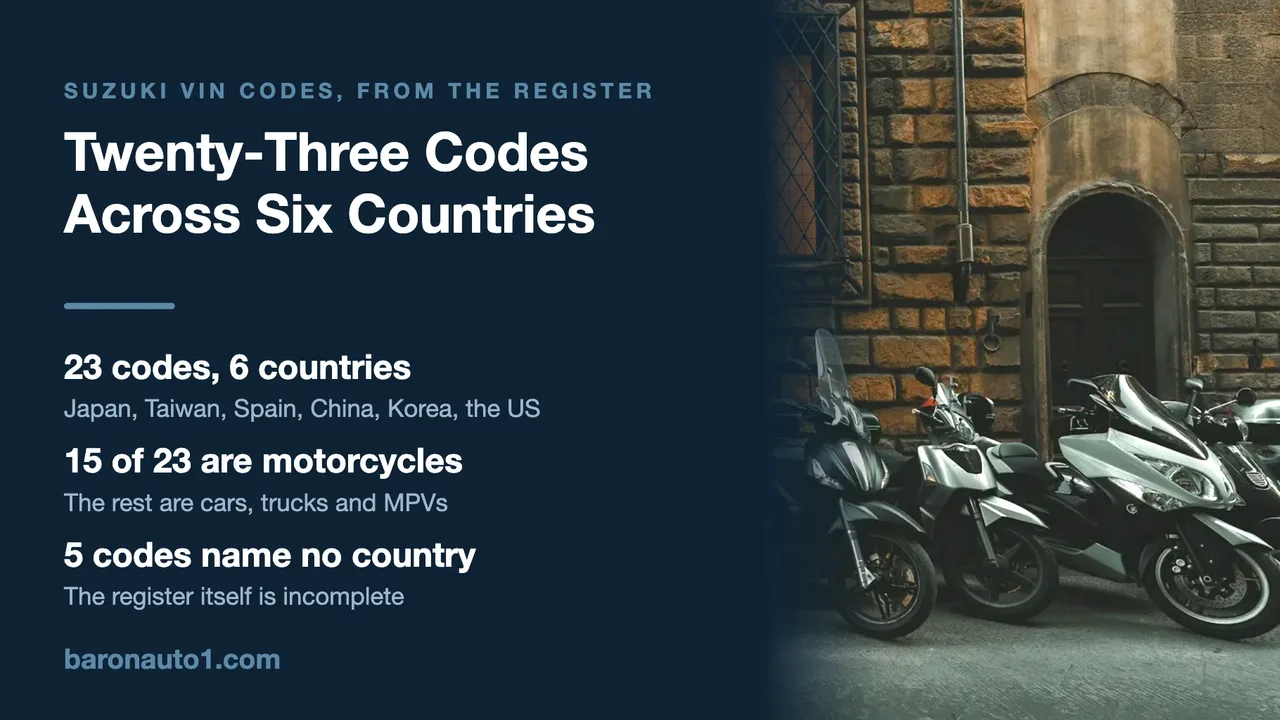
Six countries against twenty-three codes, and five of those codes name no country at all. The register is thinner than it looks.
The short version
- There is no Suzuki-only decoder. One federal register reads every VIN issued for this market, and a Suzuki-branded lookup box is that same query with a badge on it.
- What is Suzuki-specific is the register entry: 23 world manufacturer identifiers, filed under 2 company names, spread across 6 countries, against the 179 models the federal decoder holds for the make.
- The register names 6 different countries against those codes — Japan, Taiwan, Spain, China, South Korea and the United States — and 5 of the codes name none. That field records where a filing sits, not where a vehicle was built.
- A decode that comes back with the country blank on this make is the register being thin, not the number being wrong. There is no deeper query that fills those rows in.
- The codes split 15 Motorcycle, 4 Passenger Car, 2 Truck and 2 Multipurpose Passenger Vehicle. That is a count of filings rather than of vehicles sold, and most of this entry is filed as motorcycle codes — but the car and truck codes are still there.
- The register holds 179 models for the make and publishes no model names we can print, so this page names none. Decoding an actual number returns the model; a list does not exist to quote.
- The decode is the build as filed. Service history, whether a frame and an engine belong together, and which market a grey import was built for are all outside it.
Search for a Suzuki VIN decoder and you get input boxes. Behind nearly all of them sits one federal register, answering one question, for every manufacturer that certifies vehicles for sale in the United States. Nothing about the box is Suzuki-specific, and nothing needs to be.
What is Suzuki-specific is the register entry itself — which codes the company has filed, under which names, in which countries. That is a small set of public facts, and on this make it is more interesting than usual, because Suzuki’s entry is scattered across six countries and filed almost entirely under one of its two names. It is also incomplete in a way worth naming out loud rather than papering over.
This page works from a single pull of NHTSA’s vPIC register, read on 5 September 2026 and archived alongside the site’s other make data. Every figure here traces to that file. Where the federal data does not answer a question a Suzuki buyer would reasonably ask — and on this make there are several — the page says so rather than filling the gap with something that reads well.
One decoder reads every make, this one included
The vehicle identification number is a federal standard: seventeen characters, laid out the same way on everything certified for sale here. Positions one to three are the world manufacturer identifier, assigned centrally to the legal entity that files for the right to issue numbers. Positions four to eight describe the vehicle in a scheme the manufacturer designs. Position nine is a check digit computed from the other sixteen. Position ten is the model year. Position eleven is the plant. The last six are the serial.
Because that structure does not change from make to make, a general decoder handles a Suzuki exactly as it handles anything else.Our guide to reading a VIN position by position sets out the full layout, and the by-make index collects what the register holds for each manufacturer we have read.
This matters for a practical reason rather than a pedantic one. When two websites give different answers about the same vehicle, the difference is almost never in the decoding. It is in how each site handles the fields the register leaves thin, and in whether the site is reading the register at all or guessing from a pattern it has learned. On Suzuki, as the next few sections show, the thin fields are the interesting ones.
Six countries, and prefixes that vary more than the badge does
Across the 23 codes the register records 6 countries. That is a wide spread for a single entry, and it is worth reading code by code.
The distribution runs like this. Japan holds 9 codes. Taiwan holds 4. The United States holds 2. Spain, China and South Korea hold 1 each. And 5 codes carry no country at all, which is the subject of the next section.
Some of the codes make the spread concrete. JS1, JSA, JKS, JSK and JSL all record Japan. LM1, LM4, RK6 and RK7 record Taiwan. VTT records Spain. 5SA records the United States. RFD records nothing. All of those were opened in 2015.
Read that list back and the practical point falls out. The prefixes on this entry have very little in common with one another. Two Suzuki-badged machines can open with entirely different characters because they were issued under different codes, and nothing on the outside of either vehicle will tell you which. The badge is the same on all of them. The first three characters are not.
One caution, and it is the same caution the site gives on every make page. The country field records where a filing sits, not where a vehicle was assembled. A code registered in one country can carry numbers for machines built somewhere else, and the register does not track a vehicle from a production line to a crate. Treat the country line in a decode result as a fact about paperwork. That reading is narrower, and it is the only one the data supports.
Five codes have no country recorded, and that is the register being thin
This is the finding a Suzuki owner is most likely to run into personally, so it is worth stating without hedging: 5 of the 23 codes carry no country at all. Not “unknown”, not a placeholder, not a different country. The field is empty.
RFD is one of them. It is in the register, it was opened in 2015 like the rest of that group, it is filed under a Suzuki entity, and the country column against it holds nothing.
What that means for someone decoding a number is straightforward and mildly deflating. If your result comes back with the country blank, the lookup has not failed and your VIN is not suspect. You have hit a row where the register itself has no value to give. There is no deeper query that produces one, no second source that fills it in, and no honest way for any website to print a country for those codes. A decoder that shows you a confident country for every Suzuki is inventing five answers.
The broader lesson generalises past this make. The federal register is an administrative record built from what manufacturers submitted, and administrative records have gaps. A blank field is evidence about the record. It is not evidence about the vehicle. The failure mode to avoid is the one where a buyer reads an empty column as a warning sign and walks away from a perfectly ordinary machine, or where a seller reads it as a mystery worth explaining and invents an explanation. Neither is warranted. The row is simply short.
Two names on the filings, and one of them holds almost everything
The 23 codes are held between 2 registered entities, SUZUKI MOTOR CORPORATION and SUZUKI MOTOR OF AMERICA, INC, and the division between them is nothing like even. SUZUKI MOTOR CORPORATION holds a single code, JS1, filed under Japan. SUZUKI MOTOR OF AMERICA, INC holds the other 22.
Those 22 are everything else in the entry: every Taiwan, Spain, China, South Korea and United States filing, the five codes with no country against them, and the remaining Japanese codes as well. So the name on a Suzuki filing is a poor guide to where that filing sits. An American entity is the recorded holder of codes filed in five other countries, and the one code held under the Japanese name is not the only Japanese code. Why the register is arranged that way is not something the register says, and this page is not going to invent a reason. It is a fact about who submitted which paperwork to a federal agency. It is not a claim that one entity designed a vehicle and the other imported it, and the register does not carry enough information to support a claim of that kind either way.
Worth recording alongside it: querying the register for the name returns 0 false matches, so the codes above are the whole set. On a handful of makes that same query drags in unrelated small builders, trailer shops and converters whose registered company names happen to contain the string, because the endpoint matches names as text rather than resolving brands. That is why different websites publish different code counts for the same manufacturer. Suzuki has none of that noise, and it registers under its own name rather than sitting beneath a parent group. The 23 codes are the 23 codes, and a reader who runs the query themselves will see the same set.
Fifteen motorcycle codes, four car codes, two truck codes
Split the 23 codes by the vehicle type each one was filed under and the shape of the entry appears immediately. Motorcycle holds 15. Passenger Car holds 4. Truck holds 2. Multipurpose Passenger Vehicle, the class that catches most of what the market calls an SUV or crossover, holds 2.
Two things in that distribution deserve attention, and they pull in opposite directions.
The first is that motorcycle filings dominate. Fifteen of twenty-three codes are filed under a single type, which is a heavy concentration. What that counts, though, is filings and nothing else. It is not a count of vehicles sold, of machines on the road, or of the people who look a Suzuki number up. It says that most of this entry was opened for two wheels, and that is the whole of what it says.
The second is that the four-wheeled codes are still in there. Four passenger car codes and two truck codes, plus two more for the MPV class — eight codes for vehicles with a steering wheel. And on the register’s own dates they are the newest part of the entry rather than an abandoned corner of it. Every one of the 15 motorcycle codes was opened in 2015. The two most recently opened codes in the whole Suzuki entry are on the other side: JS4, filed as a Truck, opened in 2016, and JG7, filed as a Passenger Car, opened in 2017. Those codes exist, they are filed, and the numbers they issued are still attached to vehicles that are still being bought and sold second-hand. A Suzuki car’s VIN decodes today exactly as it always did.
One more detail, small but honest. The register recognises five vehicle types for this make — Motorcycle, Passenger Car, Truck, Multipurpose Passenger Vehicle and Low Speed Vehicle — while the codes themselves fall into only four of those. The fifth type is recognised for the make without a code filed under it in this pull. That is the kind of inconsistency that lives in every large administrative dataset, and it is worth knowing about before it surprises you in a decode result.
Know which kind of Suzuki you are decoding
Because this make spans two wheels and four, a Suzuki decode result means different things depending on what is standing in front of you, and a reader who does not know which they are looking at will misread it.
The mechanics differ before the decoding starts. On a car the number is visible through the base of the windscreen on the driver’s side and repeated on the certification label in the driver’s door aperture. On a motorcycle it is stamped into the frame, usually read off the steering head, often dirty and sometimes painted over. Our guide to where the VIN is on a car covers the four-wheeled locations, and our motorcycle VIN lookup guide covers the two-wheeled ones across marques, including what a sound stamping should look like and what to do when it does not look sound.
The records differ too, and that difference is larger than most buyers expect. Cars pass through more registration and inspection events than motorcycles do, so they leave a thicker trail. A thin history report on a bike is normal and proves very little in either direction, which is exactly why the physical inspection carries more of the weight on two wheels.
And the type field in a decode result needs reading carefully. The word that comes back describes how the code was registered, not what is parked in the garage. Where a machine has four wheels but was issued a number under a motorcycle code, the result will still say Motorcycle. That is not an error in the lookup and it is not evidence that a seller has misdescribed anything. Our ATV VIN lookup guide covers the titling side of that mismatch, which is consistently the harder half of buying an off-road machine used.
One hundred and seventy-nine models, and no list to publish
The federal decoder holds 179 models for this make. That number is the decode’s vocabulary — the set of model names it can return when it resolves an actual VIN.
We are not printing the names, and the reason is worth stating plainly rather than dressing up. The pull this page is built on returned the count without a usable roster of names, so a list here would be a list we assembled from somewhere else and presented as though it came from the register. That is the exact move this site exists to avoid. Model rosters are published in several places on decoder sites; most are copied between them, and few say where they came from.
What that means in practice costs you nothing. Decoding a real number returns the model for that vehicle, resolved by the register from the manufacturer’s own submission. You do not need a printed list to get an answer about the machine you are actually buying — you need the seventeen characters. The list only matters to somebody browsing, and browsing a model roster is not how anybody has ever checked a used vehicle.
The reverse trap matters more anyway, and it applies to every make. A model list is not a trim list. The register knows the model line; it does not know which engine option, which wheel, which interior or which package a specific vehicle left the factory with, and those are precisely the distinctions that move a used price. Our pages on trim level by VIN and build sheets set out how far that can be pushed and where it stops. The honest summary of the model field is that it will confirm a vehicle claiming to be one thing decodes as that thing, and it will not settle an argument about which version.
Why this page prints no Suzuki position table
The question a lot of readers arrive with is more specific than anything above: what does the fifth character mean on a Suzuki, or the sixth, or the seventh. Tables claiming to answer that are easy to find. This page does not have one, and the reason is a limit in the source rather than an editorial preference.
The federal register publishes what it publishes: who holds each prefix, which vehicle class the prefix covers, which country the entity filed under, and when the code was opened. It does not publish the manufacturer’s descriptor key for positions four to eight. Those positions are the manufacturer’s own scheme, and no part of the public register decodes them character by character.
So a brand-specific position table is a document we would have to source somewhere other than the register. Most of the ones in circulation appear to be reverse-engineered from small samples of real numbers, and once one exists it gets copied between sites until it looks like consensus. It might be right. We cannot check it, we cannot cite it, and printing it here would give it a credibility this page has not earned it.
What works instead is decoding an actual number. When vPIC resolves a specific VIN, it returns the descriptor fields as the manufacturer certified them for that vehicle — body class, engine, displacement, model. That is a better answer than a printed key, because it is specific to the machine you are asking about rather than to a pattern somebody inferred. The parts of the number that are fixed by standard rather than by manufacturer choice — the check digit at position nine, the model year at position ten — are the parts a table can legitimately cover, and we cover them on the validator page and the year chart.
Grey imports, and the market a vehicle was built for
A register spread across 6 countries raises a question that a single-country register does not: which market was this vehicle actually built for?
The federal decode does not answer it. What the register holds is the country a code was filed under, and as established above that field describes paperwork rather than production — and on five Suzuki codes it holds nothing at all. Nothing in the decode result tells you the market a specific vehicle was specified, homologated or sold into.
This matters more on this make than on most, and for an obvious reason. A manufacturer registering codes in six countries is a manufacturer whose products exist in more than one specification, and machines do move between markets. A vehicle brought in privately can differ from the one sold here in lighting, instrumentation, emissions equipment and the parts catalogue that serves it. None of that is visible in seventeen characters.
The place those differences do show up is the paperwork and the metal. The title and its chain of states, the certification label and whether it reads the way a domestic-market label should, the way the instruments are marked, and whether a dealer can order parts against the number are all checks a buyer can make. Our page on VINs that do not match covers what to do where the readings on a vehicle disagree with each other or with the documents, which is the situation an imported machine is most likely to produce.
On a bike, the frame number and the engine number are different numbers
Fifteen of Suzuki’s 23 codes are filed as motorcycles, so the distinction comes up often on this make, and no decoder will flag it for you.
The frame carries the vehicle’s legal identity. The engine carries its own separate identifier, cast or stamped into the case. On a car those two are rarely separated in practice, because pulling an engine is a workshop job with a bill attached. On a motorcycle they come apart far more readily, and they do so legitimately — engines are rebuilt, replaced and moved between frames as ordinary maintenance culture, and have been for decades.
The federal decode answers for the frame number and only the frame number. It does not know what engine is fitted, whether that engine is the one the machine left the line with, or whether the two components have any documented relationship. When a decode returns a model and a displacement, it is repeating what the manufacturer certified for that frame identity. It is not looking at the metal in front of you.
The habit that follows is simple and worth doing on every used bike. Read the frame number directly off the steering head rather than copying it from the title. Read the engine number separately and write it down. Ask the seller to account for any difference between the engine that is fitted and the machine as described. A documented rebuild or a period-correct replacement is ordinary and gets disclosed easily. An engine nobody can explain, on a machine priced as original, is a reason to stop.
Where the stamping itself looks wrong — ground, restamped, filled, or freshly painted at the neck alone — that is a finding in its own right and it outweighs anything a lookup returns. The free theft check described in how to check if a car is stolen is the next query, and it costs nothing.
What the decode will not tell a buyer
The site’s standing position is that a decode and a history are different things. Here is what the federal decode is silent about on this make, stated plainly.
Service history. Nothing about oil changes, valve clearances, chain and sprocket replacement, cambelts or the last time anything was adjusted reaches the register. On machines whose maintenance is frequently done by the owner in a garage, there may be no record anywhere except a box of receipts.
Whether the frame and engine belong together. Covered above, and the single most common way a used motorcycle differs from the machine its number describes.
Which market it was built for. Also covered above, and unusually relevant on a make with a register in six countries.
Whether a frame has been straightened. A bike that has been down the road and been rebuilt carries the same identity it always had. If no insurer wrote it off, there may be no record to find at all. This is invisible to every lookup on the internet and visible to a competent inspector with the machine on a stand.
Mileage. Odometer readings enter the system at registration and inspection events rather than continuously, and motorcycles pass through fewer of both than cars do. Our page on checking mileage by VIN explains where the readings come from and why the trail on two wheels is thinner.
Accidents that nobody filed. Damage reaches the record only where an insurer or a state wrote something down. Our page on accident checks by VIN covers which events reach the file and which never do.
What the decode does give you is the identity as filed, and that is the anchor for everything else. Every record retrieved afterwards is retrieved against that number.
The records that sit around the number
Once the number is validated and decoded, the useful checks run in a fixed order, and the free ones come first.
The federal recall lookup takes the VIN and answers for that specific vehicle at no cost. It is the one check that can end a purchase from a kitchen table before anyone has travelled. Our guide to checking open recalls covers reading a result, including the case where a campaign was completed by a previous owner.
The insurance-bureau theft check is also free and also takes a VIN. A clear result is a weak signal on its own, because it covers participating members only. It starts the checking rather than ending it, and our page on what a free VIN check actually returns sets out the boundaries of each free tool honestly.
The title record is the one that costs money and the one that carries the brands: salvage, theft recovery, flood, and the state-by-state chain of who titled the vehicle and when. Our page on checking a title by VIN explains what that record contains and what it structurally cannot. Where a brand is present, the brand is the purchase — what a branded title means orders them by how much each should worry a buyer, and flood checks by VIN covers the one that hides best.
Then the physical inspection, which is not the last resort but the largest single share of the evidence, particularly on a motorcycle. Our guide to the pre-purchase inspection makes the general case. On a bike, find somebody who knows the model family rather than a general workshop.
A sequence for a used Suzuki
Put together, the order looks like this, and none of the first four steps requires leaving home.
Get the full seventeen characters from the seller and validate the check digit. A number that fails is a transcription error until proved otherwise, and finding that out early costs nothing. On a bike, expect the number to have been read off a dirty frame by somebody crouching beside it with a phone, and expect typing errors accordingly.
Decode it. Confirm that the model, model year and body details returned agree with the advert. Note which code issued the number, and read the country field for what it is — a record of a filing, which on this make may legitimately be blank, and which is not a claim about a factory.
Run the recall lookup and the free theft check. Both are per-vehicle, both are free, and either can end the conversation before you spend anything.
Pull the title record and read the chain rather than only the headline. A short chain with long ownerships reads well. A vehicle that has crossed several states in a short time is asking a question, and the seller should be able to answer it without effort.
Then go and look at it. Read the number off the vehicle with your own eyes — off the frame on a bike, off the windscreen and the door label on a car — and compare it character by character with the number you decoded and the number on the title. On a machine with two wheels, read the engine number too, and check the stamping area for grinding or fresh paint.
Selling one runs the same facts in reverse, and it is close to free. Photograph the stamping or the label clearly and put it in the listing. State the decoded model and model year rather than the badge. If the country field on your vehicle’s code comes back blank, expect the question and answer it the way this page does — the register records a filing, not an assembly line, and five Suzuki codes have nothing in that column. A seller who can explain their own paperwork looks like a seller worth buying from.
Common questions
Is there an official Suzuki VIN decoder?
No, and none is needed. Suzuki vehicles carry the same seventeen-character number as everything else built for this market, and the federal vPIC register resolves the manufacturer prefix for every make on the same terms. A general decoder handles the marque. What is Suzuki-specific is the register entry: 23 codes, 2 company names, 6 countries, 179 models.
How many WMI codes does Suzuki have?
23, as read on 5 September 2026. They are held between 2 registered entities, and not evenly: SUZUKI MOTOR CORPORATION holds one code and SUZUKI MOTOR OF AMERICA, INC holds the other 22. By vehicle type they split into 15 Motorcycle, 4 Passenger Car, 2 Truck and 2 Multipurpose Passenger Vehicle.
Does a Suzuki VIN tell me which country the vehicle came from?
Not dependably. The register records a country against a code, and across the 23 Suzuki codes it names 6 different ones — Japan for 9, Taiwan for 4, the United States for 2, and Spain, China and South Korea for 1 each. But that field describes where the filing sits rather than where the vehicle was assembled, and 5 codes have no country recorded at all.
Why is the country blank when I decode my Suzuki?
Because 5 of the 23 codes carry no country in the register. The lookup has not failed and your VIN is not suspect — you have hit a row where the record itself is empty. No decoder can honestly print a country for those codes, and one that does is filling in a blank it cannot see.
Does Suzuki still have car and truck codes in the register?
Yes. Alongside the 15 motorcycle codes there are 4 filed as Passenger Car, 2 as Truck and 2 as Multipurpose Passenger Vehicle. They are also the newest codes in the entry: all 15 motorcycle codes were opened in 2015, while the two most recent codes on the file are a truck code opened in 2016 and a passenger car code opened in 2017.
What models does the register know for Suzuki?
179 of them. The pull this page is built on returned the count without a roster of names we could publish, so we print none rather than copying a list from elsewhere and implying it came from the register. Decoding an actual VIN returns the model for that specific vehicle, which is the answer that matters.
Where is the VIN on a Suzuki?
It depends which kind you have. On a motorcycle it is stamped into the frame, usually at the steering head. On a car it is visible through the base of the windscreen on the driver’s side and repeated on the certification label in the driver’s door aperture. Read it off the vehicle rather than off the title, and treat two readings that disagree as a finding rather than a typo.
Can a decode tell me whether the engine is original?
No. The decode answers for the frame or chassis identity only. An engine carries its own separate number, and the register holds no relationship between the two. On a motorcycle, where engines are swapped and rebuilt routinely, read both numbers and ask the seller to account for any difference.
Will a decode show whether a Suzuki is a grey import?
No. Nothing in the seventeen characters records which market a vehicle was specified or sold into. The register’s country field describes a filing, and on this make it is spread across 6 countries and blank on 5 codes. Establish an import question from the paperwork, the certification label and the parts catalogue instead.
Why do two websites give different code counts for Suzuki?
Usually because the register’s name endpoint matches company names as text, so a raw query on a common word pulls in unrelated builders. On Suzuki the query returns 0 false matches, and the make registers under its own name rather than beneath a parent group. Where counts differ, the difference is in how each site filtered, not in the underlying register.
Does a VIN decode show service history or crash repairs?
No. A decode is the vehicle as certified when it was built. Servicing, a straightened frame, replaced bodywork and every other event in the vehicle’s life sit outside it, and on motorcycles many of those events never enter any record at all. That is what the inspection is for.
Sources and further reading
Recall, complaint and safety-rating figures on this page were retrieved from the federal databases above on August 19, 2026. Federal data changes — re-check any VIN before you rely on it.
Published September 5, 2026 · last updated September 5, 2026. Found something out of date or wrong? Tell us and we will correct it.