Tesla VIN Decoder: Four Codes, and the Questions a VIN Cannot Answer
Two codes opened in 2015, then nothing for six and a half years. The register grows when a new body style arrives, not when a factory does.
The short version
- There is no Tesla-only decoder, and there does not need to be one. Every road vehicle built for the United States carries the same seventeen-character number, and one federal register reads all of them.
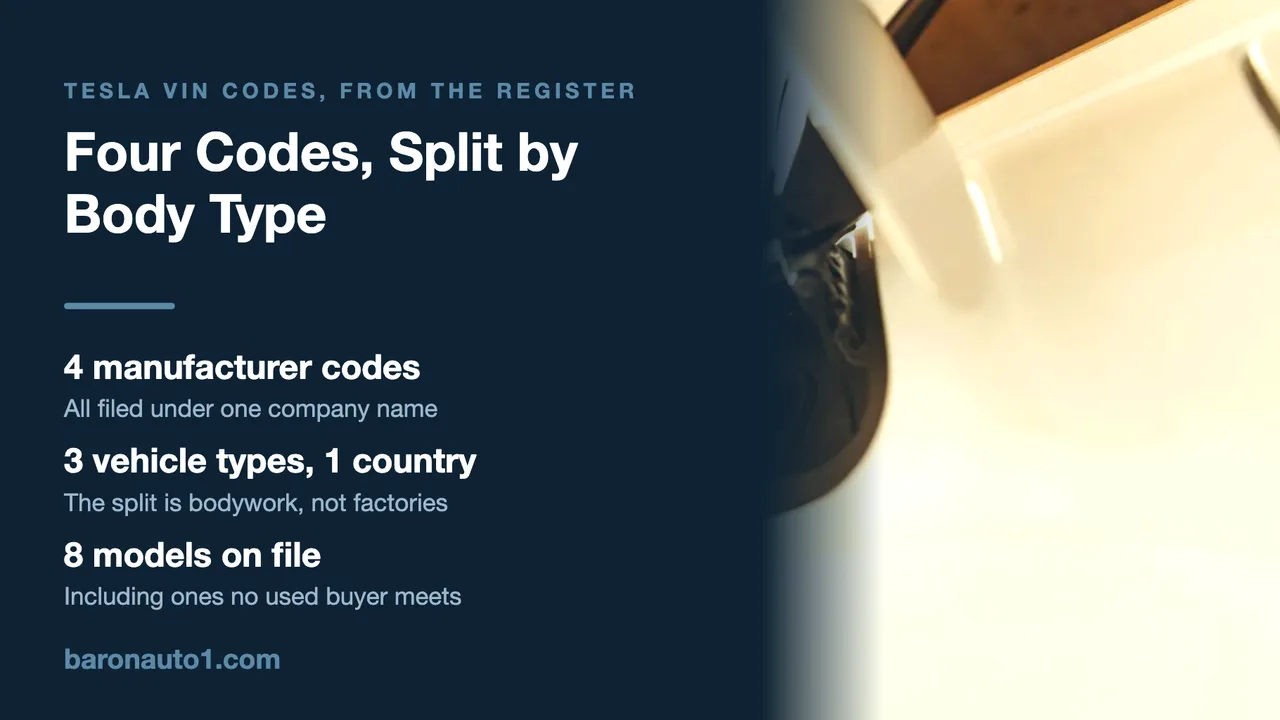
- Tesla holds four world manufacturer identifiers: 5YJ, SFZ, 7SA and 7G2. All four are registered to a single entity name, TESLA, INC., and the register records the country for all four as the United States.
- The four codes split by body type rather than by plant or by country — two file as Passenger Car, one as Truck, one as Multipurpose Passenger Vehicle.
- The dates are the interesting part. Two codes opened in 2015, then nothing for six and a half years, then one in November 2021 and one in October 2022. The register grew as body styles arrived, not as factories opened.
- The register holds eight models for the make: Cybercab, Cybertruck, Model 3, Model S, Model X, Model Y, Roadster and Semi. That is what the decode knows, not what a used buyer will meet.
- Asking the register for the name returns no false matches at all, which is rare and makes this make unusually clean to read.
- What the decode cannot carry: battery health, software entitlements, driver-assistance options, charging-network standing. Those are facts about a car and an account, not facts inside a number.
Search for a Tesla VIN decoder and the results are input boxes, most of them implying that this marque needs its own reader. It does not. The number on a Tesla is built to the same federal standard as the number on a pickup, a hatchback or a delivery van, and the register that resolves the first three characters into a manufacturer is the same register for all of them.
What is worth reading is what that register actually records for the make, because Tesla’s entry has a shape most large makers’ entries do not. This page works from the entry: four codes, one entity name, one country, three vehicle types and eight models. Nothing here is a manufacturer briefing. It is the public filing, read carefully, with the limits stated where they fall.
The limits matter more than usual on this marque. A used Tesla buyer’s real questions — how much of the battery is left, what software the car is entitled to, whether an option that was on the window sticker is still on the car — are questions the seventeen characters were never designed to answer. Saying so early is more useful than another input box.
One decoder reads every make, including this one
The seventeen-character vehicle identification number is a federal standard. Positions one to three are the world manufacturer identifier, assigned to the legal entity that builds the vehicle. Positions four to eight describe the vehicle in a scheme the manufacturer designs. Position nine is a check digit computed from the other sixteen. Position ten is the model year. Position eleven is the assembling plant. The last six are the serial.
Our guide to reading a VIN position by position sets out the whole layout; the by-make index collects what the register holds for each manufacturer we have read.
Where a brand-specific decoder would genuinely earn its keep is in the middle block. Positions four to eight are the manufacturer’s own descriptor scheme, and the federal register does not publish the key. It records who owns the prefix, what vehicle class the prefix covers, which country the entity builds in and when the code was opened. It does not record that a particular letter in position five means one thing on a saloon and another on a pickup.
So this page will not print a position-by-position table for Tesla, because we do not have one from a source we would defend. Tables of that kind are published in several places; most are reverse-engineered from small samples, some are simply copied between sites, and none of them is the register. A decode of a real number will return the descriptor fields as vPIC resolves them for that specific vehicle, which is a different and more reliable thing than a printed key.
Four codes, one name, one country
The register lists four world manufacturer identifiers for the make. Every one of them carries the same entity name, TESLA, INC., and every one of them records the same country of manufacture. There is no separate name for a European operation, no distinct filing for an energy or components arm, and no parent group above the name — the company registers under itself.
That is a smaller and flatter register entry than most makers of comparable output produce. The pattern on the larger legacy manufacturers, as the by-make index shows, is a spread: several legal entity names, several countries, and codes that separate one assembly nation from another. Tesla’s four codes separate nothing of the sort.
What they separate is body type. Two of the four file as Passenger Car. One files as Truck. One files as Multipurpose Passenger Vehicle, the class that catches most of what the market calls an SUV or crossover. Three vehicle types across four codes, one country underneath all of them.
For a buyer, the practical consequence is modest but worth knowing: the first three characters of a Tesla number tell you which class of vehicle the register expects and very little else. They are not a country tell, because there is only one country in the entry. They are not a badge tell, because there is only one name. Whatever geography or division the first character encodes on other marques, on this one it is close to a formality — and the information a buyer wants sits from position four onward, in fields only a decode of the actual number will return.
The register grew with the body styles, not with the factories
The four opening dates are the part of this entry that repays attention, because they do not behave the way a large manufacturer’s register usually behaves.
Two codes opened within weeks of each other in the spring of 2015: 5YJ on 4 March and SFZ on 16 April, both filed as Passenger Car. Then the entry goes quiet for six and a half years. The next code, 7SA, opens on 1 November 2021 and files as Multipurpose Passenger Vehicle. The last, 7G2, opens on 17 October 2022 and files as Truck.
Read the sequence against the classes rather than against the calendar and it reads plainly. A car maker registers car codes. Six years later something arrives that the register does not consider a car, and a code opens for it. A year after that something arrives that the register considers a truck, and another code opens. The entry grows when the shape of the product changes, not when a building opens.
That is genuinely unusual, and it is why we gave this make a second figure rather than reusing the standard one. On most registers the dates are noise: a maker opens a code because a new assembly country came online, or because a subsidiary was restructured, and the timing tells a buyer nothing. Here the timing and the vehicle class move together, which makes the four rows readable as a sequence rather than a list.
One caution before anybody over-reads it. An opening date is the date a code was registered, not the date a vehicle carrying it was built, sold or first titled. Codes are opened ahead of production and can sit unused. A date in this table is evidence about the filing and nothing else — and it is not a substitute for the model year, which lives at position ten of an individual number and is read against our model-year chart.
A register entry with no false matches
Most of the make pages on this site carry a warning about the same trap. The register’s name endpoint matches company names as text, so asking it for a common word returns every small builder, trailer shop and specialist converter whose registered name happens to contain it. Buyers reading a raw result can easily conclude a marque holds dozens of codes it has nothing to do with.
Tesla is the exception. Querying the register for the name returns no false matches at all. Nothing else on the register is registered under a name that catches the same string, so the entry a reader gets is the entry the company actually holds — four codes, no strangers attached.
That sounds like trivia and is not quite. It means the make page can be read at face value, and it means a buyer who runs the same query themselves will see the same four rows rather than a padded list that needs filtering. On several other marques we have had to say plainly that a headline code count is inflated by unrelated builders. Here there is nothing to subtract.
Eight models, and the ones a used buyer will never meet
The register holds eight models for the make: Cybercab, Cybertruck, Model 3, Model S, Model X, Model Y, Roadster and Semi.
That list is the decode’s vocabulary, not a used-car catalogue, and the difference trips people up. Semi is a commercial tractor unit. Cybercab is on the register as a model the register knows about. Neither is inventory a private buyer will be browsing, and their presence in the list says nothing about how many exist or whether any have been sold. A model appears in vPIC because the manufacturer files it, and filings run ahead of showrooms.
The reverse trap matters more. A model list is not a trim list. The register knows the model line; it does not know which battery, which drive configuration, which wheel, which interior or which options package a specific car left the factory with. Those distinctions are exactly the ones that move the price on a used Tesla, and they belong to the build record rather than to the model name. Our pages on trim level by VIN and build sheets set out how far that information can be pushed and where it stops.
So the honest summary of the model field is this: it will confirm that a car claiming to be a Model Y decodes as a Model Y. It will not settle an argument about which Model Y.
What the decode will not tell a Tesla buyer
This is the section that matters most, because it is where the gap between what people expect from a VIN and what a VIN carries is widest on this marque.
The number is a build identity. It was designed so that a regulator can tie a recall to a batch, an insurer can tie a policy to a car and a state can tie a title to an object. It was not designed to describe a vehicle’s current condition, and it has no field for any of the following.
Battery health. The usable capacity of a traction battery after years of use is a measured property of that pack today. It is not a property of the car as filed. No decode of any VIN, by any tool, returns it. On a used electric car it is close to the single most important number in the purchase, and it has to come from an inspection, from the car’s own reported range figures under controlled conditions, or from a specialist test — never from the number.
Software and feature entitlements. Where features are sold as software rather than as hardware, what a given car is entitled to is a record held against the vehicle and its account, not a stamping in the descriptor block. We are not going to speculate about how any manufacturer stores that internally. The point for a buyer is structural: an entitlement that can be added after the car was built, and in principle removed or not transferred on resale, cannot be a fact the VIN was carrying all along. If a listing claims a feature, the feature has to be verified on the car and in whatever account or documentation governs it.
Charging-network standing. Anything attached to an owner’s account rather than to the vehicle’s build is outside the number by definition. Treat claims of that kind the way you would treat a claim about a transferable warranty: as something to confirm in writing with whoever actually administers it.
Options bought and later removed. This is the one that catches careful buyers. A car’s original specification and a car’s current specification are different claims, and only the first has any chance of being recoverable from the build record. Where a feature has been deactivated, not transferred, or reversed at some point in the car’s life, no historical decode will show the change. Our page on options by VIN makes the same argument across all makes; on a car where features are provisioned rather than bolted on, it applies with the weights turned up.
Reading the number off the car
Whatever a listing says, the number to work from is the one on the vehicle. Read it yourself rather than copying it from an advert, and read it from more than one place.
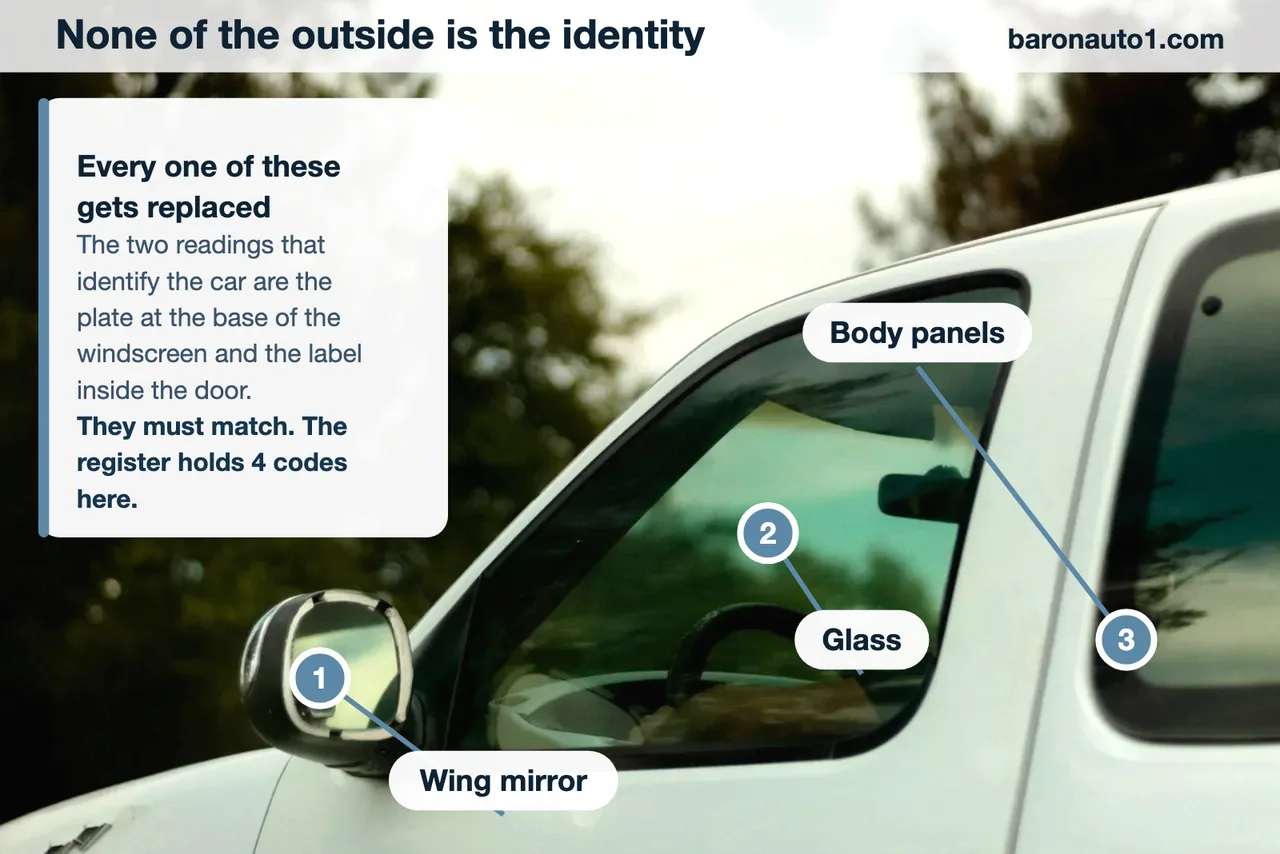
The usual locations are the same on this marque as on any other passenger vehicle: visible through the base of the windscreen on the driver’s side, and on the certification label in the driver’s door aperture. That label is a federal requirement rather than a manufacturer courtesy, which is why it is a dependable second reading. Our guide to where the VIN is on a car covers the full set of locations and the ones worth checking on a car you suspect has been apart.
Two readings that disagree is a finding in itself, not a transcription problem to be shrugged off. So is a label that looks newer than the aperture around it, or fixings that have been disturbed. Where the numbers on a car do not agree with each other or with the paperwork, our page on VINs that do not match covers what that means and what to do about it.
Before anything else, run the check digit. Position nine is computed from the other sixteen characters, so a mistyped number usually fails arithmetically before it costs anybody a journey. Our validator page covers running that check by hand, and it is worth doing on any number that arrived by text message or was read off a screen photograph.
The record attached to the number is the real work
The decode is the cheap part and the fast part. The record is where used-car money is won and lost, and the record is retrieved rather than decoded — it lives in title files, insurer reports and recall databases, keyed to the number rather than encoded in it.
Three retrievals do most of the work, in this order. The federal recall lookup is free, per-vehicle and authoritative on open campaigns; our guide to checking open recalls covers reading the result, including the difference between a campaign that is open and one that was completed by a previous owner. The theft check is free and answers a question that ends a purchase outright; how to check if a car is stolen covers it. And the title history — brands, the state-by-state chain, the odometer readings that entered the record at each titling — is the one that repays paying for, and our title-check page explains what comes back.
Two of those deserve a marque-specific note. Recalls on modern vehicles increasingly concern software as much as hardware, and a campaign closed by a remote update is still a campaign that appears in the record. Reading the campaign text rather than only the open-or-closed flag is worth the extra minute. And odometer readings on any car are snapshots taken at titling and inspection events rather than a continuous log — our page on mileage checks by VIN explains why a clean mileage history is a weaker statement than most buyers assume.
Where a car has a brand on its title, the brand is the purchase. What a branded title means orders the brands by how much each should worry a buyer, and the reasoning does not change because the car is electric. What does change is the consequence: water and collision damage reach parts of an electrified car that have no equivalent on a combustion car, and our page on flood checks by VIN carries the specific warning about damaged high-voltage batteries.
The sequence on a used Tesla
The site’s standard order, with the electric weightings applied.
Read the number off the car yourself, from the windscreen and from the door aperture, and validate the check digit. Decode it and confirm that the model and model year returned agree with the advert. A disagreement here ends the conversation early and costs nothing.
Run the free lookups before travelling. Recalls and the theft flag are per-vehicle, free and fast, and either can settle the matter from the kitchen table.
Buy the title history once and read the chain rather than the headline. Which states, in what order, with what readings and what brands. A short chain with long ownerships reads well. A car that has crossed several states quickly is asking a question the seller should be able to answer without hesitating.
Then do the part no record covers. Establish the battery’s condition by measurement rather than by assertion, because it is the largest single component of the car’s value and the one thing this entire page has been telling you the number cannot carry. Confirm every claimed feature on the car itself. And book a pre-purchase inspection with somebody who works on electric vehicles — the failure modes, the diagnostic access and the safety practices are not the ones a general workshop uses daily.
Selling one
The same information, used in the other direction, is worth money to a seller.
Publish the number. A seller who prints the VIN in the listing is telling every serious buyer that the record will survive being checked, and the buyers who care are the ones who pay properly. Photograph the windscreen plate and the door-aperture label clearly.
State the decoded model and model year rather than the badge on the boot, and state the specification honestly — particularly any feature that was added after the build, because a buyer who discovers it late will discount for it twice. Pull the title history yourself and lead with a clean chain if you have one.
Above all, get ahead of the battery question rather than waiting to be asked it. It is the first thing a knowledgeable buyer wants and the last thing a listing usually contains. Whatever evidence exists about the pack’s condition — a recent inspection, a service record, a documented test — is the single most persuasive document in the file, precisely because no decode and no history report can produce it.
Common questions
Is there an official Tesla VIN decoder?
Not a separate one, and none is needed. Tesla vehicles carry the same seventeen-character number as everything else built for this market, and the federal vPIC register resolves the manufacturer prefix for every make on the same terms. A general decoder handles the marque.
What are Tesla’s WMI codes?
The register lists four: 5YJ, SFZ, 7SA and 7G2. All four are filed under the single entity name TESLA, INC., with the United States recorded as the country for each.
Why does Tesla have four codes when it builds in one country?
Because these four separate by vehicle class rather than by geography. Two file as Passenger Car, one as Multipurpose Passenger Vehicle and one as Truck. The register records one country of manufacture across all of them.
Can a VIN tell me the battery health of a used Tesla?
No. Battery condition is a measured property of a specific pack at a specific moment. It is not a field in any vehicle identification number and no decoder returns it. It has to be established by inspection or test on the car in front of you.
Does the VIN show which software or options a Tesla has?
Not reliably, and not currently. A build record can describe how a car was configured when it was made. Features provisioned or changed afterwards are held against the vehicle and its account rather than encoded in the number, so a decode cannot confirm what a car is entitled to today. Verify features on the car and in writing.
What models does the register know for Tesla?
Eight: Cybercab, Cybertruck, Model 3, Model S, Model X, Model Y, Roadster and Semi. That is the decode’s vocabulary rather than a used-car catalogue — Semi is a commercial vehicle, and a model being listed says nothing about how many are on the road.
Where is the VIN on a Tesla?
In the usual passenger-car places: visible through the base of the windscreen on the driver’s side, and on the certification label in the driver’s door aperture. Read both, and treat a disagreement between them as a finding rather than a typo.
Will a decode tell me the trim?
It will confirm the model line as filed. Trim, battery variant and options belong to the build record rather than to the model name, and how much of that is recoverable varies by manufacturer. Our trim and build-sheet pages set out where that ends.
Does a Tesla VIN check show accidents?
A decode does not, because a decode reads the build. Damage reaches the record only where an insurer or a state filed something — a total-loss report, a title brand. Our page on accident checks by VIN explains which events reach the file and which never do.
For sale near you
Dealer listings, checked liveFinding used Tesla cars near you…
Sources and further reading
- NHTSA VIN decoder
- NHTSA recall lookup
- NMVTIS (US Department of Justice)
- 49 CFR Part 567 — Certification
Recall, complaint and safety-rating figures on this page were retrieved from the federal databases above on August 19, 2026. Federal data changes — re-check any VIN before you rely on it.
Published September 5, 2026 · last updated September 5, 2026. Found something out of date or wrong? Tell us and we will correct it.