SalvageBid Review: What It Adds on Top of IAA’s Fees and Rules
SalvageBid buys at IAA for the public, but its Terms name no seller. Its four tiers, the $600-or-10% deposit, its own fees on top of IAA’s, the next-day payment deadline, a relist fee of at least $1,299 and its arbitration clause, read from its own documents.
The short version
- SalvageBid is a broker for Insurance Auto Auctions (IAA), and IAA’s broker directory lists it. Its Terms name no seller: Salvagebid, Inc. invoices you and may use an “affiliated dealer and or dismantler.”
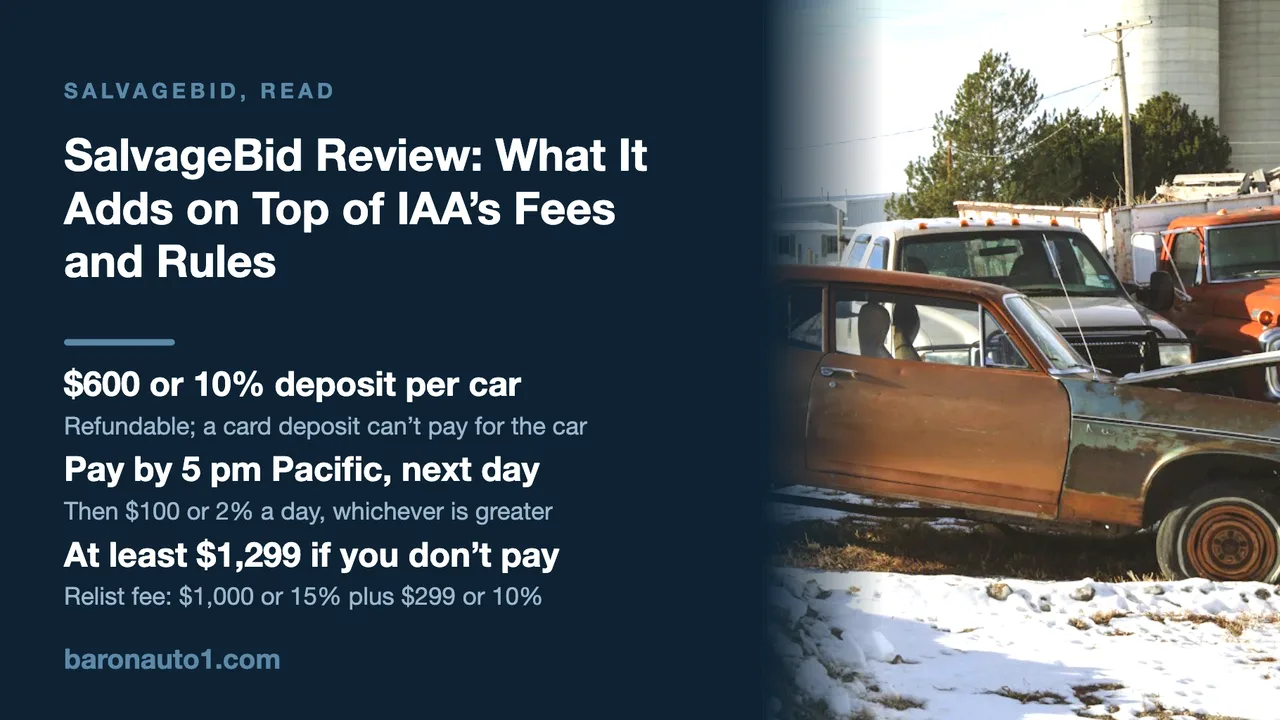
- Four tiers: Guest (free, one car up to $1,000), Starter ($35 a year, one car up to $2,000), Premium ($199) and VIP ($349), both unlimited. Every bid needs a refundable deposit of $600 or 10% of your maximum bid, whichever is greater, for each car.
- SalvageBid’s fees sit on top of IAA’s: a $299 transaction fee (Guest and Starter), 5% with a $250 minimum (Premium) or 3% with a $200 minimum (VIP), plus a documentation fee “starting at $150.” On a $1,000 Guest win that is at least $449, by our arithmetic.
- Payment is due by 5 pm Pacific the next business day. The FAQ then charges $100 or 2% of the price for every day late, whichever is greater.
- A win left unpaid for 7 business days can be relisted, and the relist fee is $1,000 or 15% plus $299 or 10%: at least $1,299 by our arithmetic, more than twice the $600 deposit.
- Disputes go to binding arbitration in Portland, Oregon, with a one-year limit on claims, unless you mail an opt-out within 30 days of first accepting the Terms.
SalvageBid is a Portland, Oregon company that lets people without a dealer license bid on Insurance Auto Auctions (IAA) cars, and its contract, not its marketing, sets what you pay. On 9 October 2026 we read its Terms and Conditions (which print no date), its six FAQ sections and its other public pages, IAA’s broker directory and Oregon’s business registry. IAA’s own fees and rules come from the documents behind our IAA auction guide, read the same day. We did not register, bid or request a quote, and this site has no relationship with SalvageBid, IAA or any broker. Its About Us page sat behind a bot check we did not try to pass.
What SalvageBid is, and which auction it buys at
SalvageBid calls itself “an online platform that facilitates access to insurance auto auctions,” and its FAQ says which one: “Why do I have to join Salvagebid to buy at IAA?” Its answer: “Insurance Auto Auctions (IAA) typically require a dealer’s license to participate,” and SalvageBid offers access “without needing a dealer’s license.” Its contact page is titled “Insurance Auto Auction Broker,” and IAA agrees: its Find a Broker page, read once on 9 October 2026, lists “Salvagebid Inc” among its United States brokers (“Bid LIVE online on IAA vehicles”). No SalvageBid page we read mentions Copart. The Terms never name IAA; they speak of “the auction,” the “auction facility” and “our vendor.”
Why a broker at all: IAA decides by state who may bid on what. By our count of its eligibility grid, a public buyer can bid directly on both clear and salvage titles in 16 of 50 states and needs a broker for both in 24 (see which states let the public bid). Our AutoBidMaster review explains how an auction broker works; this page covers only what SalvageBid’s documents add.
Being able to bid is not the same as being able to buy every car. The Terms warn that “not all vehicles listed on our Website are available for purchase by all members” and that “you must verify with your DMV what your limitations are” before bidding; Guest and Starter members may buy only where SalvageBid’s “purchasing eligibility is not restricted.” The FAQ promises “Dealer Only” vehicles to “the general public.” The Terms are what bind you.
Who you deal with, and who owns SalvageBid
Your contract is with “Salvagebid, Inc.,” but the cars are not its own: “The items listed on our Website are not owned by us.” After a win “you will be invoiced by Salvagebid,” IAA sends the purchase documents to SalvageBid’s office, and SalvageBid “will cause the ownership document to be reassigned to you.” The Terms also allow a third party in the chain: “You expressly authorize Company to engage one or more affiliated dealer and or dismantler as needed to facilitate your purchase,” and you release “any affiliated dealer or broker” from claims.
So who is the legal seller? The Terms do not say. The documents that would (the invoice, bill of sale, statement of facts, damage disclosure statement and power of attorney the arbitration clause lists) are signed during a purchase, and we did not see them. Ask in writing before you bid. AutoBidMaster’s contract, by contrast, says an unnamed Dealer sells you the car (see who sells you the car there).
Oregon’s business registry lists SALVAGEBID, INC. as a domestic business corporation, registry number 159875591, registered on 25 September 2019, at the Portland building and suite the Terms give for its Buyer Services Center. The rows name a registered agent and addresses, not owners, and the Privacy Policy mentions “owners” and “affiliated brands” without naming any.
Some threads lead to AutoBidMaster. Registry rows recorded for our AutoBidMaster review put AUTOBIDMASTER LLC (registered 13 May 2008) and CLEARVIN LLC in the same building. SalvageBid’s Terms name EasyHaul.com, LLC as its recommended transport company and give paid members free reports “through ClearVin, LLC”; AutoBidMaster names EasyHaul as its preferred vendor and lists EasyHaul and ClearVin on its About page; and the two arbitration clauses share a structure. But that building query returned 93 rows for an office building with many unrelated tenants, and no document we read says who owns SalvageBid or that it is related to AutoBidMaster.
We found no regulator action. A Google search for “salvagebid” lawsuit returned no ordinary results, and one limited to the Federal Trade Commission, Justice Department, Oregon and Washington attorney general and Consumer Financial Protection Bureau sites returned no page from any of them. That is not proof of a clean record: court dockets were not searched, and the Better Business Bureau, which blocked this site’s requests the same day, was not used. SalvageBid sells no history reports and is not on the Justice Department’s approved NMVTIS provider list; ClearVin is on its consumer-facing list (read 31 August 2026; see our ClearVin review).
Registration and the four membership tiers
To bid you must be a member “in good standing,” at least 18, and hold one account only (“An individual or entity may have no more than one account”). You upload “a valid US driver’s license, state-issued ID or a passport” and place the deposit described below. The account details must match your license “per DMV regulations on transferring ownership,” or SalvageBid says it cannot send you the title.
| Tier | Annual fee | Highest price | Cars you may buy | Bidding | Transaction fee per car | Free ClearVin reports |
|---|---|---|---|---|---|---|
| Guest | Free | $1,000 | 1 in total | Preliminary only | $299 | None |
| Starter | $35 | $2,000 | 1 in total | Preliminary only | $299 | Not stated |
| Premium | $199 | None (set by deposit) | Unlimited | Preliminary and live | 5%, minimum $250 | 5 (one FAQ answer says 10) |
| VIP | $349 | None (set by deposit) | Unlimited | Preliminary and live | 3%, minimum $200 | 10 |
Guest is limited to “one (1) item (total, not per year).” Starter’s $35 “may be applied to the purchase of a PREMIUM or VIP membership.” Only Premium and VIP members can bid live or on more than one car at once, and the FAQ gives VIP “a 5% shipping discount” and an extra business day to pay. Paid tiers renew automatically “at the then current Member rates,” and “membership fees are non-refundable.”
Arithmetic, not advice: VIP costs $150 a year more than Premium. Its transaction fee is $50 lower on any car up to $5,000, $200 lower at $10,000 and $400 lower at $20,000, so the $150 is recovered on one $7,500 car or on three cars under $5,000.
The $600 deposit, and getting it back
“Before bidding, you must place a refundable Security Deposit of $600.00 USD or 10.0% of intended maximum bid, whichever is greater,” on every tier. The minimum covers bids up to $6,000; by our arithmetic a $10,000 bid needs $1,000 and a $20,000 bid $2,000. Each car needs its own deposit: “a $1,200 deposit permits up to $12,000 across two cars.” A card deposit is usually a hold, which the FAQ says lasts 30 days before it expires and must be set again, and which SalvageBid may turn into a charge “if there are any outstanding bids or purchases.”
Getting the money back takes conditions: “no active bids, no active purchases, no outstanding offers, no balances due, no items awaiting pickup, no outstanding paperwork,” and a written request. Even then SalvageBid “may refund the Security Deposit at its discretion” and may withhold it “for any reason it sees fit.” The documents disagree on the details:
- How a US refund is paid. The Terms: “by ACH transfer,” once you give your routing and account numbers. The FAQ: “by company check.”
- How long it takes. The Terms: “up to thirty (30) business days.” The FAQ: “within 2-3 business days.” Refunds abroad go by wire, less a $30 fee.
- Toward the car. The Terms say card deposits cannot be applied, but a deposit “made by wire transfer” can be deducted. The FAQ says the deposit “cannot be used to pay for the vehicle.”
On one point both agree: win and walk away, and the deposit is gone. The FAQ says it “will not be refunded,” and the Terms let SalvageBid apply “up to and including the full amount (even if it is greater than the balance owed).”
SalvageBid’s fees on top of IAA’s
Your invoice, the Terms say, includes the winning bid, “the Salvagebid fees which are outlined in our FAQ, the fees that the auction charges, and a documentation transfer fee.” IAA’s side is set out in our IAA guide, which lists how the schedule is built and adds it up for real bids; it is not repeated here. SalvageBid’s own standing charges are:
- Transaction fee per car: $299 for Guest and Starter, 5% with a $250 minimum for Premium, 3% with a $200 minimum for VIP. By our arithmetic the Premium percentage takes over above $5,000 and the VIP one above $6,666.67.
- Documentation fee “starting at $150 to cover the ownership document transfer and mailing.” No table says what it rises to; the Terms say only that the fee and timeline “vary depending on the state and type of title.”
- Wire fees in the Terms: $25 for incoming wires and $30 for outgoing ones. International buyers also lose intermediary bank charges.
- Sales tax, which the Terms single out for “Florida residents purchasing an item located in Florida.”
| Winning bid | Tier | Transaction fee | With the documentation fee (from $150) | Share of the bid | If paid by wire (+$25) |
|---|---|---|---|---|---|
| $1,000 | Guest | $299 | $449 | 44.9% | $474 |
| $1,000 | Premium | $250 | $400 | 40% | $425 |
| $1,000 | VIP | $200 | $350 | 35% | $375 |
| $2,000 | Starter | $299 | $449 | 22.5% | $474 |
| $5,000 | Premium | $250 | $400 | 8% | $425 |
| $5,000 | VIP | $200 | $350 | 7% | $375 |
| $10,000 | Premium | $500 | $650 | 6.5% | $675 |
| $10,000 | VIP | $300 | $450 | 4.5% | $475 |
| $20,000 | VIP | $600 | $750 | 3.8% | $775 |
We treated the sale price as the bid, took the documentation fee at its printed floor and left out the membership fee. IAA’s buyer fees, tax, storage and shipping come on top of every row, so on a $1,000 Guest win SalvageBid’s layer alone is close to half the bid. The FAQ points to a fee calculator on each listing; listings sit under paths SalvageBid’s robots.txt closes to our reader, so we did not see one. Our out-the-door price guide explains why the all-in figure is the one to compare.
Bidding, paying, and what happens if you win and don’t pay
Every tier can place a preliminary bid: you set a maximum and SalvageBid “will bid on your behalf” up to it. Premium and VIP members can also bid live. Three rules matter before you click. “Once a bid or a Buy It Now has been submitted, it cannot be retracted, deleted, or canceled.” SalvageBid may “reject or void bids for any reason,” with “no guarantee that all bids will be placed.” And a top bid below the seller’s minimum goes to the seller, who has “up to two business days to accept, reject, or negotiate.”
Then the clock is short: “Payment for won vehicles must be received by 5pm Pacific Standard Time the following business day from the sale.” Win on Monday and the money must arrive by 5 pm on Tuesday; VIP members get one more business day and international members two. Methods differ by document: the FAQ and How It Works accept wire transfer, Zelle or MoneyGram, while the Terms say payments “shall be made via wire only” and “We do not accept credit cards for purchases.” Your first purchase locks the account “until the balance due on the first invoice is paid in full,” payments go to “past-due invoices first,” and a card on file may be charged for any amount due.
Pay late and the FAQ adds “a $100 or 2% of the sale price (whichever is greater) late payment fee” for “every day the payment is late.” That is $100 a day on any car up to $5,000 and $200 a day at $10,000, so three days late on a $10,000 car costs $600, by our arithmetic. IAA’s Auction Rules, for its own buyers, print a late fee of “$50 or 2% of the selling price” without saying it repeats daily (see IAA’s deadlines).
Never pay, and the Terms take over. If a car “is not paid for within seven (7) business days from the date of the sale,” SalvageBid may cancel and relist it, and you owe a Relist Fee that “is the sum of two fees”: an Auction Fee of “the greater of $1,000.00 USD or 15.0% of the sale price” and SalvageBid’s Transaction Fee of “the greater of $299 or 10% of the sale price.” The first is the same formula as the Renege Fee in IAA’s Auction Rules. The second is not your tier’s fee: a VIP member who would have paid 3% owes 10%.
| Winning bid | Auction Fee ($1,000 or 15%) | Transaction Fee ($299 or 10%) | Relist Fee | Deposit for that bid | Above the deposit |
|---|---|---|---|---|---|
| $1,000 | $1,000 | $299 | $1,299 | $600 | $699 |
| $5,000 | $1,000 | $500 | $1,500 | $600 | $900 |
| $10,000 | $1,500 | $1,000 | $2,500 | $1,000 | $1,500 |
| $20,000 | $3,000 | $2,000 | $5,000 | $2,000 | $3,000 |
The smallest possible Relist Fee is $1,299, which is 129.9% of a $1,000 bid and 2.17 times the minimum deposit; above $6,666.67 the two percentages add up to 25% of the price. If you do not wire it in time it comes out of the deposit, and “you are still responsible for the balance of the Relist Fee, plus any collection costs.” Unpaid balances may go to collections “with the addition of a One Hundred Dollar ($100) collections fee,” attorney fees include SalvageBid’s in-house lawyers at “no less than Three Hundred Fifty Dollars ($350) per hour,” and SalvageBid may “offset any amount owed to you.”
A bid is a promise you cannot take back. Bid only when you can get money to SalvageBid by 5 pm Pacific the next business day, by a method its Terms accept (a wire is the only one both documents name), and have pickup arranged. Walking away costs at least $1,299 by our arithmetic, and the $600 deposit does not cover it.
Pickup, storage, condition and the title
The car leaves on a truck: “items may not be driven from the auction lot.” Before pickup you must e-sign “the bill of sale and other sales documents” and have “a zero balance with Salvagebid.” Then the FAQ’s deadline applies: the car “must be picked up within 3 business days including the sale date,” after which storage runs at “a minimum fee of $50 per day,” or the yard’s rate if higher. Win on Monday and storage starts on Thursday; five days of it at the minimum is $250, by our arithmetic.
The Terms set a harder line. If the car is “not timely transported from the auction within seven (7) days of the sale date,” SalvageBid may “consider the item abandoned, to take over ownership, resell it,” and bill you “up to and including the full purchase price.” Until it leaves, the yard holds the car as “bailee,” neither SalvageBid nor the yard answers for damage there, and any problem “must be addressed to us prior to the item leaving the auction location.”
Nobody checks the car for you: “We do not verify the listing information, which is provided by the auction,” and “Neither Salvagebid nor our vendors inspect any vehicles.” The FAQ says SalvageBid usually cannot tell whether a car starts, “Most vehicles that come from auto auctions come without keys,” a damage report costs extra, and “Runs and Drives” describes the car on arrival at the yard, with “no guarantee” it will move at pickup (see what a Run and Drive label means). Even “a catalytic converter” is not guaranteed. See inspecting a car you cannot drive and what IAA says about condition.
The title comes later, by FedEx, after you sign and send “a valid copy of a government issued ID,” and the documents disagree on when: the FAQ says “within 3-4 weeks after the end of the auction,” one section of the Terms “four to seven weeks, or more,” another “5-7 weeks.” Plan on the longest. It may not be the title you saw: a car listed “clean” or “clear” “may become a salvage, reconstructed, or an otherwise branded title” when you register it (see salvage and clean titles compared). Cars sold on non-repairable or junk certificates come with “Purchase Agreement Documents for the parts or scrap purchase and not a physical title,” and the sale may be reported to NMVTIS, the federal title database (see our NMVTIS report guide). One FAQ answer says a reconstructed title is “treated the same way as a clean title for insurance purposes”; that is SalvageBid’s statement, not an insurer’s (see insuring a salvage-title car and when a salvage car makes sense).
Shipping and export
SalvageBid does not move cars. The FAQ says “Salvagebid is not able to provide shipping, but we suggest working with EasyHaul.com,” and the Terms call EasyHaul.com, LLC its “recommended transportation facilitation company”; you may also hire your own transporter. VIP members get a 5% shipping discount. Whoever you use, the Terms release SalvageBid from claims over “Your use of any third party service providers, even when recommended by Salvagebid.” Our car shipping guide explains how to check a broker or carrier.
SalvageBid “offers international sales for overseas buyers,” under separate rules where EasyHaul ships abroad:
- Ownership moves at the port. It “does not transfer until arrival of your item at the international port of delivery,” and you collect the car there.
- A 48-hour exemption. The abandonment and storage charge does not apply if the car and EasyHaul shipping are paid in full “within forty-eight (48) hours of the end of the auction.”
- Ocean limits. Sea transport falls under the US Carriage of Goods by Sea Act “and all limitations of damages set forth therein.”
- Cars that cannot be retitled need notice “prior to sale,” “an additional processing fee” no page prices, and “generally two to six weeks.”
The terms of use and the arbitration clause
The Terms print no revision date, SalvageBid may change them “at any time without prior notice to you,” and your next bid counts as accepting the change. They also pull in documents we could not find on the site, “the Purchase Order Agreement and Deposit Agreement, and our vendor’s terms and conditions.” The copyright clause bars copying, mirroring and framing the site but not linking to it. Everything is sold “AS-IS, WHERE- IS,” and you answer for any bid made with your login, “up to and including the full purchase price.”
Two different liability caps sit in the same document. Section 8A limits SalvageBid’s liability to the fees you paid it for the transaction, “excluding any auction fees, the purchase price of any vehicle,” or $500 if you paid none. Section 8E limits it to “THE AMOUNT OF THE PURCHASE PRICE AND RELATED FEES FOR ANY ITEM(S) IN DISPUTE.” A long release list covers even SalvageBid’s “own sole and or partial negligence.” The dispute rules:
- One year to bring any claim, and the only proper way to start one is a filing with the arbitration body. Oregon law governs every claim, wherever you live.
- Notice first: a Notice of Dispute on SalvageBid’s form, “via Certified Mail,” then 30 days to resolve it.
- Arbitration only, before the Arbitration Services of Portland, with no jury and no court action “including any action in small claims”; filing one is called a breach, and the filer pays SalvageBid’s costs of getting it dismissed.
- Modified rules: a hearing within 120 days; claims of $10,000 or less decided on documents; above that, each side must appear in person; an award can be made against a party who does not appear; legal errors can be appealed only where $100,000 or more is claimed.
- No class actions against SalvageBid “OR DEALERS.”
- A 30-day opt-out: a signed notice by certified or registered mail, postmarked “NOT LATER THAN 30 DAYS AFTER THE DATE ON WHICH YOU ACCEPT THIS AGREEMENT FOR THE FIRST TIME.” Opt out and disputes go to the courts for Multnomah County, Oregon, “not to include small claims court.”
Each side normally pays its own lawyers, except when SalvageBid is collecting from you or enforcing the release and dispute sections. The opt-out is the one choice the contract leaves you.
Where SalvageBid’s own documents disagree
All of these were live on 9 October 2026. The Terms are the contract and say “There have been no representations, warranties, or promises outside of this Agreement,” so get anything that differs from them in writing.
| Topic | One document says | Another says |
|---|---|---|
| Paying for the car | Terms: by wire only | FAQ and How It Works: wire, Zelle or MoneyGram |
| Paying the deposit | Terms: card or wire | FAQ: card, wire, MoneyGram or Zelle |
| Deposit toward the car | Terms: a wired deposit can be deducted | FAQ: it “cannot be used to pay for the vehicle” |
| US deposit refunds | Terms: by ACH, up to 30 business days | FAQ: by company check, within 2-3 business days |
| Free reports with Premium | Terms and plans answer: 5 | “How much does it cost to join?”: 10 |
| VIP renewal fee | Figures: $349 | Words: “Three Hundred Ninet- Nine Dollar” |
| Time to receive the title | FAQ: 3-4 weeks | Terms: four to seven weeks or more; elsewhere 5-7 weeks |
| Shipping | FAQ: SalvageBid “is not able to provide shipping” | Home page: “Easy global shipping is also available!” |
| Liability cap | Section 8A: fees paid to SalvageBid, or $500 | Section 8E: the purchase price and related fees |
| Who is between you and IAA | Registration page: “direct access to IAAI auction vehicles” | Terms: an “affiliated dealer and or dismantler” may be used |
| How many vehicles | Home page: “Over 350,000 cars” | Same page: “200,000+” on sale every day |
Against IAA’s own Auction Rules, read the same day, the relist Auction Fee matches IAA’s Renege Fee, but the trigger differs: 7 business days from the sale at SalvageBid, seven calendar days at IAA. SalvageBid’s next-business-day deadline is shorter than the three business days IAA gives its own buyers. The deposit rule, the fees, the deadline, the relist formula and the arbitration clause were stated the same way wherever they appeared.
Before you bid: printed terms side by side, and a checklist
People searching for SalvageBid often also look at AutoBidMaster, a broker for Copart cars whose July 2026 terms add IAA. The table sets the two companies’ printed terms side by side, both read on 9 October 2026. It holds no prices and is not a ranking. For buying from IAA directly where your state allows it, see who can buy at IAA; for Copart, our Copart fees guide.
| Term | SalvageBid | AutoBidMaster |
|---|---|---|
| Auction it buys at | IAA, on its own pages; IAA’s broker directory lists Salvagebid Inc | Copart; its July 2026 Member Terms add IAA |
| Who sells you the car | Not named; SalvageBid invoices you and may use an affiliated dealer or dismantler | An unnamed affiliated Dealer |
| Company in Oregon’s registry | SALVAGEBID, INC., a corporation registered in 2019 | AUTOBIDMASTER LLC, registered in 2008 |
| Payment deadline | 5 pm Pacific, next business day | 5:00 pm Pacific, next business day |
| Uncollected car may be treated as abandoned | 7 days after the sale date | 10 days after bid acceptance |
| Transport company named | EasyHaul.com, LLC (recommended) | EasyHaul.com, LLC (preferred vendor) |
| Arbitration body and law | Arbitration Services of Portland for all claims; Oregon law | AAA for membership claims (Delaware law); Arbitration Service of Portland for the rest (Oregon law) |
| Time limit and opt-out | One year to bring a claim; opt out by certified or registered mail within 30 days | One year; opt out by certified or registered mail within 30 days |
- Check the car before the bid: what an auction label means, a history report, and an inspection where one is possible.
- Match the tier to the car. Guest stops at $1,000 and Starter at $2,000, one car each; above that you need Premium or VIP and a deposit of 10% of your maximum bid.
- Ask in writing for the documentation fee on your state and title type, and for the name of the seller on the bill of sale.
- Add both layers: SalvageBid’s fees, IAA’s buyer fees, then tax.
- Line up a wire in your own name that can arrive by 5 pm Pacific the next business day.
- Book transport the day you win: storage can start on the fourth business day counting the sale day, and the 7-day abandonment rule runs regardless.
- Raise any problem before the car leaves the yard, and plan for the title to take seven weeks or more.
- Decide on the arbitration opt-out within 30 days of first accepting the Terms.
Common questions
How does SalvageBid work?
You register with a photo ID, pick a tier and place a refundable deposit of $600 or 10% of your maximum bid. SalvageBid bids on IAA cars for you, invoices you if you win, and has the title reassigned to you after you pay and sign. You pay by 5 pm Pacific the next business day and arrange transport, for which it recommends EasyHaul.
Is SalvageBid the same as IAA?
No. Salvagebid, Inc. is an Oregon corporation that IAA lists in its broker directory. Its Terms say the cars “are not owned by us” and that it may use an affiliated dealer or dismantler, and IAA’s fees apply on top of SalvageBid’s.
How much does SalvageBid charge?
Membership is free, $35, $199 or $349 a year. Each car adds a transaction fee ($299, or 5% or 3% with minimums of $250 and $200) and a documentation fee from $150, before IAA’s fees. By our arithmetic SalvageBid’s part is at least $449 on a $1,000 Guest win and $450 on a $10,000 VIP win.
Is the SalvageBid deposit refundable?
Yes, on written request once nothing is outstanding, though the Terms let SalvageBid withhold it “for any reason it sees fit.” Card deposits are holds that are released; other US refunds come by ACH (Terms) or company check (FAQ). Win and do not pay, and it is not refunded.
What happens if you don’t pay SalvageBid?
A late fee of $100 or 2% of the price for every day past the deadline. After 7 business days the car can be relisted and you owe $1,000 or 15% plus $299 or 10%, at least $1,299 by our arithmetic. The deposit is applied first; the rest can go to collections with a $100 fee.
Can I trust SalvageBid?
We make no recommendation. IAA lists it as a broker, Oregon’s registry shows a corporation registered in 2019, and our searches of federal, Oregon and Washington enforcement sites found nothing naming it, though court dockets were not searched. Its terms are strict: no inspection by anyone, a one-year claim limit, arbitration in Portland unless you opt out within 30 days, and FAQ answers that sometimes contradict the contract.
Sources and further reading
- NMVTIS (US Department of Justice)
- NMVTIS approved data providers
- 28 CFR Part 25 Subpart B — NMVTIS reporting rules (eCFR)
Recall, complaint and safety-rating figures on this page were retrieved from the federal databases above on August 19, 2026. Federal data changes — re-check any VIN before you rely on it.
Published October 9, 2026 · last updated October 9, 2026. Found something out of date or wrong? Tell us and we will correct it.