SalvageReseller Review: Who Sells the Car and What You Pay
Inloher Corp, not Copart, sells you the car. SalvageReseller’s three plans, the $600 deposit, its broker, document and mailing fees on top of Copart’s, the three-day wire deadline, the cancellation fees, the Florida title and its arbitration clause, read from its own terms.
The short version
- SalvageReseller is the trading name of Inloher Corp, a Florida company. Its terms say you are “purchasing vehicles from Inloher Corp, not from Copart,” and it covers Copart auctions only, not IAA.
- Three memberships: Free, Monthly ($34.99) and Yearly ($189.99). The broker fee per car, whichever is greater, is $299 or 10% (Free), $249 or 7% (Monthly) or $249 or 5% (Yearly), before Copart’s fees.
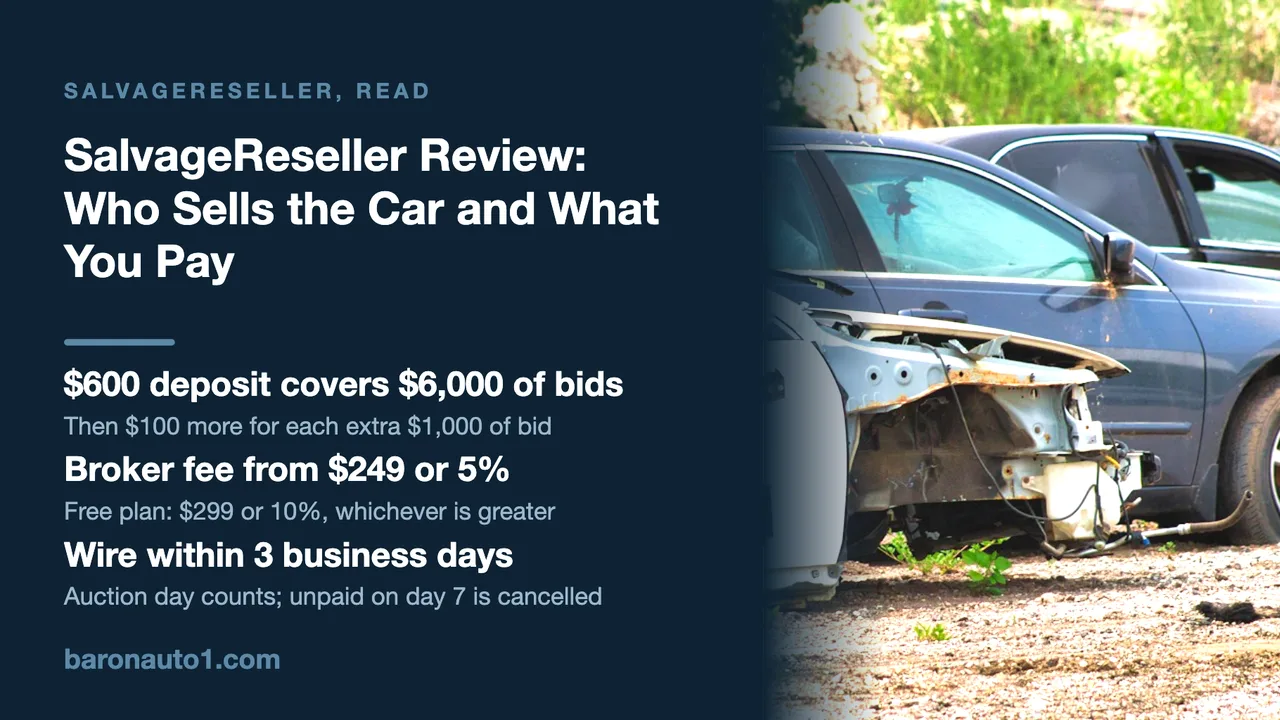
- Every bid needs a deposit: $600 covers bids up to $6,000, plus $100 for each extra $1,000. It is refundable, but it cannot pay for the car.
- Pay by bank wire within three business days, auction day counted. A $50 late fee follows; on day 7 the sale is cancelled, and the relist and cancellation fees come to at least $900 by our arithmetic.
- Each win also carries a $145 document fee and a $55 mailing fee. The title is issued in Florida in your name, about 30 business days after the auction.
- Disputes go to binding AAA arbitration in Broward County, Florida, within 12 months. We found no opt-out clause.
SalvageReseller.com lets people without a dealer license bid on Copart’s salvage and clean-title cars, and the company behind it, Inloher Corp of Coconut Creek, Florida, is the one that sells you the car. What it charges and what it can do to you are in its contract, not its marketing. On 9 October 2026 we read its Terms & Conditions (last updated 27 February 2026), its fees page and calculator, its 46-question FAQ and other help pages, Inloher’s corporate site, Florida’s corporate registry and the Better Business Bureau profile. Copart’s side comes from the documents behind our Copart fees guide, read 7 October 2026. We did not register, bid or ask for a quote, and this site has no relationship with SalvageReseller, Copart or any broker.
Who sells you the car, and who is behind SalvageReseller
Copart lets only its members bid, so in many states the public needs a broker that lends its license; our AutoBidMaster review explains how Copart brokers work. Copart’s warning applies: “When using a Broker, you are buying vehicles through the Broker and not Copart.”
SalvageReseller’s terms say exactly who that is. Section 5.1: “the Buyer is purchasing vehicles from Inloher Corp, not from Copart. All invoices, ownership documents, and contractual communications are issued exclusively by Inloher. Copart acts solely as the auctioneer and platform operator.” The terms describe Inloher as “an independent licensed dealer in the State of Florida and an authorized broker of Copart” that owns and operates the site. The seller is a named company, not an unnamed affiliate.
Only Copart is covered: “We provide access to Copart specifically, not IAA.” For Insurance Auto Auctions, see our IAA auction guide.
Florida’s corporate registry lists INLOHER CORP. as a Florida profit corporation, document number P04000155139, filed on 12 November 2004 (effective 9 November 2004) and active, with its principal address in Coconut Creek since 1 May 2008 and its latest annual report filed on 24 February 2026. It names three officers or directors (we leave out their names) but no shareholders, so who owns the company is not established from public records. The Better Business Bureau profile shows Inloher Corp. as accredited since 23 July 2009 with an A+ rating on the day we read it, and adds that the BBB “does not verify the accuracy of information provided by third parties.”
The marketing figures are claims and do not all agree: “35,000+” vehicles sold and broker status since 2004 on the About page, “250k+ Registered Users” on the home page, but “45000+ Sold Vehicles” and “18+ Years of experience” on Inloher’s corporate site. The 2004 filing date fits “since 2004,” 22 years by our arithmetic. We did not test its claim to be the only Copart broker rated A+ by the BBB.
Two claims we could not check: Florida’s dealer list refused our browser access, and Copart’s broker directory is closed to automated readers, so the dealer license and the broker registration rest on SalvageReseller’s word. Google searches for Inloher with court terms, and on the Florida Attorney General, FTC, Justice Department and CFPB sites, found no court record or regulator page. That is not proof of a clean record: we did not search court dockets, and no BBB complaint count appears here.
SalvageReseller sells VIN history reports but is not itself on the Justice Department’s list of approved consumer NMVTIS data providers as we recorded it on 31 August 2026. Its terms say reports come from “third parties, including ClearVIN,” and ClearVin is on that list; see our ClearVin review.
Registration and the three memberships
The terms accept “Any individual over 18 years of age or legal entity,” and Inloher “reserves the right to request documentation and reject applications at its discretion.” The FAQ says registration “is free and takes about a minute” with a name, email and government ID (a passport for international buyers); its compliance policy adds date of birth and home address, and for businesses the owners of 25% or more.
| Plan | Price | Broker fee per car (whichever is greater) | Free VIN reports | Percentage takes over above (our arithmetic) |
|---|---|---|---|---|
| Free (Basic) | No fee | $299 or 10% | None listed | $2,990 |
| Monthly | $34.99 a month | $249 or 7% | 2 a month | $3,557 |
| Yearly | $189.99 a year | $249 or 5% | 10 a year | $4,980 |
| Cars located in Canada | Any plan | $350 or 5% | n/a | $7,000 |
The terms say “All broker fees are exclusive of Copart fees.” Paid plans “renew automatically unless canceled prior to renewal,” and “Fees are non-refundable”: we found no first-month or first-year refund window. Inloher may suspend or close accounts “for non-payment, violations, abusive conduct, or failure to maintain deposits.”
What the free plan includes depends on which page you read. The FAQ says “The free membership has no purchase or bidding limits,” and How to Buy says every plan includes “Online live bidding.” The home page says the opposite about live auctions: “When ready to bid on live auctions, upgrade to Premium for $34.99/month.” Inloher’s corporate site gives the free Basic plan a “2 Vehicle Purchase Limit.” Ask in writing before you rely on the free plan for a live auction.
Arithmetic, not advice: on a $1,000 car the paid plans save $50 of broker fee; at $4,000 the Monthly plan saves $120 and the Yearly plan $151; at $10,000 the Yearly plan saves $500. The FAQ says the Yearly plan “costs less than two months of the monthly plan”; at the printed prices two months cost $69.98, and $189.99 is about 5.4 months, by our arithmetic. Its claim that on “a single $4,000 vehicle the fee savings versus the free plan roughly covers the membership” leaves you $38.99 short.
The $600 deposit and getting it back
Section 4.3: “A minimum USD $600 deposit is required to bid, allowing bids up to USD $6,000. Additional USD $100 is required per additional USD $1,000. Multiple simultaneous bids require separate deposits.” By our arithmetic a $10,000 maximum bid takes $1,000 and a $20,000 bid $2,000, and two high bids at once need at least $1,200.
The deposit is security, not a down payment. Section 6.9 lets Inloher apply it first “toward all outstanding amounts,” charge any card on file via Stripe if it falls short, and otherwise invoice you, and it ends: “Security deposits cannot be used toward the payment of a vehicle.” A company blog post says the opposite, that after you pay “the deposit is applied or released accordingly.” The contract is the one to rely on.
Getting it back: “Deposits are refundable only if no outstanding obligations exist,” and “Refunds are processed within three (3) business days, subject to clearance.” The FAQ adds that a leading preliminary bid counts as pending, so “the deposit has to stay on file until that lot sells.” A card deposit costs extra: “Stripe convenience fee of 2.9% applies to card payments and is non-refundable,” or $17.40 on $600 by our arithmetic. And a chargeback can mean “forfeiture of deposits”: “Buyers waive the right to dispute valid charges.”
SalvageReseller’s fees on top of Copart’s
Every win carries two layers: Copart’s buyer, internet-bid and gate fees, and SalvageReseller’s own. Copart’s layer is set out in our Copart fee schedule and worked totals, so it is not repeated here. One check is worth reporting: SalvageReseller reprints Copart’s light-vehicle buyer fees and internet-bid fees in section 6.4 and 6.5 of its terms, and we compared every row with Copart’s own secured-payment tables read on 7 October 2026. All 114 rows give the same fees. Section 8.4 adds that where Copart’s rules require it, “Copart’s provisions prevail.”
SalvageReseller’s own charges per car:
- The broker fee for your plan, from the table above.
- A $145 document fee. “A $145 USD fee is charged for every vehicle purchased, to process the vehicle documents.” Its fee table lists it among “Other Copart Charges,” but its own calculator counts it as one of the “SalvageReseller fees,” and Copart’s public fee pages, as we read them on 7 October 2026, print no such fee.
- A $55 mailing fee ($70 to Canada), which the terms split into “Copart Postal Shipping: USD $20” and “Inloher Certified Mailing: USD $35.”
- A $50 “Copart Registered Broker Fee,” filed under Copart’s charges on the fees page and in the FAQ. Copart’s public fee pages print no broker fee, and section 6.6 of SalvageReseller’s own terms, which lists the extra fees, does not include it.
- Occasional extras: a $35 administrative fee on California cars, the 2.9% card fee on card payments, and for cars located in Canada a broker fee of $350 or 5%.
| Winning bid | Plan | Broker fee | With the $145 document and $55 mailing fees | With the $50 fee it files under Copart | Share of the bid |
|---|---|---|---|---|---|
| $1,000 | Free | $299 | $499 | $549 | 54.9% |
| $1,000 | Monthly or Yearly | $249 | $449 | $499 | 49.9% |
| $3,000 | Free | $300 | $500 | $550 | 18.3% |
| $3,000 | Monthly or Yearly | $249 | $449 | $499 | 16.6% |
| $6,000 | Free | $600 | $800 | $850 | 14.2% |
| $6,000 | Monthly | $420 | $620 | $670 | 11.2% |
| $10,000 | Yearly | $500 | $700 | $750 | 7.5% |
| $20,000 | Free | $2,000 | $2,200 | $2,250 | 11.3% |
| $20,000 | Yearly | $1,000 | $1,200 | $1,250 | 6.3% |
We took the sale price to be the winning bid and left out the membership price. On a $1,000 car the broker’s own layer is about half the bid. The fees page’s calculator shows a $6,000 win with $1,048 of Copart fees and $800 of SalvageReseller fees, “Estimated total $7,848”; we rebuilt it from the tables in its terms and it adds up, excluding storage, tax and shipping.
The FAQ also offers a shortcut: “A $3,000 win commonly lands around $4,200 out the door.” Using only SalvageReseller’s own printed tables, a $3,000 win costs $4,267 to $4,425 before tax and storage, depending on plan, title type and bid type, by our arithmetic; every combination is above the figure it quotes. The broker fee can also move: the terms say “Fees may be updated with prior publication,” the fees page that Inloher may change it “at any time without notice.” Our out-the-door price guide explains why the all-in figure is the one to compare.
Paying, and what happens if you win and don’t pay
Section 6.1 makes the whole amount, “Auction closing price ... Sales tax ... Inloher broker fees ... Copart fees and applicable charges,” due together: “Payment must be received within three (3) business days, including auction day.” The fees page gives an example: “If the auction is on Monday, payment is due by 5:00pm EST on Wednesday.” Buy It Now is stricter: “Payment is required the same day of purchase,” or a $50 late fee applies.
Only a bank wire pays for the car, to Inloher’s Bank of America account: “Vehicle payments by credit card, PayPal, cash, checks, Zelle, Western Union, or direct Copart payments are not accepted.” The clock runs on cleared money: “Payment is deemed received only upon cleared funds confirmation,” and bank transfers, the terms warn, can take 1 to 4 business days to clear. Never pay at the yard; the FAQ says it “carries a $200 penalty.” Within three calendar days you must also return signed purchase documents, a government ID and, “when required,” a notarized power of attorney.
Miss the deadline and “Late payments incur a USD $50 late fee per vehicle.” Section 6.1 continues: “Failure to pay within seven (7) calendar days results in cancellation, forfeiture of deposit, and possible relisting.” Two charges follow. The relist fee is “$600 or 10% of the sale price, whichever is greater,” “taken from the security deposit paid in advance, and any remaining balance is billed to the card on file,” plus “all collection costs, including attorney fees and court costs.” On top comes a cancellation fee the fees page sets at “$300 ... for $10,000 or less, $500 for any vehicle from $10,001 to $20,000, and $1,000 for any vehicle more than $20,001.” If the card is declined, “the buyer has two business days to pay by bank wire transfer while the membership is suspended.”
| Winning bid | Relist fee ($600 or 10%) | Cancellation fee | Total owed | Deposit that bid needed | Owed beyond that deposit |
|---|---|---|---|---|---|
| $1,000 | $600 | $300 | $900 | $600 | $300 |
| $5,000 | $600 | $300 | $900 | $600 | $300 |
| $10,000 | $1,000 | $300 | $1,300 | $1,000 | $300 |
| $15,000 | $1,500 | $500 | $2,000 | $1,500 | $500 |
| $25,000 | $2,500 | $1,000 | $3,500 | $2,500 | $1,000 |
The smallest possible bill is $900, more than the deposit, with the late fee and collection costs on top. Copart relists its own members’ unpaid lots after 8 calendar days; SalvageReseller cancels a day sooner.
A bid cannot be taken back. Section 9.7: “All bids are binding and irrevocable once placed, regardless of whether the auction has concluded or the vehicle has been awarded.” Some lots need the seller’s approval, and “Sales are not final until approved,” but you cannot withdraw while you wait. Bid only when a bank wire can clear within three business days and you have a way to move the car: by our arithmetic, walking away costs at least $900.
Release, storage, abandonment and the Florida title
“Vehicles may only be removed after issuance of a Vehicle Release Authorization,” which the FAQ says is emailed “After your payment clears”; that document and a photo ID let you or your transporter collect the car. The home page and FAQ say you can pick it up yourself, but section 7.3 says it “must be removed by tow truck with proper equipment.” Ask before you plan to collect it yourself.
The free period is short and counts calendar days: “Vehicles must be removed within three (3) calendar days including auction day.” After that Copart’s storage applies, passed on to you. The terms print this schedule, and add that “Storage rates may vary by location”:
- Online bids: days 1 to 3 free, days 4 and 5 at $5, days 6 to 9 at $30, then $40 from day 10. Day 1 is the day of purchase.
- Buy It Now: days 1 and 2 free, days 3 and 4 at $5, days 5 to 8 at $30, then $40.
- Weekends: “Storage will be charged on weekends and holidays unless the weekend or holiday occurs within the first three days.”
By our arithmetic, an online-bid car collected on day 7 has run up $70, and $170 by day 10; a Buy It Now car $210 by day 10. The free period counts calendar days while payment counts business days, and a wire may take days to clear, so on a Friday sale the free days end on Sunday, before the Tuesday payment deadline. After that, “Vehicles not removed within thirty (30) days may be deemed abandoned and disposed of to recover costs. The buyer remains liable for unpaid balances.”
Every car is sold “AS-IS, WHERE-IS” with “all faults, visible or hidden,” and the FAQ says pickup “is the last chance to review the vehicle.” See the Copart damage codes.
The title is a Florida one. Section 8.1: cars with transferable documents “will be titled in the State of Florida under the name of the Buyer registered with Inloher,” never in a third party’s name, and “Titles may be clean, salvage, destruction, or other classifications as applicable.” Section 8.2: “Title processing is estimated at thirty (30) business days from the auction date,” about 6 weeks by our arithmetic. Inloher may withhold the title while any balance or dispute is open, and “does not guarantee registration eligibility in any jurisdiction.” You then retitle the car in your own state; see salvage and clean titles compared, rebuilt titles and when a salvage car makes sense.
State limits, California and sales tax
Copart warns that “Not all Brokers are able to purchase vehicles in every state or every type of vehicle,” and section 8.3 of SalvageReseller’s terms lists its limits; How to Buy adds that “Junk and parts only titles also take preliminary offers only.” The table sets them beside Copart’s own State Licensing Overview, which shows where a private individual can buy with no broker at all.
| Where the car is | SalvageReseller’s rule | Copart grid: titled cars | Copart grid: salvage |
|---|---|---|---|
| Kansas | No purchases | Broker needed | Open to private buyers |
| Missouri | No purchases | Open to private buyers | Broker needed |
| Michigan | Clean-title cars only | Open to private buyers | Broker needed |
| Colorado | Preliminary bids only | Broker needed | Open for certain document types |
| Wisconsin | Preliminary bids only | Broker needed | Broker needed |
| California | Not for California residents; car must leave the state | Broker needed | Broker needed |
In Michigan and Missouri, then, the lots that need a broker under Copart’s grid are the ones SalvageReseller does not sell. Check the grid for your state in our Copart state-by-state breakdown before paying for a broker you may not need.
California has its own agreement (section 10.2): residents may not buy California cars, every California car “must be transported out of California” at your expense, a $35 fee applies, and “Non-compliance results in cancellation, forfeiture, and account termination.”
Sales tax is collected by Inloher as a Florida dealer. Section 5.4 bases it on “Florida sales tax when applicable” or the “Buyer’s state of residence, capped at 7%.” The FAQ says “many states credit that tax when you register,” but the fees page’s state table is headed “as of 11/30/2011,” 15 years old by our arithmetic, so confirm your own state’s rate and credit with your DMV.
Transport, inspections and VIN reports
Transport. Section 7.5: “Inloher does not perform transportation services and assumes no liability for carrier actions,” and your details go to its partners. National quotes come from an unnamed “transport partner,” international ones from West Coast Shipping, and the shipment “is arranged directly between you and the transporter.” Our car shipping guide explains brokers, carriers and how to look them up.
Inspections. SalvageReseller says it cannot inspect: “we cannot examine vehicles for you, and we cannot verify or guarantee the condition, mileage, keys or history of any lot.” To walk the yard yourself you need a separate Copart membership, which its inspections page prices at “around $99 a year” for Basic and “around $249” for Premier; Copart’s own pages, read 7 October 2026, give the same $99 and $249. Code readers are banned in the yard and “test drives are not permitted.” For a remote check it points members to CarInspector.US, “Around $250, set by the provider,” with a report “within about 24 hours”; it says that firm’s fee is “non refundable once ordered” and to order “with at least two full business days left before the auction.” We did not read the inspector’s own terms. It also warns that a Run and Drive badge “only means that when Copart checked the vehicle in, it started” and moved; see what Run and Drive means and our guide to inspecting a car you cannot drive.
VIN reports. Paid plans include reports, “Yearly members get 10 free VIN reports and Monthly members get 2 every month,” and the page says they “draw on NMVTIS backed data.” The terms name the source and limit it: reports “are provided by third parties, including ClearVIN,” Inloher “does not verify, guarantee, or modify such data,” and “Reports are informational only.” ClearVin LLC is registered in Oregon (18 November 2016) at the same Portland address as AutoBidMaster LLC, as recorded for our AutoBidMaster review. Cross-check earlier sales with auction records by VIN.
Financing. “SalvageReseller and Inloher Corp are not lenders,” and the outside lenders it lists, such as Westlake’s LoanCenter and LightStream, must fund by wire inside the three-business-day window.
The terms of use and the arbitration clause
The Terms & Conditions are “a legally binding contract between the buyer ... and Inloher,” and Inloher may change them “at any time,” effective on posting, with email or site notice for significant changes. The English text prevails over the Spanish. The dispute rules come first in the document:
- Arbitration only. Any dispute about the terms, the site or a purchase goes to “binding arbitration administered by the American Arbitration Association (AAA) in accordance with its Commercial Arbitration Rules,” held “in Broward County, Florida.” “Each party shall bear its own legal fees and costs” unless the law or the arbitrator says otherwise.
- No jury, no class. Both sides waive a jury, and class, collective and consolidated claims “are expressly waived.”
- Notice and a 12-month limit. Written notice, then “thirty (30) days” to settle informally. Claims must start “within twelve (12) months from the event giving rise to the claim.”
- A one-sided exception. Inloher keeps the right to sue to collect balances, enforce liens and recover deposits.
- Limited liability. Inloher’s liability is “the lesser of” $500 or the broker fees paid on the deal, with no indirect damages; you indemnify Inloher and Copart and waive protections like California Civil Code §1542.
- Florida law applies, and anything outside arbitration goes to courts in Broward County.
We found no opt-out from arbitration and no small-claims exception in the terms. Registering also gives consent to “marketing and service communications via email, SMS, phone, or mail”; promotional messages can be refused, transactional ones cannot.
Where SalvageReseller’s own documents disagree
All were live on 9 October 2026. The terms are the contract; get anything else in writing.
| Topic | One document says | Another says |
|---|---|---|
| Live bidding on the free plan | FAQ, How to Buy: no limits; every plan has live bidding | Home page: upgrade for $34.99 a month to bid live |
| Free-plan purchases | FAQ: no purchase limit | Inloher’s site: 2 vehicle purchase limit |
| Monthly broker fee | Terms: $249 or 7% | Inloher’s site: $249 or 5% |
| Registration | FAQ: free | Home page: pay the registration fee |
| $145 document fee | Fee table: a Copart charge | Calculator: a SalvageReseller fee |
| $50 broker fee | Fees page and FAQ: charged on every win | Terms 6.6 fee list: not included |
| Changing the broker fee | Terms: with prior publication | Fees page: at any time without notice |
| Paying at a Copart yard | FAQ: a $200 penalty | Terms 6.7 non-compliance penalties: $300, $500 or $1,000 |
| Deposit toward the car | Terms 6.9: cannot be used | Blog: applied or released |
| Collecting it yourself | Home page and FAQ: pick up at the yard | Terms 7.3: removal by tow truck |
| Who you pay | Terms: Inloher, never Copart | Transport page: “Pay your Copart invoice in full” |
| Title time | Terms: 30 business days | FAQ: about 30 days; home: up to 30 days |
Two more sit against Copart’s documents. SalvageReseller applies the $15 environmental fee only to non-clean titles, where Copart’s fee page says “each item sold”; and its heavy-vehicle table prints two different rows for a $5,000.00 sale. The deposit rule, the plan fees, the three-business-day payment window, the relist and cancellation fees and the arbitration clause read the same wherever they appear on SalvageReseller.com.
Before you bid: the printed terms side by side, and a checklist
Buyers often weigh SalvageReseller against AutoBidMaster, another Copart broker, and against buying from Copart directly. The table sets printed terms side by side, with no prices; it is not a ranking. Copart’s column comes from documents read on 7 October 2026, AutoBidMaster’s from its July 2026 Member Terms read on 9 October 2026.
| Term | Copart, buying directly | AutoBidMaster | SalvageReseller |
|---|---|---|---|
| Who sells you the car | Copart, to its own Basic and Premier Members | An unnamed affiliated Dealer | Inloher Corp, a Florida dealer |
| Auctions covered | Copart’s own | Copart and IAA | Copart only |
| Payment deadline | 3 business days, sale day included | 5:00 pm Pacific, next business day | 3 business days, auction day included |
| How you pay for the car | Not part of this comparison | Wire, MoneyGram or Zelle | Bank wire only |
| If you never pay | Relisted after 8 calendar days | Relisted; relist fee plus the transaction fee | Cancelled after 7 calendar days; relist plus cancellation fee |
| Car left in the yard | Locked storage after the third business day | May be declared abandoned after 10 days | Storage from day 4 (day 3 for Buy It Now); may be deemed abandoned after 30 days |
| First-membership refund | Within 7 days if you have not bid or bought | Within 14 days if no benefits used | None; fees non-refundable |
| Disputes | Not part of our Copart reading | Arbitration; opt out by mail within 30 days | AAA arbitration in Broward County; no opt-out clause |
- Check the lot first: what Copart disclaims and earlier auction records.
- Check the state rule where the car sits, and whether you need a broker at all.
- Add every layer: Copart’s fees, the broker fee, $145, $55 and $50, then tax.
- Ask in writing whether your plan allows live bidding and how many purchases.
- Have the wire ready in your own name before you bid; it must clear within three business days.
- Book transport the day you win: storage starts on day 4, and the car goes by tow truck.
- Inspect before it leaves the yard; after pickup, claims are hard.
- Plan for a Florida title and your own state’s retitling, and price insurance for a salvage-title car.
Common questions
Is SalvageReseller legit?
We make no recommendation. Inloher Corp is an active Florida corporation filed in 2004, BBB-accredited with an A+ rating on 9 October 2026, and our searches of federal and Florida enforcement sites found no action naming it, though court dockets were not searched. Its terms are strict: wire-only payment in three business days, cancellation fees, binding arbitration with no opt-out, and documents that sometimes disagree.
Who owns SalvageReseller?
Inloher Corp of Coconut Creek, Florida, which does business as Salvage Reseller and sells you the car. Florida’s registry names its officers but no shareholders. Copart is not the seller; the terms call it only “the auctioneer and platform operator.”
How much does SalvageReseller charge?
Membership is free, $34.99 a month or $189.99 a year. Each car adds a broker fee of $299 or 10% (Free), $249 or 7% (Monthly) or $249 or 5% (Yearly), a $145 document fee, $55 mailing and a $50 fee it files under Copart, on top of Copart’s own fees and tax.
Is the SalvageReseller deposit refundable?
Yes, once nothing is pending, processed within three business days. It is at least $600, covers bids up to $6,000, cannot be used to pay for the car, and the 2.9% card fee on a card deposit is not returned.
What happens if you win and don’t pay?
A $50 late fee after three business days. On day 7 the sale is cancelled and you owe a relist fee of $600 or 10% plus a cancellation fee of $300 to $1,000, at least $900 by our arithmetic, taken from your deposit and then your card.
Can SalvageReseller buy IAA cars or ship my car?
No to IAA: it says it provides “access to Copart specifically, not IAA.” It does not ship either; it passes your request to transport partners, and the contract for the move is with the carrier.
Sources and further reading
Recall, complaint and safety-rating figures on this page were retrieved from the federal databases above on August 19, 2026. Federal data changes — re-check any VIN before you rely on it.
Published October 9, 2026 · last updated October 9, 2026. Found something out of date or wrong? Tell us and we will correct it.