Lamborghini VIN Decoder: Two Codes, Two Countries
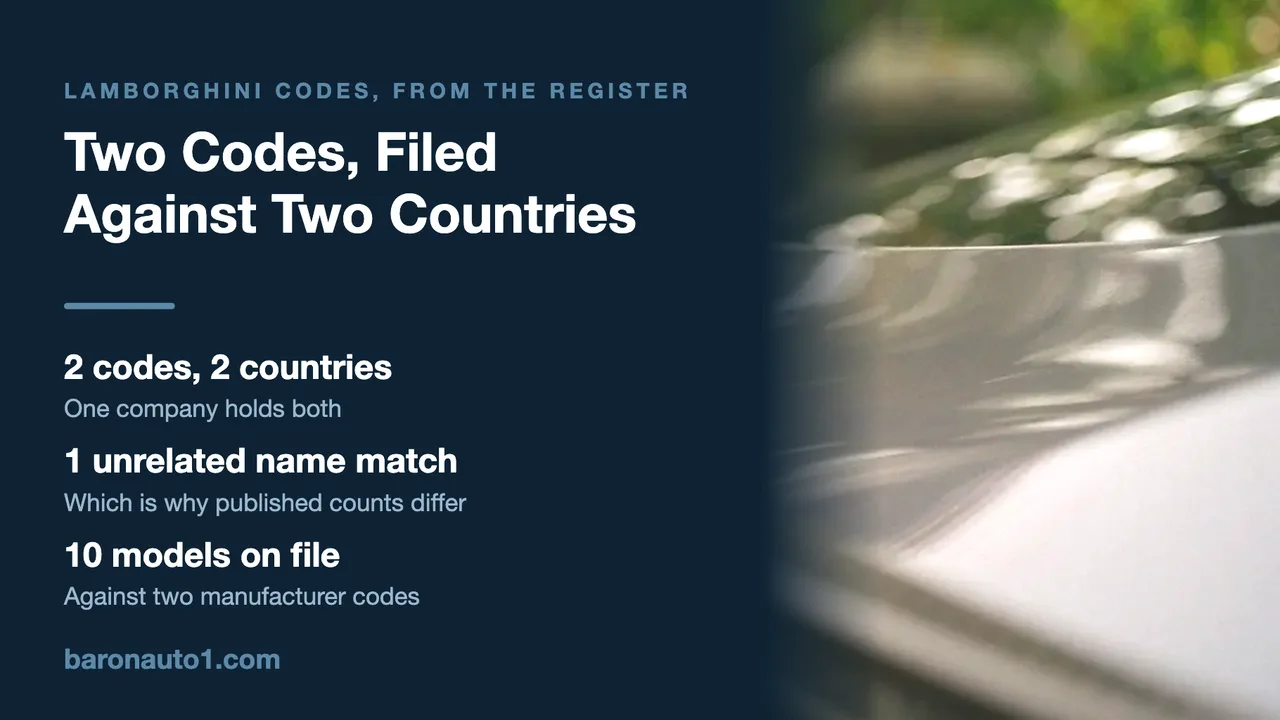
Two codes, two countries, and one unrelated company the name query drags in alongside them.
The short version
- There is no Lamborghini-only decoder and no need for one. Every vehicle certified for sale in this market carries the same seventeen-character number, and a single federal register resolves the manufacturer prefix on all of them.
- The entry is two world manufacturer identifiers: ZHW and ZPB. Both are filed under one company name, AUTOMOBILI LAMBORGHINI SPA, so the register holds a single registered entity for the make.
- ZHW is recorded against ITALY and filed as a Passenger Car. ZPB is recorded against UNITED STATES (USA) and filed as a Multipurpose Passenger Vehicle (MPV). One code per vehicle type, and the two countries separate the entry cleanly.
- That country field records where the registrant filed. It is not a statement about where any car was assembled, and the same company name sitting against both countries is the clearest demonstration of the difference.
- Both codes begin with Z even though the country records differ, so the leading character does not sort this entry by country.
- A register query on the name returns a third row, the six-character ZA9A12, filed under the same company name against ITALY. It is held out of the count of two, which is one reason published totals for this make disagree.
- ZHW was registered on 15 April 2015 and ZPB on 9 August 2018. Those are registration dates for the codes, not build dates, sale dates or model years.
- What no federal decode carries: service history, condition, whether a recall was actually carried out, and what has been changed on the car since it was built.
The phrase “VIN decoder” suggests a tool built for one marque. No such thing exists. It does not. The number stamped on the car is built to the same federal standard as the number on a hatchback or a delivery van, and the register that turns the first three characters into a manufacturer is the same register for all of them.
What is worth reading is what that register actually holds under the name, and the answer is short. This page works from an archived read of the federal register. Two three-character codes, one registered company name, two countries, two vehicle types, ten models. That is the whole of it, which means the useful work here is not padding a small file into something that sounds authoritative — it is stating precisely what the rows say, and then being equally precise about the questions those rows cannot touch.
There is one field on this entry that reliably sends people back to the search box convinced something has gone wrong, and it is the country column. Read carelessly, a two-row entry recorded against two different countries looks like a contradiction. Read properly, it is the register doing exactly what it was built to do. Most of this page is about the difference between those two readings.
One register reads every VIN, this make included
The vehicle identification number is a federal standard and its layout does not vary by badge. Positions one to three are the world manufacturer identifier, assigned to the legal entity that builds the vehicle. Positions four to eight describe the vehicle in a scheme the manufacturer designs for itself. Position nine is a check digit, computed arithmetically from the other sixteen characters. Position ten carries the model year. Position eleven identifies the assembling plant. The final six characters are the serial.
Our guide to reading a VIN position by position sets out the full layout, and the by-make index collects what the register holds for each manufacturer we have read.
A brand-specific decoder would earn its keep in the middle block, and this is where the honest answer is a gap rather than a table. Positions four to eight are the manufacturer’s own descriptor scheme, and the federal register does not publish the key to it. The register records who owns a prefix, what vehicle class the prefix covers, which country the entity is registered in, and when the code was opened. It does not record that a particular character in position five means one body style and another means something else.
So this page prints no position-by-position table and no plant-code list, because we hold neither from a source we would defend. A decode of a real number returns the descriptor fields as the federal system resolves them for that specific vehicle, which is a different and far sturdier thing than a printed key assembled from somewhere else. Where the data ends, the page stops.
Two codes, and one company name against both
A VIN opens with three characters the manufacturer does not choose. They are assigned centrally, published in full, and they identify the entity that filed for the right to issue numbers. Under this make there are two of them: ZHW and ZPB.
Both are filed under the same registered name, AUTOMOBILI LAMBORGHINI SPA. The register lists one division for the make and that is it — no second company, no subsidiary trading name, no separate entity for a particular class of vehicle. On makes where several entities file under one badge, a decode can return a company name a buyer has never seen. That does not happen here. Whichever of the two codes issued a number, the name that comes back is the same string, and it contains the badge.
The register prints that name exactly as it was filed, capitals and all, and a decode reports it character for character rather than tidying it into the form a magazine would use. Seeing a result in block capitals with a corporate suffix attached is the field working normally, not a formatting fault in the lookup.
An entry this size also changes what the first three characters are worth to a reader. On a make with a dozen codes, narrowing a number to one of them tells you something: which entity, which country of filing, sometimes which class. Here, the prefix narrows the field to one of two, and both are filed by the same company. The manufacturer prefix on this make is therefore close to a confirmation rather than a discovery. Everything specific about an individual car sits from position four onwards, and only a decode of the actual number will return it.
Italy, the United States, and what the country field records
The two codes are recorded against two different countries. ZHW carries ITALY. ZPB carries UNITED STATES (USA).
This is the field that needs the most care on this page, because its name invites a reading it will not support. The country recorded against a world manufacturer identifier describes the registration — where the entity filed for the code — and not the building in which any particular vehicle was put together. It is a fact about a filing cabinet. It is not an assembly address, a plant location or a statement about a car’s origin.
This entry demonstrates the point better than an argument could. Both codes are filed under the same company name. If the country field were recording where vehicles are assembled, one registered name could not sit against two different countries in the way it does here. What the two rows record is that the same registrant made filings recorded against two different countries. The register carries no explanation of why, and this page will not supply one from memory.
The practical consequence for a buyer is worth stating plainly. If you decode a number and the country field comes back as the United States on a car you understood to be Italian, you have not found evidence of anything. You have found the country recorded against the code that issued the number. It is not a claim about the car, and it is not grounds for accusing a seller of misdescription. The checks that would genuinely expose a misrepresented car are different checks, and they come later on this page.
The reverse caution applies too. A code recorded against ITALY is not a certificate of Italian assembly for the specific car in front of you. It records where a registration sits. Position eleven of an individual number is the plant character, and as noted above the federal register does not publish the key that turns it into a plant name, so neither this page nor any honest general decoder can convert it into a location.
Both codes open with Z, so the first character sorts nothing here
There is a habit of reading the first character of a VIN as a shorthand for where the number came from, and on some register entries the characters do line up with the countries recorded. This entry is a useful corrective, because it does not.
ZHW and ZPB share their leading character. The countries recorded against them differ. A reader who tries to work out which of the two codes issued a number by looking at the first character alone will get nowhere, because both start with Z, and a reader who tries to infer the country record from that Z will get one of the two rows wrong. The third row a name query returns, covered further down, also begins with Z.
What actually separates the two codes is all three characters, read together. ZHW and ZPB differ in positions two and three, and those are the positions that carry the distinction on this entry. It is a small point and it is the kind of small point that stops a buyer arguing with a seller about something that was never in dispute.
It is also a reason to be wary of decoding rules of thumb generally. A rule that holds on one register entry can fail on the next one, because the register is a set of filings made by companies over time rather than a scheme designed to be readable in shorthand. The reliable move is to decode the whole number rather than to interpret its first character by hand.
One Passenger Car code, one Multipurpose Passenger Vehicle code
The register files every code under a vehicle type, and the two codes here take one each. ZHW is filed as Passenger Car. ZPB is filed as Multipurpose Passenger Vehicle (MPV).
Because the split is one code per type, the two fields move together on this entry. A decode that resolves to the Passenger Car classification resolved the code recorded against Italy; a decode that resolves to Multipurpose Passenger Vehicle resolved the code recorded against the United States. On a larger entry those fields would cross in every direction. Here they do not, which makes the two rows easy to read and easy to over-read at the same time.
Over-reading is the risk, so here is the boundary. Multipurpose Passenger Vehicle is a federal classification with consequences for which safety standards apply to a vehicle. It is not a description a showroom would use, it does not name a body style, and it says nothing about doors, seats or shape. A decode returning it is telling you how the vehicle was certified. It is not telling you what the car looks like, and it is certainly not a verdict on what the vehicle ought to be called.
Nor does the class field check the badge for you. It records what the register expects of numbers issued under that code. Confirming that a specific car matches its description is still a matter of decoding that car’s own number, reading the result against the advert, and then looking at the vehicle.
The third row a name query returns
Query the register by company name rather than by code and a third row comes back: ZA9A12, filed under AUTOMOBILI LAMBORGHINI SPA, classified Passenger Car, recorded against ITALY, registered on 25 August 2015.
Six characters, not three. That length is why it is not counted in the two. The count on this site covers three-character world manufacturer identifiers, and the archived read keeps longer codes in a separate field. The reason for that rule is that the register’s name endpoint matches company names as text rather than resolving brands, and on many makes a raw name query drags in six-character codes belonging to small builders whose registered names merely contain the brand string. Filtering by length removes that noise.
On this entry the filter behaves differently, and it is worth saying so precisely rather than glossing it. The six-character row that comes back is not an unrelated builder with a coincidental name. It carries the same registered company name as the two counted codes, the same country record as ZHW, and a registration date that falls between the two counted dates. What the register does not do is explain the relationship between a six-character code and a three-character one, or say why a registrant holds both. The row exists, its fields are as printed, and that is the end of what can be claimed.
The consequence for a reader comparing sources is direct. A page that counts three-character codes reports two for this make. A page that counts everything a name query returns reports three. Neither number is invented; they are answers to two different questions. If a total you have seen elsewhere does not match the one here, that difference in counting rule is the first place to look, and the leading characters of ZA9A12 — which match neither ZHW nor ZPB — are the quickest way to tell which row is being counted.
April 2015, August 2018, and what a date proves
The register records when each code was opened. ZHW was registered on 15 April 2015. ZPB was registered on 9 August 2018. Three years and a few months separate them, and the six-character row sits between the two, in August 2015.
Those are registration dates. They are not build dates, sale dates, first-titling dates or model years, and they are not evidence that anything was produced on or near them. A date in this entry supports a statement about the order in which filings were made, and nothing further.
That distinction matters most when someone tries to use a registration date as a sanity check on a car’s age. It does not work in either direction. The model year of an individual vehicle lives at position ten of its own number, and our model-year chart sets out how that character is read. The register’s dates describe the paperwork behind a prefix, and the number on the car describes the car.
What the two dates do support is a modest observation about the shape of the entry: the code recorded against the United States is the later of the two filings. That is a fact about the order of registrations. The register does not record how many vehicles were issued numbers under either code, so the dates rank the filings and stop there.
Ten models, and how the register spells them
The archived read holds ten models for this make, and it holds the names as well as the count, so they are printed here as the register carries them: 147, Aventador, Diablo, Gallardo, Huracan, Murcielago, Revuelto, Roadster, Temerario and URUS.
Three things about that list are worth pointing out, all of them observable in the data rather than inferred from anywhere else.
The first is spelling. Huracan and Murcielago appear without the accents that a brochure would carry, and URUS appears in full capitals while the others are in title case. If you are comparing a decode result against a listing character by character, expect the register’s spelling rather than the typographically correct one. A mismatch in an accent is a difference in how a database stores text, not a difference in what car is being described.
The second is that two of the ten entries do not look like model names as a buyer would use them. The list contains 147 and it contains Roadster. Those are what the register holds, they are reproduced here unedited, and the register offers no note explaining either. We are not going to guess at what they represent, because a guess printed on a page like this becomes a fact by tomorrow.
The third is scope. A model count in this register covers what the decoder holds for the make across all years, not a current line-up, so the presence of a name says nothing about what is being sold now and the absence of one says nothing either. The list is the decoder’s vocabulary: the set of names a decode can return when it resolves a specific number.
And a model name, however it arrives, is not a trim. The register knows the model line. It does not know which engine, which drive configuration, which wheel, which interior or which options package a particular car was built with, and on cars of this kind those distinctions carry a great deal of the value. Our pages on trim level by VIN and build sheets set out how far that can be pushed and where it stops.
No parent group in the file
Some badges hold no manufacturer code at all in their own right. Their numbers are issued under a parent group’s filing, which is why a register search on the badge name returns almost nothing useful and why a decode on such a car names a company that is not the badge. The archived read records that pattern explicitly for several well-known names.
This make is not one of them. The register has no parent group recorded against it, no codes attributable to a parent, and both of its codes are filed under its own name. Badge and register entry line up, and a decode returns a name a reader will recognise.
That makes this a straightforward entry to read at face value, with one qualification already covered above: the count depends on whether six-character codes are included. Subtract nothing else. There is no parent filing sitting behind these two rows, and no unrelated builder attached to them.
It also means the by-make index is the place to go if a result on some other vehicle surprises you. Our index of what the register holds by make shows how far the badge-and-registrant gap can run elsewhere, and reading two entries side by side is the fastest way to see that a name mismatch is a property of the register rather than a fault in a lookup.
What the decode will not tell a buyer
This is the section that does the most work, because the gap between what people expect a VIN to carry and what it actually carries is widest here.
The number is a build identity. It exists so a regulator can tie a recall campaign to a batch of vehicles, an insurer can tie a policy to an object, and a state can tie a title to that same object. It was never designed to describe the condition of a vehicle today, and it has no field for any of the following.
Service history. Nothing about oil changes, fluid intervals, brake work, belts or the last time anything was inspected reaches the register, and none of it is encoded in the number. On a car maintained by independent specialists there may be no central record anywhere, only a folder of invoices, which is worth asking for and worth reading line by line rather than weighing in the hand.
Whether a recall was actually carried out. The federal recall lookup will tell you whether a campaign is recorded as open against a specific number, which is free and genuinely useful. What no decode does is confirm that a previous owner ever presented the car. A campaign showing as remedied means a remedy was recorded; a campaign showing as open means the work is outstanding as far as the system knows. Our guide to checking a car for open recalls covers how to read the result, including the cases where the flag and the reality diverge.
Which options are fitted. A build record can describe how a car was configured when it was made, and how much of that is recoverable varies by manufacturer. What no historical decode shows is a change made afterwards: a component swapped, an accessory added, a wheel package replaced, a feature disabled. Original specification and current specification are two different claims and only the first has any chance of living in a record. Our page on options by VIN makes the same argument across all makes.
Condition, mileage accuracy and damage that never reached a record. A decode reads the build. Damage enters a file only where an insurer or a state filed something, and a repair paid for privately can leave no trace at all. Our page on accident checks by VIN sets out which events reach the record and which never do.
Reading the number off the car
Whatever the listing says, the number to work from is the one on the vehicle. Read it yourself rather than copying it from an advert, and read it from more than one place.
The usual locations on a passenger vehicle are the plate visible through the base of the windscreen on the driver’s side and the certification label in the driver’s door aperture. That label is a federal requirement rather than a manufacturer courtesy, which is what makes it a dependable second reading. Our guide to where the VIN is on a car covers the wider set of locations, including the ones worth checking on a car you suspect has been apart.
Two readings that disagree is a finding rather than a transcription problem to shrug off. So is a label that looks newer than the aperture around it, or fixings that have obviously been disturbed. Where the numbers on a car do not agree with each other or with the paperwork, our page on VINs that do not match covers what that means and what to do next.
Before anything else, run the check digit. Position nine is computed from the other sixteen characters, so a mistyped number usually fails arithmetically before it has cost anyone a journey. Our validator page explains how to run that check by hand, and it is worth doing on any number that arrived by message or was read off a photograph of a screen.
The records that sit around the number
The decode is the cheap part and the fast part. The record is where used-car money is won and lost, and a record is retrieved rather than decoded — it lives in title files, insurer reports and recall databases, keyed to the number rather than encoded inside it.
Three retrievals do most of the work, in this order. The federal recall lookup is free, per-vehicle and authoritative on open campaigns. The theft check is also free and answers a question that ends a purchase outright; how to check if a car is stolen covers running it. And the title history — the brands, the state-by-state chain, the odometer readings entered at each titling — is the one that repays paying for. Our title-check page explains what comes back and, just as usefully, what structurally cannot.
Know the boundaries of the free tools before leaning on them. Our page on what a free VIN check actually returns sets out what each one covers, because a clear result from a database that only includes participating members is a weaker statement than it appears. Free checks start an enquiry. They do not finish one.
Where a car carries a brand on its title, the brand is the purchase. What a branded title means ranks the brands by how much each should worry a buyer. Water damage deserves its own note, because it reaches wiring, connectors and modules in ways that surface months later and are hard to see on a forecourt; our page on flood checks by VIN covers what the record shows and the cars it never sees.
A sequence for a used one
Put together, the order looks like this, and none of the first four steps requires leaving home.
Get the full seventeen characters from the seller and validate the check digit. A number that fails is a transcription error until proved otherwise, and finding that out early costs nothing.
Decode it. Confirm that the model and model year returned agree with the advert, because a disagreement there ends the conversation before anyone has driven anywhere. Note which of the two codes issued the number, and read the country field for what it is: the country recorded against a registration, not a statement about where the car was assembled.
Run the free lookups. Recalls and the theft flag are per-vehicle, free and quick, and either can settle the matter from the kitchen table.
Buy the title history once and read the chain rather than the headline. Which states, in what order, with what readings and what brands. A short chain with long ownerships reads well. A car that has crossed several states quickly is asking a question the seller should be able to answer without hesitating.
Then do the part no record covers. Read the number off the car with your own eyes, from the windscreen and the door aperture, and compare it character by character against the number you decoded and the number on the title. Ask for the invoices and read them. And book a pre-purchase inspection with someone who knows the model, because the condition of one specific car is the thing this entire page has been telling you the number cannot carry. Our guide to buying a used luxury car covers the running-cost questions that sit outside every record.
Common questions
Is there an official Lamborghini VIN decoder?
Not a separate one, and none is needed. These cars carry the same seventeen-character number as everything else certified for this market, and the federal register resolves the manufacturer prefix for every make on the same terms. A general decoder handles the marque.
How many manufacturer codes does Lamborghini have?
Two three-character world manufacturer identifiers, ZHW and ZPB. A name query also returns the six-character ZA9A12 under the same company name, which is why some published totals say three.
What do ZHW and ZPB mean?
They are the two manufacturer prefixes filed under AUTOMOBILI LAMBORGHINI SPA. ZHW is recorded against ITALY and filed as a Passenger Car. ZPB is recorded against UNITED STATES (USA) and filed as a Multipurpose Passenger Vehicle (MPV). The register carries nothing further about either code.
Why does one of the codes say United States?
Because that is the country recorded against that registration. The field describes where the entity filed for the code, not where a vehicle was assembled, and the clearest evidence is that both codes are filed under the same company name while the countries differ. A decode returning the United States is not evidence that a car has been misdescribed.
Does the first character tell me where the car came from?
Not on this entry. Both codes begin with Z while the countries recorded against them differ, so the leading character does not separate them. Read all three characters, and read the country field as a record of a filing.
Which Lamborghini models does the register hold?
Ten, spelled as the register carries them: 147, Aventador, Diablo, Gallardo, Huracan, Murcielago, Revuelto, Roadster, Temerario and URUS. That is what the decoder can return across all years rather than a current line-up, and two of the entries do not read like model names a buyer would use. They are reproduced unedited because the register offers no explanation of them.
Why does my decode spell it Huracan without the accent?
Because that is how the name is stored. The register also carries Murcielago without accents and URUS in capitals. A difference in accents or capitalisation between a decode result and an advert is a difference in text storage, not a difference in what car is being described.
Does Lamborghini register under a parent company?
No. The register records no parent group for the make and no codes attributable to one. Both codes are filed under the make’s own name, so a decode returns a company name that contains the badge.
Which is the newer of the two codes?
ZPB, registered on 9 August 2018, against 15 April 2015 for ZHW. Those dates record when the codes were opened. They say nothing about when any vehicle carrying them was built, sold or first titled, and the register does not record how many numbers were issued under either.
Will a decode tell me the trim or the options?
It will confirm the model line as filed. Trim, engine option and fitted equipment belong to the build record rather than to the model name, and how much of that is recoverable varies by manufacturer. Anything added, removed or swapped after the car was built sits outside every historical decode.
Can a VIN check show whether a recall was completed?
It shows whether a campaign is recorded as open or remedied against that number, which is free and worth running. It does not prove that a previous owner presented the car, and it does not show work carried out outside the campaign system. Read the campaign text rather than only the flag.
For sale near you
Dealer listings, checked liveFinding used Lamborghini cars near you…
Sources and further reading
- NHTSA VIN decoder
- NHTSA recall lookup
- NMVTIS (US Department of Justice)
- 49 CFR Part 567 — Certification
Recall, complaint and safety-rating figures on this page were retrieved from the federal databases above on August 19, 2026. Federal data changes — re-check any VIN before you rely on it.
Published September 5, 2026 · last updated September 5, 2026. Found something out of date or wrong? Tell us and we will correct it.