Lincoln VIN Decoder: The Codes Belong to the Parent Group
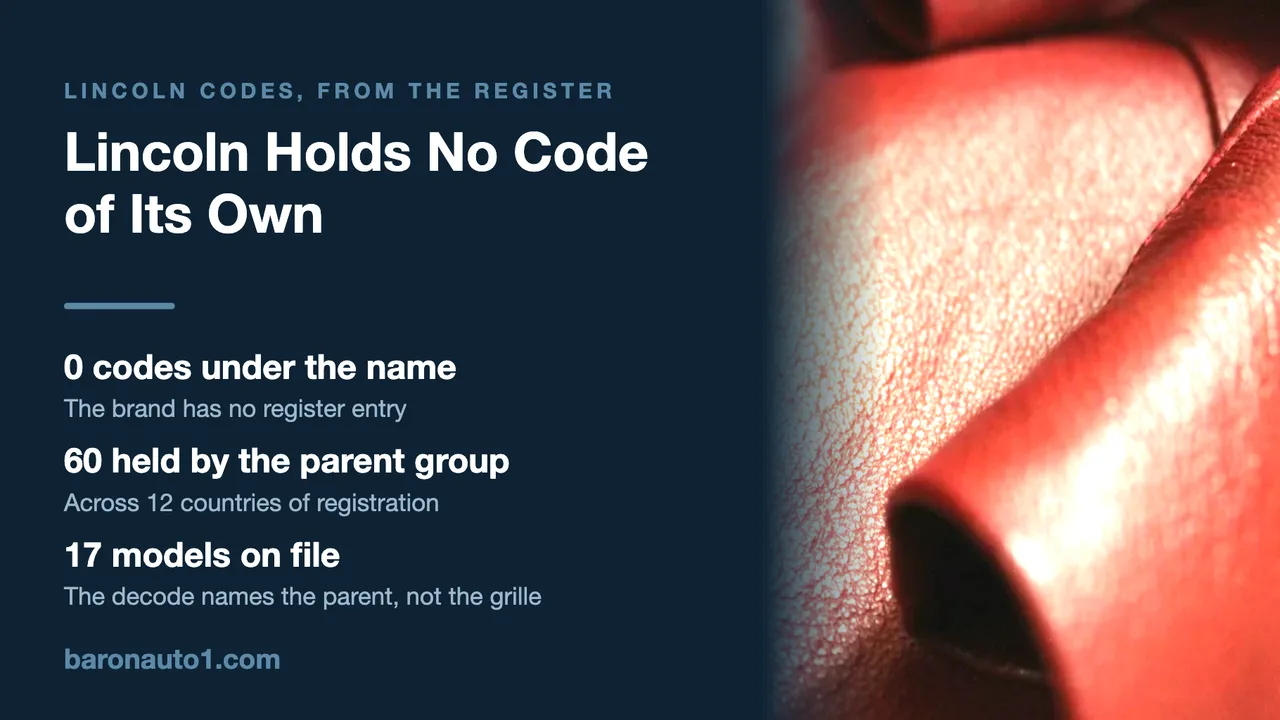
No entry under the brand name. The parent group holds 60 codes across 12 countries, and the decode names that parent.
The short version
- There is no Lincoln-only decoder and there does not need to be one. Every vehicle certified for this market carries the same seventeen-character number, and one federal system resolves the manufacturer prefix on all of them.
- The register holds no world manufacturer identifier under the name Lincoln. The count is zero. The codes a Lincoln VIN opens with are registered to the parent group the entry names — Ford — which holds sixty of them.
- Those sixty codes are filed under six vehicle classes: nineteen Passenger Car, fifteen Incomplete Vehicle, twelve Multipurpose Passenger Vehicle, ten Truck, three Bus and one Trailer.
- They are recorded against twelve countries: twenty-eight United States, twelve Canada, ten Mexico, two Germany, and one each for Norway, South Korea, Ireland, Australia, Turkey, Brazil, New Zealand and India. That field records where the registrant filed, not where a vehicle was assembled.
- A brand-name query does not come back empty here. It returns one unrelated company, LINCOLN CENTER MANUFACTURING, LLC, a trailer registration filed in February 2021 under a six-character code. It has nothing to do with the marque, and counting it in is how a zero turns into a one.
- The decoder holds seventeen models under the name, and the archived read carries them: Aviator, Blackwood, Continental, Corsair, LS, MKC, MKS, MKT, MKX, MKZ, Mark, Mark LT, Nautilus, Navigator, Navigator L, Town Car and Zephyr.
- What no decode carries, on this badge or any other: service history, the condition of the car in front of you, and whether a recall was actually carried out rather than merely recorded.
The phrase “VIN decoder” suggests a tool built for one marque. No such thing exists. It does not. The number stamped on a Lincoln is built to the same federal standard as the number on a pickup, a van or a motorcycle, and the system that turns the first three characters into a manufacturer is the same system for every one of them.
What is worth reading is what the federal register actually holds under the name, because this entry has a feature that is easy to mistake for a broken lookup. This page works from the entry. The headline number in it is zero. Not a short entry, not an awkward one — an empty one, with the codes that matter recorded somewhere else entirely, and with one stranger attached to the name for good measure.
Everything below is read off that archived entry and nothing else. Where the entry is silent — and it is silent about a great deal that brand VIN pages routinely assert — this page says so rather than filling the gap from memory. That restraint is the point. The questions that decide a used-car purchase are about how one specific car was treated, and the honest first step is knowing exactly which of those questions seventeen characters can and cannot touch.
The count under the badge is zero
A VIN opens with three characters the manufacturer does not choose. They are assigned centrally, published in full, and they identify the legal entity that filed for the right to issue numbers. Ask the register how many of them sit under Lincoln and the answer is none at all.
State that flatly, because it is easily misread. Zero does not mean the register has a hole in it, that the data pull failed, or that these cars carry numbers of some irregular kind. Every Lincoln certified for this market carries a properly assigned seventeen-character number opening with a properly registered three-character prefix. The prefix is simply not filed under the badge. The entry records a parent group, and that group holds sixty codes. A Lincoln VIN begins with one of those sixty.
This is ordinary in the way registers work and easy to misread from the outside. A world manufacturer identifier is registered by a corporate entity rather than by a marketing name, and nothing obliges the two to line up. Where they do line up there is no reason to notice the register exists. Where they do not, a perfectly correct decode returns a company name that is not the name on the grille. That is the register answering the question it was built to answer, not a fault in the lookup.
Lincoln is not alone in it. Across the forty-six makes in our file, ten hold no code of their own: Chevrolet, Jeep, Dodge, Lexus, GMC, Mopar, Acura, Can-Am, INFINITI and this one. That is a count run over the whole file rather than an impression, and it is why the by-make index is arranged the way it is. An empty entry under a badge is a normal state of affairs. The useful question is never why it is empty, but where the codes went instead. Our Acura and GMC pages walk the same finding from two other directions.
One federal system reads every VIN, this badge included
The vehicle identification number is a federal standard and its layout does not vary by marque. Positions one to three are the world manufacturer identifier, assigned to the entity that builds the vehicle. Positions four to eight describe the vehicle in a descriptor scheme the manufacturer designs for itself. Position nine is a check digit computed arithmetically from the other sixteen characters. Position ten carries the model year. Position eleven identifies the assembling plant. The final six are the serial.
Our guide to reading a VIN position by position sets out the full layout, and the model-year chart covers the single character at position ten that people most often want.
Where a brand-specific decoder would genuinely earn its keep is the middle block, and this is where we have to be straight about a gap. Positions four to eight are the manufacturer’s own descriptor scheme, and the federal register does not publish the key to it. The register records who holds a prefix, what vehicle class the prefix covers, which country the entity filed in and, on some rows, when the code was opened. It does not record that a particular letter in position five means one body style on a saloon and something else on a crossover.
So this page prints no position-by-position table for the make, and no plant-code list, because we hold neither from a source we would defend. A decode of a real number returns the descriptor fields as the federal system resolves them for that one vehicle, which is a different and far more dependable thing than a printed key. If you want the descriptor block turned into equipment, that is a build-record question rather than a register question, and our pages on specs by VIN and window stickers set out how far it can be pushed.
The brand-name lookup does not come back empty — it comes back wrong
There are two ways a register query on a badge can mislead you, and this entry manages both at once.
The first is the zero already covered: no code is filed under the name, so the honest answer to “how many codes does this badge hold” is none, and any page printing a number above zero is counting something else. The second is subtler. The register’s name endpoint matches company names as text rather than resolving marques, so asking it for a word drags in every small builder, trailer shop and specialist converter whose registered name happens to contain that string.
Run that query here and exactly one company comes back: LINCOLN CENTER MANUFACTURING, LLC, filed as a Trailer, recorded against the United States, with a registration date of 15 February 2021 and the code 1L9612. It is a six-character registration rather than a three-character prefix, and our archived read counts three-character codes only, which is why a row like this one is held separately rather than added to any total. The company is unrelated to the marque. Its name simply contains the word.
That single row is the reason to look at a raw result rather than its length. Take it at face value, count the rows, and you have a one where the correct answer is a zero — and the one you are holding describes a trailer builder. If you are decoding a trailer rather than a car, our trailer VIN guide covers what that register entry does and does not carry.
Note also what that date is. A registration date records when a code was opened on the register. It is not a build date, not a model year, and not the date any vehicle carrying it was sold or first titled. Codes are opened ahead of use and can sit unused. The rows in this entry that describe the parent group carry a code, a registered name, a vehicle class and a country, and no date at all, so this page prints no timeline for them. The one date available belongs to a company that has nothing to do with the car you are looking at.
Sixty codes, and six kinds of vehicle
The entry names Ford as the parent group and records what that group holds: sixty world manufacturer identifiers. That is the pool a Lincoln VIN opens from, and it is worth looking at properly, because it is considerably broader than a showroom.
By vehicle class the sixty split six ways. Nineteen are filed as Passenger Car. Fifteen are Incomplete Vehicle. Twelve are Multipurpose Passenger Vehicle, the federal class that catches most of what the market calls an SUV or a crossover. Ten are Truck. Three are Bus. One is a Trailer. The chart above draws that split; the numbers in it are the full counts from the entry rather than a sample.
Two cautions come with reading it. The first is that these are federal certification classes, not descriptions a salesperson would use. Multipurpose Passenger Vehicle is a regulatory category with consequences for which safety standards apply, and it covers a wide range of shapes. A decode returning it tells you how a vehicle was certified. It is not a verdict on whether something is really an SUV, and it says nothing about doors, seats or body style.
The second is that the class attaches to the code, not to your car. Fifteen codes in this entry are filed under a class the register calls Incomplete Vehicle. That is a fact about the group’s filings. It is not a claim about any Lincoln, and this page will not turn it into one — the entry gives no definition of the class and no link between any class and any badge. What it does show is that the pool a Lincoln VIN draws from is a general-purpose industrial register rather than a catalogue of cars, which is the honest frame for everything below.
Twelve countries, and what that field actually records
Every code in the entry carries a country, and across the sixty there are twelve of them.
The chart draws the largest. In full, the twelve are: the United States with twenty-eight codes, Canada with twelve, Mexico with ten, Germany with two, and then eight countries holding one apiece — Norway, South Korea, Ireland, Australia, Turkey, Brazil, New Zealand and India. Add them and you get sixty, which is the whole entry.
Now the caution that matters more than the numbers. That field records the country the registering entity filed in. It is not an assembly location, and it should never be read as one. A code recorded against a country tells you where a filing sits in a cabinet. It does not tell you where any particular vehicle was screwed together, and the register holds nothing that would let anyone refine it. Position eleven of an individual number is the plant character, but the key that turns that character into a plant name is not published in the register, so this page prints no plant table.
The entry contains a clean illustration of why the distinction is worth keeping. One of the codes in the archived rows is 1FL, filed as a Passenger Car under the registered name FORD MOTOR COMPANY, with Norway in the country field. The registrant name and the country do not tell the same story, and neither of them is telling you about a factory. They are two separate fields on one filing.
So the practical use of the country field is narrow and still worth having. It tells you where the entity that issued a number is registered. Anything more specific about one car sits from position four onward, in fields that only a decode of that car’s actual number will return.
Eleven registered names, and two that do not read like the group
The entry also lists the company names the sixty codes are filed under. There are eleven of them: FORD INDIA LTD, FORD MOTOR CO OF AUSTRALIA LTD., FORD MOTOR COMPANY, FORD MOTOR COMPANY BRASIL LTDA., FORD MOTOR COMPANY OF CANADA, LTD., FORD MOTOR COMPANY OF NEW ZEALAND LTD, FORD MOTOR COMPANY, MEXICO, FORD OTOMOTIV SANAYI A.S., TURKEY, FORD WERKE AG, KIA MOTORS (FORD IMPORTS) and THOMPSON MFG. COMPANY WEXFORD LTD.
Nine of those eleven read as national variants of one name. Two do not. KIA MOTORS (FORD IMPORTS) and THOMPSON MFG. COMPANY WEXFORD LTD. are both registered names inside this entry, and both would look, to anyone reading a decode result cold, like evidence that a lookup had gone wrong or a seller had lied.
Neither conclusion follows. A decode reports the registered entity that issued a number, character for character, because reporting the filing is the field’s job. The register gives each of these names, a country and a vehicle class, and nothing further. It does not say how the entities relate to one another, what any of them does, or why a name is written the way it is, and this site does not fill that in from memory. If you want the group’s own entry read on its own terms, our Ford register page covers it directly.
What matters for a buyer is only this. A manufacturer name that does not match the badge is not, by itself, evidence of anything wrong. The checks that would actually expose a misrepresented car are different checks: whether the number on the car matches the number on the paperwork, whether the model and model year the decode returns match the advert, and what the title record says. Our page on VINs that do not match covers the mismatches genuinely worth worrying about, and a surprising company name is not one of them.
Which of the sixty is “the Lincoln code”
This is the question the entry cannot answer, and saying so plainly is more useful than guessing.
Our archived read carries a capped sample of the parent rows rather than all sixty, and the sample is there to show the shape of the entry, not to be counted. Reading a few of them: 1FA is filed as a Passenger Car under FORD MOTOR COMPANY in the United States. 2FA is a Passenger Car under FORD MOTOR COMPANY OF CANADA, LTD. 3FA is a Passenger Car under FORD MOTOR COMPANY, MEXICO. Alongside them sit 1LN, 2LN and 3LN, filed as Passenger Cars under those same three entities in those same three countries, and 1ME, 2ME and 3ME in the same arrangement. Two more, 1F7 and 1L1, are United States Passenger Car rows, and 1FL is the row with Norway in its country field.
You can see a pattern in those strings, and it is exactly the point at which a brand page normally stops reading and starts asserting. There is no field anywhere in this entry that ties a code to a badge inside the group. The register records the entity, the class and the country. It does not record marques, and no amount of staring at the second character of a prefix turns an inference into a record.
So this page will not tell you that any specific code is the Lincoln one. What it will tell you is how to find out for a real car, which is the version of the question worth answering anyway: read the seventeen characters off the vehicle and decode them. That returns the make, the model and the model year the federal system holds for that number, which is a statement about your car rather than a generalisation about a filing cabinet.
Seventeen models the decoder holds
The register’s code side is empty under this badge. Its decoder side is not. Seventeen models are held under the name, and the archived read carries the roster rather than just the count: Aviator, Blackwood, Continental, Corsair, LS, MKC, MKS, MKT, MKX, MKZ, Mark, Mark LT, Nautilus, Navigator, Navigator L, Town Car and Zephyr.
That list is printed exactly as the register holds it, oddities included. Mark and Mark LT are separate entries. Navigator and Navigator L are separate entries. Some of the names are short and some look truncated, and we have not tidied any of them, because a tidied list is no longer the data. This is the decoder’s vocabulary for the badge — the set of names a decode can return when it resolves a specific number — and it is a record of what vPIC holds across all years rather than a current line-up.
Two things follow that are worth holding on to. The first is that the list exists at all under a badge holding zero codes, which shows how separate the two halves of the register are. The code side is organised by corporate entity. The model side is organised by marque. A badge can be absent from one and fully present in the other, and that is not a contradiction.
The second is that a model name is not a trim. The register knows the model line. It does not know which engine option, which drive configuration, which wheel, which interior or which equipment package a particular car left the factory with, and those are the distinctions that move money on a used car. Our pages on trim level by VIN and build sheets set out how far that can be taken and where it stops.
Four vehicle types under the name
There is one more field on the badge’s own side of the entry, and it is easy to miss. Separately from the codes, the register records the vehicle types held under the make name, and here there are four: Passenger Car, Truck, Multipurpose Passenger Vehicle and Incomplete Vehicle.
Note where that comes from. It is not derived from the codes — the code side of this entry is empty, so it has no classes to give. It is what the register returns when asked which vehicle types it holds under the name, and it stands on its own.
The presence of Incomplete Vehicle in that short list is the part worth flagging, for the same narrow reason as before. It means a decode under this badge can return a federal class that does not describe a finished car. That is a statement about how the register classifies, and this page stops there rather than inventing a story about what such a vehicle is or who would have one. If a decode of a real number comes back with a class you were not expecting, the class is the register speaking, not the lookup failing.
Read the four types the way you would read the eleven company names: as fields on a filing. They tell you what the federal system holds. They do not describe the car on the forecourt, and they are no substitute for the decode of that car’s own number.
What the decode will not tell a Lincoln buyer
This is the section that does the most work, because it is where the gap between what a VIN is asked to do and what a VIN actually carries is widest.
The number is a build identity. It exists so that a regulator can tie a recall campaign to a batch of vehicles, an insurer can tie a policy to an object, and a state can tie a title to that same object. It was never designed to describe a vehicle’s condition today, and it has no field for any of the following.
Service history. Nothing about oil changes, transmission fluid, brake work or the last time the cambelt was inspected reaches the register, and none of it is encoded in the number. Where a car has been maintained outside a franchised network there may be no central record anywhere — only a folder of receipts, which is worth asking for and worth reading properly when it appears.
Whether a recall was actually done. Be careful with this one. The federal recall lookup will tell you whether a campaign is recorded as open against a specific number, which is genuinely useful and free. What no decode does is confirm that anyone ever took the car in. A campaign showing as remedied means a remedy was recorded; a campaign showing as open means the work is outstanding as far as the system knows. Our guide to checking a car for open recalls covers how to read the result properly, including the cases where the flag and the reality diverge.
Which options are fitted. A build record can describe how a car was configured when it was made, and how much of that is recoverable varies by manufacturer. What no historical decode shows is a change made afterwards: an accessory added, a component swapped, a feature disabled, a wheel and tyre package replaced. Original specification and current specification are two different claims, and only the first has any chance of living in a record. Our page on options by VIN makes the same argument across all makes.
Condition, mileage accuracy and damage that never reached a file. A decode reads the build. Damage enters the record only where an insurer or a state filed something, and a well-repaired collision paid for privately leaves no trace at all. Our pages on accident checks by VIN and mileage checks set out which events reach the record and which never do.
Reading the number off the car
Whatever the listing says, the number to work from is the one on the vehicle. Read it yourself rather than copying it from an advert, and read it from more than one place.
The usual locations on a passenger vehicle are the plate visible through the base of the windscreen on the driver’s side, and the certification label in the driver’s door aperture. That label is a federal requirement rather than a manufacturer courtesy, which is why it makes a dependable second reading. Our guide to where the VIN is on a car covers the wider set of locations, including the ones worth checking on a car you suspect has been apart.
Two readings that disagree is a finding rather than a transcription problem to be shrugged off. So is a label that looks newer than the aperture around it, or fixings that have clearly been disturbed. Where the numbers on a car do not agree with each other or with the paperwork, our page on VINs that do not match covers what that means and what to do next.
Before anything else, run the check digit. Position nine is computed from the other sixteen characters, so a mistyped number usually fails arithmetically before it has cost anybody a journey. Our validator page explains how to run that check by hand, and it is worth doing on any number that arrived by text message or was read off a photograph of a screen.
The records that sit around the number
The decode is the cheap part and the fast part. The record is where used-car money is won and lost, and the record is retrieved rather than decoded — it lives in title files, insurer reports and recall databases, keyed to the number rather than encoded inside it.
Three retrievals do most of the work, in this order. The federal recall lookup is free, per-vehicle and authoritative on open campaigns. The theft check is also free and answers a question that ends a purchase outright; how to check if a car is stolen covers running it. And the title history — the brands, the state-by-state chain, the odometer readings that entered the record at each titling — is the one that repays paying for. Our title-check page explains what comes back and, just as usefully, what structurally cannot.
Know the boundaries of the free tools before leaning on them. Our page on what a free VIN check actually returns sets out what each one covers, because a clear result from a database that only includes participating members is a weaker statement than it looks. Free checks start the enquiry. They do not finish it.
Where a car carries a brand on its title, the brand is the purchase. What a branded title means ranks the brands by how much each should worry a buyer. Water damage deserves its own note, because it reaches wiring, connectors and modules in ways that surface months later and are hard to see on a forecourt — our page on flood checks by VIN covers what the record shows and, more importantly, the cars it never sees.
A sequence for a used Lincoln
Put together, the order looks like this, and none of the first four steps requires leaving home.
Get the full seventeen characters from the seller and validate the check digit. A number that fails is a transcription error until proved otherwise, and finding that out early costs nothing.
Decode it. Confirm that the model and model year returned agree with the advert, because a disagreement there ends the conversation before anyone has driven anywhere. Then read the manufacturer name for what it is: the registered entity that issued the number, which under this badge will not be the badge, and which on two of the eleven registered names in the entry does not even read like the group. That is the register working as designed.
Run the free lookups. Recalls and the theft flag are per-vehicle, free and fast, and either can settle the matter from the kitchen table.
Buy the title history once and read the chain rather than the headline. Which states, in what order, with what readings and what brands. A short chain with long ownerships reads well. A car that has crossed several states quickly is asking a question the seller should be able to answer without hesitating.
Then do the part no record covers. Read the number off the car with your own eyes, from the windscreen and the door aperture, and compare it character by character with the number you decoded and the number on the title. Ask for the service folder and read it. And book a pre-purchase inspection, because the condition of a specific car is the one thing this entire page has been telling you the number cannot carry.
Common questions
Is there an official Lincoln VIN decoder?
Not a separate one, and none is needed. These vehicles carry the same seventeen-character number as everything else built for this market, and one federal system resolves the manufacturer prefix for every make on the same terms. A general decoder handles the badge.
How many manufacturer codes does Lincoln have?
None. The register holds zero world manufacturer identifiers under the name. The codes a Lincoln VIN opens with are registered to the parent group the entry names, which holds sixty.
Why does a register search for the brand name return a trailer company?
Because the register’s name endpoint matches company names as text rather than resolving marques. One company comes back on this name: LINCOLN CENTER MANUFACTURING, LLC, filed as a Trailer against the United States under the six-character code 1L9612, registered on 15 February 2021. It is unrelated to the marque, and our archived read keeps it out of the counted codes.
Which three characters does a Lincoln VIN start with?
One of the sixty registered to the parent group. The entry holds no field that ties an individual code to a badge inside that group, so this page does not name one. Decoding the number on the actual car returns the make, model and model year the federal system holds for it, which is the answer worth having.
Why does the decode show a company name that is not Lincoln?
Because the field reports the registered entity that issued the number, not the marketing name on the car. The entry lists eleven registered names across the sixty codes, and two of them — KIA MOTORS (FORD IMPORTS) and THOMPSON MFG. COMPANY WEXFORD LTD. — do not read like the group at all. The register gives a name, a class and a country, and nothing further about how those entities relate.
Does the country in the result show where the car was built?
No. It records the country the registering entity filed in. Across the sixty codes there are twelve countries: twenty-eight United States, twelve Canada, ten Mexico, two Germany, and one each for Norway, South Korea, Ireland, Australia, Turkey, Brazil, New Zealand and India. One code in the archived rows, 1FL, is filed under FORD MOTOR COMPANY with Norway in the country field, which shows how far the two ideas can sit apart.
How many Lincoln models does the register hold?
Seventeen: Aviator, Blackwood, Continental, Corsair, LS, MKC, MKS, MKT, MKX, MKZ, Mark, Mark LT, Nautilus, Navigator, Navigator L, Town Car and Zephyr. That is what vPIC holds under the name across all years rather than a current line-up, and it is printed exactly as the register spells it.
Can a decode return something that is not a finished car?
The register holds four vehicle types under the name — Passenger Car, Truck, Multipurpose Passenger Vehicle and Incomplete Vehicle — and fifteen of the parent group’s sixty codes are filed under that last class. Those are federal certification categories rather than descriptions, and a class returned by a decode tells you how something was certified, not what it looks like.
Will a decode tell me the trim or the options?
It will confirm the model line as filed. Trim, engine option and fitted equipment belong to the build record rather than to the model name, and how much of that is recoverable varies by manufacturer. Anything added, removed or swapped after the car was built is outside every historical decode.
Can a VIN check show whether a recall was completed?
It shows whether a campaign is recorded as open or remedied against that number, which is free and worth running. It does not prove that a previous owner presented the car, and it does not show work done outside the campaign system. Read the campaign text rather than only the flag.
For sale near you
Dealer listings, checked liveFinding used Lincoln cars near you…
Sources and further reading
- NHTSA VIN decoder
- NHTSA recall lookup
- NMVTIS (US Department of Justice)
- 49 CFR Part 567 — Certification
Recall, complaint and safety-rating figures on this page were retrieved from the federal databases above on August 19, 2026. Federal data changes — re-check any VIN before you rely on it.
Published September 5, 2026 · last updated September 5, 2026. Found something out of date or wrong? Tell us and we will correct it.