Bring a Trailer Review: Fees, Bidding Rules and Who Does What
BaT runs the auction and takes the fee; the car, title and money pass between you and the seller. Its fees, card hold, two-minute clock, reserve rules, Verified Checkout and arbitration clause, read from its own terms.
The short version
- BaT’s Terms of Use say it is not a broker, dealer or traditional auctioneer and has never held title to, inspected or possessed a listed vehicle. The sale is between you and the seller.
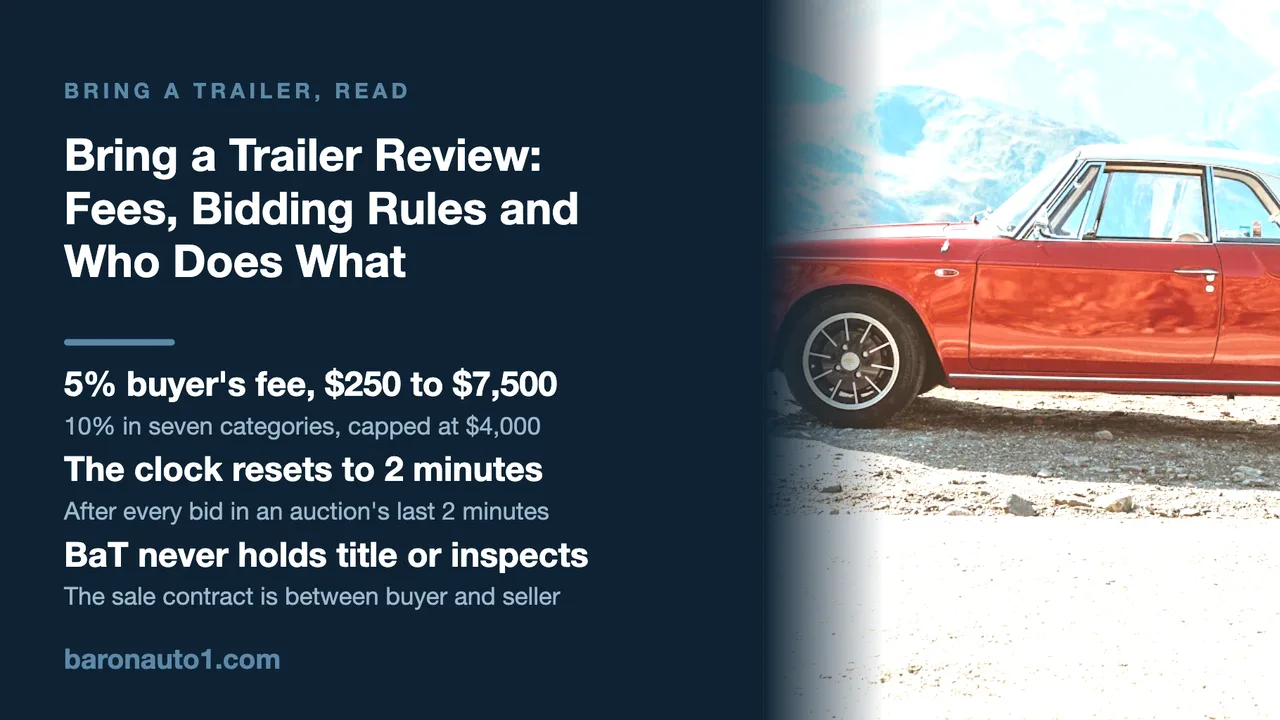
- The buyer’s fee is 5% of the winning bid on top of the price, minimum $250, capped at $7,500. Motorcycles, minibikes and scooters, parts, wheels, ATVs, go-karts and tractors carry 10%, capped at $4,000. Sellers pay $99 to list, or $429 with Plus photography.
- Every bid puts a hold for the fee on your card, BaT does not cancel bids, and in an auction’s last 2 minutes each new bid resets the clock to 2 minutes.
- You pay the seller yourself (BaT recommends a wire within three business days) or through Verified Checkout: $99, or $149 with title and registration, run by Caramel, a licensed dealer that buys the car and resells it to you.
- No BaT document we read says what happens to a winner who does not pay, beyond calling a bid “a commitment to purchase.” The Terms themselves call a bid “the first non-binding step.”
- Disputes with BaT: a 60-day informal process, then individual arbitration under New York law, one year to bring a claim, no opt-out printed. BaT is part of Hearst’s network.
Bring a Trailer (BaT) runs week-long online auctions for collector and enthusiast vehicles, and what a buyer pays, and who is responsible for the title, the inspection and the money, is written in its own Terms of Use and FAQ rather than in its marketing. On 16 October 2026 we read BaT’s U.S. Terms of Use (last revised 22 July 2026), every answer in its FAQ, its How BaT Works page, its seller, Verified Checkout and About pages, and its own 25 June 2020 announcement about Hearst. We did not register, bid, comment or request a shipping quote, and this site has no relationship with Bring a Trailer, its partners or any seller.
What Bring a Trailer is, what it says it is not, and who owns it
BaT describes itself as “an online vehicle auction platform and enthusiast community.” Its Terms are narrower. In capital letters they say BaT is “NOT AN AUTOMOBILE BROKER, DEALER OR TRADITIONAL AUCTIONEER” and does not sell, buy or negotiate the sale of any listed vehicle, and that it has never “(1) HELD TITLE FOR ANY VEHICLE,” “(2) INSPECTED ANY VEHICLE” or “(3) HAD ANY VEHICLE” listed on the site in its legal possession.
Everything about the car comes from the seller. BaT “RELIES ON THE SELLER TO PROVIDE ACCURATE INFORMATION ABOUT A VEHICLE, INCLUDING THE TITLE,” and says it “DOES NOT AND CANNOT INDEPENDENTLY VERIFY ALL INFORMATION THAT MAY AFFECT TITLE, INCLUDING BUT NOT LIMITED TO CERTAIN LIENS.” Any title status shown on a listing “REFLECTS INFORMATION PROVIDED BY THE SELLER” and is not a warranty. BaT staff help write listings, but accuracy stays “EACH SELLER’S RESPONSIBILITY,” and if a listing carries a typing error, mileage included, BaT “IS NOT RESPONSIBLE FOR SUCH ERROR OR ITS CORRECTION” though it will try to fix it.
Your agreement with BaT “expressly does not govern any sale” between users, and BaT “CANNOT ENSURE THAT A BUYER OR SELLER YOU ARE DEALING WITH WILL ACTUALLY COMPLETE THE TRANSACTION.” BaT runs the listing, the bidding and the buyer’s fee; the car, the title and the money pass between you and the seller.
Who owns it. The Terms say the site is operated by Bring a Trailer Media, LLC, “which is part of the Hearst affiliated network of media companies.” BaT’s own announcement of 25 June 2020, signed by co-founder and president Randy Nonnenberg, says “BaT has joined the brands of Hearst Autos,” that it “decided to partner with” Hearst Communications, and that it would keep “our same team, our same leadership, and our same HQ in San Francisco.” The same post dates the blog to 2007 and the auctions to 2014. Neither BaT document uses the word “acquired” or gives a price or stake, and Hearst’s own site refused our requests, so its press release was not read and the terms of the 2020 deal are not stated here.
Public records. Two Google searches for lawsuits, complaints or settlements naming Bring a Trailer Media returned no court docket and no regulator release. That is not proof of a clean record: dockets were not searched, and the Better Business Bureau blocked our requests, so no BBB rating appears here.
Its own numbers. The About page claims “over 1,000 listings per week, more than 750,000 registered bidders”; in 2020 BaT said “300+ listings every week.” These are unchecked claims, and its seller page gives different ones (see the disagreements below). The Terms also disclose affiliate marketing: BaT “may earn a commission” on some third-party links. Two other enthusiast marketplaces run on different rules; our Cars & Bids review and Hemmings review read each one’s own terms.
How a car gets accepted and listed
A seller submits photos and answers about the vehicle and requests a reserve. BaT says it chooses on “condition, quality of information, quality of photos, requested reserve price, and similar vehicles currently for sale,” and avoids “vehicles with reserves that are not realistic.” An Auction Manager replies “typically within 2 business days.”
Only an accepted seller pays. An Auction Specialist writes the listing from the seller’s information, gathering “videos, maintenance records, vehicle history, and service documentation,” and a Classic submission “usually takes a few weeks” to go live. Classic costs $99; Plus costs $429 (the $99 listing plus $330 of professional photography); White Glove is priced on inquiry; parts list for $99.
Rules that matter to a bidder:
- Reserve or no reserve. Every seller must pick one before BaT approves the listing, and may lower or waive the reserve during the auction. Reserve figures are never shown; a yellow No Reserve tag marks auctions without one, and BaT does not “announce when reserves have been met.”
- Exclusive and final. While live, the car may not be offered “ON ANY OTHER AUCTION, DEALERSHIP, OR LISTING SERVICE.” BaT says “We do not cancel auctions,” though its Terms let it remove a listing “IN OUR SOLE DISCRETION.” There is no Buy It Now.
- Length. Regular listings run 7 days; Premium listings between 7 and 21 days.
- No seller bidding. Sellers and “anyone associated with them or the vehicle” may not bid. BaT says it has “tools in place that monitor bidding” and makes each user’s account history public.
- Liens. Cars with liens are listed “very frequently,” with the lien disclosed in the listing text.
Registering, the card hold and the two-minute clock
A BaT account is free. To bid you add contact details and a credit card: “There is no charge to register, we will only authorize that your card is valid.” Bidders must also validate billing details, use two-factor authentication (2FA) and verify their email, and the Terms bar anyone under 18. With a valid card “you can bid from anywhere.”
The hold. “When bidding, we place a hold on your card for the amount of the buyer’s fee.” The FAQ puts the hold at “5% or 10% of your initial bid amount (based on the auction category), minimum $250.” If you win, the hold becomes the charge; if not, it is “released immediately at auction end,” though banks can take a few days. Repeat bids add no new holds; BaT takes a second charge at the end for the difference. BaT’s own example: a first bid of $10,000 brings a $500 hold; a win at $25,000 adds a $750 charge, a total of $1,250, which we checked is 5% of $25,000. By our arithmetic a first bid of $3,000 brings the $250 minimum, and a first bid of $8,000 on a motorcycle an $800 hold. You cannot change the card on file while you hold an active bid.
How a bid works. You type an amount and “Bidding advances immediately to your entered amount.” There is no hidden maximum working for you: the figure you type becomes the high bid and “the amount you will be responsible for paying should you win.” The bid box sets the minimum step:
| Current bid | Minimum increment |
|---|---|
| $0 to $10,000 | $100 |
| $10,001 to $50,000 | $250 |
| $50,001 to $100,000 | $500 |
| $100,000 or more | $1,000 |
The end of an auction. “During the last 2 minutes of BaT Auctions, the clock resets to 2 minutes after every bid. This happens until no more bids are placed and the auction ends.” How BaT Works says the same: “The auction isn’t over until two full minutes have elapsed since the highest bid was placed.” A last-second bid therefore buys everyone else 2 more minutes; plan your limit before the final stretch, not during it.
No take-backs. “A bid is a commitment to purchase, and we do not cancel bids on the site.” Bids, and payment, are in the currency of the car’s location: pounds in the UK, euros in the EU, dollars elsewhere.
When the reserve is not met, and what “sold” can mean
If bidding ends below a hidden reserve, there is no deal and no Buy It Now, but there is one more round. “You and the high bidder will have the opportunity to make one offer and one counteroffer,” with “24 hours per round.” Only the high bidder takes part: BaT does “not share user contact info or broker deals with any other parties after the close of auction.” If an offer is accepted, the buyer pays “the normal buyer’s fee” and the result is “marked sold” at the offer amount. If not, the auction closes unsold and the bidder does not receive the seller’s contact details.
BaT’s answers disagree on the limits: seller answers say an offer must be “more than the final bid but not more than the reserve amount,” while the bidder answer allows one “equal to or higher than the final bid” and adds “There is no maximum offer for the high bidder.”
The Make-Whole program. At its discretion BaT “may elect to make up the difference between the high bid and the reserve amount,” paying the seller by check, and then “the vehicle is considered sold and will be displayed as such on the site.” So a “sold” result can be a car whose reserve was never reached; the documents we read do not say such results are marked.
The buyer’s fee and seller fees, as printed
The FAQ: “If you win an auction we charge 5% of the final bid price on top of the winning bid,” except in seven categories (Motorcycles, Minibikes & Scooters, Parts and Automobilia, Wheels, ATVs, Go-Karts and Tractors), where “the fee is 10% of the winning bid amount, with a minimum fee of $250 and a maximum fee of $4,000.” For everything else “the minimum fee is $250 and the maximum fee is capped at $7,500.” Listings in the EU are capped at €7,500 and €4,000, and in the UK at £6,000 and £3,200. Buyers and sellers in the EU or UK also pay VAT on BaT’s fees; “Buyers located in the US will not have to pay VAT.” Fees are charged to “all major credit and debit cards,” with payments to BaT handled by Stripe.
By our arithmetic the $250 minimum decides the fee on any 5% car up to $5,000 and any 10% item up to $2,500, and the caps take over from $150,000 and $40,000.
| Winning bid | Category | Buyer’s fee | Fee as share of bid | Bid plus fee |
|---|---|---|---|---|
| $3,000 | 5% | $250 (minimum) | 8.3% | $3,250 |
| $20,000 | 5% | $1,000 | 5% | $21,000 |
| $60,000 | 5% | $3,000 | 5% | $63,000 |
| $150,000 | 5% | $7,500 (cap) | 5% | $157,500 |
| $400,000 | 5% | $7,500 (cap) | 1.9% | $407,500 |
| $1,500 | 10% | $250 (minimum) | 16.7% | $1,750 |
| $12,000 | 10% | $1,200 | 10% | $13,200 |
| $80,000 | 10% | $4,000 (cap) | 5% | $84,000 |
“Bid plus fee” is not the final price. The Terms say “A Seller may add any or all of the foregoing or any other taxes and fees to the listed price when calculating the final sale price,” so ask a dealer seller about added fees before you bid; our out-the-door price guide lists the usual ones.
Sellers pay $99 for Classic or $429 for Plus, and BaT says “that is the only fee a seller pays, period.” Its Verified Checkout answers add two payout charges that sentence leaves out: “a flat fee of $25.00” for a wire, or 0.5% “up to $100” for a Real-Time Payment, which by our arithmetic reaches its cap at $20,000.
After you win: who handles payment, title and inspection
“At the close of auction, if the reserve has been met, the buyer’s fee is paid automatically via the credit card on file.” If the charge fails, BaT emails instructions for the balance. Then “We will send you the seller’s contact information via email, and they will receive yours,” and the two of you finish the deal.
Without Verified Checkout the purchase money never touches BaT. Its advice for a direct deal: “request photos of both sides of the title and a bill of sale before making payment, and make payment within three business days or a mutually agreeable timeframe,” and “we recommend a wire transfer.” Bidders “must ensure they have funds available prior to bidding.” If the car has a lien, “you will work with the seller’s bank directly”; see how a lien payoff works. If something goes wrong, the Terms send you back to the seller: “in the event you seek a refund related to a Purchase or have any questions, you must directly contact the applicable Seller.”
| Task | BaT | Seller | Buyer | Caramel (Verified Checkout, if chosen) |
|---|---|---|---|---|
| Describing the car | Writes the listing; does not verify it | Responsible for accuracy, title included | Reads listing and comments | Checks seller’s title and vehicle information |
| Inspection | None; has never inspected a listed car | Arranges access through Contact Seller | Arranges it before bidding | None described |
| Buyer’s fee | Charges your card when you win | None | Pays 5% or 10% | None |
| Purchase money | Does not handle it | Receives it, usually by wire | Pays the seller | Holds it in escrow until title and car are released |
| Title | Has never held one | Signs it over | Transfers and registers it | Handles both in the $149 tier |
| Shipping | Optional BaT Shipping, lower 48 states | Releases the car after payment | Arranges and pays | Can be added in checkout |
| Taxes and registration fees | None | None | Pays them | Collects them up front |
Inspection is on you, and it comes first. “Bids are not contingent upon post-auction inspections.” Use Contact Seller “to ask the seller questions, schedule a viewing, or set up a test drive.” For a distant car, see our guides to a remote pre-purchase inspection, mobile inspectors and out-of-state paperwork. If you cannot see the car yourself, our Lemon Squad review reads one remote inspection company’s terms and limits.
Verified Checkout: what Caramel does and what it costs
Verified Checkout is BaT’s optional closing service for private-party sales where buyer and seller are both in the United States. The buyer chooses it, and the seller is then “required to complete the transaction using Bring a Trailer Verified Checkout.” It is run by Caramel, and the structure matters: “Caramel purchases the vehicle from the seller, then sells it to you,” as a licensed dealer. Your money goes to Caramel, “who holds the funds in escrow,” and the seller releases title and car only after it clears.
- Price. $99 for the escrow-only Lite tier, $149 with title transfer and registration done for you. Shipping, financing and service plans cost extra; online notarization, where needed, is $25.
- Sales tax can rise. Because Caramel is a dealer, “sales tax will be collected even though the seller of the BaT auction is a private party,” and BaT names Arizona, Illinois and Nevada as states that tax dealer sales but not private ones. Title fees are passed on “with no markup.”
- Paying. At $40,000 or more the buyer must wire. On most payments up to $25,000 the buyer may use Clerq: an Instant Payment at 0.75% of the amount or a Quick Transfer (ACH) at 0.4%, clearing within three business days.
- Timing. Start “within three business days”; payment “should typically be completed within seven business days.”
- Paperwork. You verify your identity with an ID and a selfie and sign a power of attorney so Caramel can sign title documents for you.
- Registration gaps. Temporary registration, often issued from Montana, “is valid for 40 days,” while the title “typically takes anywhere from 45-60 business days” to arrive. By our arithmetic that is 63 to 84 calendar days, so expect to ask Caramel for a second temporary registration, as the FAQ invites when fewer than five days remain. Classic or vintage registration “is not available through Verified Checkout,” and Pennsylvania and New Jersey buyers get secure payment only.
- Cancelling. You can cancel before pickup and get a refund in 7-10 business days, but “you will still be required to complete the transaction for the vehicle by arranging payment details with the seller.”
| Winning bid | Buyer’s fee | With Lite ($99) | With title and registration ($149) | How you may pay |
|---|---|---|---|---|
| $20,000 | $1,000 | $21,099 | $21,149 | Wire, or Clerq: $150 Instant or $80 Quick ACH on the $20,000 |
| $60,000 | $3,000 | $63,099 | $63,149 | Wire required (over $40,000) |
Financing through checkout does not change the bid: “An auction win is not contingent on financing.” If you plan to borrow, line up the loan before you bid; our private-party auto loan guide explains how lenders treat a car bought from an individual.
Shipping: the buyer’s job, with an optional BaT service
“Shipping is the responsibility of the buyer to arrange and pay for.” BaT sells its own option, BaT Shipping, quoted on eligible listings “right above the bid box.” Its printed limits:
- Pickup and drop-off must both be in the contiguous 48 states. Parts, memorabilia, minibikes, go-karts, boats and planes are not shipped.
- “The Seller must also confirm that your payment for the vehicle has been received in full before we can find a transporter.”
- Transporters carry cargo insurance, but “coverage for all losses is not guaranteed,” and BaT “strongly” recommends your own policy before the car moves.
- Report damage within 72 hours of delivery; after that you are given the transporter’s insurer to claim against directly. You then have 2 weeks to get a repair estimate. Chips, dents, scratches and road-hazard damage do not count “unless evidence of negligence is present.”
- Spare parts and belongings inside the car “are not insured”; mail the title separately. Vehicles over 79 in. high, 83 in. wide, 225 in. long or 5,500 lbs. may cost more.
Either way, our car shipping guide explains brokers versus carriers and how to document damage at delivery.
If a winning bidder does not pay
This is where BaT’s documents say least. What they do say: the buyer’s fee is charged automatically at the close, and the Terms call buyer fees “binding and thus due and payable to BaTMedia.” The FAQ says “A bid is a commitment to purchase,” and the Verified Checkout page adds that buyers must pay in full “whether or not they qualify for financing.” The FAQ is part of the “Agreement,” and BaT may close an account “for any reason or no reason,” including “any violation of this Agreement.” After a sale BaT connects only the seller and the high bidder, so there is no published second-chance offer to the next bidder.
What they do not say: none of the documents we read names a penalty for a winner who walks away, or says whether the buyer’s fee comes back if the sale collapses. The Terms point the other way, calling a bid “the first non-binding step in expressing your interest to a Seller” that “does not in and of itself create a formal contract.” Any claim between buyer and seller is theirs to pursue, not BaT’s.
Treat the bid as final even though the Terms hedge. BaT will not cancel it, the fee is charged to your card, and BaT can shut your account. Bid only after the inspection, the title check and the money are settled, because none of them is a condition of the sale.
Checking a listed car’s history before you bid
A BaT listing is the seller’s account of the car, and its title status is the seller’s claim, not BaT’s finding. Use the 7 days the auction runs for your own checks:
- Get the VIN and decode it. If the listing lacks it, ask the seller. Our guide to reading a VIN covers modern cars; “The 17-character VIN became mandatory in the United States for the 1981 model year,” so for older cars use our classic-car VIN guide, including restamped numbers.
- Check the title record. An NMVTIS report shows title brands states have reported; our free VIN check guide lists what costs nothing. BaT says a history report comes free on 1981 and later vehicles; treat it as one source among several.
- Look for liens and theft. BaT cannot verify all liens, so check for a lien and whether the car is stolen.
- Test the mileage claim with our odometer check guide, which explains the disclosure exemption older cars fall under.
- Look for earlier sales. BaT marks “Alumni” listings, so you can “view any previous listings to see what’s changed,” and each user’s activity, the seller’s included, is on a public member page. An auction history search shows whether the car went through a salvage auction.
- Check open recalls with our recall guide, and for a modified car, whether the changes are legal where you live; BaT itself says to check “rules for vintage, imported, and modified vehicles before placing a bid.”
- Know your fee. 5% (minimum $250, cap $7,500) or 10% in the seven listed categories (cap $4,000), on top of the bid.
- Inspect first. Bids are not contingent on an inspection after the auction.
- Run the VIN. Title record, liens, theft, recalls and earlier sales, before you bid.
- Have the money ready. BaT expects payment within three business days or agreed timing, and over $40,000 checkout requires a wire.
- Set your limit early. The 2-minute reset rewards bidders who decided their top number before the end.
- Price the delivery. Shipping, sales tax and registration are yours.
Terms of use, arbitration and where BaT’s pages disagree
The U.S. Terms of Use (last revised 22 July 2026) cover anyone who visits, bids or sells; Canadian users have a separate version dated 16 May 2025. The parts a buyer should know:
- Release. If you have a dispute with another user, “you release BaTMedia” from the claims that arise from it.
- Liability cap. BaT’s liability to you is limited to “THE GREATER OF (A) FIFTY US DOLLARS ($50) OR (B) AMOUNTS YOU’VE PAID BATMEDIA IN THE PRIOR 12 MONTHS,” which for most buyers means the buyer’s fee.
- Informal step first. Before any arbitration or suit, you must send a written Notice of Dispute with your facts, the relief you want and “a personally signed statement” (not one from your lawyer), then try for 60 days to settle it.
- Arbitration. Disputes then go to the American Arbitration Association under its Consumer Rules “as modified by this section”: you must “personally appear” at hearings, may be asked to sit for a deposition, and hearings take place in San Francisco or New York (or where AAA rules require), with New York as the seat. Class actions and “MASS ARBITRATION” are excluded, and you waive a jury.
- Time limit and law. A claim must start “WITHIN ONE (1) YEAR” or it is barred. New York law governs, and any court case goes to New York County. We found no opt-out procedure in the dispute section.
For bidders who know salvage auctions, one comparison of printed terms. Copart’s side is copied from the documents behind our Copart fees guide, read 7 October 2026; no prices are compared.
| Topic | Bring a Trailer | Copart |
|---|---|---|
| Who may bid | Anyone registered with a valid credit card, from anywhere | “Only registered and active Basic and Premier Members” |
| Withdrawing a bid | “we do not cancel bids on the site” | A bid “cannot be retracted, deleted, or cancelled” |
| Seeing the vehicle | BaT never inspects; arrange a viewing or inspection with the seller | Preview “either online or in person at the Copart facility” |
| Paying for the car | To the seller, ideally by wire within three business days or agreed timing | Within 3 business days of purchase, including the day of sale, or a late fee applies |
| Where disputes go | 60-day notice, then AAA arbitration under New York law | Any action is conducted in the state and county where the vehicle was located |
Where BaT’s own documents disagree. We found these on 16 October 2026:
- Is a bid binding? The FAQ and checkout page: “a bid is a commitment to purchase.” The Terms: a bid is “the first non-binding step.”
- Who pays shipping? The FAQ puts it on the buyer; the Terms leave it to “the formal agreement between the applicable Seller and Buyer.”
- Reserve-not-met offers. Floors of “more than” versus “equal to or higher than” the final bid, 24 hours in total versus 24 hours a round, and a fee “capped at $7,500” though 10% categories cap at $4,000.
- Euro and pound caps. The FAQ ties them to where the listing is; How BaT Works to where the bidder is.
- Seller fees. BaT calls the listing fee “the only fee a seller pays, period,” yet checkout payouts cost $25 by wire or 0.5% up to $100, and EU and UK sellers pay VAT on BaT’s fees.
- Timing. Pay “immediately after the auction closes” in one answer, within three business days in others; submissions answered in 2 business days or 48 hours.
- The new title. One version of the checkout page says Caramel mails it, the other that the DMV does.
- Make-Whole. The Terms describe a payment the seller returns if the car is not sold within 30 days; the FAQ describes a check sent after the buyer pays.
- Volume claims. Half a million bidders on one page, more than 750,000 on another; 900 sales a week under a title of 2,500 a month.
Common questions
Can you back out of a Bring a Trailer auction?
Not under BaT’s rules: “A bid is a commitment to purchase, and we do not cancel bids on the site.” Cancelling Verified Checkout does not undo a win; you “will still be required to complete the transaction” with the seller. The Terms call a bid non-binding between buyer and seller, but the fee is still charged and BaT can close your account.
How much does Bring a Trailer charge buyers?
5% of the winning bid on top of it, minimum $250, capped at $7,500; 10%, capped at $4,000, in the seven categories listed above. It is charged to your card when you win. Verified Checkout, if chosen, adds $99 or $149; taxes, registration and shipping are extra.
Who owns Bring a Trailer?
Bring a Trailer Media, LLC, which its Terms call “part of the Hearst affiliated network of media companies.” BaT announced on 25 June 2020 that it “has joined the brands of Hearst Autos.” Hearst’s own release could not be read, so the deal’s terms are not stated here.
Is there shill bidding on Bring a Trailer?
BaT bars sellers and “anyone associated with them or the vehicle” from bidding and says it has “tools in place that monitor bidding.” It publishes no enforcement figures, so we cannot say how common shill bids are. Bidding histories are public, so you can look at the accounts bidding against you.
Is Bring a Trailer legit?
We make no recommendation. BaT is a Hearst-affiliated company with published Terms and a detailed FAQ, and our searches found no court docket or regulator action naming it, which is not proof of a clean record. Its Terms limit its role: it never inspects or holds title to the cars, caps its liability and sends disputes to arbitration.
How do you pay for a car on Bring a Trailer?
The buyer’s fee goes to BaT by card automatically. The car is paid for separately: to the seller, BaT recommends by wire within three business days after you see the title and a bill of sale, or through Verified Checkout, where Caramel holds the money in escrow and requires a wire at $40,000 or more.
For sale near you
Dealer listings, checked liveFinding used cars near you…
Sources and further reading
- NMVTIS (US Department of Justice)
- NICB VINCheck
- NHTSA recall lookup
- NHTSA odometer fraud
- NHTSA VIN decoder
Recall, complaint and safety-rating figures on this page were retrieved from the federal databases above on August 19, 2026. Federal data changes — re-check any VIN before you rely on it.
Published October 16, 2026 · last updated October 16, 2026. Found something out of date or wrong? Tell us and we will correct it.